Quit Your Whining

In the end, the best team won. That sort of vindicates the system, no?

At the beginning of these playoffs, the first under the expanded format wherein 12 teams were allowed into the dance (2020 excepted), there was a great deal of Sturm and Drang about the early outcomes. When the 89-win Padres knocked off the 101-win Mets in the Wild Card round, and then when those same Padres bested the 111-win Dodgers in the NLDS, and when the 87-win Phillies beat the 101-win Braves, Rob Manfred’s name was being burned in effigy from coast to coast, and even down south.

“How could we let this happen?,” fans cried. “What is the purpose of being great in the regular season?,” fans lamented. To me, all I heard was whining. Buck Showalter, the terrific manager of the Mets (as well as many other teams) put it perfectly, and perfectly succinctly: “Play better.” That’s it; that’s all it takes. And maybe a little luck. But it certainly doesn’t require yet another re-working of the playoff schedule because your team, who played so well during the 162-game marathon, forgot to bring their clutch hitting to the playoffs; or had starters get sick; or just got beat in a short series. Welcome, my friends, to baseball.

But with all of this bellyaching early in October, I decided to take a look back to determine if what we were witnessing was an anomaly or part of the game. What I found was neither shocking nor surprising. In fact, what I learned is that these playoffs were very much like most of the ones in the past. Going back to 2000 (just to choose an arbitrary round year), and excepting the wonky 2020 season, there have only been three seasons in which an “upset” didn’t occur (2007, 2009, and 2018). Sure, the Padres-Dodgers 22-win differential is an extreme outlier, but the Phillies-Braves 14-win differential is right there with the 2003 Cubs (13), the 2008 Dodgers (13), and the 2019 Nationals (13).

So, having lower-seeded teams win – regardless of the number of teams in the playoffs – is not a bug, but actually a feature of baseball playoffs system. That’s what makes October (and now November) so great. Let’s take a look:

SEASONROUNDWINNER (Seed/Wins)LOSER (Seed/Wins)WIN DIFFERENTIAL
     
2001NLDSBraves (3/88)Astros (1/93)5
2002ALDSAngeles (4/99)Yankees (1/103)4
2002NLDSGiants (4/95)Braves (1/101)6
2003NLDSCubs (3/88)Braves (1/101)13
2003NLDSMarlins (4/91)Giants (1/100)9
2004NLDSAstros (4/92)Braves (2/96)4
2005NLCSAstros (4/89)Cardinals (1/100)11
2006ALDSTigers (4/95)Yankees (1/97)2
2008ALDSRed Sox (4/95)Angels (1/100)5
2008NLDSDodgers (3/84)Cubs (1/97)13
2010ALDSRangers (3/90)Rays (1/96)6
2011ALDSTigers (3/95)Yankees (1/97)2
2011NLDSCardinals (4/90)Phillies (1/102)12
2012ALDSTigers (3/88)A’s (2/94)6
2012NLDSCardinals (5/88)Nationals (1/98)10
2013ALDSTigers (3/93)A’s (2/96)3
2013NLDSDodgers (3/92)Braves (2/96)4
2014ALDSRoyals (4/89)Angels (1/98)9
2014NLDSGiants (5/88)Nationals (1/96)8
2015NLDSCubs (5/97)Cardinals (1/100)3
2016ALDSBlue Jays (4/89)Rangers (1/95)6
2017ALDSYankees (4/91)Indians* (1/102)11
2019NLDSNationals (4/93)Dodgers (1/106)13
2021ALDSRed Sox (4/92)Rays (1/100)8
2021NLDSBraves (3/88)Brewers (2/95)7

*To keep the historical record accurate, the Yankees beat the “Indians” in 2017.

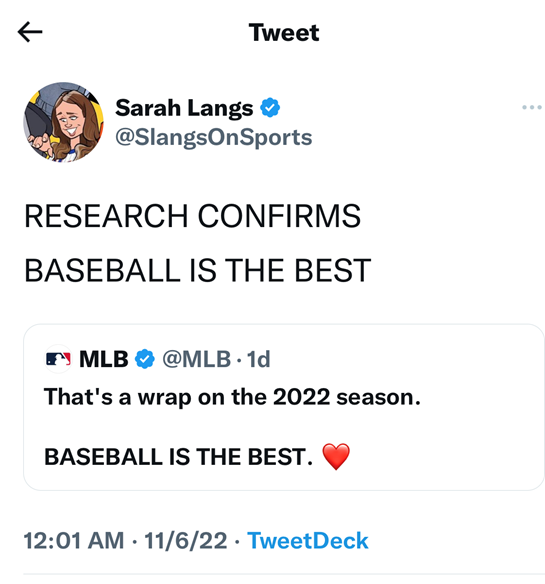
Sure, by dint of the Padres and the Phillies making a run, the numbers look skewed in 2022. And if the 87-win Fightin’s had beaten the 106-win ‘Stros, there would have been a lot of talk about upsets and unheard ofs, etc. But did the collective masses say we should re-do the World Series format after the Dodgers beat the A’s in 1988? Or when the Marlins felled the Yankees in 2003? Would we have wanted it changed if they had a parade in Philadelphia this week? The obvious answer to all of these is “no.” So kick and scream and lament that your team fell short. But quit your whining. The current system is here to stay (until there is expansion, and then we will see). Do all the math, crunch all the numbers, and then listen to the inimitable Sarah Langs:

PLAY BALL!!

Witnessing History: Albert Hits #700

On a Saturday afternoon in 2002, I walked into Pacific Bell Park to watch a pre-game montage of Barry Bonds’ milestone home runs, culminating with #600, which Bonds reached the night before. I was 18 hours too late to witness history. And when Bonds proceeded to go 0-1 with three walks, I didn’t even get a chance to see #601.

When I ventured into Dodger Stadium a three Friday nights ago, I had a hope – but not a ton of confidence – that this time I would be luckier. Truth be told, I didn’t really believe Albert Pujols had a chance to hit two home runs on a cool(ish) night at Chavez Ravine. I figured he might get one, at which point we would have seen history, but all of us in attendance would have been left on the cusp of immortality.

In my years going to ballgames across the country, I have been lucky enough to see some pretty cool things – many of which I didn’t expect. Dennis Martinez throwing a perfect game on scalding Sunday afternoon; Big Papi hitting a walk-off dinger at Fenway; the wind playing tricks at Candlestick; a Justin Turner walk-off in the NLCS; my son catching a foul ball at Comerica Park; the longest World Series game ever played; and a wild 13-12 ten-inning World Series Game 5 in Houston. Not to mention seeing my beloved Red Sox clinching the World Series with Manny Machado bending the knee.

Many of these moments were jaw-dropping and scream-inducing. Many had me leaving the park with a perma-grin that could not be wiped off for hours if not days. But what I witnessed a few Friday nights ago was something else. It was surprising, but not totally unexpected. From 2001 to 2010, there may not have been a better, more consistent hitter on the planet than Albert Pujols. And even when that run ended, he posted six additional seasons with an OPS+ between 113 and 148.

But when the mighty fall, they fall hard. Since 2017, Pujols has been a shell of himself, and that of an average ballplayer. When the Angels released Albert in May of 2021, many thought that was the end of the line – a Hall of Fame career ending with a whimper. But the Dodgers – as they so often do – breathed new life into someone else’s castoff, and got the most out of Pujols’ aging bat. In 189 at bats over 85 games for the Dodgers, Pujols socked 11 home runs and posted a 99 OPS+. But, more importantly, in his new role as “Tio Albert,” he re-found his love of the game.

Going into 2022, signing back with the Cardinals, we all wondered if Albert Pujols could – like Billy Chapel, his fictional counterpart – “push the sun back up in the sky and give us more day of summer.” For the first half of the season, he couldn’t. Through July 2nd, Pujols was hitting .192 with four dingers and a .325 slug. At that point, forget Alex Rodriguez, forget 700, all we were hoping for was an ending slightly better than Willie Mays following down in the Shea Stadium outfield. But then something happened – maybe it was Independence Day BBQ in St. Louis, or maybe Albert just began guzzling from a fountain of youth at the Gateway Geyser. Either way, as Ben Linbergh wrote about, from July 4th to the end of the season, Albert hit .321, and pounded 20 home runs with a .695 slug. To bastardize Vin Scully twice in the same paragraph, when the Cardinals arrived in Los Angeles on September 23rd, what once seemed impossible, became improbable, became possible, and then simply became.

Prior to the game, Albert and Yadier Molina were honored and gifted with custom Dodger golf bags. Albert addressed the Dodgers, thanking them for giving him a new lease on life last season (after the game he was quoted as saying: “If they didn’t give me that opportunity [last season] I don’t think I would be sitting here today or you [would] have seen history tonight”), and thanking the Dodger fans for embracing him after his ignominious departure from the team to the south.

When Albert batted in the first inning, everyone stood, and nearly everyone held a camera hoping to document history. Alas, it was not to be.

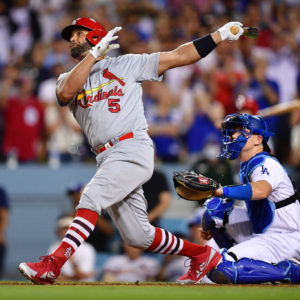
Albert didn’t disappoint when he came to the plate in the top of the third, crushing a 1-2 fastball more than 400 feet into the left field bleachers. The place exploded. The Dodgers had already clinched the NL West, so the fans didn’t care about the score. And when Pujols pointed to the sky upon touching home plate, we all collectively did the math: it’s the third inning, he potentially has three more at bats. Could he? Would he? Was that too much to ask?

In nearly 50 years, only 42,256 fans have seen a 700th home run in person. That was the attendance in San Francisco 18 years ago when Bonds joined the Hammer and the Babe. Now an additional 50,041 sat on the edge of their seats hoping to join a pretty exclusive club of fans.

Albert didn’t keep us waiting long. In the top of the fourth, after the Dodgers swapped lefty Andrew Heaney for righty Phil Bickford, Albert blasted a cement-mixer slider high and deep into the Los Angeles night. This one did not travel nearly as far as the first, but there was something romantic about the towering nature of the drive. #699 was hit so hard and so fast, we didn’t have time to appreciate it – we just hollered and watched Pujols circle the bases. But #700 was wholly different. It was majestic; it gracefully hung in the air, allowing us to track its flight, to give us hope, to build our anticipation, and ultimately to exult in its final resting place in the glove of an ecstatic fan in the first row of the left field pavilion. If a professional athlete and his fans can ever truly share a moment, the arc of this particular home run allowed for it to happen.

I cannot say that the Dodger Stadium crowd reached the same volume level as it did in after JT’s shot in the 2017 NLCS, or Max Muncy’s in the 2018 World Series, but it was damn close. If you love the roar of the crowd, the shower of cheers (to paraphrase Vinny, once again), then you could not help but be delighted by “what we just saw” (h/t Jack Buck).

Upon crossing home plate, Pujols sprinted to the backstop to give a high ten to Adrian Beltre, a fellow Dominican and dear friend, who made sure he had a literal front row seat for history. And then he offered a bunch of high fives before fully embracing Yadi – his teammate for nine seasons, both of whom are enjoying a pretty righteous send-off.

Tim Kurkjian, the Hall of Fame baseball writer, likes to say that what he loves about baseball is that you never know what you are going to see when you go to the ballpark. Those of us fortunate enough to be at Dodger Stadium on September 23, 2022 got the chance to witness history; it was not something we ever thought we would see, and something we as baseball fans may never see again.

PLAY BALL!!

Stadium Dilemma: For Having A Ball or Watching Great Ball?

Many years ago, I was watching an NFL game from Dallas. Al Michaels had the call, and he was raving about the beauty and grandeur of AT&T Stadium, Jerry Jones’ then-new gift to the world and the world of football. Al could not stop talking about the sight lines and the massive video screen that stretches more than 50 years on each side of the field. In short, Al was smitten.

A few years later I found myself at Jerry’s World, and while I was impressed with the size and the scope of the stadium, I could not have been less impressed with the fan and the viewing experience. The security queue felt endless; the bathroom lines ran into the beer lines; the sections/aisles were not well marked; and the video screen was more distracting than anything else. And don’t even get me started about the quality or the cost of the food.

I was reminded of this journey to North Texas a few weeks back when Buster Olney was discussing his favorite baseball parks. He stated that Tropicana Field is way up his list as it has the shortest distance from the press box to the clubhouse, which makes his life easier. You see, Buster, like Al, is at the stadium to do a job, not to enjoy a game. Rather than paying good money to be entertained, these media members are looking for ease of use to ply their craft.

I have no doubt that the press box at AT&T Stadium has all of the amenities an announcer needs, including a bathroom close enough in proximity to go to and fro during a typical TV timeout. I am sure Al’s car dropped him under the stadium right next to an elevator that propelled him straight to an area where all of his needs were met. The same goes for Buster, who is used to the bowels of a ballpark, so when the rest of the place looks the same, it does not much matter.

Unfortunately for most of us, we rely on these announcers to give us a feel for the parks and the stadiums where they do their work. Most of us don’t get to visit each Major League city and do our own analysis. So, when we hear trusted voices like Al Michaels and Buster Olney tell us how great something is, or how they like this one more than that, we are inclined to believe them — even if their reasoning is flawed, or at least subjective.

Because I love baseball and because I subscribe to the “trust but verify” school of thought, I have been traveling the country to visit every ballpark. I have one active stadium left, and will need to leave the country to get there, with Rogers Centre in Toronto the last box to check. As such, I consider myself a pretty good judge of what each stadium has to offer. And, just as I wholeheartedly disagree with Al’s view of AT&T, so too do I with Buster’s feelings about The Trop (as written here).

One of the reasons I have not yet ventured to Canada to see the Blue Jays is that I read that there is a two-phase set of renovations planned to start after this season. Phase One will modernize the fan experience. Now they are speaking my language. 

One would assume, in 2022, with so many pulls on the entertainment dollar, and with ticket, parking, and concession prices consistently outpacing even the most robust inflationary period in four decades, teams would be doing everything in their power to insure that a visit to their yard is fun for the whole family — and not just the diehards. In too many cases, that assumption is incorrect. And, unfortunately, I know why. Fans don’t seem to care.

According to ESPN’s Jeff Passan, MLB estimates that about 40 percent of revenues come from tickets, concessions, and other gate-related income. As we saw during the 2020 season, when faced with the prospect of no or few fans in the seats, owners VERY quickly leaned into the need to increase attendance to supplement their bottom line.

So how can they do that? By putting a better team on the field? By making the fan experience better? A mixture of the two? Unfortunately, the answer just isn’t clear.

Oakland-Alameda Coliseum (using its most well-known name) is a dump. Since 2006, the A’s have had attendance in the bottom third of all American League teams every year but one, despite four first-place finishes and four second-place finishes. The action on the field may have been good, but the ballpark experience is not, so people didn’t come.

Let’s look at the Mariners, who provide arguably the best fan experience in the game. Since 2006, they have not ranked higher than sixth in overall attendance. Is that because in those 17 years, the team has mostly been mediocre (at best) and not once made the playoffs?

Or Pittsburgh, with its beautiful skyline and delicious pierogis. Since 2006, its high-water mark is ninth in the National League (both in 2014 and 2015), which were the two seasons they made the playoffs. They are in the bottom third in attendance nearly every other year.

The Brewers have an incredible fan experience. Their attendance has been above 2 million since 2004 (excluding 2020, of course), even though they finished sixth in the NL Central that season, and have chalked up five fourth-place finishes and five third places in that time.

Since moving into Petco Park in 2004, the Padres have had at least 2 million in attendance in every year but one. And during that time, they have finished in fifth place five times, and fourth place four. Yet, fans still come to the park because it is a hell of a good time.

What about the crown jewel of the new-old ballparks: Camden Yards? Since 2006, the Orioles have been in the bottom third of AL attendance every season except for four. They topped out in sixth place the year they won the AL East (2014). Camden was “the” place to be when it opened, holding first or second place in attendance for the first eight years of its existence. But after Baltimore finished in fourth place four out of five seasons, attendance plummeted. Without a winning team, not even the most charming place in Charm City could draw fans, as the O’s found themselves in the bottom third for eleven out of sixteen seasons (2020 excluded).

For my money (and, often, it is my money), the Dodgers have one of the worst fan experiences in the entire sport. And yet, they get TONS of fans. They have drawn at least 2.8 million every year since 1996 (not counting 2020), and this includes 3.85 million and 3.56 million in seasons in which they finished fourth.

So what is the moral of the story? People don’t come to the park just for the fan experience. And they don’t just come for the winning. With that knowledge, one wonders why the Dodgers undertook a $100 million renovation to improve the fan experience if doing so wouldn’t have any impact on their attendance figures? Why would the Blue Jays spend nearly $300 million over two years to make life better for their fans? There must be some reason.

My hope is that this is a harbinger of great things to come. It would be incredible if, in an effort to create the next generation of baseball fans, teams dedicated themselves to upgrading their facilities to make the local baseball stadium a destination, a place where kids — and their parents — want to go; a place where people of any age can be entertained, regardless of the action on the field. And, if while they’re at it, they could find it in their heart to reduce the price of a beer, that would be great too!

PLAY BALL!!

A Salute to Vin Scully

A lawyer friend called me the other day to discuss a deal. But before we got down to business, we had to deal with important matters. He wanted my thoughts on the trade deadline and the passing of Vin Scully. I offered a few bromides about the Dodgers’ failure to land Juan Soto and then jumped into my feelings about Vinny.

As a general rule, I try to find silver linings. And so I told my friend I had two thoughts about what was a very sad day for baseball fans in general, and Dodger fans/Los Angelenos in specific:

THOUGHT #1:

We are just so very fortunate to have this man’s greatest hits, his greatest moments, on audio and video that we can pull up any time we want a trip down memory lane. It is not often that we are afforded that opportunity – just ask anyone who has watched grainy Hi-8 videos of dearly departed loved ones. About a day after I shared this thought with my friend, Steve Rushin wrote the following (which, as to be expected, is brilliantly articulated):

In death, his voice doesn’t fall silent, for it lives on in endless recordings and in the eternal hereafter of YouTube. Indeed, now that Vin has joined the celestial choir—the analogies are apt for the Catholic boy with the golden pipes—his voice travels with him, as broadcast signals travel through space. Somewhere, someone in the firmament is always being wished a very pleasant good evening, courtesy of Vin Scully—St. Vinny of Wherever You May Be.

Like I said…

THOUGHT #2:

We, as baseball fans, are lucky to have had a five-and-a-half-year separation from having Vinny in our everyday lives. Had this death happened a few years ago, say, in the hours after Vin called another Dodgers-Giants game, such that he was here today and gone tomorrow, well, I don’t know how we would have reacted. I don’t know if we could have watched another Dodger game for the rest of the season. I don’t know how you have that essential part of your life – at least the lives of millions of Dodger and baseball fans who listened to Vin every night – ripped from you and not felt that loss at an emotional, visceral level. Had his death occurred this way, it is not hyperbole to say that the season may have been ruined.

Vin stepped away from the mic after the 2016 season, and that has afforded us our own mourning period. We were given the opportunity to meet and get to know Joe Davis. We have learned to watch and enjoy Dodger games without Vin – something we didn’t have to contend with for nearly 70 years.

In the many, many hours of reading, watching, and listening about Vin that I have consumed since Tuesday night, this one idea stood out to me: People born in the 1800s listened to Vin call games, and so too did people born in the 2000s. Sure, none of those nineteenth-century fans are still with us, but all of us would feel this loss that much more acutely if Vin had still been a day-to-day, night-to-night presence when it happened.

A MOMENT WITHOUT VIN:

Shortly after Vin retired in 2016, the Dodgers found themselves in an epic playoff battle with the Washington Nationals. After watching Clayton Kershaw save Game 5 for the Dodgers, giving them the NLDS title, I couldn’t have been more excited – for the Dodgers and for Kershaw. But I knew the moment was missing something. And, because I grew up in Los Angeles, and because I live here now, Vin’s voice and viewpoint are in my bloodstream; I can hear him calling a game, even when he is nowhere to be found.

So, this is what I wrote immediately after that game, and am republishing it today as it seems fitting to add to the canon:


THE CALL THAT COULD HAVE BEEN

(Originally published October 16, 2016)

*Editor’s Note: The words you will read below are what you might have heard when we came back from commercial Thursday night, starting as Clayton Kershaw finished up his warm-up pitches. As best you can, read this in Vin Scully’s voice.

“When Kershaw takes the hill, you get the sense that he is not pitching against Daniel Murphy, he is not pitching against the Nationals, nor is he pitching against the Phillies, the Cardinals, the Mets, or the millions of people who have written and spoken about Clayton’s troubles in the post-season.

No, you must imagine that Clayton is pitching against those doubts that bubble up in the head of every athlete – at one time or another – those doubts that ask, “Am I really that good?”

Anyway, enough about that.

Daniel Murphy digs in and Kershaw comes set at the belt.

Fastball, up and in.

Whoa! So much for fatigue.

That fastball had a little extra something on it. In fact, I don’t think Kershaw hit 95 even once on Tuesday afternoon but, sure enough, fatigue is no match for adrenaline.

Kershaw stares in at Ruiz, shakes his head, once, now twice. Kershaw comes set at the belt, and the one and oh pitch is a fastball in on the hands; short pop on the infield, Culberson takes a few steps back, and just like that, Daniel Murphy is retired.

You have to wonder if Dave Roberts will go out and get Kershaw, having gotten the one man he was brought in to get.

Well, I guess we have our answer.

Roberts is staying put, and you get the feeling that it would have taken Roberts, Honeycutt, and a team of coaches to pry the ball out of Kershaw’s hand at this point.

So the chess match continues.

Well, fresh out of options, Dusty Baker has gone to the last man standing.

Wilmer Difo, the rookie shortstop, is Baker’s and the Nationals’ last hope.

Wilmer, from Santiago de los Caballeros in the Dominican Republic, made his major league debut on May 19th, and here he finds himself square in the eye of the hurricane.

Difo, a switch hitter, digs in from the right side against the left-handed Kershaw.

Fastball, WAY inside. Difo had to do a little dance to avoid that 93-mile-per-hour heater. Difo must be wondering how he got himself into this situation, and wondering if he can pull a Houdini and get himself out of it.

Kershaw is ready, Harper leads from second, and Werth off of first. Gonzalez is playing behind Werth, and Seager is bird-dogging Harper, trying to keep him close.

The 1-0 delivery is a fastball fouled away. And Kershaw has squared his account.

When you look out in the infield, Seager is doing his best to keep Harper from getting too big of a lead, hoping to keep him from scoring on a single.

Of course, with two outs, the runners will be off on contact. Harper runs pretty well and knowing the way Harper plays the game, there will be no holding him at third if the opportunity to score arises.

Here comes the 1-1 pitch, Difo swings through a 91-mile-per-hour slider. I tell you, that just isn’t fair.

Difo started the season in Triple-A, and now, in the biggest moment of the year, in quite possibly the biggest moment of his life, he has to face arguably the best pitcher on the planet.

Kershaw brings his hands high above his head, and slowly brings them down and settles at the belt. He takes a look at the runners, and the runners GO.

Difo dribbles it foul up along third, and the runners have to return from whence they came.

Difo had an extremely defensive swing on that pitch, and really, who can blame him? He is doing his level best just to stay in the box at this point.

You know this is the 167th game that each of the Nationals and the Dodgers have played this season; they have split the first two games of this series, and here we are in the bottom of the ninth inning of a one-run game. Folks, it doesn’t get much closer than this.

Kershaw has rubbed up a new ball and is now ready to go.

Difo digs in while Harper and Werth take their leads. The 1-2 delivery is a BREAKING ball in the DIRT, SWUNG ON and MISSED. Ruiz keeps the ball in front of him and guns it to Gonzalez covering first to complete the strikeout.

At 12:41 in the morning, East Coast time, the Dodgers have won the division series; and maybe, just as importantly, Clayton Kershaw has slayed his demons.

I tell you, folks, just when you think you have seen it all – you get Clayton Kershaw saving a game in which Dodger CLOSER, Kenley Jansen, threw nearly three innings and 51 pitches.

And, not for nothing, but the last time Kershaw, the three-time Cy Young winner, recorded a save – it came ALL the way back in 2006, in rookie ball in the Gulf Coast League. His catcher that day…Kenley Jansen.

Well, that’ll do it from the nation’s capital where the Dodgers have defeated the Washington Nationals 4-3 to advance to the National League Championship Series.

For Charlie Steiner, Rick Monday, and the rest of our crew, this is Vin Scully wishing you a very pleasant good evening, wherever you may be.”

RIP, Mr. Scully. You were a one of one, and every time we look up into that “cotton candy sky,” please know:


PLAY BALL!!

“Free” “Agency”

Each offseason, this past one included, my son laments the players that the Boston Red Sox did not sign. During Spring Training, he railed that Eduardo Rodriguez should have remained in Boston (Rodriguez’s current disappearing act in Detroit seems to have proven him wrong), and that Anthony Rizzo should have come home to his original club and been the BoSox’s everyday first baseman.

But what my son — and many fans on message boards and talk radio — seem to forget is that it is called “free agency” for a reason. Players toil away in the Minors for years making considerably less than a living wage (do you hear that, Rob Manfred?), to make it to the Majors where they are subject to six grueling years of contract fights and the whims of owners and arbitrators, to get to the holy grail: free agency. So what does that mean?

In the most simple terms, it means that for (ostensibly) the first time in a player’s professional life, he gets to choose where he wants to play. It also means that he can create a bidding war, earn life-changing money, and garner economic and personal stability. But what we as fans don’t know and — absent a tell-all — will never know, is the driving force behind a particular player’s ultimate decision. 

Maybe he has some buddies on Club X that he wants to play with. Maybe he doesn’t like the heat and humidity of the south, or the cold of the northeast. Maybe it is political, and a player could not imagine living in a liberal bastion like Los Angeles or San Francisco. Maybe a certain team has a bad reputation for dealing with injuries, and the player wants to avoid that potentiality. Maybe he wants a winning culture, and that is all that matters. Or maybe, even when they say it isn’t, it is all about the Benjamins, and the highest bidder wins the right to his services. The point is, we just … don’t … know.

So when my son bristled at Rizzo re-signing with the New York Yankees rather than with the Red Sox, he looked at the two-year, $32 million contract and said, “the Red Sox should have matched or beaten that.” Sure, they could have. But only if Rizzo wanted that sweet Red Sox money. It should be noted that Yankee fans felt the same way about Freddie Freeman, and believed they could have matched or beat his deal with the Los Angeles Dodgers.

Keeping with that theme, the Yankee faithful could not believe the team did not match the three-year, $105 million deal that Carlos Correa signed with the Minnesota Twins (the Twins!!) with opt-outs after each season. But despite Correa’s Instagram post from Times Square shortly after the 2021 season, it is entirely possible that he did not want the white hot light of playing in New York. It is not for everyone; just ask Carl Pavano.

This issue came front and center during the All-Star break when Mookie Betts told the Boston Globe that he “absolutely would have stayed in Boston” for the same deal he signed with the Dodgers. Sure, it is easy to say that today. But he had previously told GQ magazine that he wanted to go to free agency. And when the Red Sox made various (admittedly low-ball) offers to Mookie in 2020, he could have countered with the “right” number. He didn’t. If I were in Chaim Bloom’s position, I too would have thought Mookie wanted to leave — which is his wont once he reached free agency.

Which brings us to the story of the day, week, month, and maybe next two to three years: Juan Soto. Many people could not believe that Soto turned down nearly half a billion dollars from the Washington Nationals. I am sure he (and agent Scott Boras) have their reasons. Maybe the offer needed to actually be half a billion (not just “nearly”). Maybe it had to be at least $30 million per year (not $29.33 million). Maybe it had to be the highest average annual value (AAV) ever (one wonders if that is for position players or all players, as getting $43.3 million/year for 15-ish years may be more than even Boras could envision). 

Or, as has been pointed out, it could be that Soto doesn’t want to commit the rest of his career to a team whose ownership is in flux, whose farm system is depleted (23rd in FanGraphs’ latest rankings), and whose manager and general manager are only signed through 2023. Come the end of the 2024 season, Soto will be “free” and he will have “agency.” That is what he has fought and struggled for (to the extent he has ever struggled playing baseball). He is well within his rights to say, “No thank you.” 

Is he taking a risk? Sure. But how big of a risk? He has made close to $30 million in his MLB career to date, and he will probably make another $50-$60 million in arbitration over the next two years. Could he get hurt? Could he lose his ability to hit like Ted Williams? Could something catastrophic happen? Yes, to all. But those are unlikely results, and (1) he is insured and (2) he still has made enough money to live comfortably (and even book his own private plane to the Home Run Derby if he desires) for the rest of his life. Soto has the luxury of youth, time, and an ever-expanding bank account to decide where he wants to play next, and for how much.

This is an evergreen topic that gets lost in the haze of recriminations about how our team’s front office responds to free agents. That said, there is absolutely NO EXCUSE for the Red Sox not to pay Xander Bogaerts, as he has said repeatedly that he wants to stay in Boston. But that (and the Rafael Devers situation) is another topic for another day.

We, as fans, reflexively lambaste the greedy billionaire owners. And for good reason. We consider them miserly, refusing to pony up for that one player that the team needs who can change the direction of the franchise. But sometimes the owner’s decisions are not their decisions; the owner’s choices are not their choices. Front offices are subject to the wants and desires of the players the teams want and desire. And, as in life, sometimes those two simply don’t match up.

So, the next time you want to take a shot at Brian Cashman, Chaim Bloom, Andrew Friedman, or Farhan Zaidi, remember that they can only answer the calls and texts they get; they can only sign the players who want to be signed; and they can only field a team with free agents who want to be there. Of course, it hurts to think that a certain player doesn’t want to play for “your” team, but everybody hurts, sometimes.

PLAY BALL!!

The Dangers of Leading With Your Head

A few weeks ago, a friend of mine whose son plays Division I baseball told me a story. She was watching her son’s game on television when a player (not her son) dove headfirst into second base on an attempted steal. The runner’s head smashed into the shortstop’s knee, whereupon the runner collapsed on the field. For many moments, the players, coaches, and umpires didn’t know if the runner was alive – he certainly wasn’t moving. After about five interminable minutes, the player regained consciousness and was helped from the field. He was later diagnosed (luckily, as it happens) with only a concussion.

My friend told me this story as a prelude to a question that I have been asking in various forms for years: Why do players slide headfirst? Why is this even allowed?

Now, I am sure there are old-timers out there who will tell me that banning headfirst slides would be un-American; a violation of individual rights; a further wimpifying of our culture; that it would be pillow-parenting run amok. Okay, fair enough. Here in America you are entitled to your opinion, as am I.

It seems like I write about this issue every year. It turns out I have only done so in 2015, 2016, 2017, 2019, and now 2022. And the reason I keep writing about it is because it is still an incomprehensible practice.

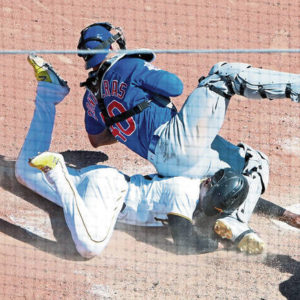
The issue came top of mind a few weeks back when I watched one of my favorite young players – Ke’Bryan Hayes – do something so monumentally stupid that I could not believe my eyes. And it made me question what his father (a former big leaguer) taught him, and what type of coaching he is receiving in the Pirates organization. Here was the situation:

Hayes was on second as the Manfred-Man to start the bottom of the 10th inning. With one out, Michael Chavis hit a short looper over first. Hayes never stopped running. Rafael Ortega scooped the ball up on one hop, turned, and fired a strike to home plate. Waiting to receive Ortega’s throw was well-known (illegal?) plate blocker Willson Contreras, all 225 pounds of him. So what did Hayes, three inches shorter and at least 20 pound lighter – not accounting for the mass of equipment Contreras was wearing – do? He dove headfirst into home plate, where he met the Cubs’ catcher, and his heavy plastic shin guards, and his oversized backside. Hayes scored the winning run, and then lay in the dirt for nearly a minute. The Pirates’ play-by-play guy stated: “I have never seen a celebration muted like this.”

Hayes was helped to his feet and off the field, and then missed then next two games with a sore shoulder. He was lucky it wasn’t considerably worse; but since he has been back in the lineup over the last nine games, he is 6-for-35, with no extra base hits. Because correlation does not prove causation, you can draw your own conclusions.

Why did Hayes dive into home rather than sliding feet first? Why not utilize a classic hook slide moving his entire body as far from Contreras, who was catching a ball thrown from right field, and thus could not get a specific bead on the runner? Or, for all you throwbacks out there, how about him knocking Contreras’ block off – Pete Rose style – in the hope of dislodging the ball from his mitt? I think a replay review would have shown that Contreras did not provide Hayes with a path to the plate prior to his receiving the throw. Any of those options would have been better than putting his fingers, hands, wrists, neck, head, and shoulders at risk. Why didn’t the Pirates coaching staff alert the players in their scouting report that Contreras likes to block the plate? Why didn’t the Pirates player development staff coach their players to be safe, not sorry, when trying to advance to the next base? Why?

Sure, we all love watching Javy Báez with a swim slide into second base avoiding the tag of an unsuspecting middle infielder. But, at what cost? In 2019, Báez dove into second base, fractured his thumb, and missed the month of September. Some lessons are never learned.

Since the Hayes incident, I have seen a handful of additional players dive into home plate, all avoiding serious injury. But that is just dumb luck. Baseball is a dangerous game on its own. Don’t believe me, ask:

  • Mookie Betts (ribs, from an outfield collision)
  • Jacob deGrom (shoulder)
  • Manny Machado (ankle, running to first)
  • Max Scherzer (oblique)
  • Salvador Perez (thumb, due to a swing)
  • Ozzie Albies (fractured foot from a foul ball)
  • Walker Buhler (flexor strain and bone spur)
  • Stephen Strasburg (ribs)
  • Chris Sale (ribs)
  • Bryce Harper (thumb, due to a HBP)
  • Anthony Rendon (wrist, due to an errant swing)
  • Jazz Chisolm, Jr. (back strain)
  • Jack Flaherty (shoulder)
  • Tyler O’Neill (hamstring)
  • Hunter Renfroe (calf)

This list could go on and on. The point is that there is enough that can go wrong on a baseball field that players don’t need to take it upon themselves to up the ante. Sliding headfirst has shown, time and again, to be a fool’s bargain; and as I wrote in 2016, extremely costly. MLB teams need to get smart about this. But so, too, do college teams. And high schools. Yes, it is legal there as well.

When and where will the madness stop? When an aspiring physicist or politician or doctor playing baseball for an Ivy League institution dies on the field because his neck and head couldn’t endure the impact with another kid’s knee? Or will it require a $30M/year superstar becoming paralyzed on a major league diamond in front of 40,000 fans and on national television because he believed that leading with his head offered him the best chance to score a run in the fifth inning of a 7-2 ballgame?

MLB has shown a willingness to change its rules when big-name players get injured on a big stage (see, the Chase Utley Rule; see, the Buster Posey Rule). Why wait until we have to name this new rule? Or, if we must, let’s call it the Hayes Rule, named for a legacy player who narrowly avoided disaster and forced baseball to do the same.

PLAY BALL!!

Tropican’t

We all create bucket lists; things we want to do or see before we leave this mortal coil. For me, I have run with the bulls and climbed Machu Picchu. I have run a marathon and climbed the Eiffel Tower. But still on my to do list is visit every major league park. Having crisscrossed the country in an effort to check every batter’s box, I began to think I would fall one short: Tropicana Field. I just wasn’t too keen on visiting that odd park on the opposite side of Tampa Bay.

But, last week, I relented. I had to see – in person – if the ballpark was as bad in person as it appears on television. Now, for years I have railed against Dodger Stadium – I find it to be one of the most fan unfriendly parks in America. But, I have also said that if I could be teleported to my seat, never needing to leave to eat or use the bathroom, and then be teleported back to my sofa, there may not be a more beautiful place to watch a game. Well, after a brief sojourn to western Florida, I now believe that Tropicana Field is the photo negative of Chavez Ravine.

Unlike Dodger Stadium, it is relatively easy to get in and out of The Trop – if you can avoid the mid-day downpours, never knowing when they might arrive. And once you are inside the park (?), it is a fan-friendly experience. The Rays have done a terrific job of highlighting their 25 years of existence with various exhibitions in the lower bowl. They have Silver Slugger and Gold Gloves on display. They have re-created lockers of their all-time greats. They have mementos of their opening season. Not to mention pictures and retired numbers (those took me a minute to figure out).

Further, they have a great area for kids and parents. There are batting cages and throwing games, as well as concessions and a small picnic-type area (decidedly underground, natch!) for the little ones. There is a quiet area for parents to chill out, and where I saw a mom breastfeeding a next generation fan. And they have actual, living, swimming Cownose Stingrays in a tank in the outfield that kids (and adults) can touch. Now, to be fair, Dodger Stadium did recently install some kid-friendly games in the outfield pavilion, so there is that.

And then there are the eats. Simply put, there is an abundance. The Trop is no Petco Park or Oracle Park. It certainly doesn’t hold a candle to T-Mobile Park as far as dining is concerned. But it holds its own. You walk around the stadium and you can get local fair (shrimp tacos) and ballpark standards (Nathan’s hot dogs for all of the New York transplants); there are various sandwich offerings, sausages, wraps, poke, pizza, and French fries. And, to top it off, and again with a nod to New York, Mister Softee is available at three locations (and yes, I did indulge).

So, yeah, the Dodgers could learn a thing or two from the Rays’ fan experience.

But for many, the fan experience is secondary to watching the game, and rightly so. For nearly two decades, the Rays have put a quality product on the field, winning the division four times since 2008, and winning the pennant in both 2008 and 2020. Tampa Bay’s front office has always been cutting edge; they were the first team to introduce the “opener” (your mileage may vary on whether that was a good or bad advancement) and began utilizing the shift long before other teams caught on (again, your mileage may vary). So, with compelling players such as Wade Boggs, Carl Crawford, Evan Longoria, James Shields, Blake Snell, and now Wander Franco, you would think the organization would want to allow them to play on a better canvas. Alas, it is not meant to be…yet. There are ongoing negotiations for a new park and/or a shared-custody arrangement with Montréal.

Coming across the bay on I-275, you see The Trop in the distance. Your/my first observation is that it is crooked. The stadium was built with a slanted roof to reduce interior volume, reduce cooling costs, and for better hurricane protection. All seem like laudable goals, but it sure is weird to look at. And, it is even weirder once you are inside, as everything is or appears slanted. There are concentric rings of catwalks (I am sure you have seen balls hit off of them) below the roof that follow the same contours. As such, you constantly find yourself tilting and un-tilting your head to make sure you are looking straight.

And because the roof is lop-sided, there is no symmetry with the upper level of the stands, which remain unpopulated, as the team’s attendance has not averaged more than 16,000/game since 2014.

The sightlines are odd, either because of the netting posts or the strange configuration of the seating, which includes picnic areas along the left and right field lines, alongside the on-field bullpens. And, when you do have a clear view, there are so many ads and so much ad hoc signage, that your eyes are often drawn away from the action. Now, I certainly understand the proliferation of ballpark advertising over the past 10-20 years, but some parks do it better than others. Some – Dodger Stadium, for instance – have a level of uniformity that makes the billboards value-add, not distracting. Some – like Chase Field – have a hodge-podge approach to their in-stadium publicity, making one think they are trying to bleed every possible dollar out of every possible square inch of wall space. Tropicana Field falls on the Chase Field end of the spectrum. And, to make matters worse, not even lost amongst the advertising are decent scoreboards or video displays. It took me two innings to find an MPH reading on Gerrit Cole’s fastball; and I never did find an exit velocity on Aaron Judge’s line out to left. The out of town scoreboard is heavy on logos, but light on actual scores.

Once I got the hang of everything, and tried to take in the game, I noticed that two of the scoreboards that actually provide useful in-game information about the pitcher and the batter are obstructed by fans in the standing area in right field. When I ventured to a higher level later in the game, the obstruction was lessened. But, come on…who was the Mensa behind that display placement decision?

The plan wasn’t to visit The Trop when the Yankees were in town – it just worked out that way. But, as could be expected, it was more like Yankee Stadium south, with the vast majority of the 16,504 in attendance wearing pinstripes and rooting on the Bombers. So, when Manuel Margot crashed into the wall in the top of the ninth inning and remained on the ground while the lead run scored, there were considerably more cheers than “aahs,” which was unfortunate (Margot was diagnosed with a patellar tendon strain and is on the 60-day IL). And when the final out landed in Aaron Hicks’ glove, and the Rays finally lost 4-2, the place erupted. It is hard to know if other teams travel as well to Tampa-St. Pete, and I am pretty sure I won’t be finding out.

I checked box #28 of active ballparks, and, in hindsight, I am glad I did. I got out of Tampa at 7am the next morning, and I am glad I did. The Rays have a lot to offer in their bizarre and hopefully impermanent stadium, concepts and ideas they can take across the bay or up to Canada. But from a game-viewing perspective, they have a lot of learn and a long way to go. However, rest-assured, when they finally do land in a new park, I will be there to watch…and critique.

PLAY BALL!

Doing a 180 on Bryce Harper

It’s mea culpa time. For years, and for reasons that I cannot fully articulate, I have disliked Bryce Harper. It didn’t go so far as hate, and I didn’t have any anger towards him, but I certainly didn’t root for him.

Now, if I was a psychologist, I might opine that Harper had been engaged in a “best of generation” competition with Mike Trout, and by being Team-Trout, I became Anti-Harper. This is entirely possible, but I am not sure that captures it.

Or, as I age and think about the next generation of ballplayers, maybe I have an intrinsic bias against guys wearing their eye black down their cheeks like war paint. But I want to believe that I got over such petty irritations after watching my son and his buddies do all manner of annoying things on the baseball field.

Maybe it was the hype. The cover of SI at age 16; the 1-1 pick in the 2010 MLB draft; his debut at 19 leading to Rookie of the Year honors. Maybe it was the flashes of brilliance (see, 2015), followed by seasons of mediocrity (at least by his standards). Maybe it was that every year Harper is penciled in as a savior and potential MVP, and in only two seasons has he truly fit that bill (winning MVP both times). Maybe it was all of the above, especially when compared to Trout.

Or maybe it was my dubiosity when, after signing a 13/$330M contract with no “opt-outs,” Harper claimed it was because he didn’t want any – he wanted to settle in Philadelphia and raise his family there. As I wrote at the timeI thought that was disingenuous, and believed then (and still partly believe today) that the only way John Middleton would give him that contract was if Harper agreed to not having any opt-outs, which would only provide him with additional financial leverage down the road.

But almost immediately upon signing that giant deal, Harper started to do all the rights things – on and off the field. Now, in fairness, he may have been doing all of the right things off the field when he was in Washington and I just wasn’t paying attention, but it is clear that he fully embraced the City of Brotherly Love, and asked them to embrace him right back. We can start with the Phanatic Cleats.

Sure, players have all sorts of swag these days, and custom cleats are more the norm than the exception, but these kicks go above and beyond. By wearing these in his first game with the team, he set the tone. By having various versions and strutting them out every few months, he showed he is more than a one-tricky pony, and that he loves the conceit.

The shoes were just the start. What I have witnessed from across the country over these past four seasons is that Harper is playing the game for the right reason…for the fans. And Harper is doing whatever he can, whenever he can, to make sure that the younger generation that comes to the ballpark doesn’t just get their (or their parents’) money’s worth on the field, but they get the personal encounters as well.

There is the story of the young Phillies fan who caught (well, actually dropped and then got again) a Freddie Freeman home run ball, and then gave it to a Braves fan. The young man was lauded for his generosity, and was brought back to the ballpark the next day and given a ball signed by Freeman…and Harper. But Bryce wasn’t done. He hooked up with the family on SportsCenter and invited the boy to Citizens Bank Park to visit the clubhouse. He made that connection, and seemed really happy to do so.

Or the moment last month when Harper, nursing his sore elbow in the dugout, spotted a college student in the stands wearing a cool Phillies cap. Bryce initiated a trade. His gamer (signed, no less) for the student’s maroon-billed Phillies lid. The fan certainly didn’t come to the park expecting that. But he left thinking Bryce Harper is one of the coolest guys ever.

And I would be remiss if I didn’t point out how fervently Harper fought for the Phillies to re-sign J.T. Realmuto. Now, Dave Dombrowski would not have paid Realmuto $115M just because Bryce demanded it. But, according to NBC Sports, Bryce “wore T-shirts, posted on Instagram, and made subtle comments to the media in an effort to convince the Philadelphia brass to make retaining Realmuto a priority.” Harper wanted the club to spend money to make it the best and most competitive team possible. At this point in his career, Bryce was truly playing for the name on the front of the jersey, not the back.

When the pandemic hit in 2020, even when he wasn’t drawing a paycheck with the season shut down, Bryce and his wife Kayla donated $500,000 to three different charities in his hometown of Las Vegas and his adopted hometown of Philadelphia to help people in the most immediate need. Sure, other players do and did the same (although it is difficult to chart), but here was a guy who was often pegged (by people such as myself) as a “me” guy, going out of his way to be a “we” guy. That is growth, that is maturity, that is a man who deserves my/our respect and adulation.

This season Harper is dealing with a partial UCL tear and cannot play defense. By his own admission, it has been a hard transition from being a two-way player to a single dimension DH. But transition he has, including a game-tying grand slam in the 8th inning of last Sunday’s game against the Angels. Harper is currently hitting .308, with a 1.001 OPS, and a 181 OPS+ (stats current through June 9th). Injury or not, Harper has played in 51 of 57 games, and is (again) putting the Phillies on his back in a desperate attempt to overcome poor managing and a poor bullpen. Philadelphia may not catch the Mets this season; and they may not even make the expanded playoffs. But it won’t be because of Bryce Harper. And despite my prior distaste for the player, I, for one, will be rooting him on.

PLAY BALL!!

Inside Baseball…Gear

For years I thought I was alone. No one else, I could imagine, spent as much time as I did analyzing players’ uniforms and gear. From double-flap helmets giving way to single flaps only once they reach the majors, to Starter jackets for pitchers on the base paths, to the mock turtleneck undershirts that were all the rage in the late ‘80s and early ‘90s. I would tune-in to games, read magazines, and watch the highlights, all in an effort to take in the small details that mattered to no one…except me.

But in the past decade or so, that all changed. Like manna from heaven, websites were created and information began to flow. I learned that I was not alone. I realized that there are other weird, fanatical people like me. People who know – and want to know – if Player X was wearing a different color belt or wristbands with his picture on them; people who know – or want to know – if Player Y was using a different model glove or wearing a magnetic necklace.

The granddaddy of sports uniform minutiae is Uni Watch (www.uni-watch.com), founded in 1999 as a column in The Village Voice. Over the years the site grew in size and stature. And if ever a topic was made for the interactive experience of the web, Uni-Watch was it. Paul Lukas – the founder and writer – is a uniform expert, and writes about the most minute detail of everything from European soccer to college football, and anything and any sport in between. When I first encountered Uni-Watch and started reading Paul’s blog, I focused mostly on the baseball research, but I was just happy to know that there were hundreds of thousands (millions?) of people like me enamored with this ephemera.

For players’ equipment, there is no better authority than What Pros Wear (www.whatproswear.com). Mike Carozza started the site in 2012 because he wanted to wear Ken Griffey Jr.’s glove and couldn’t find a good source of information on “what pros wear.” So he decided to become that source; he wanted people like him to know who was wearing what, and where they could buy it. The site was made for me – or people like me…and Mike. And when I discovered it, I could not believe that such a thing existed. It was like Mike had been reading my mind and watching me scan SI’s pre-season preview for new looks, or like he saw me freeze-framing the television so I could determine if Salvador Perez was actually wearing his tried and true All-Star gear but just with the Rawlings label stitched on. You were wondering the same thing, right?

While I have been fixated on all equipment and uniform traits for years – I am a sucker for actual stirrups – my first, true, and everlasting love is batting gloves. I have been a batting glove-aholic for as long as I can remember. I could never – ahem, can never – walk into a sporting goods store without making a beeline to the baseball section. I find the aisle with the batting gloves and check out what they have on offer; and often find myself trying on the latest models (remember when stores had sample gloves on an extendable cord for just this purpose). This adoration goes back to my youth.

When I first started playing baseball, I always got a new pair before the season. At that time, Saranac was the lead manufacturer, first with their wristband-loop Velcro closure (think Dusty Baker), and then with their “Triangle” logo Velcro closure. I cherished that soft leather, and how they felt right out of the package. The batting gloves of the ‘70s and early ‘80s, which – fun fact – were the progeny of golf gloves, weren’t the most comfortable and took some time to break in. Then, around 1985, I discovered the world of Franklin. And my whole world changed.

When you opened a new pair of Franklins, the first thing I did (do) is take a whiff. Nothing compares to the musk of the Pittards leather that Franklin still uses to make their gloves. And that concept of taking time to break in? That went away the first time I donned a pair of gloves with Franklin’s unique tri-curve design. As Mike Schmidt, the first MLB endorser of Franklin would attest, Franklins were part of your hand from the get.

It is truly hard to explain my deep fascination with this company and their inimitable product (more on that below), so I won’t really try. Suffice to say that I have made note of every design change Franklin has produced over the past 35 years; I have clocked every additional colorway added to their arsenal; I have observed which players are added to their roster nearly every season (can we attribute Aaron Judge’s early-season success to his new partnership with Franklin?), and those, like my beloved Will Clark, who left the Franklin family for Easton and then to Nike (or Ken Griffey, Jr., who skipped the stop at Easton and went directly from Franklin to Nike; or Ronald Acuña, Jr., who had some of the best batting glove game in the game, but switched from Franklin to Nike this season; I could do this all day).

When I was in high school, and Franklin’s commercial colorways were not widely available (the local sporting goods store carried all black, all white, royal/white, red/white), I would use a Sharpie and a highlighter to create my own. But in 1988, long before the internet and PayPal and Zelle, I took it upon myself to call the 800-directory (extra points and a prostate exam if you remember using that) to get the phone number of Franklin Sports in Stoughton, Massachusetts. Armed with a number, I cold-called the company and asked if I could order batting gloves directly. Either out of pity, or with a prescient eye towards eventual direct-to-consumer sales, they faxed (!) me an order form. I stewed on the various options for days – a whole world had now opened to me, and seemingly, me alone. I offered this once-in-a-lifetime opportunity to my teammates, but they could not be bothered. I begged my mom to front the money, as she needed to write a check that I mailed back east. A few weeks later a package appeared in our mailbox – a few pairs of never-seen-before-in-person batting gloves. Forget Christmas or Hanukkah, this was a brand new holiday!

As luck would have it, I was in Boston with my family last month when Franklin was having a warehouse sale. Their headquarters was about fifteen minutes from where were staying, so we HAD to go. We pulled off the highway, and there it was – just a series of buildings, but awe-inspiring nonetheless. We parked and headed in. Take one guess where I went first? They had hundreds of pairs of batting gloves that just needed to be seen, touched, tried on. No one in the immediate family plays baseball anymore, but my nephew does. So for him, we shopped. We also grabbed a volleyball, some hockey pucks, and a t-shirt. And that was when the connection was made.

An innocuous question about having any more shirts in my size led to a conversation about the above-referenced faxed order more than three decades ago. And that conversation introduced me to the literal Franklin family – Larry (the founder’s son) and his son Adam. Once Adam discovered my fascination and historical knowledge, he brought me to the Taj Mahal, the Sistine Chapel, the Mecca of batting gloves. My family and I were given entrée into a room at the back of the Franklin facility where all MLB players’ batting gloves are housed. In this room, from floor to ceiling, were cubbies with thousands of pairs of gloves. As a show of my insanity, I started rattling off players just by the model, design, and colorway. After nearly forty years of obsessing about batting gloves, I was welcomed into the inner-sanctum.

Adam showed us where the latest designs and improvements are made. He showed us concepts and products that even the big leaguers don’t yet know about (I can tell you what colors certain teams’ not-yet-released City Connect uniforms will be because I have seen their accessorized batting gloves), and he gave us a behind-the-scenes look at the goody box of gloves each Franklin-wearing player gets for each season’s special occasion games. As I said to my kids, this was Dad’s Disneyland.

Kids today don’t just get to mimic their favorite player’s batting stance or pitching motion. Now they can wear all of their gear and use all of their equipment. The information is there for everyone to find, fixate on, and potentially buy. Swing by your local Little League and you will see kids with Evoshield elbow protectors; stop by your local high school and see players diving back into first with running mitts. As for me, well I spend my free time playing with the Franklin batting glove customization tool (www.https://franklinsports.com/custom).

When I was a kid, I would have sooner believed that you could hang a television on the wall and watch first-run movies in your living room, or that you could store all of your albums and cassettes on a device the size of a deck of cards, or that you could do your research project on a Commodore 64, than I would have believed that you would always know exactly what every baseball player was wearing and what gear he was using, or that you could create your own custom batting gloves and have them shipped directly to your home just a few weeks later. People always talk about the good ol’ days. Forget that. With Uni-Watch, What Pros Wear, Franklin Sports, and, hell, your local Dick’s Sporting Goods, we are way better off today. Head on over, and…

PLAY BALL!!

Fenway Park: A Family Affair

A few months ago, my wife, who is a master at planning vacations, hit me with this idea: How about we meet up for Spring Break in Boston? Because she knows the animal, she had already checked the schedule and confirmed that the Red Sox would be in town. And, because the kids are growing and at different schools and thus have different Spring Break schedules, she also made sure that they all could join us in the Back Bay. Since the two youngest had never been to Boston, and because I never pass up an opportunity to go to Fenway Park, the answer was an easy one.

A click on the MLB site and then a call to the Red Sox ticket office locked in seven choice seats for a Sunday afternoon in April. Now, when I bought these tickets the players were locked out, but I felt relatively confident that the owners and players would resolve their differences with plenty of time to spare. And then they didn’t. And then Rob Manfred canceled the first week of the season. And then he canceled another week. While I wanted the impasse resolved and 162 games to be played, I clung to Manfred’s assertion that missed games would not be made up, and that the current schedule would hold. As such, I still had a few days of wiggle room; but the outcome was beginning to look bleak. Of course, a trip to Boston would still be incredible without the Red Sox. Of course, there was plenty of sights to see, history to learn, food to eat, without noshing on Fenway Franks. But, all things being equal, why would one ever do that? It wasn’t Red Sox or bust, but it was damn close.

As we all know, the owners and the players came to an uneasy accord. The first week of the season was lost, but all else remained on schedule, and our tickets for the Sunday before Patriots’ Day would and could be put to use. Suffice it to say, there was jubilation in our house when the lockout was lifted.

My son flew in from college a day early to take his third public tour of Fenway – he just cannot get enough. And on Sunday, we arrived at Jersey Street before the gates opened. Rather than waiting on line, I took the kids to Lansdowne Street and bought some souvenirs. We walked up Ipswich to Van Ness and then back to Jersey, where fans were now flowing through the gates. A brief (can it be brief?) stop at the team store netted nothing additional (yet), so we walked around the former Yawkey Way and took in the sights and sounds. I have been to nearly every ballpark, and nothing really compares to the scene outside Fenway (unfortunately, one needs a ticket to get onto Jersey Street, so this excitement is not open to the public).

The law school roommate of a dear friend of mine is an executive with the Red Sox, and he met us outside Gate A to take us on a behind-the-scenes tour of the park. We saw nooks and crannies not available to typical fans (who knew the Red Sox had their own garden where they grow fruits and vegetables for both their luxury suites and local homeless shelters?), as well as well-worn haunts like the Top of the Monster. We went to Ted William’s red seat and checked out the brand new bar and deck area behind the right field bleachers; and we watched Red Sox legend Tim Wakefield broadcast from the new NESN booth overlooking right field. In the Royal Rooters Club we saw “The Dave Roberts Base” (which is exactly what you think it is), as well as tons of memorabilia going back over a hundred years. I showed my kids pictures of what Fenway looked like when their Papa attended games there as a kid. We saw four World Series trophies and the Red Sox Hall of Fame plaques. We had spent the previous days touring Boston and learning American history; we spent Sunday morning touring Fenway Park and learning Red Sox history. Your mileage may vary on which is more important.

After our multiple dime tour, we met the rest of the family back on Jersey Street. My wife and stepdaughter were now the last two who had never been inside America’s Most Beloved Ballpark. So, it was my great pleasure to walk them up the grandstand and have them see the field and the Green Monster for the first time. It’s not the same as Billy Crystal’s description of first walking into Yankee Stadium, which he had only seen in black and white, but it is a close second. When your baseball life experience is essentially made up of Dodger Stadium, Fenway Park is otherworldly. You are just so close to the field; that wall is just so tall; and everything is just so green. And whether you are a Red Sox season ticket holder, or you are making your first visit to Fenway, the old building never disappoints.

The game got off to a slow start, but the offense picked up in the later innings. But the truth is, it did not matter. We bought snacks from the ubiquitous vendors, and held our breath when Kiké Hernández did his best Pudge Fisk impersonation, pulling one just foul down the line. Around the fourth inning my stepson said “this place is the best.” He and I don’t always see eye to eye, but on this we can agree.

And as we moved into the bottom of the sixth, I stopped my kids from leaving their seats, as I knew what was to come. The seventh inning stretch and then “Sweet Caroline” were capstones for the girls. The Red Sox win, “Dirty Water,” and “Tessie” were the capstones for me and the boys. We piled out of Fenway Park with full bellies and smiles on our faces. But we still had to make one more stop at the team store. For those who had never been before, they now knew how special the Fenway experience is; they now had to have a keepsake.

I have been to more than thirty MLB parks, and nearly all of the current ones. When people ask me my favorite, I always start with the notion that you have to take Wrigley Field and Fenway Park out of the conversation, as those two are cathedrals, they are cultural institutions, they are historic landmarks. I have spent a lot of time at Wrigley over the past few years, and don’t get to Fenway as often as I would like. But maybe that is for the best, as Fenway never stops being special; it never ceases to amaze, impress, and satisfy what my baseball-loving heart desires. As my friend Gabrielle Starr has written, “If you’ve been to Fenway before, you know what I mean. It’s that buzz of magic, of history, and anticipation. It’s the pulling of that thread that connects baseball’s past and present.”

I have pulled that thread, and been to Fenway Park with my dad, and with my sons. But this time I got to bring my wife and all my kids, and got to experience it through their eyes. They say you are only as happy as your most unhappy child. Well, after three hours in uncomfortable seats facing slightly the wrong direction, on a blustery Sunday in Boston, I was walking on sunshine.

PLAY BALL!!