The 2024 Draft Class Is On Its Way To Being The Best Ever After Two Years

any of you readers listen to the Effectively Wild podcast, and if you happened to listed to Episode 2483 last week, you may be able to skip the rest of this article. On that show, hosts Ben Lindbergh and Meg Rowley discussed (among many other things) the 2024 draft class, and the impact those players are having on the 2026 season, which is barely two months old.

For context, over twenty rounds, there were 615 amateur players selected in the June, 2024 draft. According to various studies over the years, approximately 15-20% of drafted players make it to the big leagues. As such, we could typically expect that more than 90 of the players selected in 2024 will eventually make it to the major leagues. Again, according to various studies, the standard player will do so three to five years after he was drafted. So getting there in two years is a sign of something. But what?

  • The extreme skills of today’s young ballplayers.
  • Better training and preparation from Little League through summer leagues and travel ball and beyond.
  • Colleges acting more like professional baseball development programs than institutions of higher learning (said differently, athlete-students rather than student-athletes).
  • And, what we have seen a lot lately, teams accelerating their timeline for prospects.

So, if we figure that roughly 100 of the players from 2024 will make it at some point, it is not so shocking that 15 already have. By comparison to 2023, when 614 players were selected, 29 made their debuts two years later. So 2024/2026 is on a faster pace, but not crazily so.

But what is crazy is the production teams are getting from their “debutantes” (h/t to the aforementioned Ben Lindbergh). As of last week, players who have debuted in the major leagues this season have accrued 19.9 WAR. That is a pace of nearly 60 WAR for the whole season (which is only one-third done), and that is with just 15 players. The numbers are astounding.

The 2023 draft class put up 43.2 WAR with those 29 players – for the entire 2025 season. They were led by Paul Skenes and Wyatt Langford and Matt Shaw.

In 1987, the 1985 draft class of 36 players, led by some guy named Barry Bonds, and some guy named Barry Larkin, and some writer’s favorite player, Will Clark, put up 37.1 WAR, which stands as the second highest WAR two years after any draft.

So who and how is this group of 2024ers doing it? See some of the answers above for the how. As for the who, let’s take a look at the early bloomers:

Travis Bazzana was selected first in 2024, came up to Cleveland on April 28th, and is now slashing .294/.389/.450. He often finds himself in the leadoff spot for Stephen Vogt’s club.

Chase Burns went #2 to the Reds. So far this season he is 7-1 with a 1.96 ERA. He has struck out 72 batters against just 20 walks and is in the early Cy Young conversation.

Nick Kurtz went #4 in that draft, and already won Rookie of the Year. This year he is slashing .283/.432/.493 for the upstart Athletics.

Jac Caglianone (#6) is still trying to find his footing in Kansas City. There was early talk of “Jactani” being a two-way player when he came out of the University of Florida, but his natural power made him a better fit to be an everyday player. This year has seen improvement from a disastrous rookie campaign, but he is still not the middle of the order threat the Royals are hoping for.

JJ Wetherholt (#7) made the Cardinals out of spring training and has not looked back. While his batting average is below par (.248), he is getting on base at a .350 clip while leading off for St. Louis and playing a terrific second base. He has already accumulated 2.6 WAR in two months.

Konnor Griffin (#9) looked like he could make the Pirates out of spring training, but the team decided to give the then-19-year-old reps in Triple-A insofar as he had never even played at that level. Well, he was ready. After putting up a 1.196 OPS through his first five games at Indianapolis, he got the call to Pittsburgh, where he is slashing .270/.327/.402 with fourteen extra-base hits and playing great defense at short.

The Cubs drafted Cam Smith with the 14th pick in 2024, and then sent him to Houston (with Isaac Paredes and Hayden Wesneski) in return for the right to rent Kyle Tucker. I would imagine Jed Hoyer would like to have that one back. Smith played fine as a rookie and is playing fine as a sophomore, but all of the talent is there, and Kyle Tucker is not.

Injuries and a lack of inspiration forced the Mets to bring up Carson Benge (#19) and give him run in their outfield. He has not set the world on fire (he has just an 90 OPS+ through 54 games), but the future looks bright for the youngster.

Trey Yesavage (#20) announced his presence with a jaw-dropping showing in last year’s post-season for the Toronto Blue Jays. He began this season on the injured list with a right shoulder impingement, but in his six starts to date, he has a 2.19 ERA, 2.42 FIP, and a 201 ERA+. He looks every bit the ace he did last October.

Ryan Waldschmidt was the 31st pick in 2024 and got the call to come to Arizona on May 8th. He has yet to hit his first big league homer, but he is batting .2964 with a 110 OPS+.

Payton Tolle went in the second round to Boston in 2024 (#50 overall) and has quickly found himself to be an integral piece of the Red Sox’ starting rotation. He has a 2.61 ERA and 0.895 WHIP over his seven starts.

Gage Jump (#73) just got the call to Sacramento, making his debut on the hill for the A’s last week. He went five innings and gave up four earned runs on nine hits to a Mariners team that is finding its stride. He struck five while only walking one in the loss.

Ryan Johnson (#74) made headlines when he skipped the minor leagues altogether and joined the Angels on their Opening Day roster in 2025 directly out of Dallas Baptist. After making four appearances this season with the Halos where he gave up 14 earned runs in 8-1/3 innings, he is currently back down in Triple-A.

Last (in draft order) is Sam Antonacci (5th Round, #140 overall) who made a name for himself with Team Italy in the World Baseball Classic. Antonacci is playing left field nearly every day for the surprising White Sox, and is hitting .275 with a .369 OBP. He has played five games at second base as well.

There is no doubt that additional players from 2024 will get the call this season. Charlie Condon (#3) got a taste in Colorado last season, but remains in Triple-A as of this writing. The White Sox may have reason to call up left handed pitcher Hagen Smith (#5). Christian Moore (#8) who got a cup of coffee with the Angels last season, may come up again. James Tibbs III, who was selected by San Francisco, then traded to the Red Sox as part of the Rafael Devers deal, and then subsequently traded to the Dodgers for Dustin May, is currently crushing it at Triple-A Oklahoma City. And there are many more who could add to the list and add to the WAR total for this special class of players.

PLAY BALL!!
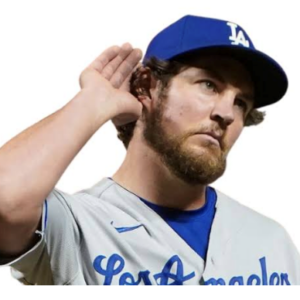
Trevor Bauer Made His Bed And Now He Has To Lie In It

Trevor Bauer was selected third overall in the 2011 draft by the Arizona Diamondbacks out of UCLA, and made his MLB debut the following June. He started four games for Arizona in 2012, going 1-2 with a 6.06 ERA.

After clashing with his teammates in the desert, the team traded him (along with Bryan Shaw and Matt Albers) to Cleveland in return for Shin-Soo Choo, Jason Donald, Tony Sipp, and Lars Anderson. Bauer began 2013 at Triple-A Columbus, starting 22 games and going 6-7 with a 4.15 ERA before being called up to the big club. In four MLB games, Bauer essentially matched his 2012 season, going 1-2 with a 5.29 ERA.

2014 saw him again on the farm, but he was down there for only a short while (2.15 ERA). Once in Cleveland, he started 26 games, going 5-8 with a 4.18 ERA.

Bauer’s 2015 and 2016 seasons were remarkably similar (11-12, 4.55 ERA, 4.33 FIP / 12-8, 4.26 ERA, 3.99 FIP) as he settled in as an everyday pitcher in Terry Francona’s rotation.

In 2017, Bauer took a leap. He went 17-9, threw 176-1/3 innings, and struck out 196 batters while walking only 60. That season was worth 2.9 bWAR.

In 2018, he upped his game even more, going 12-6 with a 2.21 ERA and a 2.44 FIP. He pitched 175-1/3 innings and struck out 221 against just 57 walks. With 6.0 bWAR, he made the All-Star team, finished 6th in Cy Young Award voting, and got MVP consideration. At this point, Bauer was on his way to becoming somewhat of an “ace,” a moniker he had desired since college.

Bauer’s 2019 season started well enough, opening with a 4-1 record through his first seven starts. Then he lost five straight while sprinkling in three no-decisions. He followed that with four straight wins and five out of six. On July 23rd, Bauer pitched 7-2/3 innings, struck out nine while wielding just three hits and no runs. He left the game with a 1-0 lead, just to watch Brad Hand gave up a game-tying homer to Justin Smoak with one out in the bottom of the ninth. And then he had to endure Tyler Olson coming into the game in the bottom of the 10th and going walk, wild pitch, single, and walk-off single (Smoak, again) to give the Blue Jays the 2-1 win.

That was the backdrop as Bauer headed into his next start, a Sunday afternoon game in Kansas City on July 28th.

Staked to a 3-0 lead in the top of the first, Bauer started his outing by giving up hits to three of the first four Royals batters, but escaped surrendering just one run.

In the third inning, he gave up a leadoff single, followed by a walk, and then a wild pitch. A ground ball to first should have meant just one run, but first baseman Jake Bauers’ errant throw allowed Hunter Dozier to score to tie the game.

Cleveland retook the lead in the top of the fourth, and Bauer bounced back with a 10-pitch inning in the bottom half. Danny Duffy led off the top of the fifth with a home run, giving Bauer a two-run lead to work with.

Bauer, with a 5-3 lead going into the bottom of the fifth, gave up a leadoff single to Alex Gordon. Brian Dozier then lofted a fly ball to center field that Óscar Mercado lost in the sun, allowing it to drop on the warning track and bounce over the fence for an automatic double. Jorge Soler then walked on a very close 3-2 pitch (probably overturned in the ABS era) to load the bases. Ryan O’Hearn then hit a dribbler in front of the mound that Bauer couldn’t field, allowing a run to score (it was ruled a hit). Cheslor Cuthbert then hit a duck-fart (60.6-mph off the bat) into right field over the outstretched arm of second baseman Mike Freeman, which knocked in the tying run. After striking out Bubba Starling for the first out of the inning, Nicky Lopez hit a grounder up the middle that Bauer just barely missed fielding; it ended up in center field, scoring two runs. Bauer got a new ball from the umpire, and immediately rejected it by throwing it to the dugout. When he got a second ball, he noticed manager Terry Francona coming to the mound, so Bauer chucked that ball over the center field fence. When Tito got to the obviously frustrated and pouting pitcher, he asked: “What the fuck is wrong with you?!” Bauer put his hand on Francona’s shoulder, ostensibly in apology, and headed for the showers.

After the game, Bauer apologized for his behavior.

“I want to be clear that my frustrations were with myself and my inability to stop the situation and keep my team in the game. I’m an intense competitor. That fire is what drives me. Today, it completely consumed me and took over…It was unbecoming. It was childish. Unprofessional. There’s no place for it in the game.”

MLB fined the pitcher an undisclosed sum, but did not suspend him. However, Cleveland was done with him. Two days after the incident, they traded the immature 28-year-old to Cincinnati as part of a three-team deal (ironically, Francona would later become the Reds’ manager).

Bauer finished the season in Cincinnati, and pitched there in 2020 as well. Before the 2021 season, the Dodgers signed him to a three-year, $102 million contract. MLB placed Bauer on administrative leave in July of that year following sexual assault allegations. In April, 2022, he was suspended for 324 games (ultimately reduced to 194 games on appeal). Los Angeles released him in January, 2023, but not before they paid him roughly $61 million for 17 games and 107-2/3 innings.

Bauer was never criminally charged for the actions that predicated his suspension, and he actually won a civil judgment against his accuser. And yet, no MLB team wanted his services. Was he “blackballed”? It is hard to say.

Since his release by the Dodgers, Bauer has pitched in Japan, Mexico, and now on Long Island. At 35, he clearly still has skills and could be useful to some big league team in need of pitching. But, is he worth the hassle? Interestingly, after Bauer chucked the ball over the fence that day in Kansas City, Francona said the following to the assembled press: “I don’t want this to be his legacy. This kid’s a good pitcher.” What he didn’t say is as important – if not more important – than what he did say.

When Bauer threw a no-hitter for the Ducks, there was no grand celebration on the mound. Teammates, all the way back to college and possibly before, simply do not like Bauer. And organizations, from Arizona to Cleveland to Los Angeles, tire of his act pretty quickly.

If Bauer is anything, he is true to himself, and will not change for anyone or any amount of money. He has no one else to blame for his lot in life, but he does not seem to have the introspection or care for what others think to evolve in any way. And that has cost him his major league career. Hopefully the $112 million he earned over 13 seasons is enough to buy happiness, because it certainly won’t buy a positive or lasting legacy.

PLAY BALL!!

Dwight Evans Should Be Given Some Additional Hall of Fame Consideration

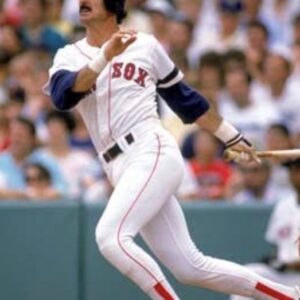
For a while during the mid-‘80s, the Boston Red Sox right fielder Dwight Evans, “Dewey” to the fans in the Back Bay, was always on base and always making great plays. He was the heart and soul of a Red Sox team that flirted with greatness.

Evans grew up in Southern California, and starred at Chatsworth High School on the same field where Mike Moustakas would eventually play. In 1969, the Red Sox selected Evans in the fifth round of the draft. Three years later he made his major league debut. He came in as a pinch-runner for Reggie Smith (who ended his career in Southern California and still runs a hitting clinic in the area) in the bottom of the sixth inning of a game in September, and then had his first plate appearance in the bottom of the eighth, popping out to short.

Evans got 63 more plate appearances over the final two weeks of the 1972 season, slashing .263/.344/.404, but ended the season with an 0-for-4 ten days before this writer was born.

Evans became an everyday player the following year, and won his first Gold Glove in right field in 1976 (he would go one to win seven more). He hit his stride in 1981, tying for the American League lead (with Eddie Murray) with 22 home runs, and leading the league in walks (85), OPS (.937), total bases (215), and bWAR (6.7). For all of that he became a second-time All-Star, a first-time Silver Slugger, and came in third in MVP voting (behind Rollie Fingers(?) and Rickey Henderson). He won his third Gold Glove, to boot.

The following year he played in every game and led the league with a .402 on base percentage. It was in 1981 when he got his first taste of being the team’s leadoff hitter (101 plate appearances). For whatever reason, I recall Dewey batting leadoff throughout the ‘80s, when in fact that was his calling in just 1985 (355 plate appearances). No matter, he was in top-ten in on base percentage eight years between 1981-1989. Over an illustrious 20-year career, he slashed .272/.370/.470, with 385 homers (68th all-time) and 483 doubles (82nd all-time).

Evans first appeared on the Hall of Fame ballot in 1997, and barely survived to fight another day, with just 5.9% of the vote (a candidate needs to receive 5% or more to remain in contention the following year). In 1998 he nearly doubled his support, with 10.4%. But in 1999, only 3.6% of the electorate checked the box next to his name, pushing him off the ballot altogether.

In 2020, the Veterans Committee heard his case, and 50% voted for his induction. Unfortunately, 75% is required. All of which begs the question: Is Dwight Evans a Hall of Famer?

This is where Baseball Reference is exceedingly helpful. Where the average Hall of Famer has 27 instances of “black ink” (i.e., leading the league in a category), Evans has only 15. According to Bill James’ Hall of Famer Monitor, where a score of 100 denotes a likely entrant, Evans is only at 70 (but, note, that this just considers his offensive production, and not his Gold Glove defense).

By James’ Hall of Fame Standards, where the average Hall of Famer scores a 50, Evans lands at 44. Per Jay Jaffe’s JAWS metric, Evans falls just shy in every category:

  • Career bWAR: 67.2 / Average Hall of Fame right fielder: 69.7.
  • Peak 7-year bWAR: 37.3 / Average Hall of Fame right fielder: 42.2.
  • bWAR/162: 4.2 / Average Hall of Fame right fielder: 4.9.
  • Evans’ overall JAWS score 52.2 / Average Hall of Fame right fielder: 56.

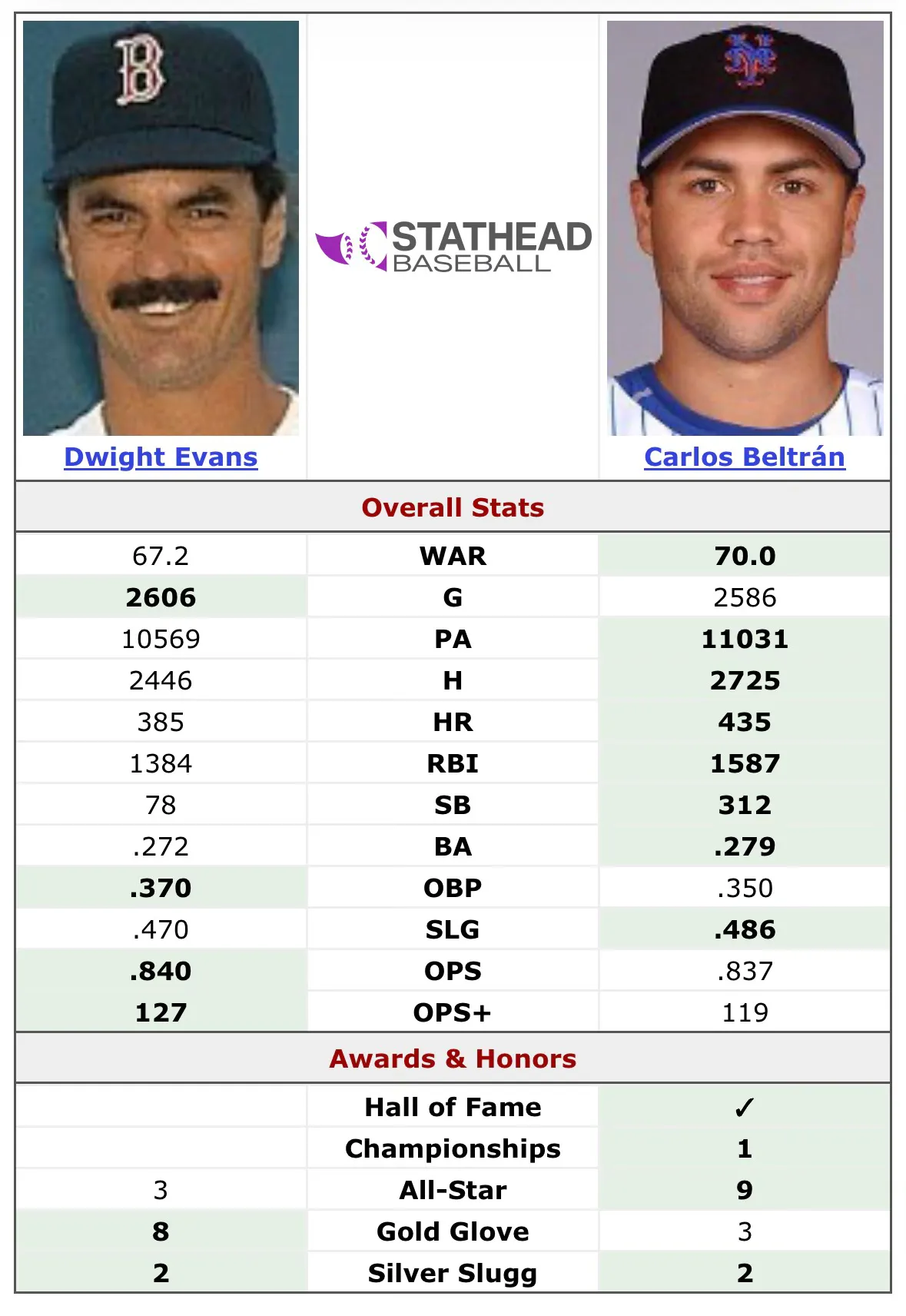
Does all of this advanced analysis mean that Evan is certainly not a Hall of Famer? By no means. If you are a “Large Hall” fan, you could definitely see Dewey with a plaque. If a “Small Hall” is more your speed, you think Evans probably belongs in the “Hall of Very Good.” Neither argument is incorrect. But, as we watch more and more players get further consideration for the ultimate honorific, it seems only right and reasonable that Dwight Evans get another look. And with Carlos Beltrán getting the nod this year, let’s compare the two:

Based on this side-by-side comparison, there is every reason for the Contemporary Baseball Era Committee, which meets again in 2028, to give Dewey serious consideration.

PLAY BALL!!

The “Manfred Man” Bestows a Loss On a Pitcher Who Just Did His Job

On Episode 2375 of the Effectively Wild podcast, co-host Ben Lindbergh — no fan of the “Manfred Man” (aka the “Ghost Runner,” which is a misnomer; aka the “Zombie Runner,” which is an insult to the guy actually standing on second base) — pointed out how the rule instituted in 2020 (during Covid) produced a great injustice about a week ago in a game between the Dodgers and the Giants.

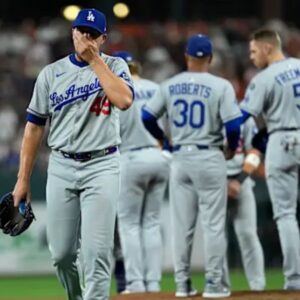
Here is the scenario: With one out in the ninth inning of 1-1 tie, Blake Treinen came in from the bullpen to replace Jack Dreyer with the winning run on third. Manager Dave Roberts immediately ordered an intentional walk to Willy Adames (this begs the question as to why Roberts didn’t do that with Dreyer on the hill, as, alas he created the mess and should be charged with the walk). With the bases now loaded — but the only runner that mattered standing on third base — Treinen got Wilmer Flores to fly to short center field, where Andy Pages caught the ball and threw a strike to catcher Ben Rortvedt to complete the double play. That ended the threat, ended the inning, and ended regulation baseball.

Treinen came back out for the bottom of the tenth, which meant that Christian Koss (who pinch-ran for Flores) took his rightful place at second base to start the inning as the aforementioned “Manfred Man.” Treinen induced Matt Chapman to ground to second baseman Tommy Edman for the first out of the inning, while Koss moved to third. At this point, with left-handed hitting Jung Hoo Lee scheduled to bat, Roberts removed Treinen for lefty Tanner Scott. To summarize, Treinen had faced two batters (technically three, as the intentional walk to Adames counts as a batter faced), and recorded three outs (one via a double-play). Suffice it to say, he had done his job.

Scott took the mound and actually struck out Lee, but home plate umpire Bill Miller ruled that Rortvedt didn’t catch strike three, so he called it a foul ball. Lee walked on the next pitch. With runners on the corners, and again, the only runner that mattered standing on third base, Roberts order an intentional walk to Casey Schmitt. Two pitches later, catcher Patrick Bailey sent a 97 MPH fastball into the left field bleachers for a walk-off grand slam. For purposes of deciding who takes the loss, the only runner that matter was on third — Koss, the “Manfred Man” — who took his place while Treinen was on the hill. As such, Treinen took his fourth loss of the season.

Sure, pitcher wins are an antiquated stat in today’s sabermetrically inclined world. Sure, advanced stats will protect Treinen at contract time (although his actual stats may truly hurt him), and no one will be looking at this loss on this Friday night in September when he becomes a free agent at the end of next season. But, come on! It is right there is the box score in every paper in America, on every website that covers the sport. It just isn’t right. Lindbergh (and others) offered up that this should, if nothing else, be a “team loss,” and not dropped at the feet of the pitcher who literally did nothing wrong and everything right.

Per Lindbergh, who was relying the research of Michael Mountain, this exact situation has occurred ten other times between 2020 and 2024. This would be the 11th, and those eleven pitchers have a reason to gripe, even if they are just shouting into the wind where no one — not fans, agents, managers, or general managers — give one good darn about a pitcher’s win-loss record. But still!

PLAY BALL!!

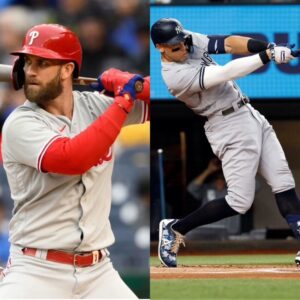
Bryce Harper vs. Aaron Judge – Who You Got?

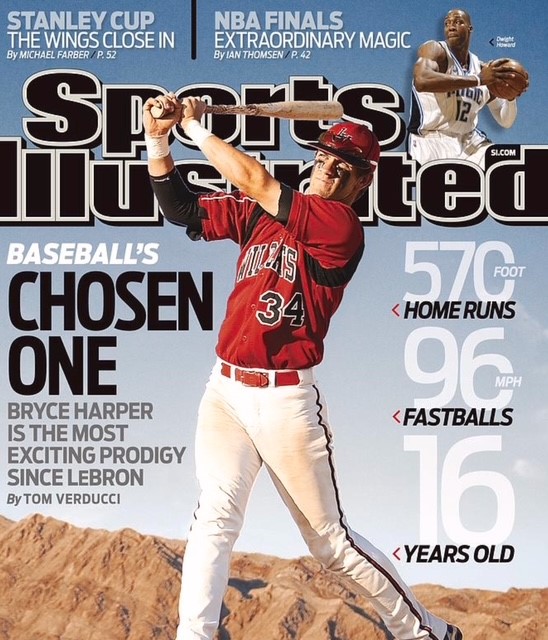
Bryce Harper became a sensation when he was 16 years old, appearing on the cover of Sports Illustrated.

He forewent his final two years of high school (obtaining his GED) to enroll in junior college, making him draft eligible at the age of 18. He was selected 1/1 in the 2010 draft by the Washington Nationals. Harper signed a very unconventional deal — $9.9 million over five years, which included a $6.25 million signing bonus and eight semesters of college.

The Oakland Athletics selected Aaron Judge, a high school kid playing less than 90 minutes away in Linden, California, in the 31st round of that same draft, a mere 934 picks after Harper. Judge elected to go to Fresno State instead. Three years later the New York Yankees took Judge in the first round, with the 32nd pick. He received a $1.8 million signing bonus.

Harper made his MLB debut in 2012 at the tender age of 19. That season he played in 139 games, slashed .270/.340/.477, with 22 home runs, and a 118 OPS+. He was an All-Star and won the Rookie of the Year.

Judge made his MLB debut in 2016, at the seasoned age of 24. That year he played in just 27 games, and looked overmatched, slashing .179/.263/.345, with four home runs. He had an OPS+ of 61, and was worth -0.3 bWAR. But, with his rookie status still intact, he corrected whatever ailed him, and came out guns-a-blazing in 2017. Playing in 155 games, he slashed .284/.422/.627, with 52 home runs and a 171 OPS+. It was an 8.1 bWAR season that saw him become an All-Star, win a Silver Slugger Award, come in second in MVP voting, and win the Rookie of the Year.

Because they started at different times, Harper is now in his 14th season, while Judge is in just his tenth. As of Tuesday morning, Harper’s baseball card looks like this:

.280/.387/.521; 142 OPS+; 357 HR; 1034 RBI; Rookie of the Year; 8x All-Star; 2x MVP

Judge’s looks like this:

.293/.410/.613; 177 OPS+; 354 HR; 807 RBI; Rookie of the Year; 7x All-Star; 2x MVP

In March of 2019, Harper signed a 13-year deal with the Philadelphia Phillies for $330 million, which, at the time, was the largest free agent contract in terms of total dollars, in baseball history. The deal has no opt outs, so Harper will play in the City of Brotherly Love through the 2031 season, when he will be 38 years old.

In December of 2022, Judge signed a 9-year deal with the Yankees for $360 million, which, at the time, was the largest free agent contract in terms of total dollars, in baseball history. The deal has no opt outs, so Judge will play in the City that Never Sleeps through the 2031 season, when he will be 38 years old.

When Judge’s contract expires, he will have earned a hair less than $400 million. Harper’s deal nets him just under $378 million, but his contract includes a handful of incentives ($500K for an MVP; $100K for a World Series MVP; and $50K for each of certain seasonal awards), which have given him another $800,000 with six years still to go.

By many accounts, Aaron Judge is the best right-handed hitter of his generation, and potentially of all-time. He is averaging 52 home runs per every 162 games. If he kept that pace going for the next six seasons (highly unlikely, but worth the analysis), he will become a free agent sitting somewhere around 650 homers. That is one good season away from A-Rod (696) and Albert Pujols (703); and a remarkable season away from The Babe (714). Extrapolate those numbers out, and he would be two good seasons (by Judgian standards) away from Henry Aaron and Barry Bonds.

Harper, on the other hand, will not reach such lofty heights. He is not the best left-handed hitter of his generation (but he is probably in the top-five), and most certainly not the best of all-time. His power will not allow him to amass the types of numbers that Judge has in his sights, but 500 dingers are well within reach (he needs to average less than 25-per-year over the next six seasons to join that club). Harper may have been the “Chosen One,” and will most likely fulfill all of his promise and more. But his career stats may ultimately pale in comparison to Judge’s.

Yet, to date, neither player has brought a World Series title to their city. Do that – and do it more than once – and the rest of the stats will fall by the wayside when local legends are written. As it stands, Harper’s home run in the eighth inning of Game 5 of the 2022 National League Championship Series to push his team to the World Series

probably ranks higher than Judge’s 62nd home run in Texas to break the American League single-season record, in terms of stories people will tell their grandkids about.

Both the Phillies and the Yankees have been built for post-season success. As of right now, Philadelphia looks like the best team in the National League, while the Yankees are faltering. That all could change over the next two months. And both players still have six more years to burnish their credentials. Only time will tell who has the better overall career. But, in the end, it may not matter, as we fans are just lucky to get to enjoy two of the best who have ever done it.

PLAY BALL!!

Hometown Heroes

*This article first appeared in the IBWAA Here’s the Pitch Newsletter.

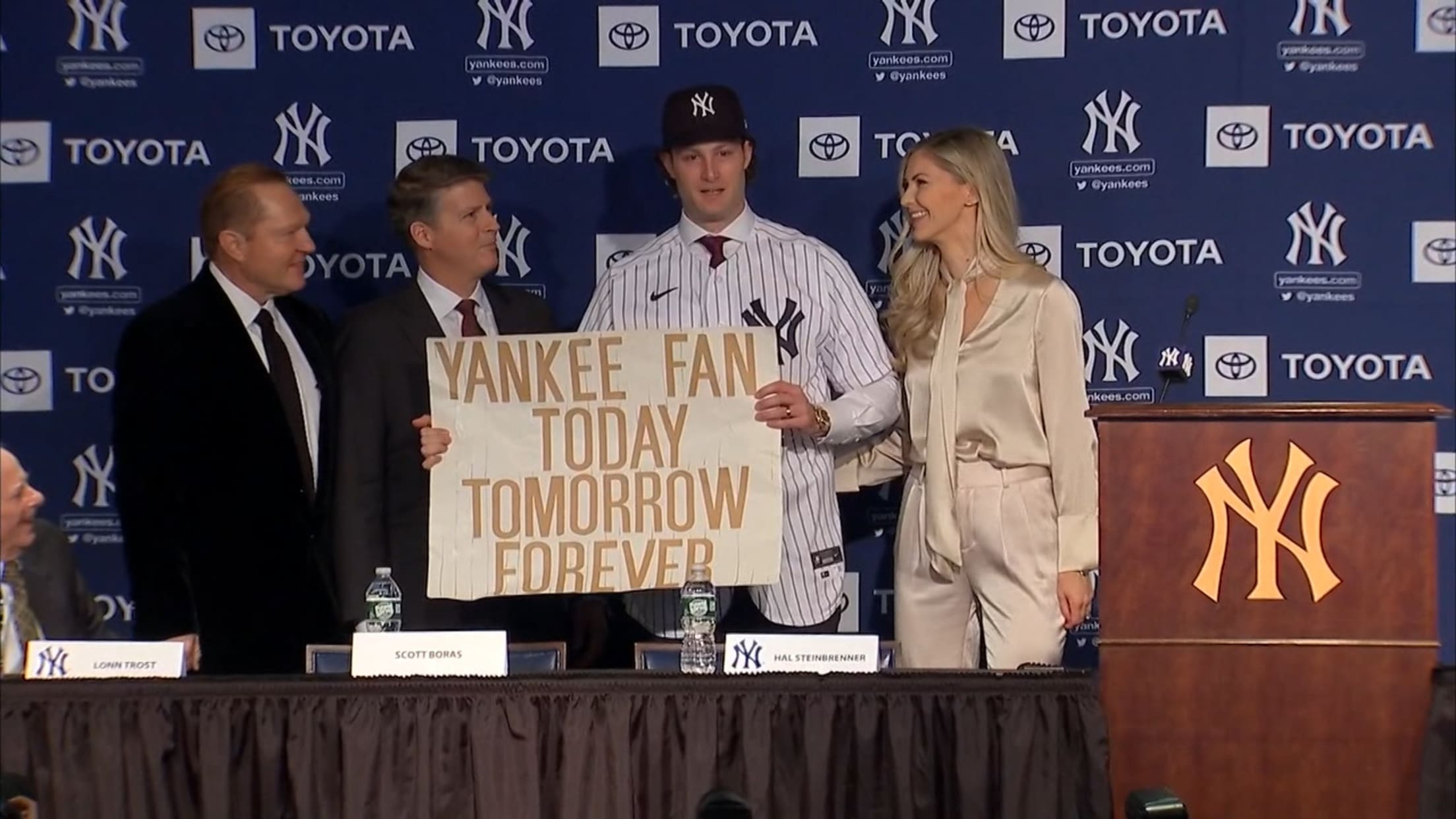
In the lead-up to the 2024 World Series, much was made about the sign Gerrit Cole made and brought with him to the 2001 fall classic. Although he was born and raised in Southern California (but considerably closer to Angel Stadium than Dodger Stadium), and he went to college at UCLA, Cole is a lifelong Yankee fan.

In fact, Cole brought the sign with him when he signed his $324 million contract with the Yankees in 2019. This past October, Cole got the chance to play for his beloved team on the largest stage. This is truly what dreams are made of.

The same is true for Yankees shortstop Anthony Volpe. The second-year player grew up on Manhattan’s Upper East Side, his family had a share of Yankees season tickets, and he attended the last World Series New York won—in 2009. With his team on the brink of elimination in Game Four of this year’s edition, Volpe hit a game-changing grand slam home run to give the Yankees a 5-2 lead, one that they would not relinquish in their only victory against the Dodgers.

The homer might have changed the whole complexion of the Series had the Yankees not booted away the fifth inning of Game Five, allowing the Dodgers to come back from a 5-0 deficit, and ultimately win the game and the title.

Marcus Stroman grew up on Long Island and was on the Yankees roster for the World Series. Unfortunately, he did not make any appearances. He was, however, afforded a front-row seat to cheer on—and to be ready if needed—his hometown team. Stroman played for the other New York team (which is about seven miles closer to his hometown) in 2019 and 2021 (he opted out of the 2020 Covid year), but neither of those Mets teams made the playoffs.

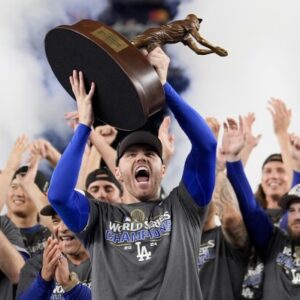
For the Dodgers, the story is slightly more complicated. World Series hero and MVP Freddie Freeman grew up in Southern California, but, like Cole, much closer to Angel Stadium. In fact, he was an Angels fan and attended the 2002 World Series match-up against Barry Bonds and the Giants. But, when Freeman signed with the Dodgers in 2022, he felt as if he was “coming home,” getting to be closer to the father who raised him after his mother passed away when Freddie was ten years old. There is no doubt that Freeman is a Dodger legend (and fan) now.

Austin Barnes was born in Orange County, California, which makes him like Cole and Freeman, and he grew up in Riverside, which is roughly 55 miles east of Los Angeles. He played three innings in Game 5 of the NLCS against the Mets, but never came to bat. That said, he was on the World Series roster and got to celebrate the Dodgers victory. We should note that Barnes played in five of the Dodgers’ six games in the 2020 World Series against the Rays. Unfortunately, all of those games were played in Texas, so there wasn’t any sort of hometown crowd to cheer him on.

Joe Kelly, who was not on the Dodgers’ World Series roster, also hails from Orange County. But his performance on the field, and his pouty face against the Astros in the 2020 season, has made him a low key Dodger legend. Like Barnes, after nearly starting a mid-season brawl in Houston, he played for the Dodgers in the 2020 World Series in Dallas.

The true hometown hero is pitcher Jack Flaherty. Acquired by Los Angeles at the trade deadline, Flaherty was given the opportunity to pitch on the same mound from which he threw a 1-0 shutout to give the Harvard-Westlake School the Southern Division CIF State Championship in 2013.

After Game One of the National League Championship Series, I had the opportunity to ask Flaherty how it felt to pitch in front of his Little League buddies at the stadium he frequented as a kid. He said it was great to know they were there and to have their support. Flaherty then had the good fortune to pitch Game One of the World Series in front of those same fans. He threw 5-1/3 innings, scattering five hits, surrendering only two runs, while striking out six. After a rough start to Game Five (four ERs over 1-1/3 innings), Flaherty cheered on and celebrated with the Dodgers as they won their second World Series in five years.

Every day across this great land a kid goes into their backyard and envisions hitting the game-winning home run or striking out the final batter. This year, Gerrit Cole, Freddie Freeman, Anthony Volpe, and Jack Flaherty got to move those stories from their backyards to the most hallowed ballfields in the game. Maybe next season Kyle Hendricks will pitch his hometown team, the Angels, to the World Series.

PLAY BALL!!

Francisco Lindor Is Primed To Be Even Better

*A version of this article first appeared in the IBWAA “Here’s the Pitch” Newsletter on February 16, 2024.

Please don’t allow us to forget about or overlook the splendor and greatness of Francisco Lindor.

When Lindor was in Cleveland, his brilliance was appreciated. In fact, he was beloved, but always with the jaundiced eye of: “This small market team will never be able to afford this magnificent player long-term.” And that turned out to be correct.

Before the 2021 season, then Guardians sent Lindor (with Carlos Carrasco) to the Mets for Amed Rosario, Andres Gimenez, and two prospects. And in typical big-market fashion, the Mets immediately signed Lindor to a 10/$341 million contract.

Under the white hot lights of the Big Apple and the pressure a $341 million contract thrusts upon a player, Lindor hit under .200 over the first two months of the 2021 season. The fans in Queens didn’t totally sour on him by Memorial Day, but it certainly wasn’t a great first impression. And New York fans are a difficult lot to win over, or win back, if you make a poor first impression.

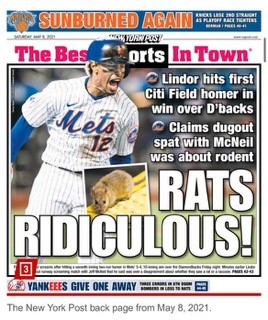
And then, while batting .158, slugging .200, with one home run under his belt in his first 26 games with the Mets, Lindor grabbed second baseman Jeff McNeil by the throat in an altercation behind the dugout.

While this kerfuffle played out in the New York tabloids, the story changed from a fight to a mild argument to a simple disagreement over whether they saw a rat or a raccoon in the bowls of CitiField. Regardless of the actual story (one which we may never know), it was a bad look for the $300 million guy with the sub-Mendoza batting average.

Lindor tried to redeem himself over the course of the rest of the season, but he didn’t exactly set the world on fire. Playing around an oblique injury that thwarted him in parts of July and August, Lindor hit .252 with 16 home runs after May. “Mr. Smile” ended 2021 with an OPS+ of 100, and his worst career statistics in nearly every offensive category.

2022 was much closer to a standard Lindor season. He hit .270, tallied 26 dingers, drove in 107 runs, and had a 125 OPS+. He even came in ninth in MVP voting.

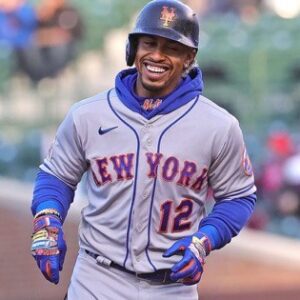
But to the fans and the media, the first two months of 2021 (on the field and just off of it), and his $34 million salary, still loomed large. So heading into 2023, Lindor had a target on his back, justified or not. Lindor, with his huge smile and flashy batting gloves, seemed made for New York, but to the victor goes the spoils, and you must perform to get the love. According to Mets fans, he had not yet performed.

If Lindor hoped to get that giant apple-shaped monkey off his back early in 2023, he didn’t do himself any favors. He came out of the gate hitting .218 in March/April, but did slug four home runs. May and June weren’t much better: .227 and .230, respectively. He did hit 6 dingers each month, and was trending in the right direction. In mid-June, Lindor’s wife, Katia, gave birth to their second daughter. And the sleep deprivation did him some good. In the twelve games after becoming a “girl dad” twice over, Lindor hit .310, belted four home runs, and had an OPS of 1.035.

In July, he hit another five round-trippers, with an OPS of .923. In August, he kept it going, collecting 32 more hits, nine for extra bases, with a .371 OBP. And then in September (of a wasted season for the club), Lindor continued to build. Seven home runs, eleven extra base hits, 19 RBI, and an OPS of .868.

When the season was done, Lindor had made the Flushing fans smile with 31 homers, 98 RBI, a 120 OPS+, and his first time joining the 30/30 club (actually 31/31). All of which led to Lindor winning the Silver Slugger award for the third time (but his first in New York). From the time of his second child’s birth, only four players had more bWAR than Lindor, and all of the other players laced them up in Los Angeles and Atlanta.

With the exception of a few bumps in the road, if you looked closely and in the aggregate, the Lindor that we all knew and loved has been there all along. It is just that sequencing in sports matters, and that may have allowed the fans in New York to miss it.

So, now Lindor enters Year Three of his massive contract in a good place, ostensibly physically as well as mentally. The team – despite a rough 2023 – is built to win, with a strong rotation and depth at nearly every position. It is all set up for the All-Star shortstop to have another MVP-caliber season, the type that the Mets faithful all anticipated when the club acquired him and then signed him to the largest deal in franchise history. The Lindor of old has been there all along, but now is the time for him to take it to the next level.

PLAY BALL!!

When Is It Time to Panic?

*This article first appeared in the January 11th edition of the IBWAA “Here’s the Pitch” Newsletter; and prior to the Cubs finalizing their deal with Shota Imanaga and acquiring Michael Busch and Yency Almonte from the Dodgers.

When the calendar turned to 2024, the hot stove began to cool. We are just a month away from pitchers and catchers reporting, and then the rest of the squads will be on the field a few days later. For some teams, their offseason work is done. The Dodgers have tried to win the winter, spending more than a billion dollars on two Japanese players. But they have made a few additional moves as well.

The Braves have been quite active, shoring up their lineup for a deep run into October. Early on, the Mets made some deals, signing Luis Severino, Jorge López, and Joey Wendle. And now they have signed Harrison Bader to play somewhere in their outfield. The Royals have made all sorts of deals that no one saw coming, adding Michael Wacha, Seth Lugo, Hunter Renfroe, and others.

Many teams have tried to be active, only to be thwarted or left at the altar on numerous occasions. The Giants thought they had a strong chance to acquire Shohei Ohtani or at least Yoshinobu Yamamoto, and the Blue Jays thought they had Ohtani in their crosshairs as well. The Mets and Yanks thought the young Japanese fireballer could land with them, but alas, it was not meant to be for any of them.

But certain teams have been relatively quiet. Until last week, the Red Sox had been all but dormant. Same for the Guardians. If you are a member of any number of fanbases, you may be beginning to wonder “when is the time to panic.” When it is time to consider that it may be too late for your club to make sufficient moves in order to contend next fall.

Pennants, of course, are not won during the winter (see the Padres and Mets), but they can be lost. With the expanded playoffs, with so many teams believing they have a shot at the postseason, the trade deadline is more muted than ever. As such, the ability to remake your roster midseason is all the more difficult. If a team has obvious holes, those need to be filled when players are unsigned and all 30 teams are potential trade partners.

The Red Sox went into the offseason in desperate need of pitching. They signed Lucas Giolito, but then immediately traded Chris Sale. Maybe not a one-for-one in production, but definitely a one-for-one in roster spots. It is unlikely that Cooper Criswell will be pitching meaningful innings for the BoSox down the stretch. Signing Jordan Montgomery or Blake Snell would definitely move the needle and would turn around their winter and their outlook for 2024. But as of this writing, neither have signed with Boston.

The Giants were able to sign Japanese first baseman Yoshi Tsutsugo on a Minor League deal, and they inked catcher Tom Murphy to a two-year deal. But neither will help them on the mound or – most likely – at the ticket window. Getting Robbie Ray from the Mariners (for former Mariner Mitch Haniger and pitcher Anthony DeSclafani) may help them in the short run. But none of those moves will make them contenders in the packed NL West.

The Orioles made a surprise run to win the AL East last season. The Yankees and Red Sox had bad seasons, and the Rays fell off after an amazing start. To compete again in 2024 – the first year they were supposed to make noise – they need more pitching. Adding Jonathan Heasley and Craig Kimbrel will not keep the beasts of the east at bay.

And then there are the Cubs. They started the offseason with a managerial splash, wooing Craig Counsell to travel south from Milwaukee with the richest contract for a manager in MLB history. But, since then, pretty much crickets … until Tuesday night. The Cubs reportedly have signed Japanese left-hander Shōta Imanaga to (according to Jon Morosi) a multi-year deal at about $15 million per season. 

With Imanaga potentially taking the place of free agent Marcus Stroman, the Cubbies still have needs on the mound. But the most important question for fans on the North Side is, will they re-sign Cody Bellinger? Are they waiting for the $200 million-plus asking price to come down? Could they re-sign Stroman? Is Matt Chapman a possibility? Rumor has it that they are eyeing Rhys Hoskins. The NL Central is a winnable division, and the team has arguably the best manager in baseball, but he needs some names to write on the lineup card each day.

The same analysis could be done for a handful of other teams. As the snow falls, and then melts, and fans begin to dream of warm summer days in their favorite ballparks, they need something upon which to hang their hopes. Right now, because of their team’s lack of moves, some fans are beginning to panic.

PLAY BALL!!

Taking the L on Corey Seager

This article first appeared it the IBWAA “Here’s the Pitch” newsletter.

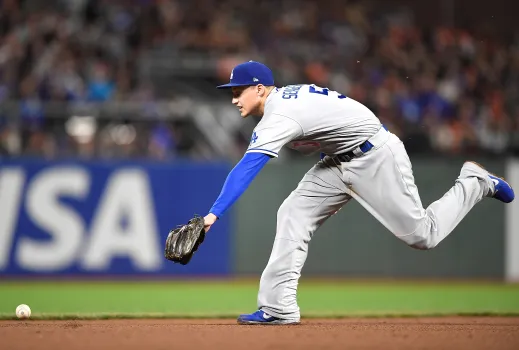
Living in Los Angeles, and having seen every one of Corey Seager’s first seven MLB seasons, I held an unpopular (both in that I was somewhat alone and that people didn’t like it) opinion that he was overrated. When he got hurt in 2018 and missed the remainder of the season, I also held the unpopular position that the Dodgers were better off with Manny Machado at short if they wanted to make a deep playoff run.

To begin, as a rookie in 27 games in 2015, Seager set the world on fire, hitting .337 and slugging .561, with 13 extra-base hits in 98 at-bats, for a jaw-dropping 174 OPS+.

Seager played an iron-man-level 157 games in his sophomore campaign, slashing .308/.365/.512 with a gaudy 134 OPS+. This netted him an All-Star game appearance, third place in National League MVP voting, a Silver Slugger Award, and the NL Rookie of the Year. He accrued 5.2 bWAR, eighth among all NL position players. And yet, I still was not convinced.

2017 was more of the same. 145 games played (138 at short), .854 OPS, 126 OPS+, another All-Star appearance, another Silver Slugger Award, 5.3 bWAR. And he only made 11 errors in 520 chances. What was I missing?

Seager tore his UCL less than a month into the 2018 season and missed the entirety of the Dodgers’ pennant run. The good news for Seager: It was Machado who struck out to end the World Series in front of the hometown crowd.

Seager came back from his injury in 2019 to lead the league in doubles (44), hit .272, and slugged .483 with an .817 OPS. It was a relatively pedestrian (for him) 2.9 bWAR season. I was starting to feel vindicated.

We can skip the 2020 season, except for the fact that Seager was the MVP of both the NL Championship Series and the World Series. He hit .328 with eight home runs and 20 RBIs that postseason, including a ridiculous 1.256 OPS in the World Series.

In May of 2021, Seager got hit by a pitch and missed 11 weeks and 65 games. This could have been catastrophic in a walk year, but both before and after his stint on the IL, Seager put up another season of great numbers. He hit .306 with a .915 OPS, and still earned 3.6 bWAR. This set him up for a mega contract.

At this point, in seven seasons with the Dodgers, including the truncated 2020, Seager slashed .297/.367/.504, with 280 extra-base hits, a 131 OPS+, 21.2 bWAR, and two postseason MVP awards. And yet, shockingly, I had seen enough. The truth is that I believed Seager to be a VERY good player, but – postseason MVPs notwithstanding – not a Superstar!. And I didn’t think the Bums should shell out a Superstar! contract for a very good player.

If we use FanGraphs’ $8.1 million per bWAR as a baseline, and we use Seager’s 3.6 bWAR from 2021 as the reference point, he would be worth about $29 million per year. In today’s marketplace, that makes sense. 

But for how many years? How long can a 6-foot-4 shortstop continue to play passable defense (even the great Cal Ripken Jr. eventually moved to third base). Would the Manny Machado deal (10 years/$300 million) make sense? How about the Nolan Arenado deal (8/$260 million)? Or the Anthony Rendon version (7/$245 million)? As a Dodgers season ticket holder, I did not want to see the team invest either 10 years or $300 million in a guy who I (incorrectly) felt was overrated, and who I believed (and it remains to be seen) cannot remain at shortstop long-term.

When Seager became a free agent, the largest contract Andrew Friedman had ever awarded was Mookie Betts’ 12 years for $365 million extension. Could the Dodgers pay something roughly akin to that for Seager? Of course they could. But should they? Clearly, the club didn’t think so. 

As was reported at the time, the Dodgers offered – and Seager declined – an eight-year, $250 million proposal. $31.25 million per year until his age 36 season is a very strong offer. True, it didn’t match Machado, but it was in line with Arenado. And when that deal was inked, Arenado had accumulated 31.4 bWAR (roughly 50% more than Seager), was a four-time All-Star, had three top five MVP finishes, had won six consecutive Gold Gloves, and was generally considered the best third baseman in baseball. So, offering Seager $10 million less over eight years was not at all disrespectful. But when you have Scott Boras in your corner, there is (almost) always another offer out there. Enter the Texas Rangers.

Over the course of roughly 24 hours in December, 2021, the Rangers signed Marcus Semien to a 7/$175 million deal to play second base and then Seager to a 10/$325 million deal to man short. That is why you hire Boras. Seager got a bump of $1.25 million per year over the Dodgers’ offer, and got that for two full additional years. Truth be told, when the news broke, my reaction was, “Good riddance.”

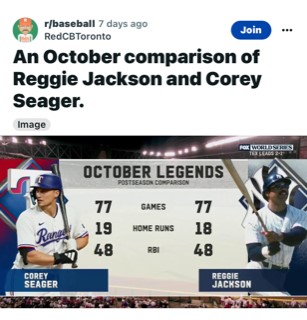
In the two seasons he has played with the Rangers, Seager has hit .281 with 66 home runs, a .350 OBP, and slugged .530. This year he accumulated 6.9 bWAR in just 119 games. If not for that guy in Anaheim pitching and hitting, Seager would win the AL MVP playing in less than 75% of his team’s games. Because the season-long MVP appears off the table, Seager simply won the World Series MVP with a (second) performance of a lifetime. It remains to be seen how Seager ages, and, accordingly, how his deal ages. But, flags fly forever, and there had never been one in North Texas before last week. Seager has shown himself to be at his best in the biggest moments, making a strong case to be the next Mr. October. That has to be worth something.

In order to grow as a human, you have to admit when you are wrong. And while I still don’t think that the Dodgers – or any team – should have paid Seager $325 million, it is clear that he is a Superstar!. As the Rangers got the W, I took the L. As for what the Dodgers would look like if they had shelled out the money to keep Seager, I guess we’ll never know.

PLAY BALL!!

Buffing Their Halo: The Angels Make the Best of a BAD Situation

About a week before the August 1st trade deadline, the Los Angeles of Anaheim made it known that they would not be trading their once-in-a-century two-way star, Shohei Ohtani. Many in the baseball world criticized this decision, believing that the Angels could reset their farm system (currently ranked 28th by MLB Pipeline) with the haul they would receive for their soon-to-be free agent. 

Not four days later, owner Arte Moreno doubled down on his decision, trading two top-100 prospects to the White Sox for pitchers Lucas Giolito and Reynaldo López. Just a few days after that, Moreno tripled down, trading two lower-level prospects to the Rockies for C.J. Cron and Randal Grichuk. In making these moves, the frugal leader pushed his team above the competitive balance tax (first tier: $233M) for the first time in his 20 years as owner. When the dust settled on these deals, the Angels, who had won nine of their last 12 games, were four games back of the third and final Wild Card spot. Moreno had pushed his chips all in. 

Since the trade deadline, the Angels are an MLB-worst 8-23, falling 11 games behind the three-way goat rodeo for the final two Wild Card spots. As of August 28th, FanGraphs listed the Angels’ playoff odds at 0%, where they remain today. Suffice it to say, the gamble didn’t pay off. 

To add to the insult are injuries to Ohtani – who will most likely need “some sort of procedure,” including potentially a second Tommy John surgery – and Mike Trout, who most likely won’t play the rest of the season due to a bad wrist. As such, the Angels found themselves with players they didn’t need and a potential CBT bill due. Sure, Moreno could have just played out the string with the decisions he made in July, but that is not how one becomes a billionaire; that is not how one comes to own an MLB team. 

If the Angels stood pat, they would have ended the season above the CBT threshold (since we don’t have full visibility, the numbers vary: according to Spotrac, by about $5M; according to Roster Resource, by about $1.4M), which is subject to a 20% tax. Although a tax bill somewhere between $280,000 and $1M is a drop in the bucket for a team valued at more than $2 billion, why spend that if you don’t have to. Further, by staying above the CBT threshold, the compensation pick the Angels will receive if Ohtani signs elsewhere (once he receives and turns down a qualifying offer) would come after the fourth round. However, if they are not required to pay the tax, the compensation pick would come following the second round. The difference is somewhere between 60 and 70 picks – a massive difference. 

One last benefit of staying below the $233M CBT level: First-time offenders are subject to the above-referenced 20% tax, but second-timers get hit with a 30% tariff. So, if the Angels want to spend lavishly this offseason (on, say, a two-way superstar), their tax basis will be 50% less.  

Faced with this situation, the Angels did the prudent thing – they put six players, including four they recently acquired, on waivers. This means that any team could “claim” the player by simply agreeing to pay their salary for the final month of the season. All of the players the Angels put on waivers will be free agents at the end of the year, so there was no long-term loss of player capital. If all six players had been picked up, the Angels would have saved roughly $7M in salary obligations; and the above-referenced competitive balance tax; and would get a processing fee of $50,000 per guy. In short, by “dumping” (as it has been portrayed by many media outlets), the team stood to be more than $8M in the black and receive a draft pick nearly two rounds earlier.  

Five of the six were claimed. Randal Grichuk got stuck in Anaheim, a boon for the club since part of his salary is still being paid by the Blue Jays, and the Rockies sent cash to the Angels when he was acquired six weeks ago. Now that the five players are in their new (temporary) homes, the Angels saved just under $6M in salaries and received $250,000 in waiver fees. Unfortunately, without moving Grichuk, it has been reported that the Angels did not fall below the CBT threshold, and thus will receive the worse draft pick if they lose Ohtani to free agency. 

Buster Olney lamented the Angels’ waiver action as cynical. But when he interviewed a baseball executive, the choice was lauded as a savvy business decision. Olney fears that this may become the new norm and upset pennant races, which would contravene the intent of abolishing the August 31st revocable waiver wire a few years ago. However, insofar as the players are available to teams in reverse order of the standings, this will not automatically benefit big market teams (the five players were acquired by Cleveland, Cincinnati, and Seattle).  

Even if this does become customary, it would add another level of strategy for teams who may elect to lose a game or two at the end of August to improve their waiver claim position. 

As a postscript to this story, and in a sign that maybe the tide is beginning to turn for the Angels, the team caught a break. Max Stassi, who has missed the entire season due to a family emergency, was still receiving paychecks. However, over the weekend he informed the club that while he is now capable of playing, he will not return to the team, thus forfeiting approximately $1.2M in salary. With this reduction – and with removal of the five above-referenced players – it appears the club is now under the CBT threshold, and is in line to receive a better draft pick. Taking Stassi’s money off the books would have had no effect if the Angels had not been shrewd and clever in the days before the waiver deadline.

The Angels are a snake-bitten organization, to be sure. They have made many questionable decisions (see, Vernon Wells, Josh Hamilton, Albert Pujols, Anthony Rendon, dealing with the Mayor of Anaheim, etc.). They can be taken to task for holding onto Ohtani last season, this past winter, and this July. But once they sunk the cost and sunk in the standings, they didn’t need to be sunk. Bemoan all you want, worry about the league-wide implications if you must, but for the first time since they re-signed Trout, the Angels should be praised for attempting to execute an adroit strategy, setting the team up for future success (or at least less pain).

PLAY BALL!!