Trust, But Verify

With the trade deadline behind us, the recriminations have come fast and furious. Fans from coast to coast were left scratching their heads trying to figure out what their favorite team did, and why? All these fans have theories, and ways in which they would have done it better. Those fans include my son, who continued to send me text messages that simply read: “Chaimmmmmmm!” in the days and hours leading up to the 6pm ET cutoff.  

But, as I have previously written, and as I have repeatedly explained to my son, it takes two to tango. A general manager cannot make a deal by him/herself; they cannot make a deal just because they want to or because the fans are demanding it. Heck, they cannot even make one when they make one (more on that below). GMs need a trade partner. This has been true for time immemorial. And in the compressed moments of the trade deadline, reasonable minds often differ on value and compensation, on outlooks for the future and assessments of the present. In short, regardless of what Phil from Fall River says on WEEI, it may not be Chaim Bloom’s fault. 

Further, not every deal that Steve from Spokane thinks will be great for the Mariners will actually improve the team (either this season in the years to come). Rationality and reasonableness are not necessarily the coin of the realm on Twitter or talk radio. 

Nearly every MLB team is owned by a billionaire. And each such owner employs a head of baseball operations and/or a general manager, each of whom leads a team of scouts, evaluators, and quants, all of whom are in active dialogue with their coaches and players, as well as their counterparts throughout the league. Those people have risen to decision-making positions within an organization that is one of only thirty in a $12 billion industry. They watch every game, they review every prospect list, they scour every farm system, they track nearly every collegiate program. At this moment in time, this group of roughly 600 people know more about the current state of Major League Baseball than anyone on the planet. And yet… 

And yet, Walt from Washington Heights is calling for Brian Cashman to be fired because the Yankees didn’t do much at the deadline. Walt, who works for UPS, or is a tenth grade Social Studies teacher, or is an accountant or lawyer, has no compunction about calling into WFAN to tell Brian Cashman how to do his job, or how to do his job better. Forget the fact that Cashman has forgotten more about player evaluation and the competitive balance tax and winning and losing than Walt will ever learn; forget that Cashman has an owner in one ear and a staff of people in another. According to Walt, he knows something that Cashman doesn’t. 

I don’t mean to pick on Walt or Cashman. These same conversations are happening all across the league. It makes some sense, insofar as “fan” is short for “fanatic,” and “fanatic” is defined in the Oxford Dictionary as “a person filled with excessive and single-minded zeal.” But general managers don’t have the luxury of being excessive or single-minded. They have organizations to run, and not just for this season. They are fiduciaries for the long-term health and welfare of their team. Isaac from Indian Hills doesn’t have to worry about next season Reds’ lineup; all he cares about is winning, today! Fortunately for the Reds, Nick Krall does. 

Furthermore, as stated above, just because a GM wants to make a deal, it doesn’t mean the other side does. Maybe the Red Sox tried to get Tommy Edman from the Cardinals, but the Red Birds weren’t willing to let him go; or they wanted a king’s ransom for him. We know the latter to be the case for Dylan Cease. Sure, Cease would have solidified the Red Sox rotation, but at what cost? Was he worth two of the Boston’s best prospects for a flailing chance to make the second Wild Card slot this season? 

Sometimes a GM thinks they made a deal. The Dodgers and Tigers had a trade in place for Eduardo Rodriguez. However, no one asked Rodriguez if that was okay with him, and he invoked his no trade clause to thwart the deal. Andrew Friedman’s fault? That said, as an aside, I do believe there is fault to be laid on this one: (1) Scott Harris, the rookie President of Baseball Operations for the Tigers, screwed that up royally (Tigerly?); (2) Rodriguez claimed he wanted to stay on the east coast (Detroit?) to be closer to his family…in Florida, which might be plausible if; (3) Rodriguez’s agent didn’t acknowledge (albeit cryptically) that they were trying to sweeten Eduardo’s deal to allow the trade to go through, but they just ran out of time. But, I digress. 

The Orioles got crushed for not doing more at the deadline. By all accounts they are a year ahead of schedule, so they had to decide how much of their future they were willing to mortgage for the present. But, despite what Glenn from Glen Burnie posts on X, they most assuredly did the analysis. The decisions the Orioles made – regardless of whether or not fans in the DMV agree with them – were not rash and were based on considerably more information than that possessed by the guy sitting at the bar licking Old Bay off his fingers. 

Many teams reached out to Perry Minasian about Shohei Ohtani. Is it their fault that the Angels (most notably, owner Arte Moreno) elected not to trade him? I am sure that many organizations – the Giants and Mariners come to mind – wanted to improve their lots. But, it is possible they didn’t have the resources – financial and/or human – to make the trades that their fanbases would have loved. Which begs the question, which fanbase loves what their team did? The Rangers? Maybe the Astros? Possibly the Braves? That leaves 27 disappointed fanbases. You can’t please everyone. 

I truly wish that each team was required to deliver some sort of post-trade deadline “Truth and Reconciliation” report. They would state whom they were in on, who they made offers to, why they didn’t make certain offers, and which side scuttled potential trades. Of course, to quote Rodney Dangerfield, this type thing could only happen in “Fantasyland.”  

But fans do deserve some level of transparency from their teams. The fans pay the exorbitant tickets prices and the ridiculous parking fees and the obscene cost of beers. The fans buy the merch and watch the games on TV, which allows the team-owned RSNs to charge inflated fees to cable providers (for now, at least). In short, the fans are entitled to the truth – or at least some reasonable facsimile of the truth. So, if the “Truth and Reconciliation” report cannot be prepared, every GM should be required to give a post-deadline press conference wherein he/she answers questions from beat reporters about the choices the team made. And, for kicks, I would allow a few fans into the room so they can ask questions as well. 

The Red Sox did a truncated version of this, with both Chaim Bloom and GM Brian O’Halloran answering questions. I think O’Halloran summed up the experience and his team’s (and very likely many other teams’) choices quite well:  

“[Deadlines are] always an assessment of are there any trade opportunities that we can do that make sense in our position — not just in the standings, but our position organizationally. I think [all those deadlines are] actually pretty similar in that we contemplated tons of things, and just none of them made sense to do.” 

Fans are free to agree or disagree, that is what makes this a great country. But a little perspective is important. Acknowledging how little we actually know is important. These men and women want to win as much, if not more, than Hal from Huntington Beach, as their livelihoods oftentimes depend on it. So, some benefit of the doubt may be in order. But, as Ronald Reagan often said, “trust, but verify.” See you at the press conference. 

PLAY BALL!! 
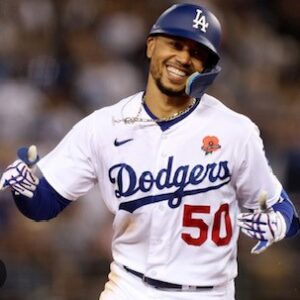
Mookie Betts: Same As He Ever Was

About six weeks ago, after watching Mookie Betts go 0-for-5, with 2 strike outs and leaving a couple of runners on base, I had a thought bubble. At the time, Mookie was hitting roughly .240 and slugging below .500. This was the thought bubble: “Has Mookie lost it? Did the Red Sox avoid a catastrophe, and are the Dodgers stuck with a $365M contract for a player who once was?”

Maybe it was just wishful thinking. Maybe it was just me hoping that my favorite team didn’t make an all-time blunder. Maybe I just didn’t want this to be Babe Ruth Part Deux for Boston fans.

Truth be told, at the time I took the long, and unpopular, view that the Red Sox were correct in trading Mookie Betts. I didn’t think he would sign long-term in Boston (despite his now, after-the-fact, protestations to the contrary) and that he wanted to test the free agent market. He then came to my hometown team, allowing me to see him up close each and every day. And he has been terrific. Or has he? This is where my bias may have kicked in.

I have been watching Mookie for his entire career, but even more so now that he is in Los Angeles. And I could have sworn that – as stated above – he had lost a little something. He seemed to be striking out slightly more often; he seemed to be getting runners in from scoring position slightly less often. He seemed to be just a tick or two off the guy we all love and adore. But the eye test is not nearly enough – I had to do the work.

Now, for purposes of this analysis, I put aside the fact that Mookie is a 6-time Gold Glove winner in right field and offered to play second base and shortstop to solidify the Dodgers’ defense. The intangible of that type of leadership – and the ability to play those positions so adroitly – cannot be quantified (well, the analytics department in any organization can quantify it, but we as mere mortal fans have a harder time putting “actual” value to such versatility). I wanted to just look at the offensive numbers to see if Mookie, now into his thirties, was losing a step or two. Let’s take a look:

 H2BHRBBSOBAOPSOPS+bWAR
201517442184682.291.8201176.1
201621442314980.318.8971339.5
201716646247779.264.8031086.4
201818047328191.3461.07818610.7
2019176402997101.295.9151347.3
2020*64 (173)9 (24)16 (43)24 (65)38 (103).292.9271473.6
2021^12329236886.264.8541264.0
2022154403555104.269.8731396.4
2023+86 (164)20 (38)23 (44)52 (99)64 (122).272.9371483.9

*The stats for 2020 are over the 60-game season, with the number in parentheses representing a 162-game season.

^This is the first year of Mookie’s 12/$365M extension.

+All stats current through July 4th, with the numbers in parentheses representing a full-season projection.

According to the above, maybe – if you squint a lot – you might be able to see some flaws in Mookie’s overall batting profile.

Putting aside his 2016 season when he had 214, Betts has lived between 160 and 180 hits. Those numbers were down the past two seasons, but he is back on pace this year. The lower hit totals caused his batting average to dip (and even with his current hit totals, he is still at the lower-end of his career averages). Mookie is no longer a perennial (or even close to a perennial) .300 hitter. And you can call it causation or correlation, but his BABIP has also dropped every year since hitting a high of .368 in 2018 (.309 –> .289 –> .276 –> .272 –> .269).

But the number of doubles is essentially the same across seasons; and he is on pace for a career high in home runs, which may be part of the reason why he agreed to participate in this year’s Home Run Derby. His OPS is pretty darned consistent for his entire career. His OPS+ is elite, every season.

The quick review of the above shows that he is starting to strike out more often. He first broke 100 Ks in 2019, was on pace for the same in 2020, did it again last year, and this season is heading for an all-time high. Is there any substance to that noise? Only time will tell. But going back to the eye test, it seemed to me, as a casual observer, that those strike outs have come in inopportune moments.

Baseball Reference has a metric called BRS% (the percentage of all baserunners who scored by the batter, but not necessarily resulting in an RBI). Mookie’s career average is 17.7% (including 17.6% in his MVP season). In 2019 it was 14.9%, then jumped to 18.6%, then fell to 13.7%, coming back to 16.1% last season. This year, he is living at 19.8%. So maybe my “clutch eye” was tuned in the last couple of years, but this year he is pushing for a career best. Hmm?

Other than 2019, Mookie never grounded into double plays at a 10% clip (i.e., what percentage of opportunities to ground into double plays did the player do so). This year he is just under at 10% (4/45).

I decided to take a look at one more advance stat (also from Baseball Reference): Productive Outs, which means advancing any runner with no outs; driving in a run with the second out; with failure meaning not advancing the runner(s) with an out. And here Mookie is close to a career low. His percentage of Productive Outs is 28.6%. For context, his career average is 30.5%, and his career median in 33.3%. One might argue that the above is within the margin of error; and this writer might agree with that assessment.

So what does all of this mean? It means that Mookie is still fantastic. He is still a joy to watch and, by all accounts, an even better teammate. He is still going to give the Dodgers about 7 bWAR this year; will still hit around 40 HRs; and will still be 30-40% better than the average Major League player. Regression or not, father time sneaking up on him or not, he is still one of the greats of the game. We can quibble about strike out rates, but need to read them with walk rates (nearly at a career high). And then we need to factor in what I told you to forget above. This guy has repeatedly traded in his gold outfielder’s mitt to play middle infield, and has arguably done it better than Kiké Hernández has in Boston (Mookie: 3 errors in 102 chances at 2B/SS; Kiké: 14 errors in 246 chances at 2B/SS).

As we age, our eyesight gets worse, and it would figure that so too does the eye test. Maybe he wouldn’t have stayed in Boston, and so the Red Sox were smart to trade him; but that is irrelevant to the current analysis. Mookie Betts was and remains an all-timer.

PLAY BALL!!

Taking Off My Red Sox?

Joe Posnanski, the fantastic sportswriter and podcaster, simply had enough. After a lifetime of Cleveland Browns fandom, after “Red Right 88,” “The Drive,” “The Fumble,” a middle-of-the night absconding to Baltimore, after a revival of the franchise, after all the heartbreak, and near elation, the ownership of the Browns dropped one additional straw — a $230 million guaranteed contract straw — onto an oft-injured camel, and Joe was out. As he has written in his terrific blog and talked about on The Poscast, when the Browns threw caution and morality to the wind and signed (alleged) serial sexual harasser Deshaun Watson to a fully guaranteed $230 million contract, with only $1 million allocated to this season when he was certain to be suspended (he was, for 11 games), Joe took his rooting interest elsewhere. Where? He is not sure yet; he has spent this season searching for a new team.

Last year, Cincinnati Reds fans were none-too-pleased that the team traded Sonny Gray, Jesse Winker, Eugenio Suárez, and Amir Garrett. When a reporter asked team COO (and son of the owner) Phil Castellini how he would respond to the fans booing the product on the field, he asked: “Well, where are you going to go?” Now that is a front office executive who really seems to care about the fans, their enjoyment, and their willingness to support the organization. While it is not possible to know if — or how many — Reds fans called Castellini’s bluff and went elsewhere (Posnanski style), we do know that fewer fans showed up to watch the Reds play last season than at any point since 1984 (2020 excluded).

Joe’s plight with the Browns, and Cincinnati fans’ rejection of the Reds, got me thinking about my beloved Red Sox. It seems that Boston’s ownership group, who should never need to buy another drink anywhere in New England ever again after bringing four World Series championships since 2004, has turned its back on the fans they claim to cherish so much.

These owners formed Fenway Sports Group to spread their investments over the BoSox, Fenway Park, Liverpool in the Premier League, the NHL’s Pittsburgh Penguins (who lost the NHL Winter Classic at Fenway Park on Monday while John Henry was heckled and cursed walking the concourse), 80% of NESN, and 50% of NASCAR’s RFK Racing. 

With all of these disparate interests, the owners seem to have taken their eyes off the Red Sox ball, or are just too busy keeping their eyes on Boston’s bottom line. They appear to care little about the success of the club or their fans’ feelings. So — like it was for Joe P. — the question becomes: When are ownership’s actions so egregious that it is time to pick a new favorite team? In the case of the Red Sox, when is too little simply too much?

Jon Lester

One could argue that the beginning of the end was offering home-grown hero Jon Lester (overcame cancer, threw a no-hitter, and won the World Series in 2007 and 2013) a ridiculously below-market deal before the 2014 season. Lester had said that he would take a hometown discount to stay in Boston. So, the club offered him four years and $70M. Lester viewed that offer insulting and never even responded. He was traded to the A’s before the end of the season, and ultimately signed a six-year, $155M deal with the Cubs (and helped break their curse in 2016).

Mookie Betts

And then there was the trade of the beloved Mookie Betts. Entering his final season before free agency in 2020, the Red Sox traded Mookie and David Price to the Dodgers for pennies on the dollar. (Note: This trade got worse in the past few weeks when the Red Sox DFA’d Jeter Downs, one of the highly-touted prospects included in the deal.) 

The organization will say that they tested the contract extension waters with Mookie, and couldn’t come to terms. Mookie will say that he would have agreed to the deal that the Dodgers ultimately lavished on him (12/$365M). In the interest of candor, I was (and remain) in favor of trading Betts, as I believe he truly wanted to become a free agent, and I find his after-the-fact proclamation that he would have taken a similar deal in Boston a touch too convenient. That said, the team didn’t make a competitive offer for Betts, and off he went.

Hunter Renfroe – JBJ = JBJ – Hunter Renfroe

In 2021, the Red Sox signed Hunter Renfroe to a $3.3M contract, and let fan-favorite (but chronic offensive under-performer) Jackie Bradley Jr. leave in free agency. Sentiment aside, these were good/smart deals. But after the season, rather than paying Renfroe the $7.6M he was due to make in arbitration, they elected to trade him to the Brewers to bring back … JBJ — at a much higher salary ($9.5M + an $8M buyout). Huh?

Last season in Milwaukee, Renfroe hit 29 dingers with a 126 OPS+. No Red Sox player hit that many home runs, and only two players had an OPS+ of more than 126 — we will get to them below. Oh, and Jackie played only 90 games in Boston, posting a 60 OPS+, before he was unceremoniously traded to the Blue Jays.

Xander Bogaerts

Mistakes can be overcome, and the spring of 2022 provided an opportunity. The Red Sox faithful could easily overlook losing Renfroe and replacing him (at considerably more cost and considerably less productivity) with JBJ, if the team could have locked up the de facto captain, the heart and soul of the club, Xander Bogaerts. As a reminder, in 2019 Bogaerts signed a team-friendly six-year, $120M contract, with an opt-out after three seasons. 

Knowing that an opt-out was likely, the Red Sox engaged Bogaerts in negotiations last spring. Those words are italicized because what the team offered was neither engagement nor a negotiation. With three years and $60M left on the deal, the Red Sox proposed making it four years and $90M. Said differently, they wanted Bogaerts to forego the open market by taking one additional year at $30M. As the saying goes: Those who don’t learn from the past are destined to repeat it.

Suffice it to say, like Lester eight years earlier, this “offer” landed with a thud. As such, the Xander contract/opt-out hung over the player and the team all season. But, if there is a silver lining in a last-place finish, it is that you get a full month head start on the off-season. After failing in Spring Training, the Red Sox had the entire month of October and into November to fix it. Narrator: “They didn’t.”

At 9 a.m. on Nov. 6, 31 days after the final out of their season, Bogaerts was, for the first time in his professional career, not a member of the Red Sox. But, all was not lost. When the general managers met in Las Vegas later that week, there was hope that something would get done. Narrator: “It didn’t.”

But there were still the Winter Meetings in San Diego in early December. Presumably, the owners of a multi-billion dollar conglomerate wouldn’t let history repeat itself; wouldn’t lose another face of the franchise; wouldn’t let Rafael Devers’ big brother, and the role model to their other young players, don another uniform. They couldn’t be that obtuse, could they? Well, on the eve of the close of those meetings, after much silence, there was a glimmer of light. Jon Heyman (he of the “Arson Judge appears headed to the Giants” fame), tweeted that the “Red Sox are in heavy discussions with” Bogaerts. Apparently “heavy discussions” were a six-year, $162M offer. Sure, that is $7M per season, and three seasons longer, than his current deal, but not nearly close enough.

Not 24 hours later, Xander signed a 11-year/$280M deal with the San Diego Padres. Now those were “heavy negotiations.” Of course, that deal is stupid; of course, that deal won’t pan out when Xander is a 40-year-old third baseman. But the Red Sox fiddled, and the team got burned. Six years and $162M probably would have gotten it done in March. It might have gotten it done in November before Trea Turner signed for $300M and Carlos Correa signed for more than $300M (twice, or maybe not at all). But once those deals were agreed upon, there was no world in which Scott Boras was going to let Bogaerts sign a deal without a “2” up front; and if it meant signing for 11 years to get it done, well, age is just a number (as is $280M).

And so, another star has fallen. The Red Sox now have a hole at shortstop that could be filled by moving Kiké Hernández there, which creates a hole in center field; or by moving Trevor Story there, which creates a hole at second base (assuming Story’s arm is even strong enough to play short). And they are left with a massive hole in their clubhouse, where the guy who did everything but wear a “C” on his jersey will be missed immensely.

Rafael Devers

Rafael Devers — Bogaerts’ “little brother,” best friend, and protégé — will feel Xander’s absence most acutely. During the writing of this article, Devers and the Red Sox agreed to a $17.5M deal for 2023 to avoid arbitration. And moments before this article was sent to the editors, Devers and the Red Sox agreed to a 11-year/$331M contract (subject, of course, to that pesky physical).

After the above-referenced losses, Devers was the Red Sox’ top priority, and ownership came through. This was a rarity, as, at every turn over the past decade, with the exception of the disastrous Chris Sale deal, the team has taken a conservative approach to spending. Dave Dombrowski fleeced the farm system to win “now,” and accomplished that in 2018. But ownership, knowing Dombrowski would want to spend real free agent money to keep the party going, let him go. (Dombrowski went to the Phillies, spent a truckload of John Middleton’s money, and won another pennant.)

The Red Sox still care about winning; I truly believe that. Lately, however, pennants are secondary to profits. The organization has chosen to lose “smartly” rather than win imprudently. And that reputation seems to be preceding the club. Multiple free agents have foregone Red Sox’ money and taken the same deal elsewhere. Why do you think that is? When Justin Verlander signed with the Mets, he was asked why. His response: “Steve.” Now ask yourself if any free agent would sign with Boston and respond: “John” or, even worse, “because of Fenway Sports Group.” All of that said, John Henry and Fenway Sports Group stepped up and paid Devers — words I never thought I would write.

As fans we ask: “Why own a team if you aren’t going to do everything you can to win?” An owner may respond: “Why own a team and lose money?” However, in Boston — unlike, say Oakland – they don’t have to make that Hobson’s choice (the Red Sox are valued at $3.9 billion and Fenway Sports Group is valued at $9.8 billion). Any yet, the Red Sox owners consistently make it so. But with the Devers signing, maybe the tide is beginning to turn.

Which leads us back to the original question: Is it time to cut bait? Is this my Joe Posnanski moment? Is it time to call the Phil Castellini bluff? With Rafael Devers in the organization for eleven more years, with Kiké Hernandez signed for another year, with Tanner Houck in the rotation, and Marcelo Mayer soon manning short, I’m not sure I can. The Red Sox have tested my and millions of fans’ mettle, and they have failed that test time and again. But on Wednesday they started the long road of earning back the fans’ trust. It came not a moment too soon.

PLAY BALL!!

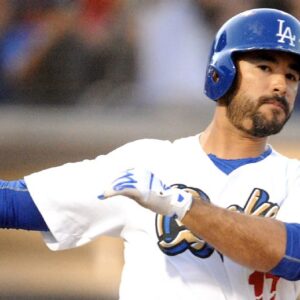
Re-Examining Andre Ethier

On May 28, 2006, the Los Angeles Dodgers started Matt Kemp in center field and Andre Ethier in left. This was the first time the two “rookie sensations” played together in Dodger blue. Kemp went 1-for-4 to start his career, and Ethier went 0-for-2 with a walk in his 22nd career game.

Starting on that late May day, these two would play side-by-side for the next eight seasons. By all accounts, the players got along just fine, with their only competition being who could do more to help the team win. But in the stands and on talk radio and on the message boards, there was definitely a split allegiance: people were either Team Kemp or Team Ethier. In the interest of full candor, I was always an Ethier guy (that could be owing to my being a L/L guy who loved Andre’s smooth swing).

Ethier was a solid player who was never too flashy. He ended his career hitting .285 with 162 home runs, and 21.5 bWAR (24.2 fWAR). His Baseball Reference page shows a dearth of black ink – he never led the league in ANYTHING. He was fifth in Rookie of the Year voting in 2006, and sixth in MVP voting in 2009 when he won a Silver Slugger award; he went to two All-Star Games, and won a Gold Glove. Ethier earned more than $115M for his very respectable career, all with the Boys in Blue.

Kemp, on the other hand, was an athletic gem. Although his rookie campaign was lackluster (.259/.289/.448 in 52 games), he hit his stride in 2007. From 2007 through 2018, he never dropped below 101 OPS+, topping out with 172 in his remarkable 2011 season. After leading the league in games played in 2010 (his first black ink), Kemp roared into 2011 and throttled the rest of the league. He hit 39 homers, knocked in 126, scored 115 runs, had 353 total bases, and had the above-referenced 172 OPS+. All of those stats appear in bold on his player page. Some will argue (this writer included) that he got screwed out of the MVP award by a cheating and lying and unrepentant Ryan Braun, but one can shed no more tears about that spilled milk. In lieu of the MVP, he was an All-Star (his first of three appearances), a Silver Slugger, and a Gold Glover. All-in-all, an MVP-caliber season.

In 2011, Kemp signed an 8/$160M deal with the Dodgers. However, by 2016, that salary was being paid by three different teams: the Padres (to whom Kemp was traded in 2015), the Braves (to whom Kemp was traded in 2016), and the Dodgers (who remained on the hook for $3.5M/year through the end of the contract). At first blush, the various trades of Kemp may be a reflection of a player’s worth. And to adapt Malcolm Gladwell’s “Blink,” that would be correct.

After posting an 8.0 bWAR in 2011, Kemp reeled off seasons of: 2.8, 0.7, 1.2, 0.5, 0.2, 0.1, -1.3, 1.2, -1.0, and 0.1. Rarely has a star player had such a precipitous and expeditious fall from grace. After those stints in San Diego and Atlanta, and since they were already paying him, the Dodgers brought Kemp back in 2018. He played 146 games in blue and treated the Chavez Ravine faithful to a decent season with 21 home runs, an .818 OPS, and 121 OPS+, good for a 1.2 bWAR. But the good times didn’t last. The Dodgers traded Kemp to the Reds, who released him by early May of the following season. The Mets signed him three weeks later, only to release him within seven weeks. Kemp signed with the Marlins for the 2020 season, only to be released before the Covid-reduced season began. Kemp then signed with the Rockies, playing in 43 games and hitting .239 with 41 Ks in 132 plate appearances. That was the end of the line.

The above wasn’t written to dunk on Matt Kemp. He played 14 more years in the major leagues than all but a tiny percentage of humans on the planet; and for a brief moment in time, he was amongst the best; and he earned more than $170M for his efforts. I wrote the above because I believe that the common perception is that Matt Kemp was a better ballplayer and had a better career than Andre Ethier. I believe that is simply incorrect (Ethier bests Kemp in bWAR 21.5 to 21.4, but Kemp bests Ethier in fWAR 25.3 to 24.2). Sure, Kemp had higher highs (that 2011 season is one for the ages), but he also had WAY lower lows. Injuries derailed Ethier’s career in 2016 and 2017, and he elected to retire at the end of the 2017 season (after appearing in his 50th post-season game, a Dodger franchise record). He unretired, didn’t get signed, and then officially called it quits in July of 2018.

Ethier vs. Kemp came to mind because Andre’s name appears on the 2023 MLB Hall of Fame ballot. This is his first – and most likely last – time on the list. He is nowhere close to being a Hall of Famer; he isn’t even close to being in the Hall of Very Good. Andre Ethier was simply a solid major league outfielder who went about his business with no fuss and no muss for twelve seasons. He was a pillar in the community, who was appreciated by teammates and opponents, alike. Unfortunately, for the bulk of his career, he was overshadowed by a player with considerably more athletic ability, more raw tools, and one season of VERY flashy stats. But that should not cloud our memory of Andre Ethier. Every team wants and needs a few Andre Ethiers. And, if he fails to garner 5% of the HOF votes (which, let’s be fair, is highly likely), and thus this is the last time we truly reflect on his career, I want to make sure we all appreciate who and what he was.

PLAY BALL!!

“Free” “Agency”

Each offseason, this past one included, my son laments the players that the Boston Red Sox did not sign. During Spring Training, he railed that Eduardo Rodriguez should have remained in Boston (Rodriguez’s current disappearing act in Detroit seems to have proven him wrong), and that Anthony Rizzo should have come home to his original club and been the BoSox’s everyday first baseman.

But what my son — and many fans on message boards and talk radio — seem to forget is that it is called “free agency” for a reason. Players toil away in the Minors for years making considerably less than a living wage (do you hear that, Rob Manfred?), to make it to the Majors where they are subject to six grueling years of contract fights and the whims of owners and arbitrators, to get to the holy grail: free agency. So what does that mean?

In the most simple terms, it means that for (ostensibly) the first time in a player’s professional life, he gets to choose where he wants to play. It also means that he can create a bidding war, earn life-changing money, and garner economic and personal stability. But what we as fans don’t know and — absent a tell-all — will never know, is the driving force behind a particular player’s ultimate decision. 

Maybe he has some buddies on Club X that he wants to play with. Maybe he doesn’t like the heat and humidity of the south, or the cold of the northeast. Maybe it is political, and a player could not imagine living in a liberal bastion like Los Angeles or San Francisco. Maybe a certain team has a bad reputation for dealing with injuries, and the player wants to avoid that potentiality. Maybe he wants a winning culture, and that is all that matters. Or maybe, even when they say it isn’t, it is all about the Benjamins, and the highest bidder wins the right to his services. The point is, we just … don’t … know.

So when my son bristled at Rizzo re-signing with the New York Yankees rather than with the Red Sox, he looked at the two-year, $32 million contract and said, “the Red Sox should have matched or beaten that.” Sure, they could have. But only if Rizzo wanted that sweet Red Sox money. It should be noted that Yankee fans felt the same way about Freddie Freeman, and believed they could have matched or beat his deal with the Los Angeles Dodgers.

Keeping with that theme, the Yankee faithful could not believe the team did not match the three-year, $105 million deal that Carlos Correa signed with the Minnesota Twins (the Twins!!) with opt-outs after each season. But despite Correa’s Instagram post from Times Square shortly after the 2021 season, it is entirely possible that he did not want the white hot light of playing in New York. It is not for everyone; just ask Carl Pavano.

This issue came front and center during the All-Star break when Mookie Betts told the Boston Globe that he “absolutely would have stayed in Boston” for the same deal he signed with the Dodgers. Sure, it is easy to say that today. But he had previously told GQ magazine that he wanted to go to free agency. And when the Red Sox made various (admittedly low-ball) offers to Mookie in 2020, he could have countered with the “right” number. He didn’t. If I were in Chaim Bloom’s position, I too would have thought Mookie wanted to leave — which is his wont once he reached free agency.

Which brings us to the story of the day, week, month, and maybe next two to three years: Juan Soto. Many people could not believe that Soto turned down nearly half a billion dollars from the Washington Nationals. I am sure he (and agent Scott Boras) have their reasons. Maybe the offer needed to actually be half a billion (not just “nearly”). Maybe it had to be at least $30 million per year (not $29.33 million). Maybe it had to be the highest average annual value (AAV) ever (one wonders if that is for position players or all players, as getting $43.3 million/year for 15-ish years may be more than even Boras could envision). 

Or, as has been pointed out, it could be that Soto doesn’t want to commit the rest of his career to a team whose ownership is in flux, whose farm system is depleted (23rd in FanGraphs’ latest rankings), and whose manager and general manager are only signed through 2023. Come the end of the 2024 season, Soto will be “free” and he will have “agency.” That is what he has fought and struggled for (to the extent he has ever struggled playing baseball). He is well within his rights to say, “No thank you.” 

Is he taking a risk? Sure. But how big of a risk? He has made close to $30 million in his MLB career to date, and he will probably make another $50-$60 million in arbitration over the next two years. Could he get hurt? Could he lose his ability to hit like Ted Williams? Could something catastrophic happen? Yes, to all. But those are unlikely results, and (1) he is insured and (2) he still has made enough money to live comfortably (and even book his own private plane to the Home Run Derby if he desires) for the rest of his life. Soto has the luxury of youth, time, and an ever-expanding bank account to decide where he wants to play next, and for how much.

This is an evergreen topic that gets lost in the haze of recriminations about how our team’s front office responds to free agents. That said, there is absolutely NO EXCUSE for the Red Sox not to pay Xander Bogaerts, as he has said repeatedly that he wants to stay in Boston. But that (and the Rafael Devers situation) is another topic for another day.

We, as fans, reflexively lambaste the greedy billionaire owners. And for good reason. We consider them miserly, refusing to pony up for that one player that the team needs who can change the direction of the franchise. But sometimes the owner’s decisions are not their decisions; the owner’s choices are not their choices. Front offices are subject to the wants and desires of the players the teams want and desire. And, as in life, sometimes those two simply don’t match up.

So, the next time you want to take a shot at Brian Cashman, Chaim Bloom, Andrew Friedman, or Farhan Zaidi, remember that they can only answer the calls and texts they get; they can only sign the players who want to be signed; and they can only field a team with free agents who want to be there. Of course, it hurts to think that a certain player doesn’t want to play for “your” team, but everybody hurts, sometimes.

PLAY BALL!!

Doing a 180 on Bryce Harper

It’s mea culpa time. For years, and for reasons that I cannot fully articulate, I have disliked Bryce Harper. It didn’t go so far as hate, and I didn’t have any anger towards him, but I certainly didn’t root for him.

Now, if I was a psychologist, I might opine that Harper had been engaged in a “best of generation” competition with Mike Trout, and by being Team-Trout, I became Anti-Harper. This is entirely possible, but I am not sure that captures it.

Or, as I age and think about the next generation of ballplayers, maybe I have an intrinsic bias against guys wearing their eye black down their cheeks like war paint. But I want to believe that I got over such petty irritations after watching my son and his buddies do all manner of annoying things on the baseball field.

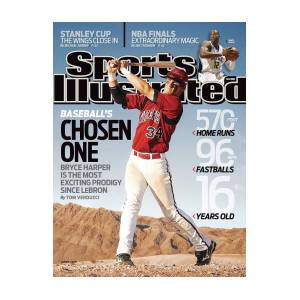
Maybe it was the hype. The cover of SI at age 16; the 1-1 pick in the 2010 MLB draft; his debut at 19 leading to Rookie of the Year honors. Maybe it was the flashes of brilliance (see, 2015), followed by seasons of mediocrity (at least by his standards). Maybe it was that every year Harper is penciled in as a savior and potential MVP, and in only two seasons has he truly fit that bill (winning MVP both times). Maybe it was all of the above, especially when compared to Trout.

Or maybe it was my dubiosity when, after signing a 13/$330M contract with no “opt-outs,” Harper claimed it was because he didn’t want any – he wanted to settle in Philadelphia and raise his family there. As I wrote at the timeI thought that was disingenuous, and believed then (and still partly believe today) that the only way John Middleton would give him that contract was if Harper agreed to not having any opt-outs, which would only provide him with additional financial leverage down the road.

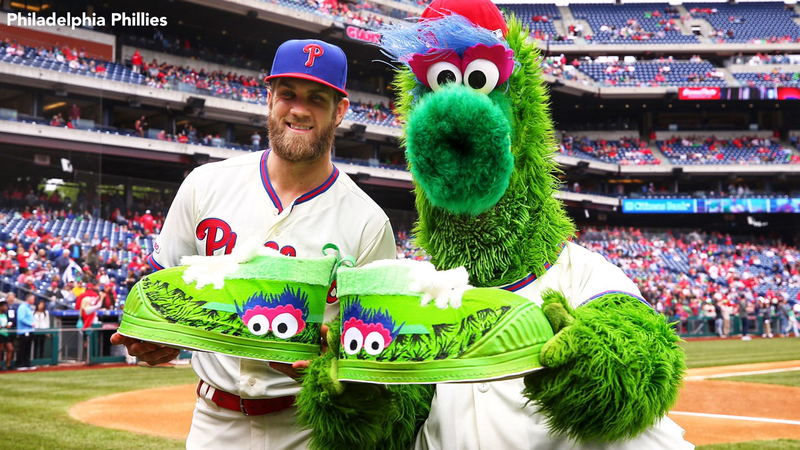
But almost immediately upon signing that giant deal, Harper started to do all the rights things – on and off the field. Now, in fairness, he may have been doing all of the right things off the field when he was in Washington and I just wasn’t paying attention, but it is clear that he fully embraced the City of Brotherly Love, and asked them to embrace him right back. We can start with the Phanatic Cleats.

Sure, players have all sorts of swag these days, and custom cleats are more the norm than the exception, but these kicks go above and beyond. By wearing these in his first game with the team, he set the tone. By having various versions and strutting them out every few months, he showed he is more than a one-tricky pony, and that he loves the conceit.

The shoes were just the start. What I have witnessed from across the country over these past four seasons is that Harper is playing the game for the right reason…for the fans. And Harper is doing whatever he can, whenever he can, to make sure that the younger generation that comes to the ballpark doesn’t just get their (or their parents’) money’s worth on the field, but they get the personal encounters as well.

There is the story of the young Phillies fan who caught (well, actually dropped and then got again) a Freddie Freeman home run ball, and then gave it to a Braves fan. The young man was lauded for his generosity, and was brought back to the ballpark the next day and given a ball signed by Freeman…and Harper. But Bryce wasn’t done. He hooked up with the family on SportsCenter and invited the boy to Citizens Bank Park to visit the clubhouse. He made that connection, and seemed really happy to do so.

Or the moment last month when Harper, nursing his sore elbow in the dugout, spotted a college student in the stands wearing a cool Phillies cap. Bryce initiated a trade. His gamer (signed, no less) for the student’s maroon-billed Phillies lid. The fan certainly didn’t come to the park expecting that. But he left thinking Bryce Harper is one of the coolest guys ever.

And I would be remiss if I didn’t point out how fervently Harper fought for the Phillies to re-sign J.T. Realmuto. Now, Dave Dombrowski would not have paid Realmuto $115M just because Bryce demanded it. But, according to NBC Sports, Bryce “wore T-shirts, posted on Instagram, and made subtle comments to the media in an effort to convince the Philadelphia brass to make retaining Realmuto a priority.” Harper wanted the club to spend money to make it the best and most competitive team possible. At this point in his career, Bryce was truly playing for the name on the front of the jersey, not the back.

When the pandemic hit in 2020, even when he wasn’t drawing a paycheck with the season shut down, Bryce and his wife Kayla donated $500,000 to three different charities in his hometown of Las Vegas and his adopted hometown of Philadelphia to help people in the most immediate need. Sure, other players do and did the same (although it is difficult to chart), but here was a guy who was often pegged (by people such as myself) as a “me” guy, going out of his way to be a “we” guy. That is growth, that is maturity, that is a man who deserves my/our respect and adulation.

This season Harper is dealing with a partial UCL tear and cannot play defense. By his own admission, it has been a hard transition from being a two-way player to a single dimension DH. But transition he has, including a game-tying grand slam in the 8th inning of last Sunday’s game against the Angels. Harper is currently hitting .308, with a 1.001 OPS, and a 181 OPS+ (stats current through June 9th). Injury or not, Harper has played in 51 of 57 games, and is (again) putting the Phillies on his back in a desperate attempt to overcome poor managing and a poor bullpen. Philadelphia may not catch the Mets this season; and they may not even make the expanded playoffs. But it won’t be because of Bryce Harper. And despite my prior distaste for the player, I, for one, will be rooting him on.

PLAY BALL!!

MLB Labor Negotiations: Moving Mountains

From the moment word came down that the owners and players had reached an agreement and the MLB lockout would be lifted, baseball writers all over the country took to their keyboards to bang out stories about the new CBA. 

Jeff Passan, weary and exhausted, the victim of a Twitter hack, was able to hash out a quick summary of the deal.

Jayson Stark did another of his many-thousand-word summaries.

Evan Drellich, who followed this process as closely as anyone, wrote a great piece about how and what the players won. But I don’t think he went far enough.

What the MLBPA was able to achieve after a 99-day lockout was nothing short of monumental.

Did they get everything they wanted at the outset? Of course not. Did they fundamentally alter the financial landscape of the game? No, but that was never in the offing. Unfortunately, in the excitement of “a deal” and players reporting to Spring Training and the season being salvaged, I believe many of the changes they were able to achieve are either being overlooked or elided.

When negotiations got really heated late last month, Michael Bauman of The Ringer tweeted that it is hard to negotiate with a party when their singular response is “Fuck you, that’s why.” And that, truly, is what the players were up against. As has been written time and again – whether or not it is true may be immaterial – neither Rob Manfred nor the owners who employ him seem to like baseball. They may like owning their teams, and the reflective glory of being 1 of 30; they may like the tax benefits that come from owning a unique civic institution; they may like the centerpiece of their real estate portfolio, the item that draws people to their parking lots, hotels, and other “around the ballpark” destinations. But the game itself, and the players who make it great, well, whatever.

Oh, and they have billions of dollars. And most – if not all – have alternative revenue sources from which to pay their mortgages and fund their vacations. But the players – save for a few who have potentially lucrative hobbies on the side (looking at you Ross Stripling) – have baseball, and only baseball. And they only have that for a limited period of time. And the period of time during which they can be fairly compensated has been lessened by the owners repeated insistence on artificially deflating salaries and/or the ability to spend. 

The Long Road to Riches

When a player gets drafted, he doesn’t get to pick his team, and “slots” restrain his signing bonus. That player is beholden to that organization for years in the minor leagues making below-poverty wages. Once he reaches the majors, he is skilled enough to be (arguably) one of the best 750 in the world at his profession, and yet is paid a minimum salary for at least three years. After those three years, if he is still employed, he is forced to not only advocate for himself in an arbitration proceeding, but he is forced to listen to a fully-fleshed out assault on his worth, his value, and the team’s desire to keep him employed. And after three years of running that gauntlet, he is afforded “free agency,” where teams now tell him he is too old, his most productive years are behind him, that teams don’t pay for past performance, and/or they would but for that pesky Competitive Balance Tax, which has thwarted the team’s ability to pay your market value. Sorry!!

Here is where we insert the “poor baseball players…they get paid to play a kid’s game and, at worst, make more than ten times the US median income in any given year” trope. But when you think they have just a few years to make that salary, and then the rest of their lives to live (who amongst us is considered old for our profession once we turn 30, let alone 35?), the players’ plight is not that outrageous.

And that is all a red herring. Professional athletes’ salaries should not ever be measured against lunch pail carrying Joes and Janes. They, by virtue of their talents, are simply different. No one pays $50 plus parking to watch me negotiate contracts all day – just sayin’.

The Long Road to Change 

With that as the backdrop, the players went about doing the absolute best they could – and for the right people. The negotiations were centered (not exclusively) on the youngest players and those in the middle class. Max Scherzer and his $43M/year and Marcus Semien and his 7/$175M deal sat at that negotiating table and fought for everyone else. And when the owners said, “Fuck you, that’s why,” and then locked out the players to “jump-start negotiations” and then didn’t offer a response for six weeks, and then began setting artificial deadlines to finalize the deal or the players would begin losing paychecks, the players had to pick their battles and fight the fights they could win.

They did better than that. 

Set forth below, in simple terms, is what the players were able to achieve in the face of complete intransigence and an apparent total lack of care:

I. Minimum Salary

Who amongst us wouldn’t like to get a 23% raise? The players were able to increase the minimum salary (in year one) from $570,500 to $700,000. To put this in context, roughly one-third of the league made the minimum salary last season, and 62% had salaries of less than $1M. This change alone may ultimately impact more players than any of the other issues. It was a huge win.

II. Limitation on Options

Related to the minimum salary, but not getting nearly enough press, is the limitation of the number of times a player can be optioned to the minors in a given season. A team can now only do that five times. So, players like Tanner Houck of the Red Sox will not be optioned seven times, being sent down after each start during July and August. Houck accrued 64 days of service time and was paid approximately $275,000 – less than half the 2021 MLB minimum – even though he was one of Boston’s most effective pitchers. Will teams utilize all five? You bet. Will some players be stuck in the minors due to this limitation? No doubt. But, if a player is performing, and the team is trying to win, this will ultimately be a net positive for young players (especially pitchers).

III. Pre-Arbitration Bonus Pool

As if conjured out of thin air, the players were able to obtain an additional $250M for the players over the life of the deal. With the $50M/year pre-arbitration pool, exceptional players (and many not so exceptional players) will receive additional monies that simply never existed before. 

The Jayson Stark article referenced above does a nice job of explaining who gets paid for what. To give this some context, when Pete Alonso won the 2019 Home Run Derby, he nearly tripled his salary. And by winning again in 2021, Alonso has now earned more from the Home Run Derby ($2M) than he has in three seasons with the Mets ($1.47M, due to his rookie contracts). Something about that just doesn’t seem right. 

But with this new pool, players who are not yet eligible for arbitration will get paid bonuses for their performance. As Stark pointed out, Vlad Guerrero, Jr. would have netted an additional $1.75M last season (2nd in MVP voting), which is more than three times his salary. The $50M will be given for various awards, and then allocated amongst the best remaining 100 players (which means that even not-so-exceptional players will reap the benefit of this hard-fought MLBPA win).

IV. Thwarting Service Time Manipulation

Players who excel have a chance to thwart the owner’s ability to manipulate their service time. In fairness, this provision does not go far enough, nor will it truly compel teams to stop this heinous practice, but it does afford players like Kris Bryant (for whom this new rule is all but named) from getting hosed by teams utilizing financial calendars.

If a player finishes first or second in Rookie of the Year voting, he gets a full year of service time, whether he was rostered for 150 days, or 15. Would a team keep a player in the minors for so long that he has no realistic ability to win ROY, maybe – never underestimate the audacity of MLB front offices. But that would be a serious tank job, and a result that no amount of bargaining could ever eliminate, and one sure to be the topic of a grievance.

V. Universal Designated Hitter

It took 50 years for both the AL and the NL to have the same positions in their starting lineup every day. And while the addition of the designated hitter in the National League will most likely benefit older players rather than younger ones, as guys like Nelson Cruz and Albert Pujols will now be able to cash at least a few more checks before their lack of defense ends their careers, any change that essentially adds a roster spot is good for the game and potentially good for young and middle-class players.

VI. Expanded Playoffs

Increasing the playoff pool from 10 to 12 teams means an additional $85M in television money for the teams, which was sprinkled out to the players in the form of the increased minimum salary and higher CBT thresholds (more about those below). Now, baseball purists who were just digesting the Wild Card and the expanded Wild Card are having none of this, but the truth of the matter is that more playoff baseball is more baseball, and more baseball is good for baseball…and baseball players.

With the new format, there are four additional teams coming into your living room each October. With young (and old) players now afforded the chance to play on the biggest stage, in front of the largest viewing audience, they get more exposure and more opportunity for financial gain. Mike Trout may not need the playoffs to get another Subway sponsorship or increase his value, but Bobby Witt, Jr. sure might. And if the Royals can sneak into a 12-team playoff where they would have been left out of a 10-teamer, and the Midwesterner gets to play in primetime in the fall in front of millions of viewers – and millions of impressionable kids – and he performs as we all expect he will, well then Bobby, Jr. may be the guy to get the next Subway deal. 

VII. Increased CBT Thresholds 

I have covered this one last even though, by all accounts, it was the most contentious issue in the labor negotiations. Quite obviously, the increased amounts are a win for all players. For years teams have worried about exceeding the “soft cap,” so much so that only two exceeded it last year, and another half dozen double-checked their abaci to make certain that they spent within $5M without going over.

But now, with an additional $20M (in year one), teams may not be as concerned about throwing an extra million or two to that middle reliever who will be an asset down the stretch. And where this may become really beneficial (and which I have not seen written about), is teams’ willingness to make trades at the deadline. In years past, teams wouldn’t make a trade that jeopardized their CBT situation, even if it gave them a better chance to win. With that additional $20M to play with (more in later years of CBA), teams will have more wiggle room to take on salary and give their team a chance to play in the expanded playoffs…which will give players more exposure…which will open up additional opportunities…which will potentially be a financial boon (in fairness, to both the players and the owners).

Moving Mountains

The MLBPA moved mountains over the course of the past four months, but really in the past few weeks. They won the social media battle. They won the PR battle (Rob Manfred didn’t help the owners’ cause by lying about profitability, setting artificial deadlines, laughing at somber moments, and practicing his golf swing while players, ticket takers, and hot dog vendors were staring down the gauntlet of being out of work). And they won the negotiating battle. At no point did it seem that the owners wanted to make a deal. At every turn they threw up another obstacle: one day it was an international draft; the next it was refusing to take “yes” for an answer because it came past the 6 pm deadline; lastly, it was a requirement that the players drop two grievances against the owners as a condition to closing (one of which the players agreed to drop). 

But in spite of all of that, the players held together and got way more than any reasonable observer would have thought possible. The players went into these negotiations with wide eyes and great aspirations. But they had to know, at a visceral level, that there were no 8-run homers available; they could not make up all of the ground lost in 2011 and 2016 in one CBA negotiation. They quickly made concessions where they could; they gave up on redefining the sport; they remained focused on protecting the most vulnerable amongst them. And by a vote of 26-12, they prevailed. Hopefully, one day, we will learn why all eight Executive Subcommittee members voted “no,” and why four other player reps felt the same. But, for now, the players won, and baseball is back.

And we, as fans, are nothing less than elated. But before we start booing Gerrit Cole for another lousy outing, or Manny Machado for not running out a grounder, remember the work that these guys did – collectively – to protect the sport. Because there were many times when it seemed like the players were the only people at the table who cared to do so.

Mountains were moved. And, as per usual, it was labor that did the work. I cannot wait to hear, on April 7th:

PLAY BALL!!

MLB’s Middle-Class Isn’t So Middling

I have a great deal of ambivalence about the current lockout. I am, by no means, pro-owner. But that doesn’t mean I am necessarily pro-player, either. And I am really tired of the trite trope of billionaires vs. millionaires. Both sides are right and wrong. Unfortunately, the most intransigent issues are financial, with the players wanting to be paid more, and the owners wanting to pay less. That makes for tough sledding.

There are, of course, many issues on the table beyond the aforementioned financial ones, and those should be considered and fought for as vociferously as the ones related to pay. In fact, possibly even more so. Over the past few seasons, and in the lead-up to the lockout, there was a great deal of focus on the middle-class of players, who are being pushed aside for rookies and their minimum salaries, rather than being paid in the free-agent market. We, as fans, have been told that we are heading down the NBA road of rooting for teams comprised of stars and scrubs, with no in-between. The system is flawed. But how flawed? Who isn’t getting paid?

Last month I wrote about teams giving out raises to players when they have no contractual or, quite frankly, moral obligation to do so. I don’t see the MLBPA complaining about that. For those interested in that story, the article can be found here.

Despite all of the sturm and drang about middle-class players getting squeezed, the numbers don’t necessarily bear that out.

A quick primer: Typically, a player is under team control for the first three seasons, wherein the club can pay that player any salary at or above the minimum. After the player’s third season, the team can: (1) not offer the player a contract, effectively cutting him (known as “non-tendering”); (2) negotiate a new contract, either for one or multiple years (it is normally for one year); or (3) go to arbitration, where a neutral third party decides between the player’s proffered salary and the team’s (in “Baseball Arbitration,” there is no baby to split, it is one or the other).

It is hard to calculate how many arbitration-eligible players suffer the fate of option (1) above. There may be many. But for those to whom no contract is tendered, we can stipulate that the player is either really bad or simply not worth the money. Maybe those players should be squeezed out of the market/league.

If no deal is reached (option (2) above), then the player and team go to arbitration, which is an arduous and somewhat antiquated process. It forces an adversarial confrontation between two parties who, regardless of the outcome, will be on the same side, fighting the same battles, hoping to achieve the same goals, as soon as the proceedings end. It is a zero-sum exercise for a non-zero-sum relationship.

With the lockout, the arbitration process is on hold. But prior to December 2, 36 players settled their contract status with teams before going to arbitration (i.e., option (2) above). I analyzed each one of those 36. 

Players are correct in their thinking that – in the aggregate – the competitive balance tax is being used as a soft salary cap (only the Dodgers and Padres paid the CBT this past season). They are also correct that – in the aggregate – more and more teams are spending less (i.e., tanking) to procure better draft pick placement (total spending in 2021 was down 4% from 2019, and was at its lowest level since 2015). But before the players die on this hill, before they allow the 2022 season to be truncated, resulting in missed paychecks, they need to look at the state of the state, and how players are being compensated.

And, to reiterate, this analysis does not involve free agents, so we can take Max Scherzer and his $43M AAV and Corey Seager and his 10/$325M contract out of the equation. This is just players who teams thought enough of to tender contracts, fearing the heavy hand of an arbitrator. Based on the value of these deals, either owners are very risk-averse or the arbitration system is totally out of control (such that teams fear the outcomes). But either way, these middle-class players are not getting squeezed.

In every case but two, when the players settled, they got a raise. You may think, “okay, we all get an annual raise” (or so we hope). Well, the average raise for these 36 players was 66.6%. Do you get an annual raise of 66.6%?

And I wish I could report that a few massive deals throw this calculation out whack. Nope. The median was 46.5%. One player – Seranthony Dominguez – took a 0.3% pay-cut. That may be because he didn’t pitch last season due to Tommy John surgery. One player – Guillermo Heredia and his 0.3 bWAR – remained static at $1M. The other 34 got PAID.

So now you may be thinking, “well, those other players were most likely very deserving of raises, and it’s not my money, so pay the man.” That would be a fair guess, but far from the truth. Despite the players’ argument that mid-level players are being shoved aside for rookies who can do the job cheaper, the facts – at least in these cases – show something very different.

Of the contracts reviewed, three players received raises in the 4.1%-6.4% range; three players in the 12%-19% range; one player received a 22.7% raise. The highest bWAR of any of these players: Noe Ramirez and his 0.8. 

Of the 14 players receiving raises between 30.6% and 59.4%, only one had a bWAR of more than 1.0 (Lucas Luetge’s 1.5).

But it gets better/worse. Of the players analyzed, the average raise for a player with a negative bWAR was virtually the same as the entire control group: 66.7%. You read that correctly. There were 8 players with negative bWAR – meaning that if a replacement player came along, that replacement player would actually be better than those who received raises. I am quite certain that the MLBPA will not be touting these contracts when lamenting the fate of the middle-class player.

This topic struck my fancy due to a single contract. All season long, as Cody Bellinger got hurt, then hurt again, and then looked totally lost at the plate, the question du jour was “will the Dodgers cut Bellinger?” At season’s end, by bWAR, Bellinger was the fifth-worst player – out of 1369 – in MLB. Now, one season may be an aberration. And he was coming off two injuries that sapped his power. But not his eyesight. And not our eyesight. And, if additional information is needed, here are Bellinger’s wRC+ numbers (with 100 being average) over the past three seasons: 2019: 161 (5th best); 2020: 113 (67th best); 2021: 48 (223rd out of 224 players with at least 350 PA).

But okay, Bellinger is a mainstay in Los Angeles. He plays above-average outfield defense, can fill in at first base, and has speed on the bases. He was a Rookie of the Year and won a World Series and an MVP. So, of course, you tender him a contract and be prepared to go to arbitration. Bellinger was paid $16.1M to compile -1.5 bWAR in 2021. What argument could he possibly make to get a raise for 2022? What arbitrator would have agreed that Bellinger shouldn’t be happy with, at best, the status quo.

I could argue that the Dodgers could and should have offered him $5M and told him to take or leave it. But that is not what happened. Instead, the Dodgers gave Bellinger a raise. Sure, it was on the lower end of the raises in this control group, but it was still a 5.6% bump, which equates to an additional $900K for 2022. Again, this is small by baseball measures, but completely unwarranted. If Bellinger is getting nearly an additional $1M for stinking up the joint all year, who doesn’t get a raise?

More than $1,700,000,000 in contracts were doled out in November prior to the lockout. A cynic might say that the owners did this to soften the players’ argument about salary depression, but that is a seriously risky bet. A different cynic might say that by agreeing to so much prior to the lockout, that there will be very little left when negotiations resume (whenever that happens). But regardless, the deals that have been signed, including those referenced above and the 6 nine-figure deals closed prior to the lockout, cannot be taken back, they are a fait accompli, those players are not getting squeezed, they are getting paid, and paid handsomely.

As we head deeper into this lockout, with pitchers and catchers due to report in less than a month and no progress made on a new collective bargaining agreement, I would hope that the MLBPA focuses on battles they can win with facts and not emotion. There is no reason the Mets should pay a player (Scherzer) more than the total roster for an entire MLB team (Orioles). Teams like the Rangers, Diamondbacks, and Tigers cannot justify having less than $100M in committed contracts, so a salary floor makes sense. So too does a higher CBT threshold. And if the players can raise that tide, it will, ostensibly, raise other boats. Then crack down on service time manipulation, expand the playoffs, make the DH universal, and call it a day/deal.

Get back to the bargaining table with achievable goals, based on real numbers, not perceptions, so that on March 31st we can hear an umpire yell:

PLAY BALL!!

Do Raises Buy Goodwill?

For those of us who follow baseball closely – and one must assume that if you are reading this, you do – we take for granted our knowledge of the business of the game. We know, at a subconscious level, when a player will be eligible for free agency, and what “service time manipulation” means. We understand the significance of opt-outs and the nuances of the competitive balance tax. But the truth is, all of these things that we can recite as easily as “2+2,” are quite arcane to the casual observer. Want proof? Try explaining “Super Two Status” to someone who doesn’t frequent FanGraphs or follow Pitching Ninja on Twitter.

A while back I found myself having drink with my wife, waiting for a table at a local restaurant. A game was playing on the television above the bar. Some player was on the screen – I don’t recall who, but it could have been Walker Buhler or Fernando Tatís (pre-extension) or Rafael Devers. The who is irrelevant. I said to wife something along the lines of: “This guy is one of the best bargains in baseball.” She asked, “Why is that?” And so began a long and complicated discussion about rookie deals, the tendering of contracts, arbitration, and then free agency. Either I explained it very well or she is a quick study, or she is a good enough actress to pretend she understood even when she was too bored to ask for additional details. But she did stump me with one simple question:

If the teams control players for three years before they reach arbitration, why would the teams ever give them a raise?

In response I gave a trite answer about how we all want to be rewarded for our hard work, asking how would we feel if our bosses didn’t give us raises on yearly basis. It was such an innocent question. But it raised such an interesting point.

As ordinary shmos, we want and need to be rewarded for our hard work and we expect a raise each year. Our employers – ostensibly – want to keep us as employees, knowing that the time and cost of replacing a worker is substantial (as companies have learned during the “great resignation”). There is mutuality to the relationship in a standard setting that does not exist in professional sports. If an employer treats its employees well, pays them a decent wage (with reasonable bumps), and provides them with adequate benefits, that employee will theoretically stay. But regardless of how well a team treats a player, he has an off-ramp; a time when he can, and oftentimes is expected to, take his talents to South Beach, or Dallas, or New York. So, if players toil for years to get to get to free agency, to get to a point where they can create a bidding war for their services, it begs my wife’s question: Why do teams bother giving raises?

A quick primer: The typical baseball player is under “team control” for six years (sometimes less, sometimes more, let’s not busy ourselves with those distinctions). For the first three seasons he is under contract, the team is required to pay him the major league minimum ($570,500 in 2021). After seasons three through five, he either negotiates a new agreement with the team or goes to arbitration and pleads his case. After season six, he is a free agent and can go wherever he desires. But every year players are tendered contracts for their second and third seasons with raises built in. Not substantial raises, but usually in the 5-10% range. I imagine we all would be quite happy with raises of 5-10% in a given year. But, again, why do teams do this?

At first blush, one might think that giving a player a raise in Year 2 and/or Year 3 is a reward for a job well done. And nominally, that is what it is. But is there any other point in a player’s career where ownership provides more than what is contractually required (either collectively or individually)? Shohei Ohtani just won the MVP award, banging out an 8.1 fWAR season. According to a 2020 article from FanGraphs, each point of WAR was worth $8M. That number varies on a season-by-season basis, but let’s use that as a basis. According to that metric, Ohtani was worth $64.8M to the Angels last season. Now, one can quibble about paying players on a per-WAR basis. But, one cannot quibble with the idea that Ohtani was worth more to the Angels than the $4.25M the team paid him last season. Near as I can tell, Ohtani doesn’t have any contractual bonuses for receiving any awards. Despite his brilliance and the historic nature of his 2021 season, the Angels will pay him the same $4.25M next year. Why? Because that is what is in his contract; that is all that is required. There will be no “atta boy” 5-10% pay raise for Ohtani in 2022.

We could do the same analysis for hundreds of other players who out-performed their contracts, and yet will not get any raise for their efforts. Players in their first three years of service time are subject to the whims and generosity of their organizations. And, judging from baseball’s middle class and the fact that the owners just locked out the players and issued Kremlin-level propaganda about their decision, it is fair to say that players are not often the recipients of teams’ largesse. So, if teams rarely (if ever) give away anything they don’t have to, why do they (seemingly) always give a raise for Year 2 and Year 3?

Just to put a finer point on it, according to the glossary at MLB.com, “Clubs may choose to sign their pre-arbitration players to one-year deals for more than the Major League minimum to build goodwill for future negotiations, but they are under no obligation to do so.” Which got me thinking: Does buying goodwill ever pay off? How often do player reward their teams by staying with them upon reaching free agency?

Going back to 2015-2016 off-season, I tracked the top twenty free agents for each season, then narrowed the analysis to include only players who spent all (or most) of their pre-free agency years with their original club. These players got the minimum, then got raises for Years 2 and 3, and then did what? Let’s take a look:

Ian Desmond: He played with the Nationals from 2009-2015. When he became a free agent in 2016, he left for the Rangers.

Chris Davis: Davis actually played 193 with the Rangers before being traded to the Orioles, so he isn’t a perfect comp. But since he received a raise from the Orioles in Year 3, and then went through three years of arbitration with the club, it still works. Davis rewarded (?) the O’s by sticking with the club, and signing one of the worst deals in baseball history (7/$161M, which netted the Orioles a total of -2.8 bWAR before Davis retired in the middle of the 2021 season). I am guessing Baltimore wished they hadn’t earned such goodwill.

Jason Castro: He came up with Astros, earned the minimum, and got raises in Year 2 and 3. As soon as he became a free agent, he bolted for the Twins.

Kenley Jansen: Kenley came up with the Dodgers, went through the paces, and then signed a 5/$80M deal. So either the early-year raises paid off, or the $16M/year moved the needle. One will never know.

Wilson Ramos: Was drafted by the Twins, but got traded to the Nationals before he reached the majors. Once he became a free agent, he signed with the Rays.

Eric Hosmer: This may the poster-child for goodwill not being rewarded. Hosmer was drafted third overall by Kansas City in 2008, worked his way through the minors, and began his career at Kaufman Stadium. He received a raise before Year 2, which earned enough goodwill for him to sign three pre-arbitration contracts of $3.6M, $13.9M, and $12.25M. Then he took a $17.4M Qualifying Offer. As a free agent, Hosmer shunned the Royals’ 7/$147M offer to take an 8/$144M deal with the Padres. If it looks like he took a worse deal, that’s because he did. Do you think the Royals might want those raises back?

Lorenzo Cain: Fellow Royal Lorenzo Cain was originally drafted by the Brewers, he played 43 games with the team before being traded to Kansas City. He received raises in Years 2 and 3, and then went back to Milwaukee the first chance he could – when he reached free agency.

George Springer: He came up through the Astros system, won a World Series, and then left the country to sign with the Blue Jays as soon as he had the chance.

DJ LeMahieu: After a cup of coffee with the Cubs, LeMahieu spent his formative years with the Rockies. He reached free agency, took the Yankees’ money, and ran.

AJ Pollock: Pollock came up with the Diamondbacks, took their raises, and then left for the division rival Dodgers once he became a free agent.

Corey Seager: For Dodger fans, it is hard for them to imagine Corey in any other uniform. He was the future. Well, he was until we wasn’t…when he reached free agency and quickly signed a massive 10/$325M deal with the Rangers.

Eduardo Rodriguez: He got two raises, signed three one-year deals, and went to arbitration once with the Red Sox. When he became a free agent, he immediately signed with the Tigers.

Carlos Correa: Time will tell if Correa rewards the Astros for their largesse, but the tea leaves are not pointing in that direction.

Trevor Story: Will Story remain a Rockie? I wouldn’t count on it. Story expected to be traded at the 2021 deadline, and it seems his bags are already packed for parts and teams unknown.

There are, of course, many more players we could analyze, some of whom stayed with their clubs. But, the vast majority of those were because they had no other options. Kenley Jansen and Chris Davis both of whom took massive deals to stay with the original clubs, may be the exceptions that prove the rule. Giving players raises for Years 2 and 3 doesn’t seem to buy (the team) anything. As Bob Sugar so aptly puts it, “It’s not show Friends, it’s show business.” And as these examples prove, goodwill cannot be bought with $25-$50K raises. Which brings us back to the bar and to my wife’s question: Why do teams ever give players a raise?

The answer, unfortunately, is the same as why they changed the formula to Coke: No one knows.

PLAY BALL!!

All I Want for Christmas

It’s that time of the year when champions are crowned and parades are held; when Christmas tree lots spring up seemingly out of nowhere; and stoves get hot. And sure, the stoves may stay tepid this off-season with impending expiration of the current CBA and the expected lockout in December, but that doesn’t mean we, as baseball fans, can’t speculate and create our wish lists.

I, like most of you, am a fanatic baseball fan. And I, like you, follow the sport all year round. But, possibly even more than being a fan of baseball, I am a fan of nostalgia, and origin stories, and people coming home and old friends getting together once again. And this year, with so many free agents with so many compelling possibilities and so many teams with obvious needs, it would be nice if they were all paired with happy endings. So, when I head to my local mall and climb up onto Santa’s lap (does this still happen in a post-Covid world?), here is what I will be wishing for.

Max Scherzer and Justin Verlander are reunited in Detroit. The poor Motor City deserves something to smile about (non-Miguel Cabrera division). After the Malice at the Palace and Darko Miličić, after settling for Jared Goff, after the hollowing out of the rust belt, it would be great if Tigers fans had something great to root for, again. None of Aníbal Sánchez, Doug Fister, or Rick Porcello are available, but no matter. The Tigers have a young crop of power arms (which now includes Eduardo Rodriguez) who could learn at the hip of these aging (but not yet aged) veterans both of whom still have plenty in the tank.

Kris Bryant heads to the City of Brotherly Love to join his fellow Las Vegan, Bryce Harper. According to FanGraphs Roster Resource Depth Chart, the Phillies plan to have Adam Haseley (.190/.190/.238) in left field and Alex Bohm (.247/.305/.342) at third base. Tell me that Bryant isn’t a better option at either position. And with Andrew McCutchen gone, and Nate Fassnacht seemingly ready to get a cup of coffee at either third or in left, Bryant provides a great deal of flexibility.

Javy Báez stays in New York, keeping the Lindor-Báez double-play combo intact. These two are old friends, playing with and against each other on the fields of Puerto Rico, and on the Puerto Rican national team in the World Baseball Classic. Keeping them together will allow them to get past the thumbs down kerfuffle, and could create the most exciting up the middle duo since Omar Vizquel and Roberto Alomar (Cleveland, 1999-2001). Of course, the Mets will need someone in the front office to actually sign Báez, so this may take a while.

The Seager Brothers – Corey and Kyle – head to the Bronx. Sure, the Yankees may be fitted at third base with DJ LeMahieu, but he could easily slide over to first base, splitting time with Luke Voit, while the Brothers Seager handle the left side of the infield. Corey is perfectly suited for Yankee Stadium and its short porch in right, and the Yankees desperately need more left-handed hitting. Both Kyle and Corey grew up Yankee fans idolizing Derek Jeter. Is there a better coda for the Seager boys than taking over the position Jeter played and the position to which he should have moved later in his career?

Oakland needs to resign Marcus Semien. Has there ever been a more perfect Oakland A? Semien grew up in the Bay Area, turned down a draft offer to go to Cal Berkeley, where both of his parents went. He was nothing less than solid for the green and gold from 2015 through 2020. Unfortunately, his breakout 2021 season may have priced him out of Oakland’s market. But if anyone would be willing to take a literal hometown discount, it would seem Semien is the ideal candidate.

Speaking of hometown discounts, if the Braves do anything this winter other than finding the perfect place to display their World Series trophy, it is to resign Freddie Freeman. It is not truly a “hometown” insofar as Freddie is from Southern California, but has anyone since Chipper Jones more/better represented the city of Atlanta and this team? Could you imagine Freddie in any other uniform? He could probably play for another ten years; but even if he can’t, there will be value in having him around the team, at Spring Training, in the press box, well into his 40’s. It might require that the team to break the bank, it might require some additional year ingenuity, and it might require Freddie backing off what he could get from, say, the Rangers, to be in Atlanta on opening day to collect his World Series ring, and to never have to buy a drink in that town again. But there are enough smart people in this equation to figure it all out.

Speaking of players never to be seen in another uniform, and as I have previously written, the Dodgers MUST resign Clayton Kershaw. I don’t care how many years it takes – remember co-owner Magic Johnson once signed a 25-year player/personal services agreement with the Lakers – but something needs to be worked out. My thoughts about this are written in more detail here.

Like Semien, I want Kyle Schwarber to go home again and play for the Guardians. The Middletown, Ohio native, who played his college ball in Indiana and his formative baseball seasons in Chicago, needs to keep his midwest roots and, like Chrissie Hynde, he needs to go back to Ohio. Franmil Reyes probably has the DH slot filled, but Schwarber showed this year that he could be serviceable at either first base or in left field. And with an off-season to work on his infield skills, he even could become average. What is not average is his bat. This season he had a 148 OPS+, with a career OPS+ of 119. He is an on base machine, and makes every clubhouse a better, happier place. In the 2016 World Series, Schwarber went 7-16 at Progressive Field; and for his career, he has a .364/.417/.788 slash line with 4 home runs while playing the “The Jake.”

With Báez in New York, Bryant in Philly, and Schwarber in Cleveland, Anthony Rizzo needs to go back to the Cubs. He belongs there. He is an institution there. Enough with the Yankee pinstripes and the #48. He and Jed Hoyer have been together from the Red Sox to the Padres to the Cubs. And while there will no more “Bryzzo” t-shirts for sale on Waveland Avenue, they will sell plenty of #44 jerseys. His easy smile, smooth glove, and ferocious bat play well on the North Side. And Rizzo doesn’t have any of the service-time manipulation baggage that Bryant carries. The Cubs deserve Rizzo, but more importantly, the Cubs’ fans deserve Rizzo.

And speaking of teams and communities deserving of a player, let’s end this with Chris Taylor going back to Seattle.The Mariners fans never got a chance to witness CT3 in full, with 86 total games and only 68 hits in his 2+ seasons there. But they have witnessed him – from afar – grow up, and they have seen the player that he has become, on the biggest of stages. With the Dodgers, Taylor has shown his versatility, playing above-average all over the diamond. With Kyle Seager gone, Taylor could become an everyday third baseman. Or he may be an even better option at second base than Dylan Moore. Or he could play a different position every day. It doesn’t matter, insofar as Taylor has shown over the past four seasons that any team is better when he is on the field.

That’s it, Santa. That is all I want for Christmas. That, and for the owners and players to come to a quick resolution so we don’t have a protracted labor battle; and that spring training and the season start on time. That’s not too much to ask, is it?

PLAY BALL!!