The Sad Story Of Mel Hall

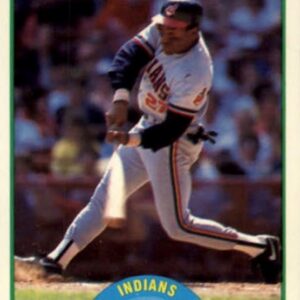
When I was a kid, there was a outfielder for the Cleveland Indians who used to put batting gloves in each back pocket so that when he hit a home run, he could “wave goodbye” to the other team. In the parlance of the day, Mel Hall was a “hot dog.”

Funnily enough, he never got to wave goodbye to the other team more than 18 times in a season, so the gimmick may have been lost on the masses.

The Chicago Cubs selected Hall in the second round of the 1978 draft out of Port Byron High School in New York, which is about 30 miles west of Syracuse. Three years later, on September 3, 1981, he made his MLB debut, flying out to right field against Doyle Alexander of the Giants. He would get into ten more games the remainder of the year, collecting one hit in twelve plate appearances.

Hall became an everyday player for the Cubs in 1983, slashing .283/.352/.488 for a 128 OPS+, which was good for third place in Rookie of the Year voting.

The Cubs traded the outfielder to the Indians in mid-June of 1984. And while his numbers with Chicago were better than with Cleveland, he was still a solid performer for his new American League club (104 OPS+).

A car accident kept Hall out of nearly the entire 1985 season. He came back in 1986 and slashed .296/.346/.493, with a then-career-high 18 home runs. 1987 and 1988 were more of the same.

Prior to the 1989 season, Cleveland traded the outfielder to the Yankees, and that is when and where the real trouble began. During spring training, he brought both his wife and his girlfriend to the team hotel and then proceeded to watch them get into a fight near the pool. While on the injured list, he got into a violent wrestling match with Rickey Henderson. And then he brought a gun into the clubhouse. In the years before “Manny being Manny,” the team seemed to shrug it all off, with Hall stating, it’s “me being Mel Hall.”

He still played in 113 games that year for the Bombers, hit 17 homers and had a 103 OPS+.

His production was roughly the same in 1990. 1991 was up there with his best seasons, as he slashed .285/.321/.455, setting a career-high with 19 homers and 80 RBI. In 1992, he did it again, putting up about the same numbers, including his all-time high of 81 RBI.

And yet, when his contract with the Yankees expired, no MLB team wanted him. So, Hall took his talents east, and signed a two-year, $4 million contract to play for the Chiba Lotte Marines in the NPB. He then played for the Chunichi Dragons, before coming back stateside in 1996 with the San Francisco Giants. That experiment lasted a month, as the club released him after he got three singles in 25 at-bats.

Not willing to give up, he signed a minor league contract with the White Sox, but that lasted only twelve days. Years later he would try his hand at independent ball, but that didn’t lead anywhere.

While playing in New York, Hall was known to have two great passions: spending money and chasing women. That, unto itself, made Hall like many athletes. Unfortunately, Hall had a proclivity for young women. It started with him inviting a 15-year-old (and her family) to a game at Yankee Stadium in 1989. And then there were others. It took until 2007 for Hall to be arrested. It happened in Texas, where he was charged with two counts of sexual assault and of having sex with a woman under the age of 17. During the investigation, a second victim – under the age of 14 – was identified. A twelve-year-old girl was determined to have been raped by Hall.

He was ultimately convicted of three counts of aggravated sexual assault of a child and two counts of indecency with a child. He was sentenced to 45 years in prison, where he currently resides. His earliest possible parole would be in late 2031, when Hall will be 71 years old. Based on his actions off the field, that simply may be too soon to let this predator free.

Hall could have made a name for himself as an irreverent player and a fan favorite. Instead, he became a clubhouse cancer, a pariah, and a convicted felon.

It will be a long time until Mel Hall can ever again… PLAY BALL!!

Trevor Bauer Made His Bed And Now He Has To Lie In It

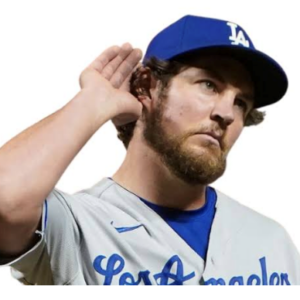
Trevor Bauer was selected third overall in the 2011 draft by the Arizona Diamondbacks out of UCLA, and made his MLB debut the following June. He started four games for Arizona in 2012, going 1-2 with a 6.06 ERA.

After clashing with his teammates in the desert, the team traded him (along with Bryan Shaw and Matt Albers) to Cleveland in return for Shin-Soo Choo, Jason Donald, Tony Sipp, and Lars Anderson. Bauer began 2013 at Triple-A Columbus, starting 22 games and going 6-7 with a 4.15 ERA before being called up to the big club. In four MLB games, Bauer essentially matched his 2012 season, going 1-2 with a 5.29 ERA.

2014 saw him again on the farm, but he was down there for only a short while (2.15 ERA). Once in Cleveland, he started 26 games, going 5-8 with a 4.18 ERA.

Bauer’s 2015 and 2016 seasons were remarkably similar (11-12, 4.55 ERA, 4.33 FIP / 12-8, 4.26 ERA, 3.99 FIP) as he settled in as an everyday pitcher in Terry Francona’s rotation.

In 2017, Bauer took a leap. He went 17-9, threw 176-1/3 innings, and struck out 196 batters while walking only 60. That season was worth 2.9 bWAR.

In 2018, he upped his game even more, going 12-6 with a 2.21 ERA and a 2.44 FIP. He pitched 175-1/3 innings and struck out 221 against just 57 walks. With 6.0 bWAR, he made the All-Star team, finished 6th in Cy Young Award voting, and got MVP consideration. At this point, Bauer was on his way to becoming somewhat of an “ace,” a moniker he had desired since college.

Bauer’s 2019 season started well enough, opening with a 4-1 record through his first seven starts. Then he lost five straight while sprinkling in three no-decisions. He followed that with four straight wins and five out of six. On July 23rd, Bauer pitched 7-2/3 innings, struck out nine while wielding just three hits and no runs. He left the game with a 1-0 lead, just to watch Brad Hand gave up a game-tying homer to Justin Smoak with one out in the bottom of the ninth. And then he had to endure Tyler Olson coming into the game in the bottom of the 10th and going walk, wild pitch, single, and walk-off single (Smoak, again) to give the Blue Jays the 2-1 win.

That was the backdrop as Bauer headed into his next start, a Sunday afternoon game in Kansas City on July 28th.

Staked to a 3-0 lead in the top of the first, Bauer started his outing by giving up hits to three of the first four Royals batters, but escaped surrendering just one run.

In the third inning, he gave up a leadoff single, followed by a walk, and then a wild pitch. A ground ball to first should have meant just one run, but first baseman Jake Bauers’ errant throw allowed Hunter Dozier to score to tie the game.

Cleveland retook the lead in the top of the fourth, and Bauer bounced back with a 10-pitch inning in the bottom half. Danny Duffy led off the top of the fifth with a home run, giving Bauer a two-run lead to work with.

Bauer, with a 5-3 lead going into the bottom of the fifth, gave up a leadoff single to Alex Gordon. Brian Dozier then lofted a fly ball to center field that Óscar Mercado lost in the sun, allowing it to drop on the warning track and bounce over the fence for an automatic double. Jorge Soler then walked on a very close 3-2 pitch (probably overturned in the ABS era) to load the bases. Ryan O’Hearn then hit a dribbler in front of the mound that Bauer couldn’t field, allowing a run to score (it was ruled a hit). Cheslor Cuthbert then hit a duck-fart (60.6-mph off the bat) into right field over the outstretched arm of second baseman Mike Freeman, which knocked in the tying run. After striking out Bubba Starling for the first out of the inning, Nicky Lopez hit a grounder up the middle that Bauer just barely missed fielding; it ended up in center field, scoring two runs. Bauer got a new ball from the umpire, and immediately rejected it by throwing it to the dugout. When he got a second ball, he noticed manager Terry Francona coming to the mound, so Bauer chucked that ball over the center field fence. When Tito got to the obviously frustrated and pouting pitcher, he asked: “What the fuck is wrong with you?!” Bauer put his hand on Francona’s shoulder, ostensibly in apology, and headed for the showers.

After the game, Bauer apologized for his behavior.

“I want to be clear that my frustrations were with myself and my inability to stop the situation and keep my team in the game. I’m an intense competitor. That fire is what drives me. Today, it completely consumed me and took over…It was unbecoming. It was childish. Unprofessional. There’s no place for it in the game.”

MLB fined the pitcher an undisclosed sum, but did not suspend him. However, Cleveland was done with him. Two days after the incident, they traded the immature 28-year-old to Cincinnati as part of a three-team deal (ironically, Francona would later become the Reds’ manager).

Bauer finished the season in Cincinnati, and pitched there in 2020 as well. Before the 2021 season, the Dodgers signed him to a three-year, $102 million contract. MLB placed Bauer on administrative leave in July of that year following sexual assault allegations. In April, 2022, he was suspended for 324 games (ultimately reduced to 194 games on appeal). Los Angeles released him in January, 2023, but not before they paid him roughly $61 million for 17 games and 107-2/3 innings.

Bauer was never criminally charged for the actions that predicated his suspension, and he actually won a civil judgment against his accuser. And yet, no MLB team wanted his services. Was he “blackballed”? It is hard to say.

Since his release by the Dodgers, Bauer has pitched in Japan, Mexico, and now on Long Island. At 35, he clearly still has skills and could be useful to some big league team in need of pitching. But, is he worth the hassle? Interestingly, after Bauer chucked the ball over the fence that day in Kansas City, Francona said the following to the assembled press: “I don’t want this to be his legacy. This kid’s a good pitcher.” What he didn’t say is as important – if not more important – than what he did say.

When Bauer threw a no-hitter for the Ducks, there was no grand celebration on the mound. Teammates, all the way back to college and possibly before, simply do not like Bauer. And organizations, from Arizona to Cleveland to Los Angeles, tire of his act pretty quickly.

If Bauer is anything, he is true to himself, and will not change for anyone or any amount of money. He has no one else to blame for his lot in life, but he does not seem to have the introspection or care for what others think to evolve in any way. And that has cost him his major league career. Hopefully the $112 million he earned over 13 seasons is enough to buy happiness, because it certainly won’t buy a positive or lasting legacy.

PLAY BALL!!

The “Manfred Man” Bestows a Loss On a Pitcher Who Just Did His Job

On Episode 2375 of the Effectively Wild podcast, co-host Ben Lindbergh — no fan of the “Manfred Man” (aka the “Ghost Runner,” which is a misnomer; aka the “Zombie Runner,” which is an insult to the guy actually standing on second base) — pointed out how the rule instituted in 2020 (during Covid) produced a great injustice about a week ago in a game between the Dodgers and the Giants.

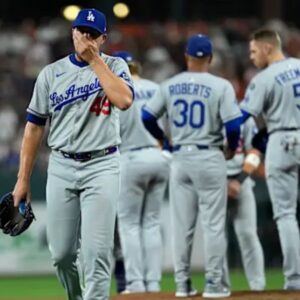
Here is the scenario: With one out in the ninth inning of 1-1 tie, Blake Treinen came in from the bullpen to replace Jack Dreyer with the winning run on third. Manager Dave Roberts immediately ordered an intentional walk to Willy Adames (this begs the question as to why Roberts didn’t do that with Dreyer on the hill, as, alas he created the mess and should be charged with the walk). With the bases now loaded — but the only runner that mattered standing on third base — Treinen got Wilmer Flores to fly to short center field, where Andy Pages caught the ball and threw a strike to catcher Ben Rortvedt to complete the double play. That ended the threat, ended the inning, and ended regulation baseball.

Treinen came back out for the bottom of the tenth, which meant that Christian Koss (who pinch-ran for Flores) took his rightful place at second base to start the inning as the aforementioned “Manfred Man.” Treinen induced Matt Chapman to ground to second baseman Tommy Edman for the first out of the inning, while Koss moved to third. At this point, with left-handed hitting Jung Hoo Lee scheduled to bat, Roberts removed Treinen for lefty Tanner Scott. To summarize, Treinen had faced two batters (technically three, as the intentional walk to Adames counts as a batter faced), and recorded three outs (one via a double-play). Suffice it to say, he had done his job.

Scott took the mound and actually struck out Lee, but home plate umpire Bill Miller ruled that Rortvedt didn’t catch strike three, so he called it a foul ball. Lee walked on the next pitch. With runners on the corners, and again, the only runner that mattered standing on third base, Roberts order an intentional walk to Casey Schmitt. Two pitches later, catcher Patrick Bailey sent a 97 MPH fastball into the left field bleachers for a walk-off grand slam. For purposes of deciding who takes the loss, the only runner that matter was on third — Koss, the “Manfred Man” — who took his place while Treinen was on the hill. As such, Treinen took his fourth loss of the season.

Sure, pitcher wins are an antiquated stat in today’s sabermetrically inclined world. Sure, advanced stats will protect Treinen at contract time (although his actual stats may truly hurt him), and no one will be looking at this loss on this Friday night in September when he becomes a free agent at the end of next season. But, come on! It is right there is the box score in every paper in America, on every website that covers the sport. It just isn’t right. Lindbergh (and others) offered up that this should, if nothing else, be a “team loss,” and not dropped at the feet of the pitcher who literally did nothing wrong and everything right.

Per Lindbergh, who was relying the research of Michael Mountain, this exact situation has occurred ten other times between 2020 and 2024. This would be the 11th, and those eleven pitchers have a reason to gripe, even if they are just shouting into the wind where no one — not fans, agents, managers, or general managers — give one good darn about a pitcher’s win-loss record. But still!

PLAY BALL!!

The Savannah Bananas Are Something Totally Different

The Savannah Bananas are not for everyone. The Savannah Bananas are for everyone. Of course there is an inherent contradiction in those two statements, but they remain true.

For certain baseball die-hards, those who lament the “Manfred Man” and the pitch clock and the ban on shifts, they will not like Banana Ball. But what you see when you go to a Savannah Bananas baseball game is something that can (and is) enjoyed by people of all ages, stripes, and backgrounds. I recently told a colleague – a massive baseball fan – that I went to a Bananas game, and he asked, “What is that?” And that is when I realized that despite their massive and still-growing success, not everyone knows about the Savannah Bananas. Allow me to provide a brief introductory course.

It all started in 2016 as a collegiate summer baseball team in the Coastal Plain League. Lynn Moses, a local Savannah resident, won the “name the team contest” and was honored with season tickets. The Bananas won the Pettit Cup (the CPL championship) in their inaugural season, and was named the league’s organization of the year in both 2016 and 2017.

Owners Jesse and Emily Cole, master marketers, wanted to change the summer baseball paradigm. So, in 2018, the team created the alternative “Banana Ball” rules (more about those below) and first used them during an intra-squad game. The fans seemed to love it, so in June of 2020, they played their first official game using the rules. After that, Banana Ball was played in their home park, Grayson Stadium, and customary baseball rules were used on the road. After the 2022 season, the Coles decided that playing two different types of baseball was not tenable, so they formed another squad – the Party Animals – to be their main opponent, and left the Coastal Plain League.

It is important to stop here to clarify a myth. When people ask about the Savannah Bananas, the most ready comparison is the Harlem Globetrotters. And, in some ways, that is apt. So, by transitive property, the Party Animals would be the Washington Generals. But, under even the most basic level of scrutiny, it is obvious that one thing is not like the other. For starters, the Bananas don’t win every game. The Party Animals (and now the additional opponents, the Firefighters, the Visitors, and the Texas Tailgaters) come to play. In fact, the Bananas recently had a seven-game losing streak against the Firefighters. And while the Generals are often the butt of the Globetrotters’ jokes, the Bananas’ opponents give as good as they get, and are never played for fools.

You see, despite some of the naysayers, at its core, Banana Ball is real baseball. The pitchers pitch – and they throw relatively hard; the batters bat – and they hit the ball a long way; the fielders field – they just do it with a little more flair. No game, score, or winner, is ever preordained. The final tally presents a winner, and oftentimes that is not the Bananas.

Here is a quick breakdown of the Banana Ball rules, which make this game different than “typical” baseball:

  • Games are won by points, not runs. Score more runs in an inning, you win a point. Except in the final inning (more about that below), when every run counts as a point.
  • Each game is subject to a strict two-hour time limit. Jesse comes onto the field to announce the start of the clock, and then we can watch the countdown on the scoreboard. No new inning can start after 1:50; but once an inning starts, it is played to its completion.
  • Batters cannot step out of the batter’s box; doing so results in an automatic strike.
  • There is no bunting; doing so results in an automatic ejection.
  • Batters can attempt to steal first base on a wild pitch/passed ball.
  • Walks are referred to as “sprints”. After ball four, the batter takes off and runs the bases and goes as far as he can until each defensive player has touched the ball.
  • There are no mound visits.
  • Any foul ball caught cleanly by a fan results in the batter being out.
  • “The Golden Batter Rule”: One time per game, a team may send any hitter in the lineup to bat in any spot. (Jayson Stark wrote about the possibility of this in MLB earlier this season.)
  • In the last inning, each run is counted as a point, so the goal is to score as much as possible.
  • In the case of a tie, there is a “showdown tiebreaker.” Each team’s half-inning during the showdown ends with any out or with any run scored by the batter. If the batter puts the ball in play, he must attempt to score. A batter who draws a walk goes to second base. Any home run during the showdown ends the game. Here is the defensive arrangement for each showdown round:
    • Round 1: Pitcher, catcher, one fielder.
    • Round 2: Pitcher and catcher only. Yes, that means that the pitcher must chase down any hit ball.
    • Round 3 (and beyond): Pitcher, catcher, and single fielder, but the round begins with the bases loaded.

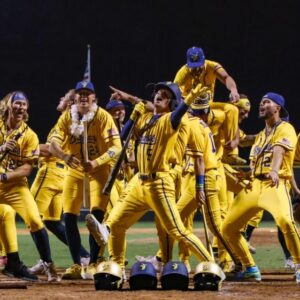
Beyond the difference in rules, a Bananas game is an all-out party. Music plays from minutes before the first pitch and continues until the final out is recorded. Players (and coaches) break out into dance routines every so often. The home plate umpire doesn’t just call balls and strikes, he dances like Frank Drebin. When a player hits a home run, it is not uncommon for him to surf on his teammates from third to home (you’ve got to see it to understand it). “Stilts,” a player standing nearly 11-feet tall often takes the mound and sometimes comes to bat. There are celebrity guest pitchers and batters (Patrick Renna, the “Bambino” from The Sandlot, pinch hit at a recent game in Anaheim).

But the game is just part of the party. Hours before the national anthem, the players are in the parking lot signing autographs for adoring fans (each player and coach comes armed with his/her own Sharpie). A couple of hours before the first pitch, the players and coaches participate in a parade around the outside of the stadium with the team’s band playing around them. Players play catch (both baseball and football) with fans – and not just in the lower bowl, the get all the way to the upper deck. There is a banana throwing contest from the farther reaches of the ballpark. The “Man-Nanas,” a group of former professional wrestlers entertain the crowd moments before the game begins. And, just to make sure everyone understands what they are about to see, the “Chief Potassium Enthusiast,” Matt Graifer, a former professional wrestling announcer, wearing a bright yellow sport coat and bow tie, stands atop the dugout and explains all of the rules to the fans.

If this sounds like a lot, it is. If it sounds a bit unhinged, it is. If it sounds like a darn good time, it is. But despite the fact that many Bananas game are broadcast on television, this is something that needs to be seen in-person to be truly appreciated. But don’t try to buy tickets directly from the team’s website – every game this summer is sold out, and there is a three million person wait list (not a joke or a typo). But, that is what is the secondary market is for.

PLAY (BANANA) BALL!!

Fans Need To Do Their Job

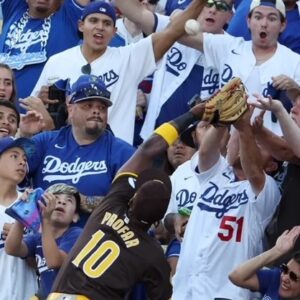
In the bottom of the first inning of Game 2 of the NLDS, Mookie Betts hit a ball 354 feet down the left field line. Jurickson Profar, a converted shortstop, went back to the wall, leaped into the stands extending his gloved left hand as far as he possibly could, and then retreated back onto the field of play, bouncing on both feet like a kid on Christmas morning. Betts was somewhere between second and third base when Profar finally divulged that he had caught the ball. His antics fooled Betts, the fans, and the television broadcast, which had displayed a home run graphic while Mookie circled the bases.

In the aftermath of Profar’s play, the Dodger fans were none-too-pleased, which led to jawing, and then ball-throwing, and then a nine-minute delay before the seventh inning while security encircled the outfield, led fans to jail, and cleaned up the beers dropped onto the warning track.

For starters, fan should NEVER act that way. Buying a ticket does not give you a license to say rude or offensive things to players (I understand some people may have a different view of this). Buying a ticket does not legally allow you to throw things – balls or beers – onto the field. In short, just because you buy a ticket doesn’t mean you automatically get to be a jerk.

But, buying a ticket, does give the fan a certain type of license.

MLB Rule 6.01(e), discusses “Spectator Interference” as follows: “When there is spectator interference with any thrown or batted ball, the ball shall be dead at the moment of interference and the umpire shall impose such penalties as in his opinion will nullify the act of interference.”

The penultimate two sentences of the official comment to the rule states: “No interference shall be allowed when a fielder reaches over a fence, railing, rope or into a stand to catch a ball. He does so at his own risk.”

As such, fans do have the right to catch a ball that comes into the stands. Fans are given license to mess with the player diving over the wall. Fans have as much right to the ball as the player, and if that means hitting an arm or knocking a glove off a hand, so be it.

Accordingly, while I blame the Dodger fans for their putrid behavior before the seventh inning, I also blame the fans for allowing Profar to make that catch. There is simply no world in which a visiting player, during a playoff game, in a packed stadium, should ever be able to make that play. In 1989, Bill Welch and Jeff Moses published “The Tenth Man: How Major League Baseball Teams Can Gain a 2 to 3 Run Advantage Every Game.” The Seattle Seahawks have made an industry out of the 12th man, as their fans have an adverse effect on visiting players. There is a real benefit to playing at home, but only if the fans do their job.

When you watch the video of Profar’s catch, you can clearly see multiple fans who had a clear shot to either catch the ball or interfere with Profar’s ability to do so. They all failed at their job. The poor security guard can be seen cowering, and he may have impeded some fans getting in Profar’s way, but there were plenty of others available.

Fernando Tatís had hit a home run in the top of the first inning of this pivotal game, and Betts was about to even the score. And, maybe more importantly, Betts was about to end his 0-for-18 post-season hitting woes. As it turned out, it took another full game – pushing the streak to 0-for-22 – before Betts got a hit, which was an actual homer over the outstretched arm of Profar (again). Who’s to say what the rest of Game 2, an eventual 10-2 Padres blowout, would have looked like had the score been 1-1 after 1, with Mookie feeling confident at the plate.

The Dodger fans cannot be blamed for the six home runs that Dodger pitchers surrendered in that game. But they can be blamed for the one home run that they allowed a Padres pitcher to not surrender. Fans can hoot and holler; they can sing and dance and call out their team’s name during “Take Me Out To The Ballgame.” Fans can wave rally towels and stand when their pitcher gets two strikes on an opposing batter. And they can – and should – do anything and everything possible to make sure that the opposing team does not reach into the bleachers and pull back an actual, verifiable, genuine home run ball. If they fail to do that when given that opportunity, then they have failed their team, they have failed to do their job. There is no question that the Dodger fans failed their team in the first inning of Game 2 of the NLDS.

PLAY BALL!!

Buffing Their Halo: The Angels Make the Best of a BAD Situation

About a week before the August 1st trade deadline, the Los Angeles of Anaheim made it known that they would not be trading their once-in-a-century two-way star, Shohei Ohtani. Many in the baseball world criticized this decision, believing that the Angels could reset their farm system (currently ranked 28th by MLB Pipeline) with the haul they would receive for their soon-to-be free agent. 

Not four days later, owner Arte Moreno doubled down on his decision, trading two top-100 prospects to the White Sox for pitchers Lucas Giolito and Reynaldo López. Just a few days after that, Moreno tripled down, trading two lower-level prospects to the Rockies for C.J. Cron and Randal Grichuk. In making these moves, the frugal leader pushed his team above the competitive balance tax (first tier: $233M) for the first time in his 20 years as owner. When the dust settled on these deals, the Angels, who had won nine of their last 12 games, were four games back of the third and final Wild Card spot. Moreno had pushed his chips all in. 

Since the trade deadline, the Angels are an MLB-worst 8-23, falling 11 games behind the three-way goat rodeo for the final two Wild Card spots. As of August 28th, FanGraphs listed the Angels’ playoff odds at 0%, where they remain today. Suffice it to say, the gamble didn’t pay off. 

To add to the insult are injuries to Ohtani – who will most likely need “some sort of procedure,” including potentially a second Tommy John surgery – and Mike Trout, who most likely won’t play the rest of the season due to a bad wrist. As such, the Angels found themselves with players they didn’t need and a potential CBT bill due. Sure, Moreno could have just played out the string with the decisions he made in July, but that is not how one becomes a billionaire; that is not how one comes to own an MLB team. 

If the Angels stood pat, they would have ended the season above the CBT threshold (since we don’t have full visibility, the numbers vary: according to Spotrac, by about $5M; according to Roster Resource, by about $1.4M), which is subject to a 20% tax. Although a tax bill somewhere between $280,000 and $1M is a drop in the bucket for a team valued at more than $2 billion, why spend that if you don’t have to. Further, by staying above the CBT threshold, the compensation pick the Angels will receive if Ohtani signs elsewhere (once he receives and turns down a qualifying offer) would come after the fourth round. However, if they are not required to pay the tax, the compensation pick would come following the second round. The difference is somewhere between 60 and 70 picks – a massive difference. 

One last benefit of staying below the $233M CBT level: First-time offenders are subject to the above-referenced 20% tax, but second-timers get hit with a 30% tariff. So, if the Angels want to spend lavishly this offseason (on, say, a two-way superstar), their tax basis will be 50% less.  

Faced with this situation, the Angels did the prudent thing – they put six players, including four they recently acquired, on waivers. This means that any team could “claim” the player by simply agreeing to pay their salary for the final month of the season. All of the players the Angels put on waivers will be free agents at the end of the year, so there was no long-term loss of player capital. If all six players had been picked up, the Angels would have saved roughly $7M in salary obligations; and the above-referenced competitive balance tax; and would get a processing fee of $50,000 per guy. In short, by “dumping” (as it has been portrayed by many media outlets), the team stood to be more than $8M in the black and receive a draft pick nearly two rounds earlier.  

Five of the six were claimed. Randal Grichuk got stuck in Anaheim, a boon for the club since part of his salary is still being paid by the Blue Jays, and the Rockies sent cash to the Angels when he was acquired six weeks ago. Now that the five players are in their new (temporary) homes, the Angels saved just under $6M in salaries and received $250,000 in waiver fees. Unfortunately, without moving Grichuk, it has been reported that the Angels did not fall below the CBT threshold, and thus will receive the worse draft pick if they lose Ohtani to free agency. 

Buster Olney lamented the Angels’ waiver action as cynical. But when he interviewed a baseball executive, the choice was lauded as a savvy business decision. Olney fears that this may become the new norm and upset pennant races, which would contravene the intent of abolishing the August 31st revocable waiver wire a few years ago. However, insofar as the players are available to teams in reverse order of the standings, this will not automatically benefit big market teams (the five players were acquired by Cleveland, Cincinnati, and Seattle).  

Even if this does become customary, it would add another level of strategy for teams who may elect to lose a game or two at the end of August to improve their waiver claim position. 

As a postscript to this story, and in a sign that maybe the tide is beginning to turn for the Angels, the team caught a break. Max Stassi, who has missed the entire season due to a family emergency, was still receiving paychecks. However, over the weekend he informed the club that while he is now capable of playing, he will not return to the team, thus forfeiting approximately $1.2M in salary. With this reduction – and with removal of the five above-referenced players – it appears the club is now under the CBT threshold, and is in line to receive a better draft pick. Taking Stassi’s money off the books would have had no effect if the Angels had not been shrewd and clever in the days before the waiver deadline.

The Angels are a snake-bitten organization, to be sure. They have made many questionable decisions (see, Vernon Wells, Josh Hamilton, Albert Pujols, Anthony Rendon, dealing with the Mayor of Anaheim, etc.). They can be taken to task for holding onto Ohtani last season, this past winter, and this July. But once they sunk the cost and sunk in the standings, they didn’t need to be sunk. Bemoan all you want, worry about the league-wide implications if you must, but for the first time since they re-signed Trout, the Angels should be praised for attempting to execute an adroit strategy, setting the team up for future success (or at least less pain).

PLAY BALL!!

The Blue in the Sky

We currently have the lowest unemployment rate in 50 years, but we could always use more jobs. Going back many years, I have had a plan to add at least 15 new ones. And while these jobs wouldn’t do much for the national labor statistics, they would do a great deal for our enjoyment of the game of baseball.

MLB introduced a replay system in 2008, at first simply to review home runs. That remained the case until 2014, when replay was expanded to include a slew of additional plays (e.g., force calls, tags, fair/foul calls (in the outfield only), skipping bases, hit-by-pitches, fan interference, etc.). Over the years, the replay rules have been refined. To wit:

  • 2015: Managers no longer had to leave the dugout to challenge a call, and they retained challenges after every overturned call (it used to be just after the first victorious challenge).
  • 2017: The time to request a challenge was limited to 30 seconds, rather than merely before the next play. And, here was a big one: the replay crew in New York had a two-minute time limit to reach a final conclusion (more on that below).
  • 2020: Managers’ window of opportunity was further reduced to 20 seconds. 
  • 2022: Umpires were now mic’d up to inform the fans of the final decision.

My idea then, as it remains today, is that MLB should employ one additional umpire for every game. We will call him/her the “Blue in the Sky” (or “BITS”). BITS would sit in the booth (maybe right next to the official scorer) with an earpiece and microphone that goes directly to the home plate umpire and a “bat” phone that goes directly to the replay headquarters in New York. 

If/when there is a close play, BITS would immediately radio down to the home plate ump and tell him (as of this writing, there are no female umpires in MLB) to hold one beat. BITS would either have a bank of monitors in front of them or would use the bat phone to call New York. In addition, the moment BITS contacts the home plate ump, the two-minute clock would start. If BITS cannot get a decision when that bell rings, the call on the field stands. As we all know, the current two-minute rule is rarely enforced, with replay reviews — from inception until explanation — often taking five minutes or longer.

By engaging BITS, we take the decision-making out of the hands of the manager — or, more accurately, out of the hands of some video intern watching the angles as quickly as possible in a closet a few feet up the runway. Sure, we could still allow managers to have one challenge per game for that unlikely situation wherein BITS doesn’t think anything is amiss.

But BITS, by virtue of their vantage point, has a much better bead on the play. Watching at home or sitting in the stands, we have an immediate reaction when a play should be reviewed, but managers don’t have that same perspective. So let’s take that out of his hands; let’s have a paid professional doing that hard work. And this will also relieve the issue of a missed call in the late innings because a manager exhausted his challenges earlier in the game.

With the new rules implemented for the 2023 season, the role of BITS becomes that much more important. Let’s take a look at a few situations where BITS could prove helpful:

The Shift: BITS can tell, nearly definitively, if two infielders are on either side of second base, and if all infielders are on the dirt. Plus, they can see if any infielder is getting a running start before a pitch is thrown. There is just no way for a manager to be able to see that from the dugout.

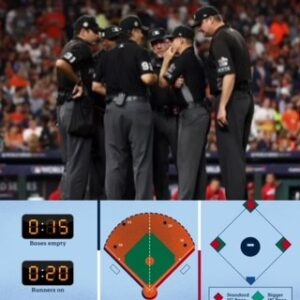
Pitch Clock: While the home plate umpire is equipped with a buzzer that informs him if/when the 15/20 seconds have expired, he does not have one for the 8-second deadline for the batter. BITS will be able to see that clearly. Further, BITS could use his/her reasonable judgment as to whether the catcher was ready (which was the cause of consternation in the Red Sox-Braves game the first week of spring) if/when a batter is assessed a strike for not being ready. BITS could be sitting next to or close to the clock-keeper (not sure this individual has a formal title yet) to make sure that they are starting and stopping the clock in accordance with the rules and circumstances.

Disengagement: There will be questions — mark my words — as to whether or not a pitcher actually disengaged from the rubber. Do it thrice, and a balk will be called. The balk has always been the worst call in baseball, as it is never uniformly applied and nearly impossible to know if the pitcher was actually trying to “deceive the runner.” But, BITS will have a considerably better angle to determine a disengagement and potentially a deception.

I know it is an unpopular position as a sports fan to say we need additional referees or umpires, but in this case, it makes perfect sense. Let’s put an end to a guy running out with a monitor and officials donning headphones. Let’s take the onus off managers to make split-second decisions. Let’s have BITS, the “Blue in the Sky,” make the call. And then leave it to the on-field ump to say:

PLAY BALL!!

Bring on the Chaos

I have a motto, one that I communicate to my kids as well as anyone I work with, and one that has served me well for over two decades: “Try never to make the same mistake twice.”

Because, in the words of Billy Joel, “We’re only human, we’re supposed to make mistakes.” Mistakes are, for my money, the number one way to learn anything. Try, do, screw up, figure it out, move on to the next one. In my career, I have learned more from deals, or provisions, or contracts that I messed up than any that went perfectly well. We have to feel that pit in our belly; we need to have a sleepless night or two; we have to get red with embarrassment when malfeasance is made public. These are the teachable and learning moments. They suck. And we wouldn’t wish them on anybody. But they happen. And we learn and we grow. And then we resolve never to make that same mistake again.

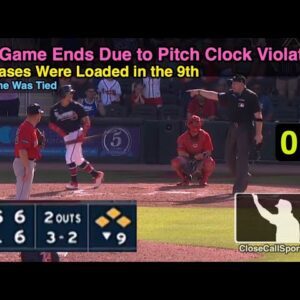
So, when a Red Sox – Braves spring training game ended with a “Clock Off” (h/t Mike Ferrin), I could not have been happier. For those of you who missed the biggest story of the first week of the spring (other than Manny Machado’s $350M and Gavin Lux’s shredded ACL), Braves second baseman Cal Conley came to the plate in the bottom of the ninth with the bases loaded and the score tied. He ran the count to 3-and-2, and then got called out because he was not in the batter’s box, ready to hit, when the pitch clock struck 8 seconds. Never mind that Red Sox catcher Eli Marrero was standing (not crouching) at that moment, the rule is that the batter must be ready. Per MLB, the correct call was made. And because the teams had decided against extra innings, the game ended in that most unconventional manner.

The announcers proclaimed, “This is mayhem…this is baseball in 2023.” In fairness, it is hard to tell if the announcers were being derisive or just descriptive. Either way, I don’t care. Bring on the chaos. Let every game from now until March 29th have a moment of uncertainty; let there be pitchers and batters violating the pitch clock; let there be infielders with their feet on the outfield grass; let there be players taking a running start to field their position. And let the umpires call a violation on each and every occasion. That is the only way they will learn. Let them make mistakes, and then try never to make the same mistake twice.

When MLB announced the new rules, and further decreed that they would be implemented from day one of spring training, some people lost their mind. Even if they were inclined to abide by the changes, some players and fans thought a slower implementation would be better for those who have been playing one way their entire lives. I disagreed then, and disagree now. And, from the looks of things on fields from Florida to Phoenix, players are getting comfortable, and the rules are having their desired effect.

Other than baseball purists who want players wearing wool and traveling by train, who doesn’t prefer games ending in roughly 2½ hours? Other than those same purists, who cares what happens in a meaningless spring training game where players who won’t sniff the big leagues this season are pitching, catching, and hitting in a tie game in the bottom of the ninth? Let chaos reign for the next four weeks. Let’s get it all out of our systems. Let the players have a moment of embarrassment. Machado – and his $350M contract – was the first player to take a called (not thrown) strike under the new rules. Do I think that is the last time he takes one of those? Probably not. But maybe Jake Cronenworth or Xander Bogaerts saw that and thought to himself, “Never going to happen to me.”

Same for pitchers. On the first weekend of the spring, over sixteen games, there were 35 violations, 27 by pitchers. Did they all learn their lessons? I doubt it. But maybe/hopefully, their teammates did. Some pitchers, like the Guardians’ Cal Quantrill, have made an adjustment and sped up their routine. New Red Sox closer Kenley Jansen, one of the players for whom the pitch clock was implemented, has been working all off-season to speed up his delivery, including changing his double-swivel to get going quicker. He seems excited, not exercised, by the new challenge. These are athletes who can change their arm angle or their grip on the ball after a single bullpen session; there is no reason they can’t learn to pitch a smidge more quickly.

Spring training used to be about getting players into physical shape. This year it is about getting into mental shape – dealing with the new rules. Let the players make all sorts of mistakes; let the umpires make all sorts of mistakes; let the announcers proclaim mayhem or bedlam or anarchy. That way, when the games matter, when there is something to play for – be it in April or October – everyone is on the same page…and on the same clock.

PLAY BALL!!

The Dangers of Leading With Your Head

A few weeks ago, a friend of mine whose son plays Division I baseball told me a story. She was watching her son’s game on television when a player (not her son) dove headfirst into second base on an attempted steal. The runner’s head smashed into the shortstop’s knee, whereupon the runner collapsed on the field. For many moments, the players, coaches, and umpires didn’t know if the runner was alive – he certainly wasn’t moving. After about five interminable minutes, the player regained consciousness and was helped from the field. He was later diagnosed (luckily, as it happens) with only a concussion.

My friend told me this story as a prelude to a question that I have been asking in various forms for years: Why do players slide headfirst? Why is this even allowed?

Now, I am sure there are old-timers out there who will tell me that banning headfirst slides would be un-American; a violation of individual rights; a further wimpifying of our culture; that it would be pillow-parenting run amok. Okay, fair enough. Here in America you are entitled to your opinion, as am I.

It seems like I write about this issue every year. It turns out I have only done so in 2015, 2016, 2017, 2019, and now 2022. And the reason I keep writing about it is because it is still an incomprehensible practice.

The issue came top of mind a few weeks back when I watched one of my favorite young players – Ke’Bryan Hayes – do something so monumentally stupid that I could not believe my eyes. And it made me question what his father (a former big leaguer) taught him, and what type of coaching he is receiving in the Pirates organization. Here was the situation:

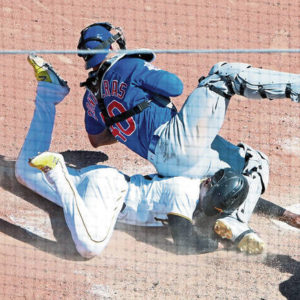
Hayes was on second as the Manfred-Man to start the bottom of the 10th inning. With one out, Michael Chavis hit a short looper over first. Hayes never stopped running. Rafael Ortega scooped the ball up on one hop, turned, and fired a strike to home plate. Waiting to receive Ortega’s throw was well-known (illegal?) plate blocker Willson Contreras, all 225 pounds of him. So what did Hayes, three inches shorter and at least 20 pound lighter – not accounting for the mass of equipment Contreras was wearing – do? He dove headfirst into home plate, where he met the Cubs’ catcher, and his heavy plastic shin guards, and his oversized backside. Hayes scored the winning run, and then lay in the dirt for nearly a minute. The Pirates’ play-by-play guy stated: “I have never seen a celebration muted like this.”

Hayes was helped to his feet and off the field, and then missed then next two games with a sore shoulder. He was lucky it wasn’t considerably worse; but since he has been back in the lineup over the last nine games, he is 6-for-35, with no extra base hits. Because correlation does not prove causation, you can draw your own conclusions.

Why did Hayes dive into home rather than sliding feet first? Why not utilize a classic hook slide moving his entire body as far from Contreras, who was catching a ball thrown from right field, and thus could not get a specific bead on the runner? Or, for all you throwbacks out there, how about him knocking Contreras’ block off – Pete Rose style – in the hope of dislodging the ball from his mitt? I think a replay review would have shown that Contreras did not provide Hayes with a path to the plate prior to his receiving the throw. Any of those options would have been better than putting his fingers, hands, wrists, neck, head, and shoulders at risk. Why didn’t the Pirates coaching staff alert the players in their scouting report that Contreras likes to block the plate? Why didn’t the Pirates player development staff coach their players to be safe, not sorry, when trying to advance to the next base? Why?

Sure, we all love watching Javy Báez with a swim slide into second base avoiding the tag of an unsuspecting middle infielder. But, at what cost? In 2019, Báez dove into second base, fractured his thumb, and missed the month of September. Some lessons are never learned.

Since the Hayes incident, I have seen a handful of additional players dive into home plate, all avoiding serious injury. But that is just dumb luck. Baseball is a dangerous game on its own. Don’t believe me, ask:

  • Mookie Betts (ribs, from an outfield collision)
  • Jacob deGrom (shoulder)
  • Manny Machado (ankle, running to first)
  • Max Scherzer (oblique)
  • Salvador Perez (thumb, due to a swing)
  • Ozzie Albies (fractured foot from a foul ball)
  • Walker Buhler (flexor strain and bone spur)
  • Stephen Strasburg (ribs)
  • Chris Sale (ribs)
  • Bryce Harper (thumb, due to a HBP)
  • Anthony Rendon (wrist, due to an errant swing)
  • Jazz Chisolm, Jr. (back strain)
  • Jack Flaherty (shoulder)
  • Tyler O’Neill (hamstring)
  • Hunter Renfroe (calf)

This list could go on and on. The point is that there is enough that can go wrong on a baseball field that players don’t need to take it upon themselves to up the ante. Sliding headfirst has shown, time and again, to be a fool’s bargain; and as I wrote in 2016, extremely costly. MLB teams need to get smart about this. But so, too, do college teams. And high schools. Yes, it is legal there as well.

When and where will the madness stop? When an aspiring physicist or politician or doctor playing baseball for an Ivy League institution dies on the field because his neck and head couldn’t endure the impact with another kid’s knee? Or will it require a $30M/year superstar becoming paralyzed on a major league diamond in front of 40,000 fans and on national television because he believed that leading with his head offered him the best chance to score a run in the fifth inning of a 7-2 ballgame?

MLB has shown a willingness to change its rules when big-name players get injured on a big stage (see, the Chase Utley Rule; see, the Buster Posey Rule). Why wait until we have to name this new rule? Or, if we must, let’s call it the Hayes Rule, named for a legacy player who narrowly avoided disaster and forced baseball to do the same.

PLAY BALL!!

Pick a Lane

Much has been written about organizations not caring enough to field a competitive team. In an effort to combat this scourge, the players tried to impose a salary floor in the latest CBA negotiations to thwart the concept of “tanking.” Shortly after the new CBA was signed, the Oakland A’s, doing their best Major League impression, went into fire-sale mode, bringing their 2022 salary commitments down to around $50M. The Orioles are in year pi of their rebuild. The Pirates are so parsimonious that the Effectively Wild podcast has dubbed any failure to pay players “Nutting” (after Pirates owner Bob Nutting).

We desperately need 30 teams to go out there and compete, to try to win.

We want teams to try to win, but, apparently, just not too hard. Based on what I have read and listened to since the start of the season, we don’t necessarily want our teams to try to win when doing so may come at the cost of individual achievements. We don’t want them to try to win when doing so might make the other team (or their fans) feel bad. We don’t want them to try to win when doing so might cause a violation of the so-called “unwritten rules.” To which I say, “Pick a lane.” What do we want?

The season is just a few weeks old, and we have already seen these issues rear their head on three occasions. Let’s take a look:

Clayton Kershaw & Dave Roberts

At this point, Clayton Kershaw is a national treasure. Love or hate the Dodgers, no one dislikes Kersh. The guy builds orphanages in Zambia; he hosts a ping-pong tournament each year to raise funds for Africa and the Dominican Republic. Oh, and he has had a Hall of Fame career, winning three Cy Youngs. However, the last few seasons have seen Kershaw make multiple trips to the IL with various ailments. His best days are behind him, but when healthy, he is still effective; and he is still someone the Dodgers will need in order to make a deep run in October.

So when Kershaw threw seven perfect innings, on only 80 pitches, in his first start of the season, baseball fans begged for him to keep going. But Clayton knows his body; Dave Roberts knows his star; and neither thought it made any long-term sense to send Kershaw back out there for the 8th inning. We fans were denied a shot at history; but so, too, was Kershaw. He didn’t seem to mind. But talk-radio jockeys, beat writers, and armchair managers all felt they knew better.

“He may never get another chance at a perfect game; you’ve got to let him go” was one refrain. “So what if he got tired? He could skip his next start or two,” was another. This latter take was maddeningly myopic. Suffice it to say that pushing an oft-injured, 34-year-old pitcher after a shortened Spring Training beyond what he felt he was ready for in his first start of the season just for the chance he would make history, is not good for the player or the team. Any potential injury could and would have a long-lasting impact on the Dodgers’ goal…of winning.

But, to hear “fans” lament “modern baseball” and it being ruled by “analytics” and “front offices” (a) takes away Kershaw’s agency in the matter (before the game he told Dave Robert he could only throw 85 pitches) and (b) flies in the face of the ultimate goal. How many Dodger fans would be happy exalting a perfect game in April, but being one pitcher – one Hall of Fame pitcher – short come the (expanded) playoffs? How would those “fans” feel when the Dodgers were forced to throw a bullpen game in Game 6 of the NLCS because Kershaw is on the shelf? I don’t love every decision Dave Roberts makes, but this one was one of his easiest.

Miguel Cabrera & Aaron Boone

If Kershaw is the most beloved player in MLB, Miguel Cabrera could make a case for being 1A. Who doesn’t love this guy? Hell, he gave his glove to rookie Spencer Torkelson, telling him to play first base while Cabrera moved permanently to DH, so Torkelson could start his big league career. Jayson Stark laid out the insanity of Cabrera’s hitting prowess, and the rarified air he breaths for those who have played the game and swung a bat.

And with three hits last Wednesday night, Cabrera entered Thursday’s game sitting on 2,999 hits. After going 0-fer in his first three at-bats, he came to the plate with two outs in the eighth inning of a 1-0 game, with runners on second and third. Aaron Boone had the Yankees trailing by a run with one of the greatest right-handed hitters in the history of the sport at bat, facing a lefty with a left-handed hitter on deck. So Boone did exactly the right thing: he intentionally walked Cabrera. The fans at Comerica Park went nuts. Even Cameron Maybin, in the Yankees’ broadcast booth, was shocked that Boone did it – but he agreed with the decision. You know why, because that is what you do when your job – and your goal – is to win games.

The AL East stands to be the most competitive division in all of baseball this season, where every win will be of paramount importance – and potentially the difference between making the playoffs and not. So, was Boone supposed to push that aside and let Cabrera swing away, potentially getting hit number 3,000, AND giving the Tigers a 3-0 lead? Would Brian Cashman and/or Hal Steinbrenner have looked the other way at that obvious malfeasance if/when the Yankees lose the prize by a single game? 

The naysayers will say that Austin Meadows’ softly-hit double proved the Baseball Gods right, so it did not matter. But process matters. Good judgment matters. Bosses and owners can live with bad results that derive from good decisions. They can’t abide by putting the feelings of the hometown Tiger fans ahead of the goals of the team. And you know how I know I am right? When the inning ended the fans booed, Miguel Cabrera told them all to be quiet, to look at the scoreboard, to recognize that Aaron Boone made the right call.

Mauricio Dubon & Gabe Kapler

About a week ago the Giants started thumping their division rivals, the Padres, from the get-go. By the time there were two outs in the second inning, they led 10-2. Steven Duggar, who had just knocked in the tenth run with a single, elected to steal second base. Swiping a base with a nine-run lead is not de rigueur, but doing so in the second inning may be slightly more palatable. If the Padres were upset with Duggar, they hadn’t seen anything yet.

Leading off the bottom of the sixth, with the Giants comfortably ahead 11-2, Mauricio Dubon bunted for a single. When he got to first base, Eric Hosmer greeted him with some choice words. Hosmer told MLB.com that he told Dubon: “You’ve been playing professional ball for a good amount of time obviously if you’re at this level. You’ve got to be smarter than that.”

Smarter than what? Smarter than trying to play the game to win? Smarter than trying to increase his batting average so he will get a raise next season, and maybe more money when he reaches arbitration in a few years? Sure, the Giants were up nine runs, but Hosmer was still trying to win when he swung from his heels the inning before. The Padres were trailing by nine runs but still had their starters in the game (Bob Melvin did replace Hosmer and Manny Machado in the seventh). Clearly, one side was still playing to win. Why shouldn’t the other?

After the game, reporters threw a ton of mics in manager Gabe Kapler’s face, trying to get an answer as to what he and his players were thinking. Kapler (who it should be noted, I don’t always agree with), laid it out perfectly: 

“Our goal is not exclusively to win one game in a series. It’s to try to win the entire series. Sometimes, that means trying to get a little deeper into the opposition’s ’pen…We’re not trying to hurt anybody. We just want to score as many runs as possible, force the other pitcher to throw as many pitches as possible. If other clubs decide that they want to do the same thing to us, we’re not going to have any issue with it.”

And there it is. Kapler is paid to help his team win games. If his strategy in game one of a series has an impact on games two and three, all the better. Last season the Giants won the division over the Dodgers by one game. Every game – including the games in the days after a blowout – counts. Were the Padres upset? Yes. Should they have been? Well, I do seem to recall a certain Padres star swinging on a 3-0 pitch with the bases loaded up by seven runs just a few years ago.

The “unwritten rules” of baseball aren’t worth the paper they aren’t written on – they take away the competitive spirit of the game (with the exception of throwing at someone’s head – that one actually should be written in stone).

In that same interview, Kapler spoke the truth and summed up the ultimate goal:

“Everybody is competing on a Major League Baseball field. It doesn’t make any sense how one part of the field stops competing and the other part of the field keeps competing. I can’t think of a reason why that makes sense. The pitcher on the mound is trying to get you out, the batter at the plate stops competing with all the tools at his disposal?”

Baseball is hard. Ask the heralded rookies over the past two seasons all hitting below the Mendoza Line. Ask the Blue Jays who didn’t make the playoffs last season despite possibly being the best team in the American League at season’s end. Ask the aforementioned Giants who won the division by a single robbed home run in May, only to be knocked out of the playoffs on a checked swing.

The goal is to win and to put your team in the best possible position to win. The goal is not to make the fans happy with individual achievements at the potential cost of long-term success; nor is it to mollify opposing managers who believe there is a “right way” to play the game. If we demand that our owners spend money to put quality players on the field, then we have to demand that our managers allow those players to play the game to win, both for today and for October. Otherwise, we are just a jumbled mess of contradictions and hypocrisy. So look in the mirror, baseball fans, and ask yourself what it is that you want.

Either way, you need to pick a lane!

PLAY BALL!!