
Today would be my late wife’s 54th birthday. In addition to giving me nine wonderful years of marriage and three beautiful children, she gave me her dad, Marty.
Marty was an interesting man. He never met an illness he didn’t have or couldn’t diagnose (with the help of the Physicians’ Desk Reference that he kept handy), or a line he couldn’t beat. He grew up in Chicago as a Cubs fan, and then joined the Army. Shipped off to Germany during the Korean War, he never saw military action. Rather, he whiled away his time playing baseball with his fellow recruits. Marty loved baseball.
His passion for the game was fueled by his father, Irwin, who also grew up in Chicago, and was even closer to baseball. Irwin was a concessionaire at Wrigley Field. Sometimes he sold sodas and hot dogs, other times he took tickets. But regardless of the job, the Friendly Confines were his home away from home, and his workplace.
One day in the late 1920s, Irwin was leaving the ballpark after another afternoon game on the North Side (they were all afternoon games then, as Major League Baseball’s first night game didn’t take place until May 24, 1935, at Crosley Field in Cincinnati; and the Cubs’ first night game didn’t happen until 53 years later, in 1988). As he was about to step onto Addison Street, Irwin heard a voice behind him.
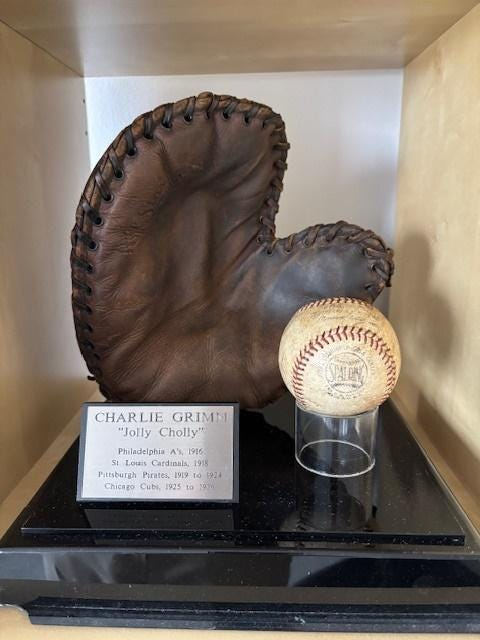
“Hey [in the retelling of the story, it is unknown if he was called by his name], “hang on a minute.” Jogging towards the Wrigley Field employee and not yet father of two was Cubs’ first baseman Charlie Grimm, known affectionately as “Jolly Cholly.” Grimm must have seen Irwin tossing peanuts with his left hand, or handing out sodas with his “southpaw,” or maybe he just had an inkling – lefties tend to be able to spot each other in the wild. When Grimm caught up to Irwin, he handed the man his first baseman’s mitt, telling him not to worry, he had others.
Irwin brought that glove home and put it away. Maybe, one day, he could share it with a son. A few years later, his wish was granted. Marty was born in 1933, and when he was old enough to fit the glove on his hand, Irwin bestowed the mitt upon his boy. As a youngster, Marty used that glove in the street and on ballfields all over Chicago. He eventually moved on to a Spalding, which he brought with him to Europe in his duffel bag along with his shaving kit and dog tags.
Marty held onto Grimm’s old mitt, first leaving it in his childhood closet, then in the home he shared with his wife (my mother-in-law), and then in his apartment as he crested into old age. Marty, like his father, had wished for a boy to play catch with. However, he was blessed with two girls.
Of his girls, one couldn’t tell an inside pitch from a soccer pitch, and had no interest in sports. The other, whom I would eventually marry, liked sports just fine, but never those played with a ball and glove. So Marty would play tennis and shoot the occasional hoop with his daughter, but he had no one to play ball with.
And then he met me. My then-girlfriend and her father weren’t especially close, but she did introduce me to him shortly after we started dating. One time, early in our courtship, we visited him at his apartment.
After a perfunctory greeting, he said to me, “Wait here.” After a few minutes and the sound of boxes and papers shuffling in the other room, he appeared with an old baseball mitt. It was in horrible shape. Dried out and stiff, with an aged Spalding ball in the pocket. He immediately said, “Let’s play catch.” I didn’t have a glove, but wasn’t too worried about his velocity hurting my bare hand, so we went to the parking lot to toss that old ball into that old glove.
While flipping that actual horsehide back and forth, we were chatting, as two are wont to do. That day he told me the story of Charlie Grimm and his father and Wrigley Field and how he had always wanted to pass the glove down to his own son. He spoke nearly as lovingly about “Jolly Cholly” as he did his own dad.
While it was clear to me that I had won this man over (the same was not yet true of his daughter), he most certainly didn’t offer the glove to me.
Over the years Marty and I would share our love of baseball, watching on television and comparing players and eras. I took him to a handful of Angels games (he lived in Orange County and rooted for his new hometown team). He was always good for a story or two and a beer or three. We truly enjoyed each other’s company.
Time passed, his daughter and I got married and had a boy of our own. And then Marty got sick. Truth be told, with so much going on in that stage of our lives, I had completed forgotten about the glove.
A few weeks before our son turned three, Marty passed away. My wife was a busy litigation attorney, and I was between jobs, so it was my responsibility to clean out his apartment. Marty was a pack rat. I found yellowed newspapers, decades old cups that McDonald’s gave away as part of Happy Meals in the ‘70s; and that dog-eared copy the Physicians’ Desk Reference.
Marty smoked and didn’t like the cool air, so the apartment had a must that was hard to bear. But I worked quickly, trying to make sure I grabbed anything and everything that had meaning. I found a cache of photographic slides (kids, ask your grandparents) from his time in Europe during the war, and an old jewelry box with some incredible heirlooms. There were Cubs and Bulls jerseys, and his letterman jacket.
I stumbled across some old scrapbooks and pictures from his childhood. And just when I thought I had gotten everything of value, everything I could fit in his trunk and mine, I gave the apartment one more look over. I went to his closet and pushed over a pile of clothes. And laying in the corner, abandoned and forgotten (first my him, and then almost by me), was Charlie Grimm’s first baseman’s mitt, with that Spalding still in the pocket.
In that moment, I knew why people go to flea markets and thrift stores, why people stop at antique shops on the side of the road or wake up early to attend estate sales. You simply never know what you might find.
I grabbed the glove and put it on the front seat of my car. This was a wonderful find, and it would get the appropriate treatment. I took it home and oiled her up. When the first cycle still left the glove dry, I did it again. And then I took the ball and glove to a local trophy store and asked them to make a special case and nameplate for both. This treasure went from Charlie Grimm to Irwin Osheroff to Marty Osheroff to me. And it was not going to be lost or mistreated while I cared for it before passing it on to my son. The watchmaker Patek Philippe has a slogan: “You never actually own a Patek Philippe. You merely look after it for the next generation.” This baseball mitt is my Patek Philippe.
As luck would have it, my son loves baseball as much as his grandfather (both of his grandfathers, actually). And it turns out that my son, like his father and his maternal grandfather, throws from the left side. As the years went on, I became an even bigger fan of baseball, and then a baseball writer. My fandom and my travels have allowed me to visit nearly every major league ballpark. Call it coincidence, chance, fortune, or fate, but my favorite of all, in fact, my favorite place to be, is Wrigley Field. It is my happy place.
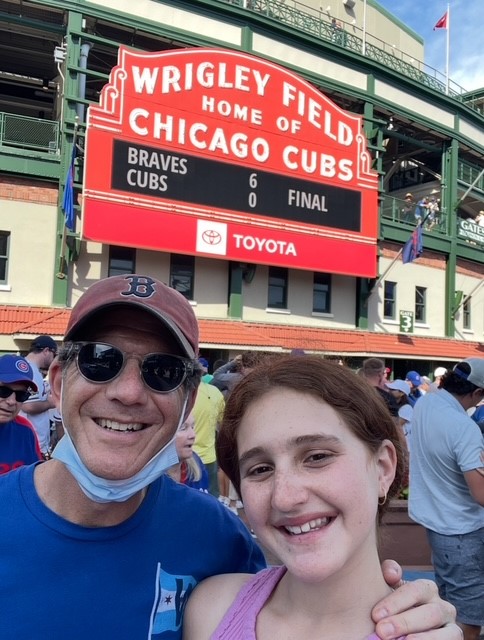
Wrigley Field is where I dragged my family on our first trip to Chicago; my girls on the next; my youngest daughter on Father’s Day a few years ago because, well, it was Father’s Day.
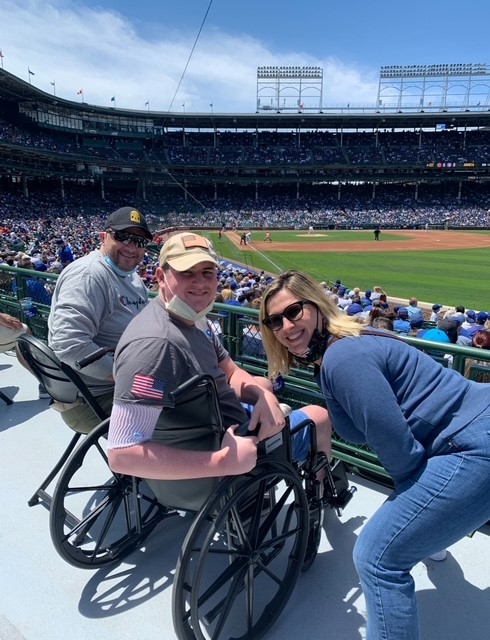
The Friendly Confines is where I took my stepson and his father as the former was recovering from cancer treatment, as there is nothing like a Sunday in the North Side sun to brighten your spirits.
It is where I took my father (and son and daughter) on a blustery day in 2023 just so we could truly experience the winds off Lake Michigan.
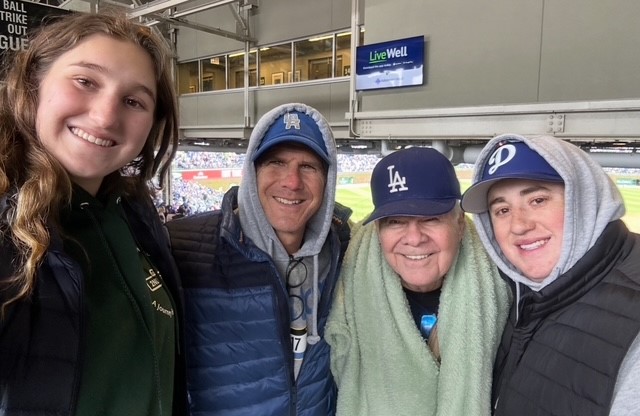
One night a few summers ago I forwent the actual ballpark, and had dinner right on Clark Street just so I could experience the sounds of the game smack in the heart of Wrigleyville. Wrigley Field calls to me like Charlie Grimm called to Irwin Osheroff; I find myself drawn to the corner of Clark and Addison time and time again.
Does my love of Chicago, and that park, trace back to Charlie Grimm? Did his beneficence to my grand father-in-law eventually, somehow, trickle down to me. Is my ardor an (in)direct result of some cosmic event that none of us is smart enough to understand? Who’s to say?
What I do know is that my late wife introduced me to her father, who told me the story of his father, and the kindness of an average big league first baseman who went out of his way to give a gift that has passed through generations, with yet more to go.
So, thank you “Jolly Cholly,” you had no way of knowing the long-term impact your small gesture would have on multiple families; thank you Irwin, for being the type of person that Charlie Grimm felt compelled to bestow such a special gift upon; thank you Marty, for indirectly bequeathing your birthright to me; and thank you Samantha, for giving me the son to whom this beautiful piece of leather will eventually pass. And, also, Happy Birthday!
PLAY BALL!!
This article first appeared in the March 7, 2025 edition of IBWAA’s Here’s the Pitch newsletter.