
The Savannah Bananas are not for everyone. The Savannah Bananas are for everyone. Of course there is an inherent contradiction in those two statements, but they remain true.
For certain baseball die-hards, those who lament the “Manfred Man” and the pitch clock and the ban on shifts, they will not like Banana Ball. But what you see when you go to a Savannah Bananas baseball game is something that can (and is) enjoyed by people of all ages, stripes, and backgrounds. I recently told a colleague – a massive baseball fan – that I went to a Bananas game, and he asked, “What is that?” And that is when I realized that despite their massive and still-growing success, not everyone knows about the Savannah Bananas. Allow me to provide a brief introductory course.
It all started in 2016 as a collegiate summer baseball team in the Coastal Plain League. Lynn Moses, a local Savannah resident, won the “name the team contest” and was honored with season tickets. The Bananas won the Pettit Cup (the CPL championship) in their inaugural season, and was named the league’s organization of the year in both 2016 and 2017.
Owners Jesse and Emily Cole, master marketers, wanted to change the summer baseball paradigm. So, in 2018, the team created the alternative “Banana Ball” rules (more about those below) and first used them during an intra-squad game. The fans seemed to love it, so in June of 2020, they played their first official game using the rules. After that, Banana Ball was played in their home park, Grayson Stadium, and customary baseball rules were used on the road. After the 2022 season, the Coles decided that playing two different types of baseball was not tenable, so they formed another squad – the Party Animals – to be their main opponent, and left the Coastal Plain League.
It is important to stop here to clarify a myth. When people ask about the Savannah Bananas, the most ready comparison is the Harlem Globetrotters. And, in some ways, that is apt. So, by transitive property, the Party Animals would be the Washington Generals. But, under even the most basic level of scrutiny, it is obvious that one thing is not like the other. For starters, the Bananas don’t win every game. The Party Animals (and now the additional opponents, the Firefighters, the Visitors, and the Texas Tailgaters) come to play. In fact, the Bananas recently had a seven-game losing streak against the Firefighters. And while the Generals are often the butt of the Globetrotters’ jokes, the Bananas’ opponents give as good as they get, and are never played for fools.
You see, despite some of the naysayers, at its core, Banana Ball is real baseball. The pitchers pitch – and they throw relatively hard; the batters bat – and they hit the ball a long way; the fielders field – they just do it with a little more flair. No game, score, or winner, is ever preordained. The final tally presents a winner, and oftentimes that is not the Bananas.
Here is a quick breakdown of the Banana Ball rules, which make this game different than “typical” baseball:
- Games are won by points, not runs. Score more runs in an inning, you win a point. Except in the final inning (more about that below), when every run counts as a point.
- Each game is subject to a strict two-hour time limit. Jesse comes onto the field to announce the start of the clock, and then we can watch the countdown on the scoreboard. No new inning can start after 1:50; but once an inning starts, it is played to its completion.
- Batters cannot step out of the batter’s box; doing so results in an automatic strike.
- There is no bunting; doing so results in an automatic ejection.
- Batters can attempt to steal first base on a wild pitch/passed ball.
- Walks are referred to as “sprints”. After ball four, the batter takes off and runs the bases and goes as far as he can until each defensive player has touched the ball.
- There are no mound visits.
- Any foul ball caught cleanly by a fan results in the batter being out.
- “The Golden Batter Rule”: One time per game, a team may send any hitter in the lineup to bat in any spot. (Jayson Stark wrote about the possibility of this in MLB earlier this season.)
- In the last inning, each run is counted as a point, so the goal is to score as much as possible.
- In the case of a tie, there is a “showdown tiebreaker.” Each team’s half-inning during the showdown ends with any out or with any run scored by the batter. If the batter puts the ball in play, he must attempt to score. A batter who draws a walk goes to second base. Any home run during the showdown ends the game. Here is the defensive arrangement for each showdown round:
- Round 1: Pitcher, catcher, one fielder.
- Round 2: Pitcher and catcher only. Yes, that means that the pitcher must chase down any hit ball.
- Round 3 (and beyond): Pitcher, catcher, and single fielder, but the round begins with the bases loaded.
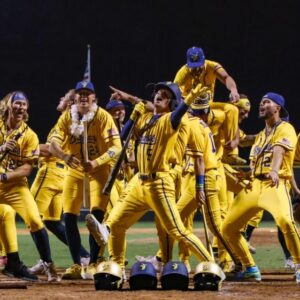
Beyond the difference in rules, a Bananas game is an all-out party. Music plays from minutes before the first pitch and continues until the final out is recorded. Players (and coaches) break out into dance routines every so often. The home plate umpire doesn’t just call balls and strikes, he dances like Frank Drebin. When a player hits a home run, it is not uncommon for him to surf on his teammates from third to home (you’ve got to see it to understand it). “Stilts,” a player standing nearly 11-feet tall often takes the mound and sometimes comes to bat. There are celebrity guest pitchers and batters (Patrick Renna, the “Bambino” from The Sandlot, pinch hit at a recent game in Anaheim).
But the game is just part of the party. Hours before the national anthem, the players are in the parking lot signing autographs for adoring fans (each player and coach comes armed with his/her own Sharpie). A couple of hours before the first pitch, the players and coaches participate in a parade around the outside of the stadium with the team’s band playing around them. Players play catch (both baseball and football) with fans – and not just in the lower bowl, the get all the way to the upper deck. There is a banana throwing contest from the farther reaches of the ballpark. The “Man-Nanas,” a group of former professional wrestlers entertain the crowd moments before the game begins. And, just to make sure everyone understands what they are about to see, the “Chief Potassium Enthusiast,” Matt Graifer, a former professional wrestling announcer, wearing a bright yellow sport coat and bow tie, stands atop the dugout and explains all of the rules to the fans.
If this sounds like a lot, it is. If it sounds a bit unhinged, it is. If it sounds like a darn good time, it is. But despite the fact that many Bananas game are broadcast on television, this is something that needs to be seen in-person to be truly appreciated. But don’t try to buy tickets directly from the team’s website – every game this summer is sold out, and there is a three million person wait list (not a joke or a typo). But, that is what is the secondary market is for.
PLAY (BANANA) BALL!!