In Boston, Brock Holt Is A Legend On and Off The Field

In the history of Major League Baseball, there have been nearly 21,000 players. Of those, 278 are enshrined in the National Baseball Hall of Fame and Museum (which will increase to 283 this coming weekend), and scores more currently playing will be there some day.

That leaves many, many players who have come and gone; gotten their proverbial “cup of coffee,” and then moved on to selling insurance or teaching middle school or coaching. Some players make an appearance, and we have no recollection of them ever being there. You might find an old baseball card and be reminded of seeing them play a game in Milwaukee in 1987, but nothing else comes to mind (looking at you, Steve Kiefer). For others, despite uninspired career statistics, they leave a mark – they are fondly remembered by the fans of the teams for which they played.

One such player is Brock Holt, the “Brockstar.” Holt is from Fort Worth, Texas, graduating from Stephenville High School in 2006. Undrafted, and with no formal collegiate offers, Holt attended Navarro College in Corsicana, Texas, about 80 miles southeast of his hometown. After two years there, he transferred to Rice University in Houston, putting up great stats, hitting .348 with 12 home runs, 67 runs scored, and 11 stolen bases — all in just 59 games. He was named to the All-NCAA Regional Team and the All-Silver Glove Trophy Series team.

His one-year success at Rice led Holt to be selected by the Pittsburgh Pirates in the 9th round of the 2009 draft. He spent parts of four seasons in the Pirates’ minor league system before being called up the “bigs” when rosters expanded on September 1, 2012. He immediately saw action, walking and scoring a run in his first major league game.

The next day he was Pittsburgh’s lead-off hitter, playing second base. After a strike out looking and a line out, he recorded his first big league hit — a single to center off Yovani Gallardo. Before the day was over, he would have his second hit and first run batted in.

Two days after that, Holt became only the second Pirate to ever have a four-hit game within his first four major league games (Jack Merson did it in 1951, but you knew that already).

When the season ended, the Pirates traded Holt (and Joel Hanrahan) to the Boston Red Sox in return for Jerry Sands, Stolmy Pimentel, Mark Melancon, and Iván DeJesús Jr. After starting the season at Triple-A Pawtucket, Holt got called to the big club to face the Angels right before the All-Star break. He ultimately played in 26 games, but was not on the post-season roster for the team that won its third World Series in ten years.

2014 was Holt’s breakout season, playing in 106 games and finishing 8th in Rookie of the Year voting. He built on that foundation with a strong 2015, making the All-Star team while accruing 2.8 bWAR (which would turn out to be a career-high).

A concussion derailed his 2016 season, limiting him to 94 games. But, in a sign of things to come, Holt hit .400 in the Division Series, which Boston lost to Cleveland.

Concussion symptoms and vertigo slowed his 2017 season, and he only played in 64 games. In 2018, Holt played six different positions (missing only pitcher, catcher, and center field). He hit .277, and was a spark plug for a team that won yet another World Series.

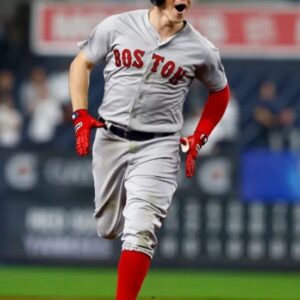
Holt may have reached folklore status with fans in New England in Game 3 of the 2018 American League Division Series against the New York Yankees. Becoming the first major league player to ever hit for the cycle in the post-season, he thumped the hated rivals, going 4-for-6 with five RBI. He saved the best for last, slamming a two-run dinger into the stands in right field in the top of the ninth to finish off a 16-1 boat race in the Bronx. In many ways, that game was the apex of Brock Holt’s major league career.

A scratched cornea and shoulder impingement limited his 2019 — his final year before free agency — to 87 games. He signed a one-year contract with Milwaukee that off-season, but was designated for assignment after just 16 games, after slashing .100/.222/.100. The Washington Nationals gave him a look in 20 games, where his slash line improved to a meager .262/.314/.354.

In a full-circle moment, Holt signed a minor league contract with the Texas Rangers prior to the 2021 season. In 76 games, he slashed .209/.281/.298, hitting just two home runs. On August 7th, he made his third career pitching appearance, retiring all three Athletics batters he faced.

During Spring Training of 2022, Holt signed a minor league deal with the Braves, but just eleven days later he requested his release. He officially retired from baseball in October of 2022.

Despite the late-career journey, Holt will always be remembered as a member of the Red Sox. As the club’s Jimmy Fund captain for five seasons, he and his wife Lakyn became the face of that charitable organization raising money for and the spirits of people getting treatment at the Dana-Farber Cancer Institute. And nearly two years after his retirement, Holt was named the co-chair of The Jimmy Fund, serving alongside broadcaster Tom Caron.

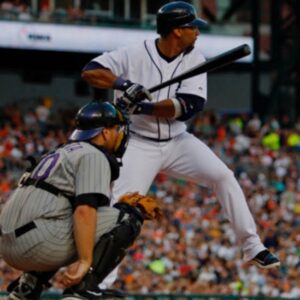
Two weeks ago, Holt found himself back at Fenway Park, this time wearing a totally different uniform. He was a special guest hitter of the Savannah Bananas, and participated in the Banana’s traditional “Dance Her Home” routine, once again entertaining 37,000 Boston faithful.

Some players come and go, and barely leave a mark. Others, like Brock Holt, live on in the hearts and the minds of a fanbase for years to come.

PLAY BALL!!
40 Years After the “Rick Camp Game”

July 4th marked the 40th anniversary of what has colloquially become known as the “Rick Camp Game.” But, as you will see, it was a whole lot more than that.

As is typical for a 4th of July game, this battle between the visiting New York Mets and the hometown Atlanta Braves, was scheduled to begin around 7:30 p.m., with a fireworks show planned upon its conclusion.

Rain in the Atlanta area pushed the first pitch back about 90 minutes, which may have been a sign of things to come. The Mets started Dwight Gooden, who was off from the start, while the Braves countered with Rick Mahler. Gooden couldn’t get through the third inning, and Mahler couldn’t get through the fourth, which may have been a sign of things to come.

Both teams scored in the first inning, and the Mets led 6-4 after six. The Mets extended their lead by scoring one run in the top of the eighth, but the Braves roared back with four in the bottom half — three on a Dale Murphy bases-clearing triple —to take the lead, 8-7. At this point, Atlanta and their faithful were just three outs away from a come-from-behind win and a spectacular fireworks display. But the Mets had other ideas.

With future Hall of Famer Bruce Sutter on the mound looking for his 15th save of the season (and 275th of his career), third baseman Ray Knight struck out. Two outs away. But three consecutive singles by Howard Johnson, Danny Heep, and Lenny Dykstra brought in the tying run. It may have been a sign of things to come.

The teams went scoreless in innings ten through twelve. In the top of the 13th, after a Ray Knight single, HoJo his a two-run homer to stake the Mets to a 10-8 lead. But, in the bottom half, Rafael Ramirez led off with a single, and after two outs (meaning the Mets were just one out away from ending this game and giving the fans at least 50% of what they came for), Terry Harper hit a game-tying two-run dinger. After thirteen innings, the score stood 10-10.

The 14th through 17th innings were uneventful, although the Bravos did get two runners on with two outs in the 16th. Alas, a Paul Runge fly out ended the threat. On they went.

Johnson led off the 18th with a single, and moved to third on a sacrifice bunt plus a throwing error. Dykstra followed with a sac fly to make it 11-10 in favor of the Mets.

In the bottom of the 18th, Gerald Perry grounded back to the box, and Harper grounded to first unassisted. The Braves, now completely out of position players, had no choice but to send pitcher Rick Camp to the plate. Atlanta was again down to its last out. And this time they had a player with a career .060 batting average and 83 strikeouts in 167 at-bats, with nary a single home run to his name. So, what did Camp do? To the Mets? To the long-suffering fans? You already know the answer. He hit an 0-2 curveball over the wall in left field to tie the game. Prior to the second pitch of the at-bat, Pete van Wieren said to his broadcast partner:

“Ernie, if he hits a home run to tie this game, this game will be certified as absolutely the nuttiest in the history of baseball.”

Well, consider it certified.

The jog around the bases may have tired Camp out, as he allowed a Gary Carter single to start the 19th, and then, after a sacrifice and an intentional walk, Knight doubled in the Mets’ 12th run. Another intentional walk preceded another Danny Heep single, which ultimately cleared the bases due to a Claudell Washington throwing error. Two batters later, Wally Backman’s singled plated Heep, extending the Mets lead to 16-11. Ironically, Keith Hernandez, who hit for the cycle in the game (it took him 12 innings and seven plate appearances to pull it off), grounded out to end the threat.

Even trailing by five; even though it was well past 3 o’clock in the morning, the Braves were not yet done. After a ground out, Hernandez committed the rare error, allowing Washington to get to second. A Ramirez fly out got the Mets — once again — one out away. But then Ron Darling walked Dale Murphy, and then walked Gerald Perry, before a Terry Harper single combined with a Howard Johnson error allowed two runs to score. The Braves were then just one batter away from bringing the tying run up to bat. Unfortunately, Rick Camp didn’t have any additional magic in his bat, and he struck out struck out to end the game.

What may be the most shocking tidbit from this game is that the Braves gave the remaining fans exactly what they were promised: a fireworks show. At just about 4 a.m. it commenced, scaring local residents who thought that war with Russia had begun.

Let’s Give Some Love To The Career of Gary Sheffield

I played first base from the time I first held a mitt until my freshman year of college. And in all those years, there was never a time when I was holding a runner on first and a left-handed batter came to the plate, that I didn’t get just a little bit nervous. Less than ninety feet separated me from a ball smashed off a bat that, because of the angle, you really couldn’t pick up immediately. It did not matter the level of competition — high school, American Legion, collegiate fall ball — it was still a scary prospect.

And that was at first base, which is most definitively not the “hot corner.” That designation is reserved for the other side of the diamond. That is where careers are made. Just ask Brooks Robinson and Mike Schmidt; Graig Nettles and Chipper Jones; Adrian Beltre and Nolan Arenado. There are more names you could add to this list who dug their spikes into the dirt — and sometimes on the grass — and dared sluggers to get one past them.

Considering my trepidation at first base, I have often wondered what third baseman were thinking when Dick Allen or Dave Winfield or Frank Thomas came to the plate. Today, that guy would be Giancarlo Stanton, with his severely closed stance and a career average exit velocity of nearly 94 MPH.

But when I was growing up, the guy who instilled the most fear, the guy who wiggled his bat above head in a taunt of the damage he was about to inflict, the guy who smashed 467 doubles and 509 home runs, and who won five Silver Slugger Awards, was Gary Sheffield. If someone had ever asked me to play third base when Gary Sheffield came to bat, I would don catcher’s gear; and I would play deep, like outfield grass deep. Imagine having Sheffield at the plate with the infield in? Better yet, don’t imagine that…that is the stuff of nightmares.

It’s unfortunate that Sheffield’s career ended before Statcast began measuring exit velocities, because there is no doubt he would he would be amongst the hardest hitters in the history of the game. But Sheffield was more than just a violent swinger — he was a complete hitter.

In 1992, his fourth full season in the big leagues, he won a batting title with San Diego, hitting .330. That .330 also included 34 doubles and 33 home runs, with 323 total bases for the season. That garnered him his first All-Star appearance, his first Silver Slugger, and third place in MVP voting (behind some guy named Bonds and Terry Pendleton).

Three years later, in 1995, he slashed .324/.467/.587, for a 177 OPS+.

The next year — 1996 — he was even better. He slashed .314/.465/.624, for a 1.090 OPS (which led the league), and a 189 OPS+ (which also led the league). He was again an All-Star and a Silver Slugger, but came in sixth in MVP voting. That was the last season that any black ink (leading the league in a category) appears on Sheffield’s Baseball Reference page.

But, rest assured, the next thirteen seasons of his career were nothing to sneeze at. Playing until his age-40 season, all he did over those years was slash .292/.400/.521, for a .921 OPS and a 141 OPS+. The man could flat out hit.

Unfortunately, Sheffield’s seasonal and thus career bWAR calculation was hampered by his woeful defense. He started his career as a shortstop, soon moved to third base, and then retreated to the outfield starting in his seventh full season. How about this for an ignominious stat: In each of his 22 years in the game, Sheffield never had a positive dWAR. It didn’t matter what position he was playing; his worst season was -2.9, playing third base in 1993, and his best was -0.2, playing third in 1990.

But Sheffield didn’t earn more than $168 million over the course of his career for his fielding gloves, just his batting gloves.

His career .907 OPS is 65th all-time. His 140 OPS+ informs us that over all those seasons, he was 40% better than the average major league hitter. He hit 509 home runs, and yet never struck out more than 83 times in a single campaign. In fact, he has considerably more walks (1,475) than strike outs (1,171).

Sheffield petered out on Hall of Fame voting last year, earning just 64% of the vote, 11% shy of induction in his final year on the writers’ ballot. His candidacy is a Rorschach test for baseball fans.

Bill James’ Hall of Fame Monitor gives him a score of 158, where a likely HOFer scores 100.

By James’ Hall of Fame Standards, he scores a 61, which is above the 50 for the average Hall of Fame inductee.

But Jay Jaffee’s JAWS index shows Sheffield below Hall of Fame average in career bWAR (60.5 vs. 69.7); 7-year peak bWAR (38 vs. 42.2); 5-year peak bWAR (49.3 vs. 56); and bWAR/162 (3.8 vs. 4.9).

However, when you check Baseball Reference’s Similarity Scores, of the ten players listed as the players whose careers most closely resembled Sheffield’s, only Carlos Beltrán isn’t already in the Hall.

Sheffield’s career is weighted down by his lousy defense and the fact that his name appeared in the Mitchell Report, the 2007 investigation into steroids in major league baseball. Sheffield has freely admitted that he utilized “the cream” while recovering from knee surgery, but adamantly denied that he ever used steroids. He also admits to buying vitamins from BALCO, the lab at the heart of the steroids scandal, but calls any other allegations of illegal drug use “fabricated.” Sheffield, in fact, was one of the first players to speak out publicly about steroid use in baseball, appearing on HBO’s real sports alleging that each team has six or seven players “juicing.”

Unfortunately, what’s done is done. Sheffield’s only hope for Hall of Fame admittance now rests with the Contemporary Baseball Era Committee, which meets again in December of this year.

But regardless of that outcome of that vote, or any votes in the future, it is important that we, as baseball fans, fondly remember the career of Gary Sheffield.