A few weeks back, on the Baseball Tonight podcast, in advance of our nation’s 250th birthday, Buster Olney and Todd Radom discussed the most “American” moments in baseball history. Olney brought up Lou Brissie.
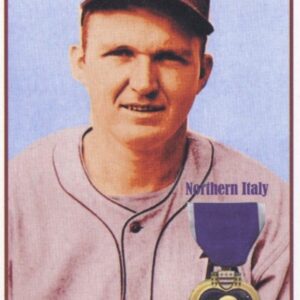
Leland Victor Brissie was born in South Carolina in 1924. He began his baseball career at the tender age of 16 in a textile league, where he caught the attention of Connie Mack. Brissie’s father insisted he finish his education before becoming a professional baseball player, and so he attended Presbyterian College in Clinton, South Carolina after high school.
At age 18, Brissie enlisted in the United State Army, and soon found himself fighting in World War II. As part of the 88th Infantry Division, he was involved in heavy fighting in Mussolini’s Italy. On December 2, 1944, at just twenty years of age, an artillery shell shattered his left shinbone into 30 pieces. At an Army field hospital Brissie was informed that the leg would need to be amputated. The budding pitcher pleaded with the medics, telling them that he was ballplayer and that he needed his leg to continue his career. He said he was willing to risk his life to save the leg.
Two years and twenty-three surgeries later, with his left leg now shorter than the right, and a metal brace holding everything in place, Brissie was home from the war and able to resume playing. The injury caused lifelong pain in the leg, but that was nothing compared to his desire to pitch in the big leagues. Mack was finally able to sign him in 1946. Brissie began at Double-A Savannah in 1947, and won 25 games. He got “the call” in late September of that year, making his major league debut against the Yankees. He went seven innings, allowing nine hits and five earned runs; he did strike out four in taking the loss.
The next time Brissie took the hill was the second game of the 1948 season against the Red Sox. In the sixth inning, with Dom DiMaggio on second after a double, Ted Williams hit a line shot back up the middle that smashed into Brissie surgically repaired left leg. DiMaggio scored on the play and Williams reached first safely. Everyone quickly crowded around the fallen pitcher. In his memoir, My Turn At Bat, Williams recalled how guilty he felt in the moment, and he rushed over as well.
Williams propensity to hit the ball to the right side of the field was so pronounced that he was often the victim of the “Ted Williams Shift” (originally known as the “Boudreau Shift”). This, of course, was long before analytics and spray charts and Joe Maddon and the Tampa Bay Rays and then MLB rules changes banning “the shift.” But on this April day, Williams went back through the box and right into the war hero pitcher.
When Williams reached the mound, Brissie, by all reported accounts, looked up at the slugger and yelled: “For chrissakes, Williams, pull the damn ball!” Brissie shook off the injury and retired 10 of the next 11 batters – including striking out Williams in the ninth – to complete the 4-2 victory for the Athletics.
Brissie’s career would last seven seasons, with him playing the final two-plus years in Cleveland. He finished with a record of 44-48 with a 4.07 ERA and a 102 ERA+. But the stats are secondary to the mere fact that he played major league baseball at all.
And it is quite possible that he is most remembered on the baseball field for the time when two war heroes faced off against one another, one giving it his best shot, the other taking the shot, and then dusting himself off to stay in the fight.
Brissie was awarded a Bronze Star and a Purple Heart as well as an American Campaign Medal for his services in World War II. After his retirement, Brissie served as the National Director of American Legion Baseball, and was part of President Kennedy’s Physical Fitness Council. Later on he would scout for the Dodgers and the Braves.
We should never forget the story of Lou Brissie, who defied the odds to live – with two legs, a full heart, and a baseball career – 89 fine years.
PLAY BALL!!
