The Angels’ Roster Would Be Solid If It Were Just A Few Years Ago

As of this writing, the Angels are the worst team in baseball…even worse than the Colorado Rockies. They are currently playing on a below-70-win pace. They won 72 last season, 63 the year before, and 73 two years before that. One thing in their favor, they have never lost 100 games in a season. So there’s that.

For a while there (2018-2023) they employed two of the greatest players to ever lace up their spikes. And yet, they still couldn’t do anything. And yet, they have averaged more than 2.5 million fans per year for the last four seasons, and are on pace for the same this year as well.

Prior to the season owner Arte Moreno cited an internal fan survey that said winning is not a top-five priority for the fanbase. And that may be why he doesn’t seem to care who he puts on the field, or how far past their sell-by date they may be.

On Episode 2490 of the Effectively Wild podcast, hosts Ben Lindbergh and Meg Rowley discussed how good the Angels could be with their current roster if it just were another year, or maybe even another decade.

Let’s take a look:

Vaughn Grissom has 211 plate appearances for the Angels this year, which is 55 more than his previous career high with Atlanta in 2022. That year he accrued 0.8 bWAR, also a career high.

Jorge Soler is essentially the Angels’ everyday designated hitter this season. He was the 2021 World Series MVP with the Atlanta Braves. And yet you would need to go all the way back to 2019 to find a year in which he had more than 1 bWAR (he had 3.5 for the Royals).

Josh Lowe has played 60 games for the Angels this year. He put up 3.7 bWAR for the Tampa Bay Rays in 2023.

Yoán Moncada has come to the plate 130 times for Anaheim this year. But we are seven years from 2019, when he had 5.1 bWAR for the Chicago White Sox.

In 2021, while playing for the Pirates and the Padres, Adam Frazier put up 4.0 bWAR with a 176 hits. This year has played in 41 games with the Angels and banged out 17 hits.

Travis d’Arnaud has received limited reps at catcher this year, which is good because we are four years removed from when he was 2.8 bWAR player with the Braves.

Jeimer Candelario had 3.6 bWAR for the Detroit Tigers in 2021 when he led the league with 42 doubles. This year he has gotten 20 plate appearances for the Angels.

Nick Madrigal was once a hot prospect in Chicago, with both the White Sox and the Cubs. He has never lived up to his promise as a hit-first middle infielder, but he did have a 111 OPS+ in 2021. This year he 12 hits in the 15 games he has played in SoCal.

Alek Manoah pitched in the All-Star Game in 2022 when he came in third in Cy Young voting. This year the Angels have given him five starts. He has 9.82 ERA.

In 2022, Jordan Romano pitched in 59 games for the Blue Jays, and ended the year with 2.9 bWAR. He had 2.2 the following season. The Angels have ran him out of the bullpen 11 times for a 10.13 ERA before releasing him.

Trey Mancini is an incredible feel-good story. He came back from colon cancer, thought about retiring, had a daughter and decided to give it another go. The Angels put him on a minor league contract and he made his way back up, getting three hits in his debut with the Halos. But you have to go back to 2019 to find his best season. That was when he hit 35 home runs, drove in 97, and accrued 3.7 bWAR for the Orioles. After five games with the Halos, he was released in late June.

If we wanted to continue this exercise into last season, we could keep it going. Kyle Hendricks pitched for the 2016 World Champion Cubs and he made 31 starts for the Angels in 2025. We also could add Kenley Jansen, JD Davis, Tim Anderson, Chris Taylor, Taylor Ward, Andrew Chaffin, and Nicky Lopez to this list of players who were once something, but weren’t anything when the Angels elected to employ them.

Moreno may be right. Fans may show up regardless of who takes the field in their crisp white jerseys. Mike Trout may be enough of a draw to keep the faithful happy. But at some point he will retire (or demand a trade); at some point the fans will grow tired of watching retread players trying to compete with teams that have an actual plan for winning. If and when that happens, the Angels will need to do more than look to the past if they want to have any hope for the future.

PLAY BALL!!
War Hero Lou Brissie And His Most Famous Moment

A few weeks back, on the Baseball Tonight podcast, in advance of our nation’s 250th birthday, Buster Olney and Todd Radom discussed the most “American” moments in baseball history. Olney brought up Lou Brissie.

Leland Victor Brissie was born in South Carolina in 1924. He began his baseball career at the tender age of 16 in a textile league, where he caught the attention of Connie Mack. Brissie’s father insisted he finish his education before becoming a professional baseball player, and so he attended Presbyterian College in Clinton, South Carolina after high school.

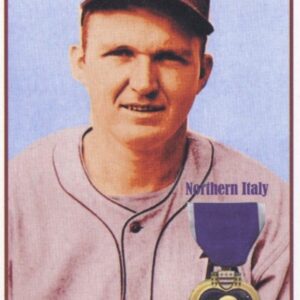
At age 18, Brissie enlisted in the United State Army, and soon found himself fighting in World War II. As part of the 88th Infantry Division, he was involved in heavy fighting in Mussolini’s Italy. On December 2, 1944, at just twenty years of age, an artillery shell shattered his left shinbone into 30 pieces. At an Army field hospital Brissie was informed that the leg would need to be amputated. The budding pitcher pleaded with the medics, telling them that he was ballplayer and that he needed his leg to continue his career. He said he was willing to risk his life to save the leg.

Two years and twenty-three surgeries later, with his left leg now shorter than the right, and a metal brace holding everything in place, Brissie was home from the war and able to resume playing. The injury caused lifelong pain in the leg, but that was nothing compared to his desire to pitch in the big leagues. Mack was finally able to sign him in 1946. Brissie began at Double-A Savannah in 1947, and won 25 games. He got “the call” in late September of that year, making his major league debut against the Yankees. He went seven innings, allowing nine hits and five earned runs; he did strike out four in taking the loss.

The next time Brissie took the hill was the second game of the 1948 season against the Red Sox. In the sixth inning, with Dom DiMaggio on second after a double, Ted Williams hit a line shot back up the middle that smashed into Brissie surgically repaired left leg. DiMaggio scored on the play and Williams reached first safely. Everyone quickly crowded around the fallen pitcher. In his memoir, My Turn At Bat, Williams recalled how guilty he felt in the moment, and he rushed over as well.

Williams propensity to hit the ball to the right side of the field was so pronounced that he was often the victim of the “Ted Williams Shift” (originally known as the “Boudreau Shift”). This, of course, was long before analytics and spray charts and Joe Maddon and the Tampa Bay Rays and then MLB rules changes banning “the shift.” But on this April day, Williams went back through the box and right into the war hero pitcher.

When Williams reached the mound, Brissie, by all reported accounts, looked up at the slugger and yelled: “For chrissakes, Williams, pull the damn ball!” Brissie shook off the injury and retired 10 of the next 11 batters – including striking out Williams in the ninth – to complete the 4-2 victory for the Athletics.

Brissie’s career would last seven seasons, with him playing the final two-plus years in Cleveland. He finished with a record of 44-48 with a 4.07 ERA and a 102 ERA+. But the stats are secondary to the mere fact that he played major league baseball at all.

And it is quite possible that he is most remembered on the baseball field for the time when two war heroes faced off against one another, one giving it his best shot, the other taking the shot, and then dusting himself off to stay in the fight.

Brissie was awarded a Bronze Star and a Purple Heart as well as an American Campaign Medal for his services in World War II. After his retirement, Brissie served as the National Director of American Legion Baseball, and was part of President Kennedy’s Physical Fitness Council. Later on he would scout for the Dodgers and the Braves.

We should never forget the story of Lou Brissie, who defied the odds to live – with two legs, a full heart, and a baseball career – 89 fine years.

PLAY BALL!!

The Sad Story Of Mel Hall

When I was a kid, there was a outfielder for the Cleveland Indians who used to put batting gloves in each back pocket so that when he hit a home run, he could “wave goodbye” to the other team. In the parlance of the day, Mel Hall was a “hot dog.”

Funnily enough, he never got to wave goodbye to the other team more than 18 times in a season, so the gimmick may have been lost on the masses.

The Chicago Cubs selected Hall in the second round of the 1978 draft out of Port Byron High School in New York, which is about 30 miles west of Syracuse. Three years later, on September 3, 1981, he made his MLB debut, flying out to right field against Doyle Alexander of the Giants. He would get into ten more games the remainder of the year, collecting one hit in twelve plate appearances.

Hall became an everyday player for the Cubs in 1983, slashing .283/.352/.488 for a 128 OPS+, which was good for third place in Rookie of the Year voting.

The Cubs traded the outfielder to the Indians in mid-June of 1984. And while his numbers with Chicago were better than with Cleveland, he was still a solid performer for his new American League club (104 OPS+).

A car accident kept Hall out of nearly the entire 1985 season. He came back in 1986 and slashed .296/.346/.493, with a then-career-high 18 home runs. 1987 and 1988 were more of the same.

Prior to the 1989 season, Cleveland traded the outfielder to the Yankees, and that is when and where the real trouble began. During spring training, he brought both his wife and his girlfriend to the team hotel and then proceeded to watch them get into a fight near the pool. While on the injured list, he got into a violent wrestling match with Rickey Henderson. And then he brought a gun into the clubhouse. In the years before “Manny being Manny,” the team seemed to shrug it all off, with Hall stating, it’s “me being Mel Hall.”

He still played in 113 games that year for the Bombers, hit 17 homers and had a 103 OPS+.

His production was roughly the same in 1990. 1991 was up there with his best seasons, as he slashed .285/.321/.455, setting a career-high with 19 homers and 80 RBI. In 1992, he did it again, putting up about the same numbers, including his all-time high of 81 RBI.

And yet, when his contract with the Yankees expired, no MLB team wanted him. So, Hall took his talents east, and signed a two-year, $4 million contract to play for the Chiba Lotte Marines in the NPB. He then played for the Chunichi Dragons, before coming back stateside in 1996 with the San Francisco Giants. That experiment lasted a month, as the club released him after he got three singles in 25 at-bats.

Not willing to give up, he signed a minor league contract with the White Sox, but that lasted only twelve days. Years later he would try his hand at independent ball, but that didn’t lead anywhere.

While playing in New York, Hall was known to have two great passions: spending money and chasing women. That, unto itself, made Hall like many athletes. Unfortunately, Hall had a proclivity for young women. It started with him inviting a 15-year-old (and her family) to a game at Yankee Stadium in 1989. And then there were others. It took until 2007 for Hall to be arrested. It happened in Texas, where he was charged with two counts of sexual assault and of having sex with a woman under the age of 17. During the investigation, a second victim – under the age of 14 – was identified. A twelve-year-old girl was determined to have been raped by Hall.

He was ultimately convicted of three counts of aggravated sexual assault of a child and two counts of indecency with a child. He was sentenced to 45 years in prison, where he currently resides. His earliest possible parole would be in late 2031, when Hall will be 71 years old. Based on his actions off the field, that simply may be too soon to let this predator free.

Hall could have made a name for himself as an irreverent player and a fan favorite. Instead, he became a clubhouse cancer, a pariah, and a convicted felon.

It will be a long time until Mel Hall can ever again… PLAY BALL!!