Comparing The Careers and Earnings of Kiké Hernández and Jurickson Profar

There are two players who have played against each other for years. One was born in Curaçao in 1993 and the other in Puerto Rico in 1991. One was signed as an amateur free agent and the other was taken in the sixth round of the 2009 draft. One made his major league debut at age 19 as a potential phenom, while the other did so at 22 as a potential utility player.

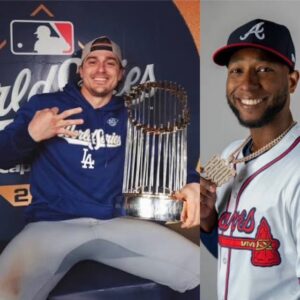
The first player is Jurickson Profar, who came into the league as an infielder, with the hope that he would become the face of the Texas Rangers franchise. The second is Enrique (Kiké) Hernández, who came up with the Houston Astros as a utility player for 42 games before he was traded to the Miami Marlins to finish his rookie campaign. When that season ended, Hernández was traded again, this time to the Dodgers.

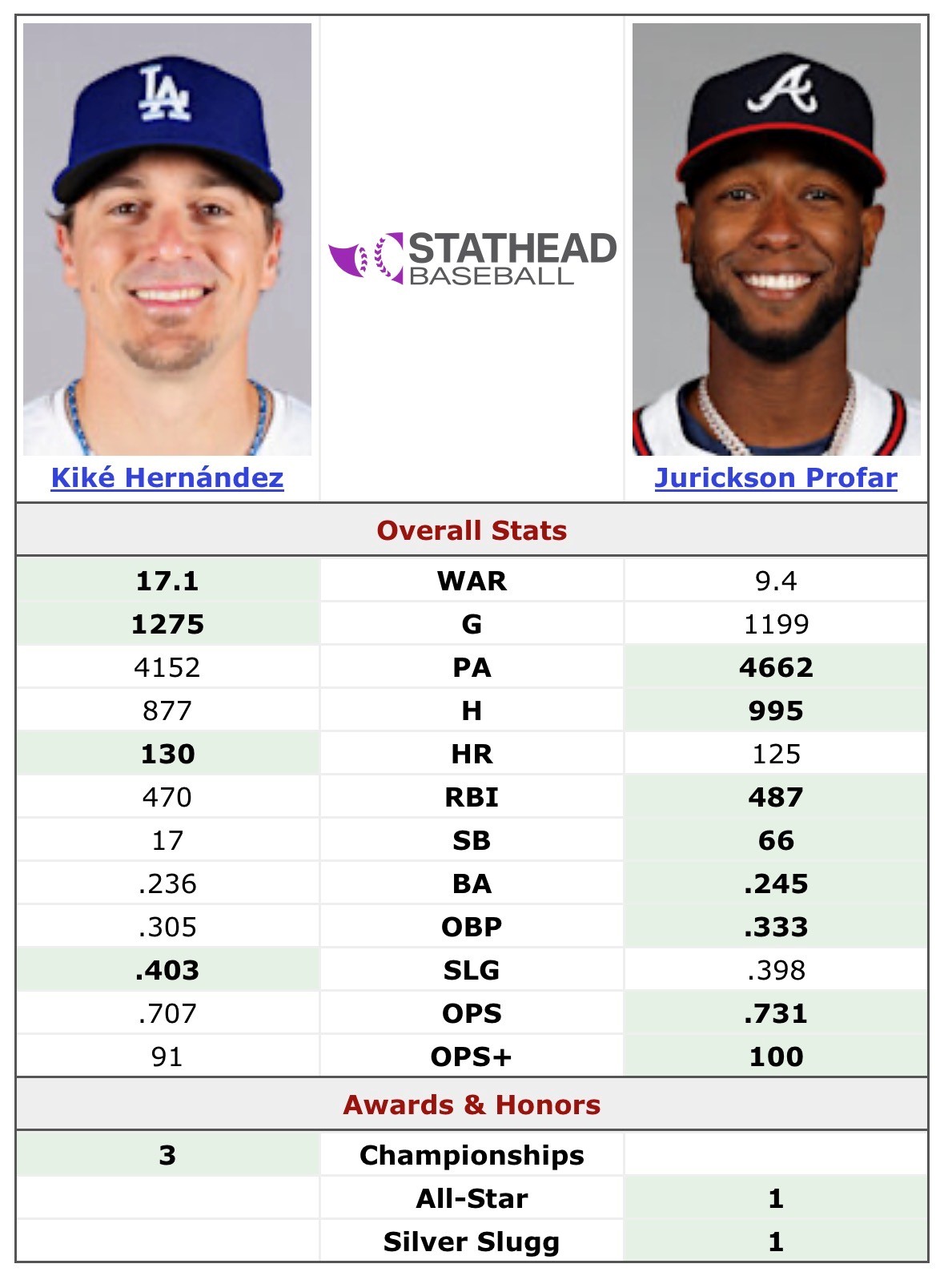
Now that each player has a dozen seasons in the books, let’s take a look at the tale of the tape:

As of today, they are within $8,000 of each in career earnings ($41.415 million vs. $41.423 million). Note, those figures do not include playoff shares – an important distinction.

While the stats look very similar, it is in October where their careers diverge. Profar has played in 27 post-season games while Kiké has been in nearly four times as many (103). Hernández has 80 hits, sixteen of which has been homers, while Profar has only 23 hits, with just one dinger.

Profar’s playoff slash line: .258/.340/.292; Hernández’s: .272/.339/.486.

Arguably Profar’s biggest post-season moment was when he robbed Mookie Betts of a home run – and then taunted the Dodger Stadium fans – in Game 2 of the 2024 National League Division Series.

Arguably Hernández’s biggest post-season moment was when he hit three home runs against the Cubs in Game 5 of the 2017 NLCS at Wrigley Field (including a grand slam). However, that was just one of the many times Hernández has excelled under the bright lights of playoff baseball.

There was Game 2 of the 2021 American League Division Series, while playing for the Red Sox against the Tampa Bay Rays. Kiké had four extra-base hits, including three doubles and a homer in a 5-for-6 performance with three runs scored and three knocked in.

The next game, back in Boston, he went 3-for-6 with another home run.

After the Red Sox dispensed with the Rays, in Game 1 of that year’s ALCS, Hernández – playing against the team that drafted him – went 4-for-5 with two home runs in Houston. And then he had two hits in each of the next two games of that series.

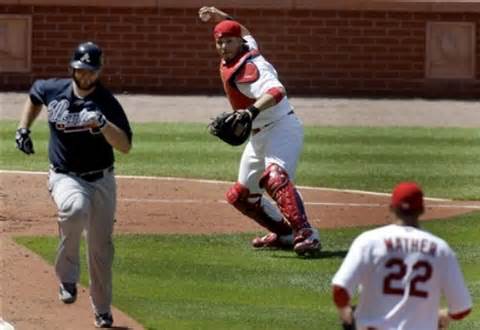
It’s not just with the bat that Kiké has proved valuable in the post-season. In the fateful fifth inning of Game 5 of the 2024 World Series, with no outs and runners on first and second and the Dodgers trailing 5-0, Will Smith hit a ground ball to the right of shortstop Anthony Volpe. Hernández made sure to line himself up in Volpe’s throwing lane to third, causing the throw to be low and offline, allowing him – and all of the runners – to be safe. We all know what happened next.

And let us not forget his glove. In bottom of the ninth inning of Game 6 of this year’s World Series, with the Dodgers down three games to two, leading 3-1, with the tying runs in scoring position, Hernández perfectly played a low liner off the bat of Andrés Giménez, thus beginning the first 7-4 double play to end a World Series game.

And we cannot forget his brain. Moments before Kiké started the aforementioned double play, he had the presence of mind to immediately throw his hands in the air when Addison Barger’s deep drive lodged under the left field wall, forcing the umpires to call it a ground-rule double. Because of the ruling, Myles Straw had to go back to third base, taking a run off the board, and Barger had to go back to second, setting up the historic double play moments later. Center fielder Justin Dean looked back over his shoulder and saw Hernández signaling the ground rule, and followed suit. Had he not seen his teammate, Dean may have tried to pick up the ball, potentially nullifying the rule, allowing the run to score and Barger to move to third with one out. Kiké’s instant processing of the rule was a decisive factor in the outcome of Game 6.

And yet, for all of his acumen, he was almost a goat. In the bottom of the ninth inning of Game 7, with the game tied and the bases loaded, Ernie Clement hit a high drive to left. Hernández raced back thinking the World Series would end on a ball hit over his head, only to be run over by teammate Andy Pages, who made the game-saving catch. The near disaster turned into just another highlight on Kiké Hernández’s post-season résumé.

Now back to the comparison. Hernández is currently a free agent. He is most likely waiting on the Dodgers to complete their off-season machinations with a potential signing of Kyle Tucker or a trade of Teoscar Hernández. He played last season on one-year $6.5 million contract, after playing on a one-year, $4 million contract the season before. If he is lucky, he will match the $10 million he got from the Red Sox in 2023. And yet Profar, the player with a similar regular season pedigree but fathoms from Hernández when it really counts, still has two years and $30 million left on the three-year, $42 million deal he signed with the Braves prior to the 2025 season. Of course, Profar forfeited about $5.8 million of that while he served an 80-game suspension for the use of performance-enhancing drugs. Regardless, he still has $30 million guaranteed while, at present, Kiké has nothing.

Considering the totality of their careers, it just doesn’t seem fair.

PLAY BALL!!

Web Gems & Premier Plays Induce Strong Feelings

In the interest of full candor, I have an addiction. I am addicted to great defensive plays. Sure, most of us are. We baseball fans delight in watching highlights of a home run robbery or a player diving into the stands to make a great catch. But my compulsion runs deeper.

For instance, I can tell you – within a minute or two – when Baseball Tonight’s Web Gems, the ESPN Top 10, and MLB Network’s Capital One Premier Plays, will appear on my screen. And I plan my viewing of other programs around this schedule. Every day I receive MLB’s Morning Lineup newsletter. I skim the stories and then click on the link for Top Plays. I do this EVERY. SINGLE. DAY. In fact, when I once realized that I had missed some, I went back and watched Top Plays from weeks before.

I believe this inclination follows on from my own baseball career, as I was always better with the glove than the bat. Watching a batter hit a ball a country mile is very cool; but watching a defender cover a ridiculous amount of ground, leave his feet, jump up, and throw a laser across the diamond, is just something special.

However, because I watch replays of anywhere from 10 to 30 great plays every day from April through October, I often feel sympathy for some of the hitters who are denied the fruit of their labor because their counterpart has done something mind-boggling. To that end, I mentally put these gems into six different categories:

1.            Robbery of an Underserved Hit (Outfield Edition): There are a surprising number of these. A batter hits a flair behind the infield, and the right fielder comes racing in to make a sliding catch. Or a shortstop ranges well behind third, up the line, to take a duck snort hit away from a batter who got jammed on a cutter. I love this version, as the batter has no valid justification to hang his head. He shouldn’t have been rewarded for this particular swing of the bat, so the fielder making a Web Gem makes this a simple transaction in my mind.

2.           Robbery of an Undeserved Hit (Infield Edition): Like it’s outfield cousin, this one involves a swinging bunt or a slow roller. Here the batter deserves slightly more credit, as he at least busts down the line to beat it out. Whatever the negative feelings are for his soft hit are made up for by his hustle for an infield single. But time and again we see Matt Chapman (or his ilk) attack the ball, barehand it, and throw on the run to beat the batter by a step. I also love when a shortstop charges behind the mound and throws on the run. But my favorite version of this is the ‘tweener between first and second, because now you have three players in action, with either the first baseman or the second baseman fielding off-balance, and then throwing to a moving target – the pitcher – covering, catching, and stepping on the bag while a runner bears down on him from behind. The beauty of these plays, when combined with weak exit velocity, allows me to feel like the ledger is even.

3.          Great Catch In Foul Territory: This one stings just a little more. The batter fought off a tough pitch, and in some ballparks he would be rewarded with another swing or two. But, the third baseman somehow heads straight back and makes an over-the-shoulder catch on top of or behind the tarp, robbing the player of his at bat. Or a second baseman ranges deep behind first and makes a sliding catch in foul territory. These plays have gotten even more interesting in the past few years with the advent of netting down the baselines. Now we have outfielders acting like Spiderman, diving into the net to make the catch. Again, my heart goes out to the batter, but these plays sure are great to watch.

4.         Robbery of a Sure Hit: We all love this one. A batter smacks a ball into deep left center; it has double written all over it. And then, seemingly out of nowhere, the center fielder appears on our screen, leaps with an outstretched glove, and makes an impossible catch possible, as he rolls over and shows the world that he has the ball. Or a batter smacks a surefire single up the middle, only to have the short stop range too far to his left, dive, leap up, and make the throw to record the out. There is the scorched line drive that the third baseman dives for and takes out of the air with his glove actually behind him. Or maybe the worst version (from the hitter’s perspective): the stab of a line drive to first base that is turned into an unassisted double play. Two outs on one swing with a 100+ exit velocity may seem like the worst, but then there is…

5.           Home Run Robbery: This is the coup de grâce. A pitcher throws a ball 90+ MPH, the batter, in his 0.45 seconds to react, engages his swing and squares the ball up (he may or may not “barrel” it), and hits it 350+ feet. From the moment it leaves the bat, the hitter feels confident that he may have gotten – if not all – enough of it to take a slow trot around the bases. Meanwhile, the outfielder is ranging back, his feet hitting the soft dirt of the warning track, his non-glove hand feeling for the wall, and then he leaps. At that moment, it is truly a leap of faith. Faith that he has timed it right; faith that he has measured it right; faith that the wall will not inflict injury when he makes contact; faith that an overzealous fan will not obstruct his momentum or his potential catch (see, Hample, Zack). And then he does it. He reaches over the wall and takes a souvenir away; takes a run (maybe more) away; takes the fans’ breath away. Ask any outfielder, and they will tell you that this is the pinnacle of their profession, this is what they all hope and practice for, and you can see it on their face when they actually pull it off. And you can feel the batter’s pain. He is usually somewhere between first and second base when he realizes that his moment has quickly, and inexorably, become someone else’s moment. They typically drop their head. But, every-so-often, the batter will doff his helmet to the fielder, a show of mutual respect. I simply love that.

6.         Robbery of a Needed Hit: For years I thought the robbed home run was the greatest indignity for a batter. But, as I have grown older, and watched more and more baseball, I have come to learn that there is an even worse fate. Some batters are in a slump – they simply cannot buy a hit. Some guys are fighting for playing time, and need to make the most of every at bat. Some guys have been victimized by a slick fielder earlier in the game, and need to even things out. Now, to be clear, “Undeserved Hits” don’t fall into this category. To get my sympathy, they have to be sure hits. And the play has to befall a guy who can’t afford it. Chris Taylor, barely hitting .100, cannot have Francisco Lindor go into short left and make a jump-throw to first. Zack Gelof, hitting below the Mendoza line, with three dingers in 143 at bats, cannot have Jose Siri take a home run away from him. Every time I watch Web Gems, or MLB’s Top Plays, I keep a steady eye on the batter. It is rare, but also so very sad, when the same batter appears more than once in the same highlight package. I don’t care if you are Luis Arraez, Aaron Judge, or Randy Arozarena (the current holder of the worst batting average in baseball), having two righteous hits taken from you in one game is too much to bear.

Baseball is a marathon, and things tend to even out – for every snagged line drive there is a Baltimore Chop for a single; for every diving play in the outfield, there is a squib over the first baseman’s head. But, baseball is also a game of confidence. And it is easy to go into a downward spiral when nothing seems to fall – even well-hit baseballs. Hitting is hard enough with pitchers throwing at insane speeds, with unseen movement, from crazy arm angles. When a batter does well enough to do well enough, but repeatedly gets thwarted by the best defense on offer, it just doesn’t seem fair.

Not every series of Web Gems or Top Plays contains all six categories, but they usually check at least four of the boxes. To wit, last Sunday’s and last Friday’s editions:

PLAY BALL!!

The Baseball Diaries

I recently read “Faithful,” by Stewart O’Nan and Stephen King. Sure, I am nearly two decades late to the party; and sure, you might revoke my membership in the Red Sox fan club for waiting so long to read this charming tome, but what can you do?

For those of you who have not read the book, here is a very brief summary: O’Nan (a Pirates fan living in the Boston area) and King (a lifelong Red Sox fan) decided to watch and chronicle every game of the 2004 Red Sox season. They did this coming off the soul-crushing end to 2003, with Grady Little and Aaron (“Fu%&*ng”) Boone. There was simply no way for the writers to know what 2004 had in store; that 2004 would see the Red Sox win the Wild Card, then come back from 0-3 in the ALCS against the hated Yankees, and then sweep the Cardinals for Boston’s first World Series title in 86 years. In the spring of 2004, they were just two baseball fans who were gluttons for punishment; two men who embarked on a journey that neither will ever forget.

All of which got me thinking: If you were a writer, or a baseball fan, or maybe both, which team would you follow for the 2024 season on the off-chance the you could catch lightning in a bottle and witness a season for the ages? It turns out that there are a few extremely worthy candidates.

Cleveland Guardians

Any list wherein one might potentially witness history has to start in Cleveland. This past season marked 75 years since this organization won the World Series. They have been to the Fall Classic four times in that span, most recently in the epic 2016 clash with the Cubs. The Guardians are a perennial threat to win the weak AL Central, and have a good chance to do so in 2024, even though both ESPN and MLB.com have the Tigers finishing ahead of them.

But, like O’Nan and King, if you could hang with this club for 162 games, and they were to win it all, then that book could easily be a best-seller. Plus, watching José Ramirez man third base all summer would be nothing short of delightful.

Seattle Mariners

There are teams with longer dry spell than the Mariners, but none that offer more potential intrigue. Seattle ended a 21-year playoff drought in 2022, but not only have they never won the World Series, in their 47 years, they have never even been there. The Mariners’ President of Baseball Operations, Jerry Dipoto, has never met a trade he wouldn’t do, or an hour of the day he wouldn’t do it.

So, despite the club’s miserly ways (and the fact that they already inferred that they are out on Shohei Ohtani), you can count of Trader Jerry making things interesting and doing everything possible to keep the team in contention. Plus, there are considerably worse places to spend 81 days over the summer than T-Mobile Park.

Baltimore Orioles

The O’s got to the playoffs a year ahead of schedule, and then got thumped by the eventual World Series champion Texas Rangers. But few teams in baseball have a better, more exciting core of young players than the Orioles. Their largesse is such that they may trade a few of their prospects for pitching, as they simply don’t have enough room on the roster, or the infield, to play them all.

The team revolves around their catcher, Adley Rutschman, whose best comp is Buster Posey. Rookie of the Year Gunnar Henderson plays short, but will probably move to third to make way for phenom Jackson Holliday. Colton Cowser, Heston Kjerstad, and Joey Ortiz are on their way. Ryan Mountcastle and Cedric Mullins are veteran anchors in the lineup, and if the team gets some additional pitching, they will be extremely dangerous in 2024. Plus, like T-Mobile, who could balk at spending every night this coming summer at Camden Yards?

New York Mets

The Mets’ World Series title drought is nine years shorter than the Mariners’ existence, but in New York, you need to calculate the same like dog years. As such, it essentially has been forever since the Mets paraded down the Canyon of Heroes. When billionaire Steve Cohen bought the Mets in November, 2020, he claimed that it would be “slightly disappointing” if the team did not with the World Series in three to five years. Well, this will be his fourth year of ownership, and last season was an unmitigated disaster.

With new President of Baseball Operations, David Stearns, and with new manager, Carlos Mendoza (stolen straight from bench of the crosstown rivals), and with Max Scherzer and Justin Verlander mostly off the books, the Mets have even more of Steve’s money to throw at free agents and/or salaries to absorb in trades. The team has already been active (Luis Severino, Joey Wendle), and are rumored to be in on Japanese pitching star Yoshinobu Yamamoto. If the Mets were to take down the Braves and the Phillies, win the NL pennant, and then bring another championship to Queens, the book could join a long list of great ones written about The Miracle Mets.

Cincinnati Reds

Like the Orioles, the Reds broke out a year early, and also employ too many great young players for their limited roster. Yes, the team appears to have lost lifelong Red, the legendary Joey Votto, but that just opened up first base for another young stud. The Reds play in the feeble NL Central, where 83 wins was enough for second place, and the low 90’s should win the division. Hunter Greene and Andrew Abbott will anchor a starting rotation that could use one more solid arm; and Alexis Díaz may be every bit the closer that his brother is.

The excitement with this team starts with wunderkind Elly De La Cruz, who made his presence known with a vengeance last season, and then spreads to the likes of Spencer Steer (23 homers in his rookie campaign, arguably their best player), Christian Encarnacion-Strand (13 home runs in 222 at bats), Matt McLain (5’9”, .864 OPS in his rookie year), and TJ Friedl (who hit 18 home runs in 488 at bats, while playing a great center field). It does get a touch swampy at Great America Ballpark during the summer, but the breeze created by these swingers and De La Cruz’s sprinting around the base paths should make it more than tolerable. This team hasn’t won a World Series since my freshman year of college. If they did so this year, while you were chronicling it, you would have quite the tale to tell.

There are, of course, many other teams worthy of your daily diary (the Tigers stand to be much-improved; any team that lands Ohtani; maybe even the woebegone Padres). Just know that whoever you choose, it is a massive commitment, with no guaranty of a 2004 Red Sox anxiety-inducing, brink-facing, record-breaking payoff at the end. Regardless, it sounds like a hell of a lot of fun.

PLAY BALL!!

The Legend, The Myth, The Man

Maya Angelou said it best: “When someone shows you who they are, believe them.” Never has this been truer than in Philadelphia a few weekends ago. On Aug. 7, the Phillies held a 42-year celebration of their 1980 World Series championship. The team invited Pete Rose to attend. Rose showed everyone who he is (again). So, hopefully, that will be the last we see or hear from the 81-year old former batting champ.

Rose holds a special place in the mind, if not the heart, of many baseball fans. But, in order to truly appreciate the adage, “the man, the myth, the legend,” it is important to review the concept in reverse. When you do this for the all-time hits leader, the results are below replacement level.

Growing up in the late ‘70s and ‘80s, Rose was a god. With hits in 44 straight games in 1978, he is the closest anyone has come to matching Joe DiMaggio’s 56-game streak. And when he broke Ty Cobb’s hit record on Sept. 11, 1985, it was (unfortunately) just the first time the world stopped on 9/11.

Pete Rose’s legend was built on his resume. Over 24 years, 4,256 hits, the 1963 National League Rookie of the Year award, the 1973 NL MVP, three World Series titles, and a World Series MVP in arguably the greatest fall classic ever played (1975), Rose is one of the all-time greats.

The myth around Rose was personified in his nickname: “Charlie Hustle.” This is a guy who sprinted to first base after every walk. He famously decked (and effectively ended the career of) Ray Fosse in the 1970 All-Star Game. But, in later years, that “Charlie Hustle” moniker took on new meaning when we learned that Rose was an inveterate gambler who bet on baseball games, including those that he was managing for the Reds. When MLB discovered such transgressions in 1989, Rose was banned from the sport for life.

Which leads us to the man. As part of Rose’s lifetime ban, he was given the right to apply for reinstatement. Then-commissioner A. Bartlett Giamatti gave Rose a roadmap: “The burden is entirely on Mr. Rose to reconfigure his life in a way he deems appropriate.” So what did Mr. Rose do? He didn’t reconfigure a damn thing.

He set up card-signing tables in Cooperstown each Hall of Fame induction weekend; he bad-mouthed Giamatti, who died a week after instituting Rose’s ban; and he denied he bet on baseball for nearly 15 years. Then, in 2003, while on a publicity tour for his forthcoming autobiography, he spilled his guts. And when asked what took so long, Rose blamed his delay in coming clean on MLB, explaining to ABC News that he “never had the opportunity to tell anybody that was going to help me … I couldn’t get a response from baseball for 12 years.”

It seems that the only place to seek absolution is at MLB’s Manhattan offices, or in a news studio when you are trying to hawk books. It seems that the only reason to tell the truth and take responsibility for your misdeeds is if someone is willing to help you — in this case, help you get reinstated so you can (potentially) be inducted into the Hall of Fame.

That should tell us all we need to know about Pete Rose, the man. But then, in 1990, Rose pleaded guilty to two counts of filing false income tax returns. He spent five months in jail, paid a $50,000 fine, and ultimately paid $350,000 in back taxes.

The final straw has to have been in 2017, when a report surfaced that Rose had a sexual relationship with at least one (if not more) underage girl during his playing days. Per the Philadelphia Inquirer: “Rose admitted in court filings that he had sex with the woman in question, but believed that she was 16 at the time their relationship began ‘sometime in 1975,’ when Rose was 34 years old and married with two children.” (For the record, Rose was not charged with any crimes because the statute of limitations had expired.)

Despite all of this information, despite the ever-changing landscape wherein gambling is still verboten for players (even if it is actively encouraged among the fans), despite the fact that women now have larger and more significant positions within the game, despite the idea that sensitivity training is at the forefront of all organizations, despite MLB’s best efforts to rid the sport of its old boys’ network, despite the Phillies becoming a feel-good story in the second half, Rose’s invitation somehow didn’t get lost in the mail. On the eve of the celebration, the team released the following statement:

“In planning the 1980 reunion, we consulted with Pete’s teammates about his inclusion. Everyone wants Pete to be part of the festivities since there would be no trophy in 1980 without him. In addition, the club received permission from the Commissioner’s Office to invite Pete as a member of the championship team.”

In the face of the protests of many Phillies fans (especially women), Rose walked onto the field with Larry Bowa, Bob Boone, and Greg Luzinski. I guess there was no (real) harm in that. Unfortunately, the Phillies didn’t send media training with the invite.

Prior to the game, Alex Coffey, a female reporter for the Philadelphia Inquirer, asked Rose what he would say to the people who say his presence at the game sends a negative message to women. His response (which, come on, who couldn’t see this coming a double into the gap away):

“No, I’m not here to talk about that. Sorry about that. It was 55 years ago, babe.”

Yes, that is what he said. And when the AP questioned Rose about that response, he retorted (while attending a celebration for a championship that happened 42 years ago):

“And who cares what happened 50 years ago.”

But wait, there is more. After showing such great sensitivity prior to the ceremony, NBC Sports Philadelphia decided it was a good idea to bring Rose into the booth during the game. Rose began regaling the broadcasters and the viewers (and the FCC, I am sure) with war stories from years past. 

After (affectionately) referring to Bob Boone as a “son of a bitch,” and after saying he had to watch out for “horseshit” on the field, he recalled a story wherein Hall of Famer Tony Perez told radio broadcaster Joe Nuxhall that he hit a “cock-high fastball.” He then tossed out one more “no shit” before the announcers did their level best to change the topic, describing a Nelson Cruz single to right, and telling Pete that there was no seven-second delay. Rose just laughed it all off.

I have previously written that Rose should be in the Hall of Fame. The Hall is a museum, and it tells baseball’s story. It should tell Rose’s story, warts and all. And those warts should be emblazoned on his plaque. But there is no reason to give a man like Rose a platform, an invitation to attend award ceremonies or team reunions, an audience with journalists while wearing a team’s uniform, or a microphone during a live broadcast. That is just common sense.

It is always great to hear from former players — they provide color and context and texture to the game. They have tales to tell and yarns to weave. And teams should celebrate the anniversary of great moments (although, I am not sure the Phillies needed to commemorate their Jasper anniversary) and have heroes on hand for the fans to applaud once more. 

But the teams and the league need to be circumspect about those decisions, and take a cautious approach. Players get older and more crotchety and less politically correct; they don’t necessarily know what words and behavior are no longer acceptable. As such, it is incumbent upon the organization to make sure that the players don’t embarrass the team or themselves.

But with Rose, it didn’t take much thought. Everyone from the Phillies to the Inquirer to NBC Sports had to know that Rose would bring scorn upon the team and the former players, make himself the focal point of the weekend, and ruin it for everyone. Of course he would. That is the story of Pete Rose, the legend, the myth, and the man.

PLAY BALL!!

Fathers & Sons

When I first walked through the gates of Sancet Field (now Stadium) at the University of Arizona, my eyes were immediately drawn to center field. Shagging fly balls out there was the best baseball player I had ever seen. He wasn’t huge (5’11”, 195 pounds), but he was so smooth. He tracked down every line drive, had a cannon attached to his shoulder, and hit the ball a country mile. Little did I know that that guy was the son of former big leaguer Clyde Mashore, who played five years in the National League in the ‘70s, finishing with -1.7 of total bWAR. My new college teammate (however temporarily) was Damon Mashore, who made it to “The Show,” played three seasons, and ended his career in 1998 with a total of .5 bWAR. Advantage: Son.

In Joe Posnanski’s fantastic book, The Soul of Baseball, the late, great Buck O’Neil had the following soliloquy: “Why do you think there are so many fathers and sons in the game? Maybe it’s because baseball is a sport you hand down to your kids. Does a father teach his son how to be a running back? No, see, that’s instinct. Everybody runs with their own style. Does a father teach his son how to play basketball? Maybe, there are a few fathers and sons in basketball, right? But it’s not the same thing. In baseball, you play catch with your son. You teach him how to hold a bat, how to swing it, how to get under a pop-up, how to throw to the right base. You teach him how to run the bases. You teach him how to run back on a ball over his head. You teach him how to throw a curveball. In baseball, you pass along wisdom, like your father did for you in your backyard.”

With apologies to Helen Callaghan, baseball is a sport of fathers and sons. So, in honor of Father’s Day and in keeping with Buck O’Neil’s brilliant insights, let’s take a look at some other apples that have fallen from trees.

Per CBS Sports:

  • There are 240 father-son combinations to have reached the big leagues.
  • There are 46 active second-generation players.
  • Five families have produced third-generation players: the Bells (Gus, Buddy, David, and Mike), the Boones (Ray, Bob, Bret, and Aaron), the Colemans (Joe, Joe Jr., and Casey), the Hairstons (Sammy, Jerry, Johnny, Jerry Jr., and Scott), and the Schofield/Werths (Ducky Schofield, Dick Schofield, and Jayson Werth).

And when Bret Boone’s son, Jake, was taken in last year’s draft by the Washington Nationals, we were given a puncher’s chance of seeing our first fourth-generation player. Suffice it to say, one (but certainly not the only) prerequisite to becoming a Major League player is having a father who did so.

That in itself is not that interesting. What is interesting is that in lineups all across the big leagues you can find the name of a second-generation player who is markedly better than his father. And, when you include two Hall of Famers in the mix, that is high praise indeed. Here is just a handful of these comparisons (all statistics current through June 17th):

Fernando & Fernando, Jr. Tatis: I am not sure we even need to do this analysis. Senior had a fine 11-year career, finishing with 6.4 bWAR. But, if he hadn’t hit two grand slams in a single inning at Dodger Stadium in 1999, we probably wouldn’t know too much about him. Now he is best known for rearing his namesake. Junior is one of (if not the) most exciting players in the game today. He is a five-tool star who does everything better than nearly everyone else. If he can avoid injuries (a valid concern), he is on his way to living up to his $324M contract and possibly to Cooperstown. Sure, that is a long way off; but, in 2.5 seasons he already has 10.1 bWAR, 50% more than dad. Senior may get the biggest piece of chicken, but Junior gets the biggest applause.

Vladimir & Vladimir, Jr. Guerrero: This one is the most fascinating of the father-son combos. Vladdy had a historic career. Over 16 seasons he collected 2590 hits, slugged 449 home runs, knocked in 1496, had an OPS of .931, and ended with 59.5 bWAR. He was elected to the Hall of Fame in 2018 with 92.9% of the vote. And yet, Vladito may be better (but not quite yet). The son learned to control the strike zone (“do as I say, not as I do”), hits the ball harder and more consistently than dad, and is off to an incredible start. But at similar places in their careers, dad still outpaces son in nearly all metrics:


  G H R HR BB SO
Vlad 258 305 154 50 61 137
Jr. 250 266 137 46 107 174


That said, take a look at this from MLB’s Instagram account:

Dante & Bo Bichette: You will recall that Dante had a great career as part of the Blake Street Bombers in the thin air at Coors Field. He started with the Angels and then moved to Milwaukee before landing in Denver. He rounded out his tenure with Toronto, Cincinnati, and Boston, compiling 274 home runs, an .835 OPS, and 107 OPS+, with 5.6 career bWAR.

Those are fine numbers, and it was a fine career. But if we just look at his and his son Bo’s first chunk of time, we will see how much better the fils is than the père.


  G H R HR BB SO
Dante 178 130 54 18 22 110
Bo 142 176 107 30 37 148


Craig & Cavan Biggio: Craig was elected into HOF in 2015. He is clearly one of the best to ever play the game. As such, he left his son, Cavan, with huge shoes to fill. As such, Cavan may be the one kid on this list who doesn’t surpass his father in either skills or (ultimate) stats. Craig came up as a catcher, moved to centerfield, and landed at second base. Cavan is also a bit of Swiss Army knife, playing second, third, and a little outfield, and has actually gotten off to a better start to his career than his dad. But he has a long way – any many hit-by-pitches – to go before he can carry dad’s jock. Considering where they started, it will be interesting to see where they finish:


  G H R HR BB SO
Craig 184 140 78 16 56 93
Cavan 205 172 125 30 135 235


One additional note about the above three from Jayson Stark’s “Weird and Wild” column in The Athletic: Last weekend, all three players, all three sons of former big leaguers, hit home runs at Fenway Park two games in a row. That has never happened before.

Clay & Cody Bellinger: Clay Bellinger had an unremarkable four-year career. But, hey, he was a big leaguer. His best contribution may have been passing his DNA to his son Cody. Since Clay only played four years, let’s take a look at Cody’s first four years (which combines the 60-game 2020 and the 16 he has played to date in 2021):


  G H R HR BB SO
Clay 183 60 57 12 22 82
Cody 522 508 337 124 267 466


If Cody doesn’t play another MLB game, he has already won a Rookie of the Year, an MVP, and a World Series. It is already clear that Cody > Clay.

Charlie & Ke’Bryan Hayes: This one may be too soon to tell, but we can make an educated guess. Charlie had a very nice career, culminating with his squeezing the last out of the 1996 World Series. Over 14 years, he collected 1379 hits, 144 of which left the yard, and accumulated 10.5 bWAR.

Ke’Bryan is the top prospect in the Pirates organization, may soon be deemed the best defensive third baseman in baseball, and hits like a mule kicks. Putting aside his lack of understanding that you must step on all of the bases when you hit one over the fence, his career looks awfully bright, and it seems he may pass papa in no time flat.

Raúl & Adalberto Mondesi: One might claim this one is too soon to tell, but I think it is safe to say that dad will have bragging rights at Thanksgiving. Raúl played 13 years, hit 271 home runs, and threw runners out with abandon. He finished his career with 29.5 bWAR.

Adalberto is a middle infielder with not much pop (35 dingers over six seasons), not much contact (359 Ks in 1200 plate appearances with 30% K-rate), not much selection (4.2% BB-rate), and a .709 OPS. If you doubled Adalberto’s career and got him to 12 seasons, he would be WAY short of his dad’s ultimate numbers. I guess, theoretically, Adalberto’s 13th season could be Mike Trout-ish and get him the win in the last furlong, but I wouldn’t bet on it.

Bobby & Bobby, Jr. Witt: This one is truly too soon to know, but you know. Putting aside the difficulty in comparing pitchers and hitters, we are stymied by the fact that Junior has yet to reach the majors (despite having an incredible spring training and tantalizing the people in Kansas City). Bobby played with eight teams over 16 seasons, collected 142 wins against 157 losses (if you are into that type of thing), with a 4.83 ERA and a 1.569 WHIP. He ended with 14.6 bWAR. If Bobby, Jr. lives up to even half the hype, he will pass Senior in his third or fourth big league season.

As you may have guessed, there are many more former fathers and current sons we could compare, including the McCullers (Lance & Lance, Jr.), the Pedersons (Stu & Joc), the Brantleys (Mickey & Michael), the Bedrosians (Steve & Cam), the Quantrills (Paul & Cal), and the Shaws (Jeff & Travis). But the players listed above are a great cross-section of the current crop of kids, most of whom are boat-racing the men who taught them the game.

However, regardless of how many records they set or how much money they make, my guess is that they will all live by Ken Griffey, Jr.’s credo: Dad still pays.

Have a wonderful Father’s Day. Grab your pops, or grab your son, or grab them both, and…

PLAY BALL!!

TOTAL ECLIPSE OF THE PARK

TOTAL ECLIPSE OF THE PARK

Blog_Eclipse_Fest

Shortly after the first of the year, while listening to one of my favorite podcasts, I was clued in to an event happening in Keizer, Oregon, eight months hence.  At the time, I had little knowledge of the impending total solar eclipse; had never heard the phrase “path of totality”; and didn’t know the city of Keizer, Oregon even existed.  But the idea of travelling to a baseball game, to meet a bunch of baseball writers, and to be part of a communal event that happens maybe twice in a lifetime, was all simply too much to pass up.

After a few keystrokes, I learned that the Salem-Keizer Volcanoes – a Short-Season Class-A affiliate of the Giants – would be holding a four-day event around the first solar eclipse to run from coast-to-coast in 99 years.  The long weekend was to be hosted by the Volcanoes, baseball writers from FanGraphs, and a team of engineers and scientists from NASA.  This stood to be entertaining and educational.

I quickly contacted the Volcanoes ticket office and bought the Eclipse Package: tickets to Sunday’s and Monday’s games; breakfast at the park Monday morning; a parking pass; and a guaranty of NASA-approved eclipse viewing glasses.  Little did I know, at the time, what a global phenomenon the eclipse would become; what it would cost to travel to Oregon; and what an amazing experience this would be.  Now I know.

Last Saturday our whole family traveled to Portland.  After a night in the Rose City, we headed 45 miles south to the state’s capital.  Repeated warnings had braced us for Carmageddon-level traffic, but the ride was smooth and we got to town in less than an hour.  On Monday morning, my son and I woke at the crack of dawn to meet 5,000 like-minded fans/sky-watchers at Volcanoes Stadium.  We grabbed ballpark breakfast (think: camp) and milled amongst baseball fans and science nerds.  The air was cool, the sky was blue, and the crowd was atwitter.  We were three hours from “totality”.

Monday morning’s game against the rival Hillsboro Hops – scheduled to start at 930am – was delayed because the opponents got stuck in traffic.  (You’ve got to love Single-A baseball!)  The Volcanoes gave up four runs in the top of the first, while we sat in the stands wondering if it was the sight-lines at the stadium, the game time, or the encroaching moon, that caused the viewing experience to be less than optimal.  NASA soon answered the question, delaying the game before we reached the home half of first, due to lack of light.

Blog_Eclipse_Sundown

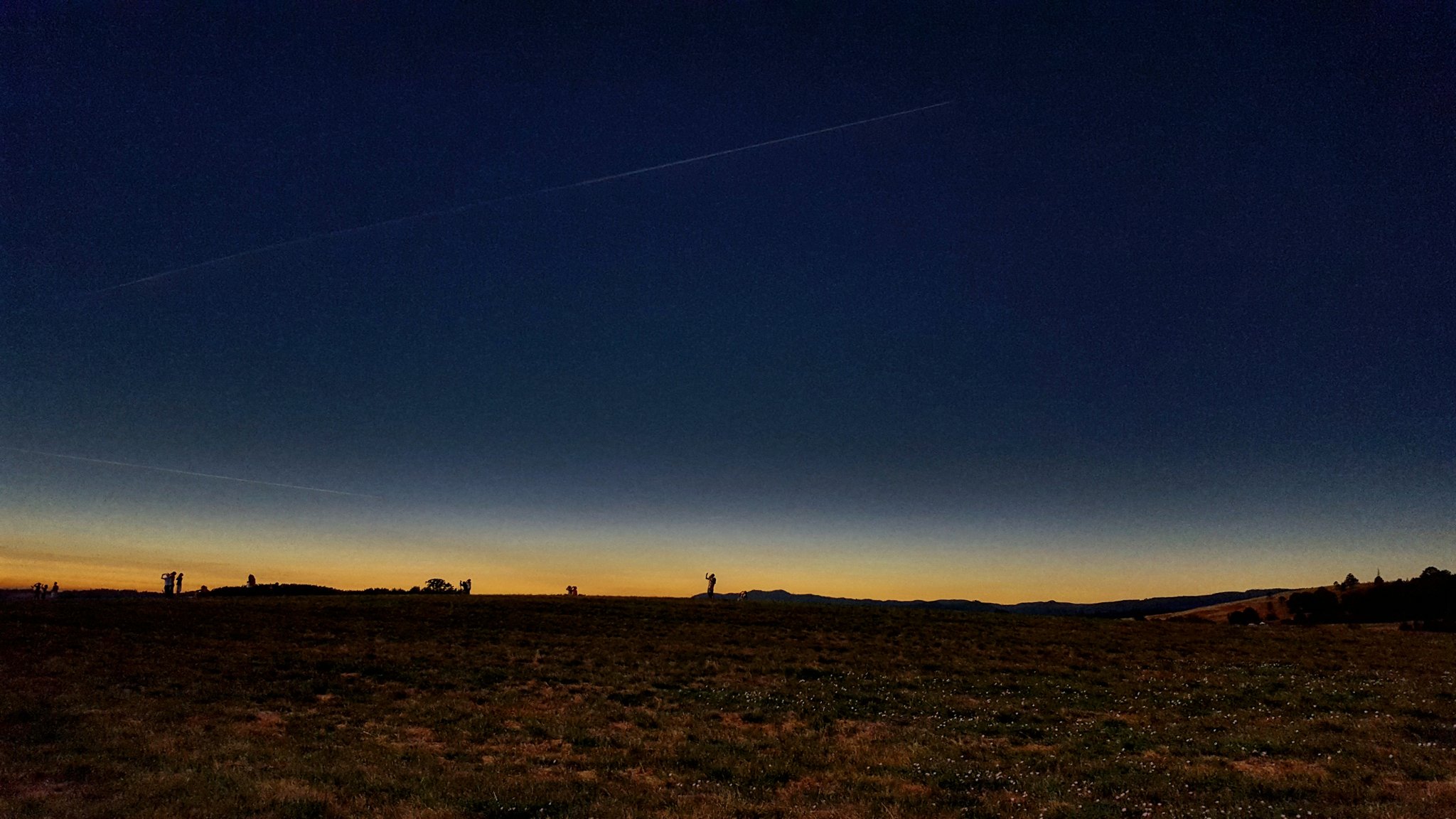
And that is when the suspense really took hold.  Players dropped their gloves and copped a squat along the baselines.  There was a buzz in the stadium as we donned our glasses and felt the air drop by as much as 12 degrees.  There was a light breeze, and we watched what appeared to be a sunset along the horizon – at 1015 in the morning.

Blog_Totality_1

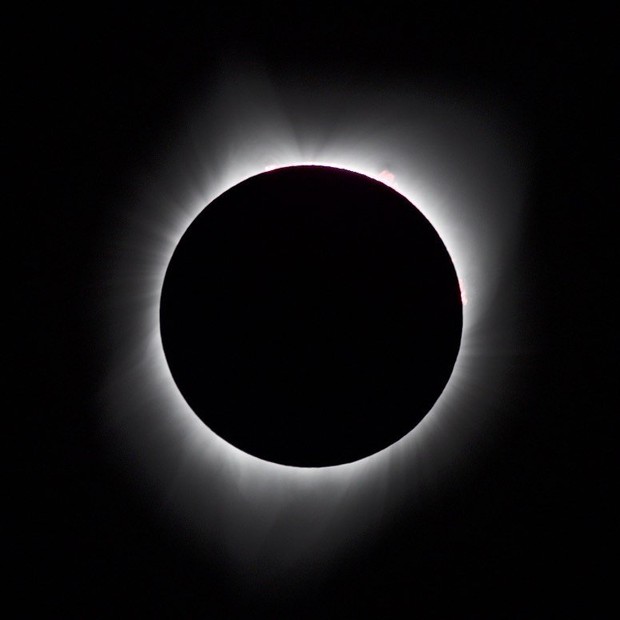
And then, within moments, the NASA engineers instructed us to remove our glasses, and we witnessed “totality”.  For nearly two minutes, the sun fought valiantly to overcome the moon’s obstruction, to little avail.


People who know of our trip have asked how it was.  Unfortunately, I am not a skilled enough writer to properly explain the experience, other than to state that I have chills just remembering it.  But, lucky for us, Ben Lindbergh was there – as part of the FanGraphs host committee – and he articulated with such prose that it makes me want to hang up my keyboard.  Please read his account.

I have joked with my sisters about Niagara Falls in 2024; and I now think there is a fair chance I will be there (April 8th, if you are planning ahead).

PLAY BALL!!

LITTLE BIG LEAGUES

LITTLE BIG LEAGUES

Blog_PNC_Field

On a recent Saturday night I found myself in the small town of Moosic, in northeast Pennsylvania.  Unless you grew up or went to school in the hills of the Keystone state, you probably never have heard of Moosic.  But if you are a baseball fan, you definitely have heard of the surrounding towns: Scranton and Wilkes-Barre (which, to be clear, is pronounced like “bear”).

Scranton Wilkes-Barre (S/WB) has been home to Minor League Baseball (MiLB) since 1919, and the Triple-A affiliate of the New York Yankees since 2007.  Over the past nearly 100 years, S/WB has hosted eight different organizations (nine if you count both the Philadelphia and Kansas City Athletics), and played in eight different parks.  In 1989, the team – then known as the S/WB Red Barons – moved into Lackawanna County Stadium, marking its eighth and (current) final “home” for S/WB baseball.

In 98 years, S/WB has had fourteen different team names, with the Red Barons having the longest tenure (from 1989 through 2006 as the Phillies’ Triple-A club).

In 2007, the Yankees moved to town, leaving Columbus, Ohio for facilities closer to the big club (just a 30-minute private flight away).  With the switch, the Red Barons became the Yankees.  But even the most valuable franchise in baseball (second most valuable in all of sports according to Forbes) cannot maintain naming dominance forever.  More about that in a moment.

At this point it would be helpful to provide a little insight into the business of Minor League baseball.  For our purposes, let’s refer to Major League organizations as “Organizations” and Minor League teams as “Affiliates”.  Or, as I like to think of them, the MLB club is the hot dog and the MiLB team is the bun.

Here is how it works: the MLB Organization “owns” the players (the hot dog), and controls all player-personnel matters.  The MiLB Affiliate owns the ballpark, and controls everything else, including ticket sales, concessions, promotions, travel, and accommodations, essentially everything that surrounds the players (the bun).

In order to be affiliated with each other, an MLB Organization signs a Player Development Contract (PDC) with an MiLB Affiliate.  The PDC has a two-year term, and renews automatically unless the Organization or the Affiliate notifies MLB that changes are afoot.

When an MLB Organization decides to find a new bun for its hot dog, it informs MLB, and the game of musical chairs begins.  That is because there are only 160 MiLB Affiliates, and unless/until an Affiliate-owner sells his/her affiliation to another location, when one Organization moves to a new location, the displaced Organization will need a new home; as such, the MiLB Affiliate owner is always entitled to some team.

For instance, when the Astros decided to leave Lancaster, California after last season, the owners of the Jethawks were not worried…they just needed to wait for the music to stop to find out which wandering soul would land in the California high desert.  (It was the Rockies).

Which brings us back to the Yankees.  After the 2006 season, the Phillies ended their PDC with S/WB in preparation for their move to Lehigh Valley (they had a two-year stop in Ottawa while their new stadium in Allentown was built).  The Yankees seized on this opening, moving their club (the hot dog) from Columbus (the bun) to the mountains of Pennsylvania (a new bun).  Now Columbus had to find a new Organization, which they did with the Cleveland Indians.  You get the idea.

When the Yankees’ Organization came to town in 2007, they compelled the S/WB owners to plaster their moniker on everything, most importantly, on the front of the S/WB jerseys.  But this is where the Affiliate and the Organization often have differing goals and incentives.  On the one hand, why wouldn’t the S/WB owners want to be associated with the Bronx Bombers, one of the most storied franchises in the history of the sport?  On the other, there is no guaranty that the team will stay beyond the two-year PDC, so the Affiliate needs to establish its own identity in the community, regardless of the Organization with whom they are currently affiliated.

And to further complicate matters, insofar as the Organization controls all player personnel issues, determining who plays and when, promoting and demoting players on a weekly (if not daily) basis, the Affiliate cannot market and advertise any individual player, as they never know for how long or how often they can trot that player onto their field.

The S/WB Affiliate was sold after the 2012 season, and the new owners decided they needed their own branding.  Keeping with their Pennsylvania roots, the Yankees were scrapped and the RailRiders were born.  For the first time since 2006, the S/WB team had its own identity.

Blog_Railriders_2 Blog_Railriders_4


Ironically, the decision to rebrand the Affiliate was made even though the new ownership group was a joint venture between Mandalay Baseball Properties and the actual New York Yankees.  But Mandalay was put in charge of managing the Affiliate, and having had great success with the Oklahoma City RedHawks, the Frisco RoughRiders, the Erie SeaWolves, and the Dayton Dragons, the Yankees wisely chose to allow the experts guide the team’s marketing.

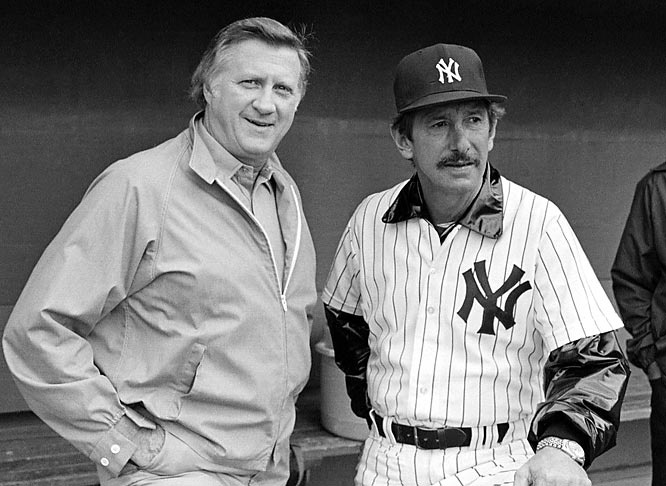
As an aside, if the name “Mandalay” sounds familiar, it is because its Chairman, Peter Guber, is a part owner of the Los Angeles Dodgers (as well as the Golden State Warriors).  So, after this sale in 2012, you had, in effect, the S/WB Affiliate co-owned by the Dodgers and the Yankees.  Somewhere George Steinbrenner and Billy Martin were spinning in their graves.
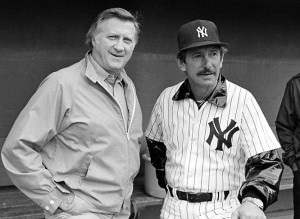
Blog_George_Billy

Mandalay ended up selling their share of the Affiliate in 2014 to a group of local investors, who now manage the club.

And managing an MiLB Affiliate is not for the faint of heart.  It requires ingenuity, gumption, chutzpah, and a whole lot of luck.  By way of example, on a soggy Saturday night a few weeks back, the Affiliate in Moosic was faced with a four-pronged problem:

(1) Call a rainout and lose a night’s gate, as well as the concessions.  The impending rain had huge financial ramifications as it has been a wet summer, so the RailRiders have already lost a handful of games; and Saturday is one of their best attendance nights.  A rainout also raised the prospect of wasting the “bucket hat” promotion.  The team would hate to give out thousands of S/WB hats to fans who didn’t see a game and who didn’t buy at least a couple of beers.

(2) If they called the rainout, the RailRiders would be forced to play a twin-bill on Sunday (assuming the weather held), putting them in a bind with respect to pitching.  This issue was further complicated by the fact that the big club has had a rash of injuries this season, forcing players to go back and forth between the Bronx and S/WB (and Trenton, the Double-A club), which put a limit on the available arms.

(3) Their opponent, the Charlotte Knights, did not want to start the game as they feared the weather wouldn’t hold, the game would be called, and they would burn some of their valuable pitching.  So the RailRiders management had to be cognizant of their potentially unhappy counterparts, who have short fuses and long memories.

(4) The RailRiders had promised their fans a post-game fireworks show.  This one was easy; in the hour before the first pitch was scheduled to be thrown, team president Josh Olerud decided the fireworks would go off regardless – Mother Nature might scuttle the baseball, but she couldn’t stop the light show.  Again, the Affiliate knows that, oftentimes, the product on the field is ancillary to the experience at the ballpark.  S/WB has fans/customers, and the management wants/needs them to keep coming back each week and each season.

Fortunately for Olerud, the team, and the fans, the clouds dispersed and the game was played.  It turned out to be a great – if damp – night at the yard.

The ballpark itself is another area of collaboration and conflict.  Per MLB rules, a facility has to have a certain number of seats, a certain level of lighting, and a certain level of amenities to be deemed acceptable to house a Triple-A team.  But being acceptable to Major League baseball is often different than being acceptable to an MLB Organization.  So, to woo a team to its town, MiLB clubs often agree to make substantial improvements/alterations to their parks.  And the inverse if also true: if an MLB Organization wants to be in a certain location, they might entice the MiLB to sign a PDC by offering incentives to improve their facilities.

When the Yankees moved to Moosic, they were content to play at Lackawanna County Stadium – one of the largest in the entire MiLB.  And S/WB was more than happy to have the Yanks – they sold 47,000 tickets on the day the move was announced.  But changes were coming.

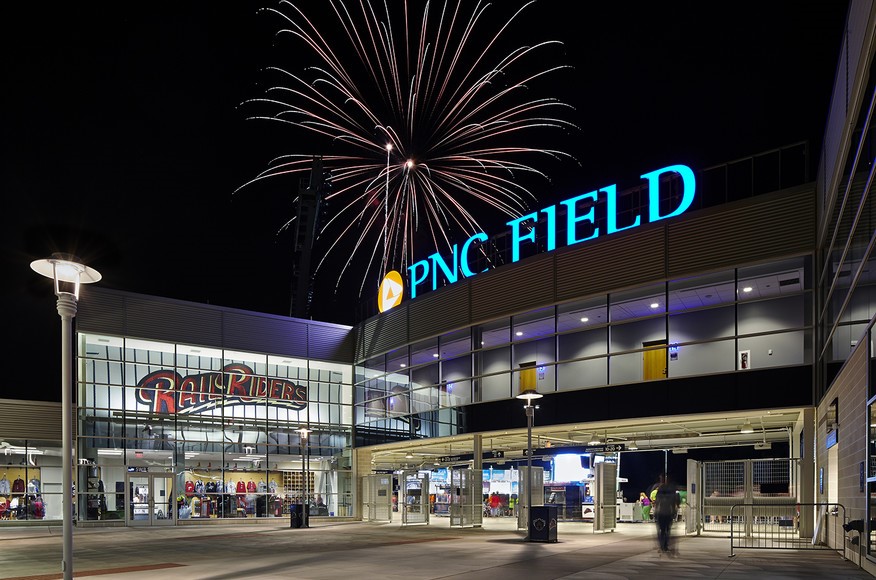
The first order of business was to remove the cumbersome name: Lackawanna County Stadium.  (For people of my generation, LCS hearkens back to “Milwaukee County Stadium” and Harvey’s Wall Bangers, or Dale Murphy and Bob Horner hitting dingers at Fulton County Stadium.  But I digress).  The naming rights were sold to PNC Bank, who dubbed the stadium “PNC Field” (not to be confused with PNC Park in Pittsburgh).

Within a few years, the owners decided that the stadium needed more than just a new name.  And so a $43 million renovation project began in 2012, completely modifying the look and feel of the park.  In a nod to history, the owners decided not to tear down the entire stadium and start anew.  Rather, they kept the location (as pretty as you can imagine, nestled right against the mountains), and ripped out everything but the lower bowl and the playing field.  The “monstrosity” (not my word) that was the upper deck was removed, as were many of the 11,000 seats.  In their place were installed a considerably smaller second-level with three rows of seats, luxury suites, and a stadium club.  They modified the seating in the lower level, and added group spaces in the outfield.  Part of the park reconfiguration was a 360-degree concourse, which gives fans full access to the park (and makes getting to the beer garden and BBQ pit in right field considerably easier).  The club also added grassy berms in the outfield that are utilized every day, but especially on “Dollar Dog” nights, where a ticket to sit on the lawn costs just $1, admission for your canine costs just $1, and the hot dogs around the park are just, you guessed it, $1.

“Dollar Dog” night should not be confused with “Two Dollar Tuesdays”, where lawn seats and Tallboys cost just two bucks.  Or “Wine and Dine Wednesdays”, a ladies night with a pregame wine tasting and wine specials during the game.  The RailRiders cater to the local college kids with “Thirsty Thursdays”, that have pre-game music and $1 Bud Lights.  And to make sure families are covered, there are “Kids Eat Free Sundays”, sponsored by Jersey Mike’s; and if your child is a member of the Champ’s Kid’s Club, they don’t even have to buy a ticket to get in.

As would be expected, the team has a slew of bobblehead nights, their “Legend Series” where former players come and sign autographs, as well as a handful of the aforementioned fireworks extravaganzas.

None of these promotions or marketing plays makes S/WB unique – you can get them at MiLB parks all over the country.  What makes S/WB special is that in 2013, after the remodel, PNC Field was honored as the Best New Ballpark by Ballpark Digest.  In the four seasons since, after shepherding Luis Severino, Greg Bird, Gary Sanchez, Clint Frazier, Jordan Montgomery, and Aaron Judge through the clubhouse to the Bronx, the RailRiders have barely missed a beat, with attendance figures within 2.5% of that much ballyhooed first season in the new park.

I have spent a lot of time, and driven a lot of miles, visiting MLB and MiLB and Independent League parks over the past few summers.  Not many have had the beauty combined with the amenities combined with the friendliness combined with the value for the dollar combined with the high quality fan experience, that I had at PNC Field.  But that does not mean I won’t keep looking.

There are more than five times as many Affiliates as there are Organizations, so wherever you live, there is bound to be one close by.  Take a drive, park a hundred yards (or less) from the gate, buy an unconscionably low-priced ticket, gulp down an ice-cold beer at a fraction of the typical $12, and enjoy a treasure-trove of local eats and standard ballpark fare.  The play on the field may not be ready for primetime (it might be as good as the A’s or the White Sox), but the fan experience most certainly will be.  The lines are short and the traffic is light.  I defy anyone to leave an MiLB game – whether in the heat of the California desert, or in the bustle of downtown Louisville, or in the verdant mountains of Pennsylvania – without a smile on their face.  Head on out to the Little Big Leagues and watch them…

PLAY BALL!!
THE $25,000 FINE

THE $25,000 FINE

Blog_Uncaught_1

Baseball is a beautiful and peculiar game, filled with majesty, intensity, and a whole lot of oddity.  If you are not a dedicated fan, you may find yourself confused by the varied and arcane rules that govern the game.  To that end, one day I may dedicate an entire post just to the most bizarre and inexplicable, but today I have  in mind just one.

A few weeks back I was sitting behind home plate at Minute Maid Park (a small humble brag?), and I witnessed something I am certain I have seen hundreds of times before, but maybe not in this manner.

In fact, we have all seen it, and probably not paid too much attention.  It has become such a routine part of the game, we forget to be annoyed.

According to Major League Baseball Rule 6.05(b), a batter is out when a “third strike is legally caught by the catcher”.  The third strike does not need to be “legally caught” if there is a runner on first base with less than two outs.  Otherwise, it does.  Got that?  Don’t be shocked if the guy sitting next to you is equally confused.

How many times have we seen a Major League baseball player strike out on a ball in the dirt, and not run?  Whether out of frustration, anger, or just plain laziness, batters take that third strike – caught or not – as a fait accompli.  Why?

The comments to Rule 6.05(b) add an additional piece of color: “A batter who does not realize his situation on a third strike not caught, and who is not in the process of running to first base, shall be declared out once he leaves the dirt circle surrounding home plate”.  This is where my trip to Houston comes in.

With two outs in the top of the fourth inning, Gary Sanchez struck out on a pitch short-hopped by Brian McCann.  As the comment to 6.05(b) suggests, Sanchez turned left and headed for the dugout.  McCann, the seasoned (grizzled?) Astros’ catcher began a slow walk back to his dugout, ball in glove, keeping an eye on Sanchez.  I watched this all unfold not fifty feet in front of me.  As soon as Sanchez left the dirt circle and stepped onto the grass (Side Note: Minute Maid Park is a dome that has natural grass – very cool), the umpire signaled “out” and the inning was officially over.

For years I have watched Big Leaguers big league this play; and for years I have yelled “Run!” at the television or to the field.  I have always wondered why this is acceptable practice, and what Gary Sanchez and his ilk are teaching our kids about hustle and heart?  Seeing this up close got my blood boiling.

With two outs in the seventh inning of that same game, rookie Clint Frazier hit a comebacker to pitcher Michael Feliz.  Frazier hustled down the line and was retired 1-3.  But imagine if Frazier simply conceded the play.  Imagine Frazier saw the ball in Feliz’s glove, knew he was out, turned left, and headed back to the dugout.  Mike and Mad Dog (I know, they aren’t together any more) would have lit up the radio waves; Buster Olney would have dedicated ten minutes of his Monday podcast to this; Quick Pitch would have had Harold Reynolds giving us a re-creation in Studio 42; and the Daily News would have had Frazier emblazoned with something pithy like “Redheaded Rookie Too Cool to Run”.  And they all would have been right.  But, since this is just a hypothetical, none of that happened.

But nary a word was said, nor an article written, nor a segment dedicated, to a barely not-a-rookie’s refusal to run to first base.  Why?

Not a week earlier, the Angels beat their cross-town rival Dodgers on this exact play.  With two outs in the bottom of the ninth, Camrin Maybin struck out on a Pedro Baez pitch in the dirt that skipped to the backstop.  Initially, Maybin, being a Big Leaguer, big leagued the play and didn’t run.  Then he realized where the ball was and high-tailed it to first base.  Yasmani Grandal chased down the errant pitch, and then airmailed it into right field, allowing the winning run to score from second.

Maybin when from goat to hero, just by doing what we expect every player on the field to do: hustle.  The amazing thing about this play is that even though the ball rolled all the way to the backstop, and even though Grandal had to chase it down, and even though Yaz had to throw the ball approximately 120 feet, and even though Maybin is one of the fastest guys on the Angels, a decent throw still would have beat him (by a lot).  It took Maybin so long to do the right thing – hustle – that he was nearly out as the result of his own indolence.

I truly believe (and I defy anyone to tell me otherwise) that a catcher – loaded with shin guards, a chest protector, and a mask – has a more difficult, and no matter what, a longer, throw to first base than a pitcher does on a comebacker.  Assume Sanchez had taken off on his third strike.  McCann would had to have corralled the ball, stepped into a throwing lane, avoided the runner heading down the line, and thrown a strike at least ninety feet.  That is no easy task.

After Feliz fielded Frazier’s grounder, he took three steps toward first base, and tossed the ball less than sixty feet with no obstructions.  And yet, Frazier sprinted down the line.  That, we expect.  That is what we demand, from Little League through college.

But we don’t blink an eye when a player concedes the out – when he’s not out.  Imagine a runner heading directly to the dugout when his teammate grounds into a tailor-made 6-4-3.  How would that go over?

Now, I don’t claim to know what penalties are assessed in Kangaroo Courts in clubhouses across the league.  However, I am willing to bet a handsome sum that not running to first on an “uncaught third strike” (the proper nomenclature) is not subject to a fine.

And it happened again last night.  With two on and two out in the top of the 9th, and the Yankees trailing the Red Sox 3-0, Chase Headley chased a Craig Kimbrel knuckle-curve that Christian Vazquez trapped.  So Headley tried to keep the game alive with a mad dash down the line, right?  He made Vazquez throw the ball – equipment and all – ninety feet with two runners on the move, right?  Headley, the twelve-year veteran provided an example to a young and up-and-coming team of how the game should be played, right?  Or he simply headed back to the dugout, allowing Vazquez to tag him for the third and final out of the game?  You tell me…

So here is my idea: Every time a Big Leaguer fails to run to first on an uncaught third strike, he is fined $25,000.  Further, the infraction and the fine are announced to the crowd.  After MLB collects the fine, the money is then donated to the Boys & Girls Club of America (the player should get the shame but not the write-off).

Sure, if you are making $25 Million, 25 large is but .1% of your salary.  But can you put a price on public humiliation?  That fine would have represented 4.4% of Gary Sanchez’s income – a hefty portion of his early-career pay.

Hit a guy in his wallet, and then hurt his pride, and see how quickly his behavior changes.  Tell to the kids at the ballpark and those watching on television that failure to play the game the right way is a punishable crime.

Have the Fenway Park PA announcer explain to the crowd that the Red Sox completed their 52nd win of the season, Kimbrel recorded his 24th save, and that the Boys and Girls Club of America is now $25,000 richer because Chase Headley chose not to hustle.  That would be the cherry on the egg on his face.

I know, I know, this is a slippery slope.  But is it, really?  There are few other instances so egregious, and so obvious.  Sure, we could fine guys for not running out a pop up, but even when they feign hustle, they still make their way to first base.  When was the last time you saw a player retired after a botched pop-up?  Had he hustled he would have been on second base, but he didn’t completely surrender the play.

This one is easy.  Join me in the quest to make “The $25,000 Fine” the order of the day.

And then we can tell Big Leaguers, just like we tell our kids, even if you strike out, you need to…

PLAY BALL!!

Postscript: After I wrote this piece, but before I published it, I watched the Sunday night highlights.  With one out in the bottom of the 7th of the Astros-Twins game, Josh Reddick struck out on a nasty curveball.  The ball skipped away from catcher Chris Gimenez.  Reddick sprinted down the line, forcing a throw.  Jose Altuve, who had been on third, took off for home on the throw to first, and by the time Kennys Vargas got the ball back to a sprinting Gimenez, Altuve had slid home with the Astros fifth run.  Brian McCann struck out to end the inning; thus Reddick’s failure to “big league” (read: play the game the right way), helped the Astros add a run they wouldn’t have otherwise scored.


A FIGHT NOT WORTH FIGHTING

A FIGHT NOT WORTH FIGHTING

Blog_Harper_Strickland

In the eighth inning of Monday’s Giants-Nationals game, with the Nats ahead 3-0, Hunter Strickland decided to seek revenge.  For what, you ask?  For an overly-aggressive slide into Brandon Crawford at second base?  For a little chin music too close to Joe Panik’s baby face?  How about a bat flip and slow trot around the bases by Hunter Pence.  Any of the above would be “justified” (if, by justified, we mean baseball’s anachronistic concept of frontier justice that we have seen on display all too often of late).  It would have been totally out of line, but it would have in keeping with the traditions of America’s Pastime.

If you guessed any of the above, you would be wrong.  And if you are reading this, my guess is that you already know the answer.  Back in the 2014 playoffs, Bryce Harper – he of the flowing locks and face paint eye black – hit two tape measure homeruns off Mr. Strickland.  One went about 450 feet, and the other landed in McCovey Cove.

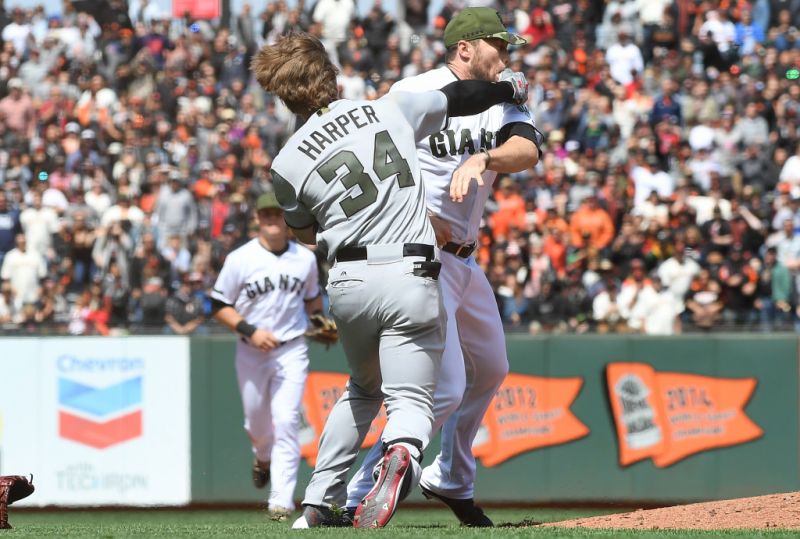
Strickland didn’t take too kindly to Harper’s appreciation of those dingers, nor his glance back to the mound as he rounded the bases.  So Strickland stewed in his juices for 30 months (baseball players have LONG memories and short fuses).  He waited until the time was just right, and then he drilled Harper in the hip with a 98 MPH fastball.  Now Mr. Harper is no shrinking violet, and he – in his own words – “saw red”.  First he pointed his bat, then he ran towards the mound, then he flung his helmet in what can only be viewed as the worst helmet toss of all time – and then he let loose with a fusillade of punches.


All the while, Buster Posey, the Giants catcher and the face of the franchise, didn’t move.  When Harper started barking at Strickland, Posey made no effort to restrain him.  When Harper started running towards the mound, Posey calmly cleaned the dirt around home plate.  It was not until six seconds after the pitch hit Harper – and after the first punches were actually thrown – that Posey even feigned an interest in the melee.

https://www.youtube.com/watch?v=YNNj6TnIiv4

So, after the talking heads got done castigating Strickland for “getting even” (?) nearly three years and a World Series title later, and after they got done making fun of Harper’s helmet tossing skills, they turned their attention to Buster Posey.  Was Posey’s failure to intervene an act of cowardice, a show of grace, a selling out of a teammate, bad sportsmanship, good sportsmanship, just good ol’ common sense, or what?

When asked about it after the game, Posey said: “Well, I mean, after it happened, I kind of saw Harper’s point.  Next thing you know, he’s going out after him. Those are some big guys tumbling around on the ground. You see, [Giants first baseman] Mike Morse is about as big as they come, and he was getting knocked around like a pinball. So … (it’s) a little dangerous to get in there sometimes.”

Posey told his truth.  Strickland was out of line and Buster was having none of it.  Some have argued that players must have their teammate’s back, no matter what.  That Posey had an obligation to at least try to slow Harper down, if not tackle him outright.  Some have argued that this was a mess of Strickland’s making, and his teammates shouldn’t put themselves in harm’s way to settle a score that had no business being settled.

Old school vs. new school.

Although the Giants have been lackluster so far this season, Posey leads the team in hits, batting average, OBP, OPS, and WAR.  He is far and away their best player, and the player they can least afford to lose.  Should he risk an injury or a suspension to defend a red-assed teammate who was first offended back when Ebola was making news?

Some say, “Yes; yes he should”.  To them, I would ask that they indemnify the Giants for that portion of the $21.4M Posey is making this season and the additional $85.6M he owed through 2021 – all money potentially at risk if Buster got injured in that scrum.  This wasn’t defending honor or getting valid retribution.  This was a case of arrested development; a player too immature to deal with another player’s success against him.

If you don’t want guys hitting the ball a country mile and then enjoying it, pitch better.  Oh, and by the way, this wasn’t some Punch and Judy who took you deep.  This was the second best player in the game, who had a 1.251 OPS in those playoffs.  And, oh, by the way (Part II), you won the friggin’ World Series not three weeks later.  Get the hell over it.  And if you can’t, don’t expect others to join you in your little Bryce Harper-invited by a 98 MPH fastball pity party.

Serve your suspension, Hunter.  And when you come back, do us all a favor and just…

PLAY BALL!!

A DAMN SHAME

A DAMN SHAME

Blog_Trout_Injury

Many people remember Tuesday’s AL Wild Card game for the six first inning runs (including three homers); or the fact that the starters recorded a combined seven outs.  For me, I will remember a little-noted play in the bottom of the 7th inning.  Aaron Judge led off with a walk, and took off for third on a base hit by Gary Sanchez.  A decent throw by Eddie Rosario gets Judge (first out of an inning at 3rd base?!), but Rosario air-mailed it, allowing Judge to take second.  What was remarkable about the player, however, was Judge’s slide into third.  Putting aside the awkwardness of the actual landing, it was that Judge dove into third base.

This is the same Aaron Judge who hit 52 homeruns, led the AL in runs, slugging percentage, and on-base percentage; who had already left the yard earlier in the game.  A player who is a lock for Rookie of the Year and is in a dead heat for MVP.  And yet, in the first game of what Yankee fans hope will be a long post season, Judge put that all in jeopardy with a head first slide.  Why?

It is well-worn territory to say that Mike Trout is the best player in baseball.  By some metrics, he is on his way to being the best player of all time.  And even though it does not seem possible, he keeps getting better.

After the first two months of this season, Trout was off to his best start, leading the league in WAR (33% better than Bryce Harper).  In fact, the early-season disparity between Trout and Harper (#1 & #2 on Fangraph’s WAR list at the time) was the same as the disparity between Harper and #20 on the list (Mookie Betts/Nolan Arenado).

Trout was second in the league (behind only the aforementioned Aaron Judge) in homers; led in OBP and OPS; second in slugging; and in the MLB Top 12 of batting average, runs, stolen bases, and RBI (if you’re into that type of thing).  In short, we were on our way to witnessing greatness squared – Trout outperforming otherwise peak-Trout.  The Millville Meteor was well on his way to another first or second finish in the MVP race for the sixth straight season (besting Barry Bonds in the process).

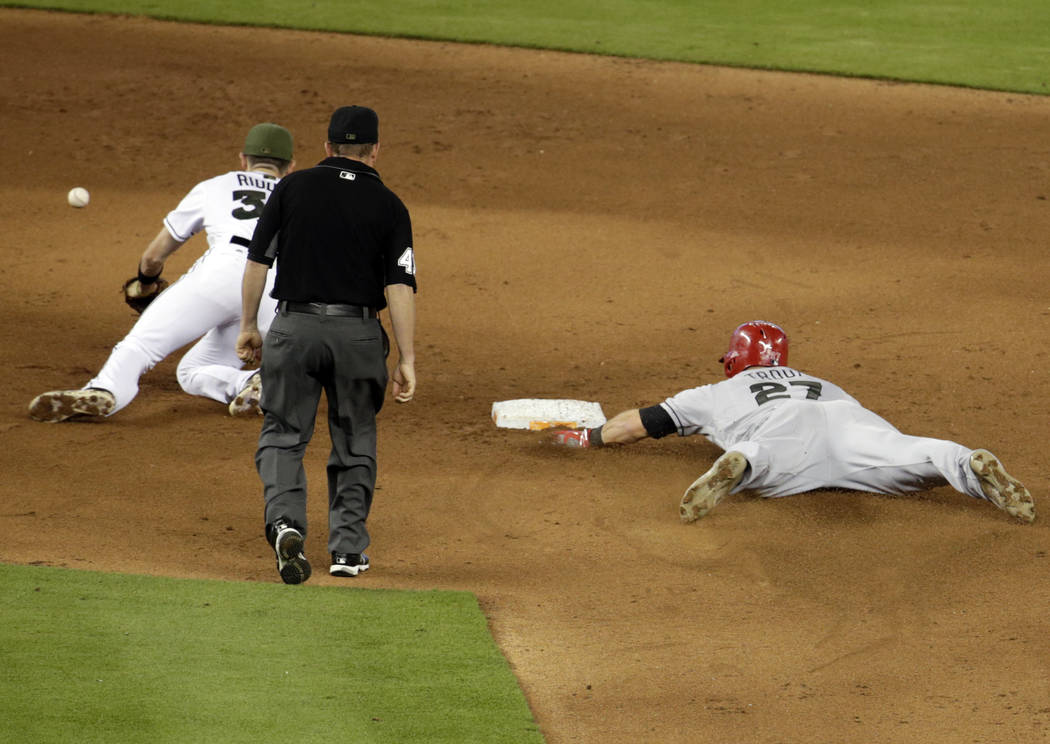
Alas, it wasn’t meant to be.  On May 28th, in completing his tenth stolen base, Trout dove head first into second.  He came up with a torn UCL in his left thumb; had surgery two days later, and didn’t return to the lineup until July 16th, after missing 39 games.  Trout made $19.2M this year, which means this dive into second cost the Angels about $6.5M of lost productivity (and, truth be told, that is a gross under-estimation of his true worth).  But, more importantly, the Angels lost their best player, their best hope for contention, their best draw, and the best reason to tune into an Angels’ game.  We as fans lost the best player in the game.  No more highlight catches; no turning on inside fastballs and hitting them to the rocks at Angels Stadium; no going from first to third on a single to left; and now no reason to pitch to Albert Pujols.

Two years ago I wrote a piece about the stupidity of sliding head first (“Using Your Head…By Using Your Feet”).  After watching Trout walk off the field that Sunday night in May, I went back to take another look.  The article was as relevant in May, as relevant this week, as it was two summers ago.  In case you missed it then, here it is again – maybe Judge can read it before he does something this stupid again.

Losing Trout for a quarter of the season (his first DL stint of his) for an injury that was self-inflicted; for doing an act we specifically prohibit kids from doing.  All you can say is that it’s a damn shame; just a damn shame!

Use your feet…

PLAY BALL!!