COARSENING OF CULTURE

COARSENING OF CULTURE
Blog_Adam_Jones

A few weeks ago, I gave a talk at my daughters’ school entitled Parenting in the Time of Trump.  The upshot of the conversation was: How do you relate to and/or protect your kids from the coarsening of our culture.  What do you do when “grab them by the pussy” is the coin of the realm?

In some ways, it is easy.  We don’t have to watch the news with our kids.  We can avoid discussing politics at the dinner table.  There is no reason to leave the front page of the newspaper on the kitchen counter.  But what happens when the sentiments either encouraged, or tolerated, by those holding the highest offices in the land permeate the culture at large?

What happens when hate crimes are on the rise and anti-immigrant and anti-Semitic graffiti becomes more pronounced?  Or when kids – being kids and thinking they are funny – ape what they see on television or YouTube and pretend to make “Heil Hitler” salutes?  Unfortunately, this is our current reality.

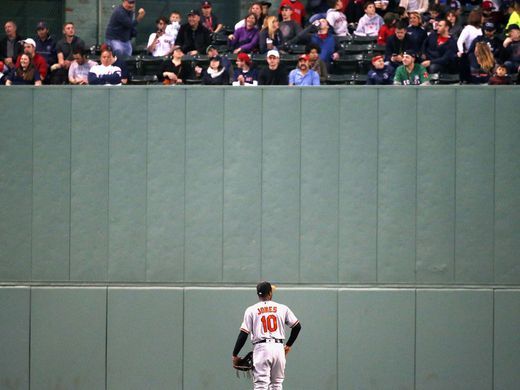
This issue really hit home the other night at Fenway Park.  The Red Sox organization likes to refer to those few acres at the corner of Yawkey Way and Lansdowne Street as “America’s Most Beloved Ballpark”.  Well, tell that to Adam Jones.  Or Carl Crawford.  Or CC Sabathia.  Tell that to the fans – with their kids – sitting in the center field bleachers on Monday night.

To be frank, what happened Monday night is nothing new.

A quick anecdote: When I was six years old, I stood outside the player’s gate at that same stadium, asking Jim Rice to give me an autograph.  He said, “I’ll be right back”, but he never came.  Not to hold a grudge, but more than 30 years later I recounted that story to Fred Lynn.  Without apologizing for his dear friend Jim, he did provide some context.  He told me, “You cannot imagine what it was like for a black man living in Boston in the ‘70s”.  It has been nearly forty years since that encounter, and my guess is that the same sentiment still holds true.

But this isn’t just about ignorant drunkards hurling racist epithets from the safety of the outfield stands.  This is about the jackasses sitting in front of me and my three kids at Dodger Stadium last month dropping F-bombs left and right.  This is about the crude behavior we witness and listen to at ballparks across our great nation.

We all hear these things.  Maybe we move to another section or cover our kids’ ears.  But what else can/should we do?  Bill Shaikin of the LA Times wrote a nice piece on Tuesday, asking a simple question: “Would you speak up?”

In the world in which live today, the answer has to be “yes”.  As I wrote above, avoiding political pitfalls is relatively easy.  The same could be said of avoiding stadium sociopaths.  No one forces us to go to games.  But who wants that?  Is that the Hobson’s Choice we have to make: in order to escape depravity, to protect our kids from hearing and seeing behavior that no one should have to endure, we have to avoid public performance; we have to shun the National Pastime?  That doesn’t seem correct; and it certainly isn’t right.

Jason Giambi once said that “fans boo because they want to cheer”.  I love that.  By all means, boo…and cheer.  Call a guy a bum and accuse the ump of being blind.  Tell the opposing manager he’s a coward when he raises four fingers and sends Mike Trout to first base.  Be an active fan.  But, like all things, do so within reason, taking into consideration what you say and who can hear what you say.

Buying a ticket is not a license to be a bigot.  Educate the kids around you about the game; don’t have them run in fear of “that crazy/mean/drunk guy over there”.

In the aftermath of “N-Word-Gate” (© DFF), Adam Jones suggested that, in addition to being ejected from the park, a transgressing fan should be fined “10 grand, 20 grand, 30 grand.  Something that really hurts”.  I am not sure how that would work, but if a fan who runs on the field can get a trespassing ticket, why can’t a racist, or homophobic, or anti-Semitic fan get charged with disturbing the peace?

Buster Olney suggested that this behavior be called out before games, in the same manner as fighting, or touching a live ball, or running onto the field.  This seems easy enough.

The Red Sox organization jumped on this immediately.  Principal owner John Henry and team president Sam Kennedy met with Jones in person to apologize on behalf of the club and to explain the steps they are taking to prevent another incident.  In fact, the next night a fan was caught making a racial statement.  He was ejected from the game and permanently banned from Fenway Park.

Commissioner Rob Manfred also issued a scathing statement, culminating with “The behavior of these few ignorant individuals does not reflect the millions of great baseball fans who attend our games”.

The bottom line, unfortunately, is that it really is up to us – the millions of great baseball fans who attend these games.  We cannot tolerate this behavior.  Whether it is the drunken lout spouting four-letter words or the outright racist throwing racial slurs.  We must– yet again – become citizen activists who are keeping our eyes and ears open and resisting this offensive behavior.  If the ushers and security guards can keep my son from standing behind the dugout and begging for balls, they can and should be called upon to keep belligerent fans from interfering with the majesty of (watching) the game.

In Baseball is America, Victor Baltov wrote “The state of baseball is the barometric pressure of America’s soul”.  After what we heard and saw in Boston this week, which opened the floodgates to many similar stories at parks across the league, it is up to us, on behalf of ourselves, our fellow fans, and our children, to collectively save America’s soul.

PLAY BALL!!
WHEN REPUTATIONS PROCEED YOU

WHEN REPUTATIONS PROCEED YOU

Blog_Yadi_Ball

Good reputations are earned.  Through hard work, dedication, and good public relations. They are earned over the course of years, decades, an entire career.  But the one sure way to earn a good reputation, to cement your stature into people’s hearts and minds, is by winning.

And once a winning reputation is earned, it is exploited.  And we, as consumers, become suckers for those reputations; lemmings lead to sometimes illogical conclusions because those reputations become hard-wired into our psyches.

I first became aware of this phenomenon back in 1988.  The Dodgers, coming off a 73-win, fourth place finish, brought in a winner.  They signed Kirk Gibson, and his hustle, heart, and (eventual) heroism to a 3/$4.5M contract (how quaint that seems today!).  Gibson, the former Michigan State football star, hitter of that dramatic homerun off Goose Gossage in the ‘84 Fall Classic, and owner of a World Series ring.  It was that Kirk Gibson; and he was bringing a certain “something” to the moribund Boys in Blue.

It took only a few weeks into Spring Training to find out what that “something” was.  The team’s official prankster, Jesse Orosco, decided to pull one over on the newest Dodger.  A little eye black around the inside of his cap; a player donning said cap; eye black on the forehead; hilarity ensues.  Well, maybe not.

Gibson didn’t take too kindly to the joke, and stormed off the field.  He had a few choice words for Hall of Fame manager Tommy Lasorda as he stomped away, and then – channeling his best Buddy Revell – he challenged the culprit to meet him in the cafeteria.  Orosco waited a day, let Gibson cool off, apologized, and we all know how the 1988 Dodger season ended.

Gibson explained away his tantrum by simply saying that game time was the wrong time to mess with him.  And I guess PFPs and infield-outfield the first week of March classify as game time in the world of Kirk Gibson.

Which brings me to my point.  By Spring Training 1988, Kirk Gibson had a reputation as a fighter, a leader, and a winner.  Nothing stood between him and the goal line or a 98 MPH heater.  He was the adult in the room; and anyone who disrespected that did so at their peril.

But what if it hadn’t been Kirk Gibson; what if had been Mike Marshall (the oft-injured first baseman, not the rubber-armed reliever); what if it had been Don Sutton or Steve Sax or John Tudor who lashed out over a silly prank?  The papers (there was no Internet in 1988) would have howled with “cry baby”, and “can’t take a joke”, and “prima donna”, and “get over yourself”.  But, because it was the exulted Kirk Gibson, the World Series hero with the tough guy moustache and the winning reputation, it was a case of “I am here to win…not play games”.  And we all ate it up.

Let’s change sports for a moment.  Tom Brady is arguably the greatest quarterback in NFL history.  He has won two MVPs, four Super Bowl MVPs, and five rings.  In short, Tommy is a winnah!  But watch Tom stalk the sidelines screaming at his teammates.  Will to win, or sore sport?  Demands excellence from all of his teammates, or casts blame on everyone else?  We know the answers to these questions because it is Tom Brady.  But change the paradigm ever-so-slightly, and ask yourself if Tom’s sideline tirades are all that different than those of the hated Jay Cutler.  Cutler “doesn’t care”, “isn’t a leader”, “has a bad attitude”, and is a “cry-baby”.  Really?


Reputation matters.  You wear them like a badge of honor, or they get hung around your neck like an albatross.

How about Joey Bats.  For years we have disliked that guy – for one reason or another – so when he had the bat flip heard ‘round the world, it became an international incident with pearls being clutched from sea to shining sea, across two sovereign nations.  But when lovable Manny Ramirez exalted with joy, it was just “Manny being Manny”, a slugger who plays the game with youthful exuberance.


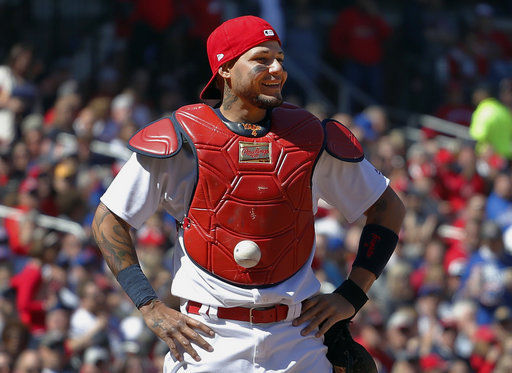
This all become relevant during opening week when Yadier Molina was involved in one of the strangest plays you will ever see.  Now, Yadi is beloved in St. Louis – he just signed a 3/$60M deal that will take him to his age 37 year – and he is a two-time World Series champion.  He is beloved in Puerto Rico as a conquering hero and the captain of their highly successful WBC team.  And he is beloved in baseball circles for his throwing arm, his in-game acumen, his control of the pitching staff, and for being the best of a trio of catching brothers.

But when Yadi Molina is caught, not red-handed, but no-handed, using an illegal substance, we all laugh it off.  Broadcasters, writers, pundits, all effused with “Wasn’t that strange!” “How wacky!”  “We’ve never seen that before.”  Buster Olney and Derrick Goold called him out, but the whole incident essentially went away.  But imagine if that had been the hated A.J. Pierzynski?  Or the decidedly old-school Brian McCann? Or rookie Gary Sanchez?  Hell, what if it had been one of the other Molina brothers?  I doubt the public perception would have been:  ¯\_(ツ)_/¯.


But Yadi’s reputation precedes and proceeds him.  He is a leader and a winner.  We, as baseball fans, have decided that we love Yadier Molina, and – as such – are willing to overlook his “look ma, no hands” routine.

I guess the moral of the story is do good unto others (i.e., be a leader); treat people with respect (i.e., see their greatness and push them to achieve levels they never thought possible, even if it requires berating and harassment); play as hard as you can (i.e., if you ain’t cheating, you ain’t trying); but most of all, win.  Win and the world will shrug its collective shoulders, will avert its prying eyes, and will tolerate nearly any boorish, unethical, or illegal behavior.

And if you don’t believe me, take at a look at the current denizen of 1600 Pennsylvania Avenue.

And if it is not stuck to your chest protector, I say:

PLAY BALL!!

p.s.  It has taken me a bit to actually write and publish this piece.  In that time, at least in one instance, shoulders were not shrugged, eyes were not averted, and boorish and unethical behavior was not tolerated.  When I first penned this, the penultimate paragraph read:

And if you don’t believe me, take at a look at the men who work at 1600 Pennsylvania Avenue and 1211 Avenue of the Americas.

OPENING DAY

OPENING DAY

Image result for opening day

Is there anything more majestic, more momentous, more magnificent, than Opening Day?

I am old enough to remember when Opening Day was always the first Monday in April, with the first pitch being thrown by the Cincinnati Reds.  That tradition went away in 1994 when ESPN began airing a Sunday Night Baseball game ahead of “Opening Day” the next afternoon (it was slightly altered in 1990 when the Reds opened the season at Houston).  And this season the ESPN tradition  was expanded to three games on Sunday (morning, noon, and night on the West Coast).  But, regardless of the changes, the beauty of Opening Day remains.

Opening Day represents renewal, a reset when—for one day at least—“this is our year” still holds promise.  For some teams, it is the beginning of something magical (the 1984 Tigers started the season 9-0 and ended the season World Series champions); while for others, it is the beginning of an inexorable decline into utter catastrophe (the 1988 Orioles started 0-21 on their way to a 54-win, last-place season).  But for us fans, it is the birth of Spring and the harbinger of the long, easy days that lie ahead.

Contrast Opening Day with the beginning of the NFL season.  The most popular sport in America, which is inextricably linked to the Frozen Tundra (read in John Facenda’s voice) and Thanksgiving and the dead of Winter.  This past year, the average temperature in the cities hosting Week 1 games was 90.3 degrees – with six games fielding players in temperatures of 95 degrees or more.  Nothing screams football like heat stroke and massive sideline fans (and water shortages in the stands).  It takes a full month or two before football actually gets into “season”.

How about basketball?  It starts quietly on a mid-week night in late October, competing against the baseball playoffs and the now-in-full-swing football season.  People often lament the length of the baseball season, but remember that basketball begins before Halloween and ends around Father’s Day.  Does anyone outside of the NBA, Bill Simmons, or Chad Ford even know when the NBA officially tips off?

But everyone knows about MLB Opening Day.  That is something special, something sacred.  Thomas Boswell once wrote a book called Why Time Begins on Opening Day.

On that first Monday, otherwise reliable employees feign illness to leave work for an afternoon in the sun; kids play hooky to spend a few hours at the yard with mom and dad; fringe players vie for that last roster spot just so they can line up on the chalk while armed forces veterans unfurl an American flag across the entirety of the outfield, before a famous singer or a local icon sings the National Anthem.  And, with the toss of a pearl, a swipe of the plate, an adjustment of the mask, a man (to date, it has only been a man) says those two words that start the proverbial engine; that change everything for the next seven months; those two words that inspire hope and engender heartache; that are as old as the hills but as fresh as the infield grass; those those two words that embody a kid’s game; and that remind us that there is beauty in simplicity and purity in potential.  Those two words…

PLAY BALL!!


My Great White Whale

MY GREAT WHITE WHALE

For years I have wondered, and have done a decent amount of research.  I have checked the newspapers and the interwebs.  I watched interviews and read everything I could during the 25-year anniversary.  And yet, the answer to my question – my great white whale – remains elusive.

Who was driving this car:

Blog_Gibby

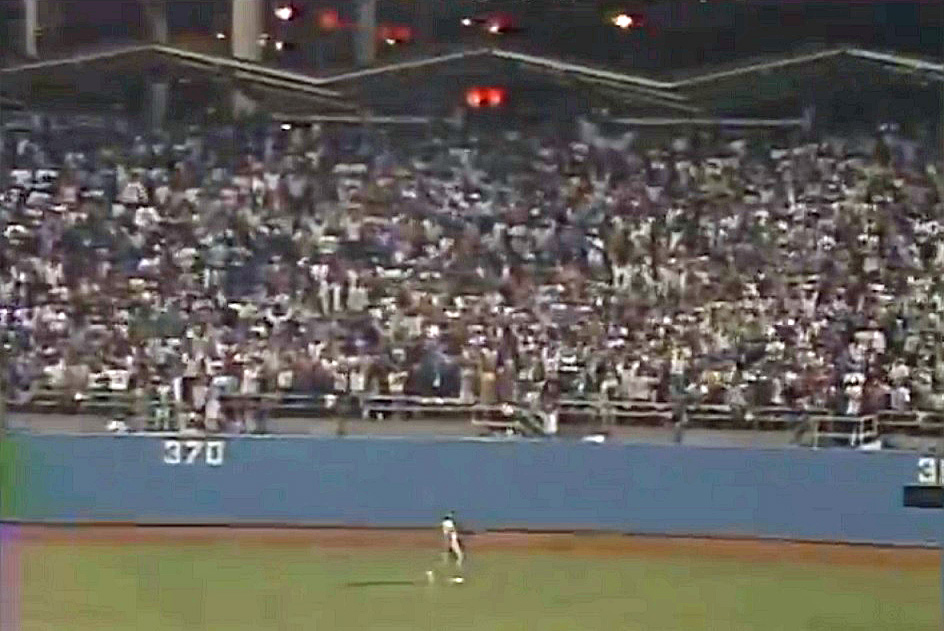
This picture represents so many things.  Let’s start with the easy one: It represents one of the greatest and most improbable moments in World Series history.

It also represents the classic Los Angeles sports fan who arrives late and leaves early.  This is done, ostensibly, to beat LA traffic.

It represents the power of sports radio.  There is no world in which the driver of that car wasn’t listening to AM 790 when Dennis Eckersley tried to slip a 3-2 slider past a hobbled Kirk Gibson.

It represents the beauty of “what if” and “only if”.  It represents opportunity lost.

This moment – this specific scene of the right field bleachers and the parking lot of Dodger Stadium – is so indelible, is so burned into my psyche, that it has become a meme in my life.  “You don’t want to be the guy in the parking lot when Gibby hit the dinger” is a phrase that I have uttered on countless occasions over the past nearly thirty years.

My boss suffered this indignity just this past weekend.  With the Clippers up 18 and five minutes to go, he left Staples with his son, and victory, in tow.  When he turned on the highway, he realized that things aren’t always what they seem.  He was the “guy in the parking lot when Gibby hit the dinger”.  Sure, a basically meaningless basketball game in March is by no means the first game of the World Series, but the theory still holds.

But this mantra was clearly in play on the first weekend of February.  With a little bit of luck, considerable Expedia alacrity, and a willingness to pay the price, on just three days’ notice, we were headed to Houston for the Super Bowl.  We arrived very late Saturday night, spent all Sunday morning at FanFest, and then headed to NRG Stadium.

By the time we got there, my son – who hadn’t slept Friday night out of sheer excitement; who got little sleep Saturday night because of late arrival/time change/more excitement/early wake-up – was suffering from a pretty bad headache.  I thought food might solve the problem; it didn’t.  I thought Sprite might solve the problem; it didn’t.  A trip to First Aid for a pair of ear plugs didn’t do the job either.  As the game wore on, and the contest became even more lopsided, the headache grew worse.

By the middle of the third quarter, with the Patriots down 28-3, my son sent me the following texts (he was sitting with his cousin at the time): “Not sure if I can make it through the rest of the game”; “I’m ready to go to bed”; “Can we leave early”; “The game is pretty much over”.

By the time I met back up with him, the Pats had scored a touchdown (but missed the extra point, natch), and were trailing 28-9.  He was in a bad way.  Now, as an aside, I suffer from migraines; and I know that feeling when the headache literally takes over your body and you have no energy to even think.  All you want/need is a quiet, dark room with a cool washcloth on your head.  What you most definitely don’t need are the bright lights of a domed stadium, with a cacophonous crowd losing their shit on every play.

We met on the concourse with about two minutes to go in the third quarter, and the Falcons in Patriots’ territory.  We had the following exchange:

  • Jake: “Can we go?  I really don’t feel well.”
  • Me: “I hear you buddy, but this is the Super Bowl, so I really need you to try to rally.”
  • Jake: “But the game is essentially over.”
  • Me: “Okay.  Let’s see what Atlanta does on this drive.  If they score, we should go.  But if they don’t, you don’t want to be the guy in the parking lot when Gibby hit the dinger.  You will never forgive yourself.”
  • Jake: “Okay.”

While we were having this conversation, there was a holding call, an incomplete pass, and a sack.  Atlanta punted.  We stayed.  And the rest, as they say, is history.

We are twenty-nine years removed from the day after my 16th birthday.

Twenty-nine years have passed since what has been deemed the greatest moment in Los Angeles sports history.

It has been twenty-nine years since we heard two of the all-time great calls: “She is . . . gone” and “I don’t believe what I just saw”.

And we are twenty-nine years from the greatest steering-wheel punch of all time; when one guy’s desire to beat traffic became the most ignominious break slam of all time.

I just wish I knew who that guy was.  He is my white whale.

The search continues…

PLAY BALL!!

Season Tickets

SEASON TICKETS

Blog_Season_Tickets

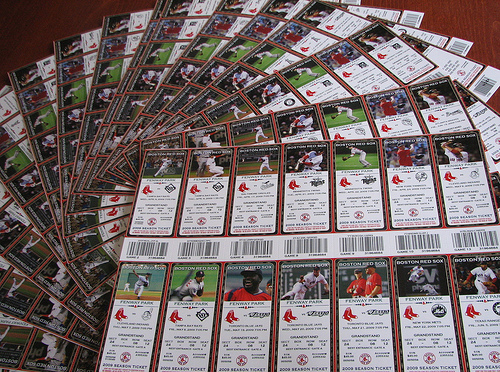
When I was a kid, there was nothing I wanted more than Dodger season tickets.  The idea of going to Dodger Stadium eighty-one times, watching that many games, eating that may hot dogs, and that many pennBlog_Pennantsants (does anyone remember when they sold felt pennants at the ballpark?) was nothing short of bringing home  heaven.
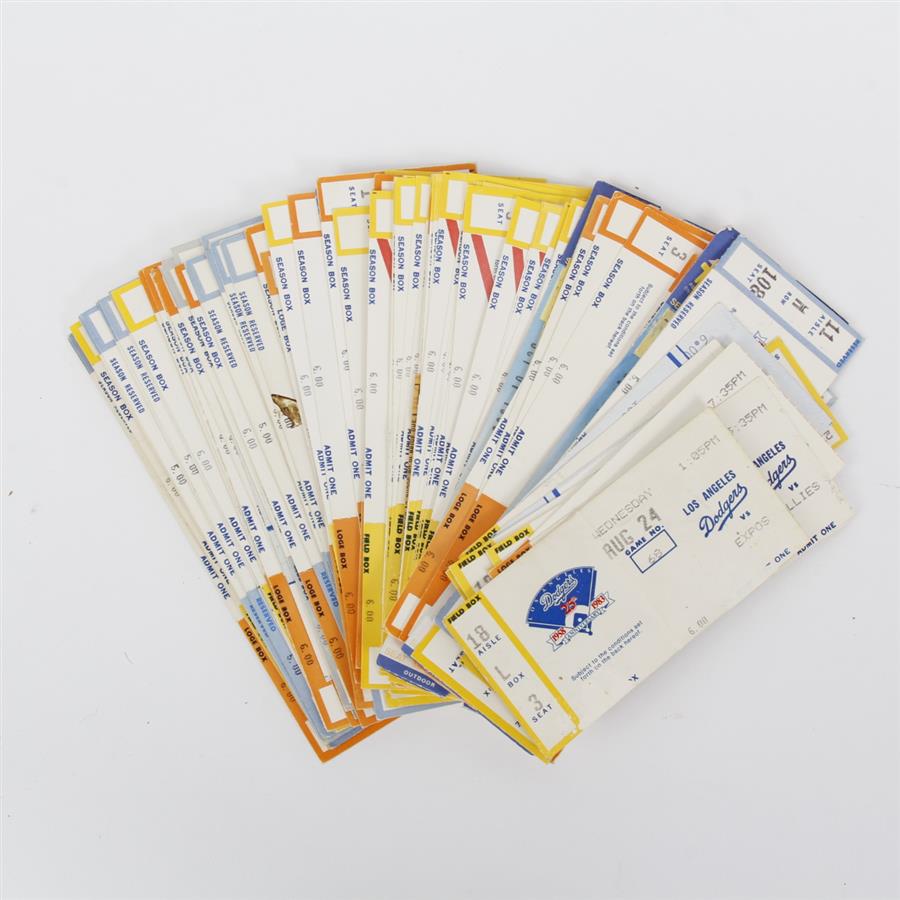
Of course, we lived more than an hour away from Chavez Ravine, the majority of the games were on school nights – or at least week nights – and my parents never could have afforded the cost of season tickets, parking, and all of those concessions/souvenirs.  Alas, I was forced to live vicariously through my friends, friends whose parents didn’t have the same constraints.  We still went to a handful of games a year, and I still went with friends, but it never seemed to be enough.

As I grew older, the idea of attending 81 baseball games in a six-month span began to lose its luster.  There are a litany of reasons why this is – and I am sure you can name nearly all of them – but chief among them is that baseball games are boring.  “What?!” you say, the man who lives, breathes, and writes about baseball is admitting that baseball is boring?  Yes, it is.  That doesn’t mean I don’t love the game, study the stats, take pleasure in its intricacies, pontificate about its minutiae, and read everything I can about the sport.  It is just my honest assessment that, as a hobby, watching baseball is considerably less exciting – moment to moment – than, say, skiing, or surfing, or scrap booking.

That said, one of the great joys of my life is going to the park.  I have been attending games for more than forty years, and I am not ashamed to admit that I still get butterflies in my belly when I approach the stadium.  Whether it is that look to the left off Highway 360 when Globe Life Park comes into view outside Dallas; or when the “L” approaches the Addison stop in Chicago.  It might be the Citgo sign you see as you drive over the Charles and approach Yawkey Way in Boston; or when the gothic facade of Yankee Stadium rises into the sky as you make your way off the “4” train in the Bronx.  I get this feeling when I pull into the parking lot at Camelback Ranch in Scottsdale for a meaningless Spring Training game, and I get it when I feel gravel under my tires for a Class A game in Lancaster.  The feeling never stops, and I truly hope it never does.

My guess is that attending eighty-one games a year would be a surefire way to extinguish that flame.  Eighty-one games is not a pleasure, it is an obligation; it is a burden.  Our ten-year-old brain often doesn’t – can’t – appreciate what our adult brain knows intuitively.  A ten-year-old doesn’t worry about traffic, or the cost of parking, or tomorrow morning’s meeting, or who in your family you are neglecting by being “out” 81 times a season.  But the adult brain is forced to consider all of those factors when making a game-going decision, and electing to override any of the above can adversely impact your enjoyment of the game.  Oh, to be young again; ignorance surely is bliss.

But, who knows.  Had I been granted my wish, had my dad come home in the spring of 1983 and shown me an envelope filled with 162 actual game-day tickets (remember how quaint an actual ticket was)Blog_Dodger_Ticket_2 and told me to get my hat and glove ready, the Oldsmobile Toronado would be headed downtown eighty-one times over the next six months, maybe I would have eventually lost my love of baseball, my desire to attend games, the thrill of approaching the park.

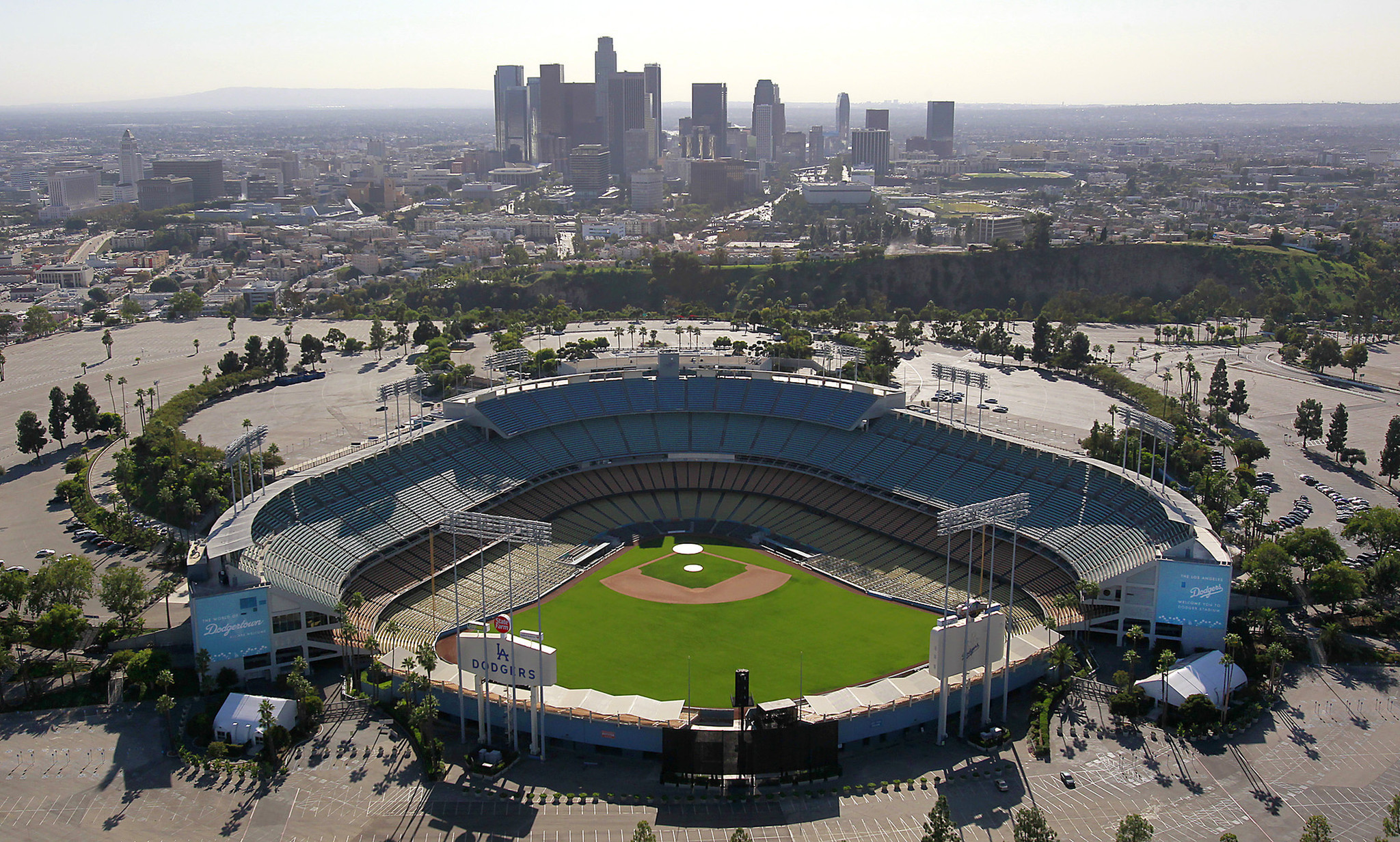
Ironically enough, I now live about a half-marathon from Dodger Stadium.  I have a teenage son who loves baseball and would love nothing more than having season tickets.  I ostensibly have the freedom to go to a ton of games.  But, for the reasons elucidated above, I have never pulled the trigger on season tickets.

A few weeks ago, a friend of mine made me an offer I couldn’t refuse: join a group of season ticket holders.  I would be buying ten games; ⅛ of a season; a mere 12.5%.  This was doable.  I checked with some other friends to see if they wanted to split it 5/5, but I had no takers, which was fine.  I am now a proud season ticket holder – but without the dread of obligation, without feeling the burden of going every night.  It took more than thirty years, but I guess good things come to those who wait.

Ten times this spring and summer (and hopefully fall), I will drive up Stadium Way, dodging ticket sellers and wayward drivers, fight traffic through Elysian Park, make that sharp left onto Academy Road, head up the slope, then make that soft right just as the hill crests, and Dodger Stadium will come into perfect focus.  Blog_Dodgers_Stadium_3

It will be everything I can do not to be giddy; to act like the adult that I am, not the kid I want to be; to never become jaded by the experience.

I’ll let you know how it goes.

PLAY BALL!!

A Tale of Two Free Agents

A Tale of Two Free Agents    

Blog_Fowl_Desmond

Last year I wrote about two players who had made difficult contract decisions.  While it seemed relatively easy to assess those decisions at the time, now, with the benefit of hindsight, we can look at those decisions with a little more clarity and see which player made the right (or wrong) call.

Let’s start with the easy one: Dexter Fowler.  As you may recall, after the 2015 season, the Cubs made Fowler a $15.8M Qualifying Offer (“QO”).  He, of course turned that down, and then sat around unemployed until after pitchers and catchers reported for Spring Training.  However, because fortune favors the brave, before position players reported, the Orioles offered Fowler a 3/$33M deal to play right field.  With just a single phone call, Fowler had doubled his guaranteed money.

But before the phone line could go dead, Fowler reversed course and signed a 1-year/$8M deal to remain the Cubs’ center fielder.  The deal included a $5M buy-out.  Fowler could have taken the easy route, signed the QO, and made $15.8 million with the Cubs.  Instead, he tested the market, and ended up taking a $2.8M hit.  That is money he can never get back.

As we all know, Fowler led off, played great defense, and helped the Cubbies win their first World Series in over a century.  And then, flush with his playoff money (~$365K), and his $5M buy-out check, Fowler signed a 5/$82.5M deal with the rival Cardinals.

Obviously, rejecting the 3/$33M deal from Baltimore made perfect sense (especially in hindsight), but rejecting the original QO still doesn’t make any.  But all’s well that ends well:  Fowler has a ring and will make more than $95M over a 6-year period.

Now the trickier one: the curious case of Ian Desmond.  After the 2013 season, Desmond turned down a 7/$107M offer from the Nationals.  Instead, he signed a 2/$17.5M deal to keep his options open after 2015.  He then turned down the Nats’ QO ($15.8M) for 2016, and found himself unemployed.  The Rangers threw him a lifeline and signed him to play center field for $8M.  If you are counting at home, at this point Desmond had cost himself $20M in actual dollars, and $61M in additional guaranteed money.  Ouch!

In 2016, Desmond had a great first half (15/55/.322/.375/.524), and seemed to be positioning himself for a big contract.  But then, in the second half, his production cratered (7/31/.237/.283/.347); the new CBA changed the way teams view long-term deals; and Desmond turned down the Rangers’ QO, thus any team that signed him would forfeit a first-round draft pick.  The pickings were again looking slim for Desmond, and he seemed to have lost both leverage and money.

But, because fortune hath many roads, the Rockies came to the rescue.  For reasons that are still inexplicable to the baseball cognoscenti, the Rockies gave up their first-round pick to sign Desmond to a 5/$70M deal to play first base (a position he has never played).

Assuming that money is the only thing that matters, Desmond may come out okay (but not great) in all this.  Had he just signed on the dotted line after 2013, Desmond would have been the Nationals shortstop for seven years and pocketed $107M.  As it stands, he had to move cities twice, leagues twice, positions twice, now plays for an also-ran in a loaded division, and will play an additional season for $11.5M less in total money.  Hubris or simply bad decision-making cost Desmond at least $11.5M, and probably closer to $25M (assuming a $14M deal for the 2021 season after the long-term Nationals deal expired).

Patience isn’t always a virtue, and good things don’t always come to those who wait.  Dexter Fowler and his reps made smart, long-term, and thoughtful decisions about his career, and it paid off handsomely.  Ian Desmond, on the other hand, seemed to make disjointed, short-sited, and capricious decisions, and will pay in the long run.

But hell, they both still play baseball for a living, so don’t feel to bad for them.

PLAY BALL!

Competitive Balance Tax Complicates Teams’ Decisions

Competitive Balance Tax Complicates Teams’ Decisions

Blog_CBT

Last season, Clayton Kershaw earned approximately $34.5 million.  On June 30th, the Dodgers placed him on the 15-day disabled list, and on August 3rd, Kershaw was moved to the 60-day DL (retroactive to June 30th).  Nonetheless, Kershaw received a check of approximately $2.65 million every two weeks (MLB players are paid over the course of the regular season).  And each time one of those checks was cut (a total of nearly $11 million while he was sidelined), it counted against the Dodgers’ Competitive Balance Tax threshold (“CBT”), also known as the “Luxury Tax”.

The CBT was first introduced for the 1997 season, and imposed a 34% tax on all monies spent above the average between the fifth and sixth largest team payrolls.  That system lasted until 1999, and then the entire idea went on hiatus until the 2003 season.  Beginning in 2003 – and still going today – a threshold level is set, and teams are charged if they have payroll in excess thereof.  This removed any comparison to other teams.  You spend, you pay.

Which takes us to the current Collective Bargaining Agreement, and the new thresholds.  In 2016, the CBT was set at $189 million, and next season it will rise to $195 million.  But, to truly understand the implications, you need to go inside the numbers.

Throughout the year, we follow a team’s salary obligations, with reporters providing fans with “real time” tallies of what a team is spending, how close they are to the “cap”, and the desire to avoid the Draconian penalties assessed if they go over (more about that below).  But the figures we hear and read about can be deceiving, and they are very difficult to calculate.

Each November, a team of really smart people in the Commissioner’s office in New York tabulates each team’s prior season’s salaries.  In theory, it is easy math.  In theory.  Here are a few rules:

  1. If a player has a multi-year deal, actual salary doesn’t matter – Average Annual Value (“AAV”) does. Even though Kershaw got paid $34.5 million, his AAV is only $30.7 million, so that is what counted against the CBT.  In contrast, Giancarlo Stanton earned only $9 million last season, but his 13-year/$325 million contract has a $25 million AAV, which is what applied against the Marlins’ CBT.
  2. If a player goes on the DL and needs to be replaced (as the Dodgers did with Kershaw and the Marlins did with Stanton), they get no dispensation. The cost of any additional player is also applied against the CBT.  If a team makes a trade, add the new salary.  If they bring a guy up from AAA and need to give him a pro-rated minimum salary, that amount counts.  Even if the team has an insurance policy on the player and receives reimbursement, the AAV still counts against the CBT.
  3. When a team picks up a player option, the actual salary paid counts against the CBT.
  4. All players on the 40-man roster are calculated in the CBT. Of course, the longer a player remains in the Minors, under the Minor League pay scale, the better for the team.  But, as stated above, once that player is promoted and gets a minimum salary ($507,500 in 2016), the numbers need to be re-jiggered to accurately calculate the CBT amounts.
  5. Any mid-season acquisitions, including cash considerations moved amongst teams, are calculated in the CBT.
  6. When a player has certain incentives, performance bonuses, or awards rewards built into his deal, those, too, count against the CBT. So, the team must plan ahead for a player having a great season.  While the Nationals were happy that Max Scherzer won the Cy Young Award last season, it cost them an additional $500,000 bonus, and an additional $500,000 hit to their CBT.  Hopefully they planned ahead.
  7. But wait, there’s more. Each team has an annual bill for player benefits, health care, and the like.  That comes to approximately $13 million per team per season.  We never hear about this, which means that last season’s $189 million cap only offered about $176 million to spend.  Those costs must be factored in as well.

When the MLB accountants and the team accountants exchange books, their numbers often vary.  This is especially true for teams not accustomed to playing in the tall weeds.  For instance, the Dodgers have at least four members of their staff assigned to salary cap issues – which makes sense as they deal with the CBT every season.  A team like the Athletics or the Rays may not have anyone assigned to this task, as doing so would be akin to being having someone assigned to review Curt Schilling’s liberal Tweets.

So why is the CBT so important?  Here is why, and it might help explain some of the (non)moves made by teams (such as the Red Sox) this off-season:

Next season’s CBT threshold is $195 million (about $182 million in salaries, but let’s not get too wonky).  Under the new CBA, the first season a team goes over the CBT, they are charged an assessment of 20% of the overage, the second time, 30%, and each time thereafter, 50%.  The analysis cannot stop there.

If a team is over by between $20-$40 million (i.e., by spending $215-$235 million next season), there is an additional 12% surcharge on the excess amounts.  But, and this is the big “but”, when a team drops below the CBT threshold, they reset for future seasons.

Let’s take a look at the Red Sox, who were over the CBT last season.  Let’s assume that once they set their 40-man, finish their arbitrations, and pay the player benefits, they are right at $195M (which is a reasonable assumption).

Now, many fans in the greater New England area were pushing the Red Sox to sign Edwin Encarnacion.  And let’s assume the Red Sox could have closed the same deal as the Indians (3/$60 million).  In 2017, Boston would be in its second season over the CBT, suffering a 30% tax (i.e., 30% of $20 million = $6M); in 2018 they would be in their third year, thus a 50%  tax (the CBT goes up to $197 million, so only a $9 million hit (50% of $18 million over); and in 2019 they would also be assessed 50% (the CBT goes up to $206 million, so only a $4.5 million tax (50% of $9 million over).  Assuming the Red Sox make no other deals that would push them into the surcharge, a $60 million deal for Encarnacion would actually cost the BoSox $79.5 million.

And, by doing so, they would severely limit their room to maneuver at the trade deadline and/or if they suffer any injuries.  Many fans may still quibble with the Red Sox’ parsimoniousness, but at least there is a valid, long-term business reason why not to make that deal.

The CBT is complicated and ever-shifting.  Teams have to be wary from the first day of the Hot Stove, until their final call-ups in September, all the way through Awards Season.  One slip up can cost millions of dollars and have implications for multiple seasons.

So, the next time you hear Jason Heyman or Ken Rosenthal or Brian Cashman or Andrew Friedman wax eloquent about the Luxury Tax and its effect on teams, you will have a better understanding of what they mean, why it’s important, and how poor these teams really are.

Enough about contracts…

PLAY BALL!!

New MLB CBA Over-Complicates Qualifying Offers

New MLB CBA Over-Complicates Qualifying Offers

Last year I wrote about the Qualifying Offer (“QO”) rule, and how it affected player mobility.  And just when you thought you had a handle on how it worked, the owners and players went ahead and renegotiated the CBA.  In the process, they bolloxed up the QO in a way that hardly anyone can comprehend.  However, if you are frequent reader, you probably enjoy this stuff as much as I, and have the patience and curiosity to know what is, and will be, for the next five years.  Here goes:

A bit of history.  Under the old CBA, if a team made a QO to a free agent player (the amount of the QO is predicated on the average of the top 125 salaries from the previous year; for 2017, the amount is $17.2M), that player had seven days to accept and sign a one-year deal; or reject, and become an unrestricted free agent.  The term “unrestricted”, however, was a misnomer, because any team acquiring that player had to forfeit its first round draft pick the following season (the only exception being teams with picks 1-10; they had to relinquish a second-rounder); and the offering team was compensated with a so-called “sandwich pick”, which is between the first and second rounds.

One more thing: the QO draft pick penalty was only applicable to players who played the entire season for their prior team (if you were traded mid-season, or joined the team after the amateur draft, an acquiring team did not face the penalty). Got it?

Well, if Occam’s Razor applies in most circumstances, its bizarro brother applies to MLB. Here is the system that will apply until 2021:

For starters, the owners and players split the world into three sets of teams: (1) those over the luxury-tax threshold (i.e., teams whose payroll exceeded $189 million last season, $195 million this coming season, escalating in later years); (2) those from the 15 smallest markets that receive revenue sharing money; and (3) teams that don’t fit into either category.  These tiers will be helpful as we move forward.

Here we go: A team offers a player a QO.  That player now has ten (not seven) days to accept or reject.  If he accepts, all is right with the world, he signs with his current team, and there is no confusion.  If he rejects, we must follow the Rube Goldberg contraption put in place to see what happens.

Let’s start with the team losing the free agent (herein, “the Loser”):

If the free agent signs a contract of $50 million or more (regardless of number of years), the Loser gets draft pick compensation.  However, the form of compensation is dependent on the Loser’s good or bad deeds.

  • If they are over the luxury-tax threshold, they receive a draft pick at the end of the fourth round.
  • If they are one of the small market teams, they receive a pick at the end of the first round.
  • If they don’t fit into either category, they receive a pick at the end of the second round.

With me so far?

If the free agent signs for less than $50 million, then:

  • If the Loser is over the luxury-tax threshold, they receive a draft pick at the end of the fourth round.
  • If they are below the luxury-tax threshold, they receive a pick at the end of the second round.

Now to the team acquiring the free agent (herein, “the Buyer”):

  • If the Buyer is over the luxury-tax threshold, they lose their second and fifth highest draft picks, plus $1 million in international pool money.
  • If they are one of the 15 small market teams, they lose their third highest draft pick, but no international money.
  • If they are none of the above, they lose their second highest draft pick, plus $500,000 in international pool money.

Under the old CBA, if a Buyer already acquired a QO free agent, and thus gave up their first round pick, there wasn’t much pain involved in acquiring a second QO player, as they only had to then forfeit a second-round pick.  Not anymore:

  • A Buyer over the luxury-tax threshold acquiring a second QO player now forfeits all of the following: their second, third, fifth, and sixth highest picks, plus $2 million in international bonus pool money.
  • If they are one of the 15 small market teams, they lose their third and fourth highest draft pick, but no international bonus pool money.
  • If neither, they lose their second and third highest draft picks, plus $1 million in international pool money.

One last rule on which I have been trying to get clarity: no player may be made a QO more than once in his career.  I am not certain if this retroactive (meaning, could Jose Bautista (who was offered a QO by Toronto) sign a one-year deal and get a QO next year, or is the new CBA retroactive, and he is protected forevermore?  More to come on that.

There you have it.  Does everyone understand?  Are the implications to each team perfectly clear?  Great!

Next time we can deal with the International Bonus Pool rules…

PLAY BALL!!

Under Armour to Mar MLB Jerseys

Under Armour to Mar MLB Jerseys

It started innocuously enough, with a sign on the outfield wall. And soon there were three or four. Before you knew it, there was advertising behind home plate, rotating inning by inning.


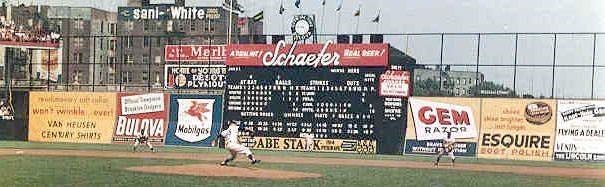
Some people loved the throwback nature of the signage — it reminded them of Ebbetts Field (with its Schaeffer beer ad) or the Polo Grounds (with its Chesterfield cigarette ad) — harkening back to days when ballparks weren’t multi-use and had incredible character.

Then, 1992, we woke up to find the MLB logo on the back of our big-leaguers’ caps. No matter, it represented the game that we love, and it was a small logo near the base of the neck.

A couple of years ago that same logo made its way to the back belt loop of MLB pants. As an aside, you always knew when a player replaced his “gamers” with an old pair, as the logo was noticeably absent.

It took more than twenty years, but creep continued. Beginning with last season’s playoffs, much to the chagrin on Phil Hecken and Paul Lukas, New Era placed their logo right there on the temple. Which begs the question: Is no place sacred?

Since the snowball had already started rolling, the powers-that-be decided to simply get out of the way. Which led to the announcement made at this week’s Winter Meetings that will forever alter the sartorial arc of Major League uniforms. Beginning in 2020, the front of Big League jerseys will be desecrated with advertising.

For years we have discussed the blurred lines between amateurs and professionals. In that context, we normally discuss money — money paid (or not) to athletes. But one way the lines are not blurry at all is in licensing. Whether you work for Boston College or the Boston Red Sox, whether you draw a check from San Diego State or the San Diego Padres, you are looking to maximize licensing revenue. And, as such, you now make your uniforms, well, uniform.

Starting in 2020, MLB uniforms will look no different than college uniforms. And that isn’t just a shame, it is downright sad. There are few pieces of iconography in our world left unperturbed by commercialization and advertising. To be clear, I am not a “get off my lawn” guy, and have been perfectly okay with the inundation of advertising in ballparks across the country (although I could do without the ads on the foul pole), but do we really need to mar the front of a baseball jersey?

Once Under Armour begins outfitting Major League teams (including base layers and outerwear), their logo will be front and (off) center, on the right chest of every Big Leaguer.

We have known for some time that UA won the licensing right to MLB uniforms (Majestic has been providing uniforms since 2005). But it wasn’t until the current meetings in Maryland (UA’s home state) that we learned where that logo would reside. According to MLB Commissioner Rob Manfred, having the logo on the front of the uniform rather than the sleeve more than doubled the license fee. While we don’t know the actual deal terms (they have yet to be disclosed), we can affirmatively state that there is a price tag on the integrity of the game.

For over 100 years fans have gone to the Bronx to see Yankee pinstripes. Beginning in 2020, their favorite players will wear a version of the jersey shown at the top of this article.

The Braves have had some version of tomahawk on their jerseys since 1945. This is what that will look like in 2020:


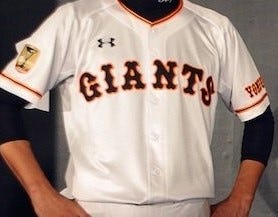
The Giants (both in New York and in San Francisco) had their name on at least one of their uniforms since 1947. Starting in 2020, they will look like this:

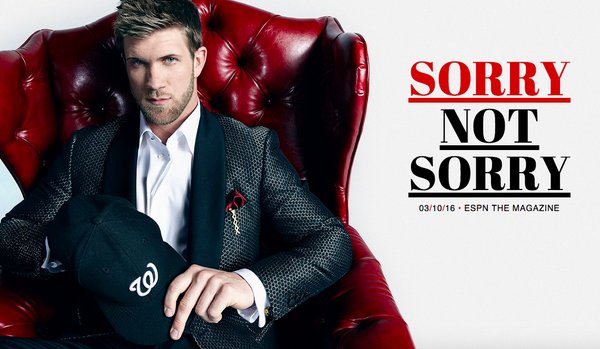
Baseball has been criticized in many circles for being anachronistic, being too tied to its past. There is consternation that basketball and football are better at appealing to a new generation of fans. That, no doubt, was the impetus for this deal. Being affiliated with Bryce Harper, Steph Curry, Cam Newton, and Jordan Spieth will help attract a younger audience. But, do they have to sully the Major League uniform?

Because what is depicted above are just a guess, I remain optimistic. I truly hope that Under Armour has the modesty and humility, and MLB has the integrity and humanity, to make it a raised logo that appears in the same colorway as the uniform. That would still give UA prominent real estate without adversely affecting (too much) the team logos that have been in place — unscathed — for generations.

PLAY BALL!!

The Debate is Over

THE DEBATE IS OVER

blog_trout_harper_2

Coke vs. Pepsi.  Hertz vs. Avis.  Budweiser vs. Coors.  Mounds vs. Almond Joy.  The debates can go on and on.

But, for the love of all things holy, can we please put a definitive end to the Mike Trout vs. Bryce Harper debate?  This race is so one-sided, Trout is doing his best Usain Bolt impression and looking over his shoulder as he approaches the finish line.

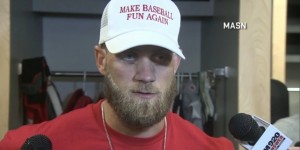
When Harper, coming off his 2015 MVP season, started the 2016 campaign by hitting nine homers in his first 23 games, the baseball world was tripping over itself to determine the value of his first free-agent contract after the 2018 season.  $500 million was being thrown around – as a bargain.  Forget market forces and quality of play, Bryce was making baseball fun again, and he was – from the pundits’ perspective – the best player in the game, worth
every penny.

blog_harper_hat

It is just so annoying when the facts don’t match the narrative.

During that same period at the beginning of the season, little ol’ Mike Trout hit .291, with five homers and 13 RBI, with a .909 OPS.  Not too shabby.  And yet, the man couldn’t get arrested.

Maybe we have just come to expect that from Trout.  Maybe it was because Trout already signed a big contract – 6/$144.5 million – that takes him through the 2020 season.  Maybe it was because Harper loves the spotlight and sought it out at every turn.  I am not sure the how or why.  I just know Harper was king, and Trout was barely a prince.

And then the Nationals went to Chicago.  Coming off a 2-4 with a dinger at Kansas City, the Harper party was in full swing.  But Joe Maddon made a conscious choice not to let Harper beat the Cubs.  Over four games, Harper came to the plate 19 times, got one hit, and walked 13 times (including four times intentionally, and an incredible six times in a 13-inning game).  And that, my friends, was that.

After that series, Harper hit .237 with 14 HRs and 59 RBI.  He ended the season hitting .243 with 24/86, and a .814 OPS.  For that, Harper was paid $5 million – not much by today’s standards, but I’m not sure Ted Lerner feels like he got his money’s worth.

All the while, Mike Trout trotted out to centerfield, playing for a team out of contention from the Opening Day flyover, with an aging Albert Pujols hitting behind him, and no other protection in the lineup.  And yet, he put up – in a word – ridiculous numbers.  But, again, this is nothing out of the ordinary.  He is a metronome and we have come to expect his greatness.  For $15 million, the Angels got the MVP (again).  But there is more to it than that.

Trout never dogs it; rarely argues with umpires; doesn’t get choked by teammates; and doesn’t invite, encourage, or welcome controversy.

blog_harper_espn_mag

Trout is just a ballplayer, and the best one on the planet.  And he has been since his first full season.

Still not convinced, take a look at this comparison:

 2012 HARPER TROUT
BA .270 .326
SLUG .477 .564
OPS .817 .963
HR 22 30
RBI 59 83
Awards All-Star/ROY (All-Star/ROY/2nd in MVP)


 2013 HARPER TROUT
BA .274 .323
SLUG .486 .557
OPS .854 .988
HR 20 27
RBI 58 97
Awards All-Star All-Star/2nd in MVP


 2014 HARPER TROUT
BA .273 .287
SLUG .423 .561
OPS .768 .939
HR 13 36
RBI 32 111
Awards All-Star All-Star/MVP


 2015 HARPER TROUT
BA .330 .299
SLUG .649 .590
OPS 1.109 .991
HR 42 41
RBI 99 90
Awards All-Star/MVP All-Star/2nd in MVP


 2016 HARPER TROUT
BA .243 .315
SLUG .441 .550
OPS .814 .991
HR 24 29
RBI 86 100
Awards All-Star All-Star/MVP


There are two interesting tidbits buried in the above stats:

(1) Trout is the first player in the history of the game to either win the MVP or be the runner-up in each of his first five seasons; and

(2) Even in Harper’s MVP season, he still only had one homerun and nine more RBI than Trout (if you are into those things).  If you are new school, Harper had a 9.9 WAR in his MVP season; Trout had an 8.9 that year.  In fact, Trout’s lowest season WAR is 8.6, and in that season he just won Rookie of the Year and was second in the MVP voting.

By comparison, with the exception of his MVP season, Harper has never had a WAR above 5.1.  Huh?  How is that possible?  How can the guy everyone said would be the first half a billion dollar player have WAR seasons of 3.7 (2013), 1.0 (2014), and 1.6 (2016) on his resume.  Why are we still discussing, let alone debating, this issue?

Trout will be paid $122 million over the next four years – and he is grossly underpaid.

Bryce Harper is second year arbitration eligible in 2017; according to MLB Trade Rumors, he will command roughly $10 million – and if history is any guide, he may be overpaid.  Harper’s career average WAR is 4.3, which puts him in league with Dexter Fowler and Addison Russell.  Good ballplayers, but not $500 players.

No one disputes Harper is a good player who may, one day, be a great player.  But he ain’t no Mike Trout.

In fact, assuming Mike Trout doesn’t get any better, and over the next five years he actually regresses by 20% (which not single baseball person anticipates as he is just hitting his prime and is getting better every year), this is what Harper would have to average in each of the next five season just to catch (a 20% worse) Trout at the 10-year mark:

H HR RBI SLG OPS WAR
196 35 110 .501 .851 12.16


Look at those numbers again. Harper would need to nearly match his MVP levels, and have career highs in hits and RBI every year for five straight years, and would need to average a 12.16 WAR just to match a 20% regressing Mike Trout.

One last piece of context, in case the above isn’t obvious. Harper would need to have the 5th best single-season WAR (just behind 1967 Carl Yastrzemski and 1927 Babe Ruth) every year for five straight years, to catch Trout on a 20% downswing.

The defense rests.

PLAY BALL!!