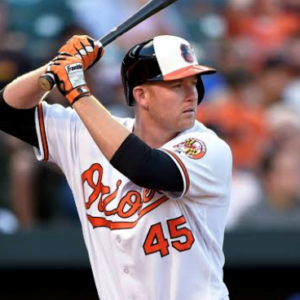
Let’s Give Mark Trumbo A Little Bit of Respect

As I scrolled through X (formerly Twitter) a few weeks ago, I came across a tweet (old habits) from the great contributor Not Gaetti. He (I am assuming from the profile picture) said the following: “Not enough people talk about Mark Trumbo.” And he listed a bunch of stats. That is right; not enough people talk about this guy.

The Anaheim Angels selected Trumbo in the 18th round of the 2004 MLB draft out of Villa Park High School. He started 2005 in rookie ball, hitting ten home runs in 299 at-bats. He slowly worked his way through the minors, notching as many as 36 dingers (which occurred in 2010 in Salt Lake, so there may be an asterisk on that season).

Trumbo made his major league debut, striking out in the seventh inning of a game against the Mariners after his September call-up. He started his career going 0-for-14 with eight strike outs before recording his first hit, a two-out, two-run single in the Angels’ last inning of the season.

That base hit must have left a lasting impression, as he broke camp with the club in 2011, played in 149 games, smashed 29 homers, while slashing .254/.291/.477, for a 114 OPS+ and second place in Rookie of the Year voting.

The following year was more of the same, but better: 32 dingers, an .808 OPS, and a 124 OPS+. That garnered him his first All-Star appearance.

In 2013 he cranked 34 home runs and drove in an even 100.

After that season, Anaheim included Trumbo as part of a three-team trade, sending him to the Arizona Diamondbacks (as a side note, Tyler Skaggs went from Arizona to Anaheim in that deal, changing the trajectory of his career and his life).

Midway through the 2015 season, the Diamondbacks traded Trumbo to the Seattle Mariners, where he put up 1.0 bWAR in 96 games, hitting thirteen home runs.

At the end of the year, the Mariners shipped him off to Baltimore. It seems reasonable that Seattle regretted the move. Trumbo had a career year — bashing 47 homers (which led the league), driving in 108, with a 122 OPS+, earning him his second All-Star nod and his first Silver Slugger Award. He won the Comeback Player of the Year Award, to boot.

Then Trumbo came back to earth. Over the next two seasons combined, he hit just 40 homers and drove in 109 runs. Trumbo missed most of the 2019 season with a knee injury, not taking his first at-bat until September 2nd. He ultimately played in 12 games in what would be his final MLB season.

When all was said and done, Trumbo’s career slash line was .249/.302/.459, with a 108 OPS+. He hit 218 homers. When discussing potential Hall of Fame pitchers, note that Trumbo had a 1.533 OPS against Mark Buehrle, and slashed .348/.375/.739 when facing Cole Hamels. Per Baseball Reference, his career is most similar to Pete Incaviglia, but a more modern-day comp would be Teoscar Hernández. Trumbo isn’t a Hall of Famer; he doesn’t even belong in the Hall of Very Good. But he had a solid career, earning nearly $60 million along the way.


On September 10, 2013, Trumbo became the first Angel to have five hits and score five runs in the same game. He had three doubles and a homer, for 11 total bases.

On April 15, 2016, Trumbo became the first Oriole to hit two home runs in the same inning, when he smashed a two-run dinger off Martín Pérez and then a three-run shot off Andrew Faulkner.


We tend to forget the players that come and go; those who don’t put up massive numbers, but are solid year after year. It is important to recognize the lunchpail guys who show up, do the work, produce, and leave the game and their teams better than where they found them. Mark Trumbo was just that type of player.

PLAY BALL!!
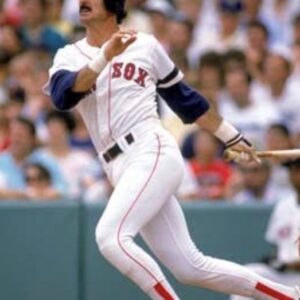
Dwight Evans Should Be Given Some Additional Hall of Fame Consideration

For a while during the mid-‘80s, the Boston Red Sox right fielder Dwight Evans, “Dewey” to the fans in the Back Bay, was always on base and always making great plays. He was the heart and soul of a Red Sox team that flirted with greatness.

Evans grew up in Southern California, and starred at Chatsworth High School on the same field where Mike Moustakas would eventually play. In 1969, the Red Sox selected Evans in the fifth round of the draft. Three years later he made his major league debut. He came in as a pinch-runner for Reggie Smith (who ended his career in Southern California and still runs a hitting clinic in the area) in the bottom of the sixth inning of a game in September, and then had his first plate appearance in the bottom of the eighth, popping out to short.

Evans got 63 more plate appearances over the final two weeks of the 1972 season, slashing .263/.344/.404, but ended the season with an 0-for-4 ten days before this writer was born.

Evans became an everyday player the following year, and won his first Gold Glove in right field in 1976 (he would go one to win seven more). He hit his stride in 1981, tying for the American League lead (with Eddie Murray) with 22 home runs, and leading the league in walks (85), OPS (.937), total bases (215), and bWAR (6.7). For all of that he became a second-time All-Star, a first-time Silver Slugger, and came in third in MVP voting (behind Rollie Fingers(?) and Rickey Henderson). He won his third Gold Glove, to boot.

The following year he played in every game and led the league with a .402 on base percentage. It was in 1981 when he got his first taste of being the team’s leadoff hitter (101 plate appearances). For whatever reason, I recall Dewey batting leadoff throughout the ‘80s, when in fact that was his calling in just 1985 (355 plate appearances). No matter, he was in top-ten in on base percentage eight years between 1981-1989. Over an illustrious 20-year career, he slashed .272/.370/.470, with 385 homers (68th all-time) and 483 doubles (82nd all-time).

Evans first appeared on the Hall of Fame ballot in 1997, and barely survived to fight another day, with just 5.9% of the vote (a candidate needs to receive 5% or more to remain in contention the following year). In 1998 he nearly doubled his support, with 10.4%. But in 1999, only 3.6% of the electorate checked the box next to his name, pushing him off the ballot altogether.

In 2020, the Veterans Committee heard his case, and 50% voted for his induction. Unfortunately, 75% is required. All of which begs the question: Is Dwight Evans a Hall of Famer?

This is where Baseball Reference is exceedingly helpful. Where the average Hall of Famer has 27 instances of “black ink” (i.e., leading the league in a category), Evans has only 15. According to Bill James’ Hall of Famer Monitor, where a score of 100 denotes a likely entrant, Evans is only at 70 (but, note, that this just considers his offensive production, and not his Gold Glove defense).

By James’ Hall of Fame Standards, where the average Hall of Famer scores a 50, Evans lands at 44. Per Jay Jaffe’s JAWS metric, Evans falls just shy in every category:

  • Career bWAR: 67.2 / Average Hall of Fame right fielder: 69.7.
  • Peak 7-year bWAR: 37.3 / Average Hall of Fame right fielder: 42.2.
  • bWAR/162: 4.2 / Average Hall of Fame right fielder: 4.9.
  • Evans’ overall JAWS score 52.2 / Average Hall of Fame right fielder: 56.

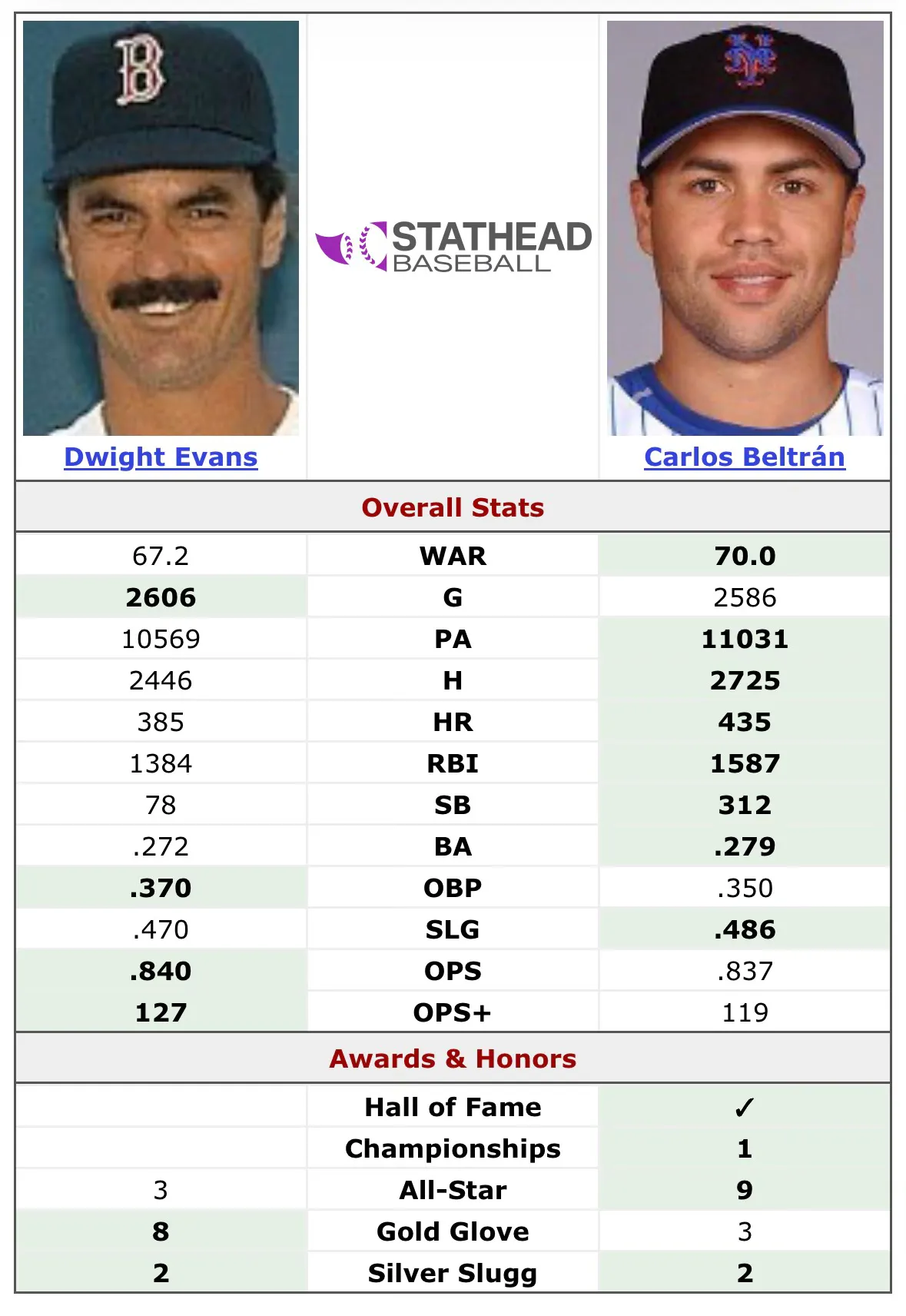
Does all of this advanced analysis mean that Evan is certainly not a Hall of Famer? By no means. If you are a “Large Hall” fan, you could definitely see Dewey with a plaque. If a “Small Hall” is more your speed, you think Evans probably belongs in the “Hall of Very Good.” Neither argument is incorrect. But, as we watch more and more players get further consideration for the ultimate honorific, it seems only right and reasonable that Dwight Evans get another look. And with Carlos Beltrán getting the nod this year, let’s compare the two:

Based on this side-by-side comparison, there is every reason for the Contemporary Baseball Era Committee, which meets again in 2028, to give Dewey serious consideration.

PLAY BALL!!

Fred Lynn Deserves Additional Hall of Fame Consideration

It was 1973 in Bristol, Connecticut. Two outfielders from vastly different backgrounds got together to play for the Boston’s Double-A affiliate. The next year they teamed up in Pawtucket, the club’s Triple-A team. So, for those following the Red Sox closely in the mid-70s, it was not a shock when the “Gold Dust Twins” took their respective positions in the outfield at Fenway Park to start the 1975 season (to be precise, they didn’t play at home until the third game of the season, after playing the first two in Baltimore).

Fred Lynn grew up in Southern California, and played collegiately at USC. He spurned the Yankees when they drafted him in the third round in 1970, signing with Boston after being drafted in the second round in 1973.

Boston selected Jim Rice with the 15th pick in the 1971 draft out of Hanna High School in Anderson, South Carolina. He played in the New York Penn League as an 18-year old, then in Winterhaven in 1972. Rice actually started the 1973 season in Triple-A, but was demoted to Bristol after ten games despite slashing .378/.425/.757 in that short span of time.

When Rice arrived in Bristol, he was paired up with Lynn, and it would remain that way for the next nine years, until Lynn was traded away to the (then) California Angels.

Both Lynn and Rice got cups of coffee with the Red Sox at the end of the 1974 season, playing in 15 and 24 games, respectively. Lynn collected 18 hits in 43 at-bats, while Rice got the same number of hits over 67 at-bats.

In 1975, Rice, playing left field, slashed .309/.350/.491, with 22 home runs and 102 RBI. To his left, playing centerfield, Lynn slashed .331/.401/.566, with 21 homers and 105 RBI. Lynn was an All-Star, won a Gold Glove, won Rookie of the Year, and was named the American League MVP. Rice came in second in Rookie of the Year and third in MVP voting. The future in the Back Bay was bright.

Rice was an All-Star eight times, won an MVP award in 1978*, and was top-five in MVP voting four more times in his sixteen year career.


*In 1978, Rice led the league in: bWAR (7.6), games played (163), plate appearances (746), at-bats (677), hits (213), triples (15), home runs (46), RBI (139), slugging percentage (.600), OPS (.970), OPS+ (157), and total bases (406). Rare has been a player been more deserving of an MVP award.


Lynn was an All-Star eight more times, over the course of the next eight seasons. He had one more top-five MVP year (fourth place in 1979), but didn’t truly do anything of note after 1983. That said, starting in 1983, he was still a high-quality ballplayer, with an OPS+ above 100 every season from 1984 through 1988, falling to 99 in his penultimate season, 1989.

Lynn’s reputation became that of an injury-prone player who could not stay on the field. Nicknamed “Fragile Freddy” by the Boston press, he played all-out and often suffered the consequences. From 1980 through 1990, he averaged just 114 game per season, but still had a 121 OPS+ for that decade-plus. Ironically, over roughly the same period, Rice – not labeled injury-prone – averaged just 129 games per season, with a 120 OPS+.

In 2009, on his fifteenth (and last) appearance on the ballot (this was reduced to ten years in 2015), Jim Rice was elected to the Hall of Fame. By contrast, Lynn got 5.5% of the vote in his first year of eligibility (1996), and then fell off the ballot the following year when he received only 4.7% (a player needs at least 5% to roll over to the next year’s ballot).

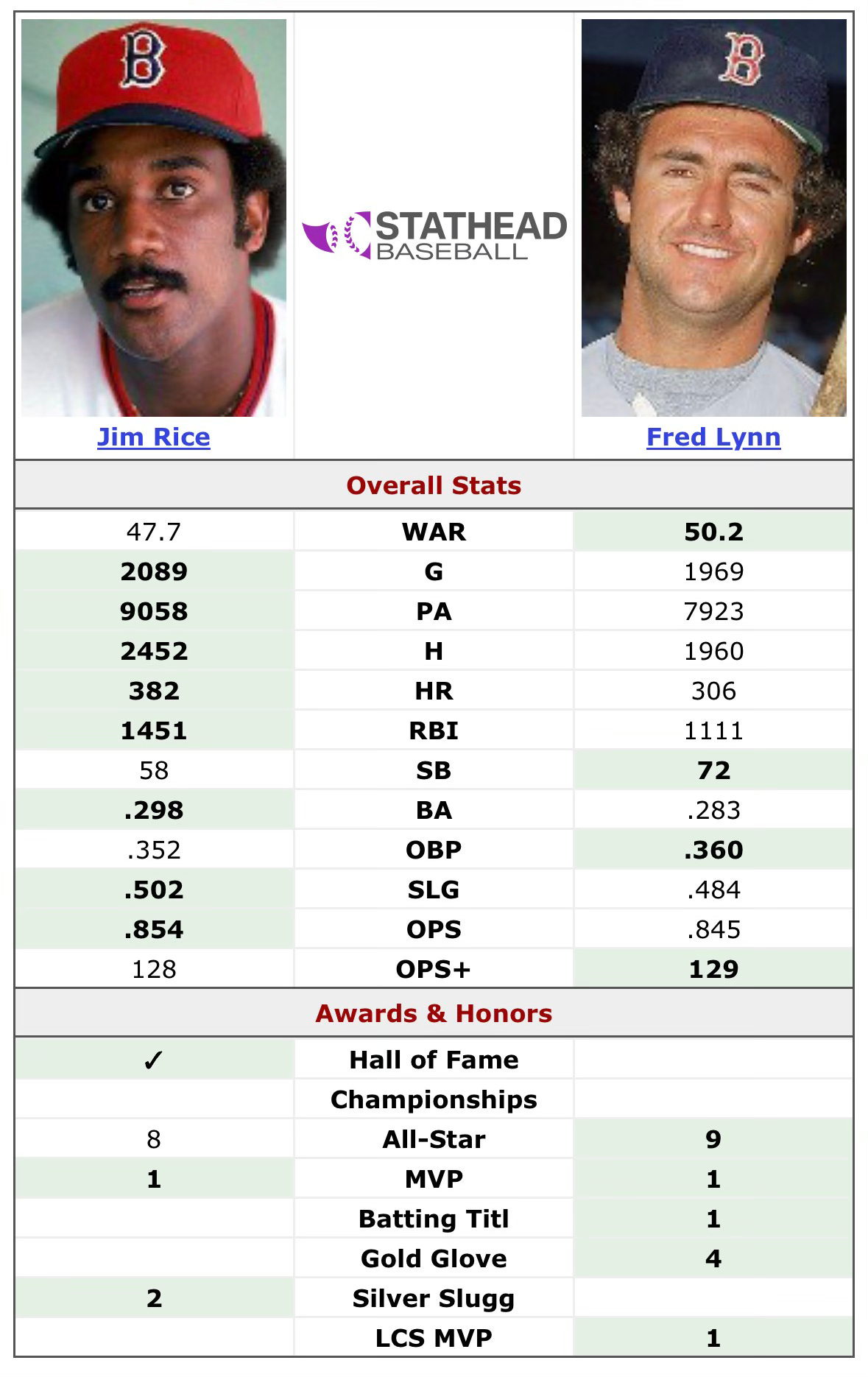
But when you look at these players side-by-side, they look a heck of a lot more similar than you might imagine. Where Rice outpaces Lynn, it is just by a hair.

Should Fred Lynn be in the Hall of Fame? Was his candidacy given short shrift by the votes? Should a future Contemporary Baseball Era Committee give Lynn another look? All fair questions. If Jim Rice is the barometer, I think the answer to the last question is most certainly yes.

PLAY BALL!!