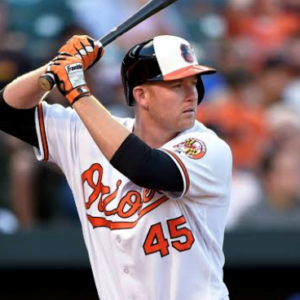
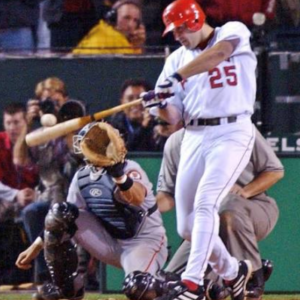
Troy Glaus, a Southern California “kid,” will turn 50 this summer. It does not seem possible that he played his last game sixteen years ago, when he finished his career in Atlanta. But it also seems fitting, as the player in the game today who most resembles Glaus is the Braves’ current third baseman, Austin Riley.
Glaus grew up in Carlsbad, California, which is just north of San Diego and just south of Anaheim. The Padres snatched the slugger in the second round of the 1994 draft, but he spurned their offer to play at UCLA. Three years later, the Angels made Glaus the third pick in the draft, signing him for $2.25 million.
Just over a year later, he made his MLB debut, playing third base and batting sixth against the Boston Red Sox. True to his billing, he smacked an RBI double in his first at-bat. Glaus played in only 48 games that season, hitting just a single home run. But in 1999, he showed the promise that the Angels (and Padres before them) had hoped for. In 154 games, he slugged 29 homers and accrued 3.1 bWAR. All of which was a prelude to 2000.
The 6’5” masher had a career year in 2000, slashing .284/.404/.604, with a league-leading 47 home runs, a 150 OPS+, and 7.8 bWAR. That was enough to make him an All-Star and to get him a Silver Slugger Award.
Things didn’t fall off too much in 2001, as he cranked another 41 homers, actually drove in six more runs (108), made another All-Star team, and won another Silver Slugger.
In 2002, Glaus’ numbers fell off slightly during the regular season, but not in the playoffs. The third baseman won the World Series MVP after hitting .385 with three homers and eight RBI, including a go-ahead double in Game 6, which was the coup-de-grâce* of their five-run comeback in that game.
*People always remember Scott Spezio’s three-run homer that got the Angels off the mat, and cut the Giant’s lead to 5-3. They may even remember Darin Erstad’s leadoff homer in the eighth inning that brought the Angels within one run. But they often forget Glaus’ two-run double that flipped the score in Anaheim’s favor.
With roughly the same numbers as 2002, Glaus was an All-Star again in 2003.
Unfortunately for the SoCal native, 2004 was his walk year, and he missed most of it with a shoulder injury, playing in only 58 games. Yet, he still hit 18 dingers with a 140 OPS+. That was not enough to convince Anaheim to give him a contract when he became a free agent. Instead, he signed a four year, $45 million deal with the Arizona Diamondbacks. All he did in Phoenix was crush 37 home runs, slug .522, and have 281 total bases.
After the 2005 season, the Toronto Blue Jays came calling, looking for offensive production, and the Diamondbacks had just the guy to send north. So, Glaus found himself on the East Coast for the first time in his career. He didn’t miss a beat, putting up nearly identical numbers to those from the year before in the desert, while even playing a handful of games at shortstop. He was an All-Star again, and for the first and only time, he received MVP votes.
Foot injuries, and his named being included in the Mitchell Report, slowed his progress in 2007. And yet, he still had a 120 OPS+ and accrued another 3.3 bWAR. At the end of the year, the Blue Jays and the Cardinals completed a so-called “challenge trade,” swapping third baseman, with Glaus switching places with Scott Rolen. Glaus had a great year in 2008, slashing .270/.372/.483, with 27 home runs, 99 RBI, a 125 OPS+, and 4.4 bWAR*. Plus, he committed just seven errors and led the league with a .982 fielding percentage.
*By comparison, Rolen slashed .262/.349/.431, with 11 home runs, 50 RBI, 109 OPS+, and 3.4 bWAR.
On September 3, 2008, Glaus hit his 300th career home run. He would hit just 20 more. In early 2009, he underwent arthroscopic surgery on his right shoulder. The Cardinals expected him to be ready for Opening Day, but setbacks kept pushing back his return, and he didn’t make his first appearance until September 2nd.
The Cardinals did not re-sign Glaus when his contract expired, so he signed a one-year, $1.75 million contract with the Atlanta Braves, which included up to $2.25 million in performance incentives. In Atlanta, he moved across the diamond to play first base, and was named Player of the Month for May, 2010 (.330, six homers, 28 RBI). But his production began to wane as the temperature started to rise. He hit .237 in June with six homers, then .182 with no dingers in July, .208 with two round-trippers in August, and went just 4-for-17 over the rest of the season. With Glaus’ production cratering, the Braves acquired Derrek Lee on August 18th to play first base, and Glaus went on the injured list with “knee fatigue.” Glaus did start Game 4 of the NLDS against the Giants, playing seven innings at third base, and going 0-for-3. That would be his last major league appearance.
Last May Glaus returned to Angel Stadium once again, this time to serve as a pinch hitter for the Savannah Bananas. He got a base hit to left field, which feels like a much more fitting end to his unfortunately unheralded career.
PLAY BALL!!