We Don’t Talk Enough About Orel Hershiser

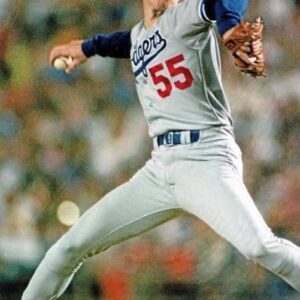
Not enough is written about Orel Hershiser’s career, and, specifically, his 1988 season.

The Los Angeles Dodgers drafted Hershiser out of Bowling Green State University in the 17th round in 1979. He made his major league debut four years later, pitching one inning, giving up two hits, and one run to the Montreal Expos.

For the first few years of his career, Hershiser was an enigma:

  • 1984: 11-8, 2.66 ERA
  • 1986: 14-14, 3.85 ERA
  • 1987: 16-16, 3.06 ERA

Smashed in the middle of those middling seasons was 1985, when he went 19-3 with a 2.03 ERA, and came in third in Cy Young voting. So, everyone in baseball knew that greatness lived within him.

That greatness was achieved in his magical 1988. He started the year with a three-hit shoutout against the Giants. He then went 8-1/3 innings, giving up one run in a win against Atlanta. Followed by a complete game win against the Braves five days later. Then he threw six innings, allowing just one earned run against the Giants. Next, while facing the Cardinals, he went eight innings and gave up three (!) earned runs.

When the calendar flipped to May, the Pirates touched him up for ten hits, but could only manage two earned runs. With the win, he ran his record to 6-0. The Buccos apparently had his number, as in Pittsburgh a week later he had his first bad game (12 hits, seven earned runs, three walks, and three homers allowed), suffering his first loss of the year. The next week he gave up just one earned run on five hits, but the Dodgers didn’t score, so he took his second loss.

Over the next ten weeks Hershiser went 12-6 with a 2.99 ERA and a 2/1 strikeout to walk ratio, which was just fine, but actually below his season totals to that point: 18-8, 2.84 ERA, 2.25 K/BB ratio. And that is when he decided to turn legend. Well, maybe even a bit before that.

You see, on August 19th, he threw a complete game shutout against the Expos. On August 24th, he threw seven scoreless innings before giving up two runs in the top of the eighth to the Mets, but did not allow them to score in the ninth (the Dodgers lost 2-1). On August 30th, he held the Expos scoreless for four innings, had a two-run blip in the fifth, and then shut them down for the final four innings. Those four innings would be the start of the incredible month to follow. And, to be clear, even before “The Streak” began, Hershiser had allowed no runs in 12 of his previous 14 innings (two runs in each of those two blemished frames).

As we all know, Hershiser went all of September without giving up a run. He went 5-0, threw 55 innings allowing just 30 hits, and struck out 34 while walking only nine batters. Oh, did I mention that – prior to coming out of a tie game in which he pitched ten innings and broke Don Drysdale’s scoreless innings streak — Hershiser had thrown eight consecutive complete games.

In his first playoff start, against the Mets in the NLCS, he went 8-1/3, but got a no-decision when Jay Howell couldn’t hold the lead. Four days later, Hershisher gave up one earned run over six innings in another Dodgers’ loss.

But since six innings was mere child’s play, the ace came in as a relief pitcher in the 12th inning the next day. After Kirk Gibson’s home run in the top half of the inning staked Los Angeles to a 5-4 lead, Tim Leary gave up back-to-back singles before recording the first out of the inning. Jesse Orosco (the former Met) came on to face two lefties, walking Keith Hernandez to load the bases, but then he got Darryl Strawberry to pop out to second. With the right-handed hitting Kevin McReynolds coming up with the bases loaded and the Dodgers facing a potential 3-1 deficit in the series, Tommy Lasorda called on “Bulldog” to get the final out. Three pitches later, he did just that.

It was no shock when he took the mound for Game 7 of the NLCS three days later at home and threw a five-hit shutout, propelling the Dodgers to the pennant.

Even superheroes need a day off, so Hershiser skipped Game 1 of the World Series, but started Game 2 in Los Angeles against the shell-shocked Athletics (try to recall how Game 1 of the 1988 World Series ended). He, of course, threw a three-hit shutout to put the Dodgers up to two games to none. Four days later, he took the hill for Game 5 and threw yet another complete game, yielding two runs on four hits, as the Dodgers won the World Series.

When all was said and done, counting both the regular season and the playoffs, in 1988 Hershiser tossed 309-2/3 innings, threw 18 complete games including ten shutouts, and went a combined 26-8. He won the NLCS MVP, World Series MVP, and Cy Young Award.

Hershiser pitched for 12 more seasons after that historic 1988. For his career, he went 204-150, with a 3.48 ERA and a 3.69 FIP. He appeared in the 1995 World Series with Cleveland after being named the ALCS MVP. He is in the Top-100 of all-time pitcher bWAR, but, unfortunately, is not likely to ever gain induction into the Hall of Fame. No matter, he was still a force of nature.

And, like I said, not enough is written about him or his season for the ages.

PLAY BALL!!
Troy Glaus Was A World Series MVP Plus A Whole Lot More

Troy Glaus, a Southern California “kid,” will turn 50 this summer. It does not seem possible that he played his last game sixteen years ago, when he finished his career in Atlanta. But it also seems fitting, as the player in the game today who most resembles Glaus is the Braves’ current third baseman, Austin Riley.

Glaus grew up in Carlsbad, California, which is just north of San Diego and just south of Anaheim. The Padres snatched the slugger in the second round of the 1994 draft, but he spurned their offer to play at UCLA. Three years later, the Angels made Glaus the third pick in the draft, signing him for $2.25 million.

Just over a year later, he made his MLB debut, playing third base and batting sixth against the Boston Red Sox. True to his billing, he smacked an RBI double in his first at-bat. Glaus played in only 48 games that season, hitting just a single home run. But in 1999, he showed the promise that the Angels (and Padres before them) had hoped for. In 154 games, he slugged 29 homers and accrued 3.1 bWAR. All of which was a prelude to 2000.

The 6’5” masher had a career year in 2000, slashing .284/.404/.604, with a league-leading 47 home runs, a 150 OPS+, and 7.8 bWAR. That was enough to make him an All-Star and to get him a Silver Slugger Award.

Things didn’t fall off too much in 2001, as he cranked another 41 homers, actually drove in six more runs (108), made another All-Star team, and won another Silver Slugger.

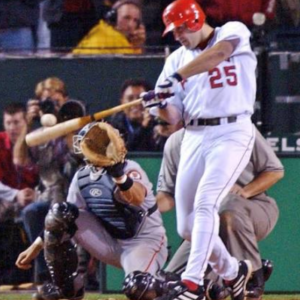
In 2002, Glaus’ numbers fell off slightly during the regular season, but not in the playoffs. The third baseman won the World Series MVP after hitting .385 with three homers and eight RBI, including a go-ahead double in Game 6, which was the coup-de-grâce* of their five-run comeback in that game.


*People always remember Scott Spezio’s three-run homer that got the Angels off the mat, and cut the Giant’s lead to 5-3. They may even remember Darin Erstad’s leadoff homer in the eighth inning that brought the Angels within one run. But they often forget Glaus’ two-run double that flipped the score in Anaheim’s favor.


With roughly the same numbers as 2002, Glaus was an All-Star again in 2003.

Unfortunately for the SoCal native, 2004 was his walk year, and he missed most of it with a shoulder injury, playing in only 58 games. Yet, he still hit 18 dingers with a 140 OPS+. That was not enough to convince Anaheim to give him a contract when he became a free agent. Instead, he signed a four year, $45 million deal with the Arizona Diamondbacks. All he did in Phoenix was crush 37 home runs, slug .522, and have 281 total bases.

After the 2005 season, the Toronto Blue Jays came calling, looking for offensive production, and the Diamondbacks had just the guy to send north. So, Glaus found himself on the East Coast for the first time in his career. He didn’t miss a beat, putting up nearly identical numbers to those from the year before in the desert, while even playing a handful of games at shortstop. He was an All-Star again, and for the first and only time, he received MVP votes.

Foot injuries, and his named being included in the Mitchell Report, slowed his progress in 2007. And yet, he still had a 120 OPS+ and accrued another 3.3 bWAR. At the end of the year, the Blue Jays and the Cardinals completed a so-called “challenge trade,” swapping third baseman, with Glaus switching places with Scott Rolen. Glaus had a great year in 2008, slashing .270/.372/.483, with 27 home runs, 99 RBI, a 125 OPS+, and 4.4 bWAR*. Plus, he committed just seven errors and led the league with a .982 fielding percentage.


*By comparison, Rolen slashed .262/.349/.431, with 11 home runs, 50 RBI, 109 OPS+, and 3.4 bWAR.


On September 3, 2008, Glaus hit his 300th career home run. He would hit just 20 more. In early 2009, he underwent arthroscopic surgery on his right shoulder. The Cardinals expected him to be ready for Opening Day, but setbacks kept pushing back his return, and he didn’t make his first appearance until September 2nd.

The Cardinals did not re-sign Glaus when his contract expired, so he signed a one-year, $1.75 million contract with the Atlanta Braves, which included up to $2.25 million in performance incentives. In Atlanta, he moved across the diamond to play first base, and was named Player of the Month for May, 2010 (.330, six homers, 28 RBI). But his production began to wane as the temperature started to rise. He hit .237 in June with six homers, then .182 with no dingers in July, .208 with two round-trippers in August, and went just 4-for-17 over the rest of the season. With Glaus’ production cratering, the Braves acquired Derrek Lee on August 18th to play first base, and Glaus went on the injured list with “knee fatigue.” Glaus did start Game 4 of the NLDS against the Giants, playing seven innings at third base, and going 0-for-3. That would be his last major league appearance.

Last May Glaus returned to Angel Stadium once again, this time to serve as a pinch hitter for the Savannah Bananas. He got a base hit to left field, which feels like a much more fitting end to his unfortunately unheralded career.

PLAY BALL!!

2026 National League Preview – Reader’s Digest Version

With the 2026 MLB season quickly approaching, it’s a good time to have a little refresher about what transpired during the Hot Stove Season, what moves have been made, and what each time might expect out of the coming campaign.

There is a great deal to get caught up on, so we will try to synthesize each team in a sentence or three.

Today we will look at the National League, with the American League on tap for next Tuesday.

So, without any further ado, in alphabetical order:

Arizona Diamondbacks

Corbin Carroll had hamate surgery, but should be back by Opening Day. However, he may not have the power that we have come to expect.

Nearly 40-year old Carlos Santana will be playing first base. Nolan Arenado waived his no trade clause, came over from St. Louis, and will play third. Merrill Kelly signed for two years, and Zac Gallen and Paul Sewald are back.

Atlanta Braves

Should the Braves run incense around the stadium to rid themselves of their bad luck? Last year, everything that could go wrong did go wrong. And this season is off to a rough start. Ha-Seong Kim, signed to play shortstop, slipped on the ice in his native South Korea, which required hand surgery, and now will be out for at least the first two months. Pitchers Spencer Schwellenbach and Hurston Waldrep will miss at least two months because of elbow surgeries, and Joey Went tore his ACL. Catcher Sean Murphy is out for the first part of the season as he recovers from hip surgery.

And the biggest story is that after missing half of last season due to a PED suspension, left fielder Jurickson Profar will be gone for all of 2026 after getting popped again. Is this the end of his career (he has one year and $14M remaining on his deal)?

Chicago Cubs

Alex Bregman will be the Cubs’ everyday third baseman after signing a five-year/$175M contract. Shota Imanaga is back. Pete Crow-Armstrong needs to be more like his first half self (.265/.302/.544, 21 homers, 71 RBI, 27 stolen bases) than his second half self (.216/.262/.372, 6 homers, 24 RBI, eight stolen bases).

Anything less than a division title will feel like a lost season to the fans on the North Side.

Cincinnati Reds

The Reds lost out on getting Ohio native Kyle Schwarber to leave Philadelphia to hit a ton of dingers at Great American Ballpark. So, they brought back former Red Eugenio Suarez (he played there from 2015-2021), who hit 49 homers last season.

Any team with Elly De La Cruz in the lineup is worth watching. But, watch out for the final diagnosis on ace Hunter Greene, who is seeing a specialist about stiffness in his right (throwing) elbow.

Colorado Rockies

A new front office is in place to bring the team into the 21st century. After a decade working for the Cleveland Browns, Paul DePodesta will be running the show, and after more than a decade working for the Dodgers, Josh Byrnes was hired as general manager. Regardless of their pedigree, it will take at least a few years for them to implement enough meaningful change for this team to be anything other than woeful.

Los Angeles Dodgers

When you have won back-to-back World Series titles, what do you do for an encore? You go out and get the two best free agents on the market. To do so, you simply outbid the wealthiest owner in the game, and give Edwin Díaz $69M and Kyle Tucker $60M per year(!) for four years. And to keep the fanbase happy, you re-sign Kiké Hernández.

Miami Marlins

In: pitcher Pete Fairbanks, utility guy Christopher Morel, and potential future outfield star Owen Caissie.

Out: Right-handed fireballer Edward Cabrera.

If everything breaks right, and other teams falter, the Marlins will vie with the Braves for fourth place in the division.

Milwaukee Brewers

This is a team that keeps losing players (and a star manager) and just keeps on winning. The Brewers won the NL Central last year, and are predicted to win it again in 2026.

Freddy Peralta is gone (traded to the Mets). Rookie of the Year finalist Caleb Durbin is gone (traded to the Red Sox). Fourth place Rookie of the Year finisher Isaac Collins is gone (traded to the Royals). Jose Quintana and Rhys Hoskins are gone as free agents.

But, Brandon Woodruff should be back, Jacob Misiorowski should only get better, and Chad Patrick and Quinn Priester round out a strong pitching staff.

Come October, don’t be shocked to see this motley Brew Crew back in the playoffs.

New York Mets

The off-season got off to a rough start for a team that missed the playoffs by one game, on the last day of the 2025 season. First they traded fan-favorite Brandon Nimmo to the Rangers for second baseman Marcus Semien. Then they lost Edwin Díaz to the Dodgers. Then they allowed franchise home run king Pete Alonso to sign with the Orioles without even making him an offer. Then they traded fan-favorite Jeff McNeil to the A’s for really nothing more than salary relief. Then they lost out on Kyle Tucker (to the Dodgers, again).

But, they signed Bo Bichette to play third base, Devin Williams to close, and traded for the oft-injured but amazing-when-healthy center fielder Luis Robert Jr. Will that be enough to get Steve Cohen the ring he so desperately covets?

Philadelphia Phillies

Will this be the year that age catches up to the Phils (their starting lineup will average 33 years old)? Will this be the year that this group of stars finishes the goal of winning their first World Series since 2008? With both Kyle Schwarber and J.T. Realmuto back, and with Ranger Suarez and Nick Castellanos gone, it is time to put up or get split up.

Pittsburgh Pirates

With the second-best pitcher on the planet, Paul Skenes, with phenom Bubba Chandler coming up the mound right behind him, with Marcell Ozuna as the everyday DH, with Ryan O’Hearn and Brandon Lowe covering the right side of the infield, this is a team that should be playing meaningful baseball in September, and has an outside shot of playing in October. That is something Yinzers can get excited about.

And keep an eye on potential Rookie of the Year Konnor Griffin, who may make his big league debut at shortstop as a teenager.

St. Louis Cardinals

This is the first year since 2006 that John Mozeliak has not been at the helm of the team. Chaim Bloom is now in charge after taking a year to learn every facet of the organization. He immediately traded first baseman Willson Contreras and pitcher Sonny Gray to Boston, and then ate $31M to send Nolan Arenado to Arizona.

JJ Wetherholt could be the Rookie of the Year at second base, and Masyn Winn could win his first Gold Glove at short.

The Cardinals need to do something to improve attendance, which had the largest fall off last season, down 22% (more than 7,700 fans per game).

San Diego Padres

After the death of principal Peter Seidler, the team is now for sale. But, to provide stability, president of baseball operations AJ Preller signed an extension through at least 2028.

The club lost Dylan Cease and Robert Suarez and Luis Arraez. They added Nick Castellanos (for the MLB minimum after the Phillies waived him). The lineup still boasts Fernando Tatís Jr. (who could be an MVP if he did not play in a league with Shohei Ohtani), Manny Machado (who continues to burnish his Hall of Fame credentials), Xander Bogaerts, Jackson Merrill (looking to bounce back from a sophomore slump), and Jake Cronenworth.

It may not be enough to overtake the Dodgers, but it may be enough to play baseball in October.

San Francisco Giants

The gutsiest move of the off-season was Buster Posey hiring University of Tennessee head coach Tony Vitello as the team’s manager, the first time anyone has ever gone from the college ranks to MLB skipper with no stops in between.

Maybe the second gutsiest move of the off-season was paying Luis Arraez $12M to be their second baseman when he ranked 299th out of 311 defenders in Fielding Run Value in 2023, the last time he played there consistently.

Harrison Bader should help solidify their outfield defense and provide some occasional pop.

Washington Nationals

Unlike the Phillies, youth is the talk of the nation’s capital. New manager Blake Butera is 33 years old; new general manager Anirudh Kilambi is 31; and new president of baseball operations Paul Toboni is just 35. And no one in the projected starting lineup is older than 27.

James Wood projects to have another incredible season. Will Dylan Crews finally show the promise that made him the number two pick in the 2023 draft, right behind his LSU teammate, Paul Skenes?

Regardless of who does what, the Nationals still appear to be amongst the worst teams in baseball, with FanGraphs projecting just 69 wins.

Note: The American League review/summary will be available next week.

PLAY BALL!!

Somehow Andy Pages, A Little-Known Second-Year Player, Became a Main Character In 2025

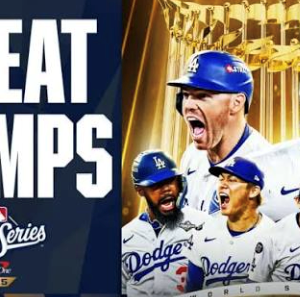
Last month the Los Angeles Dodgers won their second consecutive World Series. They were led by four-time MVP Shohei Ohtani, who, for the first time in the National League, worked his magic with his bat and his arm.

They also fielded former MVPs Mookie Betts and Freddie Freeman. The team was anchored by sluggers Max Muncy and Teoscar Hernández, and stalwart catcher Will Smith. The pitching staff included (in addition to Ohtani) Blake Snell, Yoshinobu Yamamoto, Tyler Glasnow, Roki Sasaki.

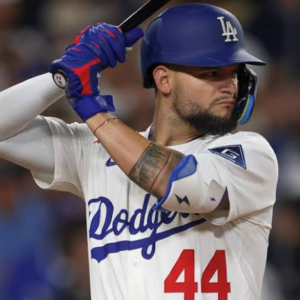
But there was one other player who found himself at the center of attention multiple times during the season. A player who failed so badly towards the end of the playoffs that he was benched. And yet, years from now, when we watch videos about the 2025 season, this guy may be the main character. I am talking, of course, about Andy Pages.

Pages made his major league debut in 2024, and he was a perfectly average. He played in 116 games, slashed .248/.305/.407, for an exact 100 OPS+. In 2025 the Dodgers named him their Opening Day center fielder, and he rewarded their faith by slashing .285/.325/.479 with 17 homers in the first half. His second half was more pedestrian (.252/.293/.435). But, no matter, he played 155 games, and jogged out to center field when the playoffs began.

Through Game 1 of the NLCS against the Brewers, the 24-year-old from Cuba was 1-for-27 with six strikeouts and no walks. He did manage a single in each of Games 2 and 3 of the NLCS, before going 0-fer in Game 4 and Game 1 of the World Series. An eighth inning single in Game 2 of the fall classic off Louis Varland would be the sum total of the offense that Pages would provide before Los Angeles celebrated their Game 7 victory at Rogers Centre.

But none of that ineptitude mattered. Here is why – and here is why Andy Pages was the Dodgers main character (non-Shohei Ohtani division) for this remarkable year.

When the story of 2025 is written, there will be four main plot points: (1) Cal Raleigh doing things no catcher and no switch-hitter has ever done before; (2) Shohei Ohtani continuing to do things no player has ever done before (including pitching six scoreless innings while hitting three home runs in the same game, which just happened to be the pennant winner); (3) the Dodgers being the first team to win back-to-back World Series this century; and (4) the betting scandal that ensnared Guardians’ pitchers Emanuel Clase and Luis Ortiz.

Let’s start with the last one. Not that anyone reading this needs a primer, but if you do, Clase and Ortiz are accused of intentionally throwing pitches out of the strike zone so that people could bet (and win) that a specific pitch would be a ball. They are alleged to have done this on numerous occasions, all to successful outcomes. Except…

On May 28th, Clase came in to the pitch the ninth inning against the Dodgers, and he faced Pages to start things off. His first offering was a slider that bounced two feet in front of the plate – very much a ball. But Pages swung anyway. That swing cost some bettor $4,000. The entire story (including Pages’ four-figure flail) did not come out until after the World Series, so Dodger fans could not use this to ridicule the slumping outfielder, but the video of that at-bat is probably the second-most watched of his career.

The most watched at-bat happened in Game 4 of the National League Division Series against the Phillies. The Dodgers led two games to one, and were on the verge of losing their second straight game and having to head back to Philadelphia to try to win a deciding Game 5. In the bottom of the eleventh inning of a 1-1 tie, they loaded the bases with two outs against Orion Kerkering. At that moment, Pages was 1-for-18 in the post-season. True to form, he hit a soft grounder back to the mound. Kerkering fumbled the ball off the bat, and rather than throwing to first base (where catcher JT Realmuto was pointing) to record the final out and push the game to the 12th inning, he got flustered and threw the ball to the backstop, allowing Hyeseong Kim to score from third with the game and series-winning run. All because of Pages’ weak contact. The video of that at-bat may have been removed from YouTube in the City of Brotherly Love, but it still has been watched thousands of times at this point.

And there will be no re-telling of the Dodgers World Series victory without the story of Andy Pages and Kiké Hernández in the bottom of the ninth inning of Game 7. Just to set the stage: After replacing Blake Snell, Yoshinobu Yamamoto hits Alejandro Kirk with his second pitch, loading the bases with one out of a 4-4 game. With the bases now loaded, and the World Series-winning run 90 feet away, Dodgers manager Dave Roberts replaces Tommy Edman in center field with the recently-benched Pages, who has a better throwing arm (98th percentile per Statcast). After Daulton Varsho’s ground ball to second resulted in an out at home (very close!), the bases remained loaded with two outs. On the next pitch, the light-hitting Ernie Clement hit a ball 101-mph and 364 feet to left-center. Hernández, playing a little shallow (as he had done the night before to great effect) turned and dashed towards the wall. He was either going to make a Willie Mays-type catch or the World Series would end – those were the only two options. That is, until Pages came out of nowhere – he covered 121 feet at 29.2 feet/second – to bulldoze Hernández and make the catch at the wall to push the game into extra innings.

A few feet to the left of where Pages made that catch Joe Carter once hit a World Series walk-off home run, and the announcer, Tom Cheek, proclaimed: “You will never hit a bigger home run in your life.” Well, Pages will never make a bigger catch in his life.

The 2025 World Series will go down as one of the greatest ever. And the Dodgers 2025 season will be remembered for a long time. It is incredible that on multiple occasions, with all of their stars and all of that star power, it was a little-known second-year player who found himself in the spotlight time and again.

PLAY BALL!!