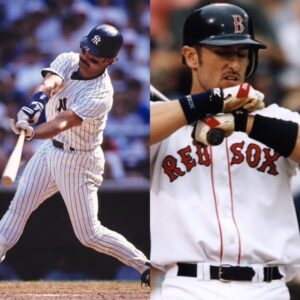
Sometimes it is fun to look at two wholly different players and see how very similar they were. Today we will look at two guys who essentially played on opposite sides of second base*, one of whom stayed on the Hall of Fame ballot for 15 years, topping out at 28.2% of the vote; and one of whom barely made it to year two, and then fell off the ballot the following year after receiving only 1.8% of the vote.
DON MATTINGLY
Don Mattingly – “Donnie Baseball” – was an institution in New York in the ‘80s. The sweet swinging first baseman came up for seven games at the end of the 1982 season, played in 91 games in 1983, and then made his mark in 1984. That year, Mattingly led the league in hits (207), doubles (44), and won the batting title hitting .343. He came in fifth in MVP voting.
That was just a stepping stone to his 1985 campaign, when he had 211 hits, 48 doubles, 35 homers, led the league with 145 RBI and 370 total bases, had a 156 OPS+, made his second All-Star team, won a Gold Glove, won a Silver Slugger award, and then won the AL MVP.
All of which set the stage for 1986, when all Mattingly did was again lead the league with: 238 hits, 53 doubles, a .573 slugging percentage, a .967 OPS, 388 total bases, and a (career high) 161 OPS+. This got him all of the same awards as 1985, except he came in second in MVP voting to Roger Clemens.
1987 was pretty much more of the same for the mustachioed slugger, as he smashed 30 home runs and accumulated 318 total bases, while still slashing .327/.378/.559, for a 146 OPS+. That was good enough for seventh in MVP voting.
A back injury in the middle of 1987 was the beginning of the end. While he still put up impressive numbers the rest of that year, things began to slow down in 1988. Over the 1988-1989 seasons, Mattingly hit a total 41 homers and had 201 RBI, and still won two more Gold Gloves.
In 1990, Mattingly’s back caused him to miss a big chunk of the season, and he ultimately played in only 102 games. That was the first of his two negative bWAR seasons (-0.3, along with -0.2 in his final year, 1995).
Mattingly bravely played out the final years of his career. From 1991-1995, he managed 752 hits and 154 doubles. But the power was zapped – he hit only 53 homers over those five seasons, and only drove in 340 runs. He hit .291, but slugged just .416. (By way of comparison, from 1984-1989, he hit .327 with a .530 slugging percentage.)
Mattingly went on to coach and manage in the big leagues, and still does not have to buy a drink anywhere in New York. The man is a legend, who many believe would have been a surefire Hall of Famer but for the bad back.
*Mattingly played third base when play resumed for the infamous “pine tar” game.
NOMAR GARCIAPARRA
The Boston Red Sox drafted Nomar Garciaparra with the 12th pick in the 1994 draft out of Georgia Tech. He made his major league debut in 1996, playing in 24 games. In his official rookie campaign, 1997, “Nomah” led the league in hits with 209, and triples with 11. He was an All-Star, won a Silver Slugger award, finished 8th in MVP voting, and was the American League Rookie of the Year.
In his sophomore season, he hit more homers, drove in more runs, had better slash numbers, and a higher OPS+. That was good enough for second place in MVP voting.
In 1999 and 2000, Garciaparra won back-to-back batting titles, while also hitting 48 home runs, smacking 93 doubles, and accumulating 638 total bases over the two seasons. That gave him two more All-Star appearances and two more top-10 MVP finishes.
A wrist injury postponed the start of his 2001 season until July 29th. The injury reared its head again at the end of August, and Garciaparra finished the year with just 83 at-bats.
The shortstop was healed in 2002, slashing .310/.352/.528, with 56 doubles to lead the league. He was, once again, an All-Star. 2003 – his last full year in Boston – was very similar to 2002. Unfortunately, negotiations between the team and the player for a long-term extension stalled, leaving the shortstop’s future with the club in limbo.
Garciaparra started the 2004 season on the injured list with an Achilles issue. When he got back to action, his bat returned to normal, but his defense faltered. And the requirement of extra rest to keep him healthy meant that even his bat could not be counted on every day. At the trade deadline, Boston’s youthful and ambitious general manager, Theo Epstein, decided that he could replace Garciaparra’s bat and improve the team’s defense by sending the fan favorite to the Chicago Cubs as part of a four-team trade, which netted the Sox Orlando Cabrera (a much better defensive shortstop) and Doug Mientkiewicz (a fine defensive first baseman).
Epstein was not wrong. Starting in 2004, Garciaparra became negative total zone rated shortstop (-12 in 2004; -5 in 2005). He did have a +4 in 2008 when he played 31 games at short for the Dodgers. But, as with many aspects of the game, Epstein could see the future, and he planned for it. It is not lost on Red Sox fans that Cabrera had a 10-game hitting streak between Game 1 of the 2004 ALCS and Game 3 of the World Series; nor is it lost on them that Mientkiewicz recorded the put-out that ended an 86-year World Series drought.
Garciaparra signed free agent contracts with the Los Angeles Dodgers for the 2006-2008 seasons, and has become an institution with the team. He has been a broadcast mainstay for years — he now does commentary for local stations — and can be seem at the ballpark most days.
WHO YOU GOT?
But if you were to ask the average fan on the street who had a better career, Mattingly’s name would roll off tongues. You wouldn’t hear many arguments that “but for” anything in particular that Garciaparra would be in the Hall of Fame. You don’t see many Nomar jerseys in the stands at either Fenway Park or Dodger Stadium. Both players had “what-if” careers. It is just how they are viewed that is so different. However, when you look at them side-by-side, they are not that different at all.