
Dwight Evans Should Be Given Some Additional Hall of Fame Consideration
For a while during the mid-‘80s, the Boston Red Sox right fielder Dwight Evans, “Dewey” to the fans in the Back Bay, was always on base and always making great plays. He was the heart and soul of a Red Sox team that flirted with greatness.
Evans grew up in Southern California, and starred at Chatsworth High School on the same field where Mike Moustakas would eventually play. In 1969, the Red Sox selected Evans in the fifth round of the draft. Three years later he made his major league debut. He came in as a pinch-runner for Reggie Smith (who ended his career in Southern California and still runs a hitting clinic in the area) in the bottom of the sixth inning of a game in September, and then had his first plate appearance in the bottom of the eighth, popping out to short.
Evans got 63 more plate appearances over the final two weeks of the 1972 season, slashing .263/.344/.404, but ended the season with an 0-for-4 ten days before this writer was born.
Evans became an everyday player the following year, and won his first Gold Glove in right field in 1976 (he would go one to win seven more). He hit his stride in 1981, tying for the American League lead (with Eddie Murray) with 22 home runs, and leading the league in walks (85), OPS (.937), total bases (215), and bWAR (6.7). For all of that he became a second-time All-Star, a first-time Silver Slugger, and came in third in MVP voting (behind Rollie Fingers(?) and Rickey Henderson). He won his third Gold Glove, to boot.
The following year he played in every game and led the league with a .402 on base percentage. It was in 1981 when he got his first taste of being the team’s leadoff hitter (101 plate appearances). For whatever reason, I recall Dewey batting leadoff throughout the ‘80s, when in fact that was his calling in just 1985 (355 plate appearances). No matter, he was in top-ten in on base percentage eight years between 1981-1989. Over an illustrious 20-year career, he slashed .272/.370/.470, with 385 homers (68th all-time) and 483 doubles (82nd all-time).
Evans first appeared on the Hall of Fame ballot in 1997, and barely survived to fight another day, with just 5.9% of the vote (a candidate needs to receive 5% or more to remain in contention the following year). In 1998 he nearly doubled his support, with 10.4%. But in 1999, only 3.6% of the electorate checked the box next to his name, pushing him off the ballot altogether.
In 2020, the Veterans Committee heard his case, and 50% voted for his induction. Unfortunately, 75% is required. All of which begs the question: Is Dwight Evans a Hall of Famer?
This is where Baseball Reference is exceedingly helpful. Where the average Hall of Famer has 27 instances of “black ink” (i.e., leading the league in a category), Evans has only 15. According to Bill James’ Hall of Famer Monitor, where a score of 100 denotes a likely entrant, Evans is only at 70 (but, note, that this just considers his offensive production, and not his Gold Glove defense).
By James’ Hall of Fame Standards, where the average Hall of Famer scores a 50, Evans lands at 44. Per Jay Jaffe’s JAWS metric, Evans falls just shy in every category:
- Career bWAR: 67.2 / Average Hall of Fame right fielder: 69.7.
- Peak 7-year bWAR: 37.3 / Average Hall of Fame right fielder: 42.2.
- bWAR/162: 4.2 / Average Hall of Fame right fielder: 4.9.
- Evans’ overall JAWS score 52.2 / Average Hall of Fame right fielder: 56.
Does all of this advanced analysis mean that Evan is certainly not a Hall of Famer? By no means. If you are a “Large Hall” fan, you could definitely see Dewey with a plaque. If a “Small Hall” is more your speed, you think Evans probably belongs in the “Hall of Very Good.” Neither argument is incorrect. But, as we watch more and more players get further consideration for the ultimate honorific, it seems only right and reasonable that Dwight Evans get another look. And with Carlos Beltrán getting the nod this year, let’s compare the two:
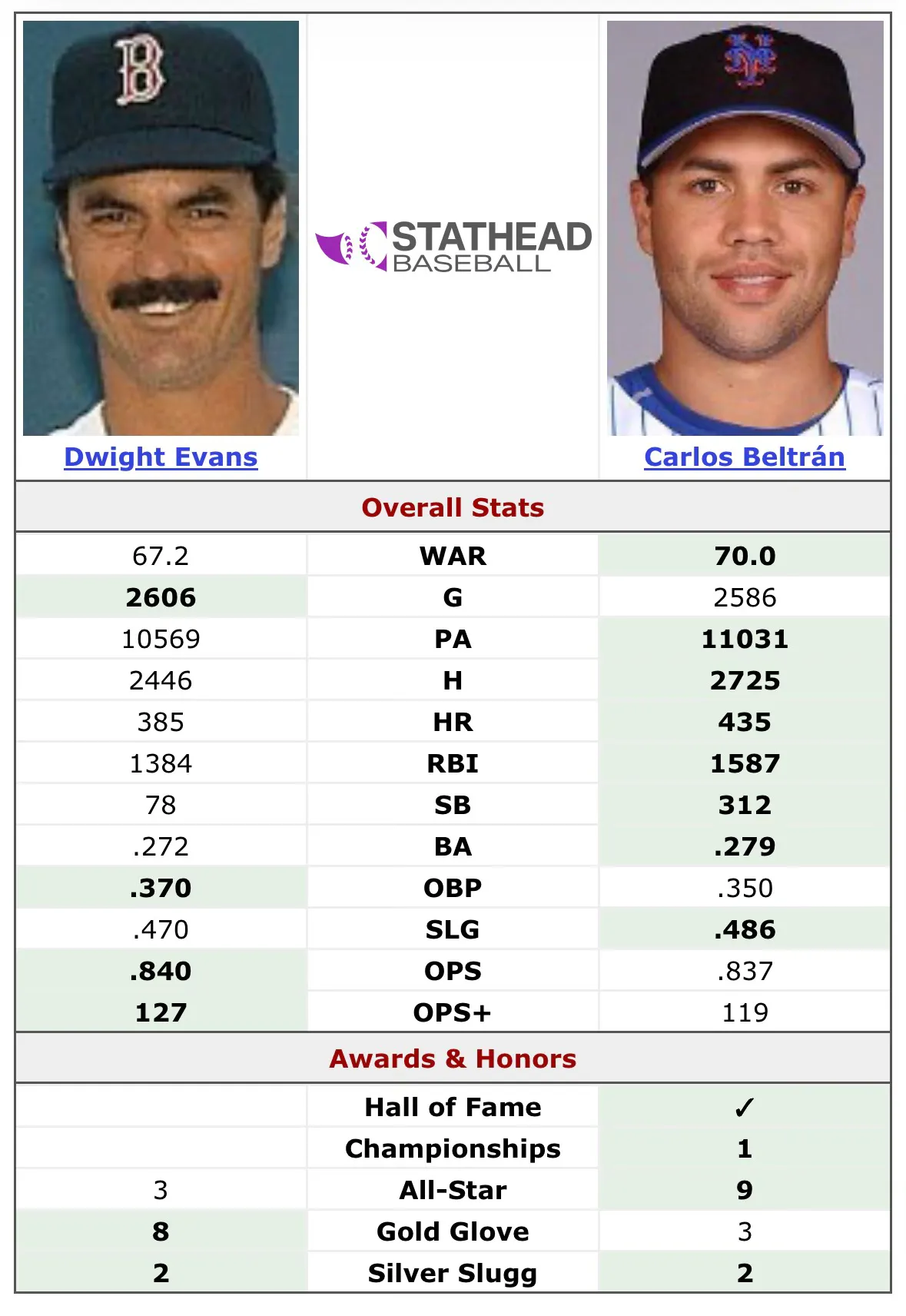
Based on this side-by-side comparison, there is every reason for the Contemporary Baseball Era Committee, which meets again in 2028, to give Dewey serious consideration.
PLAY BALL!!
