Major League Problems – Minor League Owners

When Memorial Day broke, there was a great echo in the world of sports that this was THE week. This was the week that the NBA was going to figure out its plan to finish their season and hold playoffs – ostensibly in the bubble (er, campus) of Disney World. This was the week that the NHL was going to make a decision about (not) restarting its season, and moving right into their playoff tournament. And this was going to the week that MLB decided whether or not it wanted to have a 2020 season.

The NBA has been communicating in lockstep with their player union reps and their broadcast partners. It has not been perfect, to be sure, but there is little rancor. The NHL plan was essentially met with universal applause. The MLB, well the MLB did what it always does – it bickered, it squabbled, and it leaked. And as we move closer to the artificial June 1 deadline, there is very little hope in site.

Since I previously wrote on the topic, things have only gotten worse. For years baseball has been accused of not doing enough to “sell the game.” The theme being that MLB has not worked to make its players stars. There have been fleeting attempts – like when Rob Manfred called out Mike Trout for being too private. But, by and large, that has been a weak spot. So what did the owners propose this week – after their revenue sharing model was dead prior to arrival – they tried to cut the salaries of their biggest stars by nearly 80%. Now, to be fair, there is an interesting idea in there somewhere. If you are rookie making the minimum, you take a 10% haircut – that seems fair. If you are a superstar making north of $20M, you lose more hair as, theoretically, you can afford that. Here is the problem, it is not up to the owners to tell the players who should take what discount.

In a perfect world, in a world where the players trusted the owners and the owners trusted the players, in a world where it wasn’t the Hatfields and the McCoys every time any issue arises, in a world where back-channeling was possible, someone from the league office could have floated this to the union in a casual, off-handed way, and allowed the players to come up with their own plan. Let Nolan Arenado and Clayton Kershaw and Zack Greinke and Miguel Cabrera be magnanimous and offer to cut their salaries for the benefit of the younger, poorer players. I doubt that would have happened, but in the words of Jim Carrey, at least there would be “a chance.” As it stands, there is no chance.

And no sooner than we were faced with the prospect of no deal being on the horizon, we got even more bad news. I have previously written about the deal that the owners and players closed in March with respect to compensation and other matters. Included in that deal was that all minor leaguers would get paid $400/week through May. Well, May is about to come to an end, and the Oakland Athletics, for one, are done paying.

So, as of June 1st, if you are a minor leaguer in the A’s system, you are still employed but you are not getting paid. And, because all baseball transactions are frozen, a player in the A’s system cannot get released and find another team. And, because they have not been let go, depending on where they play, the player may or may not be entitled to unemployment benefits (believe it or not, each state has different eligibility requirements under the “Save America’s Pastime Act” (which was oxymoronic from its inception) and through the CARES Act). Good times!

[Ed. Note: The A’s are owned by John J. Fisher, a businessman who has a net worth of $2.2 billion. Some back of the napkin math: if JJ Fisher were to earn 2.5% on his net worth, he would earn about $4.5 million per month. But he cannot find $400/week for players sleeping on air mattresses and eating PB&Js? And, lest we forget, these players who he refuses to pay are not panhandlers, they are his assets.]

To channel John Krasinski, here is some good news: As of this writing, the following teams have agreed to pay their players through June: Braves, Brewers, Cardinals, Cubs, Diamondbacks, Dodgers, Mets, Orioles, Phillies, Rangers, Rays, and the White Sox.

More good news: These teams have agreed to pay their players through August: Astros, Mariners, Marlins, Padres, Reds, Royals, and the Twins. What makes this list so interesting is that none of these are large-market teams, at least three of them have had severe financial issues in the recent past, and four of them haven’t been to the post-season for years. And yet, each team was able to find the extra $1M* to make peoples’ lives just a little bit better throughout the summer.

*Each team has between 200-220 players in their minor league system. At $400/week/player, that is about $84K/week. Paying the players through August would cost a little over $1M. MLB had revenues of $10.7 billion last year.

We are still waiting to hear what the other 10 teams will be doing.

But wait, there’s more. Yesterday, teams started a bloodletting of their minor league players – just cutting them outright. Now, in some cases, this may actually be better, as those players for sure will be eligible for unemployment benefits plus the additional $600/week from the CARES Act. So, we have a situation where billion dollar corporations just gave a bunch of their “employees” (technically, “seasonal apprentices”) a raise by firing them. I think that says more about their original wages than anything else, but I digress.

Teams typically release a bunch of minor leaguers at the end of spring training, but not to this degree. With no minor league season on the horizon, this week teams cut hundreds of players, with hundreds more to go (according to Jeff Passan, the number may reach one thousand). This is devastating for the individual players, many of whom have played their last professional game. But it is – in the long run – potentially devastating to the teams. They have thinned their most prized asset – their farm system, the crop of underpaid (see above) labor that they “control” and have the ability to exploit for years at below market rates. Losing just one or two diamonds in the rough in these mass firings, players who could have helped the big league club could turn out to be extremely costly.

To put this into context, understand that 1 bWAR is worth about $8M on the open market. Now, let’s take a look at the type of player who may have been cut this week (again, to save either $0 (looking at you, Oakland) or to save $400/week (everyone else)):

  • R.A. Dickey (First +bWAR season at age 29), 23 career WAR; potential lost value: $184M (I don’t want to do a regression analysis of what bWAR was worth each year of his career; we can fudge the numbers to make a point.)
  • Jose Bautista (First +bWAR season at age 28), 36.7 career WAR; potential lost value: $293.6M
  • Max Muncy (First +bWAR season at age 27), 9.4 career WAR (to date); potential lost value: $75.2M (to date)
  • Evan Gattis (First +bWAR season at age 26), 8.5 career WAR; potential lost value: $68M

Sure, it is quite possible that none of the players cut this week would have ever become Muncy or Gattis, or Dante Bichette or Joe Nathan, but there is a chance. And for a few hundred thousand bucks, teams were willing to light their lottery tickets on fire, they were willing to flush their assets down the toilet, they were willing to be misers and look like gonifs. In a battle of millionaires vs. billionaires, they certainly took the low road, and are rightly taking the public relations hit along with it.

With everything going on in the world; with Minneapolis on fire and people shot in Louisville; with at least 1,000 people still dying every day from this invisible virus; with 40 million people unemployed and the economy on the brink of a depression; with a president who seems to have his (little) hands on the rudder and is aiming straight for the iceberg; one would hope that cooler heads could prevail and the people in charge would make it their responsibility to bring a little joy to the hearts and minds of fans across this great land. It seems as if only Adam Silver and Gary Bettman got that memo. It seems as if Rob Manfred and his cadre of owners have lost their senses and their moral compass. It seems – more and more – like we will not have baseball in 2020.

And, to put the cherry on this shit sundae, if we don’t have baseball in 2020 over pay/revenues, and thus the 2021 free agent market is depressed and more players are cut or asked to take smaller salaries, look for a strike or a lockout before the 2022 season. As I said, good times!

Get your shit together so you can all…

PLAY BALL!!
Fighting Over Dollars Doesn’t Make Sense

Money, they say, is the root of all evil. The question is, is it also the root of all stupidity?

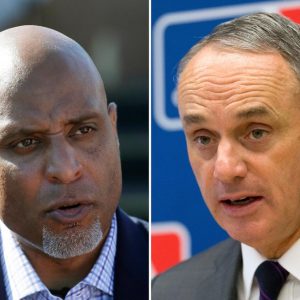
On Monday, MLB owners approved a proposal that Commissioner Rob Manfred presented to the MLBPA on Tuesday. There were a bunch of goodies in that proposal, including a potential 82-game schedule beginning in early July; expanding the playoffs to include 14, rather than 10, teams; universal use of a designated hitter in both leagues; playing only in your geographical area (e.g., AL East plays only against the AL East and the NL East); a 30-man roster, with up to 50 players being available. But the biggest item on the list is the one that may derail the whole enchilada: the owners want to put in place a one-season revenue sharing model, wherein the teams and the players would split all revenues on a 50/50 basis.

If you like math, or you want more specific details, I encourage you to read Jeff Passan’s article from Tuesday. Before this proposal even made it to the MLBPA, its president, Tony Clark, shot it down. Here is the quote that is getting a lot of press, and tells you the starting position of the players:

“A system that restricts player pay based on revenues is a salary cap, period. This is not the first salary-cap proposal our union has received. It probably won’t be the last. That the league is trying to take advantage of a global health crisis to get what they’ve failed to achieve in the past — and to anonymously negotiate through the media for the last several days — suggests they know exactly how this will be received. None of this is beneficial to the process of finding a way for us to safely get back on the field and resume the 2020 season — which continues to be our sole focus.”

This does not bode well.

It is necessary – or it certainly will become necessary – to parse Tony’s words to separate the fact from the hyperbole. While it is true that all other sports that have revenue sharing also have a salary cap, that is not necessarily the case here. If a vaccine for Covid-19 were discovered tomorrow, and the season were able to start in 30 days, then based on what the owners have offered, the players could potentially make more than they would under either the current 162-game construct, or the revised version wherein they get a prorated portion of their salary. Now, we all know that a vaccine is not coming that soon, so I have merely presented that as a strawman to thwart Clark’s rhetoric. In short, under this proposal, salaries would technically be capped by the total amount (actually 50% of the total amount) of revenues this season; but it is not, technically, a salary cap. This is because the salaries would be predicated on an unknown number (2020 revenues), and not prior year revenues (as utilized for the NBA and the NFL). But, let’s not get too deep into “Capanomics” here.

The union’s reasoning seems to be: we don’t get an uptick in salaries when the league, on the whole, does better in a given season, so we shouldn’t be penalized when the league, on the whole, does worse in a given season (which, without question, will be the case for 2020). This is a fair point, in a vacuum, but misguided in the current situation and under the current proposal. Again, this is a one-year fix in the face of a worldwide pandemic; not a reworking of the entire collective bargaining agreement. I know, I know, I can already hear the slippery slope arguments.

The better argument is that the player and owners already agreed to a new deal. You may have noticed the words “revised version” a few paragraphs above. Maybe you read right past them; but they are important. Although it may seem like several lifetimes ago, it was less than seven weeks ago that the two sides came to an agreement about salaries for the coming season. Or, at least they thought they did. That deal provided that the players would get $170M to be shared and allocated based on service time, and then those amounts would be applicable against any eventual salary for the season. The deal also provided that the players would get a prorated portion of their contracted salaries depending on the number of games played. So, in the 82-game version, players would get 50.6% of their 2020 contract amount. As far as the players are concerned, this issue was done and settled.

As an attorney, I live in fear that a contract I drafted or negotiated has some ambiguous language or some loophole that is only discovered after-the-fact. If this has ever happened to you, you can feel that pit in your stomach as you read these words. That must be what a bunch of high-priced lawyers in New York must be experiencing right now.

On Page 1 of the March 26th agreement between the players and the owners, the first point of the “Resumption of Play” section states: “[T]he 2020 championship season shall not be commenced unless and until each of the following conditions is satisfied.” It should be noted here that among the conditions is a laundry list of health and safety measures. Neither side was willing to take unnecessary risks just to play baseball; and, at present, none of those terms appear to be at issue.

However, one of the conditions ends with the following words: “[T]he Office of the Commissioner and Players Association will discuss in good faith the economic feasibility of playing games in the absence of spectators or at appropriate substitute neutral sites.” And that is where we find ourselves today – playing games without fans.

You can read that contract language ten times and still not be exactly certain what those words were intended to mean. ESPN sent the language to four attorneys not involved in the negotiation, and they got two in favor of the owners and two in favor of the players. But any posturing about the intent or specificity of that language is irrelevant. If we ever get to a point where we are determining which side has a the “correct” interpretation, the season is lost; and so too may be the sport as we know it.

Gordon Gekko once proclaimed that “Greed clarifies, cuts through, and captures the essence of the evolutionary spirit.” But, in this particular case, greed may take that evolutionary spirit to its logical conclusion: extinction. There are 30 million people out of work in this country; unemployment is headed towards 20%. More than 85,000 Americans have lost their lives in the last few months alone. No one, and I feel pretty confident in using those particular words, wants to hear that baseball wasn’t played in 2020 because millionaire players (and, yes, I know, not all of them are millionaires) and billionaire owners stood on principle claiming they were “right.”

They are so many smart ways to square this circle – without relying on courts to interpret contract language. There are too many smart people involved in these negotiations to allow it to go that far. The New York Post’s Joel Sherman posited that, as with this upcoming draft, players agree to a base salary for this season, with the remainder deferred and paid over the next two years. This solves the teams’ cash flow issues in what is a $10.7 billion industry. Agree to that concept, and then all you have to argue about is the interest rate.

The owners have stated – without actually opening their books – that if the games are played without fans, they will lose 40% of their revenue, and some teams will lose more than if the entire season is simply canceled. Okay, then open those books. Maybe seeing their actual revenues is worth the financial hit this year, giving the players ample ammunition when they start their collective bargaining after the 2021 season.

If the owners are going to lose 40% (again, for our purposes we will take them at their word), propose to split the baby with the players, and each player takes a 20% reduction in salary. Now we could be getting somewhere. And, in return, each player gets a hotel suite on the road. Or each player is allotted an additional 20% of service time for the upcoming season. Or the players agree to a 25% haircut, but the owners agree that free agency can begin after five years, rather than the current six. Give and take; back and forth. This isn’t hard. But, as we have seen all too often, egos get in the way of practical solutions.

It was heartening that after Tuesday’s meeting with the players, there were no leaks to the press. That is a step in the right direction. This battle cannot be won in public; it can only be lost. And, to be sure, a loss for either side is a loss for both.

On this morning’s Baseball Tonight podcast, Buster Olney said that Rob Manfred and Tony Clark should lock themselves in a conference room and not come out until they have a deal. I couldn’t agree more.

I won’t go as far as Scott Boras or J.B. Pritzker, but we need baseball this summer. We need it for the collective good. We need it for a feel-good distraction. We need it for civic pride. We need it for television content. The coronavirus is an actual life and death situation; baseball negotiations are not.

As Carl Fox says to his son Bud in that same seminal movie, “Money’s only something you need in case you don’t die tomorrow.” In this time of great uncertainty, player and owners would be wise to heed those words.

PLAY BALL!!

Wally’s World

People really seem to be nostalgic these days. As I previously wrote, it could be The Last Dance or it could be being cooped up at home and finally going through those old family photos, or it simply could be that because we have no “present” sports, we need to look to the past. Whatever the reason, it is our current state of mind.

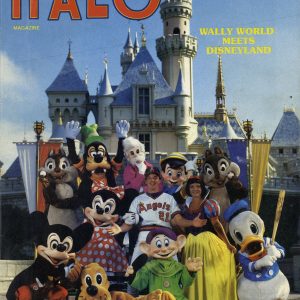
One of my daughters turned fourteen this week, which got me thinking about when I turned fourteen (there is that nostalgia again). The year was 1986, and baseball was great. Now, this article will make no reference to October of that year, nor will it mention a defunct stadium near La Guardia Airport, nor will you read the first name of the Dodgers’ (in theory, anyway) new right fielder. No, this piece will hearken back to the beginning of the season, and a player who captured everyone’s attention – seemingly out of the blue.

After having a break-out winter in Puerto Rico, the California Angels chose Wally Joyner, the fresh-faced kid from BYU, as their starting first baseman over team stalwarts Juan Beniquez, Daryl Sconiers, and “Hall of Famer Rod Carew.” And the rookie did not disappoint.

Many of us can still remember Wally Joyner’s first month in the big leagues. He was – in a word – incredible. Joyner went hitless in his first three Major League at bats before doubling for the first of his 2,060 career hits. And that double got him going. He hit in 20 of his first 25 games, collecting 35 hits, with a slash line of .337/.386/.615 and a 1.001 OPS, to go along with eight homeruns. It is hard to say if that is the best first four weeks of a MLB career, but it is up there.

Joyner’s hot start got him a feature article in the May 26th edition of Sports Illustrated, back when that meant something. By the end of May, Wally had played 48 games, hit 16 dingers, was batting .305, and had an OPS of .928. By the time we reached the All-Star break (where Wally was voted the starter over Don Mattingly and Eddie Murray), he was hitting .313 , with 20 homeruns, 72 RBI, and a .904 OPS. The kid was flying high.

And then the second half of the season happened. Wally hit .257 with only two more round-trippers and a .664 OPS. What was once a lock Rookie of Year season was passed on the outside by Jose Canseco (not the only time steroid use affected a year-end award).

By the end of the season, Canseco had the same slugging percentage as Joyner (.457) and a worse OPS (.775 vs. .805), but he hit 11 more homeruns and drove in 17 more runs. Canseco’s second half fell off as much as Joyner’s, but back in 1986, voters looked at counting stats, and Wally didn’t match up to Jose. Had Wally hit five or six more dingers, or drove in 10 or 15 more runs, there is great chance he walks away with the hardware. But the baseline for his career was set. It would be 14 years before Wally had a season with an OPS+ of less than 101, averaging a 120 OPS+ in that span (i.e., on average, Joyner was 20% better than the typical Major Leaguer for those 14 years).

We all remember that rookie season, and maybe we can still picture him in those Royals or Padres uniforms later on, but I don’t think we accurately recall what a totally consistent player he was for a decade and a half.

Wally finished his career with 11 seasons in which he hit .280 or better; 12 seasons with an OBP above .350; 12 seasons slugging at least .400; and 12 seasons with an OPS of .750 or higher (including eight with an OPS in the .800s). And yet, we remember Canseco’s career more fondly. We think he was the better player because he was a Bash Brother, won a World Series, and went 40/40.

A little thought experiment:

Player A (career): .266/.353/.515/.867; 42.4 bWAR
Player B (career): .289/.362/.440/.802; 35.8 bWAR

One additional fact, Player A played one more season than Player B, which may account for some of that bWAR discrepancy.

You are all smart readers, so by looking at that third column, you know that Canseco is Player A. But Joyner’s career is pretty comparable – on paper. He never dated Madonna or wrote a tell-all book or had a ball bounce off his head for a homerun in Cleveland. His name is Wally for heaven’s sake; he is easy to forget.

But Wally Joyner went about his business each and every day and put up solid Major League numbers. He was a joy to watch. He played the game the right way. He was slick defensively, and had a beautiful lefty stroke. I just wish more people remembered him, his game, and his career. Had he kept up the pace he started with, we would be talking about “Hall of Famer Wally Joyner.” But he wasn’t meant to be a superstar, just a super player. My guess is, at the end of the day, he is perfectly okay with that.

PLAY BALL!!