We currently have the lowest unemployment rate in 50 years, but we could always use more jobs. Going back many years, I have had a plan to add at least 15 new ones. And while these jobs wouldn’t do much for the national labor statistics, they would do a great deal for our enjoyment of the game of baseball.
MLB introduced a replay system in 2008, at first simply to review home runs. That remained the case until 2014, when replay was expanded to include a slew of additional plays (e.g., force calls, tags, fair/foul calls (in the outfield only), skipping bases, hit-by-pitches, fan interference, etc.). Over the years, the replay rules have been refined. To wit:
- 2015: Managers no longer had to leave the dugout to challenge a call, and they retained challenges after every overturned call (it used to be just after the first victorious challenge).
- 2017: The time to request a challenge was limited to 30 seconds, rather than merely before the next play. And, here was a big one: the replay crew in New York had a two-minute time limit to reach a final conclusion (more on that below).
- 2020: Managers’ window of opportunity was further reduced to 20 seconds.
- 2022: Umpires were now mic’d up to inform the fans of the final decision.
My idea then, as it remains today, is that MLB should employ one additional umpire for every game. We will call him/her the “Blue in the Sky” (or “BITS”). BITS would sit in the booth (maybe right next to the official scorer) with an earpiece and microphone that goes directly to the home plate umpire and a “bat” phone that goes directly to the replay headquarters in New York.
If/when there is a close play, BITS would immediately radio down to the home plate ump and tell him (as of this writing, there are no female umpires in MLB) to hold one beat. BITS would either have a bank of monitors in front of them or would use the bat phone to call New York. In addition, the moment BITS contacts the home plate ump, the two-minute clock would start. If BITS cannot get a decision when that bell rings, the call on the field stands. As we all know, the current two-minute rule is rarely enforced, with replay reviews — from inception until explanation — often taking five minutes or longer.
By engaging BITS, we take the decision-making out of the hands of the manager — or, more accurately, out of the hands of some video intern watching the angles as quickly as possible in a closet a few feet up the runway. Sure, we could still allow managers to have one challenge per game for that unlikely situation wherein BITS doesn’t think anything is amiss.
But BITS, by virtue of their vantage point, has a much better bead on the play. Watching at home or sitting in the stands, we have an immediate reaction when a play should be reviewed, but managers don’t have that same perspective. So let’s take that out of his hands; let’s have a paid professional doing that hard work. And this will also relieve the issue of a missed call in the late innings because a manager exhausted his challenges earlier in the game.
With the new rules implemented for the 2023 season, the role of BITS becomes that much more important. Let’s take a look at a few situations where BITS could prove helpful:
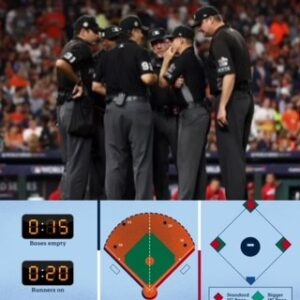
The Shift: BITS can tell, nearly definitively, if two infielders are on either side of second base, and if all infielders are on the dirt. Plus, they can see if any infielder is getting a running start before a pitch is thrown. There is just no way for a manager to be able to see that from the dugout.
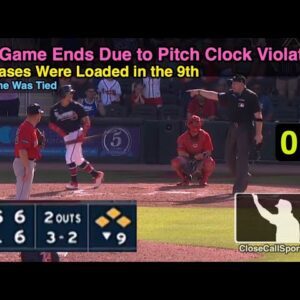
Pitch Clock: While the home plate umpire is equipped with a buzzer that informs him if/when the 15/20 seconds have expired, he does not have one for the 8-second deadline for the batter. BITS will be able to see that clearly. Further, BITS could use his/her reasonable judgment as to whether the catcher was ready (which was the cause of consternation in the Red Sox-Braves game the first week of spring) if/when a batter is assessed a strike for not being ready. BITS could be sitting next to or close to the clock-keeper (not sure this individual has a formal title yet) to make sure that they are starting and stopping the clock in accordance with the rules and circumstances.
Disengagement: There will be questions — mark my words — as to whether or not a pitcher actually disengaged from the rubber. Do it thrice, and a balk will be called. The balk has always been the worst call in baseball, as it is never uniformly applied and nearly impossible to know if the pitcher was actually trying to “deceive the runner.” But, BITS will have a considerably better angle to determine a disengagement and potentially a deception.
I know it is an unpopular position as a sports fan to say we need additional referees or umpires, but in this case, it makes perfect sense. Let’s put an end to a guy running out with a monitor and officials donning headphones. Let’s take the onus off managers to make split-second decisions. Let’s have BITS, the “Blue in the Sky,” make the call. And then leave it to the on-field ump to say:
PLAY BALL!!