MOUND BALL

MOUND BALL

Blog_Mound_Ball

Before he took some flak for assaulting/accosting a fan the other night, Joey Votto took some flak for denying batting gloves to a kid sitting behind the dugout at AT&T Park.  Votto’s told the kid that he was sitting in the front row, he is elite, and didn’t need the swag.  We can debate the merit of the response, but it got me thinking about a related topic, which got me thinking about a related topic.

First related topic: At the end of each inning, the player who recorded the last out (or his teammate as part of some bizarre lob around the diamond ritual) is now ethically bound to toss the ball into a throng of awaiting fans.  Gone are the days when fans only clamored for a foul (or homerun) ball.  Now they want the result of a ground ball to short.  I have always thought this was the classic “rich get richer” situation, where people who can afford to sit in the best seats get – in addition to better views and better food – more souvenirs.

But what about the kid sitting in the upper deck, who maybe attends a single game per season, and is in the best seat her family can afford.  Why is she left out?  Wouldn’t it do more for the fan experience if it was less about the haves/have nots, and more about spreading the proverbial wealth to kids of all stripes?  Why couldn’t a player toss the ball to an usher who then randomly selects a cute kid in the cheap seats to be the beneficiary of Joe Panik’s toss to Brandon Belt?  This seems all too easy.

Which brings me to the second related topic: The lost art of the third out ball flip.  Now, I won’t get all sepia-toned nostalgic on you – or maybe I will – but the third out ball flip was one of my (and many others’) great joys in the game.  As a former first baseman, more often than not I found the ball in my glove at the end of an inning.  If I were a current Big-Leaguer, my only (?) joy would be in finding the right fan and hoping to guide the ball to her before some horse’s ass in a Jeter Sucks t-shirt bowls her over for a 5oz. piece of a horse’s hide.

But back in the day, having that ball in your glove opened up a world of possibilities.  There is and was the age-old, pedestrian roll back to the mound.  Some players (think Howie Mandel) might have been inclined to drop the ball directly from his glove onto the mound as he made his way to the dugout.  But there were so many other great options that all sorts of players (this writer included) took advantage of.  And, because only real weirdos like this stuff, there is virtually no stand-alone footage.  Memory will have to serve:

Pete Rose was known for his ball spike.  Johnny Bench would occasionally flip an inning-ending strike out back to the umpire.  Greg Maddux, he of the 900 lifetime non-strikeout outs, often had the first baseman flip the ball to him when he made the third out.  I still love that move.

If a team was in the first-base dugout, it was always cool when the first baseman flipped the ball to the opposing team’s first base coach.  Let him (a) chew on that last out and (b) figure out what to do with the ball.

When Will Clark would make a nice pick to his glove side to end an inning, he would allow his momentum to carry him such that he had an easy toss to the first base umpire.  Always a slick move.

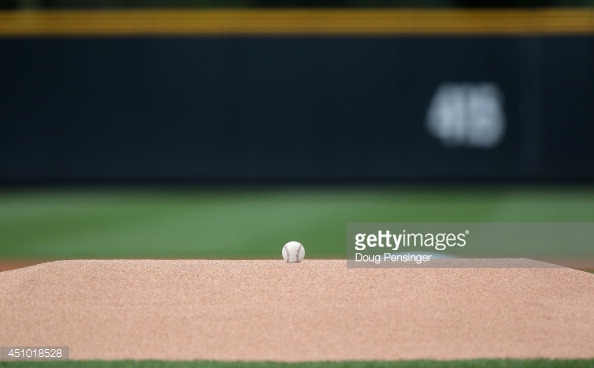
Some catchers would play a game – now known as Mound Ball in the “new ball every half inning era” – wherein he would try to roll the ball up the hill hoping to have it stop at the rubber.  Man, it’s the little things . . .

Now, I will acknowledge that player approbation has won out over player artistry.   But if canvass is going to be ripped from the third-out easel, let’s at least get more fans in on the fun.  And if we can’t do that, can we at least mandate that every player, at least once per season, needs to do an “Andrew McCutchen”:


PLAY BALL!!

MORALITY vs. IMMORTALITY

MORALITY vs. IMMORTALITY

The Mets won their first pennant in 15 years last season.  They had high hopes for this year.  And then the cornerstone of their franchise – and their infield – went down with a season-ending injury.  What is a contender to do?

The Cubs haven’t won a playoff game since 2003 (cue, Bartman).  They are the odds-on favorite to win their division, win the pennant, and win the World Series this year.  But, if they had one weakness, it was bullpen depth.  What is a team with a 108-year championship draught to do?

Winning helps a team’s valuations  Furthermore, winning in the post-season really helps bottom lines; to the tune of $20-$30M/season.

According to Statista.com, the Mets franchise value was $850M in 2014, which rose to $1.35B after the 2015 season, and their current value is $1.65B.   (For some added context, the Royals went from $457M in 2013 to $865M today, after two WS appearances and one title.)

The Mets needed a third baseman.  The Colorado Rockies had no use for the shortstop they had under contract for 2+ years and owed $38M, so they fired him.  Cynics might say the Rockies decision to release Jose Reyes was due to rookie sensation Trevor Story (who hit 14 HRs while Reyes was under league suspension).  The optimist would say the Rockies cut ties with Reyes because his behavior in a Maui hotel room against his wife was wholly unacceptable;  and an organization that doesn’t hide its Christianity wanted no part of such a player.  If the Rockies didn’t put morality above winning, they certainly put it above their bottom line.

The Mets had no such compunction.  They signed their former player, sent him to the Minors to get some reps at third base, and re-introduced him to the Flushing Faithful two weeks later.  The Mets – morality be damned – had a division (Wild Card?) to win.  Anyone who has watched the Doc & Darryl 30 for 30, or read Jeff Pearlman’s book, or Ron Darling’s book, or Lenny Dykstra’s book, shouldn’t be surprised.  As we have learned this election season, New Yorkers love “winnahs”, and how you go about “yuge” success is beside the point.

The aforementioned Cubs didn’t need a closer – Hector Rondon was doing quite well, thank you very much.  But the Cubbies are all-in for 2016.  On July 25th, according to FanGraphs, they had a 98% chance to make the playoffs.  But the playoffs aren’t the World Series, and the World Series doesn’t guarantee a parade.  The biggest “game changer” on the market was Aroldis Chapman – with his unhittable 105MPH fastball and his (allegedly) very hittable girlfriend.  Would Theo Epstein put the prospect of immortality over the simple concept of morality?  As we all know, yes he would.

Theo joined the Cubs in 2011, when the team’s valuation was $773M.  Since that time, it has risen nearly 300%, to $2.2B.

Blog_Wait_Til

“Wait ‘til next year” was selling tickets and moving the needle.  The team didn’t need a championship to add value.  But this move was about winning a title.  And if a few people looked askance at the player they acquired, if those people were not overwhelmed by his tepid apology after coming back from his 30-game suspension, if fans would rather “wait ‘til next year” than win with “that guy”, well, Epstein was not going to be deterred.  Break the Curse of the Bambino and the Curse of the Billy Goat, and Epstein could pick his Hall of Fame induction date. Win at all costs – potentially even your soul; remember, flags fly forever.

But one has to wonder what a parent in Queens or a parent on the North Side says to their kid when they are asked why Reyes and Chapman had been suspended, and why the Rockies and the Dodgers didn’t want these guys around, and why their hometown teams did?  All of that may be forgotten in October, when chants of “Let’s Go Mets” and “Go Cubs Go” ring in the streets, but it doesn’t make the questions any easier to answer.  I guess the answer is: “we root for laundry, and the laundry won; so, HOORAY!”

And, for better or worse, our society seems just fine with that answer.  When we plunk down our hard-earned money to go to the park to cheer for our team, we aren’t worrying about morality, we are praying for immortality.

PLAY BALL!!

THE JOY OF OWNERSHIP

So you want to own a baseball team?  Who doesn’t?  We sit in the stands, we sit on the couch, we think we have all the answers.

  • More cogent player personnel decisions, check.
  • A more efficient parking system at the stadium, check.
  • Cheaper beer, of course.
  • A better variety of food, done.
  • Fire that damn manager already, check, check, and check!

How hard can it be? Anyone who knows baseball could do it, right?  Maybe? It certainly would be fun to find out.

Well, a small-business owner in the leafy hamlet of Oneonta, New York got the opportunity and jumped at it. Four years ago, the Oneonta Outlaws went up for sale, and Gary Laing, a life-long resident of the City of the Hills, didn’t miss his chance. After a brief conversation with his wife, Karen, he plunked down the purchase price (amount, undisclosed) and along with a silent partner – a dear friend who Gary first met playing at Oneonta Little League – became the proud owner of an amateur baseball team.

But we are getting ahead of ourselves, as this story needs to have history in order to have context.

Oneonta, New York has been the home to some form of organized baseball going back nearly 100 years. The Utica Utes (of the NY-Penn League) first came in 1924, changed their name to the Indians, and folded after one season. The team came back in 1940, and won championships in 1941 and 1942. The League was shuttered for three years due to that pesky World War; but when play resumed, the renamed Oneonta Red Sox won championships in 1948 and 1951 (take that, Harry Frazee). And then the League folded (okay, maybe curses are real).

In 1966, the Red Sox came back to Oneonta for a single season. In 1967, Sam Nader bought the team and renamed them the Oneonta Yankees. And that, my friends, is where the legend truly begins.

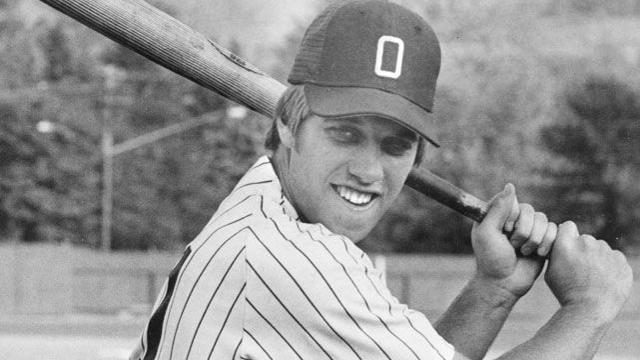
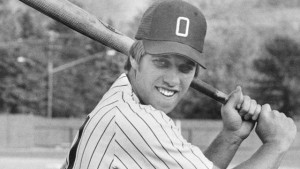
The O-Yanks would be an institution in town for three decades, winning 11 titles (apples and trees?). Don Mattingly, Bernie Williams, Andy Pettite, and Jorge Posada took their hacks at Damaschke Field; and future Hall of Famer John Elway roamed the outfield in Oneonta before scrambling on the gridiron in Denver.
Blog_Elway

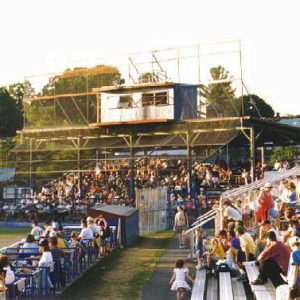
The Boss was known to set up shop in a box down the first base line, carefully observing his future Bronx Bombers. Hell, back in 1920, the Sultan of Swat – playing with the Babe Ruth All-Stars – smacked a homerun over the right field fence at Neahwa Park (now known as Damaschke Field, the home of the Outlaws).  [Ed. Note: In the 5th inning of that game, the Babe broke a bone in his wrist sliding into first base.]

Man, if those baselines could talk . . .

But all good things must come to an end, and in 1999, the O-Yanks moved to Staten Island. The Tigers quickly moved to town. The O-Tigers played in Oneonta until 2009, and then left for Connecticut. Alas, Oneonta was not without baseball for long.

In 2010, Keith Rogers and Dan Scaring brought the Saratoga Phillies to Oneonta, renamed them the Outlaws, and set sail. After installing local legend Joe Hughes as the manager, the team won a championship in 2011.

Prior to the 2013 season, Gary Laing heard a rumor, made a few calls, and soon thereafter, a life-long dream came true. Growing up poor in Oneonta in the ‘60s, often without enough food to eat, Gary would shag foul balls for Sam Nader’s O-Yanks at Damaschke, bringing them back in return for free hot dogs. Never did Gary think that one day he would be the one giving out hot dogs to little kids who shagged balls at that same park, hit by players on his team.

Gary was born and raised in town, graduated from Oneonta High School (one year ahead of Joe Hughes), and never left. He started a local business 1991, built it into something very successful, and then decided to buy a baseball team.

Granted, it’s not a Major League team, and his day-to-day decisions are vastly different than those required by Hal Steinbrenner or Peter Angelos; but he deals with real baseball issues every day, real baseball economics, and real baseball fans.

A few weeks ago, I was fortunate enough to spend some time with Gary and Karen. The term “Salt of the Earth” was invented for these two. They, along with their young sons Chris and Josh, run the team – from concessions to ad sales to being a host family for the team’s manager.

The Outlaws are members of the Perfect Game Collegiate Baseball League, where college players from around the country come for a summer of fun, fans, and a whole lot of baseball. The PGCBL is made up of 13 teams in Upstate New York – from Jamestown to Glen Falls, from the Adirondacks to Saugerties.  (If you have never spent the summer in Upstate New York, get thee to the airport – it is spectacular.)

To get around the state, players are ferried in chartered buses. To save money on accommodations, teams typically do not stay overnight in any city/town/village/hamlet. Rather, when the game ends, players take a shower, get a small meal (provided by the home team directly from the concession stand), and back on the bus they go.

“Host” families take in a player or two for the summer in return for a small stipend and season tickets to the team’s roughly 25 home dates. And yet, there is never a shortage of families willing to open up their home, set an extra seat at their table, and add another stop to their carpool. The term “host” is often quickly dropped from the description, and each spring families travel around the country to see “their boys” play college ball.

But while the players and their families are having an experience they will never forget, the owner is trying to figure out how to pay the bills. Sure, when compared to the Cubs, a PGCBL team has considerably fewer expenses (both in quantity and in cost), but also considerably fewer revenue sources.

Want to own a team? Let’s take a look:

  • First, you have to buy the team. Out of deference to Gary, the community, and the league, this amount has not been disclosed.  But it does cost something.
  • A teams needs a place to play. Ideally, the team owns the stadium. More likely, they rent it from the local municipality or college. Either way, this is the single biggest annual expenditure.
  • In order to draw the most fans, games need to be played at night. Lights and electricity are not free, adding another line item to the budget.
  • Players need equipment. Granted, most of the kids bring their own gear; but very few of them have a collection of wood bats that are used in the PGCBL, so the team must provide. Add helmets, catcher’s gear, and a whole lot of baseballs, and the costs add up.
  • These games need umpires as well. The thirteen teams pool their money to ensure three umpires per game.
  • If you are new to a league, you must pay an admission fee. That amount varies from league to league and year to year.
  • In order to get to the games against the twelve other teams, the aforementioned buses must be procured. Drivers and gas cost real money.
  • As I stated above, the team provides each host family with a stipend (which cannot possibly cover the actual cost). Some teams provide apartments for the players – a choice that is fraught with danger if one thinks about the demographic being left unsupervised for long stretches of time. And some teams work out deals with local colleges to provide dorm rooms. Any way you shake it, it costs the team money to house their players.
  • If you have ever raised a teenager, or even been in contact with a 20-year old young man, you know that they can figuratively eat you out of house and home. The teams cannot possibly keep an accurate count of the number of PB&J sandwiches they provide each season, but the number is well into four figures. Add to that food for the visiting team (see above), and in most cases, a post-game meal of burgers/dogs/fries for your team, and a club’s grocery bill gets big, quick.
  • At the yard, teams pay an official scorekeeper, a public address announcer, potentially a radio play-by-play guy/gal, and concessionaires. The Outlaws enlist a pitcher not scheduled to throw to serve as the official ticket-taker.
  • Lest we forget, you need a manager and at least two (and sometimes 3 or 4) coaches to keep this band of roving youth in line and learning. Those gents get paid real (albeit small) salaries.
  • All teams have a General Manager who handles player procurement, travel, league business, and the like.  He (or she) gets paid for that work (a far cry, of course, from Andrew Friedman or Theo Epstein money, but it’s a paycheck nonetheless).
  • Some teams employee ad sales executives to get the most out of their billboards, fencing, signage, programs, etc.  Yet even more salaries.
  • And there are, of course, a myriad of other small, incidental expenses that are incurred in running any business.

In short, it takes a field of green to field a team.

So how does an owner balance the books? How are revenues generated?

  • Ticket sales. While the largest stadium in the league holds 8,000, the average yard holds about 3,000, which is more than a team can expect on any given night. Approximately 2,000 patrons come through the proverbial turnstiles each game, at ticket prices ranging from $2-$8 (average: $4-$5). Teams do sell season tickets to their most faithful, which is great way to ensure a certain level of income.
  • If a team controls the facility (either through ownership or a long-term lease), they can augment revenue by selling signage and sponsorships, as well as renting the facility for various events (e.g., rodeos, concerts, birthday parties, clinics, camps, weddings, high schools and other leagues – all of these are real-life examples).
  • Community members (think local companies) occasionally rent the entire stadium for a single game to invite their special guests. Season ticket holders can, of course, still attend.
  • And the most surefire way to try to stay in the black is what all of the teams do: charge the players to play. Oh, you thought that pay-to-play ended with Little League? Guess again. Players have to pony up anywhere from $500 to $2,000 to have the right to play for a PGCBL club. The price depends on a number of factors, with other revenue sources being the number one determinant. A team in a larger community with more third party revenue can afford to charge less; with the inverse being true as well. And, fortunately or unfortunately, the amount of the player fee is often the number one consideration of which team a recruited player selects. In this way, the PGCBL is no different than MLB: large market teams have a competitive advantage over small market teams.

Most teams run either right at break even, or at a slight deficit. This is not a money-making proposition – this is a labor of love.

So there it is. There are 41 summer collegiate baseball leagues all across this great country, accounting for approximately 376 teams (it changes season-by-season).

Find one for sale. Buy it. And soon you, too, will be putting your baseball knowledge, your business acumen, and your marriage to the test. Gary Laing will tell you that there is nothing he would rather do and no place he would rather do it. Ownership has its privileges, including incredible heartbreak and immense joy.

One last thing: If you find such a team and are looking for a partner, give me a call.

PLAY BALL!!
KEEPING SCORE

KEEPING SCORE

We all know the old adage: The difference between a .250 hitter and a .300 hitter is a hit a week.  One minor duck fart, quark, Baltimore Chop, Texas Leaguer, or frozen rope per week, and a guy is on his way to All-Star games and the possibility of mega-riches; one less and a guy is on his way to Triple-A – potentially out of baseball forever.

There is no corollary (in baseball adages, anyway) for pitchers; but the same concept applies.  One less earned run per week, he goes from a 4.00 ERA to a 2.9 ERA.  Again, one earned run less per week is the difference between the chance to make $1M per start, and being in the Minor Leagues, making about $85K per year.

Whether a hitter reaches base via hit or error, or whether a run is deemed earned or unearned, can have major financial implications.

And it’s not just hits and errors, but wins, losses, saves, and a whole litany of other potentially lucrative statistics.  (Take a look at MLB Rule 10 for all kinds of nuggets.)

Simply put, a lot rides on one person’s assessment.  Of course, with Sabermetrics and advanced stats like OPS and WRC and FIP and WHIP and BABIP, standards like AVG and ERA may be antiquated, but they are still oft-used and oft-relied upon – especially in contract negotiations.

Blog_Scorebook_1

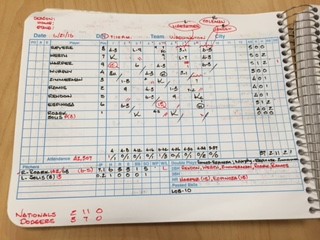
That means that the men and women who sit in the press box – more specifically, in the scorer’s box – and jot down dashes and dots, using multiple pens in multiple colors, creating chicken-scratch in small squares in a small pad of bound paper – have enormous power, whether they know it or want it.

We all know how to keep score.  It started at our kid’s Little League game when you either drew the short straw or looked like someone who (a) knew the game or (b) paid attention or (c) didn’t have a ready excuse not to.  You took “the book” with all those little diamonds, filled in the lineup, and did your best to keep up and keep track.  No one really cared what you did as long as you got the score right and didn’t issue too many errors to the youngsters on the field (“come on, that was a hit . . .”).  Easy enough.

But, for the many men and women who sit high above Major League stadiums every day, the stakes are considerably higher.  And more people rely on that snap judgment than you can imagine.  The scoreboard operator needs to signal to the fans; the television and radio announcers need to tell their respective viewers/listeners; hitters need to know if their batting average just went up or down; and pitchers need to know if what just happened on the field will affect their ERA.  It all matters.  And it all must be decided in a matter of seconds.  How is it done?

Ed Munson, one of three official scorers for the Dodgers and Angels (he alternates), has been doing this for 37 years and scored over 3,500 games.  He will tell you that he knows baseball, and goes with his gut.  I was lucky enough to sit in the box with Ed one night not too long ago, and watch a master do his job.  He made it look so easy.  Trust me, as I kept my book next to his, it is not.  And when Joc Pederson hit a shot up the middle into the shift, and Danny Espionza either couldn’t or wouldn’t get in front of it, Ed made the call immediately.

Up in the box, we had a short post-call debate.  In the end, I begrudgingly agreed with his call (hit).  And when Yasiel Puig grounded into an inning-ending double play on the next pitch – while it didn’t become moot (see AVG, above) – it became considerably less controversial.  No one would have gained from that being ruled an error.

But, the official scorer cannot make decisions based on bias or potential value.  He/she needs to make instantaneous calls based on angles, speed, skill, experience, and the rules of the game (a copy of which Ed keeps next to him every night – even though he knows the book cold).

Until about five years ago, it was not unheard of for a manager – or a player – to so vehemently disagree with a scorer’s decision that they would call up from the dugout to plead their case.  While some viewed this as a Bush League move, others simply viewed it as too distracting to someone trying to do their job in real time.

In an effort to quell any such base instincts, the 2011 CBA gave the players a quiet, but important “win” and – in this process – essentially removed the term “official” from a scorer’s job description.  Because now, rather than simply being subject to the whims of the official scorer, a player (or, more typically, his agent) has 72 hours to file an appeal.  This involves an actual application, often accompanied by a video clip and an explanation as to why the call should be changed.

The appeal is sent to Joe Torre, MLB’s Chief Baseball Officer.  Torre has full discretion, but – according to the rules – the call should only be changed if it was “clearly erroneous”.  Torre customarily sends an email to the official scorer to get his/her interpretation of the play and their reasoning behind the call.  He then has the option of consulting with other MLB officials to get their input; but when Torre renders his decision, it is final, it is “official”.

While you might think that longtime scorers feel usurped by Torre’s ultimate authority, the opposite is actually true.  Mark Jacobson, who has been scoring Orioles games since 1992, told the Baseball Hall of Fame: “It is not a perfect system but … it takes it out of having to deal with the endless ‘did not, did so’ arguments in the press box because now you send it in, let Joe sort it out … and I can go home and not have to worry about whether I’m going to look at that play tomorrow”.

Stew Thornley, who scores for the Minnesota Twins, likes the new process because it is better than confrontations with players or team officials over a contested call.

Scorers have up to twenty-four hours to change any of their calls.  Some, like Munson, record all of their games and go back and review any controversial play to make sure they got it “right” (or, at least, that their call was justifiable).  But most scorers take their ego out of it – they don’t really care if their call is overturned by Torre, as long as there is sound reasoning.  While that may seem counter-intuitive, it really isn’t.  Think about the person who is willing to sit still for 3+ hours and watch every single pitch and record the outcome of every such pitch in a little notebook, with but one goal in mind: making sure that the plays on the field are judged correctly.

They aren’t doing it for the money: They get $170/game (some teams provide food, others don’t; they all provide parking).

They aren’t doing it for the accolades: Michael Duca, who scores for the Giants, told the SF Gate back in 2012: “If you’re doing the job right, you irritate all 50 players in both dugouts”.

They aren’t doing it for the fame: Ask any – even avid – baseball fan if they can name a single scorer.  See what I mean?

No, they are doing it for their love of the game and their belief in getting things right.  As Duca artfully put it: “We act as curators for the history of the game”.

This idea of being a curator of the game really hit home when I learned that Jim Gates, the official scorer of the Oneonta Outlaws (a member of the Perfect Game Collegiate Baseball League, which gathers college players from across the country to play games in Upstate New York in June and July), is none other than the Library Director at the Hall of Fame – a man responsible for more than 3,000,000 documents related to the National Pastime.  In his day job he curates the past, and in his night gig he curates the present.

These men and women, who show up every day and every night have earned a certain amount of respect; and it would be a massive error not to tip your cap to these unheralded stewards of our game.

PLAY BALL!

EXORCISING DEMONS

EXORCISING DEMONS

On October 16, 2003, Aaron “F*&^%ng” Boone added to the Boston lore by hitting a walk-off, game-winning, series-ending homerun in the bottom of the 11th inning, sending the Yankees to the World Series and the Red Sox home without a championship for the 85th consecutive year.

The Boston faithful had reason for hope in the 8th inning that night, up 5-2 with but five outs to go.  As a lifelong Red Sox fan, I have no need to relive (or write about) what transpired next, it being forever seared into our brains by one of the worst managerial decisions in the history of the game.  Suffice it to say, Red Sox fan’s hearts were ripped out, yet again.

In 2004, the script seemed to be re-written.  The Red Sox wiped the slate clean, hired a new manager, and brought themselves into the ALCS with more than just a hope that “this is the year”.  And then the Yankees stepped on the field.  Before you could blink an eye, the Yankees were up three games to none, and a long, cold, dreary winter in the Northeast was again on the horizon.

As a lifelong Red Sox fan, I have much need to relive (and write about) what transpired next, it being forever seared into our brains by the greatest comeback in the history of the sport.  The Red Sox looked into the abyss; there was nothing staring back; at that moment, they found their character; and that is what kept them out of the abyss.  On the shoulders of David Ortiz, the Red Sox rode to victory after victory after victory, ultimately vanquishing the Yankees in Game 7.  The BoSox kept that momentum and swept the Cardinals to win their first world championship in 86 years.  Their demons were exorcised on a cold, Fall night in St. Louis.

So why am I writing about the 2004 Red Sox in the middle of the 2016 season?  Fair question.  The answer (hopefully) will become clear in a moment.

“Red Right 88”

“The Drive”

“The Fumble”

“The Shot”

Jose Mesa and Edgar Renteria and Craig Counsell

“The Decision”

Is it becoming any clearer?

The City of Cleveland has had its share of heartache and heartbreak. Probably a whole lot more than their fair share. The links listed above represent nightmares – literal and figurative – for people of Northeast Ohio.  They represent opportunities squandered and seasons wasted.  They represent the downward turn in the Rust Belt and lakes on fire.  They represent the DNA in multiple generations who have known nothing but loss – and pain.  It has been 52 years since the City of Cleveland has sniffed the sweet smell of success; tasted the sweet wine of winning; drank the sweet champagne of championship.  Clevelanders have grown weak not having to lift trophies over their heads; and have filled landfills with unused ticker tape.

But all of that was supposed to change with “The Letter”.  After the 2014 season, the Cavaliers decided that “this will be the year”.  They brought in a new coach and lured back the hometown hero – and this time he brought with him championship experience.  Just as the Red Sox hired a new manager and brought in an ace with championship experience for 2004, their script was due for a rewrite.

The Cavaliers had a great season and brought themselves to the Finals.  But two of their three best players got hurt, they ran into the buzzsaw that was the Golden State Warriors, and their championship hopes were thwarted for yet another year.  Cleveland fell into another malaise.  Countless stories were written. Documentaries were made.

But Cleveland is a resilient town, and the Cavs are a resilient team.  They battled a sluggish start, fired their “bad-fit” (read: didn’t see eye-to-eye with LeBron) coach, and slowly rounded themselves into a championship-caliber team.  And, just like the 2004 Red Sox, they brought themselves all the way back to the championship.

And just like the 2004 Red Sox, facing the same opponent, they looked overmatched and outclassed.  And just like the 2004 Red Sox, they found themselves on the brink of elimination in the most ignominious and embarrassing of ways.  And just like the 2004 Red Sox, in order to win, in order to hoist a trophy, in order to exorcise their demons, they would have to do something that no other team in the history of the sport had ever done.  The Chinese proverb states: Go straight for the heart of danger, for there you will find safety.  These teams live in that danger.  This is not just a way for these franchises, this is the only way.

So, for those reasons; because the sports gods work in strange and (un)predictable ways; because momentum is a fickle bitch and cannot be denied; because winning on your opponent’s turf makes the victory that much sweeter (just ask Steph Curry); because there simply cannot be any other outcome; the Cavaliers will win tonight.

Or, Steph will do Steph things.  Klay will do Klay things.  Draymond will stop doing Draymond things, and the Dubs will repeat.  What the hell do I know?

For my money, take the 4.5, take the Cavs on the money line, and be prepared for the Cuyahoga to catch fire again.  Someone wake up Barry Goldwater, the City of Cleveland is ready to party like it’s 1964!

PLAY/JUMP BALL!!

EATING CASH

EATING CASH

Eating cash is the new eating crow.  I am not sure when the tide turned and teams decided it was better to eat cash and release or trade a player rather than rolling him out day after day (or start after start) and suffer the indignity of a deal gone bad.  But it definitely has happened.  We have seen this phenomenon a few times just this past week.  To wit:

After an on-radio tirade by the team’s general partner, Padre GM A.J. Preller thought it best to rid himself of James Shields.  The problem, Shields is still owed about $58M (from the 4/$75M deal he signed last season).  The White Sox, knowing they had a ton of leverage, required the Padres to eat $31M of that.  The ChiSox get an innings eater at $7M/year for the next three years.  (However, he only went 2 innings and gave up 7ER in his White Sox debut, so maybe it wasn’t such a good deal.)

Last week the Dodgers did a two-fer: First they released Alex Guerrero.  The Dodgers finally resigned themselves to the idea that this was just a bad deal for a bad player.  There is plenty of blame to go around on this one: While playing shortstop in Cuba, the scouts felt that he didn’t have the skills to play that position in the big leagues.  The Dodgers game him some work at second base, but never enough reps to get proficient (that is partly due to Dee Gordon’s little-anticipated ascendance at the position in 2014); and then they moved him around the diamond like he was playing a game of musical chairs.  Unfortunately for both the player and the team, the music has stopped.  The front office thought it made sense to take a 4/$28M risk on a mid-level hitter with no real Major League defensive position.  Now the Dodgers are forced to pay about $7M to make this mistake go away.

But Guerrero is a drop-in-the-bucket compared to the debacle that is and was Carl Crawford.  With the hand-writing on the wall for seasons, the Dodgers finally bit the bullet and ate the remaining $35M on this deal.  Red Sox fans rejoiced when the Dodgers took over this $142M albatross in 2012, and now the Dodgers are left holding the bag.  Time will tell if Crawford can ever be serviceable Major League player, but he will still be paid like one through the end of next season.

These two teams are tied in ways other than the 5 Freeway and the NL West.  When Dodgers dumped Matt Kemp on the Pads before last season, they agreed to pay $3.5M of the $21.5M Kemp is entitled to until the end of the 2019 season.  However, when (if?) the Padres can dump Kemp on some other unsuspecting team prior to the August 1st trade deadline, it seems pretty clear that they will have to eat some money.  Thus, there is a great chance that, come August, Matt Kemp is wearing yet another uniform and getting paychecks from three different clubs.

One team unwilling (yet) to eat cash, and choosing instead to eat crow every other day or so is the Philadelphia Phillies.  They still owe Ryan Howard about $16M for this season, and then $10M to buy out his option for next year.  Rather than release a fan favorite (?) and someone who has meant a lot to the team and the community, they give Howard spot starts and pinch-hitting opportunities.  How has that worked out: 9 HRs, 9 singles, .150 BA, .559 OPS, and strike outs in 1/3 of all plate appearances.  There is no sign that Matt Klentak or the owners are willing to embarrass Howard by releasing him; they would rather embarrass him by allowing him to try to hit.

Of course, as I have written previously, the grand-daddy of all “eating cash” deals is still a guy who was back in the news today: Josh Hamilton.  As of the moment the Angels shipped Hamilton to the Rangers, they remained on the hook for $73.5M of $79.5M Hamilton was due through 2017.  It was announced today that, after it had been previously announced that Hamilton would miss the entire season, he had surgery to totally reconstruct his ACL.  He may never play again.  I guess, since he was traded in-division, this may be the best news the Angels could have received.

As television deals get richer, and as revenues continue to grow, and as GMs cannot help themselves from making long-term dumb (?) deals (see Greinke, Zack; Pujols, Albert; Cabrera, Miguel; Sabathia, CC; Sandoval, Pablo; Ramirez, Hanley; Ellsbury, Jacoby; etc., etc.), in the years to come you may see more and more teams electing to eat cash rather than eat crow.

PLAY BALL!!

UNDERVALUED ASSETS

Last week we set out to determine which team was carrying the worst contracts for the 2016 season.  As we saw, there were many contenders.  We ended by making reference to the great value in Noah Syndergaard’s $535K deal.  The great news for baseball owners and GMs is that there are many more Thor-like contracts out there – deals for impact players WAY below 2016 market value.

From the start, understand that the average MLB salary this season is $4.4M.  Now, that is not a median, just the mean.  There are a ton of over-priced players making more than $4.4M (see last week’s article); and there are a ton of players making substantially less – while their numbers would indicate they deserve substantially more.

The Major League minimum salary for 2016 is $507.5K (as a point of reference: in 1967 this was $6,000).  As you may know, for the first few years of a player’s career – prior to becoming arbitration eligible – the team dictates the player’s salary.  So, for the sake of simplicity, we will count any player making in the $500Ks a minimum deal.  Here is just a sampling of who falls into this category:

  • Dellin Betances (Best set-up man in baseball?)
  • Mookie Betts (Five-tool future of the Red Sox)
  • Jackie Bradley, Jr. (AL Player-of-the-Month; 29-game hitting streak)
  • Gerrit Cole (Ace of Pirates)
  • Carlos Correa (Rookie of the Year)
  • Sonny Gray (Come July, will be the most sought-after pitcher in baseball)
  • Kevin Kiermaier (Gold Glove winner)
  • Francisco Lindor (Rookie of Year runner-up)
  • Kevin Pillar (Gold Glove runner-up)
  • Addison Russell (Cornerstone SS for World Series favorite)
  • Corey Seager (Ranked top prospect in baseball)
  • Trevor Story (2016 Rookie of the Year?)
  • Marcus Stroman (Ace of Blue Jays)
  • Noah Syndergaard (No further description necessary)

If you raise the bar to the $600Ks, you also get Xander Bogaerts, Kris Bryant, and Jacob deGrom.

But those guys are mere pups.  Let’s seek out some real value under the league average:

  • Jose Fernandez: $2.8M
  • Chris Archer: $2.9M
  • Kenta Maeda: $3.125M
  • Jose Altuve: $3.68M
  • Matt Harvey: $4.325M
  • Corey Kluber: $4.7M (slightly above average, but worth including here)

For between $5-$10M, you could trot the following All-Star lineup:

  • P – Dallas Keuchel: $7.25M
  • P – Chris Sale: $9.15M
  • P – Madison Bumgarner: $9.9M
  • P – Yu Darvish: $10M
  • C – Devin Mesoraco: $5M
  • 1B – Anthony Rizzo: $5.28M
  • 2B – Paul Goldschmidt: $5.83M (some creative license)
  • SS – Manny Machado: $5M (back to his natural position)
  • 3B – Nolan Arenado: $5M
  • LF – Bryce Harper: $5M
  • CF – Yasiel Puig: $7.2M (opinions on the value of this deal vacillate from week to week)
  • RF – Giancarlo Stanton: $9M (his $325M deal is heavily backloaded; if he doesn’t opt-out, he gets $25M+ from 2018-2028)

If you wanted to spend more than $10M, but didn’t want to get to the list of 38 players making $20M or more this season, you could make do with these guys:

  • P – Stephen Strasburg: $10.4M
  • P – Jake Arrieta: $10.7M
  • C – Josh Donaldson: $11.65M (have to move him back to his original position)
  • 1B – David Ortiz: $16M
  • 2B – Ben Zobrist/Neil Walker: $10.5M (each)
  • SS – J.J. Hardy/Jhonny Peralta: $12.2M/$12.5M
  • 3B – Evan Longoria: $12.6M
  • LF – Alex Gordon: $12M
  • CF – Mike Trout: $16M
  • RF – Andrew McCutchen: $13.2M

Said differently, there are 55 players making more this season than this particular All-Star team.  So, all is not lost for the owners; there is still hope (and value) to be found on each 25-man roster.  Well, for this season anyway . . .

PLAY BALL!!

DUDGER STADIUM


DUDGER STADIUM

Hot Take: The Dodgers hate their fans?  More than three million people have flowed through the gates at Chavez Ravine in 18 of the past 20 seasons, so the fans obviously don’t hate the Dodgers, but the feeling certainly doesn’t seem mutual.  The only explanation I can come up with is that with so many fans coming each year, they must believe “if it ain’t broke, don’t fix it.”

Every Dodger game you watch on television starts with an aerial view of the park, with palm trees to the north and downtown to the south, and then Vin Scully or Dan Shulman or Bob Costas regaling us with the majestic beauty and unparalleled views and the perfect day/night for baseball.  Unfortunately, 70% of Angelenos cannot see that aerial view on a regular basis (thanks, Time Warner and the Dodgers for not stepping in to try to resolve that issue); and for those who can, it is significantly better to watch the games from the comfort of your living room.  Because, once you pull through Elysian Park or off the 110 or through the Sunset Gate, the fan experience comes to a screeching halt.

Dodger Stadium is the third oldest ballpark in baseball.  But that statistic is a bit deceptive.  Fenway Park is 104 years old; Wrigley Field is 102 years old.  Dodger Stadium is, by comparison, a mere pup at 54.  And, like many things in L.A., it looks considerably better from afar.  Get too close, and you may not like what you see, what you hear, or how you feel.

When real estate magnate Frank McCourt bought (leveraged?) the team in 2004, he immediately raised the price of parking.  Despite new ownership, that hasn’t changed.  You do get a deal if you buy online in advance – a deal that matches the drive-up price at Anaheim Stadium just 32 miles down the road.  Speaking of the Angels, do you know Arte Moreno’s first official act as the team’s new owner?  He lowered beer prices.  The Angels don’t hate their fans!

The Dodgers also went about rejiggering the parking lot, seemingly for easier ingress and egress.  Unfortunately, this plan requires drivers to leave from the gate they entered, even if they are heading somewhere different from whence they came.  And getting a parking space in Dodger Stadium means braving a ridiculous bottleneck (16 lanes down to 3-4), and rude flag-wavers who are drunk with power and direct you to a spot roughly half a mile from the actual gate.  In fairness, this problem is not unique to the Dodgers.

Once you cross the threshold, the Dodgers have done a nice job of making the ballpark more inviting.  They have beer gardens in the outfield and two new concession stands: a BBQ joint and an Italian restaurant (?) (more about those below).  But, the bread and butter (pun intended) of Dodger Stadium is, was, and always will be the Dodger Dog.  So, guess what, that is essentially all you can get as you circle the ballpark.

Sure, you can get a Super Dodger Dog if you are so inclined.  You can get a piece of Stouffer’s that is hailed as “Brooklyn Pizza” (if I were the Borough president, lawsuits would be filed over that misrepresentation).  In a city of nearly five million Hispanics, there is a single Mexican stand (a total of three is you count the “Express” versions with less fare).  I guess that is about right, insofar as this is a city with the second highest Jewish population in the U.S., and there is a single deli – that serves a beef dip and a pastrami sandwich.  And those are the choicest options in the best sections of the park (where tickets start at $40 and go up above $175).

Head upstairs to where the proletariat sit, and the options get lesser and lesser; until you are at the Top Deck wherein you have your choice of the aforementioned two types of Dodger Dogs, French fries, and soft serve ice cream in a helmet.  Enjoy!

The Dodgers thought they were classing the place up a few years ago when they opened the Think Blue BBQ and Tommy Lasorda’s Trattoria.  Each has roughly five items on their respective menus.  Compare that with the full BBQ pit at Anaheim Stadium, and tell me that the Dodgers tried their best.  Compare that with the North Beach stand at AT&T Park and tell me Tommy is really proud of what they have done.

I could do this all day; I could compare each concession at Dodger Stadium to any other ballpark (save, maybe, Fenway Park and Wrigley Field) and “other” would win every time.

This past weekend I was in DC at Nationals Park.  I walked around the field level three times trying to decide which delicious food item I wanted to eat.  My options seemed unlimited; I am hard-pressed to think of something that wasn’t on offer.  To take that to its illogical conclusion, the Nats have a stand called “Taste of the Majors”, which has food from various major league parks.  Suffice it to say, the Dodgers were not represented (settle down Dodger Dog lovers; they are not nearly as good as you think they are).  I went with a grilled chicken sandwich; it was delicious.  Imagine trying to get a grilled chicken sandwich at Dodger Stadium . . . I’ll wait ’til you stop laughing.

Later that night I was at Citizens Bank Park in Philadelphia.  I ended up making the same three rotations before I landed.  I was torn between Bull’s BBQ (owned and overseen by the great Greg Luzinski)

Blog_Dudger_Bull1    58

and Tony Luke’s (considered by many locals to be the best cheesesteak in town).

Blog_Dudger_Tony

I also weighed standing in line for Chickie & Pete’s Crab Fries – another local legend available at the yard.

Blog_Dudger_Chickie

Remind me what local legends are on offer at Chavez Ravine?  Is it too much to ask to get a Felipe’s window?  Would anyone object to an El Cholo stand?  Randy’s Donuts wouldn’t be right at home behind homeplate?  No one would eat a Canter’s corned beef or a Langer’s pastrami sandwich?

Blog_Dudger_Felipes      Blog_Dudger_ElCholo

Blog_Dudger_Randy        ME.Canters.3.0112.BC.1–––Canter's Deli celebrated its 50th anniversary by offering corned beef sandwiches like this one for the 1048 price of 50 cents. Photo taken 1/12/98.Photo/Art by:Bob Carey

Blog_Dudger_Langers

What makes this so infuriating is that Los Angeles is going through a massive food renaissance.  Wolfgang Puck got his start here; Thomas Keller has a restaurant here; Tom Colicchio has a restaurant here; David Chang is about to open a restaurant here; two of the ten best new restaurants in the state are located essentially within walking distance of the park (Broken Spanish and B.S. Taqueria).  And yet, the powers-that-be cannot bring themselves to offer more than soggy dogs/stale buns or a single concession selling a Wagyu burger.  Thanks, but no thanks.

And let’s not even get started on the lines.  The stadium has gotten better about this on the Field Level over the past few seasons, but go upstairs – even one level – and try to get a bite or a beer in less than an inning.  There have been games where I, and friends, have missed multiple innings trying to get some ice cream.  No fair adding an extra concessionaire or opening another window or maybe incentivizing your workers to have a touch more urgency than a DMV clerk on siesta.  This is a problem that is easily solved, not prevalent at most other parks, and frustrating as hell.

But enough about the eats.  As I so often do in these columns, I ask the question: What about the kids?

Remind me again what is fun for kids at Dodger Stadium.  There is, of course, a tiny playground on the roof level.  Anyone have any interest in bringing their kids up there?

Blog_Dudger_Playground

As an aside, coincidentally and anecdotally, the last two times I was near the playground, I witnessed the following: (1) A gang-banger (or what I believed to be based on dress, tattoos, and speech) dropping F-Bombs while waiting in line for beer at the stand shown above.  Unfortunately, that beer line snaked right into said playground; and (2) A man being led around the playground in handcuffs, as he was escorted out of the park.  Family-friendly indeed.

Again, I could go chapter and verse about the kid-friendly activities available at nearly every other park in America.  And, are you telling me that the Dodgers don’t have the space to create a kids’ area?  How about between the aforementioned BBQ and Tommy restaurants?  Do you think a little batting cage; radar gun; mini-diamond couldn’t fit somewhere on the 352 acres that make up the entire complex?  For the love of Vin, they talked about building a football stadium on the site; but they cannot figure out how or where to put a jungle gym/slide/bounce house/pop-a-shot?

No mascot.  No in-game traditions (and no, I don’t count the “under which hat is the ball located” game a tradition).  No more Nancy B.  I will give them that they have improved the replays on DiamondVision (a little throwback phrase), but those still pale in comparison to other parks.  The new scoreboard is definitely an upgrade over the one they had in place since the ‘60s, but it doesn’t compare to what is out there.

And while this may be picking a nit, this is Hollywood – the entertainment capital of the world – shouldn’t the Dodgers be held to a higher standard?  Shouldn’t the Dodgers want to set the standard?

At this point I know a lot of Dodger faithful are muttering to themselves one of two things: (1) you are wrong and/or (2) then just don’t go.  On the former, I am not.  On the latter, I am considering that (even though I know it is an idle threat and one I will never go through with).

But when I hear the Rams’ new stadium will have for their fans, when I see what is available at the Big-A, when I visit Staples Center and get a full immersive experience, I simply feel cheated by the Bums.

One of my favorite things to do is visit different ballparks.  Each trip I have planned from March through August of this year involves visiting at least one new/different ballpark.  I love going to a game, taking in the atmosphere, having a beer and a brat.  But I need more.  And even if I don’t need more, other people need more.  For the prices we are paying, we all deserve more.

I am left to believe that the vast majority of the three million people who roll into Dodger Stadium each season simply haven’t had the good fortune of visiting other parks.  They have not tasted the crab cakes at Camden Yards; they haven’t watched the Phillie Phanatic do his thing at Citizens Bank Park; they haven’t enjoyed the carnival atmosphere on Yawkey Way; they haven’t eaten the garlic fries at AT&T; they haven’t watched the train circle Minute Maid Park; they haven’t heard a local celebrity belt “Take Me Out of the Ballgame” at Wrigley Field; they haven’t been to the Shake Shack at CitiField; they haven’t played on the diamond at Petco; or ridden the merry-go-round at The K; or watched Bernie the Brewer slide into a beer mug after a dinger at Miller Park; or had a Ted Drewes at Busch Stadium; or rooted in the President’s Race at Nats Park.  Again, this list could go on and on . . .

Blog_Dudger_Camden     Blog_Dudger_Phanatic1

Blog_Dudger_Yawkey        Blog_Dudger_ATT

Blog_Dudger_Train    Blog_Dudger_Wrigley

Blog_Dudger_Shake  Blog_Dudger_Petco

Blog_Dudger_K    Blog_Dudger_Miller

Blog_Dudger_Drewes    Blog_Dudger_Prez

Sure, you do get a five-minute fireworks show on Friday nights.  Sure, the Dodgers have done more in the community lately and added two movies nights and sleepovers in the outfield.  But, for a place that wants to be a fan and family destination 81 times over a six-month period, the Dodgers simply aren’t up to snuff.

When one of your owners is the man who coined the phrase “Showtime”, you expect – and you should demand – more.

Memo to the Dodgers: Three million fans notwithstanding, it’s broke, fix it!

PLAY BALL!!

WHO HAS IT WORSE?

WHO HAS IT WORSE?

Remember the good old days, when Kevin Brown’s 7/$105M deal with the Dodgers seemed like the worst contract in history?  Brown was baseball’s first $100M man; and the deal included twelve chartered flights from Georgia for Brown’s family.  A year later the Angels, not to be outdone, gave Mo Vaughn 6/$80M.  GMs from around the league clutched their pearls and warned of the end of the world.  GMs today would give anything for a bad $13-$15M deal.

With the baseball season two weeks old, and teams beginning to take shape, it seems like the right time to evaluate who is holding this year’s “Kevin Brown Bag” or who has the “Mo Worse Blues”.  Here are the leading contenders:

Even with the offset paid by the Rangers, the Angels are giving Josh Hamilton about $21M to play for a division rival.  “Play” is a relative term, as Hamilton is currently on the DL with no return date set.  Here’s to hoping that the Angels share some of the insurance money.

Unfortunately, there is no insurance for the Albert Pujols deal.  The Angels are paying him a mere $24M this season . . . and will have to for another four years.

Maybe the Mets are in the worst position.  Their franchise player has spinal stenosis and cannot swing the bat, field a grounder, or throw the ball like he used to.  And yet, David Wright will take home $20M this season, and is signed for another 4/$67M.

The Mets can take solace in the fact that their cross-town rivals have three massive albatrosses weighing down the books (and this doesn’t even count Mark Teixeira).  The Yanks will pay Jacoby Ellsbury $21M this season to play mediocre centerfield (see: http://m.mlb.com/video/v594676183/seanyy-ketel-marte-goes-first-to-home-on-a-single/?game_pk=447034) and hit .213.  The good news is that Ellsbury is on the field and not on the DL.   The bad news is that he is signed for four more years.

The Yankees are paying A-Rod $21M this season, and next.  What some may not know is that he is currently batting 6th, hitting .118, and doesn’t even bring a glove to the ballpark.

But the Bombers biggest dead weight may be C.C. Sabathia.  C.C. will get $25M this season (and next), barely made the starting rotation, is averaging 5 IP, and has an 5+ ERA.

The Rangers are paying Shin Choo Soo $20M this year (and still have another $82M to go).  His biggest contribution this season: getting hurt so Nomar Mazara could take his place in the lineup.

But if the Soo deal isn’t bad enough, the Rangers are paying Prince Fielder $18M this season (the Tigers are kicking in another $6M), and will do so until 2020.  Through two weeks, he is hitting .167, with one extra base hit.

And maybe not as egregious, Elvis Andrus gets $15M this season – and potentially for seven more.  To date, he has one extra base hit.

People may think Guggenheim has unlimited money, but paying Carl Crawford $21M this year (and next) to, once-again, be on the DL, doesn’t seem like good business.

And the Dodgers also get to throw in $3.5M this year – and for three more years – for Matt Kemp to play for a division rival.  The Padres are paying $18M for a guy who is only a shell of his former self.

Although he is still one of the best hitters in baseball (and in the conversation for best right-handed hitters of all time), the Tigers paying Miguel Cabrera $28M this year, and then at least that much for the next seven years, is absurd.  That is a lot of Little Caesars pizza.

The end is near on the Ryan Howard deal.  But, the Phillies still must pay him $25M this season to be a platoon first baseman, and another $10M at the end of the year to make him go away.

The end isn’t quite so near on the Joe Mauer deal.  The mid-market Twins are committed to $23M this year, and two more years, to have Mauer be a light-hitting first baseman with blurry vision and potentially serious concussion issues.

The Rockies inherited the Jose Reyes deal, which will require them to shell out $22M this year and next – just to watch him languish on the DL.  The Rockies best hope is that Rob Manfred throws the book at Reyes for his domestic violence incident, and he gets suspended without pay.

In a brass move, the Red Sox sent Rusney Castillo to Pawtucket, even though they are paying him $10M this season, and have him under contract for four more years – with escalators.

Robinson Cano may end up being worth $24M this season, so he doesn’t really belong on this list.  But he will at some point between now and 2023.

The same goes for Zack Greinke, who is getting $34M this year.  So far, he is 0-2 with 6.75 ERA.  To put that in perspective, Greinke would have to give up 1 run/game over his next 30 starts to match last season’s career year.  The next five years may be painful for Arizona’s bottom line.

But this article would not be complete without mentioning the Big-Two, the bookends of the Red Sox infield.  Pablo Sandoval found himself on the bench, and then on the DL, while cashing $17.6M worth of checks this season, and at least that much over the next three years.  And Hanley Ramirez has potentially reinvented himself as a first baseman – and he better – because he is taking $22M/year from now until 2018.

Somewhere Kevin Malone and Bill Bavasi are having a beer and laughing at what were once believed to be “bad” deals.

One last note: the Blue Jays are paying R.A. Dickey $12M this season – not too bad.  But to think he was traded for Noah Syndergaard (and others), who may be the best pitcher in baseball right now, and who is making $535K this season and won’t be eligible for arbitration until 2018.

This list should be Exhibit #1 for the owners when they sit down to negotiate the next collective bargaining agreement.

PLAY BALL!!


Dan


____________________________________________

Dan Freedman

Senior Vice President | Business & Legal Affairs

GOOD UNIVERSE
9777 Wilshire Boulevard | Suite 400

Beverly Hills | California | 90212

P: 310.623.9868


HEAD FIRST SLIDES HURT BOTTOM LINES

HEAD FIRST SLIDES HURT BOTTOM LINES

According to FanGraphs, A.J. Pollock tied for second in wins above replacement (WAR) among outfielders last season; and he was fourth overall in WAR in the National League. His unique combination of speed and power (20 HRs/39 SBs) make him a must-have for any fantasy team. And, when paired with Paul Goldschmidt and Zack Greinke, he helped make the Diamondbacks a force to be reckoned with in the NL West. That is, until the final weekend of Spring Training. That is when Pollock dove home and fractured his elbow – which occurred either as he stopped his dive or as he pushed himself up.

But regardless of what actually caused the break, it seems that this injury could have been avoided in the most simplistic of ways: don’t slide into a base – especially home plate, where the catcher, his equipment, a loose bat, and even the umpire, are all obstacles that present potential for severe injury – head first.

Which begs the question: Why do players insist on diving into any base? The common argument is ‘that is how we have always played, so we can’t change now’. Unfortunately for today’s players, that argument doesn’t hold water.  Little League doesn’t allow head first slides, and various leagues have outlawed the practice at first base and home plate. The fact is, players could – if they so choose – slide feet first.

But this issue is more important than just old-school vs. new-school, or player preferences. This is a true bottom line issue – players are getting injured sliding head first, and it is costing teams millions of dollars in lost time (not to mention the medical care/rehab costs attendant to such injuries).

Credit: Kim Klement-USA TODAY Sports

What is set forth below is by no means a comprehensive list – rather just a representative list – of players who have been injured over the past few years sliding head first, how many games they missed, and the total salary cost of that missed time (based on their salary in the given season):

  • Josh Hamilton (2014, home plate): $154K/game x 48 games = $7.4M
  • Rafael Furcal (2011, third base): $80K/game x 75 games = $6M
  • Ryan Zimmerman (2011, third base): $55K/game x 44 games = $2.45M
  • Ian Kinsler (2013, third base): $80K/game x 25 games = $2M
  • Melky Cabrera (first base): $49K/game x 22 games (season-ending injury) = $1M
  • Ryan Ludwick (2013, third base): $12K/game x 116 games = $1.4M
  • Michael Bourn (2013, first base): $43K/game x 20 games = $864K
  • Bryce Harper (2014, third base): $13K/game x 57 games = $756.5K
  • Ben Zobrist (2014, second base): $43K/game x 13 games = $561.7K
  • Nolan Arenado (2014, second base): $3K/game x 37 games = $111K
  • Alex Gordon (2010, second base): $7K/game x 9 games (missed Opening Day) = $63K

And those are just a handful of the quantifiable injuries. There are many others, like Dustin Pedroia, who tore the ulnar collateral ligament in his left thumb on Opening Day in 2013 diving into first base. Pedroia played the entire season with the injury (he had surgery in the off-season), but suffered his lowest homerun output in six seasons, a then-career-worst slugging percentage, and a then-career-worst OBP. Pedroia was paid $10M for this injury-caused below-average season.

As of today, we don’t know how many games A.J. Pollock will miss, but it may be the whole season. He is due $3.5M, regardless.

Of course, insurance offsets some of the lost amounts set forth above, but teams are not paying these players huge salaries to have them sit on the bench or the trainer’s table or in the operating room.  They pay them to play – and play well.  And one easy way to at least protect against a stupid injury is for players to use their head, and then use their feet.

PLAY BALL!!