
Stadium Dilemma: For Having A Ball or Watching Great Ball?

Many years ago, I was watching an NFL game from Dallas. Al Michaels had the call, and he was raving about the beauty and grandeur of AT&T Stadium, Jerry Jones’ then-new gift to the world and the world of football. Al could not stop talking about the sight lines and the massive video screen that stretches more than 50 years on each side of the field. In short, Al was smitten.

A few years later I found myself at Jerry’s World, and while I was impressed with the size and the scope of the stadium, I could not have been less impressed with the fan and the viewing experience. The security queue felt endless; the bathroom lines ran into the beer lines; the sections/aisles were not well marked; and the video screen was more distracting than anything else. And don’t even get me started about the quality or the cost of the food.

I was reminded of this journey to North Texas a few weeks back when Buster Olney was discussing his favorite baseball parks. He stated that Tropicana Field is way up his list as it has the shortest distance from the press box to the clubhouse, which makes his life easier. You see, Buster, like Al, is at the stadium to do a job, not to enjoy a game. Rather than paying good money to be entertained, these media members are looking for ease of use to ply their craft.

I have no doubt that the press box at AT&T Stadium has all of the amenities an announcer needs, including a bathroom close enough in proximity to go to and fro during a typical TV timeout. I am sure Al’s car dropped him under the stadium right next to an elevator that propelled him straight to an area where all of his needs were met. The same goes for Buster, who is used to the bowels of a ballpark, so when the rest of the place looks the same, it does not much matter.

Unfortunately for most of us, we rely on these announcers to give us a feel for the parks and the stadiums where they do their work. Most of us don’t get to visit each Major League city and do our own analysis. So, when we hear trusted voices like Al Michaels and Buster Olney tell us how great something is, or how they like this one more than that, we are inclined to believe them — even if their reasoning is flawed, or at least subjective.

Because I love baseball and because I subscribe to the “trust but verify” school of thought, I have been traveling the country to visit every ballpark. I have one active stadium left, and will need to leave the country to get there, with Rogers Centre in Toronto the last box to check. As such, I consider myself a pretty good judge of what each stadium has to offer. And, just as I wholeheartedly disagree with Al’s view of AT&T, so too do I with Buster’s feelings about The Trop (as written here).

One of the reasons I have not yet ventured to Canada to see the Blue Jays is that I read that there is a two-phase set of renovations planned to start after this season. Phase One will modernize the fan experience. Now they are speaking my language. 

One would assume, in 2022, with so many pulls on the entertainment dollar, and with ticket, parking, and concession prices consistently outpacing even the most robust inflationary period in four decades, teams would be doing everything in their power to insure that a visit to their yard is fun for the whole family — and not just the diehards. In too many cases, that assumption is incorrect. And, unfortunately, I know why. Fans don’t seem to care.

According to ESPN’s Jeff Passan, MLB estimates that about 40 percent of revenues come from tickets, concessions, and other gate-related income. As we saw during the 2020 season, when faced with the prospect of no or few fans in the seats, owners VERY quickly leaned into the need to increase attendance to supplement their bottom line.

So how can they do that? By putting a better team on the field? By making the fan experience better? A mixture of the two? Unfortunately, the answer just isn’t clear.

Oakland-Alameda Coliseum (using its most well-known name) is a dump. Since 2006, the A’s have had attendance in the bottom third of all American League teams every year but one, despite four first-place finishes and four second-place finishes. The action on the field may have been good, but the ballpark experience is not, so people didn’t come.

Let’s look at the Mariners, who provide arguably the best fan experience in the game. Since 2006, they have not ranked higher than sixth in overall attendance. Is that because in those 17 years, the team has mostly been mediocre (at best) and not once made the playoffs?

Or Pittsburgh, with its beautiful skyline and delicious pierogis. Since 2006, its high-water mark is ninth in the National League (both in 2014 and 2015), which were the two seasons they made the playoffs. They are in the bottom third in attendance nearly every other year.

The Brewers have an incredible fan experience. Their attendance has been above 2 million since 2004 (excluding 2020, of course), even though they finished sixth in the NL Central that season, and have chalked up five fourth-place finishes and five third places in that time.

Since moving into Petco Park in 2004, the Padres have had at least 2 million in attendance in every year but one. And during that time, they have finished in fifth place five times, and fourth place four. Yet, fans still come to the park because it is a hell of a good time.

What about the crown jewel of the new-old ballparks: Camden Yards? Since 2006, the Orioles have been in the bottom third of AL attendance every season except for four. They topped out in sixth place the year they won the AL East (2014). Camden was “the” place to be when it opened, holding first or second place in attendance for the first eight years of its existence. But after Baltimore finished in fourth place four out of five seasons, attendance plummeted. Without a winning team, not even the most charming place in Charm City could draw fans, as the O’s found themselves in the bottom third for eleven out of sixteen seasons (2020 excluded).

For my money (and, often, it is my money), the Dodgers have one of the worst fan experiences in the entire sport. And yet, they get TONS of fans. They have drawn at least 2.8 million every year since 1996 (not counting 2020), and this includes 3.85 million and 3.56 million in seasons in which they finished fourth.

So what is the moral of the story? People don’t come to the park just for the fan experience. And they don’t just come for the winning. With that knowledge, one wonders why the Dodgers undertook a $100 million renovation to improve the fan experience if doing so wouldn’t have any impact on their attendance figures? Why would the Blue Jays spend nearly $300 million over two years to make life better for their fans? There must be some reason.

My hope is that this is a harbinger of great things to come. It would be incredible if, in an effort to create the next generation of baseball fans, teams dedicated themselves to upgrading their facilities to make the local baseball stadium a destination, a place where kids — and their parents — want to go; a place where people of any age can be entertained, regardless of the action on the field. And, if while they’re at it, they could find it in their heart to reduce the price of a beer, that would be great too!

PLAY BALL!!
Catch Therapy: An Open Glove and An Open Heart


It was the darkest moment of my life. Darker even than the actual moment, just three hours earlier, when the doctors broke the news to me. Darker even than the moment just two hours earlier, when I was the one breaking the news to a mother. A fitful 90 minutes of sleep does not prepare you for the hardest conversation you (hopefully) will ever have. I saw my nearly six-year old’s smiling face, and told him – as straight as I possibly could – that his mom had died.

The facts of what else transpired that day and over the next few weeks are unimportant, other than to say that I did my level best to make sure that my son (as well as his two younger sisters) knew that they were loved and cared for. And one way that manifested itself was our playing catch in front of the house every morning while he waited for his carpool. I would stand on the porch, he would stand on the sidewalk, and we would toss the ball back and forth, chatting about the upcoming day. When his ride arrived, he would flip me his glove, say goodbye, and be off to school. I wanted him to have normalcy, and playing catch was something we always did, so this became part of our daily ritual.

That daily ritual slowed as the years went on, but it never stopped. Through grade and middle and high school, we continued to play catch – whether in the street or at the park or anywhere else there was space to air it out. “Air it out” is an interesting phrase, as the process of throwing a 5 oz. piece of leather back and forth allowed us to have frank, interesting, and insightful conversations. There is something about that metronomic exercise. We always start slow, pick up the pace and intensity, and then take it back down after the curveballs have fatigued our elbows and shoulders.

Thankfully, leaving for college did nothing to change our tradition. When my son came home for spring break last March, he grabbed two gloves, came into my office, and asked, “Do you want to play catch?” So back out to the street we went.


Throughout the spring, my stepson, enjoying his senior year of high school, had a friend over nearly every day. She hung out, went swimming, and watched movies. She is the twin sister of one of my stepson’s closest friends, a boy who was simply ideal; beloved by everyone – kids and adults alike. But one summer evening about two years ago, a reckless driver struck his car, and this wonderful young man was gone in an instant. The grief – for the family and the community – was overwhelming. We all shared moments of pain and lost possibility. The kids rallied around each other, and were there for this boy’s sister. And now this boy’s sister became one of my stepson’s new best friends. She did not replace her brother, it is just that the qualities that made him so special are present in her as well; and my stepson is a great judge of character.

So it was with this as the backdrop that I opened The Athletic this spring to an article by Rustin Dodd. It took me two paragraphs to get chills; it took five for me to start crying. I could never tell the story of Ethan Bryan, or his father, Dan, better than Rustin did. Or Ryan McGee at ESPN; or Jeff Truesdell of People Magazine; or Anthony Castrovince of MLB.com; or Harry Smith at the Today Show. But here is a short summary:

Dan’s son, Ethan, a talented pitcher/utility player, was killed in a car accident during his sophomore year – just like my stepson’s friend. The shock of losing his son was – at times – more than Dan could bear. Some days he didn’t want to get out of bed; others he was simply too numb to do or feel anything. But after Dan threw out the first pitch at a West County High School baseball game, he found a gift – a book – waiting for him in the dugout: “A Year of Playing Catch: What a Simple Experiment Taught Me About Life.” The book was written by a man named Ethan D. Bryan. The book was published one week before the death of Ethan C. Bryan. Dan devoured it. And then he decided he would honor his son, and try to begin healing, by playing catch every day in 2022. He started in his backyard on a cold New Year’s Day with Ethan’s best friend, Tycen, and he hasn’t stopped since.

Reading Rustin’s story about Dan was a gut punch. I know the feeling of tremendous loss; I know the therapeutic value of playing catch; and in my home nearly every day this spring was a reminder of a car accident that took a sophomore high school student’s life. I needed to meet Dan Bryan. So I reached out to Rustin, who got us in touch. We emailed back and forth, and put a date on the calendar. There is virtually no distance I won’t go to see baseball, so there was absolutely no reason I wouldn’t go to St. Louis to throw one.

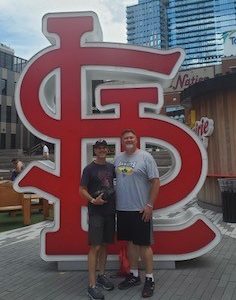
Last week, about 15 hours after I dropped my catch partner for his sophomore year in Wisconsin, and about five months after Dan and I started communicating, we met at Ballpark Village next to Busch Stadium. We decided to play catch on the makeshift field in the middle of the Village. I had asked my son for one of his game balls – just to be safe. Dan told me: “I have the ball” – the one that was in Ethan’s glove in the back of his car that fateful day.

The Inspiration and the Author (and Ethan’s glove)

Dan and I started throwing and started talking, and we shared more than you can possibly imagine. If misery loves company, so too do people trying to transcend it. What started as therapy for a grieving father has turned into a two-way street of recovery. Many of the people who have contacted Dan for a catch have lost children, and they have found solace in Ethan’s story, in Dan’s story, and their ability to share their own story in an unconventional setting, where there are no preconceived notions of what should be said, or how one should feel or react.

Dan told me that the phrases he hears most often while flipping a ball back and forth are: “I didn’t expect to share this” and “I have never told this to anyone.” There is something about the process, the rhythm of throwing a baseball that allows one to open up. But it is also Dan himself. A bear of man, we had known each other not five minutes when he asked if he could give me a hug. He is open and honest about his feelings; he is vulnerable to strangers; he is not afraid of his emotions, and thus allows others to share theirs.

Dan is a Midwesterner who found God in his journey to restoration, and was saved earlier this year. I am a West Coast Jew who has a deep ambivalence about God’s role in all of this. And yet we were able to talk religion, spirituality, and faith. We found common ground in our respective losses, but also recognized the differences in our experiences. We each shared pearls of wisdom to take back to our daily lives, and created memories and a friendship that will survive well past our respective rotator cuffs.

Jason Kander, the former Army Captain who served in Afghanistan, was elected to the Missouri state legislature, and served as the Missouri Secretary of State, wrote a book about his battle with PTSD and mental health. In “Invisible Storm,” he wrote the following:

“My decision to go public about my mental health came with certain challenges, but it definitely helped me heal. Not having to put on a show for myself or others made a big difference. I encourage everyone to be up front about their own struggles, in their own way. You don’t need a huge platform. Just letting some coworkers or your circle of friends know what you’re going through can have strong positive effects, and you’ll be glad you did it. In this age of social media, we all live a public life to one degree or another, and you never know who might see your story, follow your example, and give themself permission to seek help.”

Kander is a massive baseball fan and a fellow Missourian, so it is possible that he knows Dan and Ethan’s story. Or maybe there is just something in the water in Missouri that makes people wise. Like Kander, Dan Bryan elected to share his sadness and grief with others with the hope that he could heal himself. What Dan discovered is that he was helping them heal as well.

Dan has met with people old and young, girls and boys, strangers and family members. He has tossed the ball with someone from as far away as Israel, and – on September 9th (his wedding day) – as close as his bedroom, when he will play catch with his fiancé, Jennifer. Dan was contacted by a 10-year old boy who wanted to play catch “with that man, because he can’t he play with his son anymore.” And he has been stopped in the street and outside the ballpark, as his and Ethan’s story is something that people want to be part of. The potential apotheosis of this whole affair was Dan playing catch with Albert Pujols on the field at Busch Stadium, talking about parenting, first catches, and fathers and sons.


It has been nearly 14 years since I had that dreadful conversation with my kindergartner. He is now a sophomore in college. I have spoken with countless people over the years; I have sat in many counseling sessions; I have attended various loss groups; I have offered advice and guidance for people who have lost loved ones, and have I received the same in return. But none of those interactions had the impact of my day with Dan Bryan. What started with Ethan D. Bryan’s book became a mission to celebrate Ethan C. Bryan’s life; what began as an idea to foster Dan’s road to emotional recovery became an act of philanthropy for people far and wide.

Dan and I finished playing catch after working up a lather on a typical August day in St. Louis. And then we sat on a bench and chatted some more; and then we ate. We spent nearly three hours together, learning about each other’s lives, and offering unconditional love and support. I left Ballpark Village with a full yet heavy heart. I could call my son and tell him whom I met and what we did, but Dan cannot. Dan told me that his biggest fear was that his son would be forgotten. But through this project, by reaching all manner of people, by opening his glove and opening his heart, Dan has insured that that will not happen. As long as people have a memory of their time with Dan, Ethan’s story will continue to resonate, will continue to have an impact, and will continue give context and meaning to a life cut short. And Dan will continue to leave each throwing session feeling better, stronger, and more connected – to both his son and the world at large. As Dan likes to say, and as he has dubbed this adventure: “Baseball Seams to Heal.”

So go home, grab a friend or a kid, grab a ball and glove, and tell them it’s time to:

PLAY BALL!!