The Dangers of Leading With Your Head

A few weeks ago, a friend of mine whose son plays Division I baseball told me a story. She was watching her son’s game on television when a player (not her son) dove headfirst into second base on an attempted steal. The runner’s head smashed into the shortstop’s knee, whereupon the runner collapsed on the field. For many moments, the players, coaches, and umpires didn’t know if the runner was alive – he certainly wasn’t moving. After about five interminable minutes, the player regained consciousness and was helped from the field. He was later diagnosed (luckily, as it happens) with only a concussion.

My friend told me this story as a prelude to a question that I have been asking in various forms for years: Why do players slide headfirst? Why is this even allowed?

Now, I am sure there are old-timers out there who will tell me that banning headfirst slides would be un-American; a violation of individual rights; a further wimpifying of our culture; that it would be pillow-parenting run amok. Okay, fair enough. Here in America you are entitled to your opinion, as am I.

It seems like I write about this issue every year. It turns out I have only done so in 2015, 2016, 2017, 2019, and now 2022. And the reason I keep writing about it is because it is still an incomprehensible practice.

The issue came top of mind a few weeks back when I watched one of my favorite young players – Ke’Bryan Hayes – do something so monumentally stupid that I could not believe my eyes. And it made me question what his father (a former big leaguer) taught him, and what type of coaching he is receiving in the Pirates organization. Here was the situation:

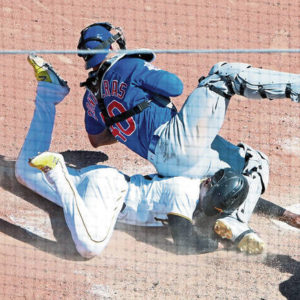
Hayes was on second as the Manfred-Man to start the bottom of the 10th inning. With one out, Michael Chavis hit a short looper over first. Hayes never stopped running. Rafael Ortega scooped the ball up on one hop, turned, and fired a strike to home plate. Waiting to receive Ortega’s throw was well-known (illegal?) plate blocker Willson Contreras, all 225 pounds of him. So what did Hayes, three inches shorter and at least 20 pound lighter – not accounting for the mass of equipment Contreras was wearing – do? He dove headfirst into home plate, where he met the Cubs’ catcher, and his heavy plastic shin guards, and his oversized backside. Hayes scored the winning run, and then lay in the dirt for nearly a minute. The Pirates’ play-by-play guy stated: “I have never seen a celebration muted like this.”

Hayes was helped to his feet and off the field, and then missed then next two games with a sore shoulder. He was lucky it wasn’t considerably worse; but since he has been back in the lineup over the last nine games, he is 6-for-35, with no extra base hits. Because correlation does not prove causation, you can draw your own conclusions.

Why did Hayes dive into home rather than sliding feet first? Why not utilize a classic hook slide moving his entire body as far from Contreras, who was catching a ball thrown from right field, and thus could not get a specific bead on the runner? Or, for all you throwbacks out there, how about him knocking Contreras’ block off – Pete Rose style – in the hope of dislodging the ball from his mitt? I think a replay review would have shown that Contreras did not provide Hayes with a path to the plate prior to his receiving the throw. Any of those options would have been better than putting his fingers, hands, wrists, neck, head, and shoulders at risk. Why didn’t the Pirates coaching staff alert the players in their scouting report that Contreras likes to block the plate? Why didn’t the Pirates player development staff coach their players to be safe, not sorry, when trying to advance to the next base? Why?

Sure, we all love watching Javy Báez with a swim slide into second base avoiding the tag of an unsuspecting middle infielder. But, at what cost? In 2019, Báez dove into second base, fractured his thumb, and missed the month of September. Some lessons are never learned.

Since the Hayes incident, I have seen a handful of additional players dive into home plate, all avoiding serious injury. But that is just dumb luck. Baseball is a dangerous game on its own. Don’t believe me, ask:

  • Mookie Betts (ribs, from an outfield collision)
  • Jacob deGrom (shoulder)
  • Manny Machado (ankle, running to first)
  • Max Scherzer (oblique)
  • Salvador Perez (thumb, due to a swing)
  • Ozzie Albies (fractured foot from a foul ball)
  • Walker Buhler (flexor strain and bone spur)
  • Stephen Strasburg (ribs)
  • Chris Sale (ribs)
  • Bryce Harper (thumb, due to a HBP)
  • Anthony Rendon (wrist, due to an errant swing)
  • Jazz Chisolm, Jr. (back strain)
  • Jack Flaherty (shoulder)
  • Tyler O’Neill (hamstring)
  • Hunter Renfroe (calf)

This list could go on and on. The point is that there is enough that can go wrong on a baseball field that players don’t need to take it upon themselves to up the ante. Sliding headfirst has shown, time and again, to be a fool’s bargain; and as I wrote in 2016, extremely costly. MLB teams need to get smart about this. But so, too, do college teams. And high schools. Yes, it is legal there as well.

When and where will the madness stop? When an aspiring physicist or politician or doctor playing baseball for an Ivy League institution dies on the field because his neck and head couldn’t endure the impact with another kid’s knee? Or will it require a $30M/year superstar becoming paralyzed on a major league diamond in front of 40,000 fans and on national television because he believed that leading with his head offered him the best chance to score a run in the fifth inning of a 7-2 ballgame?

MLB has shown a willingness to change its rules when big-name players get injured on a big stage (see, the Chase Utley Rule; see, the Buster Posey Rule). Why wait until we have to name this new rule? Or, if we must, let’s call it the Hayes Rule, named for a legacy player who narrowly avoided disaster and forced baseball to do the same.

PLAY BALL!!

Tropican’t

We all create bucket lists; things we want to do or see before we leave this mortal coil. For me, I have run with the bulls and climbed Machu Picchu. I have run a marathon and climbed the Eiffel Tower. But still on my to do list is visit every major league park. Having crisscrossed the country in an effort to check every batter’s box, I began to think I would fall one short: Tropicana Field. I just wasn’t too keen on visiting that odd park on the opposite side of Tampa Bay.

But, last week, I relented. I had to see – in person – if the ballpark was as bad in person as it appears on television. Now, for years I have railed against Dodger Stadium – I find it to be one of the most fan unfriendly parks in America. But, I have also said that if I could be teleported to my seat, never needing to leave to eat or use the bathroom, and then be teleported back to my sofa, there may not be a more beautiful place to watch a game. Well, after a brief sojourn to western Florida, I now believe that Tropicana Field is the photo negative of Chavez Ravine.

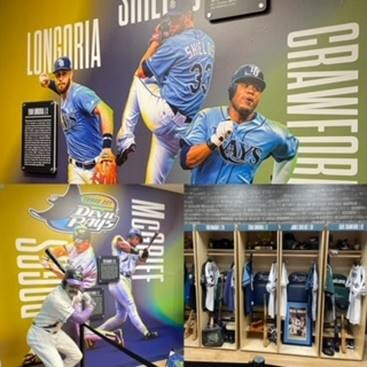
Unlike Dodger Stadium, it is relatively easy to get in and out of The Trop – if you can avoid the mid-day downpours, never knowing when they might arrive. And once you are inside the park (?), it is a fan-friendly experience. The Rays have done a terrific job of highlighting their 25 years of existence with various exhibitions in the lower bowl. They have Silver Slugger and Gold Gloves on display. They have re-created lockers of their all-time greats. They have mementos of their opening season. Not to mention pictures and retired numbers (those took me a minute to figure out).

Further, they have a great area for kids and parents. There are batting cages and throwing games, as well as concessions and a small picnic-type area (decidedly underground, natch!) for the little ones. There is a quiet area for parents to chill out, and where I saw a mom breastfeeding a next generation fan. And they have actual, living, swimming Cownose Stingrays in a tank in the outfield that kids (and adults) can touch. Now, to be fair, Dodger Stadium did recently install some kid-friendly games in the outfield pavilion, so there is that.

And then there are the eats. Simply put, there is an abundance. The Trop is no Petco Park or Oracle Park. It certainly doesn’t hold a candle to T-Mobile Park as far as dining is concerned. But it holds its own. You walk around the stadium and you can get local fair (shrimp tacos) and ballpark standards (Nathan’s hot dogs for all of the New York transplants); there are various sandwich offerings, sausages, wraps, poke, pizza, and French fries. And, to top it off, and again with a nod to New York, Mister Softee is available at three locations (and yes, I did indulge).

So, yeah, the Dodgers could learn a thing or two from the Rays’ fan experience.

But for many, the fan experience is secondary to watching the game, and rightly so. For nearly two decades, the Rays have put a quality product on the field, winning the division four times since 2008, and winning the pennant in both 2008 and 2020. Tampa Bay’s front office has always been cutting edge; they were the first team to introduce the “opener” (your mileage may vary on whether that was a good or bad advancement) and began utilizing the shift long before other teams caught on (again, your mileage may vary). So, with compelling players such as Wade Boggs, Carl Crawford, Evan Longoria, James Shields, Blake Snell, and now Wander Franco, you would think the organization would want to allow them to play on a better canvas. Alas, it is not meant to be…yet. There are ongoing negotiations for a new park and/or a shared-custody arrangement with Montréal.

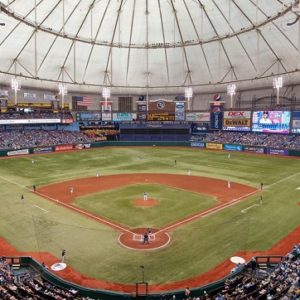
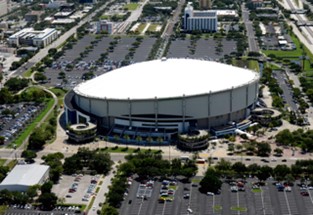
Coming across the bay on I-275, you see The Trop in the distance. Your/my first observation is that it is crooked. The stadium was built with a slanted roof to reduce interior volume, reduce cooling costs, and for better hurricane protection. All seem like laudable goals, but it sure is weird to look at. And, it is even weirder once you are inside, as everything is or appears slanted. There are concentric rings of catwalks (I am sure you have seen balls hit off of them) below the roof that follow the same contours. As such, you constantly find yourself tilting and un-tilting your head to make sure you are looking straight.

And because the roof is lop-sided, there is no symmetry with the upper level of the stands, which remain unpopulated, as the team’s attendance has not averaged more than 16,000/game since 2014.

The sightlines are odd, either because of the netting posts or the strange configuration of the seating, which includes picnic areas along the left and right field lines, alongside the on-field bullpens. And, when you do have a clear view, there are so many ads and so much ad hoc signage, that your eyes are often drawn away from the action. Now, I certainly understand the proliferation of ballpark advertising over the past 10-20 years, but some parks do it better than others. Some – Dodger Stadium, for instance – have a level of uniformity that makes the billboards value-add, not distracting. Some – like Chase Field – have a hodge-podge approach to their in-stadium publicity, making one think they are trying to bleed every possible dollar out of every possible square inch of wall space. Tropicana Field falls on the Chase Field end of the spectrum. And, to make matters worse, not even lost amongst the advertising are decent scoreboards or video displays. It took me two innings to find an MPH reading on Gerrit Cole’s fastball; and I never did find an exit velocity on Aaron Judge’s line out to left. The out of town scoreboard is heavy on logos, but light on actual scores.

Once I got the hang of everything, and tried to take in the game, I noticed that two of the scoreboards that actually provide useful in-game information about the pitcher and the batter are obstructed by fans in the standing area in right field. When I ventured to a higher level later in the game, the obstruction was lessened. But, come on…who was the Mensa behind that display placement decision?

The plan wasn’t to visit The Trop when the Yankees were in town – it just worked out that way. But, as could be expected, it was more like Yankee Stadium south, with the vast majority of the 16,504 in attendance wearing pinstripes and rooting on the Bombers. So, when Manuel Margot crashed into the wall in the top of the ninth inning and remained on the ground while the lead run scored, there were considerably more cheers than “aahs,” which was unfortunate (Margot was diagnosed with a patellar tendon strain and is on the 60-day IL). And when the final out landed in Aaron Hicks’ glove, and the Rays finally lost 4-2, the place erupted. It is hard to know if other teams travel as well to Tampa-St. Pete, and I am pretty sure I won’t be finding out.

I checked box #28 of active ballparks, and, in hindsight, I am glad I did. I got out of Tampa at 7am the next morning, and I am glad I did. The Rays have a lot to offer in their bizarre and hopefully impermanent stadium, concepts and ideas they can take across the bay or up to Canada. But from a game-viewing perspective, they have a lot of learn and a long way to go. However, rest-assured, when they finally do land in a new park, I will be there to watch…and critique.

PLAY BALL!

Doing a 180 on Bryce Harper

It’s mea culpa time. For years, and for reasons that I cannot fully articulate, I have disliked Bryce Harper. It didn’t go so far as hate, and I didn’t have any anger towards him, but I certainly didn’t root for him.

Now, if I was a psychologist, I might opine that Harper had been engaged in a “best of generation” competition with Mike Trout, and by being Team-Trout, I became Anti-Harper. This is entirely possible, but I am not sure that captures it.

Or, as I age and think about the next generation of ballplayers, maybe I have an intrinsic bias against guys wearing their eye black down their cheeks like war paint. But I want to believe that I got over such petty irritations after watching my son and his buddies do all manner of annoying things on the baseball field.

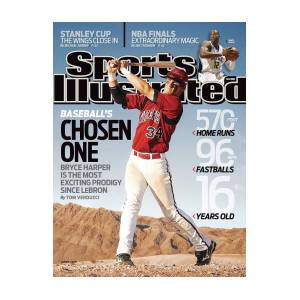
Maybe it was the hype. The cover of SI at age 16; the 1-1 pick in the 2010 MLB draft; his debut at 19 leading to Rookie of the Year honors. Maybe it was the flashes of brilliance (see, 2015), followed by seasons of mediocrity (at least by his standards). Maybe it was that every year Harper is penciled in as a savior and potential MVP, and in only two seasons has he truly fit that bill (winning MVP both times). Maybe it was all of the above, especially when compared to Trout.

Or maybe it was my dubiosity when, after signing a 13/$330M contract with no “opt-outs,” Harper claimed it was because he didn’t want any – he wanted to settle in Philadelphia and raise his family there. As I wrote at the timeI thought that was disingenuous, and believed then (and still partly believe today) that the only way John Middleton would give him that contract was if Harper agreed to not having any opt-outs, which would only provide him with additional financial leverage down the road.

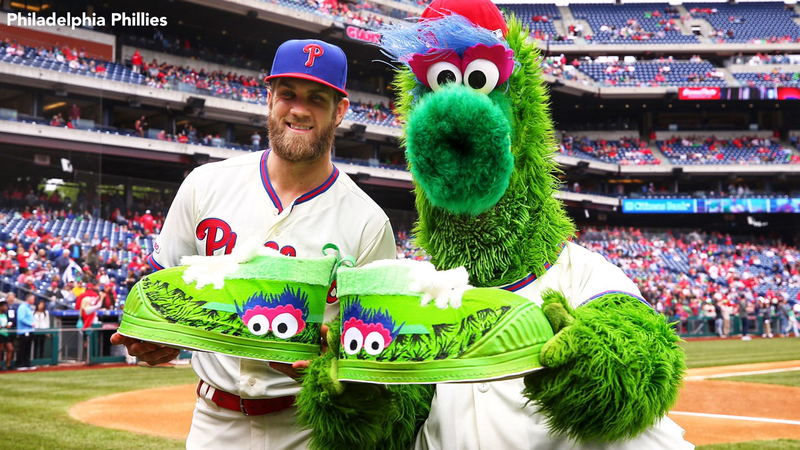
But almost immediately upon signing that giant deal, Harper started to do all the rights things – on and off the field. Now, in fairness, he may have been doing all of the right things off the field when he was in Washington and I just wasn’t paying attention, but it is clear that he fully embraced the City of Brotherly Love, and asked them to embrace him right back. We can start with the Phanatic Cleats.

Sure, players have all sorts of swag these days, and custom cleats are more the norm than the exception, but these kicks go above and beyond. By wearing these in his first game with the team, he set the tone. By having various versions and strutting them out every few months, he showed he is more than a one-tricky pony, and that he loves the conceit.

The shoes were just the start. What I have witnessed from across the country over these past four seasons is that Harper is playing the game for the right reason…for the fans. And Harper is doing whatever he can, whenever he can, to make sure that the younger generation that comes to the ballpark doesn’t just get their (or their parents’) money’s worth on the field, but they get the personal encounters as well.

There is the story of the young Phillies fan who caught (well, actually dropped and then got again) a Freddie Freeman home run ball, and then gave it to a Braves fan. The young man was lauded for his generosity, and was brought back to the ballpark the next day and given a ball signed by Freeman…and Harper. But Bryce wasn’t done. He hooked up with the family on SportsCenter and invited the boy to Citizens Bank Park to visit the clubhouse. He made that connection, and seemed really happy to do so.

Or the moment last month when Harper, nursing his sore elbow in the dugout, spotted a college student in the stands wearing a cool Phillies cap. Bryce initiated a trade. His gamer (signed, no less) for the student’s maroon-billed Phillies lid. The fan certainly didn’t come to the park expecting that. But he left thinking Bryce Harper is one of the coolest guys ever.

And I would be remiss if I didn’t point out how fervently Harper fought for the Phillies to re-sign J.T. Realmuto. Now, Dave Dombrowski would not have paid Realmuto $115M just because Bryce demanded it. But, according to NBC Sports, Bryce “wore T-shirts, posted on Instagram, and made subtle comments to the media in an effort to convince the Philadelphia brass to make retaining Realmuto a priority.” Harper wanted the club to spend money to make it the best and most competitive team possible. At this point in his career, Bryce was truly playing for the name on the front of the jersey, not the back.

When the pandemic hit in 2020, even when he wasn’t drawing a paycheck with the season shut down, Bryce and his wife Kayla donated $500,000 to three different charities in his hometown of Las Vegas and his adopted hometown of Philadelphia to help people in the most immediate need. Sure, other players do and did the same (although it is difficult to chart), but here was a guy who was often pegged (by people such as myself) as a “me” guy, going out of his way to be a “we” guy. That is growth, that is maturity, that is a man who deserves my/our respect and adulation.

This season Harper is dealing with a partial UCL tear and cannot play defense. By his own admission, it has been a hard transition from being a two-way player to a single dimension DH. But transition he has, including a game-tying grand slam in the 8th inning of last Sunday’s game against the Angels. Harper is currently hitting .308, with a 1.001 OPS, and a 181 OPS+ (stats current through June 9th). Injury or not, Harper has played in 51 of 57 games, and is (again) putting the Phillies on his back in a desperate attempt to overcome poor managing and a poor bullpen. Philadelphia may not catch the Mets this season; and they may not even make the expanded playoffs. But it won’t be because of Bryce Harper. And despite my prior distaste for the player, I, for one, will be rooting him on.

PLAY BALL!!

Inside Baseball…Gear

For years I thought I was alone. No one else, I could imagine, spent as much time as I did analyzing players’ uniforms and gear. From double-flap helmets giving way to single flaps only once they reach the majors, to Starter jackets for pitchers on the base paths, to the mock turtleneck undershirts that were all the rage in the late ‘80s and early ‘90s. I would tune-in to games, read magazines, and watch the highlights, all in an effort to take in the small details that mattered to no one…except me.

But in the past decade or so, that all changed. Like manna from heaven, websites were created and information began to flow. I learned that I was not alone. I realized that there are other weird, fanatical people like me. People who know – and want to know – if Player X was wearing a different color belt or wristbands with his picture on them; people who know – or want to know – if Player Y was using a different model glove or wearing a magnetic necklace.

The granddaddy of sports uniform minutiae is Uni Watch (www.uni-watch.com), founded in 1999 as a column in The Village Voice. Over the years the site grew in size and stature. And if ever a topic was made for the interactive experience of the web, Uni-Watch was it. Paul Lukas – the founder and writer – is a uniform expert, and writes about the most minute detail of everything from European soccer to college football, and anything and any sport in between. When I first encountered Uni-Watch and started reading Paul’s blog, I focused mostly on the baseball research, but I was just happy to know that there were hundreds of thousands (millions?) of people like me enamored with this ephemera.

For players’ equipment, there is no better authority than What Pros Wear (www.whatproswear.com). Mike Carozza started the site in 2012 because he wanted to wear Ken Griffey Jr.’s glove and couldn’t find a good source of information on “what pros wear.” So he decided to become that source; he wanted people like him to know who was wearing what, and where they could buy it. The site was made for me – or people like me…and Mike. And when I discovered it, I could not believe that such a thing existed. It was like Mike had been reading my mind and watching me scan SI’s pre-season preview for new looks, or like he saw me freeze-framing the television so I could determine if Salvador Perez was actually wearing his tried and true All-Star gear but just with the Rawlings label stitched on. You were wondering the same thing, right?

While I have been fixated on all equipment and uniform traits for years – I am a sucker for actual stirrups – my first, true, and everlasting love is batting gloves. I have been a batting glove-aholic for as long as I can remember. I could never – ahem, can never – walk into a sporting goods store without making a beeline to the baseball section. I find the aisle with the batting gloves and check out what they have on offer; and often find myself trying on the latest models (remember when stores had sample gloves on an extendable cord for just this purpose). This adoration goes back to my youth.

When I first started playing baseball, I always got a new pair before the season. At that time, Saranac was the lead manufacturer, first with their wristband-loop Velcro closure (think Dusty Baker), and then with their “Triangle” logo Velcro closure. I cherished that soft leather, and how they felt right out of the package. The batting gloves of the ‘70s and early ‘80s, which – fun fact – were the progeny of golf gloves, weren’t the most comfortable and took some time to break in. Then, around 1985, I discovered the world of Franklin. And my whole world changed.

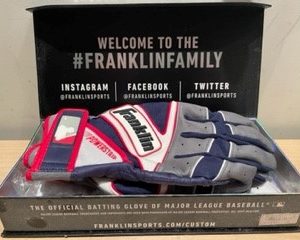
When you opened a new pair of Franklins, the first thing I did (do) is take a whiff. Nothing compares to the musk of the Pittards leather that Franklin still uses to make their gloves. And that concept of taking time to break in? That went away the first time I donned a pair of gloves with Franklin’s unique tri-curve design. As Mike Schmidt, the first MLB endorser of Franklin would attest, Franklins were part of your hand from the get.

It is truly hard to explain my deep fascination with this company and their inimitable product (more on that below), so I won’t really try. Suffice to say that I have made note of every design change Franklin has produced over the past 35 years; I have clocked every additional colorway added to their arsenal; I have observed which players are added to their roster nearly every season (can we attribute Aaron Judge’s early-season success to his new partnership with Franklin?), and those, like my beloved Will Clark, who left the Franklin family for Easton and then to Nike (or Ken Griffey, Jr., who skipped the stop at Easton and went directly from Franklin to Nike; or Ronald Acuña, Jr., who had some of the best batting glove game in the game, but switched from Franklin to Nike this season; I could do this all day).

When I was in high school, and Franklin’s commercial colorways were not widely available (the local sporting goods store carried all black, all white, royal/white, red/white), I would use a Sharpie and a highlighter to create my own. But in 1988, long before the internet and PayPal and Zelle, I took it upon myself to call the 800-directory (extra points and a prostate exam if you remember using that) to get the phone number of Franklin Sports in Stoughton, Massachusetts. Armed with a number, I cold-called the company and asked if I could order batting gloves directly. Either out of pity, or with a prescient eye towards eventual direct-to-consumer sales, they faxed (!) me an order form. I stewed on the various options for days – a whole world had now opened to me, and seemingly, me alone. I offered this once-in-a-lifetime opportunity to my teammates, but they could not be bothered. I begged my mom to front the money, as she needed to write a check that I mailed back east. A few weeks later a package appeared in our mailbox – a few pairs of never-seen-before-in-person batting gloves. Forget Christmas or Hanukkah, this was a brand new holiday!

As luck would have it, I was in Boston with my family last month when Franklin was having a warehouse sale. Their headquarters was about fifteen minutes from where were staying, so we HAD to go. We pulled off the highway, and there it was – just a series of buildings, but awe-inspiring nonetheless. We parked and headed in. Take one guess where I went first? They had hundreds of pairs of batting gloves that just needed to be seen, touched, tried on. No one in the immediate family plays baseball anymore, but my nephew does. So for him, we shopped. We also grabbed a volleyball, some hockey pucks, and a t-shirt. And that was when the connection was made.

An innocuous question about having any more shirts in my size led to a conversation about the above-referenced faxed order more than three decades ago. And that conversation introduced me to the literal Franklin family – Larry (the founder’s son) and his son Adam. Once Adam discovered my fascination and historical knowledge, he brought me to the Taj Mahal, the Sistine Chapel, the Mecca of batting gloves. My family and I were given entrée into a room at the back of the Franklin facility where all MLB players’ batting gloves are housed. In this room, from floor to ceiling, were cubbies with thousands of pairs of gloves. As a show of my insanity, I started rattling off players just by the model, design, and colorway. After nearly forty years of obsessing about batting gloves, I was welcomed into the inner-sanctum.

Adam showed us where the latest designs and improvements are made. He showed us concepts and products that even the big leaguers don’t yet know about (I can tell you what colors certain teams’ not-yet-released City Connect uniforms will be because I have seen their accessorized batting gloves), and he gave us a behind-the-scenes look at the goody box of gloves each Franklin-wearing player gets for each season’s special occasion games. As I said to my kids, this was Dad’s Disneyland.

Kids today don’t just get to mimic their favorite player’s batting stance or pitching motion. Now they can wear all of their gear and use all of their equipment. The information is there for everyone to find, fixate on, and potentially buy. Swing by your local Little League and you will see kids with Evoshield elbow protectors; stop by your local high school and see players diving back into first with running mitts. As for me, well I spend my free time playing with the Franklin batting glove customization tool (www.https://franklinsports.com/custom).

When I was a kid, I would have sooner believed that you could hang a television on the wall and watch first-run movies in your living room, or that you could store all of your albums and cassettes on a device the size of a deck of cards, or that you could do your research project on a Commodore 64, than I would have believed that you would always know exactly what every baseball player was wearing and what gear he was using, or that you could create your own custom batting gloves and have them shipped directly to your home just a few weeks later. People always talk about the good ol’ days. Forget that. With Uni-Watch, What Pros Wear, Franklin Sports, and, hell, your local Dick’s Sporting Goods, we are way better off today. Head on over, and…

PLAY BALL!!

Fenway Park: A Family Affair

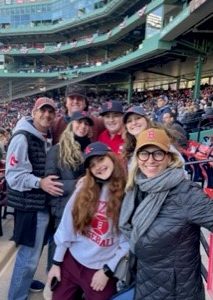
A few months ago, my wife, who is a master at planning vacations, hit me with this idea: How about we meet up for Spring Break in Boston? Because she knows the animal, she had already checked the schedule and confirmed that the Red Sox would be in town. And, because the kids are growing and at different schools and thus have different Spring Break schedules, she also made sure that they all could join us in the Back Bay. Since the two youngest had never been to Boston, and because I never pass up an opportunity to go to Fenway Park, the answer was an easy one.

A click on the MLB site and then a call to the Red Sox ticket office locked in seven choice seats for a Sunday afternoon in April. Now, when I bought these tickets the players were locked out, but I felt relatively confident that the owners and players would resolve their differences with plenty of time to spare. And then they didn’t. And then Rob Manfred canceled the first week of the season. And then he canceled another week. While I wanted the impasse resolved and 162 games to be played, I clung to Manfred’s assertion that missed games would not be made up, and that the current schedule would hold. As such, I still had a few days of wiggle room; but the outcome was beginning to look bleak. Of course, a trip to Boston would still be incredible without the Red Sox. Of course, there was plenty of sights to see, history to learn, food to eat, without noshing on Fenway Franks. But, all things being equal, why would one ever do that? It wasn’t Red Sox or bust, but it was damn close.

As we all know, the owners and the players came to an uneasy accord. The first week of the season was lost, but all else remained on schedule, and our tickets for the Sunday before Patriots’ Day would and could be put to use. Suffice it to say, there was jubilation in our house when the lockout was lifted.

My son flew in from college a day early to take his third public tour of Fenway – he just cannot get enough. And on Sunday, we arrived at Jersey Street before the gates opened. Rather than waiting on line, I took the kids to Lansdowne Street and bought some souvenirs. We walked up Ipswich to Van Ness and then back to Jersey, where fans were now flowing through the gates. A brief (can it be brief?) stop at the team store netted nothing additional (yet), so we walked around the former Yawkey Way and took in the sights and sounds. I have been to nearly every ballpark, and nothing really compares to the scene outside Fenway (unfortunately, one needs a ticket to get onto Jersey Street, so this excitement is not open to the public).

The law school roommate of a dear friend of mine is an executive with the Red Sox, and he met us outside Gate A to take us on a behind-the-scenes tour of the park. We saw nooks and crannies not available to typical fans (who knew the Red Sox had their own garden where they grow fruits and vegetables for both their luxury suites and local homeless shelters?), as well as well-worn haunts like the Top of the Monster. We went to Ted William’s red seat and checked out the brand new bar and deck area behind the right field bleachers; and we watched Red Sox legend Tim Wakefield broadcast from the new NESN booth overlooking right field. In the Royal Rooters Club we saw “The Dave Roberts Base” (which is exactly what you think it is), as well as tons of memorabilia going back over a hundred years. I showed my kids pictures of what Fenway looked like when their Papa attended games there as a kid. We saw four World Series trophies and the Red Sox Hall of Fame plaques. We had spent the previous days touring Boston and learning American history; we spent Sunday morning touring Fenway Park and learning Red Sox history. Your mileage may vary on which is more important.

After our multiple dime tour, we met the rest of the family back on Jersey Street. My wife and stepdaughter were now the last two who had never been inside America’s Most Beloved Ballpark. So, it was my great pleasure to walk them up the grandstand and have them see the field and the Green Monster for the first time. It’s not the same as Billy Crystal’s description of first walking into Yankee Stadium, which he had only seen in black and white, but it is a close second. When your baseball life experience is essentially made up of Dodger Stadium, Fenway Park is otherworldly. You are just so close to the field; that wall is just so tall; and everything is just so green. And whether you are a Red Sox season ticket holder, or you are making your first visit to Fenway, the old building never disappoints.

The game got off to a slow start, but the offense picked up in the later innings. But the truth is, it did not matter. We bought snacks from the ubiquitous vendors, and held our breath when Kiké Hernández did his best Pudge Fisk impersonation, pulling one just foul down the line. Around the fourth inning my stepson said “this place is the best.” He and I don’t always see eye to eye, but on this we can agree.

And as we moved into the bottom of the sixth, I stopped my kids from leaving their seats, as I knew what was to come. The seventh inning stretch and then “Sweet Caroline” were capstones for the girls. The Red Sox win, “Dirty Water,” and “Tessie” were the capstones for me and the boys. We piled out of Fenway Park with full bellies and smiles on our faces. But we still had to make one more stop at the team store. For those who had never been before, they now knew how special the Fenway experience is; they now had to have a keepsake.

I have been to more than thirty MLB parks, and nearly all of the current ones. When people ask me my favorite, I always start with the notion that you have to take Wrigley Field and Fenway Park out of the conversation, as those two are cathedrals, they are cultural institutions, they are historic landmarks. I have spent a lot of time at Wrigley over the past few years, and don’t get to Fenway as often as I would like. But maybe that is for the best, as Fenway never stops being special; it never ceases to amaze, impress, and satisfy what my baseball-loving heart desires. As my friend Gabrielle Starr has written, “If you’ve been to Fenway before, you know what I mean. It’s that buzz of magic, of history, and anticipation. It’s the pulling of that thread that connects baseball’s past and present.”

I have pulled that thread, and been to Fenway Park with my dad, and with my sons. But this time I got to bring my wife and all my kids, and got to experience it through their eyes. They say you are only as happy as your most unhappy child. Well, after three hours in uncomfortable seats facing slightly the wrong direction, on a blustery Sunday in Boston, I was walking on sunshine.

PLAY BALL!!

MLB Labor Negotiations: Moving Mountains

From the moment word came down that the owners and players had reached an agreement and the MLB lockout would be lifted, baseball writers all over the country took to their keyboards to bang out stories about the new CBA. 

Jeff Passan, weary and exhausted, the victim of a Twitter hack, was able to hash out a quick summary of the deal.

Jayson Stark did another of his many-thousand-word summaries.

Evan Drellich, who followed this process as closely as anyone, wrote a great piece about how and what the players won. But I don’t think he went far enough.

What the MLBPA was able to achieve after a 99-day lockout was nothing short of monumental.

Did they get everything they wanted at the outset? Of course not. Did they fundamentally alter the financial landscape of the game? No, but that was never in the offing. Unfortunately, in the excitement of “a deal” and players reporting to Spring Training and the season being salvaged, I believe many of the changes they were able to achieve are either being overlooked or elided.

When negotiations got really heated late last month, Michael Bauman of The Ringer tweeted that it is hard to negotiate with a party when their singular response is “Fuck you, that’s why.” And that, truly, is what the players were up against. As has been written time and again – whether or not it is true may be immaterial – neither Rob Manfred nor the owners who employ him seem to like baseball. They may like owning their teams, and the reflective glory of being 1 of 30; they may like the tax benefits that come from owning a unique civic institution; they may like the centerpiece of their real estate portfolio, the item that draws people to their parking lots, hotels, and other “around the ballpark” destinations. But the game itself, and the players who make it great, well, whatever.

Oh, and they have billions of dollars. And most – if not all – have alternative revenue sources from which to pay their mortgages and fund their vacations. But the players – save for a few who have potentially lucrative hobbies on the side (looking at you Ross Stripling) – have baseball, and only baseball. And they only have that for a limited period of time. And the period of time during which they can be fairly compensated has been lessened by the owners repeated insistence on artificially deflating salaries and/or the ability to spend. 

The Long Road to Riches

When a player gets drafted, he doesn’t get to pick his team, and “slots” restrain his signing bonus. That player is beholden to that organization for years in the minor leagues making below-poverty wages. Once he reaches the majors, he is skilled enough to be (arguably) one of the best 750 in the world at his profession, and yet is paid a minimum salary for at least three years. After those three years, if he is still employed, he is forced to not only advocate for himself in an arbitration proceeding, but he is forced to listen to a fully-fleshed out assault on his worth, his value, and the team’s desire to keep him employed. And after three years of running that gauntlet, he is afforded “free agency,” where teams now tell him he is too old, his most productive years are behind him, that teams don’t pay for past performance, and/or they would but for that pesky Competitive Balance Tax, which has thwarted the team’s ability to pay your market value. Sorry!!

Here is where we insert the “poor baseball players…they get paid to play a kid’s game and, at worst, make more than ten times the US median income in any given year” trope. But when you think they have just a few years to make that salary, and then the rest of their lives to live (who amongst us is considered old for our profession once we turn 30, let alone 35?), the players’ plight is not that outrageous.

And that is all a red herring. Professional athletes’ salaries should not ever be measured against lunch pail carrying Joes and Janes. They, by virtue of their talents, are simply different. No one pays $50 plus parking to watch me negotiate contracts all day – just sayin’.

The Long Road to Change 

With that as the backdrop, the players went about doing the absolute best they could – and for the right people. The negotiations were centered (not exclusively) on the youngest players and those in the middle class. Max Scherzer and his $43M/year and Marcus Semien and his 7/$175M deal sat at that negotiating table and fought for everyone else. And when the owners said, “Fuck you, that’s why,” and then locked out the players to “jump-start negotiations” and then didn’t offer a response for six weeks, and then began setting artificial deadlines to finalize the deal or the players would begin losing paychecks, the players had to pick their battles and fight the fights they could win.

They did better than that. 

Set forth below, in simple terms, is what the players were able to achieve in the face of complete intransigence and an apparent total lack of care:

I. Minimum Salary

Who amongst us wouldn’t like to get a 23% raise? The players were able to increase the minimum salary (in year one) from $570,500 to $700,000. To put this in context, roughly one-third of the league made the minimum salary last season, and 62% had salaries of less than $1M. This change alone may ultimately impact more players than any of the other issues. It was a huge win.

II. Limitation on Options

Related to the minimum salary, but not getting nearly enough press, is the limitation of the number of times a player can be optioned to the minors in a given season. A team can now only do that five times. So, players like Tanner Houck of the Red Sox will not be optioned seven times, being sent down after each start during July and August. Houck accrued 64 days of service time and was paid approximately $275,000 – less than half the 2021 MLB minimum – even though he was one of Boston’s most effective pitchers. Will teams utilize all five? You bet. Will some players be stuck in the minors due to this limitation? No doubt. But, if a player is performing, and the team is trying to win, this will ultimately be a net positive for young players (especially pitchers).

III. Pre-Arbitration Bonus Pool

As if conjured out of thin air, the players were able to obtain an additional $250M for the players over the life of the deal. With the $50M/year pre-arbitration pool, exceptional players (and many not so exceptional players) will receive additional monies that simply never existed before. 

The Jayson Stark article referenced above does a nice job of explaining who gets paid for what. To give this some context, when Pete Alonso won the 2019 Home Run Derby, he nearly tripled his salary. And by winning again in 2021, Alonso has now earned more from the Home Run Derby ($2M) than he has in three seasons with the Mets ($1.47M, due to his rookie contracts). Something about that just doesn’t seem right. 

But with this new pool, players who are not yet eligible for arbitration will get paid bonuses for their performance. As Stark pointed out, Vlad Guerrero, Jr. would have netted an additional $1.75M last season (2nd in MVP voting), which is more than three times his salary. The $50M will be given for various awards, and then allocated amongst the best remaining 100 players (which means that even not-so-exceptional players will reap the benefit of this hard-fought MLBPA win).

IV. Thwarting Service Time Manipulation

Players who excel have a chance to thwart the owner’s ability to manipulate their service time. In fairness, this provision does not go far enough, nor will it truly compel teams to stop this heinous practice, but it does afford players like Kris Bryant (for whom this new rule is all but named) from getting hosed by teams utilizing financial calendars.

If a player finishes first or second in Rookie of the Year voting, he gets a full year of service time, whether he was rostered for 150 days, or 15. Would a team keep a player in the minors for so long that he has no realistic ability to win ROY, maybe – never underestimate the audacity of MLB front offices. But that would be a serious tank job, and a result that no amount of bargaining could ever eliminate, and one sure to be the topic of a grievance.

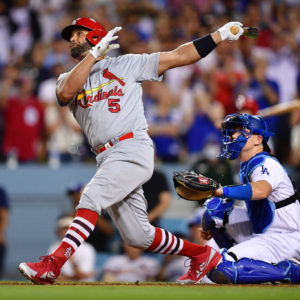
V. Universal Designated Hitter

It took 50 years for both the AL and the NL to have the same positions in their starting lineup every day. And while the addition of the designated hitter in the National League will most likely benefit older players rather than younger ones, as guys like Nelson Cruz and Albert Pujols will now be able to cash at least a few more checks before their lack of defense ends their careers, any change that essentially adds a roster spot is good for the game and potentially good for young and middle-class players.

VI. Expanded Playoffs

Increasing the playoff pool from 10 to 12 teams means an additional $85M in television money for the teams, which was sprinkled out to the players in the form of the increased minimum salary and higher CBT thresholds (more about those below). Now, baseball purists who were just digesting the Wild Card and the expanded Wild Card are having none of this, but the truth of the matter is that more playoff baseball is more baseball, and more baseball is good for baseball…and baseball players.

With the new format, there are four additional teams coming into your living room each October. With young (and old) players now afforded the chance to play on the biggest stage, in front of the largest viewing audience, they get more exposure and more opportunity for financial gain. Mike Trout may not need the playoffs to get another Subway sponsorship or increase his value, but Bobby Witt, Jr. sure might. And if the Royals can sneak into a 12-team playoff where they would have been left out of a 10-teamer, and the Midwesterner gets to play in primetime in the fall in front of millions of viewers – and millions of impressionable kids – and he performs as we all expect he will, well then Bobby, Jr. may be the guy to get the next Subway deal. 

VII. Increased CBT Thresholds 

I have covered this one last even though, by all accounts, it was the most contentious issue in the labor negotiations. Quite obviously, the increased amounts are a win for all players. For years teams have worried about exceeding the “soft cap,” so much so that only two exceeded it last year, and another half dozen double-checked their abaci to make certain that they spent within $5M without going over.

But now, with an additional $20M (in year one), teams may not be as concerned about throwing an extra million or two to that middle reliever who will be an asset down the stretch. And where this may become really beneficial (and which I have not seen written about), is teams’ willingness to make trades at the deadline. In years past, teams wouldn’t make a trade that jeopardized their CBT situation, even if it gave them a better chance to win. With that additional $20M to play with (more in later years of CBA), teams will have more wiggle room to take on salary and give their team a chance to play in the expanded playoffs…which will give players more exposure…which will open up additional opportunities…which will potentially be a financial boon (in fairness, to both the players and the owners).

Moving Mountains

The MLBPA moved mountains over the course of the past four months, but really in the past few weeks. They won the social media battle. They won the PR battle (Rob Manfred didn’t help the owners’ cause by lying about profitability, setting artificial deadlines, laughing at somber moments, and practicing his golf swing while players, ticket takers, and hot dog vendors were staring down the gauntlet of being out of work). And they won the negotiating battle. At no point did it seem that the owners wanted to make a deal. At every turn they threw up another obstacle: one day it was an international draft; the next it was refusing to take “yes” for an answer because it came past the 6 pm deadline; lastly, it was a requirement that the players drop two grievances against the owners as a condition to closing (one of which the players agreed to drop). 

But in spite of all of that, the players held together and got way more than any reasonable observer would have thought possible. The players went into these negotiations with wide eyes and great aspirations. But they had to know, at a visceral level, that there were no 8-run homers available; they could not make up all of the ground lost in 2011 and 2016 in one CBA negotiation. They quickly made concessions where they could; they gave up on redefining the sport; they remained focused on protecting the most vulnerable amongst them. And by a vote of 26-12, they prevailed. Hopefully, one day, we will learn why all eight Executive Subcommittee members voted “no,” and why four other player reps felt the same. But, for now, the players won, and baseball is back.

And we, as fans, are nothing less than elated. But before we start booing Gerrit Cole for another lousy outing, or Manny Machado for not running out a grounder, remember the work that these guys did – collectively – to protect the sport. Because there were many times when it seemed like the players were the only people at the table who cared to do so.

Mountains were moved. And, as per usual, it was labor that did the work. I cannot wait to hear, on April 7th:

PLAY BALL!!

The Silver Age of First Basemen

There is a belief that your baseball fandom hits its stride between the ages of 12 and 14. That certainly holds true for me. And luckily for me, as a bats-left/throws-left first baseman, I hit my fandom stride in what I would call the “Silver Age” of first basemen. Why not the Golden Age? Because as good as the collection of first-sackers listed below are, I’m not sure they live up to an era that had Lou Gehrig, Jimmy Foxx, and Hank Greenberg.

Here is a non-comprehensive list of the veritable super-stars who held runners on base in the eighties:

Pete Rose: 4,256 hits; played for 24 years. Only not a Hall of Famer due to that pesky gambling thing.

Rod Carew: Retired in 1985 after more than 3,000 hits, with 13 seasons of 150 hits or more (four with 200 or more); 7 batting titles including four in row (1972-1975). Inducted into the Hall of Fame in 1991.

Eddie Murray: Between 1977 and 1995, had only one season with less than a 105 OPS+, and had a 103 OPS+ in his 21st year. He got a plaque in Cooperstown in 2003.

Jack Clark: You rarely hear his name any more, but from 1978 through 1991, his lowest OPS+ was 125, with five seasons above 150. Plus, he crushed the souls of Los Angelenos in the 1985 playoffs.

Wally Joyner: I already dedicated a whole article to him here.

Mark McGwire: Even before his goatee and biceps grew, he set a major league rookie record with 49 HRs in 1987. Would be in the Hall of Fame today but for Andro, Deca-Durabolin, and Winstrol.

Mark Grace: No batting gloves, no matter. 2,445 hits, lifetime .303 hitter, career OBP of .383. And how about this line for the 1989 playoffs: .647/.682/1.118/1.799.

There are four very obvious names not listed above, all of whom hold a very special place in my heart; all of whom were cornerstones of ‘80s baseball:

My inaugural first-baseman’s mitt was a Rawlings Keith Hernandez model.

Before the Batting Stance Guy ever struck his first pose, I closed my stance and dropped the head of the bat over my shoulder – and even removed my batting gloves – just like Will Clark.

My first baseball coach was a diehard Yankee fan. The only thing we could agree on was that Don Mattingly was the best hitter in the league.

Steve Garvey defied what I looked for in a first baseman – he batted and threw (I use that word loosely) right-handed – but he was my hometown guy; and he played every…single…day; and he could stretch like a Russian ballerina, and picked every errant Bill Russell throw.

These guys were not only good, they were great. As such, each year, when Hall of Fame balloting comes around, all four get a ton of attention. There are some who will swear that if Player X is in the Hall of Fame, so too should Garvey. Others will say that Mattingly was well on his way, but a bad back thwarted his potential enshrinement. Some claim that cocaine slowed Hernandez down. As for Will, well, he’ll always be a Hall of Famer…in my heart, if not in my head.

But the truth is, despite their greatness for periods of time, and despite my unrequited love, none of these four guys had Hall of Fame careers. Sure, that can be a subjective analysis (ahem, Harold Baines, ahem), but the facts and the stats bear this out.

Each player included at www.baseballreference.com has a “Hall of Fame Statistics” section, which lists the following:

Black Ink: This is how many times the player led the league in “important” stats. Accordingly, you get four points for leading in HRs, RBI, and/or batting average; three points for runs, hits, and/or slugging; two points for doubles, walks, and/or stolen bases; one point for games, at bats, and/or triples. The average Black Ink points for a Hall of Fame first baseman is 27.

Gray Ink: This is the same as Black Ink, but the player need only be in the top ten of the league. The average Gray Ink points for a Hall of Fame first baseman is 144.

Hall of Fame Standards: This is a considerably more complicated math problem, with 17 different inputs. You can read more about it here. The average Hall of Fame Standard point total for a Hall of Famer is 50 (with 100 being the max).

WAR: This is also known as bWAR, and it is Baseball Reference’s calculation to determine how much better a player is than a player that would typically be available to replace that player. I will save you the headache of explaining how they do this.

JAWS: This is the preeminent tool for determining if a player is Hall-worthy. The sabermetrician Jay Jaffe first developed this system in 2004, comparing players at each position with players already enshrined, using advanced metrics to account for the wide variations in offensive levels throughout the game’s history. The JAWS score is a player’s career WAR averaged with his seven-year peak (not necessarily consecutive).

With that as the backdrop, let’s dig into the numbers.

Black Ink Gray Ink HOF WAR 7-Year Peak WAR JAWS
Average HOF First Baseman 27 144 50 65.5 42.1 53.8
Steve Garvey 12 142 32 38 28.7 33.4
Keith Hernandez 14 118 32 60.3 41.2 50.8
Don Mattingly 23 111 34 42.4 35.7 39.1
Will Clark 13 94 42 56.5 36.1 46.3

As you can see from the above metrics, none of these guys meet the criteria necessary to have plaques in Cooperstown. And despite the oft-heard “Garvey was a Hall of Famer” (on the field and in the bedroom), it appears that Keith Hernandez has the strongest case to ultimately be enshrined. His WAR is only 8% lower than the average; his 7-Year Peak WAR is within the margin of error; and his JAWS score should be close enough for government work (especially for a guy who played and now broadcasts in New York).

What is incredible about these numbers is that you would have sworn that for at least a seven-year window, both Don Mattingly and Will Clark were the best hitters in the world. And yet, the statistics belie that memory. I guess that is just nostalgia of my youth. Chuck Klosterman, the best-selling author who always has an interesting way of looking at things, recently said the following: “Nostalgia is looking at the past through the lens of your own personal experience and therefore changing the meaning of that memory based on the way you want to feel about your relationship to your own life.”

In my own life, I want Garvey, Hernandez, Mattingly, and Clark to be inducted into the Hall of Fame. In real life, they were good; they were, in-fact, great. They were part of the Silver-Era of first basemen. But try as I might, I cannot conjure them into being Hall of Famers. And, you know what, my memories will suffice.

Garvey’s chiseled jaw and dimpled chin perfectly placed on his front shoulder awaiting the pitch.

Hernandez’s mad-dash charge of a bunt.

Donny Baseball’s six grand slams in 1987.

Will the Thrill’s bat drop/arm cock as he launched another one into the upper deck at Candlestick.

Who needs plaques when I have those images burned into my brain.

PLAY BALL!!

How Do You Explain PEDs and the Hall of Fame?

Read enough newspapers or watch enough news or listen to enough podcasts, and you are bound to get slapped in the face with poor reportage. It’s the law of big numbers. But, as a discerning baseball fan, I have come to expect that, while I may not agree with all baseball takes and opinions, I believe they come from an informed and considered place. Football analysts shoot from the hip, basketball commentators like to make headlines, but baseball observers are more careful. Or so I believed.

After the Hall of Fame released the results of the BBWAA vote last month, I listened to “The Athletic Baseball Show” podcast hosted by Ken Rosenthal. He had a murderer’s row of guests, and I knew there would be much to discuss regarding Roger Clemens, Barry Bonds, Curt Schilling, and A-Rod, and, of course, the election of David Ortiz. The show lived up to my expectations up to about the 2:40 mark, when guest Britt Ghiroli said the following:

“Well, David Ortiz still has some ties to PEDs, so how can you let him in and not let Clemens and Barry Bonds in?” And then she referenced a tweet by pitcher Kevin Gausman who asked, “How do you explain this?” And she then opined that a lot of people are left wondering, “How do you explain this?” 

Now, this is by no means intended to be a pile on Ghiroli. I think she is a fantastic reporter and writer, and I find her articles thoughtful and insightful. That said, this issue is not hard to explain. And I was disappointed that not only did Ghiroli not clarify the situation, she perpetuated the question; she gave it life and further validity.

To be fair, I was equally disappointed with Rosenthal, who offered no rebuttal, no explanation. This was all unfortunate, because it is very easy (although slightly time-consuming) to explain. Since neither Ghiroli nor Rosenthal did so, I will.

2003 Anonymous Steroid Testing

In 2003 MLB conducted a random, anonymous test to get a loose idea of who was taking what. Coming off the “chicks dig the long ball era,” with Mark McGwire and Sammy Sosa imitating a modern-day Maris and Mantle — just doing it every year — and then with Barry Bonds asking both of them to hold his beer, MLB decided to dip its toe into the murky PED waters.

The results of that test were supposed to remain anonymous; but intent didn’t matter once the names began to leak. Ortiz’s name was included on a list of 104 players who tested positive …  for something. The findings (i.e., what was discovered) were never disclosed and the urine samples have been destroyed (convenient, I know). At the time the names were leaked, the MLB Players’ Association said that 13 of the samples were in dispute, but they didn’t say which ones.

Years later, Commissioner Rob Manfred stated that the inclusion of at least 10 names on the list could be doubted for “legitimate scientific reasons.” He didn’t elaborate, other than to say, “even if you were on that list, it was entirely possible that you were not a positive” (emphasis added). Manfred put a button on the issue by stating that he felt it would be unfair for Hall of Fame voters to use that positive test against Ortiz.

David Ortiz’s Career

When the 2003 test was conducted, Ortiz was entering his seventh year in the big leagues. He had previous highs of 20 home runs and an .839 OPS. Drug testing began in earnest in 2004, with at least two tests per year: one during Spring Training and one during the season, with the possibility of additional random tests as, when, and where determined by MLB. Assuming Ortiz was never called out for additional checks (which he claims he was), he was tested for steroids at least 26 times between 2004 and when he retired. During that span, he hit 452 home runs, and averaged a .956 OPS. And do you know how many times he tested positive for PEDs? To quote Jayson Stark, “That would be none.” 

Spring Trainings and regular seasons, playoffs and World Series. The world was watching every swing he took and every ball he crushed. And yet, other than his name appearing on an anonymous list in 2003, not a whiff of scandal, nary a scintilla of evidence of cheating. Those are the “ties” Ghiroli referenced.

Since Ghiroli mentioned Ortiz in the same breath as Clemens and Bonds, let’s take a look at what makes them different, let’s try to “explain it.”

Roger Clemens

In 2006, then-Commissioner Bud Selig appointed former senator George Mitchell to investigate the use of PEDs in baseball. Clemens’ former strength and conditioning coach, Brian McNamee, told the Mitchell Commission that he provided performance-enhancing drugs to Clemens. But an MLB commission — even one run by a former senator — is not great stakes. So it carried considerably more weight when McNamee put his hand on a bible and testified in front of Congress, and said the same thing.

Sure, McNamee could have been lying. But McNamee also testified that he provided HGH to Clemens’ teammate, Andy Pettitte, and Pettitte later acknowledged that to be true (and apologized for his use). After McNamee’s testimony, Clemens was charged with perjury and obstruction of Congress. Because of the he-said-he-said nature of the matter, Clemens was ultimately found not guilty. But that didn’t stop Clemens and McNamee from filing defamation cases against each other. Clemens’ suit against his former trainer was tossed out and McNamee’s case against Clemens was settled, with Clemens’ insurance company picking up the tab. Both men will likely go to their grave claiming they are right, righteous, and full of rectitude. But only one of these men had a bona fide reason to lie.

Regardless, in contrast to Ortiz, there were credible allegations — made in multiple courts of law and to Congress — that Clemens utilized PEDs during seasons in which he won two of his seven Cy Young Awards (at ages 36 and 39). The main witness who testified against Clemens was proven to be truthful by none other than Clemens’ best friend and former teammate. Those facts seem markedly different from a name on a list. That’s how you explain it.

Barry Bonds

In 2003, Greg Anderson, Bonds’ trainer, was indicted by a federal grand jury and charged with supplying steroids to a number of athletes. Bonds was called to testify before the grand jury, and he admitted to utilizing “the clear” and “the cream,” but claimed they were nutritional supplements, not illegal drugs. Prosecutors did not believe this testimony, and asked Anderson to testify in front of another grand jury to determine if Bonds had committed perjury. Anderson refused — even though a search of Anderson’s home found drug records, including some with Bonds’ name on them — was held in contempt of court, and taken away to jail.

Bonds was indicted for perjury and obstruction of justice, and was convicted on the obstruction charge. That conviction was ultimately overturned by the Ninth Circuit Court of Appeals on the grounds that Bonds gave a “rambling, non-responsive answer to a simple question” and that there was insufficient evidence that the statement was material to the investigation. It is important to note what the appeals court didn’t say: Bonds told the truth.

Anderson started training Bonds in 2000, the same year that Bonds set his then-career high in home runs with 49. The next year he hit a record-breaking 73 (at age 37). The following three seasons he hit 46, 45, and 45 (at age 40). Prior to engaging Anderson’s services, Bonds’ season high in home runs was 46, in his age-28 season. Bonds had a then-career high OPS that same season of 1.136. Nearly a decade later, after he started working with Anderson, Bonds had OPS seasons of 1.127, 1.379, 1.381, 1.278, and 1.422.

Bonds’ alleged PED use was the topic of the best-selling 2006 book entitled Game of Shadows, written by San Francisco Chronicle writers Mark Fainaru-Wada and Lance Williams. It should be noted that Bonds sued the authors and publisher of the book not for defamation, but over their use of grand jury documents. Bonds didn’t try to clear his name, he didn’t sue in open court that his reputation was in tatters due to vicious lies. Rather, he tried to block the authors and publisher from profiting from ill-gotten grand jury documents.

In contrast to Ortiz, whose name was on a single list leaked to a New York Times reporter, and who the Commissioner has somewhat exonerated, Bonds was involved in multiple state and federal lawsuits, leading to his (overturned) conviction. He was tied to the conviction of at least two of his associates (Anderson and Victor Conte, the owner and founder of BALCO). His name appears in drug files, journals, and affidavits. Although he never failed an MLB drug test, according to the aforementioned indictment, Bonds tested positive for anabolic steroids and other PEDs. I’m sure that Ghiroli, and Rosenthal, know all of this. Yet, they couldn’t “explain it.”

I am not here to say that Clemens or Bonds should or should not be in the Hall of Fame; that was up to the BBWAA writers (and now the Today’s Game Era Committee). What I am here to say is that we — as a society, and with all things — must stop the common practice of false equivalence. Not everything is equal; not all situations are the same.

It is imperative that those we trust with reporting the “facts” understand this, do their research, and be prepared to offer thoughtful and detailed rebuttals when lesser antagonists or clickbait wannabes try to say otherwise. This was a layup for Ghiroli and Rosenthal. They knew the topic ahead of time. No one expects reporters to be perfect, but we expect them to be prepared. Two writers who I truly respect both whiffed, and we are all worse off because of it.

Ortiz was elected to the Hall of Fame because enough writers believed that having your name on a list well before your career took off, followed by nothing but cleanliness as you built your Hall of Fame credentials, is not disqualifying. Clemens and Bonds were not elected to the Hall of Fame because the sum total of the allegations made against them — in court, before Congress, under oath, in affidavits, and in other testimony — was disqualifying.

Britt, Ken, Kevin, that is how you explain it. And please don’t get me started on A-Rod.

PLAY BALL!!


Do Raises Buy Goodwill?

For those of us who follow baseball closely – and one must assume that if you are reading this, you do – we take for granted our knowledge of the business of the game. We know, at a subconscious level, when a player will be eligible for free agency, and what “service time manipulation” means. We understand the significance of opt-outs and the nuances of the competitive balance tax. But the truth is, all of these things that we can recite as easily as “2+2,” are quite arcane to the casual observer. Want proof? Try explaining “Super Two Status” to someone who doesn’t frequent FanGraphs or follow Pitching Ninja on Twitter.

A while back I found myself having drink with my wife, waiting for a table at a local restaurant. A game was playing on the television above the bar. Some player was on the screen – I don’t recall who, but it could have been Walker Buhler or Fernando Tatís (pre-extension) or Rafael Devers. The who is irrelevant. I said to wife something along the lines of: “This guy is one of the best bargains in baseball.” She asked, “Why is that?” And so began a long and complicated discussion about rookie deals, the tendering of contracts, arbitration, and then free agency. Either I explained it very well or she is a quick study, or she is a good enough actress to pretend she understood even when she was too bored to ask for additional details. But she did stump me with one simple question:

If the teams control players for three years before they reach arbitration, why would the teams ever give them a raise?

In response I gave a trite answer about how we all want to be rewarded for our hard work, asking how would we feel if our bosses didn’t give us raises on yearly basis. It was such an innocent question. But it raised such an interesting point.

As ordinary shmos, we want and need to be rewarded for our hard work and we expect a raise each year. Our employers – ostensibly – want to keep us as employees, knowing that the time and cost of replacing a worker is substantial (as companies have learned during the “great resignation”). There is mutuality to the relationship in a standard setting that does not exist in professional sports. If an employer treats its employees well, pays them a decent wage (with reasonable bumps), and provides them with adequate benefits, that employee will theoretically stay. But regardless of how well a team treats a player, he has an off-ramp; a time when he can, and oftentimes is expected to, take his talents to South Beach, or Dallas, or New York. So, if players toil for years to get to get to free agency, to get to a point where they can create a bidding war for their services, it begs my wife’s question: Why do teams bother giving raises?

A quick primer: The typical baseball player is under “team control” for six years (sometimes less, sometimes more, let’s not busy ourselves with those distinctions). For the first three seasons he is under contract, the team is required to pay him the major league minimum ($570,500 in 2021). After seasons three through five, he either negotiates a new agreement with the team or goes to arbitration and pleads his case. After season six, he is a free agent and can go wherever he desires. But every year players are tendered contracts for their second and third seasons with raises built in. Not substantial raises, but usually in the 5-10% range. I imagine we all would be quite happy with raises of 5-10% in a given year. But, again, why do teams do this?

At first blush, one might think that giving a player a raise in Year 2 and/or Year 3 is a reward for a job well done. And nominally, that is what it is. But is there any other point in a player’s career where ownership provides more than what is contractually required (either collectively or individually)? Shohei Ohtani just won the MVP award, banging out an 8.1 fWAR season. According to a 2020 article from FanGraphs, each point of WAR was worth $8M. That number varies on a season-by-season basis, but let’s use that as a basis. According to that metric, Ohtani was worth $64.8M to the Angels last season. Now, one can quibble about paying players on a per-WAR basis. But, one cannot quibble with the idea that Ohtani was worth more to the Angels than the $4.25M the team paid him last season. Near as I can tell, Ohtani doesn’t have any contractual bonuses for receiving any awards. Despite his brilliance and the historic nature of his 2021 season, the Angels will pay him the same $4.25M next year. Why? Because that is what is in his contract; that is all that is required. There will be no “atta boy” 5-10% pay raise for Ohtani in 2022.

We could do the same analysis for hundreds of other players who out-performed their contracts, and yet will not get any raise for their efforts. Players in their first three years of service time are subject to the whims and generosity of their organizations. And, judging from baseball’s middle class and the fact that the owners just locked out the players and issued Kremlin-level propaganda about their decision, it is fair to say that players are not often the recipients of teams’ largesse. So, if teams rarely (if ever) give away anything they don’t have to, why do they (seemingly) always give a raise for Year 2 and Year 3?

Just to put a finer point on it, according to the glossary at MLB.com, “Clubs may choose to sign their pre-arbitration players to one-year deals for more than the Major League minimum to build goodwill for future negotiations, but they are under no obligation to do so.” Which got me thinking: Does buying goodwill ever pay off? How often do player reward their teams by staying with them upon reaching free agency?

Going back to 2015-2016 off-season, I tracked the top twenty free agents for each season, then narrowed the analysis to include only players who spent all (or most) of their pre-free agency years with their original club. These players got the minimum, then got raises for Years 2 and 3, and then did what? Let’s take a look:

Ian Desmond: He played with the Nationals from 2009-2015. When he became a free agent in 2016, he left for the Rangers.

Chris Davis: Davis actually played 193 with the Rangers before being traded to the Orioles, so he isn’t a perfect comp. But since he received a raise from the Orioles in Year 3, and then went through three years of arbitration with the club, it still works. Davis rewarded (?) the O’s by sticking with the club, and signing one of the worst deals in baseball history (7/$161M, which netted the Orioles a total of -2.8 bWAR before Davis retired in the middle of the 2021 season). I am guessing Baltimore wished they hadn’t earned such goodwill.

Jason Castro: He came up with Astros, earned the minimum, and got raises in Year 2 and 3. As soon as he became a free agent, he bolted for the Twins.

Kenley Jansen: Kenley came up with the Dodgers, went through the paces, and then signed a 5/$80M deal. So either the early-year raises paid off, or the $16M/year moved the needle. One will never know.

Wilson Ramos: Was drafted by the Twins, but got traded to the Nationals before he reached the majors. Once he became a free agent, he signed with the Rays.

Eric Hosmer: This may the poster-child for goodwill not being rewarded. Hosmer was drafted third overall by Kansas City in 2008, worked his way through the minors, and began his career at Kaufman Stadium. He received a raise before Year 2, which earned enough goodwill for him to sign three pre-arbitration contracts of $3.6M, $13.9M, and $12.25M. Then he took a $17.4M Qualifying Offer. As a free agent, Hosmer shunned the Royals’ 7/$147M offer to take an 8/$144M deal with the Padres. If it looks like he took a worse deal, that’s because he did. Do you think the Royals might want those raises back?

Lorenzo Cain: Fellow Royal Lorenzo Cain was originally drafted by the Brewers, he played 43 games with the team before being traded to Kansas City. He received raises in Years 2 and 3, and then went back to Milwaukee the first chance he could – when he reached free agency.

George Springer: He came up through the Astros system, won a World Series, and then left the country to sign with the Blue Jays as soon as he had the chance.

DJ LeMahieu: After a cup of coffee with the Cubs, LeMahieu spent his formative years with the Rockies. He reached free agency, took the Yankees’ money, and ran.

AJ Pollock: Pollock came up with the Diamondbacks, took their raises, and then left for the division rival Dodgers once he became a free agent.

Corey Seager: For Dodger fans, it is hard for them to imagine Corey in any other uniform. He was the future. Well, he was until we wasn’t…when he reached free agency and quickly signed a massive 10/$325M deal with the Rangers.

Eduardo Rodriguez: He got two raises, signed three one-year deals, and went to arbitration once with the Red Sox. When he became a free agent, he immediately signed with the Tigers.

Carlos Correa: Time will tell if Correa rewards the Astros for their largesse, but the tea leaves are not pointing in that direction.

Trevor Story: Will Story remain a Rockie? I wouldn’t count on it. Story expected to be traded at the 2021 deadline, and it seems his bags are already packed for parts and teams unknown.

There are, of course, many more players we could analyze, some of whom stayed with their clubs. But, the vast majority of those were because they had no other options. Kenley Jansen and Chris Davis both of whom took massive deals to stay with the original clubs, may be the exceptions that prove the rule. Giving players raises for Years 2 and 3 doesn’t seem to buy (the team) anything. As Bob Sugar so aptly puts it, “It’s not show Friends, it’s show business.” And as these examples prove, goodwill cannot be bought with $25-$50K raises. Which brings us back to the bar and to my wife’s question: Why do teams ever give players a raise?

The answer, unfortunately, is the same as why they changed the formula to Coke: No one knows.

PLAY BALL!!

All I Want for Christmas

It’s that time of the year when champions are crowned and parades are held; when Christmas tree lots spring up seemingly out of nowhere; and stoves get hot. And sure, the stoves may stay tepid this off-season with impending expiration of the current CBA and the expected lockout in December, but that doesn’t mean we, as baseball fans, can’t speculate and create our wish lists.

I, like most of you, am a fanatic baseball fan. And I, like you, follow the sport all year round. But, possibly even more than being a fan of baseball, I am a fan of nostalgia, and origin stories, and people coming home and old friends getting together once again. And this year, with so many free agents with so many compelling possibilities and so many teams with obvious needs, it would be nice if they were all paired with happy endings. So, when I head to my local mall and climb up onto Santa’s lap (does this still happen in a post-Covid world?), here is what I will be wishing for.

Max Scherzer and Justin Verlander are reunited in Detroit. The poor Motor City deserves something to smile about (non-Miguel Cabrera division). After the Malice at the Palace and Darko Miličić, after settling for Jared Goff, after the hollowing out of the rust belt, it would be great if Tigers fans had something great to root for, again. None of Aníbal Sánchez, Doug Fister, or Rick Porcello are available, but no matter. The Tigers have a young crop of power arms (which now includes Eduardo Rodriguez) who could learn at the hip of these aging (but not yet aged) veterans both of whom still have plenty in the tank.

Kris Bryant heads to the City of Brotherly Love to join his fellow Las Vegan, Bryce Harper. According to FanGraphs Roster Resource Depth Chart, the Phillies plan to have Adam Haseley (.190/.190/.238) in left field and Alex Bohm (.247/.305/.342) at third base. Tell me that Bryant isn’t a better option at either position. And with Andrew McCutchen gone, and Nate Fassnacht seemingly ready to get a cup of coffee at either third or in left, Bryant provides a great deal of flexibility.

Javy Báez stays in New York, keeping the Lindor-Báez double-play combo intact. These two are old friends, playing with and against each other on the fields of Puerto Rico, and on the Puerto Rican national team in the World Baseball Classic. Keeping them together will allow them to get past the thumbs down kerfuffle, and could create the most exciting up the middle duo since Omar Vizquel and Roberto Alomar (Cleveland, 1999-2001). Of course, the Mets will need someone in the front office to actually sign Báez, so this may take a while.

The Seager Brothers – Corey and Kyle – head to the Bronx. Sure, the Yankees may be fitted at third base with DJ LeMahieu, but he could easily slide over to first base, splitting time with Luke Voit, while the Brothers Seager handle the left side of the infield. Corey is perfectly suited for Yankee Stadium and its short porch in right, and the Yankees desperately need more left-handed hitting. Both Kyle and Corey grew up Yankee fans idolizing Derek Jeter. Is there a better coda for the Seager boys than taking over the position Jeter played and the position to which he should have moved later in his career?

Oakland needs to resign Marcus Semien. Has there ever been a more perfect Oakland A? Semien grew up in the Bay Area, turned down a draft offer to go to Cal Berkeley, where both of his parents went. He was nothing less than solid for the green and gold from 2015 through 2020. Unfortunately, his breakout 2021 season may have priced him out of Oakland’s market. But if anyone would be willing to take a literal hometown discount, it would seem Semien is the ideal candidate.

Speaking of hometown discounts, if the Braves do anything this winter other than finding the perfect place to display their World Series trophy, it is to resign Freddie Freeman. It is not truly a “hometown” insofar as Freddie is from Southern California, but has anyone since Chipper Jones more/better represented the city of Atlanta and this team? Could you imagine Freddie in any other uniform? He could probably play for another ten years; but even if he can’t, there will be value in having him around the team, at Spring Training, in the press box, well into his 40’s. It might require that the team to break the bank, it might require some additional year ingenuity, and it might require Freddie backing off what he could get from, say, the Rangers, to be in Atlanta on opening day to collect his World Series ring, and to never have to buy a drink in that town again. But there are enough smart people in this equation to figure it all out.

Speaking of players never to be seen in another uniform, and as I have previously written, the Dodgers MUST resign Clayton Kershaw. I don’t care how many years it takes – remember co-owner Magic Johnson once signed a 25-year player/personal services agreement with the Lakers – but something needs to be worked out. My thoughts about this are written in more detail here.

Like Semien, I want Kyle Schwarber to go home again and play for the Guardians. The Middletown, Ohio native, who played his college ball in Indiana and his formative baseball seasons in Chicago, needs to keep his midwest roots and, like Chrissie Hynde, he needs to go back to Ohio. Franmil Reyes probably has the DH slot filled, but Schwarber showed this year that he could be serviceable at either first base or in left field. And with an off-season to work on his infield skills, he even could become average. What is not average is his bat. This season he had a 148 OPS+, with a career OPS+ of 119. He is an on base machine, and makes every clubhouse a better, happier place. In the 2016 World Series, Schwarber went 7-16 at Progressive Field; and for his career, he has a .364/.417/.788 slash line with 4 home runs while playing the “The Jake.”

With Báez in New York, Bryant in Philly, and Schwarber in Cleveland, Anthony Rizzo needs to go back to the Cubs. He belongs there. He is an institution there. Enough with the Yankee pinstripes and the #48. He and Jed Hoyer have been together from the Red Sox to the Padres to the Cubs. And while there will no more “Bryzzo” t-shirts for sale on Waveland Avenue, they will sell plenty of #44 jerseys. His easy smile, smooth glove, and ferocious bat play well on the North Side. And Rizzo doesn’t have any of the service-time manipulation baggage that Bryant carries. The Cubs deserve Rizzo, but more importantly, the Cubs’ fans deserve Rizzo.

And speaking of teams and communities deserving of a player, let’s end this with Chris Taylor going back to Seattle.The Mariners fans never got a chance to witness CT3 in full, with 86 total games and only 68 hits in his 2+ seasons there. But they have witnessed him – from afar – grow up, and they have seen the player that he has become, on the biggest of stages. With the Dodgers, Taylor has shown his versatility, playing above-average all over the diamond. With Kyle Seager gone, Taylor could become an everyday third baseman. Or he may be an even better option at second base than Dylan Moore. Or he could play a different position every day. It doesn’t matter, insofar as Taylor has shown over the past four seasons that any team is better when he is on the field.

That’s it, Santa. That is all I want for Christmas. That, and for the owners and players to come to a quick resolution so we don’t have a protracted labor battle; and that spring training and the season start on time. That’s not too much to ask, is it?

PLAY BALL!!