
Two Pitchers With Similar Stats But Dissimilar Reputations
CURT SCHILLING
Curt Schilling was selected out of Yavapai College in the second round of the 1986 MLB draft by the Boston Red Sox. In July of 1988, Boston traded Schilling, along with outfielder Brady Anderson, to the Orioles in return for veteran pitcher Mike Boddicker. Ironically, Schilling made his major league debut just five weeks later — throwing seven innings of six-hit/three-run ball in a Baltimore win against those same Red Sox.
In a little-remembered transaction, Baltimore traded Schilling to the Houston Astros in January of 1991. He threw 75-2/3 innings for the Astros over 56 games out of the pen, before Houston sent Schilling to Philadelphia in return for Jason Grimsley. Schilling went on to re-sign with the Phillies when he became a free agent at the end of the 1995 season. And it was in Philadelphia where Schilling became a star. In his first eight years in the City of Brotherly Love, Schilling won 95 games with a 3.31 ERA and a 127 ERA+. He went to three All-Star games (1997-1999), twice led the league in complete games, and twice led the league in strikeouts.
At the trade deadline in 2000, Philadelphia shipped Schilling to the Arizona Diamondbacks, where he teamed with Randy Johnson to become one of the best 1-2 combinations in the history of the sport. In 2001, Schilling went 4-0 over the NLCS and the World Series, with a 1.12 ERA, and 56 strikeouts against only six walks. Schilling famously started Game 7 of that Fall Classic, going 7-1/3 innings, leaving the game with the D’Backs trailing 2-1. Miguel Batista came in to record one out, and then Johnson got the next four Yankee batters to set up Luis Gonzalez’s dramatic walk-off single in the bottom of the ninth. Johnson and Schilling were honored as World Series Co-MVPs.
At the end of the 2003 season, over Thanksgiving dinner at Schilling’s Arizona home, Theo Epstein, the Red Sox’ general manager, convinced Schilling to waive his no-trade clause and come back to where it all started: Boston. It worked. And in 2004, the big righty helped Boston “reverse the curse” and win their first World Series in 86 years. In four games over that post-season, Schill went 3-1, including the dramatic “Bloody Sock” Game 6 of the ALCS against the Yankees. He followed that up with a win in Game 2 of the World Series against the Cardinals.
Schilling won three more games in the 2007 post-season, helping the Red Sox win their second World Series in four years. A shoulder injury ended his career after that 2007 season. When all the ink was dry, Schilling had a career record of 216-146, an ERA of 3.46, an ERA+ of 127, and is one of 20 pitchers to record 3,000 strikeouts (3,116). His career bWAR sits at 79.5.
JUSTIN VERLANDER
The Detroit Tigers selected Justin Verlander with the second overall pick in the 2004 draft out of Old Dominion University in Virginia. He made his major league debut 13 months later against Cleveland, striking out four, while giving up seven hits and four earned runs over 5-1/3 innings. He pitched in only one other game that year, going six innings and giving up five earned runs. When the 2005 season ended, Verlander had an 0-2 record, a 7.15 ERA, and a total of seven strikeouts to his name.
It didn’t take long for the future Hall of Famer to hit his stride. In 2006, Verlander went at least six innings in 22 of his first 24 starts, going 15-6. For the season, he went 17-9 with a 3.63 ERA and 124 strikeouts. That would be the last time he had less than 150 strikeouts in a season for next eight years, including leading the league in 2009 (269), 2011 (250), 2012 (239). When this streak broke in 2015 (only 113 Ks in 20 games), he came back in 2016 to again lead the league with 254, and a league-leading 7.4 bWAR. That was good enough to garner him his second Cy Young runner-up, which was in addition to his Cy Young and MVP wins in 2011.
At the trade deadline in 2017, Detroit sent Verlander to the Houston Astros for three players that didn’t amount to much (a pitcher who never made the big leagues, Daz Cameron (career -1.7 bWAR), and Jake Rogers (2.6 bWAR)). After arriving in Houston, Verlander went 5-0 with a 1.06 ERA, with 43 strikeouts against five walks. In the post-season, he went 4-1 with a 2.21 ERA, helping the Astros beat the Dodgers to win the World Series.
In 2018, he had a career-high 290 strikeouts in 214 innings, and once-again was the Cy Young runner-up (to Blake Snell). It was the sixth time he finished in the top five.
In 2019, after signing a 2-year, $66 million contract to stay with Houston, he won 21 games with a 2.58 ERA. He was an All-Star for the eighth time and won his second Cy Young Award. And, oh-by-the-way, he also threw his third career no-hitter, shutting down the Blue Jays in Toronto. After such a fantastic regular season, Verlander was off his game in the playoffs, going 1-4 with a 4.33 ERA. He lost both Games 2 and 6 of the World Series, which the Astros eventually lost in seven games to the Washington Nationals (a series in which every game was won by the visiting team).
Verlander’s Covid-shortened 2020 season was even shorter due to a groin injury and then Tommy John surgery. He didn’t pitch in 2021. But he came roaring back in 2022, going 18-4 with a career-best 1.75 ERA. He struck out 185 batters in just 175 innings. For his efforts, he was the American League Comeback Player of the Year, and won his third Cy Young Award.
After the 2022 season, Verlander signed a two-year, $86.7 million contract with the Mets. But he made only 16 starts in Queens before being shipped back to Houston, where he went 7-3 over eleven starts. In the post-season, he went 1-1 with one no-decision, while the Astros fell to the eventual World Series champion Texas Rangers.
In 2024, Verlander moved into the top-ten in career strikeouts, passing Greg Maddux. He also won his 260th career game.
Verlander signed with the San Francisco Giants for the 2025 season, hoping to somehow eek out the final 38 wins he needs to become the 25th pitcher to reach the 300-win plateau. As of this writing, he has added only three to the ledger, making the final 35 seem near impossible for the 42-year old hurler (who will be 43 on Opening Day next season).
As of this writing, Verlander has a career record of 265-158 with a 3.32 ERA, and ERA+ of 128, with 3,546 strikeouts. He has won two World Series, been a league MVP, ALCS MVP, won the Rookie of the Year. He has three no-hitters and won three Cy Youngs. He has accumulated 81.7 bWAR to date.
COMPARISON:
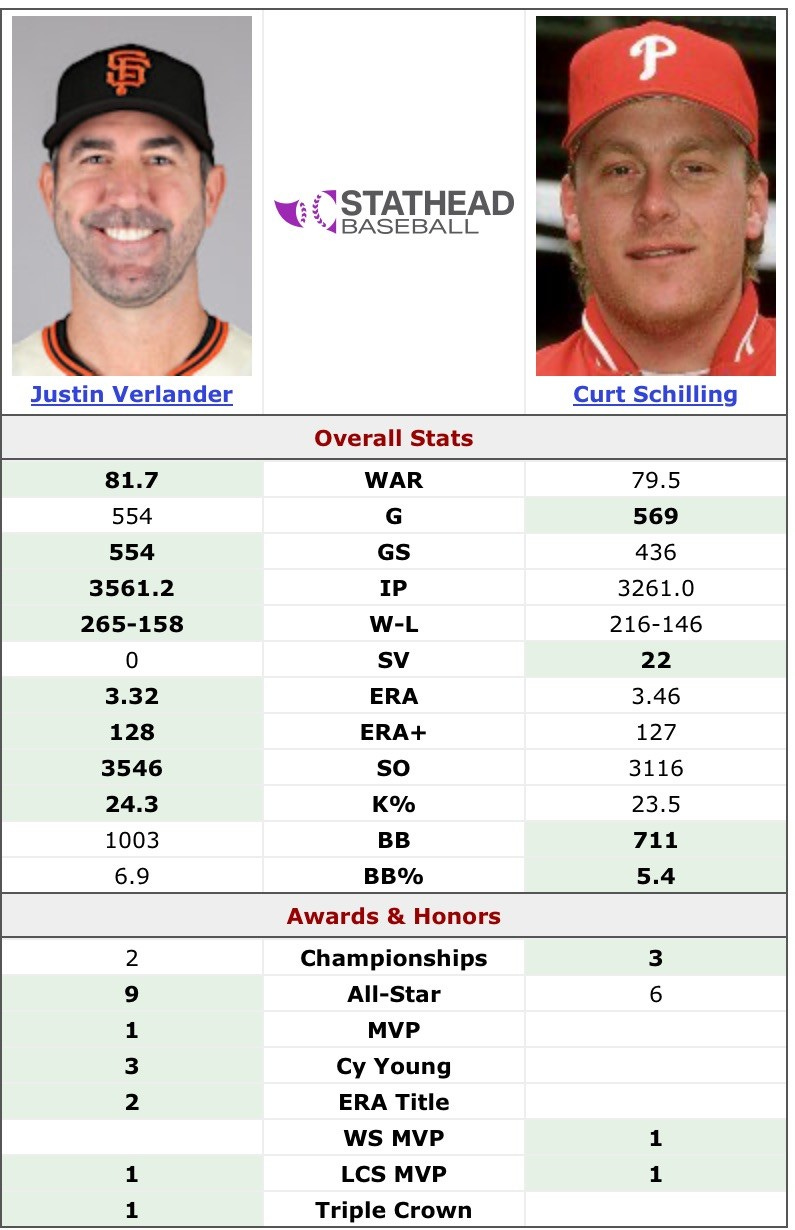
When you put these two careers side-by-side, and squint just a little bit, they look awfully similar. And Schilling, without question, was the better post-season performer. Verlander, as mentioned above, has more career black ink (79 vs. 42) and has more wins, more strikeouts, and a better ERA. However, it is how they have conducted themselves off the field and with the press that is the major separator. Schilling has no one to blame but himself for how he is viewed in the public sphere, while Verlander has gone about his career with class and respect every step of the way. Maybe not so similar after all.
PLAY BALL!!
