Last week, in his daily newsletter, Joe Posnanski wrote the following:
“You will remember how Buck O’Neil always talked about hearing that sound three times in his life — hearing it when the ball came off Babe Ruth’s bat, then hearing it when the ball came off Josh Gibson’s bat, then hearing it a third time when the ball came off Bo Jackson’s bat.”
Batting Practice
One of my favorite things to do is get to the ballpark early and watch – and listen – to batting practice. I love the sound of the fielders catching balls; but what I love even more is the rhythmic sound of the ball making contact with the bat. It is different during BP, as that is a concerto, not a one-off experience (more about that below). If you are so inclined, close your eyes during batting practice and just listen. If the bullpen catcher or whoever is throwing that day is on his game, then every five to ten seconds there will be a “thwap.” Some “thwaps” will be soft, and others will be hard. And then, every so often, without opening your eyes, without hearing anything else, you will know that a ball has left the yard. It just sounds different. And there is a consistency to it. Unfortunately, most clubs don’t open the gates until the final batting group is in the cage, and this cohort typically doesn’t have the big boppers, and thus the chances of hearing “the sound,” goes down. But do give it a try some time.
Game Time
During the game, this “sound off the bat” exercise takes on a different dimension. Because now it matters. And now it is the result of a mano a mano battle, with the hitter winning. And when you hear it, it normally means either a souvenir or an incredible play is about to be made. For obvious reasons, you don’t close your eyes during live action on the off-chance that you will hear something magical. Rather, you watch intently – and don’t leave your seat when the middle of the order is due up – and hope to hear the music.
The Hardest Hits of 2024
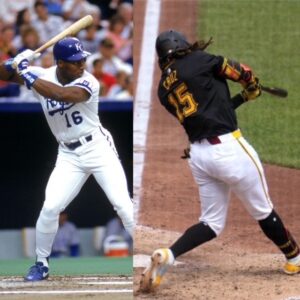
According to Statcast, the hardest hit ball last season came off the bat of Oneil Cruz of the Pittsburgh Pirates. With two outs in the bottom of the ninth inning in a game against the Giants, with the Pirates trailing 6-5 and runners on the corners, the shortstop laced a ball 121.5 MPH down the rightfield line for a game-tying double. It must be noted that he turned around a 100.3 MPH cutter from Camilo Doval. The ball was hit so hard that the runner on first had no chance to score on the play (Pittsburgh won the game in the bottom of the 10th). The laser to right was Cruz’s third hit of over 115 MPH that game, including a 116.5 MPH opposite field double in the third inning. He became the first player to ever have three such hits in one game.
The list of hardest hit balls last season is a who’s who of MLB sluggers, many of whom you would guess from the outset. Giancarlo Stanton comes in at #2 at 120 MPH. Shohei Ohtani is #3, at 119.2. Vladimir Guerrero, Jr. is #4, with 117.6. Aaron Judge is right behind at 117.5 MPH. Yordan Alvarez is #9 with a ball hit at 117 flat. Fernando Tatís, Jr., Pete Alonso, Adolis García, Juan Soto, Kyle Schwarber, and Manny Machado are all in the Top-20.
What is surprising about this list are some of the other names that most certainly were not on your bingo card. Coming in at #7 is Yandy Díaz of the Rays, with a ball hit 117.4 MPH – the hardest of his career by nearly three miles per hour.
Ketel Marte, a great player who came in 3rd in MVP voting last season, was #10 after hitting a ball 117 MPH. Marte is quite interesting. His career average exit velocity is 89.8, which is just slightly above the MLB average of 88.5. But, he has hit one ball at least 115 MPH every season since 2018. And 117 isn’t even his career best – he hit one 117.1 in 2023.
Coming in at #13 is José Ramírez, with a ball struck 116.6 MPH, far and away the hardest of his career. Ramírez was one of the most underrated players in all of baseball (until that trope was repeated so often that he has now become properly-rated), who hits for average, for power, and in the clutch. But his average exit velocity of essentially league-level (88.8 vs. 88.5) is probably how most fans view him. And yet, every year he laces a ball or two over 110 MPH.
Jo Adell of the Angels has been on the cusp of greatness for years. The former #10 pick in the 2017 MLB draft, he was Anaheim’s top prospect. FanGraphs gave him a future value of 60 (on the 20-to-80 scale) with 70 Raw Power. Many viewed him as the perfect companion to Mike Trout in the Angels’ outfield, but it just never came together for him. Over five seasons he has played in 308 games, hit .207, rapped 38 home runs, slugged .381, for a 79 OPS+. When he makes contact, he can make contact. But that’s the issue. By Statcast’s measurements, he is in the 98th percentile for bat speed, but in the 2nd percentile in “squared up” percentage. That is an awful combination. As a rookie, Adell hit a ball 115 MPH, and followed that up with shots of 117.2 and 115.6 in the coming years. Unfortunately, he simply cannot do that consistently enough to become even a good everyday player. That said, both FanGraphs and ESPN have Adell in Anaheim’s starting lineup come Opening Day, so hope truly does spring eternal.
To round out the Top-20 is new Texas Ranger Jake Burger. Last year, while playing for the Marlins, he hit a ball 115.5 MPH. But this one isn’t so shocking, insofar as Burger ranks in the 84th percentile in average exit velocity (91.3 MPH), and his hardest hit balls in each of his four big league seasons are: 115.2, 114.4, 118.2, 115.5. Burger has been penciled in as the Rangers everyday first baseman next season. If you want to hear “the sound,” head to the heart of Texas, where their lineup will include – in addition to Burger – the aforementioned Adolis García (78th percentile in exit velocity at 91 MPH), Corey Seager (91st at 92.1), and newly acquired Joc Pederson (93rd, at 92.3).
Hitting has never been harder in the major leagues. Last year we had the seventh worst overall batting average since 1871. But the players are in better shape and the hitters are more keen to swing from their heels than ever before (the 15 highest number of strikeouts per game have been achieved in the last 15 seasons). So, when they hit the ball, when they truly make contact, we as fans sitting in the stands or watching from our couches are treated to “the sound” – maybe not the same sound that Buck O’Neil heard – of greatness, the sound that draws us to the game, the sound that reminds us how truly special these guys really are. Forget batting average and strike out totals, we may be in the golden age of “the sound.”
PLAY BALL!!