Fan(less)tastic Finishes: What We Will Miss This Post-Season

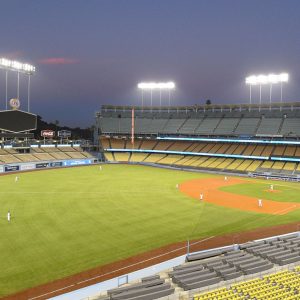
A few days ago, for the first time this year, my son and I went to Dodger Stadium. Unfortunately, it wasn’t for a game or to ridicule the Astros. It was just to get a Covid test.

I simply cannot remember going this long without watching a baseball game in person (which makes me kick myself for not venturing to Spring Training before everything shut down). But, alas, even though Rob Manfred is opening the gates in Arlington, I would need to buy both plane and playoff tickets in order to attend any baseball games in 2020. At this point I would put the odds at 30/70.

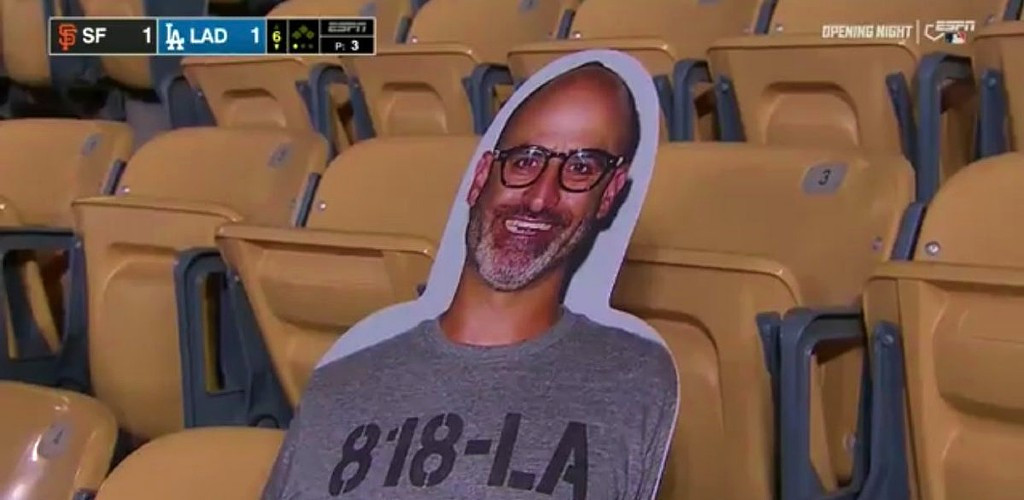
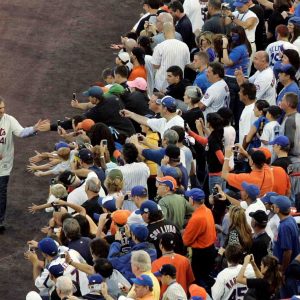
When the season started and certain teams populated their parks with cardboard cut outs, I was immediately on board. Putting aside the fact that a group of comedy friends bought one for the late Brody Stevens so he could posthumously represent the “818” at Dodger Stadium; and putting aside all of the great stories about family members getting to watch another game (or season) with a loved one, having “bodies” in the stands lent some dimension to the viewing experience. Having the “people” there made the ballparks look less empty, less cavernous, less lonely. But, the truth of the matter is that stadiums across the country were lonely this summer (just ask the play-by-play guys who broadcast away games from the press box in their empty parks). And that got me thinking about the impact of having insentient facsimiles rather than living, breathing fans in the stands.

Sam Miller of ESPN recently wrote an incredible article about the actual, real life impact of having patrons at the game, including the extra distance David Freese’s ball may have traveled in the ninth inning of Game 6 of the 2011 World Series due to the ambient heat of 43,000 fans. But I have a different angle: would the moments that we so cherish have the same resonance if they happened in sterile ballparks rather than ones foaming with fanatics?

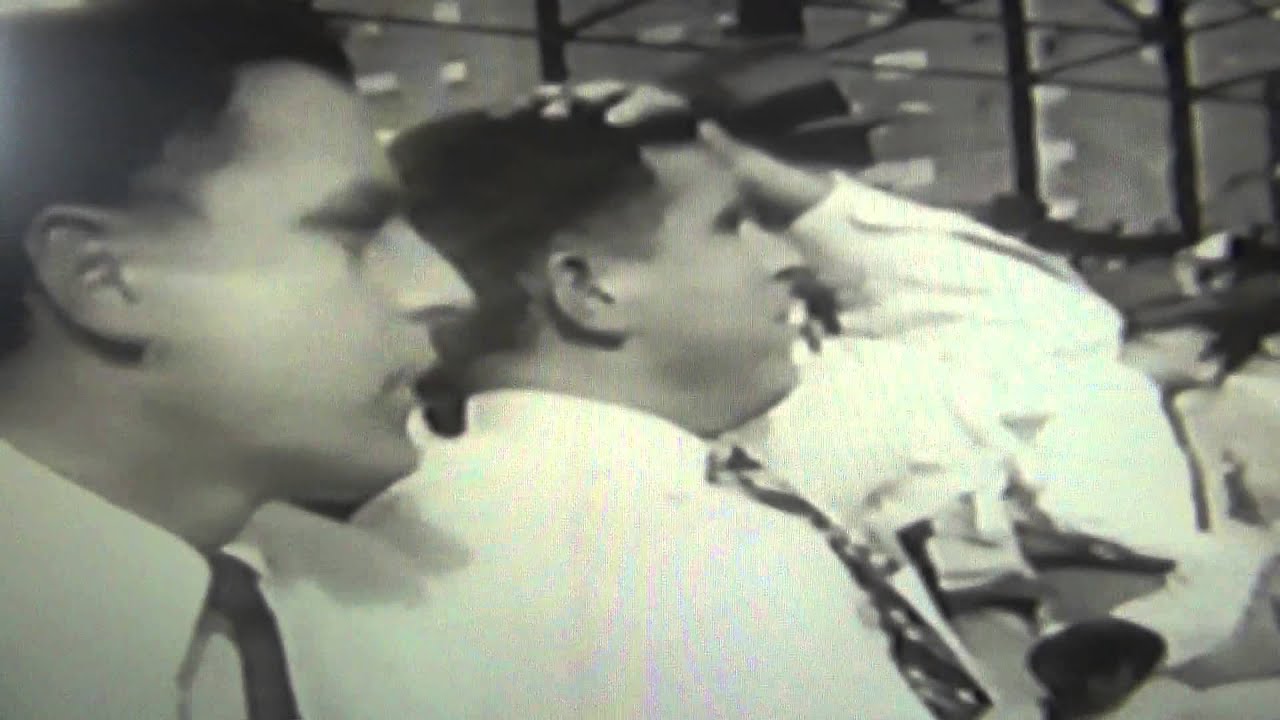
Sure Willie Mays’ catch in the 1954 World Series is an all-timer, but few of us actually saw it happen live. Is part of that memory more endurable because the camera caught a shot of these guys:

Imagine if Kirk Gibson hit his home run in the 1988 World Series into a poster board rather than a screaming hoard of Dodger bleacher bums? Go back and re-watch the full the nine-minute video and try to imagine the entire at bat happening in silence. But more than that, would this be the top-rated moment in Los Angeles sports history if Vin Scully didn’t turn off his mic for an astounding, stupefying, glorious 68 seconds (start at the 6:47 mark) and allow the roar of the crowd to carry Gibby and us – viewing at home – around the bases and back home again?

Piggy-backing on Sam Miller’s article, does anyone honestly believe that the 55,000 screaming patrons in Shea Stadium on the night of October 25, 1986, didn’t have any effect on Calvin Schiraldi? Do we think that Bob Stanley wasn’t at least a little rattled by the cacophony in Queens? Does Rich Gedman get crossed up on mediocre fastball if the park was so quiet that the players could hear Jason Gay pecking away on his laptop? (Ed. Note: Jason Gay was 16 in 1986, and most likely wouldn’t have had one of the first mass-market laptops, but you get the point.)

Is our memory of #755 made more indelible by the image of two white men chasing down a black man as he rounds second base after receiving too many death threats to count, after being provided FBI protection for him and his children, after breaking the most hallowed record in the game? Those two fans added to the relief then anxiety and then relief again of the moment. Not true if that had happened in an empty Fulton County Stadium.

Reasonable minds might differ about the distance of Jose Bautista’s bat flip/throw in the 2015 playoffs. But at least part of his reaction had to be attributable to the nearly 50,000 Fosters-induced Canadians losing their minds on contact. Bautista may have been fired up in a desolate Rogers Centre, but certainly not *that* fired up. That said, Fernando Tatís, Jr. did a pretty fair impersonation last night in an empty Petco Park, so who knows?

In the aforementioned Miller article, he makes reference to Mariano Rivera throwing over to first base only three times in Game 4 of the 2004 ALCS; and how, with no fans in attendance, pitchers are now more willing to throw over four times or more. Did New Englander’s lusty boos keep Rivera from doing so, as Sam posits? Did the energy of the crowd give Dave Roberts that tiny extra bit of adrenaline to beat a ridiculous pop time and throw from Jorge Posada to keep an 86-year curse at bay by a fingernail? Could the players have pulled that same rabbit out of their hats in a silent Fenway Park at 1:22am and then again less than 22 hours later? This lifelong BoSox fan is dubious. Would Mark Bellhorn’s dinger in Game 6 even have been reviewed if it hit off a cut-out rather than a lurching fan? Is a huge chunk of our collective memories of those final four games enhanced because of the insanity of the Fenway faithful and the silence of the Bronx zoo (especially after Johnny Damon’s grand slam in Game 7)?

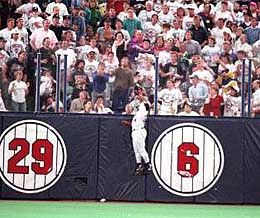
Did the sight of 55,000 white “Homer Hankies” flying around under the white roof of the Metrodome have any impact on our memories of the 1987 and 1991 Twins? Do the fans behind the outfield glass make Kirby Puckett’s Game 6 catch any more of a Web Gem?

And no list of this sort would be complete without asking about an eighth inning foul ball in Game 6 of the 2003 NLCS. With no fans in attendance, we would be able to answer the to-date unanswerable question of whether or not Moises Alou would have caught Luis Castillo’s pop fly. But assuming he couldn’t (some might say that is a fair assumption), our memory of that game, and the ensuing collapse (looking at you, Alex Gonzalez), and the following twelve years of futility, are forever altered by the fact that there were fans in the Friendly Confines on the night of my 31st birthday.

This recitation could go on and on (and I am sure you all are thinking of a few moments right now), but it will not for 2020. Regardless of how many people Manfred allows into the giant Costco that is Globe Life Field (it looks like it will be 11,500), it will not be comparable to having rabid fans rooting on their hometown team in the late innings on a cold October night. It will be antiseptic, it will be hollow, and it just won’t be the same. And, potentially, neither will the outcomes.

And yet, we will still watch.

PLAY BALL!!

The Unknown Impact

When I was about six years old, as a favor to my father’s cousin, Doug DeCinces brought me (and my dad) onto the field at the “Big-A” before a game. He introduced us to Jimmy Reese and Rod Carew, and let us step into the dugout. When it was over, I am pretty sure I floated back to my seat in the grandstand. More than four decades on, I still remember that day.

When Tom Seaver died this past week, the result of Lewy body dementia and Covid-19, the collective baseball community opened its nostalgia vein and bled all things “Tom Terrific.” So many great stories were written about Seaver not making the varsity team until his senior year of high school; his brief enrollment in the Marines before a late growth spurt; his time at USC and his then-voided draft by the Braves in 1966; and, of course, the serendipity of the Mets winning a mini-lottery and landing “The Franchise.” There was no shortage of tales about Seaver’s brilliance on the mound, and the lives he touched off of it.

In the midst of the Seaver hagiography, a buddy sent me an essay written by Josh Wilker of Cardboard Gods. It tells the story of an 18-year old Josh hitchhiking his way to Fenway Park in 1986 to watch Seaver pitch for the Red Sox. I won’t step on the article – it is well worth your read – but suffice it to say that watching a future Hall of Famer on the mound that day had a lasting impact on Josh’s life.

Reading Wilker’s story got me thinking about the relationship between athletes and us mere mortals, and the asymmetricality [Ed. Note: I know it is not a word.] of that bond. Performers perform, they do their job, and unbeknownst to them, our lives are oftentimes changed.

Athletes put on their uniform, take the field, and earn their pay. They have no idea the effect that that performance, on that one day, in that one game, has on the people in the stands. And I am not talking about Reggie Jackson or Kirk Gibson, Don Larsen or either “Game Six.” I am not talking about the games wherein the announcer states “35,000 in attendance but millions will claim to have been here.” I am talking about quotidian instances when a first baseman tosses a ball to a boy in the stands; or when a utility player gives his broken bat to a little girl; or when one man stepping on the mound fulfills a kid’s dream of witnessing that player pitch in person.

This phenomenon can happen in any sport, or any form of performance (see, Hamilton), but the imbalance seems that much more acute in baseball where they take the stage (in non-pandemic seasons) 162 times each year, so no particular game should have any more meaning than another…to the players. But to the fans, to the people who pay their hard-earned money, who surprise their children with tickets, or those who hitchhike from out of town, each game represents an opportunity to have a life impacted in ways one can never anticipate. And it doesn’t just have to happen on the field – it can just easily happen at a card signing or a chance encounter in the grocery store.

This concept begets a little chicken and egg dilemma. Do these encounters affect us because we hold athletes in such a high regard, or do we hold these athletes in such high regard because of the effect of our encounters? I, for one, am not philosophically adroit enough to answer that question. But I do know the impact is real. Any of us who have been fans for any period of time can think back to a specific moment and remember with perfect clarity what a player did or said that one time. These earworms are permanently embedded, but accessible enough to become stories told over and over, often to bored and weary friends and relatives.

But that begs a larger question – does this happen in our everyday life, outside the theater or the stadium? Is it possible that as we go about our lives, we are the players and the people with whom we interact are the fans? Maybe you gave up your seat on the subway to a pregnant woman, and she carries that act of chivalry with her forevermore. Maybe you allowed a driver to get ahead of you in traffic, and that allowed him to make the light and get to his kid’s game moments before he hit his first home run. That man will always hold the guy in the silver Civic in high regard. And the Civic driver – like Tom Seaver in Wilker’s story or Doug DeCinces in mine – is none the wiser. Maybe you passed along your friend’s kid’s resume to HR with a short note, and thus began a long and illustrious career. This concept could, conceivably, apply to everyone, everyday. It just may be that it is heightened when the do-gooder plays on a field in front of 40,000 fans.

People spoke of Seaver’s passing as if they lost a family member. And what a wonderful testament to a life lived – that a man who you didn’t know could impact your life in such a profound way that his death feels like losing one of your own. But Seaver didn’t know any of that. He went about his day, he did his job (better than maybe five or ten other people in the history of the game), and then behaved admirably off the diamond. He didn’t know whose life he affected, whose life he changed, whose earworm he created.

Bill Simmons is one of the most well-known sports journalists in the world, he calls any number of coaches and players good friends, he runs a media empire and can get anyone on the phone at nearly any time (including President Obama). And yet, even he has a Tom Seaver earworm. He reflects with great revelry the time he stood in a makeshift batter’s box while Seaver played catch with Bill’s buddy, Gus. Bill has traveled the world and seen every form of competition up close; he has hosted thousands of podcasts; he has written two books and millions of column words. And yet, nearly forty years after the fact, he can still describe, with precision, standing in his friend’s front yard when Tom Terrific buzzed him with a curveball. If you had asked Seaver about that day prior to his death, I feel fairly certain he would have had no recollection. But, no matter, Simmons does. And there are any number of stories just like that; when a performer did something or said something that impacted our lives – maybe not permanently, maybe not even significantly – but impacted us nonetheless.

These stories represent an important life lesson – our actions have reverberations well beyond our vision. The next time we pass a homeless man begging on the street or a kid selling chocolate bars or someone asks for a letter of recommendation, think about the impact that our response might have; consider those who may always remember a small word or deed, a simple act of kindness, something that we will forget in a day’s time, but they will keep with them forever. Tom Seaver did that for a generation of Mets fans; and so too have athletes, actors, and performers all across the world for their fans. We would be wise to follow their lead.

PLAY BALL!!

The Baseball Gods

Every season, it seems, for one reason or another, we are thrown into the abyss of the “unwritten rules.” The list is long, if not readily understood. There are the age-old tropes of the “right way to play” and “that’s not how it is done” and “everyone knows not to do that.” And even with those, we learned a new one this week – one with obvious racial undertones – by Rangers manager Chris Woodward when discussing not swinging on a 3-0 pitch up by seven runs:

“It’s kind of the way we were all raised in the game [emphasis added].”

There has been much written about Fernando Tatís, about his exuberance, and that of fellow Latin players. There has been gallons of ink spilt about new school vs. old school, about “letting the kids play,” about stodgy standard-bearers, and the aforementioned “unwritten rules.” There is no need to rehash the same here.

But what struck me this week was the beauty of the Baseball Gods (capitalized out of reverence). Don’t believe in them? Live as a Red Sox fan until mid-October, 2004; or as a Cubs fan until the rain started to fall in Cleveland on November 2, 2016; ask an announcer about mentioning the number of base hits allowed when a pitcher is pulling his car up for his date with destiny; or just ask any Astro about the status of their pitching staff this season. Or read either of these books.

The Baseball Gods struck back this week in ways only they know how.

On Wednesday, I had the following text exchange with my brother-in-law about the aforementioned Tatís brouhaha:

Him: Our house is buzzing with Tatís talk. We don’t get all the hoopla because in MLB people come back from 7 run leads and it’s on the pitcher to not give him that pitch.

Me: 7 runs in that bandbox is not insurmountable…

We discussed more, like Chase Tingler’s poor handling of the matter, and how Tatís should be more accountable if he missed a sign, but you get the essence.

And here is where the Baseball Gods decided to show up and flex all their celestial might: On Thursday, just about twenty-fours after the above back-and-forth, the Phillies put up seven runs on the Blue Jays in the first inning. Now, granted, a seven-run lead after half an inning is different than a seven-run lead after seven; and, granted, Sahlen Field is not the new Globe Life Field. Nevertheless, the lead is/was the same. The Jays scored two in the bottom of the first; and then – that magic number again – seven in the bottom of the sixth to take a 9-7 lead, ultimately winning 9-8.

No sooner had the baseball purists stepped down from Mt. Pious to say that players should play differently with a seven-run lead did a team come back from that exact deficit. Was the ultimate outcome of that Phillies-Blue Jays game the impetus for Tingler and Chris Woodward to change their respective tunes? Did all-timers like Johnny Bench and Reggie Jackson coming out on Tatís’ behalf change the temperature?

Did the sheer number of think pieces and/or the leveling of Woodward’s hypocrisy make this nothing more than a tempest in a teacup?

Or, did the Baseball Gods strike down once more to remove this silliness from the front pages of sports columns by opening Thom Brennaman’s mic before the second game of the Reds-Royals double-header on Thursday night? The truth is, we will never know.

But, if we learned anything these past few days it is that we doubt the Baseball Gods at our own peril.

PLAY BALL!!

Honor Among Cleves

I spent nearly my first two decades on the planet playing baseball, and nearly the next three observing the game (some might claim too closely). What I learned in that time is that baseball players are a lot of things, they are tough, they are competitive, they are ready to fight, and they have hollow legs when it comes to post-game libations (see, Boggs, Wade). But one thing you don’t hear too often is “principled.” Sure, baseball players abide by the “unwritten rules,” and will willingly throw at a batter’s head if the previous guy pimped a home run (thankfully that practice is employed less and less these days), but they don’t often take a stand. Ask Bruce Maxwell how well kneeling for the national anthem worked out for him.

It is with this as the backdrop that I was shocked, I dare say astonished, to hear what transpired after an Indians’ team meeting late this week. For those you who may have missed the story or don’t know all the details, allow me a small recap:

  • The Indians, like all teams, are governed by the strict MLB rules and regulations regarding Covid protections.
  • The Indians, like some teams, are more acutely aware of the potential impact of violations insofar as one of their star pitchers, Carlos Carrasco, elected to play this season even though he missed most of last year after being diagnosed with leukemia. Carrasco’s doctors warned him against joining the team, but he wanted to help his club win their first World Series since 1948.
  • The Indians, unlike some other teams, have so far managed to avoid the Covid bug, and have played all of their scheduled games to date.
  • The Indians were in Chicago last week to take on the White Sox and then the Cubs. After Saturday’s game, pitchers Zach Plesac and Mike Clevinger went out to dinner with some friends and back to one of the friend’s houses to play cards. In violation of the rules, neither player informed the team he was leaving the hotel. And Plesac was spotted by MLB security arriving back after the 10pm curfew. Clevinger was not sighted, nor was his absence from the team known at the time.
  • After the team learned of Plesac’s malfeasance, they ordered a car service to drive him back to Cleveland, and forced him to quarantine for three days. Clevinger, however, kept his part of the sojourn to himself, and boarded the team flight home. A flight, it should be noted, that also carried Carlos Carrasco and rest of the Indians players and coaching staff.
  • The team ultimately learned of Clevinger’s participation, and sent him home to quarantine as well.

The Indians players – non-Chicago dinner division – were apoplectic. They felt betrayed. They were hurt.

Pitcher Adam Plutko put it bluntly:

“They lied to us. They sat here in front of you guys [the media] and publicly said things that they didn’t follow through on. So those grown-ass men can sit here and tell you guys what happened and tell you guys what they’re going to do to fix it. I don’t need to do that for them.”

All-star shortstop Francisco Lindor was a little more gentle, stating:

“We’re humans, and we make mistakes. We’ve got to be accountable when we make those mistakes, and we’ve got to understand that you can’t put yourself first. In the times we’re in, you cannot put yourself first.”

Here is where the story gets interesting. The team ultimately traveled to Detroit to take on the Tigers. After completing their quarantines, Plesac and Clevinger each loaded up their respective cars and drove to outskirts of the Motor City to meet the team at their hotel. Once there, they pleaded their case, and attempted to fall on their swords.

It bears mentioning here that prior to the trip to Detroit (or possibly on the way) Plesac recorded a six-minute video to Instagram (while driving) wherein he tried to explain his side of the story, intimated that the MLB protocols were confusing and did not match with the CDC, claimed he is a responsible human because his mother is a nurse, and then blamed the entire episode on the media. Here is my favorite nugget:

“The media really is terrible, man. The media is terrible and they do some evil things to create stories and to make things sound better, makes things sound worse. Truthfully, I’m disgusted the way the media has handled this whole situation surrounding our team.”

So, in short, Plesac is a good guy, MLB bolloxed their rule-making, and it’s all the media’s fault. Okay. Got it. Now back to two players driving themselves to Detroit.

At the hotel Plesac and Clevinger spoke with the team and there was a Q&A. They provided their accounts. Now, this is where one would expect that baseball players being baseball players, guys who care about winning first and foremost, guys who overlook their teammate’s transgressions each and every day, guys who know that losing two-fifths of their starting rotation is less than ideal in this 60-game sprint, would, if not forget, at least forgive, and allow the players to rejoin the team. And that is where you would be wrong.

The front office and the coaching staff, after taking the temperature of the players in the room, elected to send the two offending pitchers to the team’s alternative training site in Eastlake, Ohio, where they must remain – by league rules – for at least ten days (unless someone gets injured). They drove three hours with the hope of recovering their dignity and their place in the rotation; they were forced to drive three hours home with their tails between their legs and their reputations in tatters.

I have never been a Cleveland fan. I rooted against them in the 2007 ALCS when they played my Red Sox; I rooted against them in the 2016 World Series against the (There’s Always Next Year) Cubs. But, with this season in shambles for the BoSox, I am pulling for the Indians. I want them to go all the way. I want them celebrating on the mound; I want Tito Francona and this group of players who stood on principle, who stood by one another, and who refused to stand for selfishness and self-importance; I want them to stand at the podium and hoist the Commissioner’s Trophy for the first time in 72 years.

And if, by that time, Plesac and Clevinger have properly repented and re-earned their teammates’ respect and ultimately help the team achieve that goal, then all the better. Go Tribe!

PLAY BALL!!

The $10,000 Fine

About three years ago I wrote an article entitled “The $25,000 Fine,” which dealt with the scourge of batters not running to first on an uncaught third strike. Surprisingly, much of the feedback I received from that missive was negative, as people didn’t seem to care too much about players’ laziness; people did not seem to think that players should be pecuniarily punished for their failures on the field; people didn’t seem to think that publicly shaming athletes for their indolence was good policy. Okay, fine, whatever. It was an idea, a lark; it was meant at least 50% tongue-in-cheek.

But my latest concept has much more serious implications – many of which are playing out in real time. In an effort to play the season safely (if that is even possible), MLB and the MLBPA developed what is called the 2020 Operations Manual, a 101-page document detailing the league’s health and safety protocols. The sheer volume of this document is staggering, and covers nearly every eventuality you could imagine – except, of course, what to do if four players on one team test positive before a Sunday afternoon game. But I digress.

There is no need to delve too deeply into the inch-thick document, but suffice it to say that it was well thought out and intended to keep the players as safe as possible. For our purposes, however, it is important to highlight just a few of the provisions:

• The only contact allowed on the field are tag plays and other incidental contact that occur during normal play.

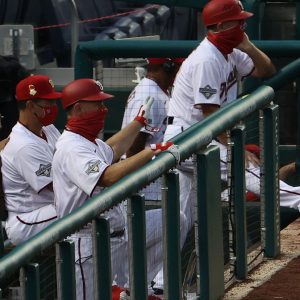
• Players, coaches, and trainers are required to wear face coverings everywhere except the field.

• High fives, fist bumps, and hugs are prohibited.

• Dugout seating requires at least six feet between each player.

• Players and staff are required to put a personal towel over the dugout railing when leaning over the same.

• A ball will be thrown away after it is touched by multiple players, and throwing the ball around the infield is discouraged.

• First- and third-base coaches are not to approach baserunners or umpires, and players should not socialize with opponents.

I have pointed out these specific rules because after having watched baseball for six days, it seems that all of them are being broken…with impunity. And, in Houston last night, the Dodgers and Astros came dangerously close to breaching the “fighting will be met with severe discipline” edict (I guess severe discipline can be assessed for not fighting as well, as Joe Kelly, Dave Roberts, and Dusty Baker learned this afternoon).

What don’t the players and coaches understand about the global pandemic? Maybe some of them believe it is just a hoax. Maybe some of them believe – like the recently diagnosed Congressman, Louie Gohmert – that wearing a mask can actually give you coronavirus? Maybe some of them believe that the rules don’t apply to them, or that they are impervious to a disease that does not discriminate based on age, gender, or profession.

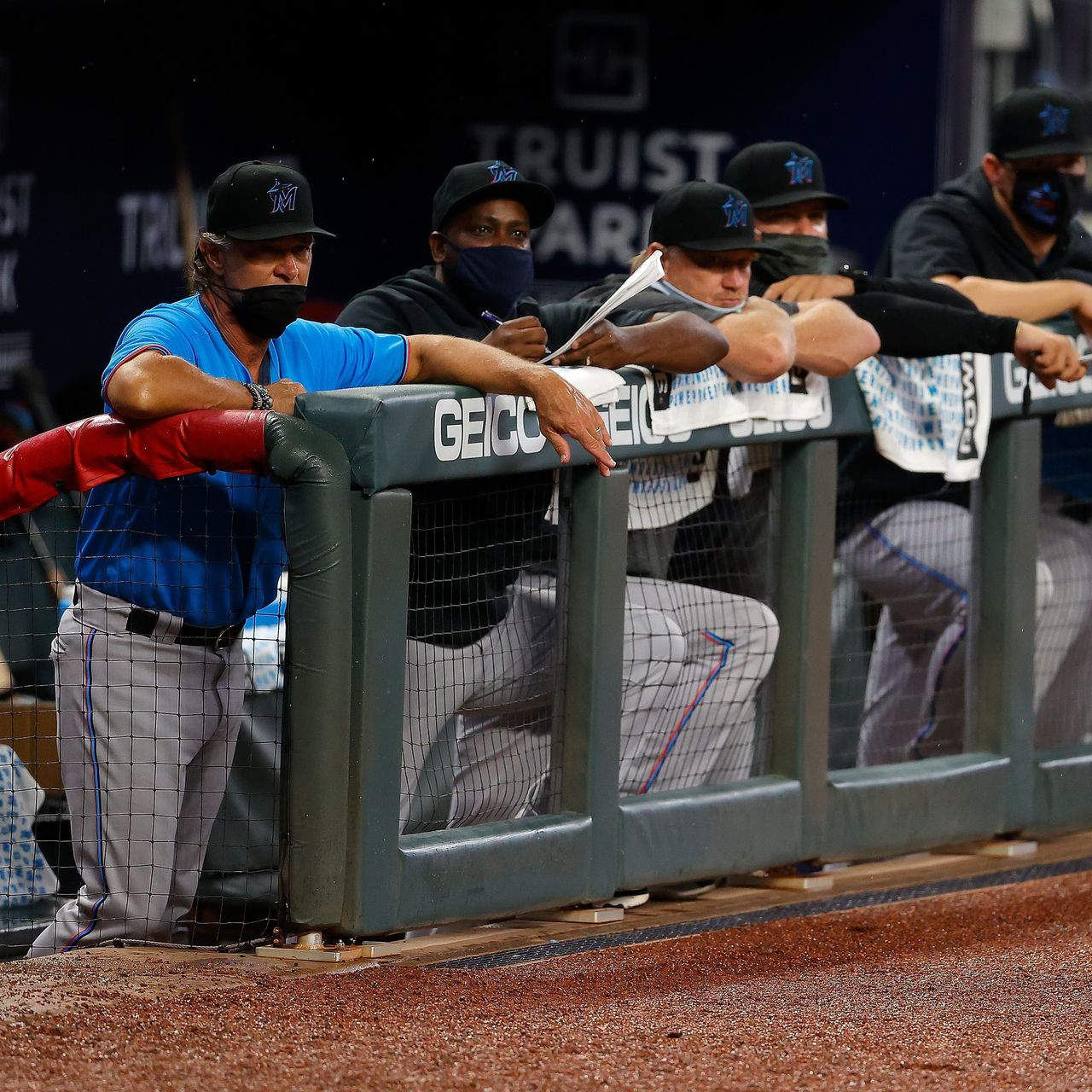
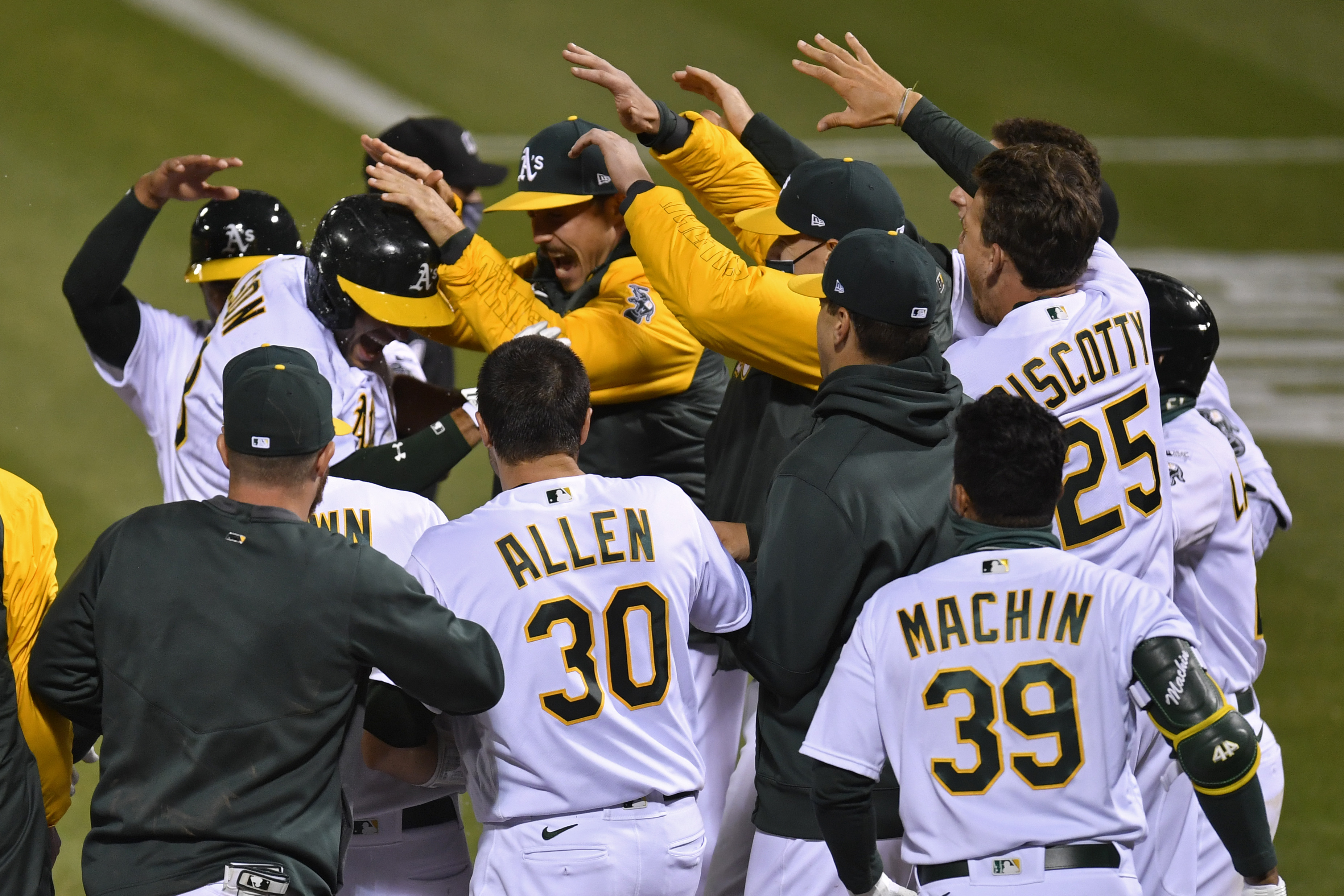
But if what happened with the Miami Marlins this week is not enough to scare players straight, I have an additional incentive. The players were informed of the litany of rules in late June, before they embarked upon Summer Camp. They have lived with the protocols for more than four weeks. If they don’t know or understand them by now, and if they don’t appreciate the gravity of adhering to them by now, they never will. So let’s put some money where their mask is supposed to be. Each player is given a mulligan for everything that has transpired to date – and that includes the Marlins players who (allegedly) went out on the town in Atlanta and were the architects of their own demise – and they are, as of today, given one additional warning for infractions. It is useful to note that while the league cannot track everything personnel does (especially away from the ballpark), a violation of any of the rules listed above can be seen on television every night. One need not contact trace to find an infringer; one just needs to log in to MLB.TV. After the warning, each player is fined $5,000 for each violation, and the team is punished in an equal amount. If Don Mattingly keeps his mask under his nose while in the dugout, $5,000 for him + $5,000 for the Marlins. If the Athletics jump on Matt Olson after a walk-off homerun (all but two without masks, natch), $5,000/each + $55,000 for the team (Olson does not get fined). All proceeds go to Black Lives Matters or other charities dealing with social justice issues.

Unlike the $25,000 fine I previously wrote about, there would be no announcement or public shaming aspect. Just cold hard cash. Players walk into the clubhouse the next day to find a bill from the league. Despite Charles Barkley’s protestations to the contrary, athletes are role models. And although it seems that more and more people are getting behind the idea of masks being incredibly helpful in curbing the spread of this disease (including, ever-so-gingerly, the Commander-in-Chief), and that social distancing is vital to keeping the disease at bay, you can turn on your television every night and see well-known athletes not abiding by these nearly-universally accepted concepts and not obeying their specific rules. What does that say to the general public?

And even if this is not about setting an example for society at large, what about the non-athletes these players encounter every day? It was reported today that a visiting clubhouse staffer in Philadelphia tested positive after the Marlins were in town. That guy doesn’t make millions of dollars per year; my guess is he doesn’t make six figures. And yet the players, so cavalier in their approach to the protocols, have put his life in danger. If the risk to the season isn’t enough; if care for your fellow man isn’t enough; if being a role model for kids and adults isn’t enough; then maybe taking a hit to their wallet will be. And you can be sure that if the owners, who fought and scratched to make the best financial deal possible for this abbreviated season, are forced to scratch a check every night for their team’s failures, they will be demanding that their manager starts running a tighter ship. There simply may not be any other way.

Here’s to hoping that everyone stays (and/or gets) healthy and that we continue to hear this every day from now through October:

PLAY BALL!!


A Good Reason to Sign Betts

The Los Angeles Dodgers just signed Mookie Betts to the largest contract in the team’s history. Depending on how you calculate the money and the years, and the reduction due to a shortened 2020 season, it is either worth more or less than the deals given to Mike Trout and Gerrit Cole. But where the deal ranks all-time is somewhat irrelevant. It is a monster contact, and one Mookie richly deserves as the consensus second best player in the game.

With the deal now done, the Red Sox are getting raked over the coals for not signing Betts to a similar contract. The argument being that the Boston ownership, which owns a regional sports network, Liverpool FC, and a racing team, could afford – competitive balance tax or not – to pay Betts whatever he is worth, plus 10%.

But the fact of the matter is that Boston could never “force” Mookie to sign a deal – a concept that keeps getting lost in the haze of vitriol. The team offered him at least $300M and he didn’t even counter – he was quite clear that he wanted to test free agency. Maybe he didn’t want to finish his career on the east coast and wanted to go somewhere warmer; maybe the pandemic changed his point of view and he felt like it was a bad idea to go into the market after an abbreviated season; maybe he just so loved it in L.A. that he couldn’t imagine playing anywhere else. We may never know why he chose to sign, but sign he did. And kudos should be given to Andrew Friedman and the Dodgers ownership, not criticism of their counterparts in the Back Bay.

The reasons the Dodgers chose to lock Betts up are obvious. He was the 2018 MVP; in six years he has accumulated 41.8 bWAR; has scored at least 100 runs in each of the last four seasons; and has never had an OPS less than .800. Not to mention that he is beloved by his teammates and plays hard every night. But in all of the writing and all the summaries of the deal that I have read, there is one angle I have not yet seen discussed.

When one thinks of the Dodgers, when one looks at their 2019 World Series lineup, when one peruses the official program (do they still have official programs without fans?), this is what one sees:

Clayton Kershaw
Cody Bellinger
Corey Seager
Justin Turner
Walker Buehler
Max Muncy
Chris Taylor
A.J. Pollock
Joc Pederson

What do all of these players have in common? In 2020, after the death of George Floyd, after the death of Ahmaud Arbery, after the death of Breonna Taylor, after the nationwide unrest and the Black Lives Matter marches and rallies, the Dodgers – playing in one of the most racially and ethnically diverse cities in the world – were an incredibly white group.

It is not every day that a team has the opportunity to sign one of the best players in the game. And when that team essentially has unlimited money, and that team has won seven straight division titles, but has lost two of the last three World Series, and that team hasn’t won a World Series in more than three decades, then you throw whatever you can to get that player. And so the Dodgers did.

But, I believe it would be naïve to think that Mookie being Black didn’t factor into their rationale, even just a little bit. He is a five-tool star. He is a pillar of the community. He is a player you want in your organization for the next baker’s dozen years. But his being Black, on a team with only two other Black players on its Opening Day roster, on a team without a marquee Black player since Matt Kemp roamed the outfield in the prime of his career in 2014 (an argument can be made for Yasiel Puig, but he was a polarizing figure in Los Angeles; and Curtis Granderson in 2017 doesn’t count as “marquee”), certainly helped the cause. This was a signing the Dodgers had to make; it was the right deal on many levels.

Much has been written about how patient Friedman has been; how he never handed out a nine-figure contract; how he was waiting for the one big score. But it is not like he didn’t try. He offered Gerrit Cole $300M; he offered Anthony Rendon more than $200M. He wanted either/both of those guys. And either/both would have made the Dodgers better…and whiter. So, in hindsight, it was a blessing they both chose to pass and sign elsewhere. Having the opportunity to sign Betts may not have been a happy accident, but it was made possible because two white players didn’t become Dodgers.

One has to believe that part of Betts’ $365M (or $375M depending on how you calculate it) contract served a public relations purpose; signing Mookie checked at least two boxes for the organization. I don’t fault them for that, but I also don’t overlook it. In these fraught times, when every corporate decision is viewed through multiple lenses, when companies and teams are working overtime on their DEI initiatives, when how you act is finally becoming a measure of who you are, it is not too far-fetched to believe that at least part of the Dodgers’ calculus in giving Mookie Betts more than a third of a billion dollars was the color of his skin.

And the team and the city (not to mention Mookie) are all the more rich because of that.

It’s Opening Weekend.

PLAY BALL!!

Taking the Low Road

I have been negotiating deals for more than two decades. In fairness, I have never been involved in collective bargaining, nor have I had any multi-billion dollar deals cross my desk. But, there are some principles of negotiation that are applicable to all types of deals – regardless of industry, venue, or value. One of those principles is that the best place to be in any negotiation is on the high road. You may win some and you may lose some, but in the end, you can hold your head high if your side of the street is clean. Muddy the waters, hedge on the truth, or fail to be forthcoming, and you will either cower under a sword of Damocles for the life of the deal, or, in the event of an impasse, you will carry the burden of “what if.” Neither is a great way to go through life; and neither bodes well for a long and/or successful career.

As I watched what I guess can be called a “negotiation” between Major League Baseball and the Major League Baseball Players Association unfold over that past two months, I kept asking myself, “Who is going to take the high road?” I wanted to know which side – press coverage be damned – was going to present an offer or series of offers that would allow them and their constituents to sleep well at night, regardless of the outcome. Well, baseball is starting up again (maybe?), no “deal” was done, and neither side ever even hinted at taking the northern route.

I can understand and appreciate that many of you reading this didn’t follow this as closely as I did; and some of you may be confused by the outcome. So, at the risk of being pedantic, and without stepping on the thousands of fingers that have already written about the current state of the state of baseball, allow for this basic primer.

After spring training shut down and the prospect of an actual season became tenuous, the owners and the players – back in late March – came to an agreement about what to do for the coming season (or, what to do if there was no season). The problem is that once they pulled that contract out of the drawer, they couldn’t agree upon what they had previously agreed upon. That’s an inauspicious place to start. But we do know a few things for sure:

  • The players were provided an advance of $170M against their eventual 2020 salaries, to be divvied up based on service time. If the season didn’t happen (it still may not), this money was the players to keep, no give backs.


  • If the 2020 season happens, no matter how many games get played, each player would get credit for a full season of service time. (For the uninitiated, service time affects when a player is eligible for salary arbitration and free agency. This is obviously an important issue.) And if the season is scrapped, players would get the same amount of service time for 2020 as they received for 2019. So, Mookie Betts would still become a free agent next fall as he would get credit for a full season (he played a full season in 2019); and Gavin Lux would only get credit for about 1/7th of the 2020 season, as he only spent about that much time on the Dodgers’ roster in 2019.


  • The one issue that you have been reading about ad nauseam is what would happen if the teams played with no fans in the stands. The players believed the March contract was iron clad that they received a pro rata share of their salaries – with or without fans. The owners disagreed, and seized on this language: “[T]he Office of the Commissioner and Players Association will discuss in good faith the economic feasibility of playing games in the absence of spectators or at appropriate substitute neutral sites.” Somehow the players didn’t believe this says what we can all read it says. And this, my friends, was the first time the players could have taken the high road and chose otherwise.

My guess is that the players received some bunk legal advice. I think they were told that it was pro rata no matter what, and then the die was cast. There was no slinking back to the membership to say, “Um, guys, remember what we told you about that pro rata thing? Yeah, well, we forgot about that other provision that mentions economic feasibility and the absence of spectators.” Rather, they charged right ahead and essentially dared the owners to “prove us wrong.”

It seems that the owners must be afraid of heights as well, because they twisted themselves into various Wetzels trying to get out paying the players. First they claimed that pro rata was only if fans were in the stands (not an unfair reading). But then they said they could only play X number of games because they would lose $640,000 for each game played in empty parks. When asked to provide the proof such assertion, they hemmed and they hawed, but they didn’t bring any receipts. Then they dawdled. They fiddled while Rome burned. They took their sweet time responding to the players. And when they did respond, they simply dressed up the same offer in different clothes. When you drilled down on their offers, they presented the players with about $1B in salaries, payable either (a) over 82 games, or (b) over 76 games, or (c) over 60 games, or (d) to be allocated amongst the players based on how much they would otherwise be paid. But it was like a Taco Bell menu each and every time – all of the ingredients were the same, it was just a question of what shape you wanted it delivered. The players rejected each one.

“Wait a minute”, you may be saying. “Didn’t they come to an agreement? And isn’t that why we have an upcoming season?” Unfortunately, they didn’t. One of the provisions of that March agreement allowed the commissioner to set the schedule if no agreement could be reached. And it seems that this was the trump card the owners kept in their back pocket the whole time. If they could just delay the negotiations until only 50-ish games became feasible, they could implement the schedule and save a bunch of dough.

The players knew this; they knew that at the end of the day, they could be “forced” to play. But, they wanted to make sure if that ever happened, they would get their pro rata salaries. So, they continually pushed back against offers that would have actually earned them more money (e.g., 80% for 70 games vs. 100% for 50 games), because they should get “a day’s pay for a day’s work.” At some point in this battle (about two months too late), the owners realized two things: (1) the players were never moving off the pro rata concept (right or wrong, they were willing to die on that hill); and (2) the players were setting the owners up for a grievance.

A quick sidebar about grievances. These are available in labor situations when one side doesn’t believe the other side acted reasonably in a negotiation. They are long and costly. But, by the players estimation, if they could show the owners were being unreasonable, they could win a grievance and extract the value of the difference between the number of games the owners instituted, and what they could prove was a reasonable and feasible number of playable games. The players believe(d) this could be somewhere in the neighborhood of $1 billion. A grievance could and would happen while games are being played, so it would not result in any work stoppage.

Back to our story. Once the owners gave up on trying to reduce salaries below a pro rata share, they offered the players a 60-game schedule, but conditioned on the players waiving their right to file a grievance. The players countered at 70 games with the aforementioned waiver. The owners responded by saying they would not respond. The players then took to press releases and social media to proclaim, “Tell us when and where.” They told the owners to set the schedule and they would be there. So the owners did just that.

Low road, meet the players. The players then started to balk at some of the health and welfare provisions; they started to complain about the number of days in the schedule; they said they couldn’t necessarily be there “when and where” the owners wanted. Ultimately, the owners set a schedule the players would abide by, the health and welfare issues were resolved, and a season was set.

So now we have a season to look forward to. I am not a huge fan of Trevor Bauer – I think he is mercurial, not a great teammate, and oftentimes thinks he is the smartest guy in the room. But, I have to say he nailed it with this tweet:

“So we gave up shares of playoff money, eliminating the qualifying offer for 2021, paycheck advance forgiveness, Covid 19 protections, and protection for non-guaranteed arb contracts for next year in order to hold on to our right to file a grievance…”

As stated above, the grievance may ultimately be worth a lot of money, so waiving that right is a big deal. But, that is a roll of the dice. And it is money that if it comes, won’t come for years. And the players were willing to waive it for just an additional 10 games. So, to preserve their right to file a lawsuit, the players passed on the following (h/t to Jeff Passan), all of which were on the table at one point or another:

  • Expanded post season (from 10 to 16 teams) for 2020 and 2021. This was agreed. It was a done deal. More teams competing (which, over 60 (or 70) games, would have been incredible). More money for more playoff games (see below). Losing this was simply asinine.


  • Universal DH for 2020 and 2021. This was agreed. It was a done deal. As it stands, we will have it for 2020, but no guarantee beyond this season. This is an additional roster spot for an aging slugger, or a toolsy fringe prospect who can play various positions allowing a corner outfielder or first baseman to have an occasional day off. Losing this is taking money out of players’ pockets.


  • Forgiveness of $33M of the above-referenced $170M advance. This one was not agreed, but seemed playable. And it has real-life implications for certain players. If a player has a guaranteed MLB contract, he received a minimum of $286,500 from the $170M allotment. The players demanded pro rata compensation; and now they are playing 60 games, or 37% of the regular season. Some examples:

A player like Collin McHugh of the Red Sox has a guaranteed contract of $600K, of which he is only entitled to 37%, or $222,000. But he has already been paid $286,500. So, he technically owes the Red Sox $64,500 for the right to play this year. Yes, they figured that out, and he does not have to write a check to the team every two weeks. But save for incentives in his agreement, he will not be paid anything additional for playing in 2020. Cant’ see how that was a win for the players.

But McHugh is relatively rich (he has made about $16M so far). Take the case of Braves prospect Cristian Pache. He is entitled to $46K for a “split” contract (between the majors and the minors). If he doesn’t spend any time in the majors this season, he is entitled to $17K. Per the March deal and the $170M advance, he has already been paid $16,500. There is no minor league season this year, so no minor league salaries. But Cristian won’t go home to become a barista. He most likely will be on the 60-man “taxi squad” that is ready to fill in when a player gets hurt or gets Covid. For that right, for being a professional athlete required to remain in shape, for being ready to play at a moment’s notice and exposing himself to sickness with roommates and in the clubhouse, Mr. Pache will get an additional $500 over the next three months. Yes, that is correct. He will get about $40/week – pre-tax. I am sure Pache could have used some of that $33M in salary forgiveness.

According to Bob Nightengale of the USA Today, 19% of all players will be playing for virtually free this year, earning $25,000 or less since they already received their share of the $170M advance. Doesn’t seem like a good deal.


  • The players had asked for a 50/50 split of incremental playoff money. The league offered a flat $50M. They will get neither.


  • To protect future free agents in a down economy, the league offered to eliminate direct draft-pick compensation for free agents tagged with qualifying offers. Teams losing a top free agent would get a compensatory draft pick, but the signing team would not be penalized by having to give up a top pick. This would be a boon to the players and an extra incentive (or not a disincentive) for teams to sign a free agent. That proposal, too, went the way of the dodo bird.


  • And for the fans, the owners had asked and the players had agreed to additional commitments to wearing microphones on the field and other broadcast enhancements. The players had also offered to hold events such as an off-season All-Star Game or Home Run Derby to generate additional revenue. All gone in a fit of pique.


  • If there is one silver lining in all of this, it is that in the player’s final proposal, they offered to allow advertising on jerseys. Thankfully, that also died in their inability to close a deal.


Covid-permitting, there will be baseball in 2020. To crib Jayson Stark, ultimately they didn’t drive the bus off the cliff. But neither side passed the driving test. It is easy to stand on the sidelines and judge the parties and their various chess moves; it is much harder to be in the arena. And yet, some decisions seem quite simple on their face.

Joel Sherman, I believe, was the first to posit that the owners could offer pro-rated salaries, with a three-year deferment. Imagine how much more smoothly this could/would have gone if the owners offered that as soon as the players hardened their position with regard to further salary reductions. Sure, the owners didn’t want to take on additional debt in these trying times, but they could have made up the difference by offering smaller contracts and making fewer free agent signings in the future. Three years down the road, they could have been in an even better financial position. And they would have called the players’ bluff. And they could have started down the road to recovery with additional playoffs, and additional television revenue, and advertising on uniforms, and an extra-seasonal All-Star Game and Home Run Derby. And they would have taken the high road which would go a LONG way towards mitigating the risk of a potential $1B grievance award. They did none of that.

The players could have made the same deferment offer. They could have gotten more players, and more games, and more revenues, and more advantageous free agency, and more fun and excitement. They could have positioned the owners to make more money to give them less ability to cry poverty next off-season. And they could have shown strength by wisdom, not intransigence. Going into the 2021-22 labor negotiations, the players will have very little leverage; the game is somewhat damaged; the billionaires have the resources and capital reserves to hang on a whole lot longer than the vast majority of players. The owners’ assets will be there for decades, they have ample time to recoup any losses brought on by a strike or a lockout. But the players have just a few years to make their money, to monetize their asset. Lose (part of) another season to labor strife and the losses will be considerably more than the value of 10 games (which, due to Covid, may never get played).

The players won this battle in the court of public opinion, but they didn’t win anything else. They lost time, they lost money, and they lost the high road and any chance to win the next one. And whether they actually play the 2020 season or not, the next one portends to be a doozy.

July 23…

PLAY BALL!!
L’dor V’dor

It was the Spring of 2009; my wife had recently died. I wanted to do something special for my son. He was only six when she passed, and our relationship meant all that much more to me, as he – without knowing it – became my rock in those cold, dark days. With both the gloom of winter, and the grief of loss, starting to recede, I looked forward to longer, more joyful days ahead.

My son was, even at that young age, and still today, a massive baseball fan. As a doting father, I introduced him to the Boston Red Sox early on. He quickly became well-versed in the lore, the curse, the reverse, and – as of 2009 – the two championships in four years, after there being none the previous eighty-six.

I decided to plan a summer trip to Boston, a walk along the Freedom Trail, a visit to the Old North Church, shopping at Faneuil Hall, pizza in the North End, and, of course, his first visit to Fenway Park. This was going to be a father-son trip that neither of us would ever forget.

I casually mentioned my plans to my father. My father, born and bred in Dorchester. A man who still – throughout his sixties and well into his seventies – heads back to Boston at least once every year or two to visit friends and family; a man who – having lived in Los Angeles for 56 of the last 62 years – still drops the occasional “R” when speaking quickly or after a few too many cocktails; a man who proudly hangs a Ted Williams jersey in his dining room and brazenly wears his “B” hat into Dodger and Angel Stadiums. In short, my father is a man who loves himself some Beantown.

Moments after we spoke, my dad booked himself a flight, a rental car, and a hotel. And then he told me he was joining our trip. Truth be told, I was a bit miffed. This was going to be something special between me and my boy; a little father-son bonding time on the east coast. And now it was not that; now it was something different; and now it was not what I had envisioned. But it didn’t take long for that irritation to subside, and for me to see what this had now become, in its most simple form: a three-generation trip. In Hebrew there is an expression, “l’dor v’dor,” from generation to generation. This was that, personified.

Summer came, and so did the trip. Despite a nasty migraine on the flight to Boston, I rallied and allowed my dad to drive us forty-five minutes into the suburbs to his favorite Chinese restaurant. Calling it mediocre would be kind, but my dad insisted that the food was much better “back in the day.” There was no chance that one headache and one bad meal were going to ruin this trip.

The next day was straight out of Fodor’s, as we covered all of the tourist attractions. It is possible that I followed this same path when I was about my son’s age, but I have no recollection. So this turned out to be as much about my education as about his.

Credit where credit is due: my dad really knows the city. He knows how and where to drive – no easy feat with one-way streets and turnabouts at every intersection. He knows how and where to park – which can be tricky with narrow cobblestone and usurious parking lots. And he knows where to dine (save for one bad Chinese restaurant) – this is considerably easier insofar as you cannot throw a rock in Boston and not find something delicious to eat.

What originally seemed like my dad horning in on our vacation turned into him making it so much better. With grandpa in charge, we took a trip down (his) memory lane: we went to his old neighborhood and the vacant lot where his childhood home once stood; we strolled the halls of his middle school; and we drove to the temple where he became a bar mitzvah. My mom grew up in Boston as well, so he took us to her building, and we talked our way into a tour of her exact apartment, just two floors up. We got sodas at my father’s haunt – Simco’s on Blue Hill Avenue. We walked along the lonely roads of Southie where my father found trouble, and where trouble found him, so many years ago. Suffice it to say, I never could have done this alone; I never could have shown my son his grandparents’ childhood without my father leading the way. I never could have added the color or the context or the meaning of this heritage without my dad.

Saving his best for last, my dad had made arrangements with the Red Sox for us to have an exclusive tour of Fenway Park. The tour turned out to be not so exclusive, but it was one of the greatest afternoons any of us will ever have. As our guide led us down the grandstand to step onto the field of this beloved ballpark, I yelled out, “I am not who sure is more excited.” My father quickly responded, “I do! I am; I am excited for my grandson, my son, and for me!” He was right. He won. Three generations. L’dor v’dor, indeed.

While we were in Boston, as fate would have it, Ted Kennedy passed away. Our hotel was just down the street from the JFK Presidential Library, so we stood on line to pay our respects while Senator Kennedy lay in repose. This was the perfect historical bookend to our trip, and yet another opportunity to educate and bond with my father (who voted for Jack in 1960) and with my son (who was just old enough to conceptually understand the import of the Lion of the Senate).

As I begin to mentally and emotionally prepare for my son to leave home next year, to start his journey as a college student, I often think back to that trip. For a few days, it seemed my father reclaimed the reins on me that he had let go so many years before. I wonder if and when I will do the same with my son. And, if so, will it have the same resonance?

This much I do know: Not for the world would I trade those four days in Boston with my father and my son. Those experiences, those memories, they are with me forever, they will last for three lifetimes, they will last for generations.

PLAY BALL!!

Shame

These past few weeks I have been thinking a great deal about people. About what they do; what they think; how they act; what they say. I have been thinking about the how and why people post on social media; why they believe anyone cares about their point of view. I have been thinking about people’s inner beliefs and their inner monologues. And I have been wondering why people aren’t more judicious before they speak, before they post, before they tweet.

I get that we live in a “post it or it didn’t happen” world. I understand that people want to be heard and need that dopamine rush attendant to “likes.” But I also know that a whole lot of people do and say things that they wish they could take back – oftentimes moments, sometimes days, after they hit send or speak into a microphone.

We all know that the titular Commander in Chief has no such compunction. He has never uttered, thought, or tweeted a single thing that he regrets – there is nothing that hasn’t been “perfect.” But that is because he is completely incapable of introspection. That is because he is a narcissist, and narcissists simply don’t feel shame.

Merriam-Webster defines shame as “a painful emotion caused by consciousness of guilt, shortcoming, or impropriety.” We, as a society, use the word more often as a verb, and do so in a cynical fashion. And it is ugly. We, as a society, never fail to wag a finger, tsk-tsk, or hold people in contempt. We shame them. And often for no reason other than to make ourselves feel better. We don’t use shame as constructive criticism to achieve a better outcome, we do it to embarrass the wrongdoer, and make he or she feel less than.

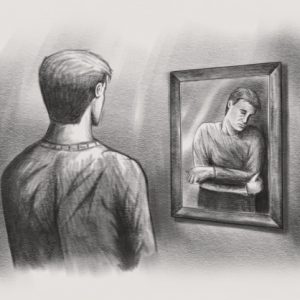
But shame – the noun – if properly effectuated, if it forces people to look in the mirror and not like what they see, can lead to growth and change and progress.

While in quarantine I have considered the implications of shame. Specifically, I have wondered what it would look and sound like if Oliver Stone made a slight alteration in the words he wrote for Gordon Gekko. Herewith:

“Shame – for lack of a better word – is good. Shame is right. Shame works. Shame clarifies, cuts through, and captures the essence of the evolutionary spirit. Shame, in all its forms – shame for how you live, shame for money, for lack of love, for lack of knowledge – has marked the upward surge of mankind. And shame – you mark my words – will save that malfunctioning experiment called the United States of America.”

Some people march, and others riot. People scream and yell and quietly protest. But it does not seem that anything or anyone really changes until they feel shame. I take no pleasure in writing these words, but more and more it seems readily apparent that they are a truism. Time and again we have seen how shame has changed people’s behaviors and their thoughts and their reactions.

Drew Brees went on television and spoke from his heart. And then the backlash began. It is my sincere hope that he heard the words of the people in his community, in his sport, in his locker room, and gave himself that hard look in the mirror. And maybe, just maybe, he felt some level of shame for what he said and how he said it. And, as such, he woke the next day woke. He changed his view and his tone so much so that he was willing to take on that titular Commander in Chief.

Here, shame “worked.”

Why do we think Bill Barr, all high and mighty with his ordering the code red on peaceful protesters in Lafayette Square suddenly claimed “it wasn’t me”? Or Mark Esper going from standing next to the president in front of St. John’s Church for a photo-op to claiming he didn’t know where he was going, to giving a press conference wherein he denounced the president’s plan to use the military to police our city streets. They both saw the reactions to their actions and felt shame. And then they attempted to Ginger Rogers their way back into good social standing.

Per Gekko, “shame was right.”

A few weeks ago I (and many others) wrote about the owner of the Oakland Athletics, a billionaire named John Fisher, and his parsimonious decision to refuse to pay his minor league players $400/week throughout the summer. As of early last week, 29 of 30 teams had agreed to fund their minor league players through at least June. Fisher was the lone miser. When 29 other billionaires think you are being Scrooge McDuck, it is time to revise your thinking. So Fisher changed his tune and agreed to pay his players through August. And he agreed to set up a fund for furloughed employees.

This “shame for money” led Fisher to change course.

Shame is the cornerstone of everything happening in this country today. The City of Minneapolis feels great shame – not that their police committed an atrocious murder in broad daylight – but that the world saw them commit an atrocious murder in broad daylight. In all of the officer-involved killings from 2013-2019, only 1% have led to arrests, let alone convictions. Why, because they weren’t caught on tape; because the municipalities were not forced to feel shame.

Why were Ahmaud Arbery’s hunters finally arrested – two months after-the-fact? Because a videotape of the horrible incident went viral and the city officials felt shame. The world saw their inaction – their lack of investigation – and they felt compelled to do the right thing. In fact, the highly-regarded mayor of Atlanta, Keisha Lance Bottoms, acknowledged that but for the uprising, she wouldn’t have even reviewed the tape. She didn’t need to say it, but to not review the tape in the present environment would have been shameful.

She felt shame for her “lack of knowledge.”

Let’s take a look at the NFL. On May 30th the league issued an anodyne statement expressing condolences for George Floyd’s death and that they were “committed to continuing the important work to address these systemic issues.” It was roughly the same bromide as nearly every other organization. Unfortunately for “the shield,” they hold a unique position in this battle. Seventy percent of the league is black, the teams paid a massive collusion claim to Colin Kaepernick for effectively blackballing him for kneeling during the national anthem, and they are viewed as being behind the curve on issues of racial justice. The NFL players would not allow the league off that easy. So last Friday night, Commissioner Roger Goodell sat in his basement and offered a mea culpa. He apologized for the league’s past behavior. He said the magic words: “we were wrong” for not listening earlier and encouraging players to speak out. Did Roger find his inner DeRay McKesson in less than a week? Or was something else at play? From New York Magazine:

“[The league] was forced by a powerful video, shared Thursday night on social media, in which New Orleans Saints star Michael Thomas and numerous other black players called out the league, called attention to the killing of Floyd, Breonna Taylor, Ahmaud Arbery, and other African-Americans killed by police — and demanded the league stand behind them. ‘What if I was George Floyd?’ many of the players asked, insisting that they will ‘not be silenced’ anymore.

“Twenty-four hours later, with apparently little input from team owners, Goodell did what the players told him to do, in some cases saying verbatim what they had demanded he say. They published a ‘message on behalf of the NFL’ and forced the NFL to literally repeat what they said.”

Goddell saw he was on the wrong side of history (again), and as such, shame “cut through and captured the essence of the evolutionary spirit.”

The Buffalo Police Department claimed a 75-year old man tripped and fell and was injured in a confrontation with approaching officers. Then two different videos of the incident went viral. The BPD then suspended two officers. While the powers-that-be felt shame for their inaction, 57 fellow police felt no such embarrassment, as they resigned as a result of the suspensions. One can only hope that when those 57 officers go home or to church or to the grocery store, their neighbors can provide a level of opprobrium that their senior officials could not; maybe they will at some point feel shame for encouraging their comrades to walk past an old man bleeding from the head. Maybe that shame will cause them to un-resign and acknowledge that orders or not, their actions were not acceptable behavior on our streets or anywhere else on this planet. We need a some men in blue in western New York to feel a level of shame.

How about the NBA owners who looked the other way and turned a deaf ear to the racism spewing from Donald Sterling’s mouth for so many years? Or the Hollywood executives and actors who laughed off the “rumors” of Harvey Weinstein’s alleged indiscretions? This list could go on and on.

As we move into mid-June, as the NBA plans to resume its season at the end of July and the NHL some time shortly thereafter, we must ask ourselves if the MLB owners can be forced to feel some form of shame. What will it take for them to look in the mirror and realize that they are self-fulfilling their prophesy? They want to claim “baseball isn’t very profitable” (the Cardinals Bill DeWitt, Jr.) or “the league itself does not make a lot of cash” (the Cubs Tom Ricketts). Well one way to ensure both of those statements are true is to squander this opportunity to own the month of July – to be the first and only of the big four sports to be playing real games. You want to have your clubs lose money and lose value, either (a) not have baseball in 2020 over financial considerations and/or (b) have this dispute end so acrimoniously (e.g., Rob Manfred imposes a 48-game season) that we have a strike or a lockout after the 2021 season. If that were to happen, then these owners’ words will look prescient. But can someone, somewhere, say something that will force these billionaire penny-pinchers to feel the shame of their inaction, of their intransigence, of their…wait for it…greed?

Because that type of shame is what is needed to “save that malfunctioning experiment called Major League Baseball.”

PLAY BALL!!


Major League Problems – Minor League Owners

When Memorial Day broke, there was a great echo in the world of sports that this was THE week. This was the week that the NBA was going to figure out its plan to finish their season and hold playoffs – ostensibly in the bubble (er, campus) of Disney World. This was the week that the NHL was going to make a decision about (not) restarting its season, and moving right into their playoff tournament. And this was going to the week that MLB decided whether or not it wanted to have a 2020 season.

The NBA has been communicating in lockstep with their player union reps and their broadcast partners. It has not been perfect, to be sure, but there is little rancor. The NHL plan was essentially met with universal applause. The MLB, well the MLB did what it always does – it bickered, it squabbled, and it leaked. And as we move closer to the artificial June 1 deadline, there is very little hope in site.

Since I previously wrote on the topic, things have only gotten worse. For years baseball has been accused of not doing enough to “sell the game.” The theme being that MLB has not worked to make its players stars. There have been fleeting attempts – like when Rob Manfred called out Mike Trout for being too private. But, by and large, that has been a weak spot. So what did the owners propose this week – after their revenue sharing model was dead prior to arrival – they tried to cut the salaries of their biggest stars by nearly 80%. Now, to be fair, there is an interesting idea in there somewhere. If you are rookie making the minimum, you take a 10% haircut – that seems fair. If you are a superstar making north of $20M, you lose more hair as, theoretically, you can afford that. Here is the problem, it is not up to the owners to tell the players who should take what discount.

In a perfect world, in a world where the players trusted the owners and the owners trusted the players, in a world where it wasn’t the Hatfields and the McCoys every time any issue arises, in a world where back-channeling was possible, someone from the league office could have floated this to the union in a casual, off-handed way, and allowed the players to come up with their own plan. Let Nolan Arenado and Clayton Kershaw and Zack Greinke and Miguel Cabrera be magnanimous and offer to cut their salaries for the benefit of the younger, poorer players. I doubt that would have happened, but in the words of Jim Carrey, at least there would be “a chance.” As it stands, there is no chance.

And no sooner than we were faced with the prospect of no deal being on the horizon, we got even more bad news. I have previously written about the deal that the owners and players closed in March with respect to compensation and other matters. Included in that deal was that all minor leaguers would get paid $400/week through May. Well, May is about to come to an end, and the Oakland Athletics, for one, are done paying.

So, as of June 1st, if you are a minor leaguer in the A’s system, you are still employed but you are not getting paid. And, because all baseball transactions are frozen, a player in the A’s system cannot get released and find another team. And, because they have not been let go, depending on where they play, the player may or may not be entitled to unemployment benefits (believe it or not, each state has different eligibility requirements under the “Save America’s Pastime Act” (which was oxymoronic from its inception) and through the CARES Act). Good times!

[Ed. Note: The A’s are owned by John J. Fisher, a businessman who has a net worth of $2.2 billion. Some back of the napkin math: if JJ Fisher were to earn 2.5% on his net worth, he would earn about $4.5 million per month. But he cannot find $400/week for players sleeping on air mattresses and eating PB&Js? And, lest we forget, these players who he refuses to pay are not panhandlers, they are his assets.]

To channel John Krasinski, here is some good news: As of this writing, the following teams have agreed to pay their players through June: Braves, Brewers, Cardinals, Cubs, Diamondbacks, Dodgers, Mets, Orioles, Phillies, Rangers, Rays, and the White Sox.

More good news: These teams have agreed to pay their players through August: Astros, Mariners, Marlins, Padres, Reds, Royals, and the Twins. What makes this list so interesting is that none of these are large-market teams, at least three of them have had severe financial issues in the recent past, and four of them haven’t been to the post-season for years. And yet, each team was able to find the extra $1M* to make peoples’ lives just a little bit better throughout the summer.

*Each team has between 200-220 players in their minor league system. At $400/week/player, that is about $84K/week. Paying the players through August would cost a little over $1M. MLB had revenues of $10.7 billion last year.

We are still waiting to hear what the other 10 teams will be doing.

But wait, there’s more. Yesterday, teams started a bloodletting of their minor league players – just cutting them outright. Now, in some cases, this may actually be better, as those players for sure will be eligible for unemployment benefits plus the additional $600/week from the CARES Act. So, we have a situation where billion dollar corporations just gave a bunch of their “employees” (technically, “seasonal apprentices”) a raise by firing them. I think that says more about their original wages than anything else, but I digress.

Teams typically release a bunch of minor leaguers at the end of spring training, but not to this degree. With no minor league season on the horizon, this week teams cut hundreds of players, with hundreds more to go (according to Jeff Passan, the number may reach one thousand). This is devastating for the individual players, many of whom have played their last professional game. But it is – in the long run – potentially devastating to the teams. They have thinned their most prized asset – their farm system, the crop of underpaid (see above) labor that they “control” and have the ability to exploit for years at below market rates. Losing just one or two diamonds in the rough in these mass firings, players who could have helped the big league club could turn out to be extremely costly.

To put this into context, understand that 1 bWAR is worth about $8M on the open market. Now, let’s take a look at the type of player who may have been cut this week (again, to save either $0 (looking at you, Oakland) or to save $400/week (everyone else)):

  • R.A. Dickey (First +bWAR season at age 29), 23 career WAR; potential lost value: $184M (I don’t want to do a regression analysis of what bWAR was worth each year of his career; we can fudge the numbers to make a point.)
  • Jose Bautista (First +bWAR season at age 28), 36.7 career WAR; potential lost value: $293.6M
  • Max Muncy (First +bWAR season at age 27), 9.4 career WAR (to date); potential lost value: $75.2M (to date)
  • Evan Gattis (First +bWAR season at age 26), 8.5 career WAR; potential lost value: $68M

Sure, it is quite possible that none of the players cut this week would have ever become Muncy or Gattis, or Dante Bichette or Joe Nathan, but there is a chance. And for a few hundred thousand bucks, teams were willing to light their lottery tickets on fire, they were willing to flush their assets down the toilet, they were willing to be misers and look like gonifs. In a battle of millionaires vs. billionaires, they certainly took the low road, and are rightly taking the public relations hit along with it.

With everything going on in the world; with Minneapolis on fire and people shot in Louisville; with at least 1,000 people still dying every day from this invisible virus; with 40 million people unemployed and the economy on the brink of a depression; with a president who seems to have his (little) hands on the rudder and is aiming straight for the iceberg; one would hope that cooler heads could prevail and the people in charge would make it their responsibility to bring a little joy to the hearts and minds of fans across this great land. It seems as if only Adam Silver and Gary Bettman got that memo. It seems as if Rob Manfred and his cadre of owners have lost their senses and their moral compass. It seems – more and more – like we will not have baseball in 2020.

And, to put the cherry on this shit sundae, if we don’t have baseball in 2020 over pay/revenues, and thus the 2021 free agent market is depressed and more players are cut or asked to take smaller salaries, look for a strike or a lockout before the 2022 season. As I said, good times!

Get your shit together so you can all…

PLAY BALL!!