
It Can’t End Like This

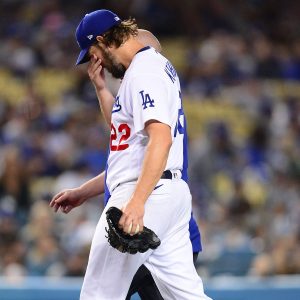
As you may know, I have a great deal of affection for Clayton Kershaw. In recent years, I, like many Dodger fans, hold my breath when he takes the mound in the playoffs. We feel, at almost a cellular level, the pain of his many post-season losses. We know, with absolute certainty, that his managers and his teams have done him dirty too many times to count – keeping him in one inning (or one batter) too long, not providing sufficient run support, allowing inherited runners to score, etc. And yet, the big Texan never complains, never makes excuses, always owns the defeats.

Last year, Kershaw flipped the monkey off his back, finally winning the World Series. According to Andy McCullough of The Athletic, Kershaw was still playing “We Are the Champions” on his home stereo well into the off-season. And good for him. But, even with that title, even with all the victories, even with the first-ballot Hall of Fame induction waiting for him five years after he hangs ’em up, it just can’t end like this.

Clayton Kershaw deserves a better send-off. His career cannot end with a ruined elbow – whether it requires Tommy John surgery or is just never the same. Clayton Kershaw deserves to walk off the mound in the seventh inning of a meaningful game in September or October, tipping his cap to the crowd while they chant his name. It can end with a “Public Enemy #1” at 72MPH making a batter look foolish. It can end with a loss after Kershaw, gassed, gives up yet another late-inning hit. It can end in any number of ways. It just can’t end like this.

This was always going to be an interesting off-season as far as Kershaw was concerned, insofar as he becomes a free agent after the last out is recorded. He made – in effect, due to a signing bonus – $31M in salary this year. He has averaged 25 starts-per-year over the past five full seasons, down from nearly 32-per in the previous five. Since 2018, he has made six trips to the IL; most of these have been related to his balky back, but now he is having trouble with his elbow and his forearm. You don’t need to be a FanGraphs member or have a subscription to MLB.tv to have a vague sense what that means…and that it isn’t good. Kershaw already ruled himself out for the remainder of the season. So what happens next?

Even if healthy(ish), the Dodgers had a decision to make with their franchise pitcher. He certainly isn’t/wasn’t going to get (ahem) Trevor Bauer money, nor Gerrit Cole money. He was probably set up for 2/$50M on a “thank you” contract. Would he have accepted that? Will the Rangers, with money to spend, try to lure Kershaw home to North Texas by offering 3/$75M or 2/$60M? Will Kersh take more to be closer to his wife and kids? We know that Kershaw doesn’t play the game for money; and we know his family is the most important thing in his life, followed a close second by charity. Will loyalty or the desire to keep wearing Dodger Blue for the entirety of his career win the day? No one knows.

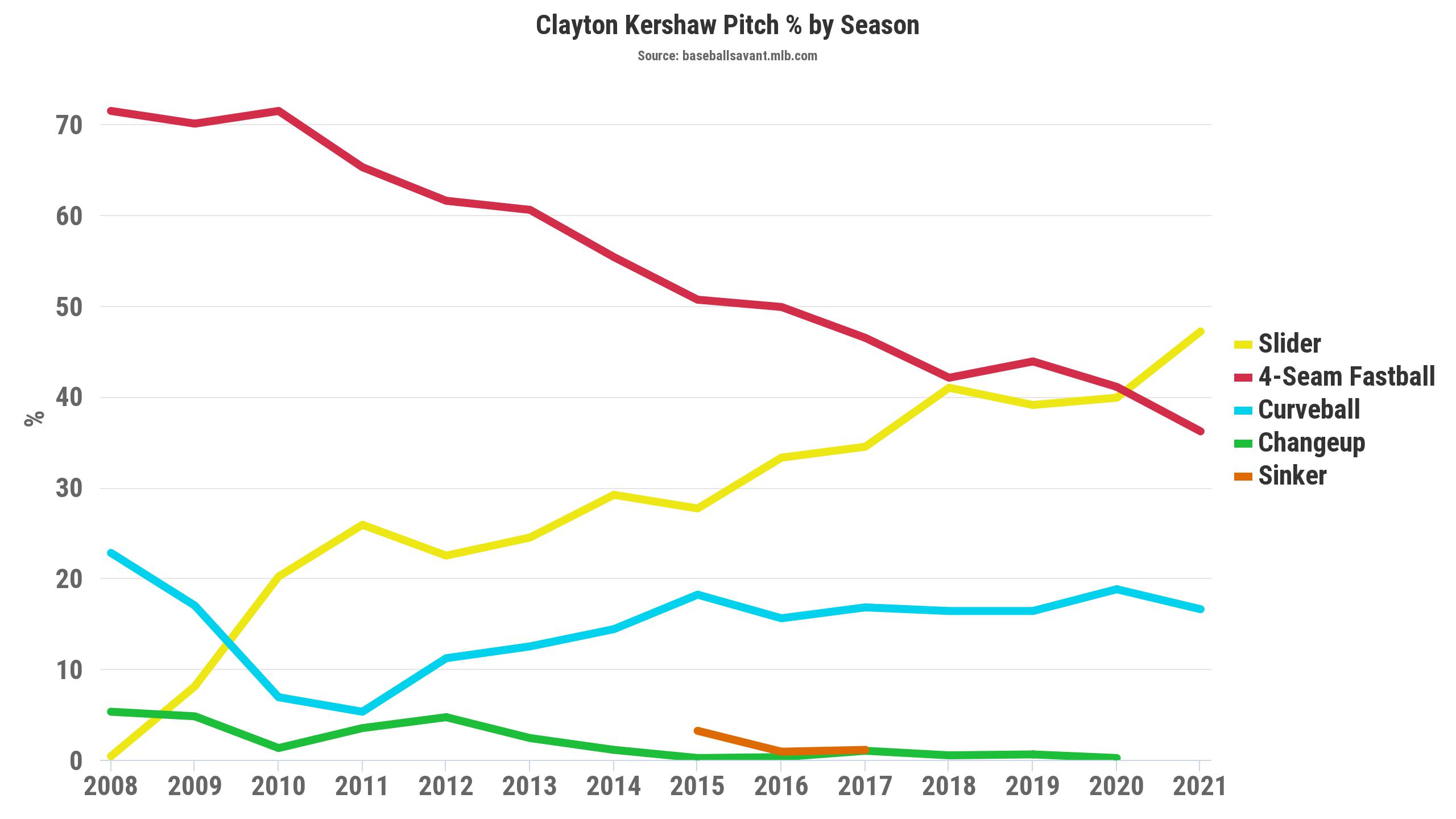
With this current injury potentially ending his 2022 season, the situation becomes even more complicated. The Dodgers have the prospect of paying the aforementioned Bauer $40M this year for half a season’s work, and will probably have to pay him something before they cut him next year (here’s to hoping that (a) he gets suspended and (b) the Dodgers finally do the right thing, admit their mistake, and bid Bauer adieu). Can they/will they pay $20M+ to another pitcher who cannot/will not take the hill next year? We know they can. So the question becomes: do they have the will? There is a reasonably good chance that Clayton Kershaw will not throw another pitch until after his 35th birthday. The history of pitchers faring well in their mid-30’s is quite ominous. Kershaw has already changed his game from power to crafty. What will he look like two years from now? What is that worth?

All of that conjecture aside, Kershaw is the final arbiter, and he may make it very easy for the club. He may elect to retire. He has nothing left to prove on a baseball field. He has his youth, his family, his foundation, and his millions. There is no reason – other than sheer desire to be great and to keep competing at the highest level – to play another game. But we know Kershaw has an unending desire to be great, that he loves nothing more than competing at the highest level. We know he bleeds for the game, and plays through pain for his teammates, and works harder than most, just for the honor of taking the bump every fifth day (or out of the bullpen).

So, from my selfish perspective, here is a logical solution for both the club and the player: 3/$66M, with the understanding that the team is paying $22M for a rehab year in 2022; $22M as a show of goodwill (to cleanse their souls for that other pitcher they signed last off-season); $22M as a “thank you” for all of the memories, all of the great moments, all of the mentoring and long-toss sessions, all of the charity ping pong tournaments, all of the jerseys sold, and all of the times he refused to throw anyone under a bus; $22M for #22. They pay $22M next year on the hope that they can pay $44M over the next two for a middle-of-the-road number three or four starter who will take the ball, take the heat, and never – not once – ever take it for granted. That is what I want. But I will take any variation on the theme…

It just can’t end like this.

PLAY BALL!!

Waiting For the Other Sock to Drop

When I was in my last year of law school, I visited a head hunter because, after almost three years of schooling and nearly six figures of debt, I decided I didn’t want to be a lawyer; and hell, “you can do anything with a law degree.” The recruiter and I bandied about a bunch of ideas, but, surprisingly, one that did not come up was MLB general manager. It should have, as according to Alex Anthopoulos — the general manager of the Atlanta Braves — one of the main responsibilities of that job is to worry about what will happen next. And, as a lifelong Boston Red Sox fan, that is my metaphysical condition from April through October (if we are lucky). 2021 has been no different.

Going into spring, I was care and worry free. ESPN predicted the Red Sox would win 79 games; SI: 80; PECOTA: 85. As of this writing, the Red Sox have already won 88 games, with nine still to go. They have surpassed all expectations, and thus increased my anxiety level many-fold. And regardless of their over-performance (at least against preseason predictions), this team consistently seems to underperform. As such, they trigger my general manager tendencies, and cause me to worry.

The BoSox spent 85 days in first place, but fell out on July 30th. Five weeks later, on September 7th, they were 10 games back of the Rays. In those 38 days, the team went 16-20, which wasn’t horrible, but neither was it great. And, truth be told, despite their record and their position in the standings, they are not very good. According to FanGraphs, their Pythagorean Record would have them at 84 wins, and their Base Runs record would have them at 81. All better than expected, but still not a team worthy of World Series aspirations.

As a team, the Red Sox are hitting .262; .269 with runners in scoring position, and .294 with the bases loaded. And yet, it feels like they never capitalize on those situations (including again last night). By comparison, the Rays are hitting .241 as a team; .250 with runners in scoring position, but .390 with the bases loaded. And that may be why the Rays have scored 17 more runs than the BoSox (811-794).

And if you have watched the Red Sox lately, you can’t miss another glaring difference: defense. Here, as above, the stats don’t even begin to tell the whole story. Boston leads the A.L. with 103 errors (by comparison, the Rays rank 8th with only 78). The Red Sox have given up 77 unearned runs, while the Rays have only given up 58. But it’s not just the errors and the unearned runs, it’s the plays that should be made, but are not. If you watched Tampa Bay’s 11-10 come-from-behind win in Boston on Sept. 6, you will know exactly what I am talking about.

Yet, the season has but nine days to go, and the Red Sox are in pole position for the Wild Card. Assuming you can get past the unclutch hitting and the woeful defense, you then have to contend with a deadly virus. Kiké Hernandez went down with COVID-19 on Aug. 27th, and the team suffered no fewer than 12 player cases (plus two staffers), including ace Chris Sale (who, we have learned, is not vaccinated — see the great piece by Steve Buckley in The Athletic). 

It would have been considerably easier if they had tanked during that period, ending their season — and my worries — once and for all. But the team went 10-9 and kept themselves in contention, adding to my angst.

So now, after getting past their pandemic woes, we fans must steel ourselves for nine innings of high leverage baseball with this pitching staff. At this point, the best outcome is hosting the Wild Card game against (most likely) either the New York Yankees or the Toronto Blue Jays. And, at this point, the best outcome is the Red Sox are able to line up Sale to pitch that game. But, since coming back from Tommy John surgery on Aug. 14th, he has gone 5, 5, 5 1/3, 6, 3 2/3, 5, and 5 innings. 

Which means that even if Sale gets the ball to start the Wild Card game, the shaky bullpen will be there to try to finish it. Do you really trust Adam Ottavino and/or Matt Barnes and/or Hansel Robles to get through either the Bronx Bombing Beef Boys or the Canadian Clubbers of Springer, Semien, Vladito, Bichette, and Teoscar Hernández — even if it is only one time through the order? As a lifelong Boston fan, I most certainly do not.

Oh, and if Sale and the bullpen are able to walk between the raindrops and make it to the ALDS, they will have to face the Rays in a best of seven. In short, I won’t be booking any flights to Boston for late October this year.

But my sincere hope is that it just doesn’t end too badly. I have seen this movie too many times. I was just a hair too young to remember Bucky Dent, but I do remember 1986 (which, conveniently, was the main focus of ESPN’s four-part documentary released last week). I will never forgive Grady Little or Aaron “Bleeping” Boone. None of us will ever forget 2011. There have been too many bad moments, too many bad months, too many bad streaks, too many bad hops and bad breaks to think anything other than bad news is on the horizon. When the end comes, just make it painless…

It is in these moments of heightened tension that I envy my son. Because, even with 2011, he has really only known Red Sox success. He has witnessed four World Series titles in his 18 short years. To him, the Red Sox are winners, not chokers; there is no curse or jinx or hex on his favorite team, just glory every three or four years.

That is why my son had no compunction about mocking the Yankees after they acquired Anthony Rizzo and Joey Gallo, saying, with absolute earnestness and confidence, that “it won’t mean anything when the Yankees don’t make the playoffs.” At which point I told him to go outside, turn around three times, and spit. In my heart, I know he didn’t stave off the wrath of the baseball gods. In fact, if history and thaumaturgy are any guide, it will be Rizzo and Gallo who hit the game-tying and game-winning home runs in the Wild Card game.

But, no matter. Whether it is the Yankees, the Jays, or the A’s, I will not — and never will — feel one bit confident that the Red Sox — this, or any other version — will come through. It is part of being a Red Sox fan; it is in our DNA. We live our lives waiting for the other sock to drop.

PLAY BALL!!

Laying Down With a Dog

I have always loved the Theo Epstein story. Local Boston kid leaves home, cuts his teeth, comes back and orchestrates the roster that ended an 86-year curse. When management wanted to go in another direction, he moved to the Midwest and orchestrated the roster that ended a 108-year curse. And then he became best buds with Eddie Vedder, the lead singer of his all-time favorite band. All the while he married a Harvard girl and had two adorable kids. What is not to love?

Well, there is this. It is a small detail that has always stuck in my craw. It is this one transaction that has sullied my appreciation for what Theo built in Chicago and my excitement over their finally turning “Next Year” into “This Year.” Right before the 2016 trade deadline, the Cubs sent pitcher Adam Warren and prospects Rashad Crawford, Billy McKinney (lately of the Dodgers), and Gleyber Torres (currently playing Derek Jeter-level defense in the Bronx) to the Yankees in return for All-Star closer Aroldis Chapman. The Cubs were looking for something to put them over the top, and Chapman had the highest K/9 in MLB and was rocking a 105 mph fastball. At the time of the acquisition, Chapman was 20 for 21 in save opportunities on the year. It seemed like a great deal, except…

Chapman started the 2016 season serving a 30-day suspension under the MLB Joint Domestic Violence Policy (“JDVP”) after an incident with his girlfriend wherein he allegedly choked her, pushed her against a wall, and then fired eight rounds in his garage in his ensuing fit of pique. Epstein and General Manager Jed Hoyer spoke with Chapman before closing the deal and felt sufficiently confident that he had learned his lesson, paid his debt to baseball (if not society), and was ready to help the Cubs win the World Series. Flags fly forever, but you have to ask yourself, at what cost?

As much as I – a fan of baseball – reveled in the Cubs victory in 2016, it pleased me to no end that Chapman melted down in Game 7 against Cleveland and wasn’t on the hill when the last out was recorded. He didn’t deserve that front page photo, that SI cover, that memory seared into the minds of every Cub fan within earshot of 670 The Score. The Chapman signing has always left a bitter taste in my mouth, and will always be a blight on Theo Epstein’s legacy.

If there is a Theo Epstein 2.0, it would be former Rays GM, and current Dodgers President of Baseball Operations, Andrew Friedman. A wunderkind from the world of finance, he cut his teeth with a microscopic budget in the backwaters of Tampa Bay, and then moved to the glitz, glamour, and gargantuan pocketbooks of Los Angeles. One can question some of the moves Friedman has made since joining the Bums in 2014, but none more so than signing Trevor Bauer last February to the richest deal on per-year basis (first season only) in baseball history.

Bauer’s exploits and “look-at-me” personality has rubbed enough people the wrong way, and enough writers have addressed his personality – shall we say – “issues,” that I feel no need to recount them here. But all of those incidents look quaint when compared to what we learned on June 29, 2021. On that day it was reported that the Pasadena Police were investigating a potential sexual assault by Bauer with an unnamed woman from San Diego. The more details that were released, the worse the story got.

We all knew Bauer wasn’t a good guy. He may not be Aroldis Chapman (or Milton Bradley), but he certainly isn’t anybody’s Nelson Cruz. It is hard to imagine any Dodger player learning that Bauer was joining their club and thinking, “alright, a great new addition to the team.” At best they were thinking, “hopefully he pitches well every fifth day, and shuts the hell up the other four.” Alas, it wasn’t Bauer’s mouth that got him into trouble.

Bad behavior from Bauer – in some form – was expected. What we should not have expected (and on this your mileage may vary) is the Dodgers woeful reaction and response to that behavior. When the news broke, the Dodgers publicly stated that Bauer would make the team’s road trip to Washington and would be on the mound the following Sunday. That was followed by Dave Roberts’ incredibly tone deaf – most charitably, ignorant – comment that the matter was “out of our hands.” It seems that Roberts believed he could sidestep the issue by relying on the JDVP, which defers punishment to the league, not the team.

But last I checked, Rob Manfred does not fill out the lineup card (insert, “no, the Dodgers front office does” joke here). The Dodgers could have come up with a valid reason – the emotional toll of being charged with a serious crime being a pretty easy one – for skipping Bauer’s next start. Hell, they could have come up with a magical hamstring strain – the same one that has caused the slumping Cody Bellinger to miss a few games last week. And while the Collective Bargaining Agreement prohibits teams from retaliating against players by benching them, the worst case scenario is that Bauer would have filed a grievance. And the Dodgers lost. And they were forced to pay a fine. As of last year, the team was worth $3.4 billion. You would think with that kind of scratch they could afford a small penalty from an arbitrator (assuming they lost the grievance) to retain the moral high ground, to send a message to the team that this conduct will not be tolerated, and to let their fans – many (50%?) of whom are women – know that despite signing Bauer in the first place, they are a class organization. Yeah, they chose not to do any of that.

Per the terms of the JDVP, MLB has the right to put a player on administrative leave for up to seven days while it investigates an incident. They have right to extend that with the consent of the MLBPA. Both of those things have occurred with Bauer. While on administrative leave, the player continues to get paid, continues to accrue service time, and has the right to continue working out at the team’s spring training facilities. And as much as I dislike Bauer, the first part of that makes me very happy.

If MLB ultimately determines that Bauer violated the terms of the JDVP, they can and will suspend him without pay. Since 2016, the shortest such suspension has been 15 games (twice), with five suspensions of 75 games or more. Sam Dyson incurred the harshest punishment: the entirety of the 2021 season.

As I am sure you are aware, Bauer has vowed to fight the charges, and there is a real chance that MLB elects not to take any action unless/until the criminal matter is resolved, whenever that occurs. But Bauer could force everyone’s hand and not consent to any additional administrative leave (he agreed this week to extend it through August 6th). If he were to do that, he would make the Dodgers put up or shut up, as they would no longer have the ability to punt their decision about what to do with their problematic pitcher.

Bauer’s contract is not public. We don’t know if the Dodgers would or will have a valid justification to terminate it. But, if such an off-ramp does exist in the legal boilerplate, it is unlikely that it would be possible to enforce that provision until the criminal matter is adjudicated. And that seems unlikely before September (when Bauer’s last 2021 paycheck will be due). And that makes me happy.

Sure, I don’t like seeing Bauer getting rich and not playing and trying to plead the fifth. But I find the idea of the Dodgers getting out their financial bind considerably more odious. The Dodgers bought their ticket; they bought a ticking time bomb; they knew the risks; they injected a virus into their World Series-winning clubhouse on a wing and a prayer that it would not turn into a cancer. Well, guess what?!? According to the Los Angeles Times’ Bill Plaschke, the majority of Dodger players do not want Bauer back under any circumstances.

Even if Bauer is ultimately exonerated in the criminal matter, he still may be suspended by MLB without pay (each tribunal has different standards). That would benefit the Dodgers in the event Bauer exercises his $32M option for next year. But even if Bauer were suspended without pay for the entirety of the 2022 season (see Dyson, Sam), he still could theoretically exercise his 2023 option and make the Dodgers pay him $32M to either pitch as a pariah or play somewhere else. Oh, and if Bauer threw the Dodgers a bone and opted out of the 2023 obligation, the Dodgers would still owe him a $15M buy-out.

So, absent a criminal indictment or conviction that allows the Dodgers to terminate Bauer’s contract, the Dodgers WILL PAY. It may not be the entire $102M, but they will cough up a huge chunk of it. And as loathsome as I find Bauer, the Dodgers being forced to spend nearly nine figures to rid themselves of this mess makes me happy.

The Boys in Blue can remove all the Bauer merchandise they want; they can cancel all the bobblehead nights they had planned; they can try to retcon their response to this episode however they choose. But we all know that they made a cold and calculated decision when they signed Bauer, who, as Plaschke rightly pointed out, “had a history of harassing and bullying women online, mocking transgender people, and spreading conspiracy theories.” Andrew Friedman, like Theo Epstein before him, put FIP and WPA and a recent Cy Young award ahead of character and rectitude and principle. The Dodgers laid down with a dog. And now they have to pay for the fleas.

PLAY BALL!!

A Game of Inches

I think I was about 14 years old when we had a bang-bang play on the baseball field. Some wise-beyond-his-years kid in the dugout said – to no one in particular – “Baseball is a game inches.” One of our wise-due-to-his-years coaches quickly retorted, “Baseball isn’t a game of inches. Sex is a game of inches.” This statement went over our heads, but we all laughed because our coach said “sex” and we were teenage boys. If life has taught me anything, it is that both the player and the coach were correct. And we saw the player’s view unfold last night at Dodger Stadium.

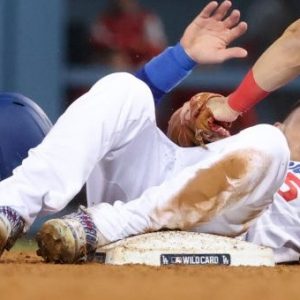
If the Dodgers ultimately find themselves in the one-game wild card round facing Yu Darvish, they will look back to July 22nd and they will be thinking about a game of inches.

If you didn’t watch or see highlights of the slow motion dumpster fire that was fourth game of the most recent Giants-Dodger series, allow me to set the stage.

On Monday night, the Giants thumped the Boys in Blue 7-2.

On Tuesday night, it looked to be more of the same. But the Dodgers scored three in the sixth, and then walked it off on a Will Smith three-run homer in the bottom of the ninth to complete a comeback from being down 6-1.

Wednesday night had the Dodgers poised to draw even in the standings with the Giants, leading 2-1 going to the top of the ninth. And then Kenley Jansen brought his gas can to the mound. Single, homer, K, double, walk, walk, Jansen replaced, K, walk, ground out. Giants 4, Dodgers 2. Gut punch.

But the Dodgers bounced back in the finale, going for the split and a one-game deficit. They led 3-1 going to the top of the ninth. Despite throwing 27 pitches (and blowing the save the night before) Dave Roberts sent Jansen back out there to try yet again. There are myriad reasons why a manager might want to get his closer back on the horse and wash the previous two save opportunities off. Roberts may believe that the Dodgers have no chance in October without a healthy Kenley (both physically and mentally), so now is the time to get him right. Maybe, as some opine, the front office dictated that the ninth inning belongs to Jansen. Maybe he demanded the ball, and Doc was too intimidated to say no. We will never know the truth. What we do know is that Kenley came out of the pen throwing darts. The announcers observed that it may have been a combination of adrenaline and embarrassment that got him to 96 MPH on the gun.

Whatever the impetus, Jansen used it to strike out Mike Yastrzemski on three pitches. He then gave up a single to Wilmer Flores (the ninth inning home run hero from the night before); followed by a strike out of Alex Dickerson on said 96 MPH heater. He started Donovan Solano with another 96 MPH cutter for a swinging strike. But MLB players can hit speed without movement, and Solano crushed the next offering (94 MPH) off the wall in dead center for a double. Tying runs in scoring position, two outs. Jansen got Jason Vosler, a rookie with all of 66 big league plate appearances, to 1-2. After a foul ball, we were introduced to our first game of inches. Jansen threw a nasty slider just inches low. The rookie spit on it; the umpire called it correctly. The next two pitches weren’t even close – bases loaded.

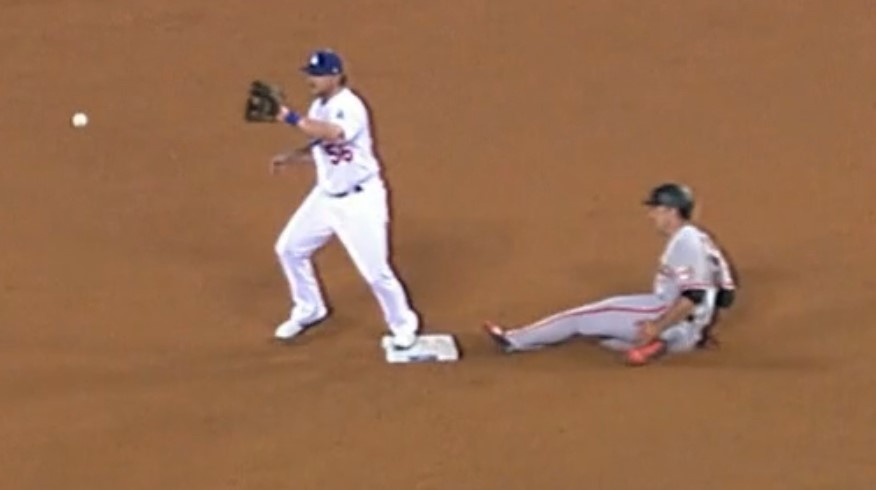
Next up, Thairo Estrada (yeah, me either). He hit a routine (although slow) grounder to short. Chris Taylor fielded it cleanly and tossed it to Sheldon Neuse who was standing on second base. Neuse caught the ball as if it were three hours before first pitch and he was having a catch with someone from the local Kiwanis Club. Neuse was drafted out of the University of Oklahoma by the Nationals in 2016. In college, Sheldon played exactly 1 game at second base. In the minors from 2016-2018, Sheldon played exactly 1 game at second base. Starting in 2019, both the A’s (to whom he was traded in 2017) and the Dodgers (to whom he was traded in 2021), started giving Neuse reps at 2B. He played 16 minor league games there before playing 20 for the A’s in 2019. He played there 21 times at Triple-A this season before being called up, and has now played there in 11 games with the Dodgers. So Neuse is no newbie at second base, but he certainly isn’t seasoned. Would a seasoned second baseman – or at least one more accustomed to the position, say Chris Taylor, or even Max Muncy who has played more than a thousand innings at second – have known to stretch for Taylor’s throw? I know Kiké Hernández would have (but he plays for the Red Sox). Gavin Lux would have (but he is out with a hamstring injury). Hell, Albert Pujols (he of 3.1 career innings at second base) would have. But that is not who was there with two outs in the ninth on Thursday night. That would be Sheldon Neuse, who didn’t heed the “game of inches” trope. So, despite an initial out call to end the game, upon further review, the runner was safe, the run scored, the bases remained loaded, and the game went on.

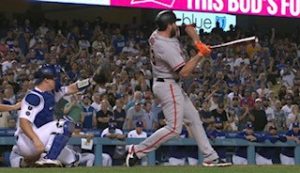
Still leading 3-2, the Dodgers just needed to retire Darin Ruf to go home happy. After working a 3-2 count, Ruf checked his swing on a cutter up in the zone, which, upon further review, was clearly a swing. But the first base umpire didn’t believe so. In the umpire’s “game of inches,” Ruf held up and took ball four, forcing in the tying run. Dave Roberts, likely frustrated with himself (why Kenley; why Neuse; why is this happening again?!), frustrated with his players (see, Jansen and Neuse), and angry at an umpire who blew the (would be) game-ending call, lost it. Out of the dugout he stormed, hat in one direction, arms in two other directions, and curse words and spittle in the direction of the offending (offensive?) umpire. Roberts got tossed, the next batter singled home two, at which point the game was all but done for.

The Dodgers were mere inches from splitting the series and being 8-5 on the season versus the Giants. They were mere inches away from being one game back of their NorCal rival. They were mere inches away from restoring some level of confidence in their $80M closer. Baseball, as the Dodgers learned the hard way Thursday night, truly is a game of inches. And, once again, the Dodgers fell short.

PLAY BALL!!

From “Let’s Go” to Letting Go

My son was three years old when I handed him a small glove and said, “Let’s go.” We were headed to Dodger Stadium and his first baseball game. But his early life experiences would not be limited to Chavez Ravine. No, as my father did before me, and as his father did before him, I elected to foist my ardor for baseball onto my son, to teach him the game and to teach him to love the game.

By the time he was six years old, he had already visited a handful of stadiums and walked on the field at Fenway Park. By age ten, he had seen a Home Run Derby and an All-Star Game, and met legends like Goose Gossage. Hell, before he could drive, he had visited the Baseball Hall of Fame and attended two World Series games. Sure, my dad and I were each raised on baseball, but neither of us had it nearly as good as my son, who was (and is) living the life of Riley when it comes to the game.

My son took to baseball like a fish to water, and began playing t-ball like the other kids. And soon he was working the Little League scoreboard on Saturday afternoons. Which led to him asking me to teach him how to keep score. He would walk around with an umpire’s indicator in his hand to keep track of the action. He learned the history of the game, watched present-day highlights, and kept an eye out for future stars (including one he played with). A running joke between us — but only because it is partially true — is that the only non-required reading he has done in the last five years is Dustin Pedroia’s biography.

My son has an affinity for baseball, and for baseballs. He has a knack for knowing just what level of annoyance is necessary to get a player to toss him one, and he knows where to stand at the end of an inning. Not even blue is safe, as my son positions himself by the umpire’s tunnel at the end of a game knowing that perfectly good pearls are in the home-plate umpire’s ball bag just waiting to be liberated and added to his collection.

But more than anything, my son loves the ballpark. Once he got his driver’s license, he would leave for games hours before me, parking outside the stadium and trekking in to be the first one through the gates. And he never wants to leave before the game is over. And by “over,” I mean that we need to step over brooms sweeping the stands.

Earlier this summer, our family spent some time in Chicago. So, of course, my son found his way to Wrigley Field hours before first pitch, leaving the rest of us to meet him there at a more reasonable time. And since we were going to be in the Midwest, and to continue my personal quest to get to every park in the majors, I booked us a trip through Ohio.

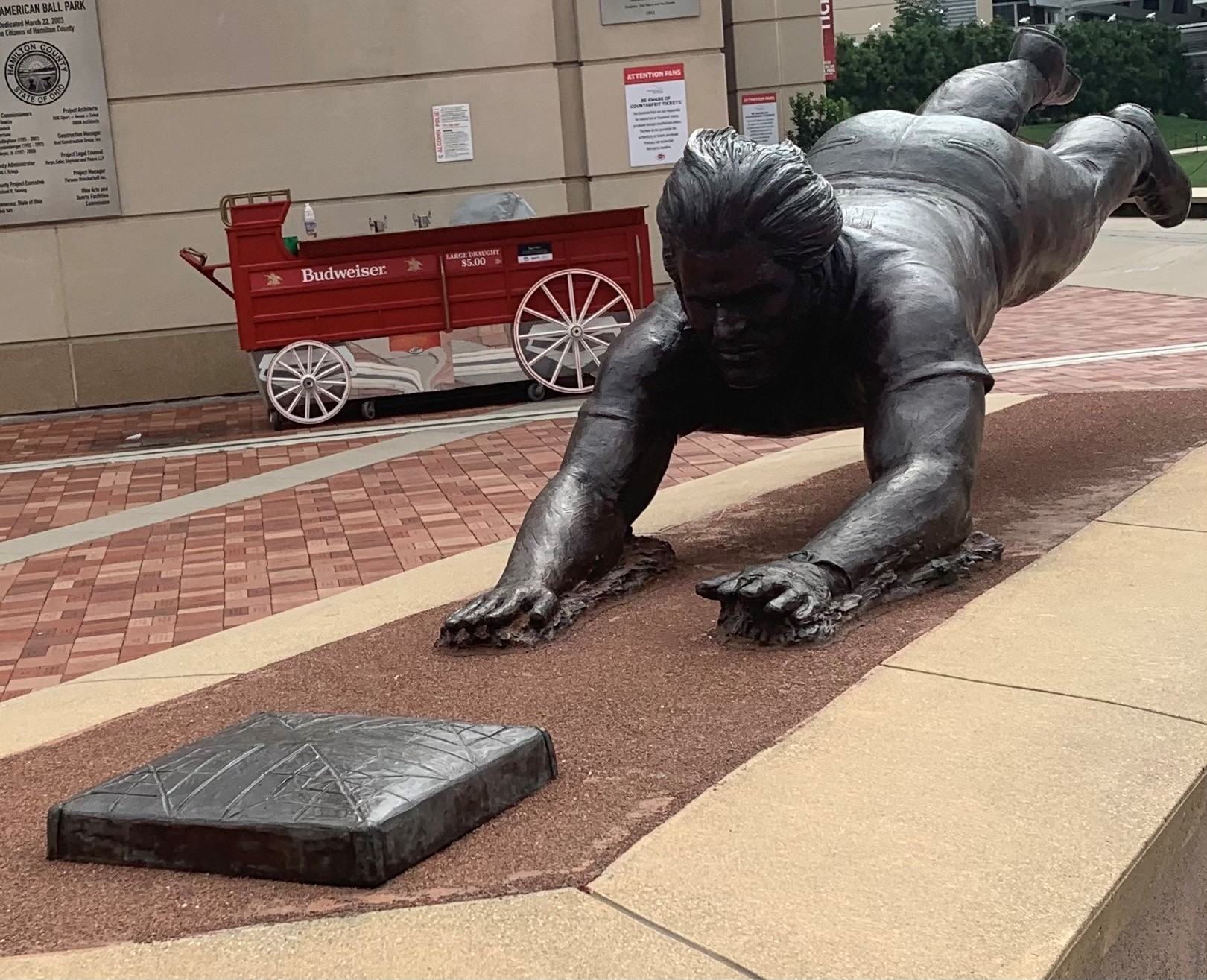
First stop: Great American Ball Park in Cincinnati. This time I went early with my son, but as soon as we had cleared the metal detector, he was off to chase a batting practice ball or a ballplayer interaction. Cincinnati was a revelation — a great park with an even better vibe. After walking past the statues of Reds greats on Joe Nuxhall Way, we were ready for our next stop: Huntington Park in Columbus.

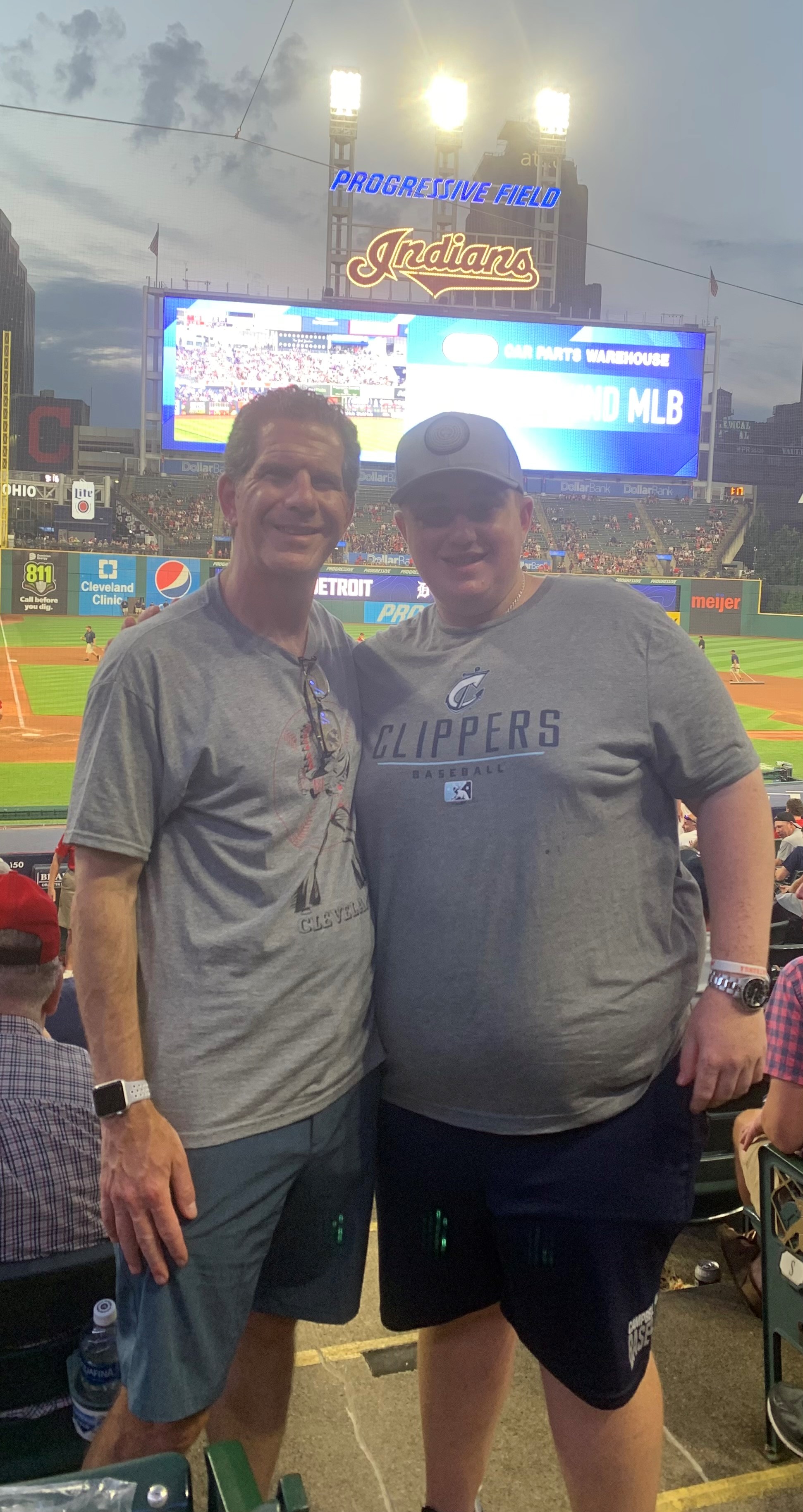
Truth be told, this Triple-A sojourn was my son’s idea. He looked at the map and the calendar, and realized that Columbus was on our way, and the team was in town. So, to the Clippers game we went. There we were treated to a grand tour of the minor league (in affiliation only) park for a team with a rich history. We sat along the first-base line and were close enough to hear the coach yell “Back!” when a pick-off attempt was made. Circling around the outfield, we could hear the center fielder call off his compadre on a fly ball in the gap. The food was great, the lines were short, and the parking was cheap. And the team store had a better selection than a major league team that I will not name to avoid offending any readers.

After a night in Columbus, we headed north to my son’s namesake yard: “The Jake.” Now known as Progressive Field, it lived up to the hype. Sure, I would have loved to have been at Municipal Stadium when the Red Sox won Game 5 of the 2007 ALCS, with Josh Beckett besting CC Sabathia. But from what I have heard about the “Mistake by the Lake,” I didn’t miss much from a ballpark standpoint. The Jake, er, Progressive Field, is fantastic. The sightlines are clean, the concourses are broad, the sausages are flavorful, and the beer is plentiful. The park holds 35,000, and it feels both larger and more intimate.

At one point late in the game, a collection of Indians faithful decided to taunt Miguel Cabrera. Even with a packed crowd, Miggy could hear them loud and clear. Their exchange was hilarious, and when the future Hall of Famer motioned for the group to stop drinking, the place erupted with laughter. The Indians scored 13 runs, Cabrera hit his 493rd career dinger, and the fans went home happy. This was one of those nights that you don’t want to end.

We took a long walk out of the ballpark — well after the grounds crew had descended onto the field. And then an even longer walk back to our hotel. Our journey was coming to an end. In that half mile stroll, I began to feel a great deal of nostalgia. Not only was this trip over, but so too was this phase of my relationship with my son.

Soon he will be a heady college student, with all that that entails. Soon he will be living nearly 2,000 miles and two time zones away. Soon he will be one of those rowdy guys drinking too many Great Lakes Lagers and shouting at opposing players. And, before too long, he will be taking his son (one can hope!) to ballgames and ballparks across this great land. East 9th Street in Cleveland, Ohio felt a little like a Rubicon, from which there was no going back.

But, like baseball, hope springs eternal. Once we were back in L.A., we had one more bite at the apple. With the Red Sox in town, we headed down to Anaheim Stadium to catch a glimpse of Shohei Ohtani (and to get his giveaway birthday pillow). Jake had a conversation with, and got a ball from, Jason Varitek, because, why wouldn’t he? And he caught a ball between innings. And the Red Sox won a nail biter. And we headed home. We drove a long way in silence. Him, with thoughts of baseball and the future. And me, with thoughts of baseball and the past.

PLAY BALL!!

What Are We Doing?

One of my best friend’s favorite thing to say is “What are we doing?” I have thought about that expression often the last couple of weeks with respect to MLB umpires turned TSA agents ferreting out illegal substances. By now we have all witnessed the Max Scherzer interrogations as well as the Sergio Romo striptease, and, of course, the Shohei Ohtani giggle-fest with the boys in blue. We know that the Mariners Héctor Santiago became the first victim of this new “sticky stuff” enforcement regime. But, really, what are we doing?


Santiago has already appealed his suspension, claiming his glove contained only sweat and rosin. And truth be told, what schmuck would load up with anything illegal the first week of spot checks? Scherzer, after Joe Girardi specifically asked the umpires to check him, said it best: “I would be a super fool to use something [that day].” This all begs the questions: Since when did umpires become scientists? Since when do they have the requisite knowledge and training to determine rosin + sweat is different than rosin + Bull Frog? Sure, a lump of pine tar on Michael Pineda’s neck is an easy call. Stevie Wonder could find a piece of sandpaper in Kevin Gross’s glove. It didn’t take the Hubble Telescope to spot the emery board flying out of Joe Niekro’s back pocket. And maybe Spider Tack is easy to discover – that shit makes Gorilla Glue look like Elmer’s. But we are now living in the gray area where pitchers may or may not be cheating, and – by rule – we have appointed the umpires judge and jury.

After his ejection last week, Santiago’s glove was confiscated and deposited into a plastic evidence bag for the guys at CSI Park Avenue to analyze. But why? As Jesse Rogers of ESPN reported: “Per source, the league didn’t need to inspect Santiago’s glove any further. The ejection and discipline are based on the umpires’ report of having detected a foreign substance.” So, why don lab gloves and radioactive tongs and make a show of taking the mitt out of play? Once they determined there was “sticky stuff,” they could have tossed Santiago – setting up his eventual 10-game suspension – and let him go to the clubhouse with at least his glove, if not his dignity. The rest of the performance was simple frippery.

Santiago, like Scherzer and Romo before him, denied any wrongdoing. And for the reasons articulated above, I tend to believe them all (but check back in a month or two when the inspections have become more lax). But what I find comical about this entire drill is that it is always the same: pitcher leaves the mound, umpire checks his hat, his glove, and his belt, and off he goes (well, not Santiago). Are those the only three places a pitcher might hide an illegal substance?

Buster Olney reported in the lead up to this new investigation routine that umpires were going to use scouting reports on different pitchers to check them for their specific tendencies. That is what Girardi was getting at with Scherzer – claiming that on all other nights Scherzer never touched his hair, but on this night he touched his hair, so obviously he was hiding something on his follicularly-challenged head. But outside of that one inspection, the umpires largely have stuck to the big three locations.

I was at a game in Cincinnati last weekend, and a Braves pitcher went behind the mound and bounced the rosin bag on his hand. He then adjusted his pants right above the ankles. The whole thing may have been totally innocuous. Or, he may have had some unlawful compound on his leg. We will never know. As this was happening I said to my son, “Let’s see if the umpires check his pants at the end of the inning.” Sure enough, the third out was recorded, and the umpires checked his hat, his glove, and his belt. The pants – which he touched immediately after loading up with rosin – were left uninspected. Which led me to ask: “What are we doing?”

It is my sincere hope that the June 15th memo, and the June 21st commencement of inspections, was a “scared straight” plan of attack. MLB is hoping that players, knowing that the Rule 6.02 (c-d) is now being enforced and suspensions are forthcoming, will stop the practice. If that was the wish, it seems to have been fulfilled. In the period between the day that word leaked that the hammer was about to fall and the day that umpires actually pulled out their science kits, spin rates dropped 22rpm for four-seam fastballs, 42rpm for sliders, and 47rpm for curveballs; strike out rates dropped a full percentage point; and batting average rose about six points (which seems small, but is actually a huge jump league-wide in a few short weeks). And since enforcement began, those rpm numbers have dropped even further and batting average has gone up another two points.

But since there have been countless inspections and only one (alleged) culprit, the current system of checks and re-checks is nothing more than Kabuki theater. If they really want to catch some culprits and end this endemic violation of the rules, the umpires should begin spot-checking different pitchers during random innings and in varied uniform and equipment locations. The pitchers can and should know that the “sticky stuff” highway is heavily patrolled, but they shouldn’t know behind which bush Smokey is hiding, and they certainly shouldn’t know what part of their person or equipment will be searched. Do that, and pitchers will have something to fear and a reason to not use the banned substances; do that, and teams will be disinclined to continue their never-ending quest to gain a competitive advantage (rules be damned); do that, and we will finally have some true law enforcement.

Otherwise, what are we doing?

PLAY BALL!!

p.s.  For more about this topic, and much, much more, tune in to the IBWAA Podcast.


When Playing Politics, Play to Win

Much has been written, including by my IBWAA colleague Dan Schlossberg, about Rob Manfred’s (unilateral?) decision to move the 2021 All-Star Game from Cobb County, Georgia (it is important to note that the Braves technically do not play in Atlanta) to Denver, Colorado due to Georgia’s new election law. MLB issued a statement saying that this was “the best way to demonstrate our values as a sport.”

More than 200 companies, including Coke, Delta, Apple, and Microsoft have spoken out about the bill and voting rights in general. And, in response, politicians from Marco Rubio to Ted Cruz to Greg Abbott have weighed in, with Mitch McConnell saying that corporations have “the right to participate in the political process [but should] stay out of politics.” Said differently, please keep those sweet corporate donations coming, but please keep your corporate mouths shut.

Our former president jumped into the fray – why wouldn’t he after suggesting that fans boycott football (and a whole host of other companies, products, channels, shows, etc.) – stating, “I would say boycott baseball, why not? I think what they did was a terrible thing.”

In lieu of (or in addition to) a boycott, a handful of congresspersons introduced legislation to strip MLB of its antitrust exemption. We can debate whether or not such an exemption should remain in effect, but what is perfectly clear is that it should not be removed as retribution for a disliked business decision.

These elected officials are doing a lot of pearl clutching about a major sports league wading into the political sphere. These are the same pearls that were clutched when NFL players kneeled for the national anthem, or when WNBA stars wore Raphael Warnock t-shirts, or when the NBA elected not to play after the death of Jacob Blake. But none of these people seemed to have an issue with military flyovers or President Bush throwing out the first pitch in the 2001 World Series, or any of the other countless political events that take place in ballparks and arenas and stadiums each and every year. And, as Howard Bryant rightly pointed out: “For people upset about sports applying political pressure on states, it appears they’ve forgotten the only reason Atlanta even has a baseball team is because in 1965 the city agreed to integrate seating at Fulton County Stadium as a condition for the Milwaukee Braves to move.”

But Manfred’s decision struck a nerve because it went right to the heart of the political process and the means and methods people use the same to get elected. I am not here to opine about the virtues or iniquities of the law, other than to say that the dialogue about it in the media and elsewhere has been misguided, focusing on prior versions of the legislation as well as the wrong aspects of it. The discourse has been exaggerated (at best), and outright wrong (at worst). Those failures – as well as the failures in the law itself – seem to be easily correctable, however.

But claiming sports and politics should not mix is a fool’s errand, a naïve desire, and a willful evasion of the world in which we live. And it is through that lens that I view Manfred’s decision to move the game. I believe that Manfred felt he had no choice. As has been pointed out by Buster Olney and others, if Manfred elected to keep the game in Georgia, this would have been a topic of conversation every day from now until July. Players would have been asked about it, throwing them – oftentimes unwillingly – into a political scrum. This had the potential to splinter clubhouses, forcing players to make what could and would be viewed as a political decision if/when they were given the honor of being an “All-Star.” Some guys just want to play ball.

Further, I am certain Manfred envisioned a scenario in which one or two players elected to forego the game, and then many more followed suit. And, of course, there is the issue of sponsors withdrawing their financial and cultural support for both the game and “the game.” And, as Schlossberg pointed out in his article, Dave Roberts’ ambivalence about managing the NL squad must have had some impact on the Commissioner’s final verdict. If I were sitting in Manfred’s gilded chair, I would fear that I might ultimately be required to cancel the All-Star Game, which would be a blemish considerably harder to erase than letting one end in a tie.

It has been reported that some owners wanted more input. But from my cynical perspective, they less wanted a seat at the table, and more wanted to delay the decision until it was too late, until it was economically and practically unfeasible to actually move the game. And, if for whatever reason, the game was eventually canceled, it would not be the owners’ fault – they would hang the whole mess around Manfred’s neck. They would disclaim any responsibility, and attempt to claim the high ground with their players, sponsors, and communities.

Again, it is easy to see why Manfred did what he did when he did it. But, that resolution seems a bit facile to me.

There is no doubt that this whole situation is fraught. And there is no doubt that politics and race have butted their way into the national pastime in a way that neither fans nor players nor owners nor the Commissioner would have ever wanted. But complaining and being outraged and calling for boycotts are all now competing to become the national pastime. And I firmly believe that some of that could have been avoided by doing the hard thing, by keeping the game in Georgia, and by having a plan.

Had Manfred taken a beat, gathered some very smart, very capable, very experienced, people in a room and given them twenty-four hours to come up with a list of ways to make this work – had he considered it less from a public relations perspective and more a human relations perspective – he may have come to a different conclusion. He may have determined that as much good could come from keeping the game in Georgia as moving it.

If it were me, and I were making $11,000,000 per year to be the leader of a $10B industry and 30 oftentimes self-interested billionaires (actually only 23 billionaires, and 7 hundred millionaires, but let’s not quibble) of various political leanings, I would have come up with a different solution.

To start, I would have gathered Stacey Abrams, Curtis Granderson, and Hank Aaron’s family to issue a statement denouncing – with specificity – the new Georgia voting law. I wouldn’t have relied on Democratic talking points or an early version of the bill. I would have quoted non-partisan election experts to explain – in clear and simple language – how and why this new law is intended to and will disenfranchise people of color.

Next, I would have laid out a comprehensive plan of how MLB intends to use All-Star week to highlight the inequities of voting laws, not just in Georgia, but across the country. This would include setting up voter registration events in Atlanta, at Truist Park, and at every MLB stadium each day of the All-Star break (utilizing the same infrastructure that made NBA arenas voting locations, and MLB parks Covid testing/vaccination sites).

And then I would re-affirm MLB’s plans to honor the late, great Henry Aaron at this year’s game. But, I would make it perfectly clear that MLB is going to focus on all of Hank’s on-field achievements as well as his civil rights advocacy. And, if they were willing to do so, I would ask Hank’s family to come on the field before the game and read a statement about his activism and how Hank would view the current state of race relations and civil rights in this country.

Lastly, I would use my power as the Commissioner of Baseball to pressure each team to make hefty donations to organizations dedicated to advocating for stronger and more equitable voting rights. And then I would commit MLB to match those donations. Utilizing my bully pulpit at the annual State of the State press conference, I would further explain how and why keeping the game in Georgia, and all of the social justice events around the event, have been a net positive; and how MLB strives to be and continues to be a leader in making positive change in communities across the country.

From my perspective, doing those thing would actually “demonstrate our values as a sport.”

But hey, that’s just me.

On Opening Day Manfred told ESPN he wasn’t moving the game. By the next day, he said he was. What happened in-between is anyone’s guess. But based on what Stacey Abrams, Jon Ossoff, and Raphael Warnock had to say about the decision, I feel confident that none of them were included in the deliberations. Manfred played politics, but he didn’t play to win. And, as a result, businesses and workers and fans in Fulton and Cobb counties, and the civic engagement of the country, all lost.

PLAY BALL!!

Mixed Emotions

I first visited Fenway Park in 1978, and so began my love for the Boston Red Sox. In those heady years, I was too young to read the box scores, and even with an outfield of Rice, Lynn, and Evans, I didn’t have a favorite player. Yaz may have come close.

I really became interested in baseball in the mid-‘80s, at which point I was following Wade Boggs and Roger Clemens, and for some reason, Marty Barrett. Mike Greenwell, begat Mo Vaughn, who begat Nomah, who begat Varitek, who begat, pound-for-pound, the best pitcher of all time: Pedro. But it was in 2004, oh that magical year of 2004, that I finally landed on my favorite player. How could you not love David “Big Papi” Ortiz? He was everything you wanted in a star – the charisma, the smile, the clutch hits, and, of course, the hugs. He carried the team on his back, and he had a blast doing it. Even as Dustin Pedroia, Jon Lester, and Mike Lowell got headlines, Papi remained my guy. Ortiz brought the “fucking city” together in 2013, and led the Red Sox to another improbable World Series title.

This is all a long way of saying that my personal die was already cast when Mookie Betts arrived in 2014. He is an electric player; he carries all five tools on his slight shoulders, has had five straight top-10 MVP seasons (including winning it in 2018), five straight Gold Gloves, has won four Silver Sluggers, and owns two rings in two cities in the last three years. He is a 300-bowler, and feeds the homeless when no one is looking. He checks every “favorite player” box, and yet he wasn’t my A-Number One; that spot is reserved for Papi. So when the Red Sox traded Mookie to the Los Angeles Dodgers before the 2020 season, I was quite sad, but not crushed. As I have previously written, I actually agreed with the team’s decision. But I cannot imagine a world in which Ortiz ever wore another uniform.

My family moved to the West Coast in 1979, and I started going to Dodger Stadium in 1980. It was an embarrassment of riches in those years. We had “Fernandomania” and an infield of 30-HR hitters. We had the antics and clutch pinch-hitting of the recently passed Jay Johnstone. We had the pride of San Pedro De Macoris: Pedro Guerrero (and if you grew up in L.A., you can hear Vin Scully saying those words as you read them here).

As the decade wore on, we had Sax and Hershiser and Gibby. Mickey Hatcher took over where Johnstone left off. And then Mike Piazza, a 62nd round draft pick, who took the league by storm. And, of course, there was Tommy. But none of these men were ever “my guy.” It took nearly another two decades of living here and going to games to find that one player. And, ironically, it started in a ballpark 70 miles north of Dodger Stadium, while this guy was playing in Single-A for the Astros. I wrote all about that here.

But when Enrique (“Kiké”) Hernández joined the Dodgers in 2015 from the Marlins, I had “my guy.” And how could you not a love an undersized overachiever who played every position (save for catcher, but not for lack of trying), hit in the clutch, and made having fun Job #1?

While that 2015 season was Kiké’s high-water mark for batting average (.307), he later hit 24 dingers in 2018 and knocked in 64 runs in 2019. But it was in the postseason when he shined the brightest. Check out these stats of a guy who never had an appointed place in the lineup, was rarely used against righties, and never knew – day to day – when or where he would play:

2015 NLDS: .308/.400/.308

2017 NLDS: .333/.500/.667

2017 NLCS: .444/.545/1.444

2019 NLDS: .429/.500/1.000

2020 NLCS: .308/.357/.769

But you can throw all of those stats away and just look at Game 5 of the 2017 NLCS and Game 7 of the 2020 NLCS. In the former, Kiké went yard three times at Wrigley Field to help propel the Boys in Blue to the World Series and raise $2,000,000 for the people of his native Puerto Rico. In the latter, he tied the game in the bottom of the 6th inning, giving the Dodgers new life, and setting the stage for Cody Bellinger’s 7th inning home run that provided the pennant-winning margin of victory.

But you can throw all of those clutch hits away and just remember Kiké sitting in the dugout in a banana costume – on the orders of Andrew Friedman – to help the Dodgers win an extra-inning affair against the rival San Francisco Giants.

In 2019, MLB came out with the “Let the Kids Play” motto. They shot a commercial with eleven players on the dais, including Mike Trout, Christian Yelich, Francisco Lindor, Aaron Judge, Giancarlo Stanton, and Ronald Acuña Jr. From my perspective, Kiké Hernández was an obvious oversight. He personifies the “let the kids play” mantra, and it is hard to find anyone having more fun and getting more from his G-d-given talent than Mr. Hernández.

So, when Kiké entered the free agent market after the World Series, I held out hope that the Dodgers would re-sign him, and that my season tickets would allow me to watch another few years of my favorite player (fans in the park permitting). But as the offseason wore on, it became ever more clear that the Dodgers had no designs on retaining Hernández. If one man’s trash is another man’s treasure, it was to my great delight that my beloved Red Sox reeled in Kiké. He got the two-year deal I had hoped for him; he took Nomar’s number, and it would seem he has finally found an everyday position, filling the rather large (metaphorically only) shoes left by Dustin Pedroia’s retirement.

Gordon Gekko once said: “Mixed emotions…like Larry Wildman going off a cliff in my new Maserati.” That is how I feel. Forty years of going to Chavez Ravine, and for the last half-decade I had my favorite player. And now he is gone. Gone 3,000 miles away, but gone to my favorite team. Having Mookie here on a career-ending deal softens the blow, but I would be lying if I said that Dodger Stadium will be a little less colorful, a little less joyful, a little less fun, without the Banana Man sliding and diving and jumping for joy. Consider me dubious, but I don’t think Trevor Bauer can fill that role or that hole – either on the field or in the clubhouse.

The people of Los Angeles will miss Kiké more than he can possibly appreciate. The analytics may say that players like him are easy to find and replace, that a guy with no specific position and who averages 1.5 bWAR/year isn’t that valuable. This is where the newfangled baseball analysis falls short.

Kiké is more than any numbers on the back of his baseball card or on any quant’s spreadsheet. He is the personification of what we want to watch and root for, and what we want our kids to aspire to be. He is a grown man playing a kids game with the exuberance of youth. You can tell he takes nothing for granted and appreciates the sport, his teammates, and most especially, the fans. So I will take solace in the fact that while I can no longer watch Kiké Hernández in person every day, I can still root for him and know that his special skill set is bringing joy to the people of Boston.

Mixed emotions indeed.

PLAY BALL!!

Through the Looking Glass

When I was six years old, I MC’d my elementary school’s production of “Alice in Wonderland.” Memory does not serve if I was afforded that lofty position because I could neither sing nor act, but if the current state of affairs is any marker, both of those analyses would ultimately be proven correct. In any event, and with apologies to Johnny Depp, Tim Burton, and, of course, Lewis Carroll, I don’t think any of them could have imagined the upside down world in which we are currently living.

To wit, for some reason, having the ability to speak on the floor of the U.S. House of Representatives and consistently having conservative voices be the top ten most engaged posts on Facebook means Big Tech is shutting you down and your First Amendment rights are being thwarted. For reasons that I cannot fully appreciate, wanting the free market (not the government) make decisions means that the government should compel private companies like Twitter and the aforementioned Facebook to allow individuals to say what they want, when they want, to whomever they want. Even with a law school degree, I don’t truly understand how strict constructionists believe that the Constitution applies to non-state actors, but I guess I am just not fully enlightened.

That is why, in some people’s minds, it makes perfect sense to claim fraud against one side, all the while demanding, cajoling, and coercing others to “find” votes for themselves. Or claiming holding one accountable for their actions isn’t a show of “unity,” but claiming the other side “stole” an election is? I just feel like I am back in the North Stratfield Elementary School multi-purpose room all over again, living in a world where left is right, right is wrong, and you cannot believe what you read, because you can only believe what you hear, unless what you hear (e.g., rioters stating: “Trump said to do so”) doesn’t comport with what you want to believe (it was Antifa conducting a false flag operation), so then you just go back to believing whatever it is you want to believe.

Which brings us to one Curtis Montague Schilling. That wind chime you hear in your backyard is from the collective sigh of relief from members of the BBWA whose votes didn’t reach 75% for Schilling earlier this week. Thus they don’t have to permanently regret voting for someone who sympathizes with Nazis and insurrectionists (although, to be fair, if it took the events of post-January 6th to get you off the Schilling bandwagon, maybe you don’t deserve said sigh of relief).

After falling 16 votes shy of induction on this year’s ballot, Schilling penned a lengthy note to the Hall of Fame, which he then posted on Facebook. In it, Schilling extols his many and varied virtues, and conveniently forgets about his many sins. I guess that is normal and typical PR spin. But where this gets all Through the Looking Glass is with regard to specifics.

Based on his letter, Schilling has a great relationship with the Hall of Fame. But they – for reasons that don’t make a whole lot of sense – have nothing to do with the HOF voting. That is the BBWA. And the BBWA, as you know, is made up of writers. And 71% of those BBWA writers thought Schilling was worthy of HOF induction. And yet, when discussing what has been written about him in the past, Schilling claims that “nothing, zero, none of the claims being made by any of the writers hold merit.” Does that include those who voted for him? I am confused.

He states: “The media has created a Curt Schilling that does not and has never existed.” So, when a reporter reports on what Schilling said in an interview, or on his radio show, or what he tweeted, who is it that creating something? When you tweet this:


who is the creator? I just don’t understand. Reporters report. Sure, they have biases like the rest of us, but Schilling is and has been hoisted on his own petard, not some imaginary boogeyman the “press” created out of whole cloth because, to his thinking, they don’t like his politics (more about that below).

Schilling wrote: “I stood at my locker 400+ times after my starts and took every question and answered honestly.” Does doing your job (and admittedly, more openly and honestly than many other professional athletes) give you the right, the permission structure, to call them liars or advocate their death? Should writers just look past his violent rhetoric because he answered a handful of their questions?

Schilling accuses writers of deceit: “Those people who stood there asking the questions KNOW [his emphasis] what they are claiming is untrue yet they quote, re-quote and link to one another story after story that began as lies and grew into bigger ones.” If that is the case, if the writers “know” what they are writing and linking to are false, why hasn’t Schilling filed a defamation suit against any of them? If someone accused me of being a Nazi-lover, or a homophobe, or an insurrectionist, I would be shouting from the mountaintops and suing in courtrooms to get the record corrected. All Schilling has done is confirmed the stories with his big mouth and his twitchy thumbs.

Schilling claims what a great teammate he was (and, I have no doubt that is true). He talks of all the different types of people he has played with, including gays. If that isn’t the “I have many black/Jewish/gay friends” argument, I have no idea what is. I hate to deliver this piece of obvious news, but being a great teammate to a gay person does not give you license to be a homophobe.

Schilling feels he is being unfairly maligned and lumped in with cheaters or other scofflaws. I think he is (shockingly) being narrow-minded. Writers can hold two thoughts in their minds at once. They can choose not to vote for players for a multitude of reasons. It is highly likely that Clemens and Bonds are not in the HOF because of their respective PED allegations. And it is very possible that Omar Vizquel’s vote tally fell because of the domestic violence claims by his wife. And we can assume that Schilling has fallen short because he is an asshole.

In his letter to the HOF, Schilling points out all the humanitarian awards he has won, many of which were voted on by writers. “Do those awards and 22 years absent of a single validating event to support their claims define me?” he asks. Schilling is a bright guy. There is no world – outside of Wonderland – that he does not see that his words and actions over the past decade have had a deleterious effect on people’s view of him. Schilling wants his HOF election to be solely about his actions on the field: “I’ll defer to the veterans committee and men whose opinions actually matter and who are in a position to actually judge a player.” But it is those same players who have been exceedingly quiet in his defense. One might turn that deference on its head and ask: Do those players want to be lumped in with this particular reprobate who gets post-career attention being a right-wing troll and social media flamethrower? Do they want to share a stage with this man? Or a drink on the porch of the Otesaga? Do they want their HOF credentials tarnished by his admission? I don’t know the answer to these questions; and if he gets 16 additional votes next year, none of us ever will.

Schilling would have you believe that he has been excluded due to his conservative politics. He states – without any evidence, ahem – that most of the BBWA are “left-leaning.” If what he avers was true – that writers are lefties and won’t vote conservatives into the HOF – then the Hall would be a lonely place. Oh, and has been pointed out repeatedly, this guy got 100% of the votes a few years ago (the guy on the right, in case there was any confusion).

But, in the upside down world, Steve Carlton’s politics weren’t too conservative for the BBWA, but Schilling’s are?

I don’t – and won’t ever – have a vote for the Hall of Fame. But I am what some people call a “Big Hall” guy. It is a museum of the history of the game, and that history – warts and all – should be on display. And I find it a bit hypocritical to have Bonds, Clemens, and Pete Rose prominently displayed in exhibits upstairs, while refusing to give them plaques downstairs. As I have written before, I think these guys should get in on their merits, and then all the facts should be included on their plaque – not just their stats. Like “…In addition, Rose was banned from baseball for betting on Reds games when he was their manager.” Or “In addition, Bonds’ records are viewed as dubious due to his rumored use of performance-enhancing drugs throughout the second half of his career.” Schilling’s could say, “In addition, Schilling came under fire for his racist, homophobic, anti-democratic screeds after his career ended.”

But I would also add another wrinkle (Mina Kimes referenced part of this wrinkle the other day, and whenever you can be in the company of Mina Kimes, you are doing something right). Each ballot should have two boxes:

  • Induction
  • Induction Weekend

Writers would be able to vote for induction, but they could also vote to do so without the pomp and circumstance of induction weekend. The player doesn’t get the right to be on stage for the ceremony; and he doesn’t get the platform to spew anything. He doesn’t ride, go to the dinner, or hang out with the other players drinking scotch and reminiscing about the “glory days.” It will be confirmed that he is and was part of the fabric of baseball, and his career merits the honor of being in the Hall of Fame, but his actions – on and/or off the field – do not comport with what the Hall wants represented on their most hallowed weekend.

If we could do both – have the plaques state the whole truth and have the weekend not tarnished by their presence – I would vote for Rose, Bonds, Clemens, and maybe even Curt Schilling, to be inducted into the Hall of Fame.

But asking for that amount of change from two pretty stodgy organizations is something that could probably only happen to Alice, in Wonderland.

PLAY BALL!!

Dave Stieb Tried, And Tried, And Tried, And Tried, And Finally Climbed The Mountain

With Mark Buehrle, Tim Hudson, and Dan Haren on the Hall of Fame ballot this year, I am reminded of a similar type pitcher who held sway over the course of three different decades, and was an absolute stud in my formative years, the ‘80s. For a guy who never took the mound before his college-playing days at Southern Illinois University, Dave Stieb was the essence of a “pitcher,” with an overpowering fastball (for the era), a plus breaking ball, and a devastating slider towards the end of his career. He quickly caught the eye of the Blue Jays scouts after only his second relief outing in college, and the rest, as they say, is history. No one has ever won more games for the Blue Jays than Stieb, who garnered 176 over a career that spanned from 1979 to 1992. But over the course of 412 starts, there are five in particular [watch after you read] that make him a legend in my (and many others’) eyes. And the fact that they happened sequentially makes it all the more delicious.

Herewith:

Game #1: August 24, 1985 vs. the White Sox

Stieb walked the second batter he faced in the bottom of the first, then induced Harold Baines to ground into a 1-6-3 double play. He then hurt his own cause in the fourth with a wild throw on a Bryan Little bunt. But he struck out the next two batters to escape unscathed. He walked Carlton Fisk to lead off the fifth; and Little in the sixth; but through eight innings, he had not given up a hit.

All of that changed in the ninth. With a 6-0 lead, Stieb went right after the White Sox, and was rewarded thusly: home runs by Rudy Law and Little (that guy again) to start the frame. At that point, Stieb’s night was done. As an aside, the White Sox were not. Gary Lavelle relieved Stieb and promptly gave a home run to Baines. He lasted only two more batters (a ground out a single), giving way to Tom Henke who sandwiched a single around two pop outs to end the game.

But Stieb established himself that night with eight innings of no-hit baseball that were only a precursor of things to come.

Game #2: September 24, 1988 vs. the Indians

Stieb retired the first seven batters before yielding a full-count walk to Andy Allanson. Two pitches later Allanson was cut down trying to steal second. And three pitches later, Paul Zuvella struck out to end the third inning. But Stieb was not exactly cruising, as it took him 46 pitches to get through the order a single time.

Things didn’t start great in the fourth, with a leadoff walk to the leadoff hitter, Julio Franco. But only four pitches later the side was retired, after a 4-6-3 double play and a three-pitch strikeout.

Stieb sailed through the fifth, sixth, and seventh. He hit a bump in the road with a hit batter with two outs in the eighth. But when pinch hitter Terry Francona flew out deep to right, Stieb was three outs away…again.

Allanson struck out swinging and Willie Upshaw grounded out to second to start the ninth. Now Stieb was one out away. After four pitches to the next batter, Stieb was one strike away. Then Franco hit was seemed like a harmless ground ball to second. But the ghosts of Lake Erie must have been present that Saturday night, as the ball hit the lip of the infield and catapulted over Manny Lee’s head into center field to end the no-hit bid. Shocked, if not dismayed, Stieb couldn’t spend too much time lamenting his bad luck. He was nursing a 1-0 lead, and Dave Clark was coming to the plate representing the winning run. Stieb got Clark to fly out to deep center to end the game, but it was – at best – a moral 1-0 victory.

Game #3: September 30, 1988 vs. the Orioles

If you are paying close attention, you will note that this was Stieb’s very next start after the heartbreak by the lake six days earlier.

Stieb cruised through the lineup the first time, on only 31 pitches. He plunked Joe Orsulak to lead off the fourth, but got square one pitch later with a 3-6 double play. When Cal Ripken, Jr. grounded out, Stieb was through four on only 40 pitches. He was through six on 58; and after issuing a one-out walk to Pete Stanicek in the seventh, got Ripken to promptly line into a double play to retire the side having thrown only 70 pitches.

It took eight pitches for Stieb to get through the eighth, at which point he had faced 24 batters. Three pitches into the ninth he was, once again, one out away. Four pitches later he was, once again, one strike away. Pinch hitter Jim Traber hit a ball even more softly (if that is possible) than Julio Franco had the week before. This time it was a blooper over the head of first baseman Fred McGriff. When the ball landed harmlessly inside the right-field foul line, all Stieb could do was roll his head around in despair. But Dave was able to keep his composure and get Orsulak to ground out to third to end the 4-0 Blue Jay victory.

Game #4: August 4, 1989 vs. the Yankees

Stieb started his 23rd game of the 1989 season against the Yankees with a 10-6 record and a 4.11 ERA. He had a season-high eight Ks on April 21 against the Rangers, and hadn’t had more than five (twice) the rest of the year. He had walked at least one batter in each of his starts in ‘89. And yet, on this night in Ontario, through 8-2/3, after facing the minimum 26 batters, he had recorded 11 strikeouts and yielded nary a walk, tossing only 82 pitches. Stieb was, once again, one out away. But after falling behind 2-0 to Roberto Kelly, he gave up a solid double down the left-field line. It just was not meant to be, and my guess is that Stieb was beginning to wonder if it was ever meant to be.

But just like in the game against the Indians, Stieb didn’t have time to bemoan his fate, as Steve Sax came to the plate representing the tying run. Yet unlike his previous outings, Stieb allowed the moment to get the best of him, giving up a single to Sax to make it a one-run game. But the Yankees’ comeback was quickly quashed three pitches later. Stieb got the win, but lost the perfect game, lost the no-hitter, and lost the shutout in the space of three pitches.

Game #5: September 2, 1990 vs. the Indians (again)

When Dave Stieb found himself back on the mound in Cleveland the first weekend of September two years after the fact, he was having the best season of his career. By that point he was 16-5 with a 3.07 ERA. He had gone at least six innings on all but three of his 26 starts and had only surrendered nine home runs pitching in the AL East during the steroid era.

The afternoon started inauspiciously, as Stieb walked Alex Cole to start the game. Cole was promptly cut down trying to steal second, and Stieb finished off Jerry Browne and Dion James to end the first.

Stieb walked Carlos Baerga with two outs in the second, but he too was caught stealing, to make it (essentially) six up, six down.

Stieb then retired the next fifteen batters in a row before walking Ken Phelps on a 3-2 pitch to start the eighth. With 103 pitches thrown, nursing a 2-0 lead, and the 5-6-7 batters coming to the plate, Cito Gaston elected to keep Stieb on the hill. Three deep fly balls later from Brook Jacoby, Baerga, and Cory Snyder ended the frame.

And so here he was…again. For the fifth time in five years, for the fourth time in two years, where it all began at Cleveland Stadium (commonly known as Municipal Stadium), Stieb was three outs away. After Chris James flew out to deep left-center and Candy Maldonado struck out swinging, Stieb was, once again, one out away. It is impossible to know what was going through Stieb’s mind as he toed the rubber to face Alex Cole (who, remember, led off the game with a walk), but it is fair to think that he momentarily lost focus, as he walked Cole on four pitches. Stieb locked in on Jerry Browne, allowing Cole to take second on defensive indifference. Fortunately, Stieb never got himself to one strike away. On a 1-1 pitch, Browne lined out to right sealing the 2-0 win; but, more importantly, ending Dave Stieb’s five-year no-hit odyssey. He had finally climbed the mountain and stood, exultantly, with his first (and ultimately only) career no-hitter.

We often talk about athletes overcoming adversity to achieve greatness. But this type of adversity is of an individual nature. Stieb – and the Blue Jays – won all four of the previous no-hit bids. The accomplishment of throwing a no-hitter had nothing to do with his team’s success, but only with slaying the demons that had thwarted him time and again. It takes great mental fortitude to deal with “failure” (such as it was) and to get back on that mound and do it over and over again. With those five games, culminating with a much-deserved no-no on September 2, 1990, Dave Stieb cemented himself in the hearts and minds of baseball fans everywhere.

PLAY BALL!!