Like Snow On the Beach

This past weekend, there was a hurricane watch in Southern California. Two weeks ago, people fled rather than vacationed in the paradise that is Hawaii. Soon we will be awash in political ads telling you to believe or disbelieve truths and untruths in equal measure. In short, the world is off kilter. Taylor Swift had it partially right: It’s “weird,” but I’m not too sure it’s “fu*^ing beautiful.”

There are many theories for what is happening today – from global warming to massive income inequality to hyper partisanship. But I have a much simpler explanation: In the space of about four minutes on October 17, 2004, the universe tilted off its axis. Nothing has been the same since.

In the bottom of the ninth inning of Game 4 of the 2004 ALCS, Mariano Rivera – the only unanimous Hall of Fame selection – walked the leadoff batter. In 19 regular seasons, Rivera walked only 286; in 96 playoff games over 32 series, he only walked 21; in over 1,000 career games, he gave a free pass to the first batter a mere 43 times. In short, it basically never happens, and then it did. That was the first glitch.

The second came just two minutes later when pinch-runner Dave Roberts stole second base by a hair’s breath. After days of flatlining, the Red Sox had a heartbeat.

Bill Mueller then singled Roberts home to tie the game. The rest, as they say, is history. But really, it is not. The Red Sox still needed a David Ortiz dinger in the 12th inning; and then they still needed to win three more games. But, what we didn’t yet know was that the walk + the stolen base + the single were three distinct acts that changed everything … forever.

There was Tony Clark’s ground-rule double that should have been a run-scoring triple. There was Mark Bellhorn’s homer that was first called a double. There was Alex Rodriguez’s “slap heard ‘round the world” that was reversed. There was the Yankees refusing to bunt on the obviously incapacitated Curt Schilling. There was the silence of Yankee Stadium in a Game 7 blowout. All of which was a prelude to the sweep of the Cardinals for the first World Series title in 86 years.

After Bill Buckner, Bucky “Fu*^in’” Dent, and Aaron “Bleeping” Boone, and decades of heartbreak, the Red Sox were on top. And they would be on top three more times over the course of the next 14 seasons. The Yankees tried to square the ledger with a World Series win in 2009. But we are now at 14 years and counting since the Yanks’ last championship, and after this past weekend, they may have hit rock bottom.

To say the Yankees have been listless this year would be an understatement. And yet, prior to their recent nine-game losing streak (which ended with a win on Wednesday over the Nationals), they were four games over .500, on their way – maybe not to the playoffs – but to their 31st consecutive winning season. So, when the Red Sox rolled into the Bronx last Friday night, I had this nagging fear that all of the old tropes would come back; the Yankees would sweep the BoSox to go back over .500 on their way to a late Wild Card push. And, when the Yankees hoisted the World Series trophy later this fall, we would all point back to this weekend as the turning point. Pre-2004, that is exactly what would have happened.

But on Friday night, the first four batters of the game reached base, culminating with a Masataka Yoshida three-run homer. The Red Sox tacked on three more in the second inning. But – true to form – 17 out of the next 19 Boston batters were retired, as the Yankees chipped away, making the score 7-3. The Red Sox scratched out a run in the top of the ninth to give a little more cushion, but I was still not relaxed.

Gleyber Torres led off the bottom of the ninth with a single. That was followed by Jarren Duran misplaying an Isiah Kiner-Falefa single into a double. In pre-off-kilter times, two runners in scoring position with no outs would have led to a six-run rally, netting the Yankees a series-opening victory and a ton of momentum. But the world no longer spins like that. Rather, Harrison Bader and Anthony Volpe struck out looking and Ben Rortvedt (who?) flew out to end it.

Gerrit Cole took the hill on Saturday to square the series. Cole is the current AL Cy Young front-runner. If anyone could right the ship, it was he. Instead, Cole gave up Luis Urías’ second grand slam in three games. Cole went only four innings on his way to his fourth loss, while the Red Sox pushed his ERA over 3.00 for the first time all season.

Sunday offered the faltering Bombers one last chance at redemption, and they did their level best. The Yankees fell behind on three different occasions, and tied the score each time (much to the consternation of Red Sox Nation). Pre-2004, the Yankees would win this game and thwart a Red Sox sweep. Post-2004, the following happened:

  • With the score tied in the bottom of the eighth, IKF led off with a single.
  • Somehow, Bader’s 107 mph liner landed in Adam Duvall’s glove.
  • There was a lazy fly to right for the second out.
  • IKF was running when Volpe singled to left. Rob Refsnyder – just into the game for the injured Duran – fell down fielding the ball, which allowed IKF to come all the way around. Trevor Story’s relay throw was low, but Connor Wong picked it and applied the tag. The call on the field was “safe,” giving the Yankees their first lead of the entire weekend.
  • The Red Sox challenged the call, and after an interminable wait, with the NESN announcers predicting the run would count, IKF was called out and the game remained tied.
  • But now the Yankees wanted to check to see if Wong illegally blocked the plate. In times of yore, the “safe” may have become “out,” but then the call would go against Wong, allowing IKF to be “safe” again. It’s just that we no longer live in those times.
  • Alas, we went to the ninth knotted at 5.

The Red Sox took a 6-5 lead in the top half.

Greg Allen led off the bottom half smacking an 0-2 fastball to within two inches of a game-tying home run. In my day, a next generation Jeffrey Maier reaches over the wall, but no one sees it, and the game would be tied. Today, Allen found himself standing on second base. After plunking DJ LeMahieu, Kenley Jansen had the winning run on base with Aaron Judge coming to the plate. Before Dave Roberts, Judge would have done what he had already done twice in the series. 

But after DR, he struck out looking on three pitches. Torres (then hitting .367 with a 1.221 OPS vs. the Red Sox this season) followed with his own strikeout. But, Jansen still needed to get past Rortvedt. He lined one hard, but right to Duvall who corralled it to complete the sweep.

As of Tuesday night, the Yankees had lost nine straight – doing so for the first time in 41 seasons; were five games under .500; and in last place in the AL East. I will NEVER claim the Yankees are done, but they are getting ever-so-close. Before Rivera walked Kevin Millar, none of this ever could have happened. The Red Sox may not make the playoffs this year, but if they effectively ended the Yankees’ season, well, that is pretty good consolation.

The BoSox swept the Yankees in the Bronx. Multiple New York threats were squelched before they began, and Boston got both clutch pitching and hitting. The Red Sox are alive, and the Bombers are in disarray.

Maybe Taylor Swift had it right after all: “Weird, but fu*^ing beautiful.”

PLAY BALL!!

Fathers + Sons = Baseball

Today is Father’s Day, which is always a frantic holiday for me as my daughters typically leave for camp this weekend, my sisters live in different directions, and it is nearly impossible to make sure every dad in the family has his day.

Last year on Father’s Day, I flew to Chicago and took in a game with my youngest. It was such a pleasure, but also twinged with guilt, as I wasn’t with the rest of my kids or my dad. If I had my druthers, we all would have been at Wrigley that day.

For context, and as you might recall, towards the end of the classic film Field of Dreams, the reclusive author Terence Mann, played by the grizzled and wizened James Earl Jones, says to Kevin Costner’s Ray Kinsella: “The one constant through all the years, Ray, has been baseball.”

I work in the movie business and deal with writers, directors, and actors all the time. And for my money, for my life, never have truer words been uttered on-screen.

You see, through all my years, baseball has been the one constant. It is my bedrock and my north star, my hobby, and my obsession. But, more importantly, baseball is – if not the foundation, then at least – the backbone upon which my relationships with my father and with my son have been forged and have flourished.

One of my first memories – from around 1977 – is standing in an empty Fenway Park in Boston. Our family was in town to visit more family, and my dad slipped a security guard a finsky to let us into the ballpark hours before that night’s game.

My father, a trained and sometimes paid photographer – a man who would gladly leave home without an American Express card, but not without his camera – found himself alone with his son in one of the nation’s most hallowed stadiums, without his extra photographic appendage!

In the days before cell phones (with cameras) were in every pocket, we had no way to document that moment. To this day, there is no proof that it happened (my kids say “pix or it didn’t happen”). But it most certainly did.

What could have been…alone in America’s most beloved ballpark

I have dined out on this story for years – especially in contrast to our children, who don’t leave their bedrooms without documenting every step on social media. But since we have no actual evidence of the day, and since memories are an imperfect beast, it is impossible to know all of the details. Which begs the question, does it matter?

The story, my memory, are foundational to me. They are a moment I shared with my father, in a ballpark, more than 40 years ago. Truth – to the extent there is just one or to the extent it has been bent by the ravages of time – is secondary, at best.

And now that I find myself solidly into my sixth decade, with my father strongly – in not a bit more slowly – into his ninth, with my son sprinting through his third, baseball seems to have taken on even greater importance in our collective lives. The sheer number of games we have watched together – on television, in the stands, or on our respective couches texting back and forth – is innumerable. Baseball is our lingua franca. Baseball is our shared love.

My grandfather – that stout man of few words but an iron will – taught my father about baseball, with a brief pit stop at stickball. My father, in turn, taught me the game, refusing to make an analogous pit stop at t-ball. So, upon having a son of my own, I felt it a familial obligation to teach him the game.

Truth be told, he took to it – as both a player and as a fan – considerably more quickly than his forefathers. So now we have three generations who adore the game, who argue about the game, who are fanatical about the game. And who love nothing more than being together, at the game.

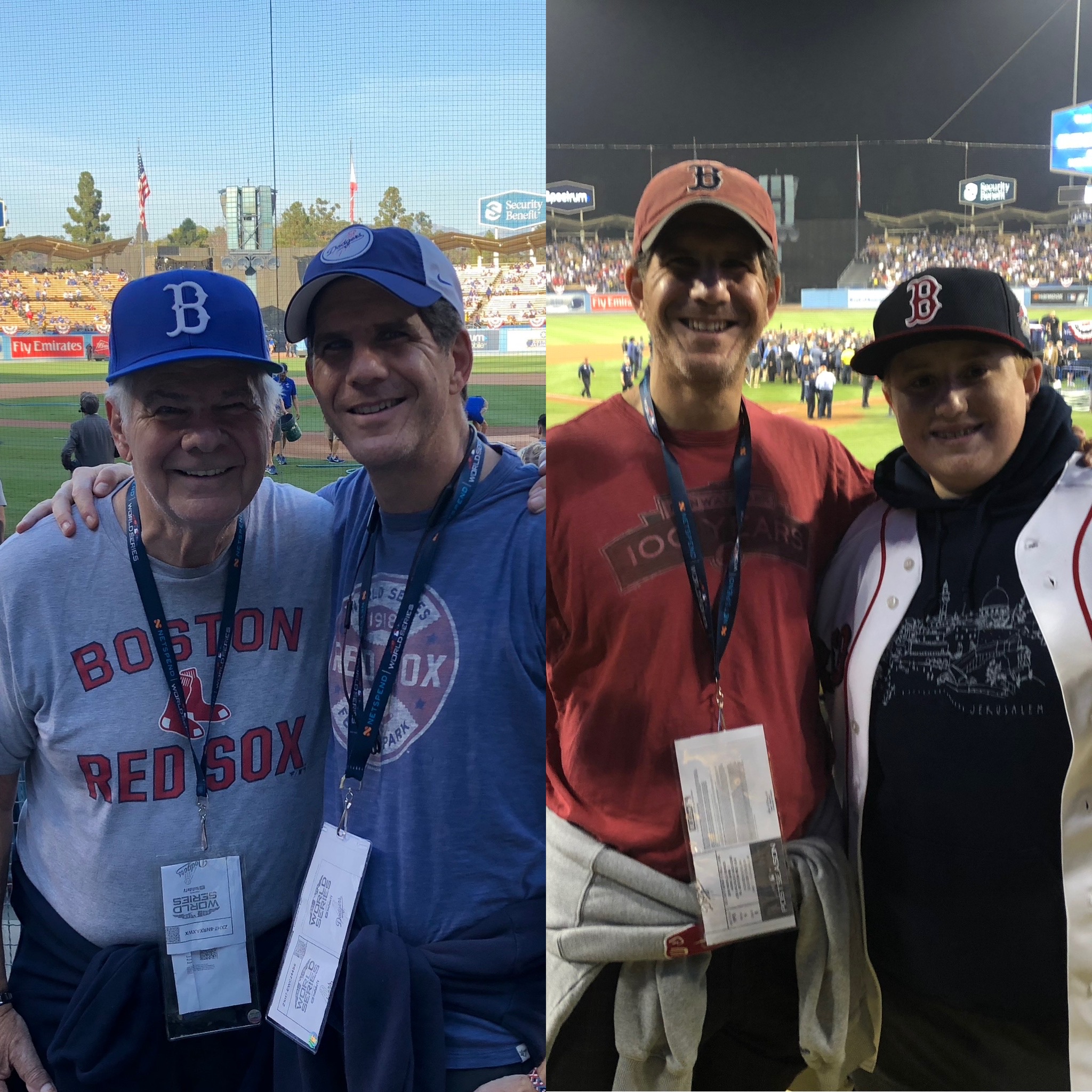
A few years back I was fortunate enough to bring my father to his first World Series. The man had lived 77 years, but never attended the Fall Classic. It was Game 3 of the 2018 edition, and we got there early to take in all the pomp and circumstance. Little did we know that we would still be sitting in our seats more than nine hours later. My dad, loving every minute, joked that he got two games in one. We were rooting for the Red Sox, but couldn’t help but cheer when Max Muncy won the game for the Dodgers with a home run in the bottom of the 18th inning.

Two nights later, I brought my son to Game 5, and we watched our beloved Boston team win the World Series together. Players go full careers without winning the World Series, but they have fame and riches to fall back on. Fathers and sons go generations without watching their favorite team win the World Series, with nothing but sorrow and woe to show for it. For me, to be able to share that moment with my son, after sharing a similar moment with my father, was truly the pinnacle of my being a baseball father and son. 

2018 World Series — Game 3 with Dad / Game 5 with Son

Since that time, I have attended more games with my father and son (both together and apart). In fact, before my boy left for college, we did a Midwest run from Chicago through Cincinnati and Cleveland, and then finished it off with a game down in Anaheim, just to get our fill before he left the nest.

And while my son has been away, I have taken my dad, and his Dodger-loving wife, to games at Chavez Ravine. My dad used to take me to games, but now I live in the liminal space where I now do the taking – I bring my dad and I bring my son – and I love it! Bringing them to games is one of the pure pleasures in my life.

A few months back I got a wild idea. My dad had never seen my son’s college, and had not been to Wrigley Field in many years. My son never misses an opportunity for me to visit, or to take him to a game. So off we went to Madison, with a drive down to Chicago to visit the Friendly Confines.

For reasons that are too ineffable to articulate, Wrigley Field is my happy place. I have visited well over 30 major league parks and all but one of the current stadiums. And when I want some joy, a relaxing time, and just pure happiness, I find my way to the corner of Clark and Addison on the North Side of Chicago. The people in Wrigleyville, the atmosphere outside the stadium, the fans inside, the 7th inning stretch, and “Go Cubs Go” after each Cubbies victory, simply make me smile. So, when afforded the opportunity to share that delight with my father and son (and my daughter as well), I couldn’t pass it up.

Unfortunately, the day we chose was unlike any other I have ever experienced at a Cubs game. We encountered snow flurries on our drive into town, and then braved 41 degrees with a light wind out to right. The sun never came out, and Wrigleyville was muted. The Dodgers beat the Cubs, which was good for our hometown rooting, but denied us my and my daughter’s favorite after-game song. We needed to rush out to make sure we didn’t miss our flight home, so we didn’t get to enjoy a 10th inning libation at the Cubby Bear. It was quick and dirty at Wrigley. And it was spectacular.

Braving the cold at Wrigley Field (Dodgers won, so no “Go Cubs Go”) / April, 2023

Nothing in life – including life itself – is guaranteed. I have learned that lesson the hard way time and again. So it is imperative that we seize the moments, the experiences, that will reside deep in our memories for years to come. Feelings of mortality force you to embrace the now; and I believe it is my obligation to live those words as much as I write them.

Neither my father nor my son are getting any younger (none of us are). That means that one of them cannot do as much with me as he used to, while the other simply may be less willing. So when you have that constant, that glue, that holds relationships together, you preserve it for as long as possible. Those constants create common ground, and help find off-ramps and detours when conversations and relationships could otherwise go off the rails. Baseball is that for me – and for my father and my son.

People who know me know how much I love the game. But with my father and son, it is intrinsic – it is part of who we are, part of what we are. Baseball is a warm blanket in which we wrap each other. For my dad, my son, and me, baseball is, quite simply, home.

I have been a father for more than two decades. My kids make me laugh and make me cry. They swell my heart and fill me with pride, in everything they do. But my true delight is when my son, after all these years, grabs two gloves and a ball, and like Ray Kinsella in the final moments of Field of Dreams asks: “Dad, you wanna have a catch?”

HAPPY FATHER’S DAY and PLAY BALL!!

Are the Red Sox Good?

My son, who in his 20 years orbiting the sun has known essentially nothing but triumph for our beloved Red Sox, remains an eternal optimist. Every year, he views the team through the prism of inevitable success. Pitching woes? Those will be solved when Chris Sale comes back. Hitting woes? Triston Casas will be the next great slugger. Shaky defense? Kiké can play anywhere.

But for me, even with four World Series rings in the last twenty years, I still harken back to 1978, and 1986, and 2003, and 2011, and many years in between. The Red Sox are always the sword of Damocles hanging over my head. I try to enjoy the wins and the championships, but I have been burned just too often. Hell, in 2004, I was counting Cardinals batters starting in the fifth inning of Game 4, knowing that their lineup was extremely formidable, and if they won Game 4, why couldn’t the Red Birds run off four straight like the Red Sox did in the previous series? Simply put, I never feel “good” about this team.

Which brings us to the 2023 squad. Coming into this season, there were many unknowns, and many distractions. Losing Xander Bogaerts to the Padres was most decidedly not made better by signing Rafael Devers to a long-term extension (they should have signed both). Having a catching tandem where one guy can catch and throw and the other guy can hit, but neither can do both, didn’t feel like a recipe for success after years of Christian Vázquez’s steady stewardship. And adding the aged (and decaying?) Kenley Jansen to the back of the bullpen for two years and $32 million didn’t seem like a good use of resources nor good for our collective heart health (this, of course, was a wrong assessment).

But the Red Sox have surprised many in the ultra-competitive AL East. We are just under the quarter mark on the season, and the BoSox are winning at a .568 clip, a 92-win pace*. Sure, that is only good for fourth place in this division, but this division may send four teams to the playoffs. So, that will play. But here is the question: Are the Red Sox good?

The answer to that question truly depends on when and where you are looking. If you are judging the team while sitting in the Fenway bleachers in the top of the first inning, you may have an entirely different view than if you are sitting in those same seats in the bottom of the ninth. Your opinion will vary depending on whether the defense is on the field, or batters are at the plate. The Red Sox — in this age of the universal designated hitter — are truly two different teams. Let’s take a look, starting with ugly:

PITCHING:

Runs Allowed/Game5.194th worst
Hits Allowed3304th worst
ERA4.974th worst
ERA+95Tied for 4th worst
WHIP1.3534th worst
HR Allowed495th worst

It’s tough sledding when you are just above the A’s and the Royals, both of whom are vying for record-setting ineptitude this season, and the White Sox, who have been a dumpster fire on the South Side. There is some good news to be found in their arms, as the team has the eighth-best bullpen ERA and is tied for the fifth-most saves in the AL. But 37 games into the season has taught that as currently constructed, the Red Sox pitching may prove to be their downfall.

But now we get to the good:

HITTING:

Runs/Game5.703rd best
Runs2113rd best
Hits344Tied for 1st place
Doubles821st place
Home Runs483rd best
Batting Avg..2702nd best
OPS.7902nd best
OPS+1133rd best

It’s pretty solid when you are competing with a Rays team that has won 80 percent of its games and is leading the league in nearly every offensive category, and with the surprising Rangers, who have found a brand new alchemy under manager Bruce Bochy.

DEFENSE:

The Red Sox defense is the perfect love child of their offense and pitching. How else do you get a team that is fourth in the league in assists, but also third worst in the league in errors? They are in fourth place for the most double plays, but have the third-worst fielding percentage. Just to put a button on this bizarre defensive unit, the Red Sox are below league average at catcher, second base, third base, shortstop (where they are in last place), and left field. But they have the best league-wide fielding percentage in center field and in right. They are just plain weird.

TOTAL PACKAGE:

So who is this team? Which version is real? The better question is which side of the ball will revert to the mean? If James Paxton and Garrett Whitlock can come off the IL and stabilize the rotation; if Sale can stop being Jekyll and Hyde and have a run of consistency; if Corey Kluber could even be a shadow of “The Klubot”; if Brayan Bello finally lives up to the hype; then the Red Sox have a chance to play well into October. But, if even one or two of the above-referenced puzzle pieces doesn’t perform up to snuff, it could be another last-place finish, with the AL East getting four teams into the playoffs and the Red Sox on the outside looking in.

You can say this: This team is fun to watch. They already have 14 come-from-behind wins. Alex Verdugo already has three walk-off hits. They came back from a six-run deficit to the Orioles and a four-run deficit to the Angels. This is a team that doesn’t quit; they grind out at-bats and grind down pitchers. And, despite how bad the pitching has been overall, they are 16-0 when leading after six innings, and 18-0 when leading after eight. So maybe something is there.

When watching the Red Sox, my blood pressure will always rise and fall like the team’s win probability chart. But as I have aged, I have adjusted so that my happiness is not predicated on the team’s success. So I will tune in all summer long (and hopefully into the fall). I will never feel “good” about their prospects, and I will always pass along my pessimism to my son, who will refute my misgivings with stats and vibes, and we will continue this lifelong obsession that has taken over at least three generations of our family.

But will we ever truly know: Are the Red Sox good?

PLAY BALL!!

*All statistics current as of May 10, 2023.

RED Hare Running / WHITE & BLUE Hair Cheering: A Very Special Patriots’ Day

As a child of parents who grew up in Boston, the city holds a special place in our ancestral heart. As multi-generation Red Sox fans, the team holds a special place in our familial heart. As a two-decade runner and marathon finisher, the Boston Marathon holds a special place in my beating heart. And as someone who has tragically lost people too young, the 2013 Marathon bombing holds a special place in my broken heart.

For all of the reasons above, Patriots’ Day in Boston is just plain special. So, when I got the message that one of my son’s best friends qualified for this year’s Boston Marathon – the 10-year anniversary of the bombing – the trip was booked post-haste.

Because the family of the boy – er, man – who would be running the race had never been to Fenway Park, I had another opportunity to present my “Billy Crystal Moment.” That is the moment when you see the stadium, in all its grace and glory, for the first time. I presented this moment to my wife and daughters last year. And this year I was given the chance to do it for a whole new group. Few things give me more pleasure than leading people down the concourse on the third base side, walking them out to the main aisle, and then having them start by looking left and then sweeping their gaze to the right to take in the entirety of “America’s Most Beloved Ballpark.”

My buddy said: “Few things in life live up to the hype…this place lives up to the hype.” I cannot tell you how happy that makes me. 

This group of eleven then made our way to Loge Box 102 for the pregame festivities. To begin, the 2013 World Series team was honored. Who doesn’t get a thrill and a chill when post-bombing (“this is our fucking city”), 2004 ALCS, and 2007 & 2013 World Series hero (and now Hall of Famer) David Ortiz takes the field? Who didn’t sing along when “Three Little Birds” played as they introduced “The Flyin’ Hawaiian” Shane Victorino? And who didn’t chuckle when Stephen Drew was met with light applause? For Red Sox fans, this was a lovely jaunt down memory lane.

But after the “Band of Bearded Brothers” – the players who put the city on their back a decade ago – were announced, the real honors were bestowed. The Red Sox brought out special guests to throw out first pitches – all of whom are related to the 2013 bombing:

  • Carlos Arredondo, the marathon spectator in the cowboy hat who rushed to the aid of bombing victims, with his wife, Melida.
  • A family friend of fallen Boston police Sgt. Dennis “DJ” Simmonds, who died of injuries he suffered during a shootout with the bombers.
  • Bill Campbell, the brother of bombing victim Krystle Campbell, and his son, William.
  • Henry and Jane Richard, the siblings of bombing victim Martin Richard.

It was the last two people introduced who brought on the waterworks. After the bombing, this photo of 8-year old Martin circulated on the internet:

Martin and his family stood close to the finish line that fateful day, as Martin and his brother loved the race – a race that they vowed to one day run. The Richard family suffered too much that day: Mother Denise lost an eye; Father Bill blew out an eardrum; and Sister Jane lost a leg. Brother Henry, with just scrapes and bruises, lost his best friend.  

Last year, Henry ran the marathon wearing an “MR8” singlet, representing the Martin Richard Foundation that his family founded after the horror of 2013. But Henry was not done. This year, he led a team of Martin’s friends – all of whom are now 18 and thus eligible to run the marathon – as a tribute to the boy they all loved. 

On the field on Sunday, Henry threw out a first pitch to Jane. The Red Sox beat the Angels. Our friends made it on the jumbotron in the 5th inning, and my kids and I did the same during “Sweet Caroline.” And Rafael Devers tossed a ball to my son. What a day at The Fens. 

The visit to Fenway, the 2013 celebration, the game and the hot dogs, were all just a prelude to the main event: Patriots’ Day.

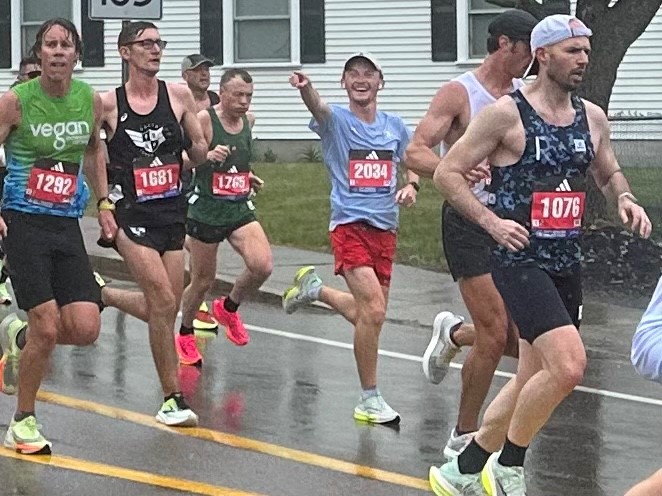
At 7am our runner boarded his shuttle in Boston Common to the start line in Hopkinton. A group of us followed a few hours later, catching him in Framingham – but not before we were treated to an Eliud Kipchoge sighting (if you don’t know, look him up). At first there was a smattering of runners; but then there were thousands pounding their way through this tiny hamlet in the rain. Craning our necks to find our guy amongst the horde of runners was an exercise in stress and excitement the likes of which I have never experienced. And then he appeared – right in the middle of the street. We saw him, he saw us, and then I cried. And then I ran a few hundred yards alongside him because, well, I have no idea why. 

We got back in the car, drove through Wellesley, Newton, Brookline, and back to Copley Square where we waited in the drizzle and then rain. The police wouldn’t let us near the finish line, so we watched the television feed on our phones, and screamed as he ran right through the camera at the finish line, a giant smile on his face. A few minutes later we all hooked up. It was considerably more emotional than I ever imagined.

Before this little redhead – who I have known since he was two – crushed the Boston Marathon in 2:45, he was the ever-reliable leadoff hitter and second baseman on a travel team that I managed for years. I coached this boy from the time he was Martin Richard’s age, and never did I have a more coachable kid; maybe never did I have a better kid. He is not my son, but standing in the rain in the heart of Boston, I could not have been more proud if he was. I thought of Martin, and his friends running for him, and my son hugging his buddy after 26.2 arduous miles, and I thought: But for the grace of G-d… And then I cried.

Baseball is and has been my bedrock, my foundation. It’s what I can talk to my father and son about, whenever and wherever. It’s where I can bring friends and family and allow them to revel in the beauty of a game that I never take for granted. It’s when, as a coach, I was able to build lasting friendships and maybe, just for a moment – or for a lifetime – have a positive impact of someone’s life.

Truth be told, I wasn’t thinking these deep thoughts as I sat in the airport ready to head home to work and bills and more quotidian matters. But I was thinking about how terrific the weekend had been. I was thinking about how special it was to introduce this group to Fenway Park, and to be there with my son and daughter, and how we cheered uncontrollably on the streets as our runner passed us by and met us afterwards, and how it was through baseball that I truly forged my relationship with this kid, and his father, and his entire family (grandparents included). And then I received a text from the marathoner. Amongst the many amazing words he wrote, he said the following: “Don’t think I would be crossing the finish line today if it wasn’t for you.”

And then I cried.

PLAY BALL!!

The Blue in the Sky

We currently have the lowest unemployment rate in 50 years, but we could always use more jobs. Going back many years, I have had a plan to add at least 15 new ones. And while these jobs wouldn’t do much for the national labor statistics, they would do a great deal for our enjoyment of the game of baseball.

MLB introduced a replay system in 2008, at first simply to review home runs. That remained the case until 2014, when replay was expanded to include a slew of additional plays (e.g., force calls, tags, fair/foul calls (in the outfield only), skipping bases, hit-by-pitches, fan interference, etc.). Over the years, the replay rules have been refined. To wit:

  • 2015: Managers no longer had to leave the dugout to challenge a call, and they retained challenges after every overturned call (it used to be just after the first victorious challenge).
  • 2017: The time to request a challenge was limited to 30 seconds, rather than merely before the next play. And, here was a big one: the replay crew in New York had a two-minute time limit to reach a final conclusion (more on that below).
  • 2020: Managers’ window of opportunity was further reduced to 20 seconds. 
  • 2022: Umpires were now mic’d up to inform the fans of the final decision.

My idea then, as it remains today, is that MLB should employ one additional umpire for every game. We will call him/her the “Blue in the Sky” (or “BITS”). BITS would sit in the booth (maybe right next to the official scorer) with an earpiece and microphone that goes directly to the home plate umpire and a “bat” phone that goes directly to the replay headquarters in New York. 

If/when there is a close play, BITS would immediately radio down to the home plate ump and tell him (as of this writing, there are no female umpires in MLB) to hold one beat. BITS would either have a bank of monitors in front of them or would use the bat phone to call New York. In addition, the moment BITS contacts the home plate ump, the two-minute clock would start. If BITS cannot get a decision when that bell rings, the call on the field stands. As we all know, the current two-minute rule is rarely enforced, with replay reviews — from inception until explanation — often taking five minutes or longer.

By engaging BITS, we take the decision-making out of the hands of the manager — or, more accurately, out of the hands of some video intern watching the angles as quickly as possible in a closet a few feet up the runway. Sure, we could still allow managers to have one challenge per game for that unlikely situation wherein BITS doesn’t think anything is amiss.

But BITS, by virtue of their vantage point, has a much better bead on the play. Watching at home or sitting in the stands, we have an immediate reaction when a play should be reviewed, but managers don’t have that same perspective. So let’s take that out of his hands; let’s have a paid professional doing that hard work. And this will also relieve the issue of a missed call in the late innings because a manager exhausted his challenges earlier in the game.

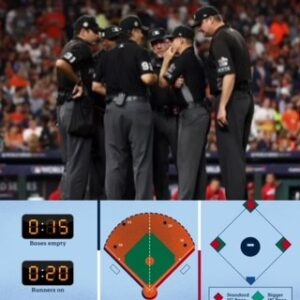
With the new rules implemented for the 2023 season, the role of BITS becomes that much more important. Let’s take a look at a few situations where BITS could prove helpful:

The Shift: BITS can tell, nearly definitively, if two infielders are on either side of second base, and if all infielders are on the dirt. Plus, they can see if any infielder is getting a running start before a pitch is thrown. There is just no way for a manager to be able to see that from the dugout.

Pitch Clock: While the home plate umpire is equipped with a buzzer that informs him if/when the 15/20 seconds have expired, he does not have one for the 8-second deadline for the batter. BITS will be able to see that clearly. Further, BITS could use his/her reasonable judgment as to whether the catcher was ready (which was the cause of consternation in the Red Sox-Braves game the first week of spring) if/when a batter is assessed a strike for not being ready. BITS could be sitting next to or close to the clock-keeper (not sure this individual has a formal title yet) to make sure that they are starting and stopping the clock in accordance with the rules and circumstances.

Disengagement: There will be questions — mark my words — as to whether or not a pitcher actually disengaged from the rubber. Do it thrice, and a balk will be called. The balk has always been the worst call in baseball, as it is never uniformly applied and nearly impossible to know if the pitcher was actually trying to “deceive the runner.” But, BITS will have a considerably better angle to determine a disengagement and potentially a deception.

I know it is an unpopular position as a sports fan to say we need additional referees or umpires, but in this case, it makes perfect sense. Let’s put an end to a guy running out with a monitor and officials donning headphones. Let’s take the onus off managers to make split-second decisions. Let’s have BITS, the “Blue in the Sky,” make the call. And then leave it to the on-field ump to say:

PLAY BALL!!

Bring on the Chaos

I have a motto, one that I communicate to my kids as well as anyone I work with, and one that has served me well for over two decades: “Try never to make the same mistake twice.”

Because, in the words of Billy Joel, “We’re only human, we’re supposed to make mistakes.” Mistakes are, for my money, the number one way to learn anything. Try, do, screw up, figure it out, move on to the next one. In my career, I have learned more from deals, or provisions, or contracts that I messed up than any that went perfectly well. We have to feel that pit in our belly; we need to have a sleepless night or two; we have to get red with embarrassment when malfeasance is made public. These are the teachable and learning moments. They suck. And we wouldn’t wish them on anybody. But they happen. And we learn and we grow. And then we resolve never to make that same mistake again.

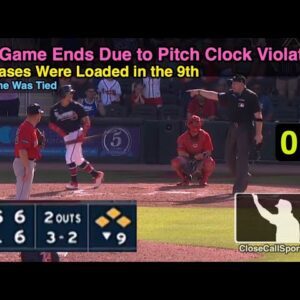
So, when a Red Sox – Braves spring training game ended with a “Clock Off” (h/t Mike Ferrin), I could not have been happier. For those of you who missed the biggest story of the first week of the spring (other than Manny Machado’s $350M and Gavin Lux’s shredded ACL), Braves second baseman Cal Conley came to the plate in the bottom of the ninth with the bases loaded and the score tied. He ran the count to 3-and-2, and then got called out because he was not in the batter’s box, ready to hit, when the pitch clock struck 8 seconds. Never mind that Red Sox catcher Eli Marrero was standing (not crouching) at that moment, the rule is that the batter must be ready. Per MLB, the correct call was made. And because the teams had decided against extra innings, the game ended in that most unconventional manner.

The announcers proclaimed, “This is mayhem…this is baseball in 2023.” In fairness, it is hard to tell if the announcers were being derisive or just descriptive. Either way, I don’t care. Bring on the chaos. Let every game from now until March 29th have a moment of uncertainty; let there be pitchers and batters violating the pitch clock; let there be infielders with their feet on the outfield grass; let there be players taking a running start to field their position. And let the umpires call a violation on each and every occasion. That is the only way they will learn. Let them make mistakes, and then try never to make the same mistake twice.

When MLB announced the new rules, and further decreed that they would be implemented from day one of spring training, some people lost their mind. Even if they were inclined to abide by the changes, some players and fans thought a slower implementation would be better for those who have been playing one way their entire lives. I disagreed then, and disagree now. And, from the looks of things on fields from Florida to Phoenix, players are getting comfortable, and the rules are having their desired effect.

Other than baseball purists who want players wearing wool and traveling by train, who doesn’t prefer games ending in roughly 2½ hours? Other than those same purists, who cares what happens in a meaningless spring training game where players who won’t sniff the big leagues this season are pitching, catching, and hitting in a tie game in the bottom of the ninth? Let chaos reign for the next four weeks. Let’s get it all out of our systems. Let the players have a moment of embarrassment. Machado – and his $350M contract – was the first player to take a called (not thrown) strike under the new rules. Do I think that is the last time he takes one of those? Probably not. But maybe Jake Cronenworth or Xander Bogaerts saw that and thought to himself, “Never going to happen to me.”

Same for pitchers. On the first weekend of the spring, over sixteen games, there were 35 violations, 27 by pitchers. Did they all learn their lessons? I doubt it. But maybe/hopefully, their teammates did. Some pitchers, like the Guardians’ Cal Quantrill, have made an adjustment and sped up their routine. New Red Sox closer Kenley Jansen, one of the players for whom the pitch clock was implemented, has been working all off-season to speed up his delivery, including changing his double-swivel to get going quicker. He seems excited, not exercised, by the new challenge. These are athletes who can change their arm angle or their grip on the ball after a single bullpen session; there is no reason they can’t learn to pitch a smidge more quickly.

Spring training used to be about getting players into physical shape. This year it is about getting into mental shape – dealing with the new rules. Let the players make all sorts of mistakes; let the umpires make all sorts of mistakes; let the announcers proclaim mayhem or bedlam or anarchy. That way, when the games matter, when there is something to play for – be it in April or October – everyone is on the same page…and on the same clock.

PLAY BALL!!

Attach Some (Payroll) Strings to Stadium Subsidies

I recently read “Field of Schemes” by Neil deMause and Joanna Cagan, which delves into the decades-long grift wherein billionaire owners bilk municipalities out of billions (it used to be millions) of dollars by having them finance stadiums under the threat of relocation. I read that book after reading Dan Moore’s terrific piece in The Ringer, in which he discussed how Camden Yards “forever changed professional sports.” In the article, Moore stated:

“In the 30 years since it opened, in the spring of 1992, Camden Yards has proved, beyond just beautiful or influential, illustrative of the more ignominious side of the political ecosystem that undergirds professional sports. The proof is in the funding. One of the worst-kept secrets in pro sports is that the people who run teams and leagues are sanctioned by the U.S. government to do so the same way kingpins run drug cartels: that is, as monopolies.”

Take the Money and Stay

There are many other thoughtful books and articles written about this topic, but the main takeaway is that public funding of professional sports stadiums does not provide the financial boon that the owners (and city council members and mayors and governors) tout when signing the legislation or cutting the ribbon. These payments are simply a boondoggle. That said, they appear to be here to stay. As of this writing, there are a total of three MLB stadiums that have not received some form of taxpayer funding (Fenway Park, Wrigley Field, and Dodger Stadium*). The amounts and the specifics vary – there are tax subsidies given directly to the team; tax-free bond issues; taxable bond issues; hotel taxes in and around the park; there are the granting of additional land for parking lots and entertainment complexes – the list is limited only by a legislature’s and an owner’s imagination. However you slice the pork, there is plenty of it to go around.

*This is only because the City of Los Angeles evicted more than 300 families to clear the land at Chavez Ravine for Walter O’Malley to buy.

As long there are civic leaders in the thrall of professional sports and their team owners, as long as there are mayors who want to throw out the first pitch or sit in a luxury box for Opening Day, as long as there are rich people willing to scratch powerful peoples’ backs, the public at large is going to continue subsidizing – if not completely paying for – ballparks. If we accept that to be true, it raises the following question for me: Do these clubs have a moral, ethical, and/or fiduciary obligation to put a competitive and enjoyable team on the field? Can owners pocket their constituent’s tax dollars plus their fellow owners’ revenue-sharing money, and continue to underspend and put a suboptimal product on the field. The answer to that question is obviously “yes.” The follow-on question is, “should they be able to.”

For starters, it is clear that no one can predict with any certainty winners and losers. Teams come out of the woodwork every season or two to shock the world. And, by the same token, money doesn’t buy championships (ask the Yankees). But, dunking on the Yankees thirteen-year fallow period aside, the Bombers nearly always put a viable team on the field.

However, for the last few years, certain teams have failed to even try. True, we live in a world where the Astros and the Cubs proved that “tanking” could be good for long-term success. But, does any bona fide baseball fan truly believe that the Pirates or the A’s are “tanking” to secure a better future?

Orioles

The Orioles have some of the best prospects in baseball, and have for a couple of years now. They made great strides last season, winning 31 more games than they did in 2021. With that improvement, how much has the team’s dysfunctional ownership spent in free agency this off-season? Let’s take a look:

  • Jordan Lyles (2/$17M)
  • Kyle Gibson (1/$10M)
  • Adam Frazier (1/$8M)
  • Mychal Givens (1/$5M)
  • Jesus Aguilar (1/$3M)

This largesse (less than what Justin Verlander will make this season) was spent after the Maryland Stadium Authority offered the Orioles a new lease, and made $600M in public funds available to improve Camden Yards. Yes, the same Camden Yards that received public funding to be built 25 years ago, and which has cost the state about $450M in debt service and interest on bonds originally issued to finance the stadium.

Athletics

The A’s may be the worst offenders in the history of sports. They are currently in protracted “negotiations” with both the City of Oakland and Las Vegas about the team’s future. Candidly, the concept the A’s have designed for Howard Terminal is beautiful, and may bring a great many benefits to a city that badly needs urban renewal. But at what cost? According to CBS Sports, “the project includes a $1B privately financed ballpark, plus another $12B in private investment for residential and commercial space in the waterfront neighborhood. The A’s are also seeking $855M in public funds for infrastructure and to develop land around the ballpark.” Said differently, the A’s are looking for nearly a billion dollars of public money. What have the A’s done to deserve such a charitable gift? Well, they have been in the bottom six of payroll for 11 of the last 13 seasons. The have been about an 82-win team over those 13 years (which is helped considerably by two 97-win seasons), and have had three below-70-win seasons (including last year’s 60-win debacle). Ask any scout or front office executive, and they will tell you that the A’s are a Quad-A team, at best. And, for that, they want $855M in public funding.

Pirates

PNC Park in Pittsburgh is one my favorite places to visit. It is sheer beauty. When it opened in 2001, it did so on the back of public funding to the tune of $216M. The Pirates lack of spending on their club has become known in baseball as “Nutting,” named for parsimonious team owner Bob Nutting. In the past 13 seasons, the team has been in the bottom six of payroll eleven times, while averaging about 76 wins (which is skewed by seasons of 98 and 94 wins). At what point do the fine people of the Steel City have the right to demand that Nutting field a competitive team; to try to win more than 63 games (their average over the past four seasons); to give a little a joy to Yinzers to go along with their tax bill? When does MLB have the right to make the same demand?

Salary Floor?

I was heartened when, at the beginning of the labor negotiations last year, MLB presented a salary floor (initial offer: $100M). Unfortunately, they tied it to a ridiculously low luxury tax threshold. The players dismissed it out of hand. According to The Athletic, there were seven teams with opening day payrolls under $100M in 2021; but according to Spotrac, that number was actually twelve. Either way, you had to know that those seven (or twelve) billionaires (except Stuart Sternberg ($700M) and Bruce Sherman ($500M)) didn’t truly want to be required to shell out additional payroll. Suffice it to say, none of those seven (or twelve) privately funded their parks.

This is truly a conundrum: Boycott the team, and the owner will claim less ticket and television revenue, and will use that as an excuse to spend less on the team, or demand more from the city (or another city). Continue patronizing your favorite or hometown club, and thus continue to put money in these miserly owners’ pockets in an (often futile) attempt to insure that the team doesn’t up and leave for more lucrative environs.

But I believe I have a solution. If MLB can have an antitrust exemption (Congress is currently looking at that…again), then they can also be subject to a federal law that states that if you receive any form of public subsidy for your ballpark, you are required to spend at least $X million on salaries for a period of time equal to the length of any public funding. The $X million could be calculated by taking the average MLB salary in a given season, multiplied by 26. Last year that would have been $114.66M ($4.41M x 26). There…problem solved. If these owners are going to take public money, they need provide a viable entertainment product. That isn’t too much to ask.

I know Kevin McCarthy has a lot on his plate, but one more congressional bill wouldn’t kill him. Get to work.

PLAY BALL!!

Quit Your Whining

In the end, the best team won. That sort of vindicates the system, no?

At the beginning of these playoffs, the first under the expanded format wherein 12 teams were allowed into the dance (2020 excepted), there was a great deal of Sturm and Drang about the early outcomes. When the 89-win Padres knocked off the 101-win Mets in the Wild Card round, and then when those same Padres bested the 111-win Dodgers in the NLDS, and when the 87-win Phillies beat the 101-win Braves, Rob Manfred’s name was being burned in effigy from coast to coast, and even down south.

“How could we let this happen?,” fans cried. “What is the purpose of being great in the regular season?,” fans lamented. To me, all I heard was whining. Buck Showalter, the terrific manager of the Mets (as well as many other teams) put it perfectly, and perfectly succinctly: “Play better.” That’s it; that’s all it takes. And maybe a little luck. But it certainly doesn’t require yet another re-working of the playoff schedule because your team, who played so well during the 162-game marathon, forgot to bring their clutch hitting to the playoffs; or had starters get sick; or just got beat in a short series. Welcome, my friends, to baseball.

But with all of this bellyaching early in October, I decided to take a look back to determine if what we were witnessing was an anomaly or part of the game. What I found was neither shocking nor surprising. In fact, what I learned is that these playoffs were very much like most of the ones in the past. Going back to 2000 (just to choose an arbitrary round year), and excepting the wonky 2020 season, there have only been three seasons in which an “upset” didn’t occur (2007, 2009, and 2018). Sure, the Padres-Dodgers 22-win differential is an extreme outlier, but the Phillies-Braves 14-win differential is right there with the 2003 Cubs (13), the 2008 Dodgers (13), and the 2019 Nationals (13).

So, having lower-seeded teams win – regardless of the number of teams in the playoffs – is not a bug, but actually a feature of baseball playoffs system. That’s what makes October (and now November) so great. Let’s take a look:

SEASONROUNDWINNER (Seed/Wins)LOSER (Seed/Wins)WIN DIFFERENTIAL
     
2001NLDSBraves (3/88)Astros (1/93)5
2002ALDSAngeles (4/99)Yankees (1/103)4
2002NLDSGiants (4/95)Braves (1/101)6
2003NLDSCubs (3/88)Braves (1/101)13
2003NLDSMarlins (4/91)Giants (1/100)9
2004NLDSAstros (4/92)Braves (2/96)4
2005NLCSAstros (4/89)Cardinals (1/100)11
2006ALDSTigers (4/95)Yankees (1/97)2
2008ALDSRed Sox (4/95)Angels (1/100)5
2008NLDSDodgers (3/84)Cubs (1/97)13
2010ALDSRangers (3/90)Rays (1/96)6
2011ALDSTigers (3/95)Yankees (1/97)2
2011NLDSCardinals (4/90)Phillies (1/102)12
2012ALDSTigers (3/88)A’s (2/94)6
2012NLDSCardinals (5/88)Nationals (1/98)10
2013ALDSTigers (3/93)A’s (2/96)3
2013NLDSDodgers (3/92)Braves (2/96)4
2014ALDSRoyals (4/89)Angels (1/98)9
2014NLDSGiants (5/88)Nationals (1/96)8
2015NLDSCubs (5/97)Cardinals (1/100)3
2016ALDSBlue Jays (4/89)Rangers (1/95)6
2017ALDSYankees (4/91)Indians* (1/102)11
2019NLDSNationals (4/93)Dodgers (1/106)13
2021ALDSRed Sox (4/92)Rays (1/100)8
2021NLDSBraves (3/88)Brewers (2/95)7

*To keep the historical record accurate, the Yankees beat the “Indians” in 2017.

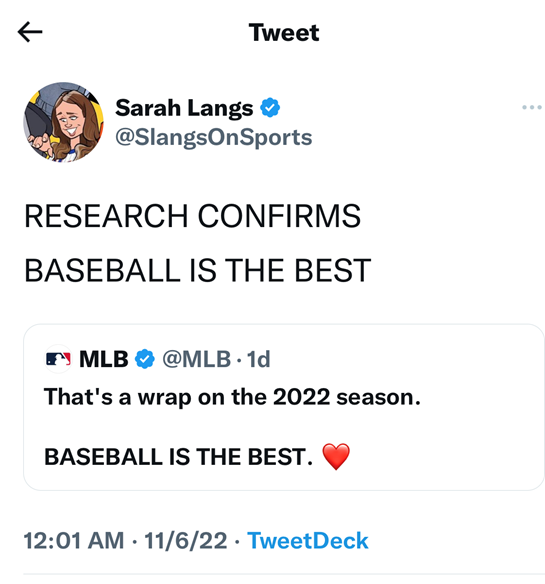
Sure, by dint of the Padres and the Phillies making a run, the numbers look skewed in 2022. And if the 87-win Fightin’s had beaten the 106-win ‘Stros, there would have been a lot of talk about upsets and unheard ofs, etc. But did the collective masses say we should re-do the World Series format after the Dodgers beat the A’s in 1988? Or when the Marlins felled the Yankees in 2003? Would we have wanted it changed if they had a parade in Philadelphia this week? The obvious answer to all of these is “no.” So kick and scream and lament that your team fell short. But quit your whining. The current system is here to stay (until there is expansion, and then we will see). Do all the math, crunch all the numbers, and then listen to the inimitable Sarah Langs:

PLAY BALL!!

The Dangers of Leading With Your Head

A few weeks ago, a friend of mine whose son plays Division I baseball told me a story. She was watching her son’s game on television when a player (not her son) dove headfirst into second base on an attempted steal. The runner’s head smashed into the shortstop’s knee, whereupon the runner collapsed on the field. For many moments, the players, coaches, and umpires didn’t know if the runner was alive – he certainly wasn’t moving. After about five interminable minutes, the player regained consciousness and was helped from the field. He was later diagnosed (luckily, as it happens) with only a concussion.

My friend told me this story as a prelude to a question that I have been asking in various forms for years: Why do players slide headfirst? Why is this even allowed?

Now, I am sure there are old-timers out there who will tell me that banning headfirst slides would be un-American; a violation of individual rights; a further wimpifying of our culture; that it would be pillow-parenting run amok. Okay, fair enough. Here in America you are entitled to your opinion, as am I.

It seems like I write about this issue every year. It turns out I have only done so in 2015, 2016, 2017, 2019, and now 2022. And the reason I keep writing about it is because it is still an incomprehensible practice.

The issue came top of mind a few weeks back when I watched one of my favorite young players – Ke’Bryan Hayes – do something so monumentally stupid that I could not believe my eyes. And it made me question what his father (a former big leaguer) taught him, and what type of coaching he is receiving in the Pirates organization. Here was the situation:

Hayes was on second as the Manfred-Man to start the bottom of the 10th inning. With one out, Michael Chavis hit a short looper over first. Hayes never stopped running. Rafael Ortega scooped the ball up on one hop, turned, and fired a strike to home plate. Waiting to receive Ortega’s throw was well-known (illegal?) plate blocker Willson Contreras, all 225 pounds of him. So what did Hayes, three inches shorter and at least 20 pound lighter – not accounting for the mass of equipment Contreras was wearing – do? He dove headfirst into home plate, where he met the Cubs’ catcher, and his heavy plastic shin guards, and his oversized backside. Hayes scored the winning run, and then lay in the dirt for nearly a minute. The Pirates’ play-by-play guy stated: “I have never seen a celebration muted like this.”

Hayes was helped to his feet and off the field, and then missed then next two games with a sore shoulder. He was lucky it wasn’t considerably worse; but since he has been back in the lineup over the last nine games, he is 6-for-35, with no extra base hits. Because correlation does not prove causation, you can draw your own conclusions.

Why did Hayes dive into home rather than sliding feet first? Why not utilize a classic hook slide moving his entire body as far from Contreras, who was catching a ball thrown from right field, and thus could not get a specific bead on the runner? Or, for all you throwbacks out there, how about him knocking Contreras’ block off – Pete Rose style – in the hope of dislodging the ball from his mitt? I think a replay review would have shown that Contreras did not provide Hayes with a path to the plate prior to his receiving the throw. Any of those options would have been better than putting his fingers, hands, wrists, neck, head, and shoulders at risk. Why didn’t the Pirates coaching staff alert the players in their scouting report that Contreras likes to block the plate? Why didn’t the Pirates player development staff coach their players to be safe, not sorry, when trying to advance to the next base? Why?

Sure, we all love watching Javy Báez with a swim slide into second base avoiding the tag of an unsuspecting middle infielder. But, at what cost? In 2019, Báez dove into second base, fractured his thumb, and missed the month of September. Some lessons are never learned.

Since the Hayes incident, I have seen a handful of additional players dive into home plate, all avoiding serious injury. But that is just dumb luck. Baseball is a dangerous game on its own. Don’t believe me, ask:

  • Mookie Betts (ribs, from an outfield collision)
  • Jacob deGrom (shoulder)
  • Manny Machado (ankle, running to first)
  • Max Scherzer (oblique)
  • Salvador Perez (thumb, due to a swing)
  • Ozzie Albies (fractured foot from a foul ball)
  • Walker Buhler (flexor strain and bone spur)
  • Stephen Strasburg (ribs)
  • Chris Sale (ribs)
  • Bryce Harper (thumb, due to a HBP)
  • Anthony Rendon (wrist, due to an errant swing)
  • Jazz Chisolm, Jr. (back strain)
  • Jack Flaherty (shoulder)
  • Tyler O’Neill (hamstring)
  • Hunter Renfroe (calf)

This list could go on and on. The point is that there is enough that can go wrong on a baseball field that players don’t need to take it upon themselves to up the ante. Sliding headfirst has shown, time and again, to be a fool’s bargain; and as I wrote in 2016, extremely costly. MLB teams need to get smart about this. But so, too, do college teams. And high schools. Yes, it is legal there as well.

When and where will the madness stop? When an aspiring physicist or politician or doctor playing baseball for an Ivy League institution dies on the field because his neck and head couldn’t endure the impact with another kid’s knee? Or will it require a $30M/year superstar becoming paralyzed on a major league diamond in front of 40,000 fans and on national television because he believed that leading with his head offered him the best chance to score a run in the fifth inning of a 7-2 ballgame?

MLB has shown a willingness to change its rules when big-name players get injured on a big stage (see, the Chase Utley Rule; see, the Buster Posey Rule). Why wait until we have to name this new rule? Or, if we must, let’s call it the Hayes Rule, named for a legacy player who narrowly avoided disaster and forced baseball to do the same.

PLAY BALL!!

Tropican’t

We all create bucket lists; things we want to do or see before we leave this mortal coil. For me, I have run with the bulls and climbed Machu Picchu. I have run a marathon and climbed the Eiffel Tower. But still on my to do list is visit every major league park. Having crisscrossed the country in an effort to check every batter’s box, I began to think I would fall one short: Tropicana Field. I just wasn’t too keen on visiting that odd park on the opposite side of Tampa Bay.

But, last week, I relented. I had to see – in person – if the ballpark was as bad in person as it appears on television. Now, for years I have railed against Dodger Stadium – I find it to be one of the most fan unfriendly parks in America. But, I have also said that if I could be teleported to my seat, never needing to leave to eat or use the bathroom, and then be teleported back to my sofa, there may not be a more beautiful place to watch a game. Well, after a brief sojourn to western Florida, I now believe that Tropicana Field is the photo negative of Chavez Ravine.

Unlike Dodger Stadium, it is relatively easy to get in and out of The Trop – if you can avoid the mid-day downpours, never knowing when they might arrive. And once you are inside the park (?), it is a fan-friendly experience. The Rays have done a terrific job of highlighting their 25 years of existence with various exhibitions in the lower bowl. They have Silver Slugger and Gold Gloves on display. They have re-created lockers of their all-time greats. They have mementos of their opening season. Not to mention pictures and retired numbers (those took me a minute to figure out).

Further, they have a great area for kids and parents. There are batting cages and throwing games, as well as concessions and a small picnic-type area (decidedly underground, natch!) for the little ones. There is a quiet area for parents to chill out, and where I saw a mom breastfeeding a next generation fan. And they have actual, living, swimming Cownose Stingrays in a tank in the outfield that kids (and adults) can touch. Now, to be fair, Dodger Stadium did recently install some kid-friendly games in the outfield pavilion, so there is that.

And then there are the eats. Simply put, there is an abundance. The Trop is no Petco Park or Oracle Park. It certainly doesn’t hold a candle to T-Mobile Park as far as dining is concerned. But it holds its own. You walk around the stadium and you can get local fair (shrimp tacos) and ballpark standards (Nathan’s hot dogs for all of the New York transplants); there are various sandwich offerings, sausages, wraps, poke, pizza, and French fries. And, to top it off, and again with a nod to New York, Mister Softee is available at three locations (and yes, I did indulge).

So, yeah, the Dodgers could learn a thing or two from the Rays’ fan experience.

But for many, the fan experience is secondary to watching the game, and rightly so. For nearly two decades, the Rays have put a quality product on the field, winning the division four times since 2008, and winning the pennant in both 2008 and 2020. Tampa Bay’s front office has always been cutting edge; they were the first team to introduce the “opener” (your mileage may vary on whether that was a good or bad advancement) and began utilizing the shift long before other teams caught on (again, your mileage may vary). So, with compelling players such as Wade Boggs, Carl Crawford, Evan Longoria, James Shields, Blake Snell, and now Wander Franco, you would think the organization would want to allow them to play on a better canvas. Alas, it is not meant to be…yet. There are ongoing negotiations for a new park and/or a shared-custody arrangement with Montréal.

Coming across the bay on I-275, you see The Trop in the distance. Your/my first observation is that it is crooked. The stadium was built with a slanted roof to reduce interior volume, reduce cooling costs, and for better hurricane protection. All seem like laudable goals, but it sure is weird to look at. And, it is even weirder once you are inside, as everything is or appears slanted. There are concentric rings of catwalks (I am sure you have seen balls hit off of them) below the roof that follow the same contours. As such, you constantly find yourself tilting and un-tilting your head to make sure you are looking straight.

And because the roof is lop-sided, there is no symmetry with the upper level of the stands, which remain unpopulated, as the team’s attendance has not averaged more than 16,000/game since 2014.

The sightlines are odd, either because of the netting posts or the strange configuration of the seating, which includes picnic areas along the left and right field lines, alongside the on-field bullpens. And, when you do have a clear view, there are so many ads and so much ad hoc signage, that your eyes are often drawn away from the action. Now, I certainly understand the proliferation of ballpark advertising over the past 10-20 years, but some parks do it better than others. Some – Dodger Stadium, for instance – have a level of uniformity that makes the billboards value-add, not distracting. Some – like Chase Field – have a hodge-podge approach to their in-stadium publicity, making one think they are trying to bleed every possible dollar out of every possible square inch of wall space. Tropicana Field falls on the Chase Field end of the spectrum. And, to make matters worse, not even lost amongst the advertising are decent scoreboards or video displays. It took me two innings to find an MPH reading on Gerrit Cole’s fastball; and I never did find an exit velocity on Aaron Judge’s line out to left. The out of town scoreboard is heavy on logos, but light on actual scores.

Once I got the hang of everything, and tried to take in the game, I noticed that two of the scoreboards that actually provide useful in-game information about the pitcher and the batter are obstructed by fans in the standing area in right field. When I ventured to a higher level later in the game, the obstruction was lessened. But, come on…who was the Mensa behind that display placement decision?

The plan wasn’t to visit The Trop when the Yankees were in town – it just worked out that way. But, as could be expected, it was more like Yankee Stadium south, with the vast majority of the 16,504 in attendance wearing pinstripes and rooting on the Bombers. So, when Manuel Margot crashed into the wall in the top of the ninth inning and remained on the ground while the lead run scored, there were considerably more cheers than “aahs,” which was unfortunate (Margot was diagnosed with a patellar tendon strain and is on the 60-day IL). And when the final out landed in Aaron Hicks’ glove, and the Rays finally lost 4-2, the place erupted. It is hard to know if other teams travel as well to Tampa-St. Pete, and I am pretty sure I won’t be finding out.

I checked box #28 of active ballparks, and, in hindsight, I am glad I did. I got out of Tampa at 7am the next morning, and I am glad I did. The Rays have a lot to offer in their bizarre and hopefully impermanent stadium, concepts and ideas they can take across the bay or up to Canada. But from a game-viewing perspective, they have a lot of learn and a long way to go. However, rest-assured, when they finally do land in a new park, I will be there to watch…and critique.

PLAY BALL!