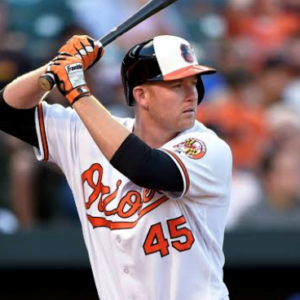
Let’s Give Mark Trumbo A Little Bit of Respect

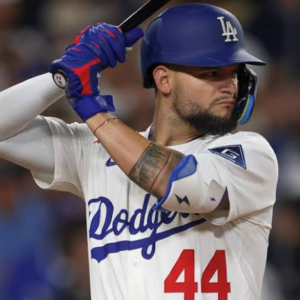
As I scrolled through X (formerly Twitter) a few weeks ago, I came across a tweet (old habits) from the great contributor Not Gaetti. He (I am assuming from the profile picture) said the following: “Not enough people talk about Mark Trumbo.” And he listed a bunch of stats. That is right; not enough people talk about this guy.

The Anaheim Angels selected Trumbo in the 18th round of the 2004 MLB draft out of Villa Park High School. He started 2005 in rookie ball, hitting ten home runs in 299 at-bats. He slowly worked his way through the minors, notching as many as 36 dingers (which occurred in 2010 in Salt Lake, so there may be an asterisk on that season).

Trumbo made his major league debut, striking out in the seventh inning of a game against the Mariners after his September call-up. He started his career going 0-for-14 with eight strike outs before recording his first hit, a two-out, two-run single in the Angels’ last inning of the season.

That base hit must have left a lasting impression, as he broke camp with the club in 2011, played in 149 games, smashed 29 homers, while slashing .254/.291/.477, for a 114 OPS+ and second place in Rookie of the Year voting.

The following year was more of the same, but better: 32 dingers, an .808 OPS, and a 124 OPS+. That garnered him his first All-Star appearance.

In 2013 he cranked 34 home runs and drove in an even 100.

After that season, Anaheim included Trumbo as part of a three-team trade, sending him to the Arizona Diamondbacks (as a side note, Tyler Skaggs went from Arizona to Anaheim in that deal, changing the trajectory of his career and his life).

Midway through the 2015 season, the Diamondbacks traded Trumbo to the Seattle Mariners, where he put up 1.0 bWAR in 96 games, hitting thirteen home runs.

At the end of the year, the Mariners shipped him off to Baltimore. It seems reasonable that Seattle regretted the move. Trumbo had a career year — bashing 47 homers (which led the league), driving in 108, with a 122 OPS+, earning him his second All-Star nod and his first Silver Slugger Award. He won the Comeback Player of the Year Award, to boot.

Then Trumbo came back to earth. Over the next two seasons combined, he hit just 40 homers and drove in 109 runs. Trumbo missed most of the 2019 season with a knee injury, not taking his first at-bat until September 2nd. He ultimately played in 12 games in what would be his final MLB season.

When all was said and done, Trumbo’s career slash line was .249/.302/.459, with a 108 OPS+. He hit 218 homers. When discussing potential Hall of Fame pitchers, note that Trumbo had a 1.533 OPS against Mark Buehrle, and slashed .348/.375/.739 when facing Cole Hamels. Per Baseball Reference, his career is most similar to Pete Incaviglia, but a more modern-day comp would be Teoscar Hernández. Trumbo isn’t a Hall of Famer; he doesn’t even belong in the Hall of Very Good. But he had a solid career, earning nearly $60 million along the way.


On September 10, 2013, Trumbo became the first Angel to have five hits and score five runs in the same game. He had three doubles and a homer, for 11 total bases.

On April 15, 2016, Trumbo became the first Oriole to hit two home runs in the same inning, when he smashed a two-run dinger off Martín Pérez and then a three-run shot off Andrew Faulkner.


We tend to forget the players that come and go; those who don’t put up massive numbers, but are solid year after year. It is important to recognize the lunchpail guys who show up, do the work, produce, and leave the game and their teams better than where they found them. Mark Trumbo was just that type of player.

PLAY BALL!!

Dwight Evans Should Be Given Some Additional Hall of Fame Consideration

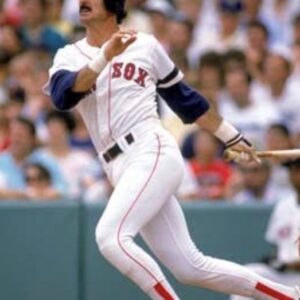
For a while during the mid-‘80s, the Boston Red Sox right fielder Dwight Evans, “Dewey” to the fans in the Back Bay, was always on base and always making great plays. He was the heart and soul of a Red Sox team that flirted with greatness.

Evans grew up in Southern California, and starred at Chatsworth High School on the same field where Mike Moustakas would eventually play. In 1969, the Red Sox selected Evans in the fifth round of the draft. Three years later he made his major league debut. He came in as a pinch-runner for Reggie Smith (who ended his career in Southern California and still runs a hitting clinic in the area) in the bottom of the sixth inning of a game in September, and then had his first plate appearance in the bottom of the eighth, popping out to short.

Evans got 63 more plate appearances over the final two weeks of the 1972 season, slashing .263/.344/.404, but ended the season with an 0-for-4 ten days before this writer was born.

Evans became an everyday player the following year, and won his first Gold Glove in right field in 1976 (he would go one to win seven more). He hit his stride in 1981, tying for the American League lead (with Eddie Murray) with 22 home runs, and leading the league in walks (85), OPS (.937), total bases (215), and bWAR (6.7). For all of that he became a second-time All-Star, a first-time Silver Slugger, and came in third in MVP voting (behind Rollie Fingers(?) and Rickey Henderson). He won his third Gold Glove, to boot.

The following year he played in every game and led the league with a .402 on base percentage. It was in 1981 when he got his first taste of being the team’s leadoff hitter (101 plate appearances). For whatever reason, I recall Dewey batting leadoff throughout the ‘80s, when in fact that was his calling in just 1985 (355 plate appearances). No matter, he was in top-ten in on base percentage eight years between 1981-1989. Over an illustrious 20-year career, he slashed .272/.370/.470, with 385 homers (68th all-time) and 483 doubles (82nd all-time).

Evans first appeared on the Hall of Fame ballot in 1997, and barely survived to fight another day, with just 5.9% of the vote (a candidate needs to receive 5% or more to remain in contention the following year). In 1998 he nearly doubled his support, with 10.4%. But in 1999, only 3.6% of the electorate checked the box next to his name, pushing him off the ballot altogether.

In 2020, the Veterans Committee heard his case, and 50% voted for his induction. Unfortunately, 75% is required. All of which begs the question: Is Dwight Evans a Hall of Famer?

This is where Baseball Reference is exceedingly helpful. Where the average Hall of Famer has 27 instances of “black ink” (i.e., leading the league in a category), Evans has only 15. According to Bill James’ Hall of Famer Monitor, where a score of 100 denotes a likely entrant, Evans is only at 70 (but, note, that this just considers his offensive production, and not his Gold Glove defense).

By James’ Hall of Fame Standards, where the average Hall of Famer scores a 50, Evans lands at 44. Per Jay Jaffe’s JAWS metric, Evans falls just shy in every category:

  • Career bWAR: 67.2 / Average Hall of Fame right fielder: 69.7.
  • Peak 7-year bWAR: 37.3 / Average Hall of Fame right fielder: 42.2.
  • bWAR/162: 4.2 / Average Hall of Fame right fielder: 4.9.
  • Evans’ overall JAWS score 52.2 / Average Hall of Fame right fielder: 56.

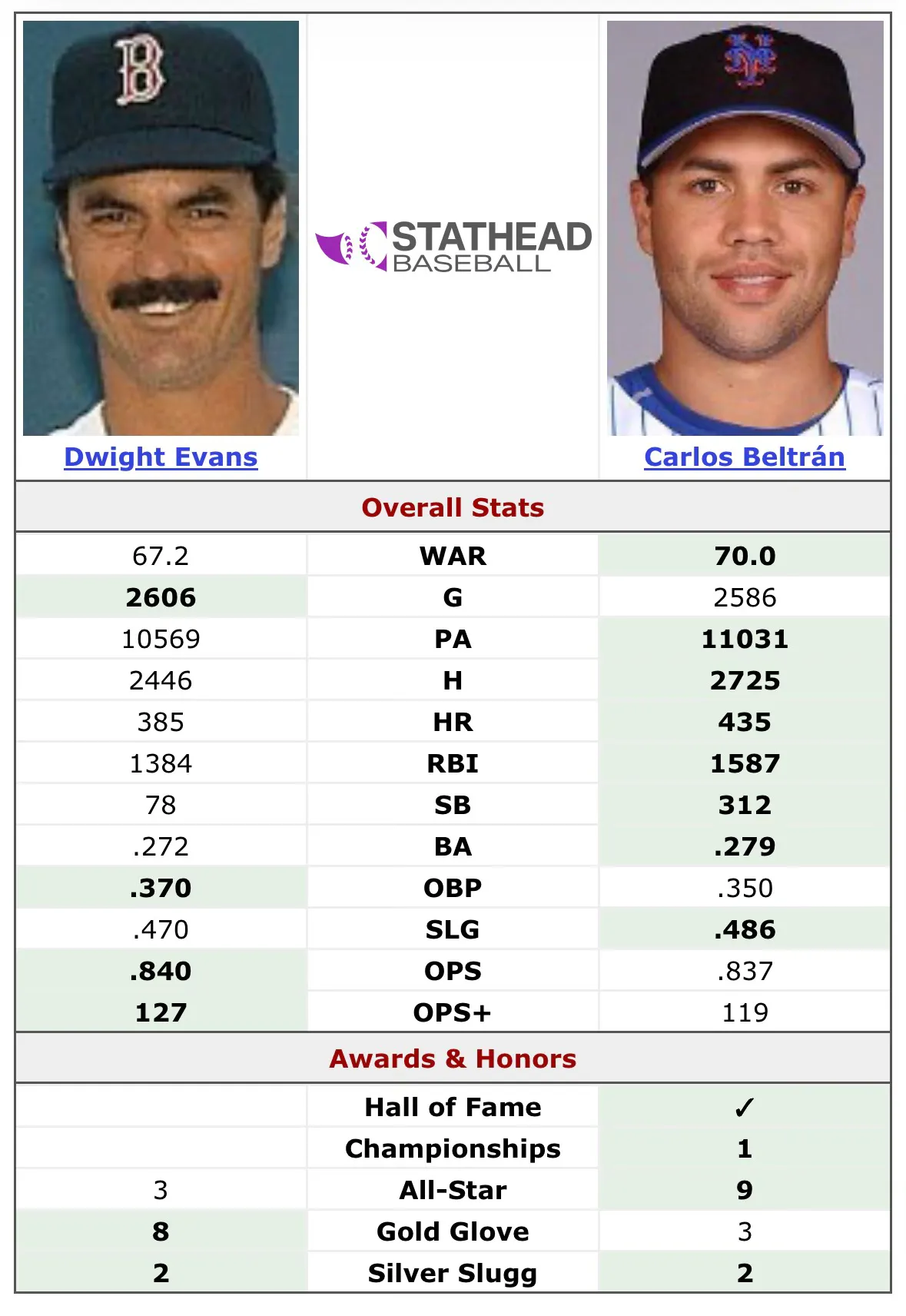
Does all of this advanced analysis mean that Evan is certainly not a Hall of Famer? By no means. If you are a “Large Hall” fan, you could definitely see Dewey with a plaque. If a “Small Hall” is more your speed, you think Evans probably belongs in the “Hall of Very Good.” Neither argument is incorrect. But, as we watch more and more players get further consideration for the ultimate honorific, it seems only right and reasonable that Dwight Evans get another look. And with Carlos Beltrán getting the nod this year, let’s compare the two:

Based on this side-by-side comparison, there is every reason for the Contemporary Baseball Era Committee, which meets again in 2028, to give Dewey serious consideration.

PLAY BALL!!

Fred Lynn Deserves Additional Hall of Fame Consideration

It was 1973 in Bristol, Connecticut. Two outfielders from vastly different backgrounds got together to play for the Boston’s Double-A affiliate. The next year they teamed up in Pawtucket, the club’s Triple-A team. So, for those following the Red Sox closely in the mid-70s, it was not a shock when the “Gold Dust Twins” took their respective positions in the outfield at Fenway Park to start the 1975 season (to be precise, they didn’t play at home until the third game of the season, after playing the first two in Baltimore).

Fred Lynn grew up in Southern California, and played collegiately at USC. He spurned the Yankees when they drafted him in the third round in 1970, signing with Boston after being drafted in the second round in 1973.

Boston selected Jim Rice with the 15th pick in the 1971 draft out of Hanna High School in Anderson, South Carolina. He played in the New York Penn League as an 18-year old, then in Winterhaven in 1972. Rice actually started the 1973 season in Triple-A, but was demoted to Bristol after ten games despite slashing .378/.425/.757 in that short span of time.

When Rice arrived in Bristol, he was paired up with Lynn, and it would remain that way for the next nine years, until Lynn was traded away to the (then) California Angels.

Both Lynn and Rice got cups of coffee with the Red Sox at the end of the 1974 season, playing in 15 and 24 games, respectively. Lynn collected 18 hits in 43 at-bats, while Rice got the same number of hits over 67 at-bats.

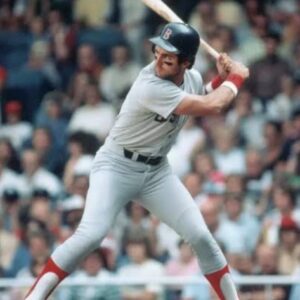
In 1975, Rice, playing left field, slashed .309/.350/.491, with 22 home runs and 102 RBI. To his left, playing centerfield, Lynn slashed .331/.401/.566, with 21 homers and 105 RBI. Lynn was an All-Star, won a Gold Glove, won Rookie of the Year, and was named the American League MVP. Rice came in second in Rookie of the Year and third in MVP voting. The future in the Back Bay was bright.

Rice was an All-Star eight times, won an MVP award in 1978*, and was top-five in MVP voting four more times in his sixteen year career.


*In 1978, Rice led the league in: bWAR (7.6), games played (163), plate appearances (746), at-bats (677), hits (213), triples (15), home runs (46), RBI (139), slugging percentage (.600), OPS (.970), OPS+ (157), and total bases (406). Rare has been a player been more deserving of an MVP award.


Lynn was an All-Star eight more times, over the course of the next eight seasons. He had one more top-five MVP year (fourth place in 1979), but didn’t truly do anything of note after 1983. That said, starting in 1983, he was still a high-quality ballplayer, with an OPS+ above 100 every season from 1984 through 1988, falling to 99 in his penultimate season, 1989.

Lynn’s reputation became that of an injury-prone player who could not stay on the field. Nicknamed “Fragile Freddy” by the Boston press, he played all-out and often suffered the consequences. From 1980 through 1990, he averaged just 114 game per season, but still had a 121 OPS+ for that decade-plus. Ironically, over roughly the same period, Rice – not labeled injury-prone – averaged just 129 games per season, with a 120 OPS+.

In 2009, on his fifteenth (and last) appearance on the ballot (this was reduced to ten years in 2015), Jim Rice was elected to the Hall of Fame. By contrast, Lynn got 5.5% of the vote in his first year of eligibility (1996), and then fell off the ballot the following year when he received only 4.7% (a player needs at least 5% to roll over to the next year’s ballot).

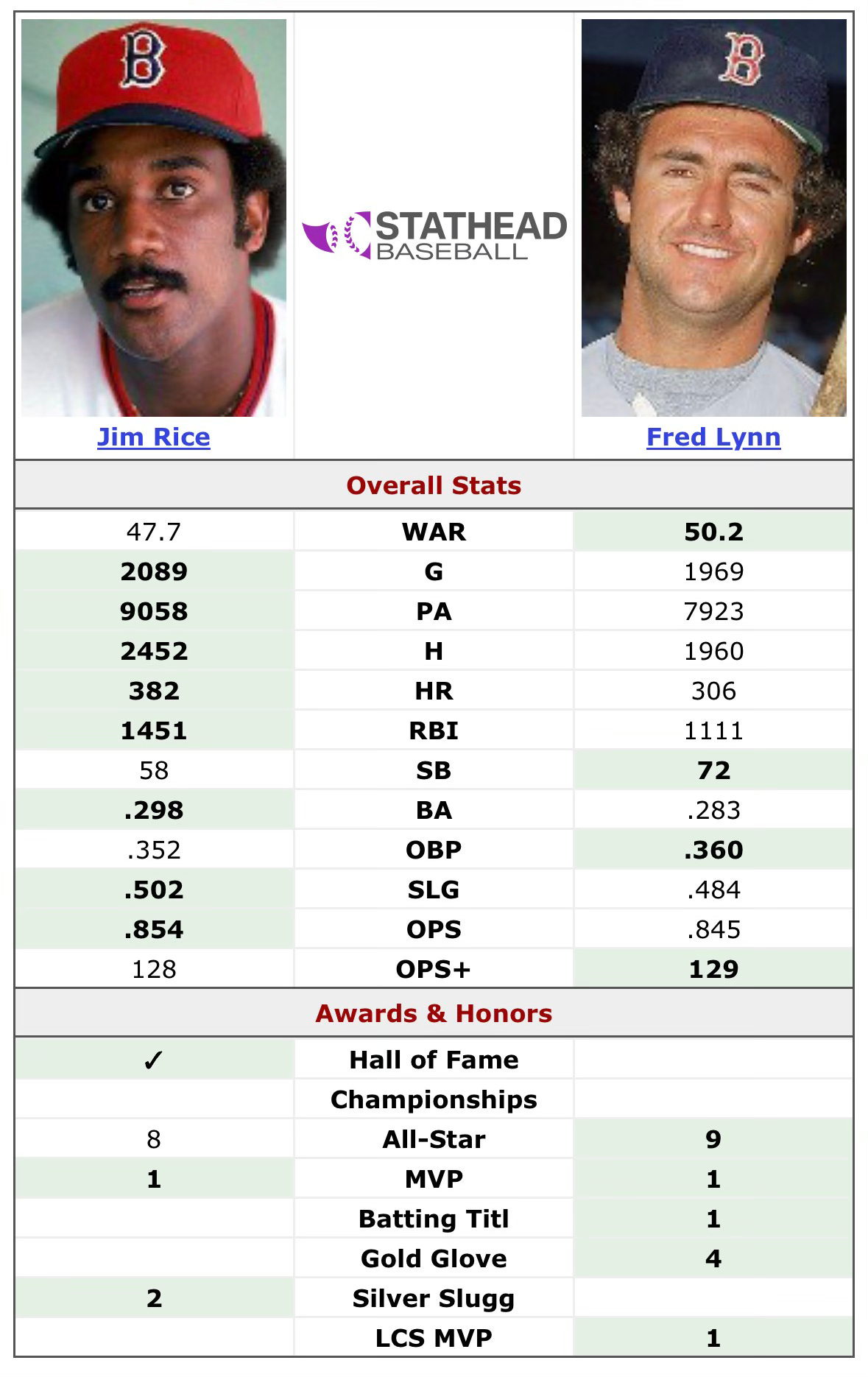
But when you look at these players side-by-side, they look a heck of a lot more similar than you might imagine. Where Rice outpaces Lynn, it is just by a hair.

Should Fred Lynn be in the Hall of Fame? Was his candidacy given short shrift by the votes? Should a future Contemporary Baseball Era Committee give Lynn another look? All fair questions. If Jim Rice is the barometer, I think the answer to the last question is most certainly yes.

PLAY BALL!!

Somehow Andy Pages, A Little-Known Second-Year Player, Became a Main Character In 2025

Last month the Los Angeles Dodgers won their second consecutive World Series. They were led by four-time MVP Shohei Ohtani, who, for the first time in the National League, worked his magic with his bat and his arm.

They also fielded former MVPs Mookie Betts and Freddie Freeman. The team was anchored by sluggers Max Muncy and Teoscar Hernández, and stalwart catcher Will Smith. The pitching staff included (in addition to Ohtani) Blake Snell, Yoshinobu Yamamoto, Tyler Glasnow, Roki Sasaki.

But there was one other player who found himself at the center of attention multiple times during the season. A player who failed so badly towards the end of the playoffs that he was benched. And yet, years from now, when we watch videos about the 2025 season, this guy may be the main character. I am talking, of course, about Andy Pages.

Pages made his major league debut in 2024, and he was a perfectly average. He played in 116 games, slashed .248/.305/.407, for an exact 100 OPS+. In 2025 the Dodgers named him their Opening Day center fielder, and he rewarded their faith by slashing .285/.325/.479 with 17 homers in the first half. His second half was more pedestrian (.252/.293/.435). But, no matter, he played 155 games, and jogged out to center field when the playoffs began.

Through Game 1 of the NLCS against the Brewers, the 24-year-old from Cuba was 1-for-27 with six strikeouts and no walks. He did manage a single in each of Games 2 and 3 of the NLCS, before going 0-fer in Game 4 and Game 1 of the World Series. An eighth inning single in Game 2 of the fall classic off Louis Varland would be the sum total of the offense that Pages would provide before Los Angeles celebrated their Game 7 victory at Rogers Centre.

But none of that ineptitude mattered. Here is why – and here is why Andy Pages was the Dodgers main character (non-Shohei Ohtani division) for this remarkable year.

When the story of 2025 is written, there will be four main plot points: (1) Cal Raleigh doing things no catcher and no switch-hitter has ever done before; (2) Shohei Ohtani continuing to do things no player has ever done before (including pitching six scoreless innings while hitting three home runs in the same game, which just happened to be the pennant winner); (3) the Dodgers being the first team to win back-to-back World Series this century; and (4) the betting scandal that ensnared Guardians’ pitchers Emanuel Clase and Luis Ortiz.

Let’s start with the last one. Not that anyone reading this needs a primer, but if you do, Clase and Ortiz are accused of intentionally throwing pitches out of the strike zone so that people could bet (and win) that a specific pitch would be a ball. They are alleged to have done this on numerous occasions, all to successful outcomes. Except…

On May 28th, Clase came in to the pitch the ninth inning against the Dodgers, and he faced Pages to start things off. His first offering was a slider that bounced two feet in front of the plate – very much a ball. But Pages swung anyway. That swing cost some bettor $4,000. The entire story (including Pages’ four-figure flail) did not come out until after the World Series, so Dodger fans could not use this to ridicule the slumping outfielder, but the video of that at-bat is probably the second-most watched of his career.

The most watched at-bat happened in Game 4 of the National League Division Series against the Phillies. The Dodgers led two games to one, and were on the verge of losing their second straight game and having to head back to Philadelphia to try to win a deciding Game 5. In the bottom of the eleventh inning of a 1-1 tie, they loaded the bases with two outs against Orion Kerkering. At that moment, Pages was 1-for-18 in the post-season. True to form, he hit a soft grounder back to the mound. Kerkering fumbled the ball off the bat, and rather than throwing to first base (where catcher JT Realmuto was pointing) to record the final out and push the game to the 12th inning, he got flustered and threw the ball to the backstop, allowing Hyeseong Kim to score from third with the game and series-winning run. All because of Pages’ weak contact. The video of that at-bat may have been removed from YouTube in the City of Brotherly Love, but it still has been watched thousands of times at this point.

And there will be no re-telling of the Dodgers World Series victory without the story of Andy Pages and Kiké Hernández in the bottom of the ninth inning of Game 7. Just to set the stage: After replacing Blake Snell, Yoshinobu Yamamoto hits Alejandro Kirk with his second pitch, loading the bases with one out of a 4-4 game. With the bases now loaded, and the World Series-winning run 90 feet away, Dodgers manager Dave Roberts replaces Tommy Edman in center field with the recently-benched Pages, who has a better throwing arm (98th percentile per Statcast). After Daulton Varsho’s ground ball to second resulted in an out at home (very close!), the bases remained loaded with two outs. On the next pitch, the light-hitting Ernie Clement hit a ball 101-mph and 364 feet to left-center. Hernández, playing a little shallow (as he had done the night before to great effect) turned and dashed towards the wall. He was either going to make a Willie Mays-type catch or the World Series would end – those were the only two options. That is, until Pages came out of nowhere – he covered 121 feet at 29.2 feet/second – to bulldoze Hernández and make the catch at the wall to push the game into extra innings.

A few feet to the left of where Pages made that catch Joe Carter once hit a World Series walk-off home run, and the announcer, Tom Cheek, proclaimed: “You will never hit a bigger home run in your life.” Well, Pages will never make a bigger catch in his life.

The 2025 World Series will go down as one of the greatest ever. And the Dodgers 2025 season will be remembered for a long time. It is incredible that on multiple occasions, with all of their stars and all of that star power, it was a little-known second-year player who found himself in the spotlight time and again.

PLAY BALL!!

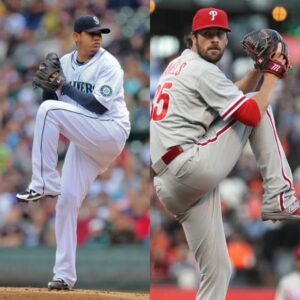
Félix Hernández and Cole Hamels Had Remarkably Similar Careers

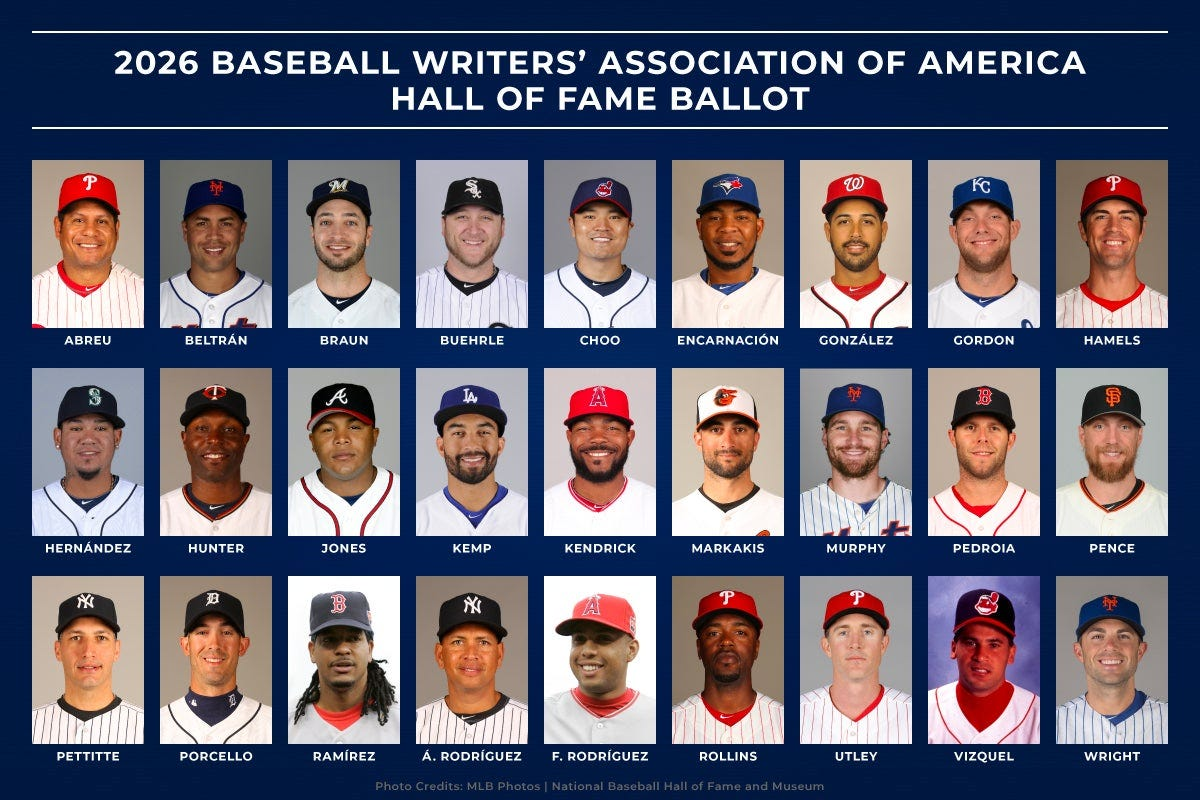
About two weeks ago, voting members of the Baseball Writers Association of American received their Hall of Fame ballots for 2026. Here are the candidates:

Last week, on the Effectively Wild podcast, Meg Rowley and Ben Lindbergh had Jay Jaffe on as their guest. For the uninitiated, Jay Jaffe is a Senior Writer at Fangraphs, author of the book The Cooperstown Casebook, and is the creator of the JAWS statistic for quantifying a player’s Hall of Fame credentials. When you have a Hall of Fame question, Jay is the first person you go to.

Meg and Ben wanted to talk to Jay about the upcoming class, and who has a chance to make it to the podium at the Clark Sports Center in Cooperstown, New York next July. It is a great listen.

As they were all talking, two names caught my ear: Félix Hernández and Cole Hamels. Not only are they listed consecutively on this year’s ballot, they are right next to each other in Hall of Fame qualifications. Let’s take a look:

King Félix pitched for 15 seasons, all with the Seattle Mariners. Hamels also threw for 15 seasons, but with four clubs (if you count his 3-1/3 innings with Atlanta in the Covid-shortened 2020 year, his last).

Hernández finished with a 3.42 ERA, Hamels, 3.43.

Hernández won 169 games, six better than Hamels’ 163.

From an ERA+ perspective, Hamels wins the battle 123 to 117.

Hamels struck out 36 more batters than Hernández (2,560-2,524), which amounts to a mere two additional strike outs per season. Essentially the same. And Hernández had more walks (805) than Hamels (767). But, again, over 15 seasons, it is about two per year, so…the same.

Over their 15-year careers, Hernández threw 31 more innings. So, again, about the same.

Hamels was an integral part of the Phillies rotation that won the 2008 World Series, winning both the Championship Series and World Series MVP awards. King Félix never pitched in the post-season (not his fault). But he did win a Cy Young Award (in 2010) and two ERA titles (2010, 2014), all of which eluded Hamels.

And yet, somehow, when you add all of these numbers together, Hamels ended his career with nearly nine more bWAR (59.0 vs. 49.8). But, that belies the fact that over at Fangraphs, Félix actually bests Hamels 54.0 to 51.6. If one didn’t throw with his left hand in the National League (for most of his career) and the other with his right hand in the American League, you would think they are the same pitcher.

With those stats in hand, let’s take a look at Jaffe’s Hall of Fame qualifications. As a reminder, per JAWS, the typical HOF pitcher has the following credentials:

72.9 bWAR // 49.8 seven-year peak bWAR // 61.3 JAWS score // 4.5 bWAR/162

Hamels only makes the grade in bWAR/162 (he has 4.7). As stated above, his bWAR is 59.0, his seven-year peak is only 37.4, and his JAWS score is 48.2.

Hernández fails in all of the categories: 49.8 bWAR, 38.5 seven-year peak, 44.1 JAWS, and 4.0 bWAR/162.

Using other metrics makes the case even worse. Just once did Hamels lead the league in any category (WHIP, in 2008), while Hernández did so just 28 times. That number is 40 for the average Hall of Famer. Bill James’ Hall of Fame Monitor (where 100 makes you a likely entrant), has Hernández at 67 and Hamels at 57. And James’ HOF Standards, where 50 is an average Hall of Famer, Hernández scores 31, while Hamels comes in at 33.

None of the above should in any way detract from either of their brilliant careers. They both have places in the Hall of “Very Good.” Neither ever has to buy a drink in their respective home towns. Hernández is in the Mariners Hall of Fame, and it just a matter of time until Hamels is on the Phillies Wall of Fame.

And while it would be great if players this similar could both be inducted and give speeches on the same day, that just doesn’t seem likely in this case. In fact, there is a chance that no one gives a speech this July, but more about that in another column to come.

PLAY BALL!!

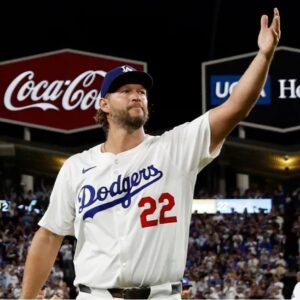
Dodger Stadium Has Hosted Many Of Clayton Kershaw’s Greatest Moments

Last Monday night, Clayton Kershaw entered Game 3 of this year’s World Series in the 12th inning, with the score still tied, with two outs, and with the bases loaded. According to him – and later confirmed – it was the first and only time he had pitched in extra innings in his illustrious 18-year career. Kershaw cannot recall ever pitching in extra innings at any point in his life.

And yet, when the bullpen gate opened in left field at Dodger Stadium, the three-time Cy Young winner, eleven-time All-Star, two-time World Series winner (now three-time), one-time MVP, and soon-to-be first-ballot Hall of Famer, strode to the mound in the biggest moment of his team’s 2025 season.

The series was tied at one game apiece. The score was tied at 5, and had been that way since Shohei Ohtani’s second home run of the game evened everything up in the seventh inning. With two outs, the visiting Blue Jays had loaded the bases against Emmit Sheehan on two walks and an 85-foot slow roller to third. Manager Dave Roberts walked to the mound, took the ball from Sheehan, and motioned for the lefty who had been loose for at least four innings. In fairness, Kershaw has come out of the ’pen in years past, but never in a moment as fraught as this one, and never against a team that simply refuses to swing and miss.

Nathan Lukes dug in for a lefty-on-lefty match-up. Kershaw went with a slider, and threw it in the dirt for ball one. He tried it again and got strike one. He tried it again and barely missed the inside corner for ball two. He tried it again and Lukes watched strike two fly by. A fifth straight slider was in the dirt, running the count full. The old expression, “they sell you the whole seat, but you only need the edge,” was true for the more than 52,000 fans in attendance. Kershaw’s wife, Ellen, stood in the second deck behind home plate with her hands either in front of her face or on her head as she watched her beloved try to wiggle out of yet another post-season jam. The sixth pitch was yet another slider, slightly below the zone, but Lukes, taking nothing for granted, fouled it off. According to Statcast, on the seventh pitch of this at-bat, Kershaw threw his hardest fastball of the season – and that was just 91.9-mph – but up enough in the zone to induce Lukes to swing and foul it away. For his final pitch ever at Dodger Stadium, Kershaw went back to the slider, and it was not a particularly good one – low and away – but the left fielder offered at it and hit a slow roller to second. Tommy Edman charged in and flipped the ball to Freddie Freeman with his glove to end the inning, end the rally, and end Kershaw’s career at the only ballpark he has ever called “home.”

The one-batter, three-act, epic in the 12th inning of Game 3 of this year’s World Series is another in the long list of memorable moments for the lanky lefty at Dodger Stadium. It joins the annals of (in chronological order):

May 25, 2008: Clayton Kershaw, age 20, wearing #54, makes his major league debut, going six innings against the Cardinals, allowing two runs on five hits, with a walk and seven strikeouts.

April 1, 2013: As the Opening Day starter against the rival Giants, Kershaw twirls a four-hit shutout with seven strikeouts and no walks. The only run of the game: Kershaw’s first and last career homer in the 8th inning.

June 18, 2014: Kershaw throws his one and only no-hitter against the Colorado Rockies. But for a throwing error by shortstop Hanley Ramirez, it would have been a perfect game.

May 15, 2015: Kershaw goes 6-2/3 innings, gives up three runs and four hits while striking out ten Rockies to notch his 100th career win.

October 4, 2015: On the final day of the season, Kershaw faces just 13 batters, allowing two hits, and striking out seven. The sixth K gives him 300 for the season, which is one of just nine such seasons in the 21st century.

August 1, 2019: En route to his 10th win of the year, with a strikeout of Austin Hedges in the 6th inning, he passes Sandy Koufax for the most strikeouts for a left-handed pitcher in Dodger history.

April 30, 2022: After passing Koufax and Don Drysdale, Kershaw passes Don Sutton to become the Dodgers’ all-time strikeout leader when he fans Detroit’s Spencer Torkelson in the 4th inning.

July 2, 2025: While strikeouts have become increasingly more difficult for Kershaw over the past few seasons, he entered this game needing only three to become the 20th player to join the 3,000 K Club. A slider on his 100th pitch of the game with two outs in the sixth inning froze the Rockies Vinny Capra, allowing history to be made.

And, of course, as referenced above, there was the eight pitch battle on October 27, 2025, that left the bases full of Blue Jays, allowed five more scoreless innings to proceed, and paved the way for Freddie Freeman to play World Series hero once again.

There may be no player in modern baseball history who has provided more highlights, made more memories, and achieved more milestones, in front of his home crowd than Clayton Kershaw. One day there will be a statue of the lefty outside Dodger Stadium, and the only question is which moment in Dodger Blue it will depict. The great news for Los Angelenos and baseball fans the world over, we can relive those highlights again and again, as we most certainly will on warm Sunday afternoon in upstate New York in the summer of 2031, when Clayton Edward Kershaw is inducted into the National Baseball Hall of Fame. Until then, there is always YouTube (see below).

PLAY BALL!!

Sid Bream Does The Impossible

Last week I wrote about baseball history that took place on October 14th. I started 120 years ago, and worked my way up to 1998. But as a heady reader pointed out to me, I missed a huge moment (upon reflection, I actually missed two, but more about the second one all the way at the bottom).

On October 14, 1992, at Fulton County Stadium in Atlanta, history was being written and re-written. Some readers – including those who read Wikipedia – will recall “The Slide.” But before we get to the slide, we need the prologue.

The 1992 National League Championship Series pitted the Atlanta Braves against the Pittsburgh Pirates. The Pirates were in the NLCS for the third straight year, having yet to make it to the World Series. The Braves were hoping to make it back to the Fall Classic after losing to the Minnesota Twins in a 10-inning thriller in Game 7 of the 1991 version.

Atlanta won Games 1 and 2 at home, before the series traveled to Pittsburgh. The Pirates won Game 3, but dropped Game 4, and found themselves on the brink of elimination…again. A 7-1 victory at home in Game 5, and a 13-4 wipeout in Game 6 in Atlanta, set the stage for yet another Game 7 showdown.

The Pirates took a 1-0 lead in the top of the first, and padded that with another run in the sixth. Doug Drabek, pitching the game of his life, took a shutout into the ninth inning. Terry Pendleton, the 1991 NL MVP – and 1992 NL MVP runner-up – led off the bottom of the ninth with a double. David Justice then hit a hard grounder that was booted by second baseman José Lind – who, ironically, would go on to win the Gold Glove. With runners on the corners and no outs, Drabek walked Sid Bream on four pitches to load the bases, put the tying run in scoring position, and the winning run on base.

Future Hall of Fame manager Jim Leyland came out and replaced Drabek with closer Stan Belinda. Ron Gant greeted Belinda with a deep sacrifice fly to left fielder Barry Bonds, cutting the lead in half. The next batter, Damon Berryhill, took a 3-1 offering that appeared to be strike two, but was called ball four, re-loading the bases. Future Hall of Fame manager Bobby Cox called on Brian Hunter to hit for second baseman Rafael Belliard. Two pitches later, Hunter had popped out to second, and now the Braves were down to their final out. If Pittsburgh could escape the jam, Cox would become the first MLB manager to ever lose two playoff series in which his teams previously led 3-1 (his Blue Jays gave up a 3-1 lead and the pennant to the Kansas City Royals in 1985). Desperate times call for desperate measures. So Cox called upon Francisco Cabrera to pinch hit for pitcher Jeff Reardon. Cabrera had 11 plate appearances all season (3-for-10 with a walk), and he was 0-for-1 in this series. So what did he do? He promptly lined a 2-1 pitch to left field, scoring Justice from third to tie the game. Barry Bonds, who at this point in his career had won two Gold Gloves, and was about to win his third, and would go on to win eight in all, scooped up the ball in left field. Bonds’ throw was just to the right of home plate, and catcher Mike LaValliere needed to reach to catch it and then swipe his tag at the sliding Bream. There is no sprint speed records for 1992, but Bream – he of the five previous knee surgeries and chronic knee pain – was known to be one of the slowest runners in the game. And yet, somehow, some way, his all-out hustle and perfectly executed slide beat LaValliere’s tag by microseconds.

When the play ended and the Braves mobbed Bream at and on the plate, Pirates center fielder Andy Van Slyke could be seen sitting in the outfield watching the celebration unfold. Prior to the 2-1 pitch, Van Slyke motioned for Bonds to come in a few steps to be ready to make a play at home. As legend has it, the often mercurial Bonds flipped Van Slyke the bird and remained in his previous position.

Game 7 of the 1992 NLCS remains the first and only time in MLB history that a team was one out away of losing a deciding game and yet won that game on the last pitch (for example: Bill Mazeroski hit his famous homer in a tie game; Joe Carter’s homer won the 1993 World Series, but it was only Game 6; Edgar Martinez’s “The Double” happened with no outs).

Even though this writer forgot “The Slide” in my original article, the Atlanta 400 Baseball Fan Club never forgets, and they get together at the site of home plate at the former Fulton County Stadium each year to celebrate and pay homage to Bream’s slide and the team’s pennant victory.

PLAY BALL!!

October 14th Is A Special Day In Baseball Lore

Every year October 14th auspiciously falls smack dab in the middle of the baseball playoffs. As such, there have been many great moments that have occurred on his date. To wit:

A mere 120 years ago, on October 14, 1905, Christy Mathewson threw a shutout against the New York Giants to give the Philadelphia Athletics the World Series crown.

We all recall that the Chicago Cubs broke a 108-year World Series drought with their victory over Cleveland in 2016. On this day in 1908, that streak began. The Cubs defeated the Detroit Tigers 2-0 in Game 5 in front of the smallest crowd (6,210) in World Series history to take home the title.

On the same day in 1929, the Philadelphia A’s turned the tables on the Cubs, scoring three runs in the bottom of the ninth inning to win Game 5 and the World Series.

On this day in 1964, the M&M boys were back at it again, with Roger Maris and Mickey Mantle hitting back-to-back homers (on consecutive pitches) off the Cardinals’ Curt Simmons to even that World Series at three games apiece. The Cardinals would go on to win the whole thing the next day.

The next year on this date, Sandy Koufax shutout the Minnesota Twins 2-0, giving us just three hits while striking out ten, to give the Dodgers a World Series title. It was his second shutout of that Fall Classic (he won Game 5 three days earlier, giving up just four hits while striking out ten).

On October 14, 1969, Tommy Agee became a household name with not one, but two, amazing catches (one in left center and one in right center), and hit a homer, in Game 3 of the World Series that the “Amazin’ Mets” would go on to win in five games.

The Mets would be back in the World Series four years later against the Athletics. On this day, in Game 2, Willie Mays recorded his final major league base hit (a run-scoring single to center off Rollie Fingers in the 12th inning).

Fifty years ago today, home plate umpire Larry Barnett made a name for himself when he decreed that Cincinnati Reds’ Ed Armbrister did not interfere with Boston’s Carlton Fisk when he ran into the catcher after attempting a sacrifice bunt. Fisk threw the ball into center field, allowing Cesar Geronimo to move to third, from where he would eventually score the winning run in Game 3 of what many still believe to be the greatest World Series ever played.

Exactly one year later, Chris Chambliss hit a ninth inning home run off Kansas City’s Mark Littell to give the New York Yankees their first pennant since 1964. As you may recall, the crowd stormed the field, and Chambliss barely survived his trip around the bases. It is hard to even imagine such a scene today.

On this day in 1984, the legend of Kirk Gibson may have been born (not really, insofar as he had already won the ALCS MVP while going 5-for-13 with one homer). On October 14th, Gibby hit two home runs and drove in five in Detroit’s clinching Game 5 victory over the San Diego Padres. Four years and a day later (October 15, 1988) Gibby truly became a legend.

The next year, famed broadcaster Jack Buck proclaimed, “Go crazy folks, go crazy,” when Ozzie Smith lifted a 2-1 pitch down the right field line for a game-winning homer in Game 5 of the 1985 NLCS at the famed Busch Stadium.

Today being an off day in the ALCS between the Seattle and Toronto, it is fitting to note that on this day in 1992 the Blue Jays became the first Canadian team to reach the World Series, after defeating the then-Oakland Athletics 9-2.

Later that night, the Pittsburgh Pirates took a 2-0 lead into the bottom of the ninth inning of Game 7 of the NLCS against the Atlanta Braves. It is worth reliving this stanza. Doug Drabek gave up a lead off double to Terry Pendleton (MVP in 1991; runner-up in 1992). David Justice then reached on a fielding error by second baseman José Lind. Sid Bream walked to load the bases. Pirates manager Jim Leyland replaced Drabek with Stan Belinda. Ron Gant then hit a deep drive to left to score Pendleton from third and make it a 2-1 game. Catcher Damon Berryhill walked to reload the bases. Brian Hunter, needing just a lazy flyball to tie the game, instead popped out to second. Up came Francisco Cabrera. Cabrera, who had eleven plate appearances all season, made his second of the post-season. He proceeded to line a 2-1 pitch to left, scoring Justice, with Bream chugging behind him. Barry Bonds – winner of eight Gold Gloves – threw home late, and Bream scored the pennant-winning run. It has become known in Atlanta baseball history as “The Slide.”

In 1998, the Padres cliched the right to play in their first World Series by defeating the Braves 5-0. They would then be swept by the Yankees in a series that was actually closer than the final verdict would reflect.

On October 14, 2015, with two on and two outs in the bottom of the seventh inning of a 3-3 Game 5 of the ALDS, José Bautista hit the second biggest home run in Toronto Blue Jays’ history (Joe Carter hit the biggest in 1993), which will always be remembered for Bautista’s epic bat flip.

Oh, and on this day in 1972, Gene Tenace became the first player to ever homer in his first two World Series at-bats, leading the A’s to a Game 1 victory over the Reds. According to family lore, my father witnessed these home runs on a television in the hospital’s waiting room while my mother gave birth to me.

PLAY BALL!!

Steve Rogers Had A Career That We Should Try Not To Forget

On Episode 2367 of the Effectively Wild podcast, host Ben Lindbergh made reference to David Laurila’s newsletter and his weekly trivia quiz. One question revolved around the three pitchers who have won at least 100 games for the Expos/Nationals franchise. Ben got the first two, and essentially got the third, but could not place the name. The name that eluded him was Steve Rogers.

The right-handed pitcher was originally selected by the New York Yankees in the 60th round of the 1967 draft. Instead, he elected to attend the University of Tulsa, where he helped the team get to the Men’s College Baseball World Series his sophomore year. Rogers played all four seasons, graduating with a degree in petroleum engineering. But rather than drilling for oil, he again registered for the MLB draft, where the Expos took him with the fourth pick in 1971.

Just about two years later he made his debut, throwing eight innings against the Astros in the famed Astrodome, allowing two runs on four hits, getting a no decision on a game that went ten innings.

Rogers pitched from 1973 to 1985, but from 1973 to 1983, he was one of the five best pitchers in baseball. As Ben referenced on the podcast, those top five pitchers – as measured by Fangraphs WAR – were Steve Carlton, Bert Blyleven, Nolan Ryan, Gaylord Perry, and Rogers. Only one of these guys is not in the Hall of Fame. Just to add to the list, after Rogers, you have Phil Niekro, Tom Seaver, and Don Sutton – Hall of Famers, all.

In 1973, Rogers came in second in Rookie of the Year voting (to Gary Matthews). In 1974, he was named an All-Star for the first time.

Between 1980 and 1983, Rogers was a top-five finalist for the Cy Young Award three times. In 1982, he came in second to Carlton.

From 1973 to 1984, he had only one season (1976) when he didn’t have double-digit wins, and yet he never won twenty games (he topped out at 19 in 1982). From 1973 to 1983, he had an ERA of 3.07 while winning 150 games and accruing 46.3 bWAR. All told, Rogers was an All-Star five different times, always among the best of the best.

As a National League pitcher before the universal designated hitter, Rogers wasn’t much of a batsman, hitting .138 with in 881 career at-bats. Amongst his 122 hits, he had eight doubles and two triples, but no home runs.

Rogers is not a Hall of Famer by any rational or analytical metric. His statistics are about 50% of what is required to be elected (his career is most similar to Burt Hooten, another blast from the ‘80s past). And, true to form, in 1991, his first (and only) year on the ballot, he failed to receive even a single vote. Fans north of the border may view that as a bit harsh.

Because Rogers toed the rubber during a golden age of pitchers (many of whom are enshrined in the Hall of Fame), he may not be that memorable to anyone other than his family and those of us who grew up assiduously watching baseball in the eighties. Unfortunately, Rogers may be best remembered for giving up a game-changing, and ultimately game-winning, home run to Rick Monday in Game 5 of the 1981 National League Championship Series.

But that on at-bat should not detract from a career of durability and viability that spanned two decades and brought smiles to the faces of many a Canadian.

Two Pitchers With Similar Stats But Dissimilar Reputations

CURT SCHILLING

Curt Schilling was selected out of Yavapai College in the second round of the 1986 MLB draft by the Boston Red Sox. In July of 1988, Boston traded Schilling, along with outfielder Brady Anderson, to the Orioles in return for veteran pitcher Mike Boddicker. Ironically, Schilling made his major league debut just five weeks later — throwing seven innings of six-hit/three-run ball in a Baltimore win against those same Red Sox.

In a little-remembered transaction, Baltimore traded Schilling to the Houston Astros in January of 1991. He threw 75-2/3 innings for the Astros over 56 games out of the pen, before Houston sent Schilling to Philadelphia in return for Jason Grimsley. Schilling went on to re-sign with the Phillies when he became a free agent at the end of the 1995 season. And it was in Philadelphia where Schilling became a star. In his first eight years in the City of Brotherly Love, Schilling won 95 games with a 3.31 ERA and a 127 ERA+. He went to three All-Star games (1997-1999), twice led the league in complete games, and twice led the league in strikeouts.

At the trade deadline in 2000, Philadelphia shipped Schilling to the Arizona Diamondbacks, where he teamed with Randy Johnson to become one of the best 1-2 combinations in the history of the sport. In 2001, Schilling went 4-0 over the NLCS and the World Series, with a 1.12 ERA, and 56 strikeouts against only six walks. Schilling famously started Game 7 of that Fall Classic, going 7-1/3 innings, leaving the game with the D’Backs trailing 2-1. Miguel Batista came in to record one out, and then Johnson got the next four Yankee batters to set up Luis Gonzalez’s dramatic walk-off single in the bottom of the ninth. Johnson and Schilling were honored as World Series Co-MVPs.

At the end of the 2003 season, over Thanksgiving dinner at Schilling’s Arizona home, Theo Epstein, the Red Sox’ general manager, convinced Schilling to waive his no-trade clause and come back to where it all started: Boston. It worked. And in 2004, the big righty helped Boston “reverse the curse” and win their first World Series in 86 years. In four games over that post-season, Schill went 3-1, including the dramatic “Bloody Sock” Game 6 of the ALCS against the Yankees. He followed that up with a win in Game 2 of the World Series against the Cardinals.

Schilling won three more games in the 2007 post-season, helping the Red Sox win their second World Series in four years. A shoulder injury ended his career after that 2007 season. When all the ink was dry, Schilling had a career record of 216-146, an ERA of 3.46, an ERA+ of 127, and is one of 20 pitchers to record 3,000 strikeouts (3,116). His career bWAR sits at 79.5.

JUSTIN VERLANDER

The Detroit Tigers selected Justin Verlander with the second overall pick in the 2004 draft out of Old Dominion University in Virginia. He made his major league debut 13 months later against Cleveland, striking out four, while giving up seven hits and four earned runs over 5-1/3 innings. He pitched in only one other game that year, going six innings and giving up five earned runs. When the 2005 season ended, Verlander had an 0-2 record, a 7.15 ERA, and a total of seven strikeouts to his name.

It didn’t take long for the future Hall of Famer to hit his stride. In 2006, Verlander went at least six innings in 22 of his first 24 starts, going 15-6. For the season, he went 17-9 with a 3.63 ERA and 124 strikeouts. That would be the last time he had less than 150 strikeouts in a season for next eight years, including leading the league in 2009 (269), 2011 (250), 2012 (239). When this streak broke in 2015 (only 113 Ks in 20 games), he came back in 2016 to again lead the league with 254, and a league-leading 7.4 bWAR. That was good enough to garner him his second Cy Young runner-up, which was in addition to his Cy Young and MVP wins in 2011.

At the trade deadline in 2017, Detroit sent Verlander to the Houston Astros for three players that didn’t amount to much (a pitcher who never made the big leagues, Daz Cameron (career -1.7 bWAR), and Jake Rogers (2.6 bWAR)). After arriving in Houston, Verlander went 5-0 with a 1.06 ERA, with 43 strikeouts against five walks. In the post-season, he went 4-1 with a 2.21 ERA, helping the Astros beat the Dodgers to win the World Series.

In 2018, he had a career-high 290 strikeouts in 214 innings, and once-again was the Cy Young runner-up (to Blake Snell). It was the sixth time he finished in the top five.

In 2019, after signing a 2-year, $66 million contract to stay with Houston, he won 21 games with a 2.58 ERA. He was an All-Star for the eighth time and won his second Cy Young Award. And, oh-by-the-way, he also threw his third career no-hitter, shutting down the Blue Jays in Toronto. After such a fantastic regular season, Verlander was off his game in the playoffs, going 1-4 with a 4.33 ERA. He lost both Games 2 and 6 of the World Series, which the Astros eventually lost in seven games to the Washington Nationals (a series in which every game was won by the visiting team).

Verlander’s Covid-shortened 2020 season was even shorter due to a groin injury and then Tommy John surgery. He didn’t pitch in 2021. But he came roaring back in 2022, going 18-4 with a career-best 1.75 ERA. He struck out 185 batters in just 175 innings. For his efforts, he was the American League Comeback Player of the Year, and won his third Cy Young Award.

After the 2022 season, Verlander signed a two-year, $86.7 million contract with the Mets. But he made only 16 starts in Queens before being shipped back to Houston, where he went 7-3 over eleven starts. In the post-season, he went 1-1 with one no-decision, while the Astros fell to the eventual World Series champion Texas Rangers.

In 2024, Verlander moved into the top-ten in career strikeouts, passing Greg Maddux. He also won his 260th career game.

Verlander signed with the San Francisco Giants for the 2025 season, hoping to somehow eek out the final 38 wins he needs to become the 25th pitcher to reach the 300-win plateau. As of this writing, he has added only three to the ledger, making the final 35 seem near impossible for the 42-year old hurler (who will be 43 on Opening Day next season).

As of this writing, Verlander has a career record of 265-158 with a 3.32 ERA, and ERA+ of 128, with 3,546 strikeouts. He has won two World Series, been a league MVP, ALCS MVP, won the Rookie of the Year. He has three no-hitters and won three Cy Youngs. He has accumulated 81.7 bWAR to date.

COMPARISON:

When you put these two careers side-by-side, and squint just a little bit, they look awfully similar. And Schilling, without question, was the better post-season performer. Verlander, as mentioned above, has more career black ink (79 vs. 42) and has more wins, more strikeouts, and a better ERA. However, it is how they have conducted themselves off the field and with the press that is the major separator. Schilling has no one to blame but himself for how he is viewed in the public sphere, while Verlander has gone about his career with class and respect every step of the way. Maybe not so similar after all.

PLAY BALL!!