I Lied

There is a lyric in the most popular (but not the best) Blues Traveler song that goes as follows:

“I’ve tried – well, no, in fact, I lied.”

That one line sums up the emotions I have had to deal with since the Dodgers won the NL pennant. Last week I explained how I was Torn Between Two Lovers and simply hoping for an entertaining and exciting seven game World Series. And then, channeling the Mike Tyson principle, the first pitch happened. Maybe not the first pitch, but definitely the first game. I now can truly understand what people mean when they say “the heart wants what the heart wants.”

Once balls were hit, pop-ups missed, cut-offs overthrown, and guys started circling the bases, I found myself rooting for the Red Sox. Maybe it is just Pavlovian. Maybe it is a reflex. Maybe it is so ingrained that no desire to see my hometown team win their first title in thirty years can outpace my love of the BoSox. It started early, and it has stuck – for more than 40 years. It is out my control…I cannot be blamed…don’t judge me.

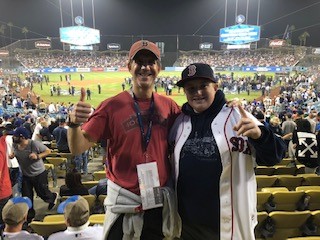
But, like John Popper said, “I tried.” I went to Dodger Stadium on Friday night wearing a Dodger hat (so what if I was wearing a Red Sox shirt). I sat there for 7 hours and 20 minutes, braving nearly nine additional innings and more than four additional hours of no food or drink (not by choice, and more about that in another column at another time), knowing in my soul that the game would end with a Dodgers walk-off. And when it happened, I was excited for Max Muncy. If you love baseball, if you love the journeyman, if you love redemption stories, what is there not to love about Max Muncy going from his high school batting cage to only the second World Series walk-off homerun in franchise history?

I was there last season, during Game 2 of the NLCS, when Justin Turner walked the Dodgers off with a monstrous three-run dinger against the Cubs. I went berserk; I could not have been more excited. But when I didn’t have that same reaction in the bottom of the 18th inning on Friday night (actually Saturday morning), I knew I was a fraud. I knew, in that moment, “well, no, in fact, I lied.” I wasn’t rooting for the Dodgers at all. I didn’t want the series to go a thrilling seven games. I wanted the Red Sox to win…every game…and take home the title for the fourth time in fifteen years. And when that wasn’t happening, I was bummed.

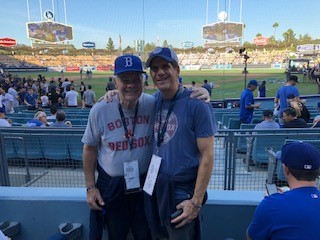
To be perfectly candid, I left Friday’s game with a smile on my face because (a) it was finally over, but more importantly, (b) I got to take my father to his first World Series game ever. And he got to see the team of his childhood battle the team of his last 60 years. And he essentially got two games for the price of one. That is an experience that I (nor he) will ever forget.

We witnessed history. We endured the longest (by time and by innings) World Series game in 114 Fall Classics, dating back to 1903. We saw a mini-Buckner and a mini-Gibby, which book-ended a relief pitching performance for the ages. As Ben Lindbergh astutely pointed out, this was a classic game that will never be shown on ESPN Classics. But we survived; we stayed until the end; I can tell my grandkids – and my dad actually told his grandkids – “I was there!”

But walking into the ballpark Sunday afternoon, knowing we were one away from winning it all; walking in amongst a sea of red jerseys and navy blue hats; walking in with scads of visiting and transplanted Massholes, I felt a connection. We all wanted the same thing.

And then there is this: I wanted to be there with my son to watch the Red Sox win the World Series. How many times in my life will I get that opportunity? How many times will I get to share that type of special moment? And it was essentially happening in my backyard.

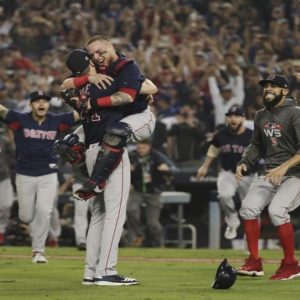
So when Manny Machado corkscrewed himself into the batter’s box on a nasty Chris Sale slider, and the “Red Sahx have won the world championship” (h/t Joe Castiglione), we high-fived, we rejoiced, we yelled, and we screamed. And whereas last year we couldn’t get out Dodger Stadium fast enough – not wanting or caring to see the Astros celebrate their title – this year we lingered. We watched the league officials set up the stage and deliver the Commissioner’s Trophy to John Henry; we listened to Steve Pearce as he accepted his MVP award and his shiny red truck; and then we experienced the players and their families soaking in the thrill of victory all across the field.

I wanted to want the Dodgers to win three games and push this battle to seven. But once I saw Craig Kimbrel try to high-wire his way through the playoffs, including a shaky 1-1/3 innings in Game 3 and an even shakier inning in Game 4, I knew in my heart of hearts that my heart of heart could not bear to watch his sweaty right wing try to retire the final batters on a cold Halloween night in Boston. No, despite my original protestations to the contrary, I wanted and needed the Red Sox to win this series and win it fast. Fortunately for me, my cardiologist, and the health and well-being of an entire region, they did just that.

We have 108 days until we say…

PLAY BALL!!
 

Three Plays – Two Losses – One Player

If the World Series was going according to plan, it would be tied at one game apiece, and we would staring down the barrel of a five-game series starting Friday afternoon in Los Angeles. As it stands – as you all know – the Dodgers find themselves in an 0-2 hole trying to get fat on some home cooking.

With two losses in two nights, there have been a lot of negative pieces written about the Dodgers:

  • Kershaw again having a rough outing in the playoffs.
  • The Dodgers’ bullpen once again letting Kershaw down and allowing inherited runners to score.
  • Roberts pulling Baez only to have Wood give up a three-run homer.
  • The Dodgers electing to keep a collective regular season total of 110 homeruns on the bench because there was a lefty on the hill.

But there is one player who seems to be getting off scot-free.

Before the series, Buster Olney did a breakdown of the key match-ups in the series. Number 1 on that list was “The Dodgers Outfielders vs. The Weirdness of Fenway Park.” Olney opined that insofar as none of the Dodgers outfielders (Matt Kemp excluded – is he still an outfielder?) had ever played at Fenway Park, learning on the fly might prove very difficult.

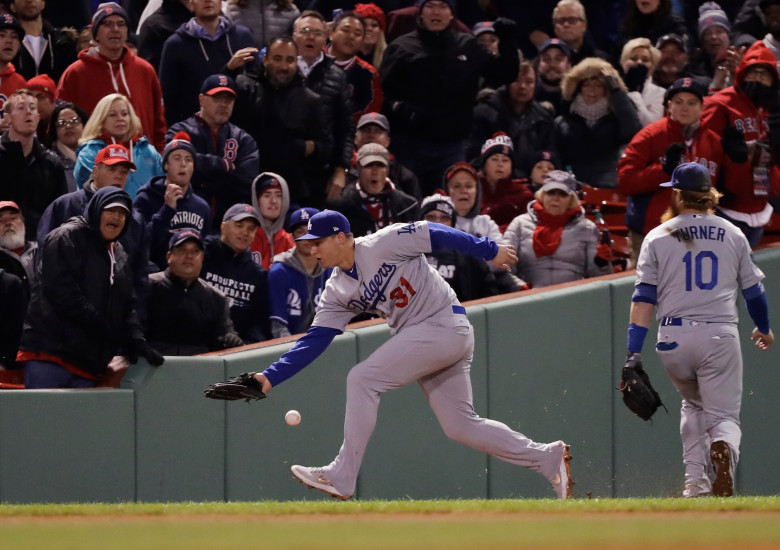
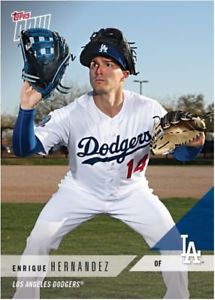
We did see Kiké Hernandez play a J.D. Martinez liner off the garage door perfectly. And we did see Cody Bellinger make an incredible sliding catch heading towards the Monster in left center. But we also saw Joc Pederson be too tentative going towards the left field line, allowing an Andrew Benintendi looper to nick off his glove and bounce into the stands for a double.

No one has really mentioned those plays, but I would aver that is because none of them were game-changers. But here are three plays that, in my estimation, were. And had the main culprit in all three been either better coached, or more prepared, or had the inclination to fully hustle, or the disinclination to show off, this series could easily be 1-1, or even 2-0 Dodgers. Allow me to explain.

Remember back to the second pitch of the bottom of the 1st inning of Game 1. The presumptive AL MVP at the plate. He hits a pop-up down the right field line. David Freese – never to be confused with Keith Hernandez at first base – tentatively goes back, worried about the jutting wall, the slick track, the tarp, and the swirling wind, and allows the ball to fall untouched. We all know what Betts did with his second chance.

I have two questions:

(1) Where was Brian Dozier? Before the trade deadline, Dozier played his entire career in the American League. That included 26 games at Fenway Park. He surely knew the surroundings, and, arguably, that is his play. I guess, positioned in the shift and playing behind second base made it impossible for him to get there. So, we will let Dozier off the hook.

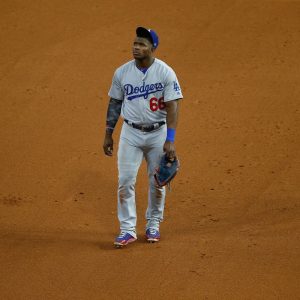
(2) Where was Yasiel Puig? He was playing VERY deep in right center. He was essentially playing no doubles defense against the first batter of the game. He was playing too deep for the situation. And while he did sprint towards the ball, in typical Puig fashion, he slowed up when it looked like Freese was camped under the ball.

Five pitches later Betts was in scoring position. Benintendi then lined a single to right, and Puig came up throwing. Again, Puig was playing VERY deep, and was obviously paying very little attention to (a) where he was standing or (b) who was on base. Had he internalized either, he never would have played hero-ball and airmailed a throw to the plate. But Puig ALWAYS wants to show off his arm, and the World Series is not a time for the Wild Horse to be put back in the barn. But, in doing so, he allowed Benny to go to second. So, when two batters later, Martinez singled up the middle, the Red Sox had a two-run lead and Kershaw was on the ropes.

That inning, and that game, could have and would have been wholly different had Betts been retired. Or, even if we assume that the pop-up was uncatchable, what does the game look like if Benintendi doesn’t go to second on Puig’s throw? Alas, Kershaw’s defense let him down…again, and no one has written about Puig’s complicity in those two plays.

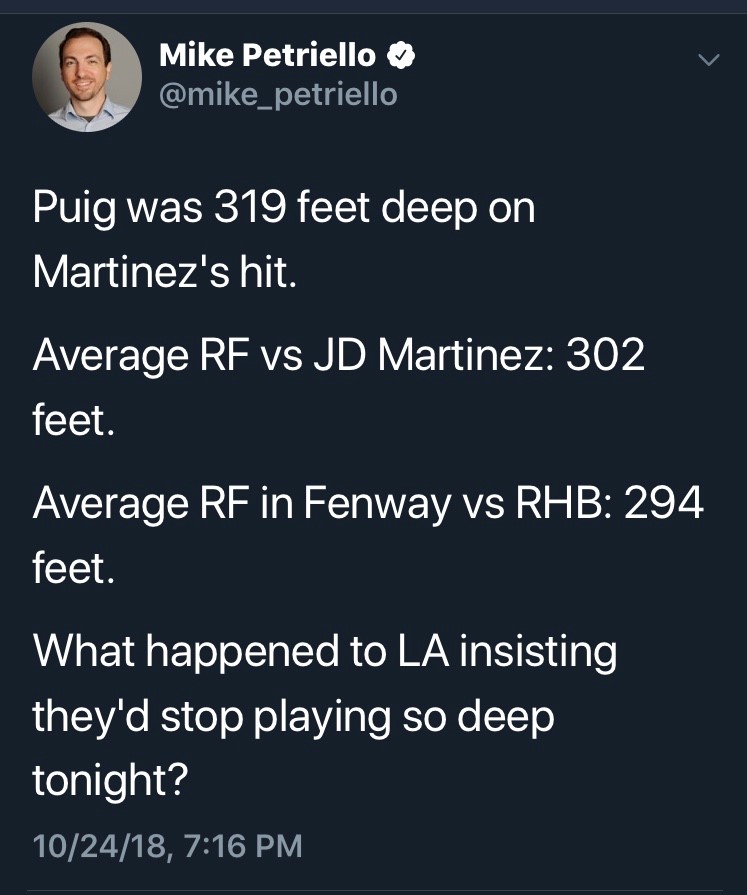
Prior to Game 2, Dave Roberts was asked about the Dodgers outfield positioning, and he confirmed that they had been playing too deep. So riddle me this, Batman, how and why was Puig playing 319 feet from homeplate when J.D. Martinez came up with the bases loaded and two outs in the bottom of the 5th?

Don’t think he was out of position, allow Mike Petriello of MLB.com to shed some light:

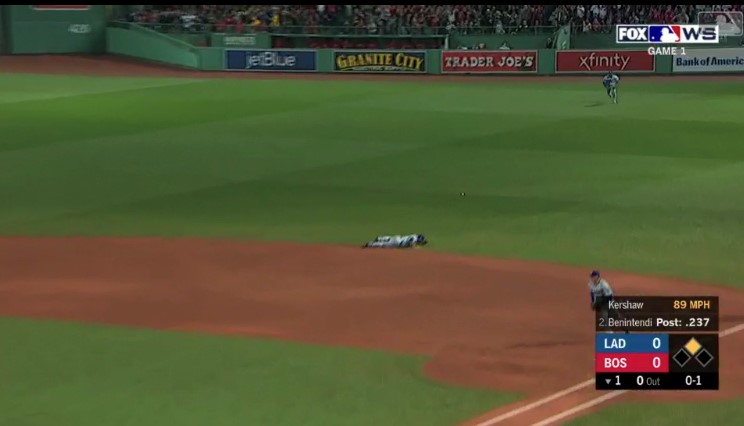
Had he been positioned properly, there is a fair chance Puig catches that ball. Sure, it would have been a great play, but haven’t we seen great plays in the playoffs? Hasn’t Puig made great plays? Is it that far-fetched to think Puig gets dirty, keeps the game tied, and leaps, hollers, and gallops his way off the field with his tongue hanging out?

But let’s assume Puig plays it safe and pulls up short. With his arm, he holds Benintendi at third, and keeps it a one-run game. Doesn’t a one-run game change the entire complexion of the next four innings? Do Red Sox fans feel as comfortable with Kimbrel in the 9th protecting a one-run lead against Machado, Taylor, and Kemp?

Who knows? Well, I think I do.

It is incredible to me that Yasiel Puig, he of the going to the World Series guaranty; he of the massive game-breaking three-run homer in Game 7 of the NLCS; he of the wild and impetuous antics, is getting a free pass for how he – in the span of three plays – so adversely affected the Dodgers chances to win the World Series.

Friday is new day. Walker Buehler could shut down the BoSox offense, and then Rich Hill could dash the hopes of his hometown team, and we could go into Sunday looking at a three-game series. As Jayson Stark likes to say, “Baseball.” There is only one way to find out.

PLAY BALL!!
Torn Between Two Lovers (2018 Edition)

Anyone who has ever read this site, or walked into my office, or seen me out and about on weekends, knows that I am a die-hard Red Sox fan.

Although I was born in Southern California, our family moved to Connecticut when I was a toddler. That, alone, didn’t make me a BoSox fan. It was my father’s nearly forty years of fandom (at that point) that cast the die. But living in New England, and visiting Fenway Park as a young child, cemented my love.

We moved back West before my seventh birthday, and since that time, I have been what Bill Simmons would call a “sports bigamist” – I love two teams: one in the American League and one in the National. For my entire life this has been easily managed, as neither was good enough to result in a battle on the largest stage. In fact, the Red Sox and Dodgers played each other in the 1916 World Series (to be technical, it was Wilbert Robinson’s Brooklyn Robins against Babe Ruth’s Boston Red Sox), and then didn’t face each other again for 86 years – until the Dodgers swept the BoSox at Dodger Stadium in 2002. In the last 16 years they have only played twelve more games against each other. The only team the Red Sox have faced less than the Dodgers in the interleague era is the Cincinnati Reds.

But those fifteen games were mere squabbles, not even close to royal rumble that is and will be the 2018 World Series.

So here I sit, on the eve of the Fall Classic, torn between two lovers. What is a sports bigamist to do?

When the Brewers pushed the NLCS to Game 7, I started looking into flights to Boston for Games 1 & 2. But once Yasiel Puig’s liner caromed off the top of the center field wall and he crotch-chopped his way around the bases; and once Dave Roberts’ over-managing didn’t come back to bite the team in the ass; and once Kenley Jansen got four outs over the 7th and 8th; and once the Dodgers once again failed to do the little things to tack on insurance runs; and once Clayton Kershaw pushed his post-season demons back into the closet for another night to clinch the pennant and potentially a new/extended contract, I began to think that traveling 3,000 miles, when I could travel 13, seemed like a bad idea.

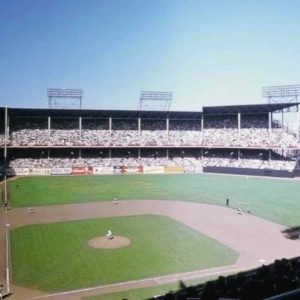
Sure, Dodger Stadium is one of the worst places for fans (exterior views and sightlines notwithstanding). And sure, Fenway Park is an America treasure. But there are some bridges (and transcontinental flights) that are just too far.

My family is divided. As I have previously written, my father came to Los Angeles with the Bums in ’58. He’s been a Dodger fan ever since. But his heart still resides in Southie.

My sisters and their husbands don’t have any particular affinity for the Red Sox, and have fully embraced their hometown team. My friends – many born and raised in L.A. – bleed Dodger blue. The gents with whom I share season tickets have been waiting 30 years (and anxiously since November 1, 2017) for a Dodger parade in DTLA (since long before DTLA was even an abbreviation).

So I will be tuned in Tuesday and Wednesday, and most likely in attendance at some of the games next weekend, knowing that whatever happens I will be happy…and sad. I will be excited…and disappointed. For the first and potentially only time I ever write these words, my and Fox Broadcasting goals are aligned: just give me seven games.

Seven nights of thrilling October baseball, with umpteen pitching changes and countless bat flips and bat licks.


Seven nights of Citgo signs and palm tree views.

Seven nights of exorcised demons for two of the game’s greatest lefties.


Seven nights of minority managers making major decisions on the game’s biggest stage.


Seven nights of Mookie smiles and Kiké joy.


Seven nights of high-wire closers doing their level best to keep cardiologists on both coasts employed well into the winter.


Seven nights of people complaining about Joe Buck.

And seven nights where three hours will never be enough; where four hours won’t be too much; where we get to savor those last drops of baseball before acknowledging to our kids, our spouses, and ourselves, that winter is coming, and spring is so, so far away.

Two years ago I wrote about the 2016 playoffs, envisioning a Cubs-Red Sox showdown. I said this would make me happy:

[A]ll I can hope is that the Red Sox and Cubs are tied at three games apiece, tied after nine innings, and then someone cuts the Eversource/NStar power grid. Then, after a collective groan, everyone calmly and politely exits Fenway Park, gets on the “T”, and goes on with their life. Hope can always spring eternal.

Replace Dodgers with Cubs, and you know how I feel today.

In 2004, I was over the moon when my team celebrated at Yankee Stadium, but I feared that my heart would be ripped out again (see, 1986). 2007 was exciting, but Red Sox fans were still basking in the glow of 2004, and the Rockies didn’t pose much of a threat. 2013 had a totally different feel, as it seemed like the BoSox were playing with house money, getting outplayed in the ALCS save for two massive and timely homeruns. Last year was special as it was the first time in my adult life my hometown team was in the World Series; but it ended with a whimper – a Game 7 that was essentially over before the Dodgers came to bat.

This year – for obvious reasons – is just plain different. Two huge payroll teams who have beaten the best to get to this stage. Two managers who, as players, have already experienced World Series glory. Two franchises steeped in tradition with rabid fanbases who always want more.

We haven’t seen this match up in 102 years. We’ve been waiting a long time. Enough talk.

PLAY BALL!!

The Demons Are Gone

October 16, 2003, bottom of the 11th inning of Game 7 of the American League Championship Series, Tim Wakefield on the mound for his second inning of work.

We all know what happened next.

That night, as we recall, the Red Sox held a three-run lead with six outs to go to advance to the next round (in this case, the World Series). And then the slow motion car crash began.

As a lifelong Red Sox fan, you could feel it: horrific dread; impending doom; we had seen it all before and there was no good way for this to end. Over the years the soul-crushing details may have been different, but the denouement was always the same: Red Sox players alone in the dugout, another team celebrating on the field; Red Sox fans in the stands or on their couch, hands on their heads and tears in their eyes. It hurts just to write the words.

Regardless of the vantage point, the outcome was preordained: the Red Sox were destined to fail.

A year later the heartbreak stage was set yet again, but maybe less painfully. After a 19-8 drubbing in Fenway on a cold Saturday night, it was a fait accompli that the season would be over the following night. A humiliating sweep at the hands of our archrivals, in our park, a year and a day after having our guts ripped out in New York. Game 3 of the ALCS ended at 12:30am local time, so technically, the misery ended Sunday morning.

Now I don’t want to get ecclesiastical, or discuss divine intervention, but something happened in the 19 hours and 50 minutes before the next game began. Maybe it took a wee bit longer; maybe it took nearly twenty-four hours…until 12:01am Monday morning for the planets to shift, for the stars to align, for something otherworldly to happen. But make no mistake, something did happen on that fall New England day of worship.

At 12:01am Monday morning, EVERYTHING changed. It was at that moment that Kevin Millar drew a leadoff walk off Mariano Rivera.

We all know what happened next.

The 3-1 pitch that missed up and in was the first tremor. In years past, Millar takes a hack at ball four, runs the count full, and Ks on a 3-2 cutter off the plate for the first out of the ninth. But now he was standing on first base.

The earth really started to move at 12:03am, when Dave Roberts barely made it back to the bag after a quick pick-off throw. In years past, he would have been a hair slow, allowing for an ignominious and yet fitting way to lose the potential tying run. But now, he just exhaled with relief, wiped the dirt off his jersey, and took another massive lead.

The waters began to recede from the shore at 12:04am, when Roberts’ left hand touched second base a millisecond before the shortstop’s glove. In years past, pundits would forever be talking about how it took the perfect Posada throw and the perfect Jeter tag to get Roberts, and unfortunately for the Fenway Faithful, the Red Sox were denied again. But now, the tying run was in scoring position.

The earth tilted on its axis at 12:05am, when Bill Mueller singled up the middle to tie the game.

And buildings began to fall at 1:22am, when David Ortiz launched a walk-off two-run dinger into the Yankees bullpen to force a Game 5.

Somewhere between 12:01am Sunday morning and 1:22am Monday morning, the fate of an entire organization – an entire city, hell, an entire region – undeniably changed forever.

We all know what happened next.

And so it was that we found ourselves in Yankee Stadium on Tuesday, October 9, 2018. The Red Sox again leading by three runs with six outs to go to get to the next round (in this case, the ALCS). In this version, the Red Sox managed to narrow the margin to three outs to go with a three-run lead and their (the league’s?) best closer on the hill. And then the slow motion car crash began again.

As a lifelong Red Sox fan, you could feel it: horrific dread; impending doom; we had seen it all before and there was no good way for this to end.

But wait. Although we have suffered the ill effects of sports PTSD, we have now come out the other side. We have won three World Series titles in the last 14 years; we have vanquished the Yankees – at Yankee Stadium, no less – on multiple occasions. We knew – in our head if not our hearts – that this time could be different.

A four-pitch walk to Aaron Judge (none were even close) followed by a Didi Gregorius single on a 1-2 pitch that could have been a groundout to first but for the previous walk. Pre-2004, Giancarlo Stanton would not have just represented the tying run, he would have become it. Alas, that world no longer exists. He struck out, meekly.

Another four-pitch walk loaded the bases, and a hit batter made it a two-run game. The ghosts were stirring, but their appearance was not certain.

Gary Sanchez – the Red Sox’s current nemesis – came to the plate. A single ties it, an extra base hit wins it, and a homer crushes the spirit of New England. In years past, we all know what would have happened.

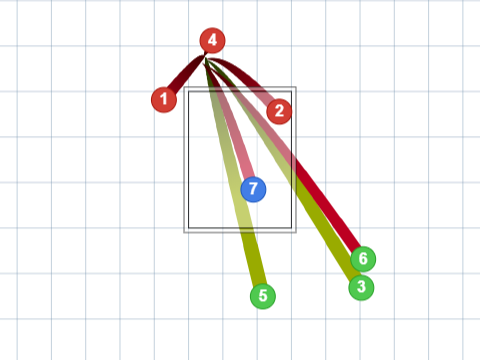
Craig Kimbrel got Sanchez 0-2 with two great fastballs, and then proceeded to run the count full with three pitches nowhere close to the strike zone (#3, #5, #6, to the right). The seventh pitch of the at bat was a dead red, center-cut, fastball (see #7) that Sanchez somehow just missed. Off the bat it didn’t look like much, but it kept carrying deeper and deeper into the New York night. On hits like this, I watch the fielder, as he will give you a good indication of whether or not the ball is playable; but I also watch the fans. In this case, the further Andrew Benintendi drifted towards the wall, the more excited the fans became, the sicker I began to feel.

That play lasted a LONG time. In fact, from the moment the ball left the bat until it landed in the glove, nearly seven second elapsed.

To put that in perspective, the longest hang time of an NFL punt last week was less than six seconds. If we were driving down the highway at 60 MPH, we would travel nearly 600 feet before that ball landed. If our eyes were trained on the game, we would have blinked at least twice between contact and the out being recorded. There is a lot one can do in seven seconds, including, apparently, hold your breath.

The Red Sox 108-win season could have been upended if Sanchez’s ball had flown five more feet. But that would have been a pre-2004 outcome. That was before the world changed.

When super-rookie Gleyber Torres hit that little roller to third (not to be confused with “a little roller up along first”), any number of things could have gone wrong, to wit:

  • No throw and the bases are loaded for Andrew McCutchen;
  • The throw pulls Steve Pearce off the bag for the same result;
  • The throw pulls Pearce off the bag and in his splayed state, Adeiny Hechavarrria scores from second to tie the game; or
  • The worst case scenario – which I envisioned in that split second – the throw pulls Pearce off the bag, Pearce tries to right himself and throw Hechavarrria out at the plate, but airmails it home allowing Neil Walker to cruise in with the winning run.

Any of those things could have or would have happened prior to 12:01am on October 18, 2004. And we, as Red Sox fans, sat there Tuesday night ever-fearful that history was going to repeat itself. That the good times were over and that David Price (in Pedro Martinez’s stead) would be on the receiving end of “Who’s Your Daddy?” chants for the rest of time.

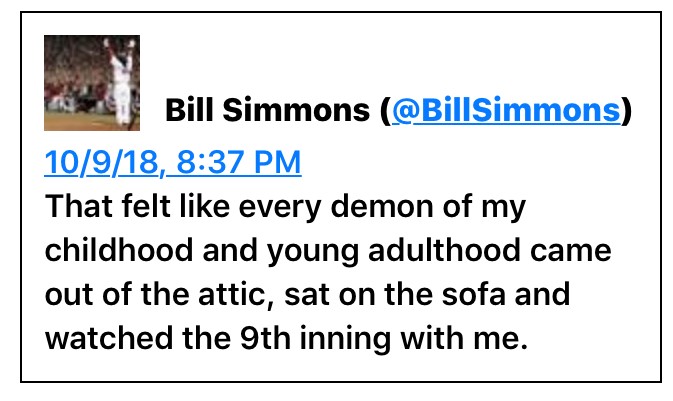
When the final out was recorded and the Red Sox had won, Bill Simmons tweeted:

Alas, those demons are gone; they have retreated to the attic or the basement or the Bronx. Sure, the Red Sox will at some point rip our hearts out again; sure, the Yankees will at some point trounce the BoSox again; sure, not every break will go our way forevermore. But, this is not a pre-2004 world. We as Red Sox fans do not live with the knowledge (only the presumption) that the worst will inevitably occur. Now we can be rational, calm, measured, knowing that the only certainty is that bad things will happen to…the Indians.

PLAY BALL!!
Being There

There is something about just “being there.” So, when my buddy Darin texted me an invitation to Friday night’s NLDS Dodgers vs. Braves game, I quickly texted back an emphatic “yes.”

He then sent me a picture of where we would be sitting – very far from homeplate – and I just as quickly texted back that being there is what matters most.

I was so eager to respond and lock down a free ticket to a playoff game, that I didn’t even realize that I had said “yes” to Clayton Kershaw. In an incredibly unusual move – a move that had not happened since Kershaw’s 21-year old season in 2009 – the Dodgers started the post-season with a pitcher who did not wear #22 on his back. The team decided it was best to give Kersh an extra day’s rest, which allowed him to be ready for Game 5 if necessary, and started Hyun-Jin Ryu in Game 1. It worked out perfectly, as Ryu threw seven innings of four-hit ball, allowing no runs in a dominant appearance.

Kershaw, as always, was diplomatic about the team’s decision. When asked if he agreed with the rotation choice, he offered a lengthy pause, and then said: “They had their reasons and I accepted them.” When asked if it was a gut punch not to be on the mound for Game 1, the fiery Texan said: “I don’t really think of it like that. I think: I get to pitch in another playoff series for the sixth year in a row. I’m looking forward to it.” This guy is a pro, and has done this long enough to know what to say and when. He must have decided, in that moment, to let his arm do the talking.

At 6:37pm on Friday night, Clayton Edward Kershaw walked out of the dugout, across the grass to, in the words of Vin Scully, “the mound at Dodger Stadium…the loneliest place in the world.” History was both Kershaw’s friend and enemy, the playoffs – not the Braves – his greatest nemesis.

Kershaw’s first pitch of the beautiful and cool Los Angeles evening was a 92-MPH fastball that Ronald Acuña Jr. promptly smacked to the wall in left center for a leadoff double. You could feel the tension in the air. Would this, could this, be another playoff disaster for the Hall of Fame-bound lefty? In a word, no; no it would not.

After giving up that leadoff double, Kershaw was masterful. He retired the next 14 batters before an infield single broke the streak. Being a baseball nerd, I watched and calculated his pitch count each inning: 29 through three and 39 after four; 55 through five and 60 after eighteen outs; 73 heading to the stretch, and just 85 when eight innings were in the books. When the Dodgers came to bat in the bottom of the 8th, I felt certain that we were about to see a playoff version of a “Maddux”: a complete game shutout with less than 100 pitches. To paraphrase the great Tim Kurkjian, that is something have never seen before.

There were 54,452 of us sitting on the edge of our seats when Kershaw climbed the stairs of the Dodger dugout and jogged out to pitch the ninth. We were about to witness history.

Alas, it was not meant to be. Kershaw took the mound to warm up as a diversion, a ploy, a chess move in the mental game between managers. If the Braves allowed left-hand hitting Lucas Duda to lead off the ninth, Kershaw would have pitched to him. If Braves manager Brian Snitker, seeing the gangly lefty on the hill, announced a right-hand hitting pinch hitter (in this case, Tyler Flowers), Roberts would pull Kershaw in favor of Kenley Jansen.

Of course, sitting in the upper reaches of the ballpark, we had no idea what was going on. We were just wholly disappointed (a) to watch Kershaw abdicate his thrown and (b) to see him to do so for the gas can that is the current incarnation of the Dodgers’ closer. True to form, Jansen gave up a hard hit to the second batter he faced. After a pop out, Jansen ran the count to 3-2 to the dangerous Freddie Freeman. A fastball off the corner would have brought the tying run to the plate, and potentially put Kershaw’s gem in peril. But Kershaw – and by extension, Jansen – was not to be denied. Freeman swung through a 93-MPH cutter, and the Dodgers had a 2-0 series lead.

I have been to a lot of baseball games, and I have seen a lot of gamesmanship. But I have never seen a manager send the face of the franchise, throwing one of the games of his life, to warm up on the mound just to compel the other team to make a move. Love or hate Dave Roberts, and many people do, this was pure genius. As we learned later, he got Kershaw’s blessing before executing the plan – the manager and the player were on the same page.

Kershaw could have pulled rank – he could have gone all Matt Harvey and essentially refused to give up the ball; he could have said to Roberts: “One day there will be a statue of me outside this stadium and a bust of me in upstate New York, I have been dominant for eight innings and have thrown only 85 pitches; I went along with your cockamamie idea and allowed Ryu to start Game 1, but if you want this baseball, you have to pry it out of my meaty left hand.” And you know what, he would have been totally justified in saying so. But he didn’t. He put team ahead of self; he put winning ahead of personal accomplishments; he was, quite simply, a pure pro.

Kershaw left the mound to a standing ovation and an anxious crowd. Jansen didn’t let him down, he didn’t let any of us down.

Walking out of the park last night I remained sad that we didn’t get to see Kershaw pitch a Maddux on a massive stage. But that is what separates fans from superstars. Michael Jordan passed up the shot, twice, giving the ball to Jim Paxson and Steve Kerr, because he knew it was about winning championships, not accolades. Kershaw didn’t care that I couldn’t boast about what I had seen; he cared that his team gets to the next round, and then the ultimate round, again.

But you know what, upon further reflection, I’m not sad. Greatness is greatness, whether it goes eight innings or nine. And when people talk about one of Kershaw’s all-timers, I will be able to say “I was there.”

PLAY BALL!!
163

I missed Opening Day. I was traveling with my family, on an island far from where any game was being played, and did not have the opportunity to partake in any of the pomp or pageantry.

Because of that, there was no way I was going to miss “Closing Day.” I made sure I was in the park – Anaheim Stadium, as it turns out – to watch the sun set on the regular season. And what a way to end it: the pre/early/mid/late season phenomenon named Shohei Ohtani led off the bottom of the ninth with a rocket single to center. He then flew around the bases to score from first on a double to left, making it a one-run game. And then, when a Mike Scioscia-led team would normally have made the rookie shortstop bunt the tying run to third, we come to find out that Scioscia relinquished his managerial duties for the final game in his 19-year run. So whoever was calling the shots in the Angels dugout threw caution to the wind, tossed out that two decade-old playbook, and let the kid hit. And hit he did. Taylor Ward is no Freddie Patek or Tim Foli or even David Eckstein. So it wasn’t a massive surprise when Ward hit a game-winning, season-ending, walk-off two-run homerun and was met at home plate by a mob of teammates and two buckets of Gatorade.

The Angels’ celebration was a much needed final image in what was yet another disappointing (some might say wasted Mike Trout) season. What a joy to watch two rookies being interviewed on the field in two different languages, while one of the last old-school managers was being interviewed for the final time. The cycle of baseball life.

But for me, I was thwarted. It turns out that I wasn’t at “Closing Day.” While the Angels were rallying to beat the A’s, the Dodgers (15-0) and the Cubs (10-5) were beating their hated rivals; and the Rockies (12-0) and Brewers (11-0) were destroying the Scherzer-less Nationals and the hapless Tigers, respectively. Put another way, all the teams that had to win on Sunday did so, by a collective score of 48-5. The lack of excitement on Sunday meant we would get a ton of excitement on Monday with not one, but two Games 163. To paraphrase the great Jayson Stark: Do you know how many times that has happened before? You would be correct…none!

Now I had to make new plans; I had to get to a Game 163. Lucky for me, there was a one being played down the street. So I sat in the 90-degree sun and watched yet another rookie, pitching sensation and potential heir apparent Walker Buehler throw 6-2/3 innings of one-hit ball; and watched the 28-year old breakout success Max Muncy launch his 35th homerun; watched Kenley Jansen hold a lead he simply could not lose; and watched as the Dodgers celebrated their sixth straight NL West title. As you know, the Brewers knocked off the Cubs earlier in the day, so when Gerardo Parra struck out on a high cutter, Games 163 were in the books, and so too was the 2018 regular season.

To be perfectly candid, there was something anticlimactic about the Dodgers’ win. Sure, winning six division titles in a row makes it seem almost rote. But I think it was the fact that both teams were going to the playoffs, regardless. The game had stakes – the winner got two days off and a guaranteed five-game series while the loser had to hop a flight to Chicago for a one-game playoff. But it seemed inevitable that the Dodgers, with their payroll and their stars and their lineage and their home field advantage, would get the W. And, in Hollywood, things tend to follow the script. We watched the players celebrate on the field, but they had already celebrated when they were assured a playoff spot; and they had already celebrated when they were assured a chance to win the division. How many bottles of champagne does it take just to get to October?

Now the real fun begins. Two do-or-die games for the right to play the Brewers and the Red Sox, respectively. An A’s team that no one saw coming. The Braves at least one year ahead of schedule. The Astros trying to defend their title. The Indians hoping to erase 70 years of futility. So hang onto your hats, as per usual, October should be a wild ride.

So how do we follow two 163s? Well, we have two single elimination games; four potential Games 5; and three potential Games 7, including a finale on Hallows’ Eve! A boy can hope…

PLAY BALL!!

Role Models

Charles Barkley famously once told the world: “I am not a role model.”

In that iconic Nike ad, Sir Charles went on to say that just because he dunks a basketball, he shouldn’t raise our kids. Fair enough, but there has been enough blowback about that commercial and his misguided sentiment in the 25 years since it first aired, that there is no need to go any deeper into the inanity of the assertion here. Suffice it to say, athletes, whether they like it or not (and some, apparently do), are role models.

The term “role model” is a funny one; and we, as a society, unwittingly and unnecessarily and unconsciously, consistently attach the word “positive” before utilizing it. However, Merriam-Webster defines the term as “a person whose behavior in a particular role is imitated by others.” Putting aside that Merriam-Webster used a word in the definition of a word it sought to define, nowhere in that definition to you see the word “positive.” We just imply it.

I do agree with Mr. Barkley on the following concept: we are responsible for raising our children – that responsibility most certainly should not be left to professional athletes. But it would be wholly naïve to believe that our children are not influenced by what they see, they read, they hear. Watch a Little League baseball game, or a Pop Warner football game, or an AAU basketball game, and tell me you don’t witness many of the same actions you see on your nightly edition of SportsCenter. Hell, I know I mimicked my favorite athletes growing up, and for part of that time, I only had George Michael’s Sports Machine as a reference point.

As a parent, I always look for teaching moments. Allow the kids to screw up, sit them down, and teach them the way forward. Show them the error of their – or someone else’s – way, and how to avoid that outcome in the future. And for that, athletes often prove to be an amazingly fertile resource. For that, athletes, and people around athletes, are incredible role models. Not a week can go by without us opening the newspaper (an antiquated concept, I confess) and read about an athlete giving us a perfect example of what not to do. And because their flameouts are often public and ignominious, these role models present us parents with wonderful teaching moments.

Over the past few weeks we have seen this happen time and again. In the first few instances, it was regarding social media.

In the span of just a few days around the All-Star break, three Major League baseball players learned the potential pratfalls of social media. First there was Josh Hader. A second-year pitcher having an incredible season. So much so that he was actually on the mound at the All-Star game in Washington, D.C. when his racist, homophobic, and generally despicable tweets from many years ago were first reported. Instead of a post-game celebration reveling in his achievement, he was forced to answer for his actions, and apologize to his friends, family, organization, teammates, and community. That is probably not how he wanted to remember his first All-Star game.

Then, a few days later, Sean Newcomb was throwing the best game of his life: one strike away from no-hitting the Los Angeles Dodgers in front of the home crowd in Atlanta. It was just about then that his racist, homophobic, and generally despicable tweets from many years ago were first reported. Again, the joy of the moment was lost in a haze of apologies and “stupid kid” justifications.

That same day, at roughly the same time, Trea Turner, the fantastic young shortstop for the Washington Nationals had his racist, homophobic, and generally despicable tweets from many years ago reported. Trea hadn’t done anything special on the day his idiotic past came to light, so at least no celebration was interrupted when he was forced to issue the following statement:

“There are no excuses for my insensitive and offensive language on Twitter. I am sincerely sorry for those tweets and apologize wholeheartedly. I believe people who know me understand those regrettable actions do not reflect my values or who I am. But I understand the hurtful nature of such language and am sorry to have brought any negative light to the Nationals organization, myself or the game I love.”

But if we thought the teaching moments were done, hang on to your hat. Unless you follow baseball closely, and/or you live in the greater Toronto area, you are fortunately unaware that a 23-year old flame-throwing closer named Roberto Osuna was suspended 75 games back in May under Major League Baseball’s Joint Domestic Violence, Sexual Assault and Child Abuse policy. This is the second longest suspension under this policy ever issued. Osuna is set to return to action this week; and it is highly likely that you, the casual baseball observer, would never have heard of Osuna and his checkered past had the Blue Jays not traded him before the July 31st trade deadline. The Houston Astros acquired Osuna, for, in the words of Jeff Sullivan, “a prospect or two, and much of what remained of their organizational integrity.”

Osuna was due in court last week, but only his attorney appeared. In an effort to make certain that fanbases in two countries equally despised his client, the attorney issued the following statement after the hearing:

“My client is not remorseful of being guilty of any criminal activity…he’s obviously remorseful of the circumstances.”

Sure, this is lawyer-speak, but sometimes lawyers (present company included) shouldn’t speak.

Upon receiving a massive amount of criticism over their acquisition of the batterer (I could say “alleged,” as he not yet been proven guilty of any crime, but he did accept MLB’s suspension without appeal, so there is something to the charges), the world champion Astros issued the following anodyne statement:

“We are excited to welcome Roberto Osuna to our team. The due diligence by our front office was unprecedented. We are confident that Osuna is remorseful, has willfully complied with all consequences related to his past behavior, has proactively engaged in counseling, and will fully comply with our zero tolerance policy related to abuse of any kind. Roberto has some great examples of character in our existing clubhouse that we believe will help him as he and his family establish a fresh start and as he continues with the Houston Astros. We look forward to Osuna’s contributions as we head into the back half of the season.”

In short, “We, the Houston Astros, value winning above all else, and we will not hesitate to field players of questionable moral character if the end result is another World Series title.” Reasonable minds can differ (can they?) on this approach to #winning, but the Astros left little doubt as to which side of that divide they land.

So what does all of this have to do with Charles Barkley? All of these examples, four athletes and a sports team, are, in fact, role models. They have given us great examples of what not to do.

We can tell our children to be careful on social media, knowing that what you tap on that little screen can come back to bite you nearly a decade later. And then we can point to Hader, Newcomb, and Turner and say: “See what I mean.”

We can teach our children that hitting women is wrong – always. And that doing so can cost you your job (at least temporarily), and your income (nearly $2.5M in Osuna’s case), and your standing in the community. And then we can point to how the baseball world has reacted to Osuna and say: “See what I mean.”

We can explain to our children that winning isn’t the only thing (despite what Red Sanders may believe). That seeking an advantage at the cost of your integrity can have long and lasting implications. That society won’t look favorably upon people who put success above everything else. And then we can show our kids Jeff Luhnow juking and jiving to put a positive spin on his steaming pile of shit that was this deal and say: “See what I mean.”

It seems that we wake up each morning and find ourselves living in a world with few consequences for outrageous behavior. It is enough to make us all borderline nihilists. But then a few dumb athletes and at least one ruthless deal-maker bring us back to Earth. Through their conduct we learn that there are, in fact, costs to bad deeds. And because these bad acts and bad actors are in the news and in our feeds, they present perfect teaching moments.

And just like we were able to teach our kids about the treachery of drinking and driving when Sir Charles was arrested for DUI; and just like we were able to teach our kids about the risks of gambling when Barkley admitted to losing at least $30M in Las Vegas over the years; so too can we teach our kids these life lessons. They are brought to us by athletes (and executives) who are, in fact, role models.

PLAY BALL!

Fathers (Day) and Sons

Last week I spoke as part of a lecture group on the topic of fatherhood. When it was over, the speakers and audience members gathered in the lobby to discuss the show, to recount how we all related to the stories, and to share the impact they had on everyone in the theater.

When I made my way to my father, he had tears in his eyes. Insofar as I spoke first, nearly ninety minutes earlier, I knew it wasn’t my story that had welled his emotions. Rather, he told me, it was all of the anecdotes combined that made him wistful, that caused him to think about his father. Feelings don’t dissipate in your eighth decade – sometimes they are heightened.

My father’s reaction to the readings made me think about my Grandpa Max, who would have been a cool 108 years old this year – one year for each stitch on a baseball. Grandpa Max (and Grandma Betty, to be fair) was one of my biggest fans, and was cheering me on when I hit my first career homerun. While that moment still brings a smile to my face, it occurred many years after Grandpa Max made his first contribution to my ultimate love of baseball: he taught my dad to love baseball. With that as the foundation, I, in-turn, taught my son to love baseball. I am unable to go back any further on the genealogical depth chart, but I know we have at least four generations covered.

My grandfather grew up in Boston a Red Sox fan; and my father grew up in Boston, a Red Sox fan. Grandpa Max was born about nine years before the cursed Red Sox World Series championship (1918) and died about nine years before the curse was broken (2004). I find some kind of weird symmetry in that.

My father moved from the east coast to Los Angeles in 1958. That is the same year, coincidentally (or not), that the Dodgers also headed west. I am not sure, but I think there is something to that as well.

Max, Saul, Dan, Jake. For well over a hundred years, we have been, and continue to be, a baseball family.

In the summer of 2009 we took a three-generation trip to Boston, and were brought onto the field at Fenway Park. My son led the way, followed by me, and then my dad. I said to our guide: “I don’t know who is more excited, Jake, me, or my dad.” My dad quickly shouted: “Me! Because I am excited for Jake, you, and myself.” Chris Rock says dad gets the biggest piece of chicken; I guess granddad gets the biggest thrill in the moment. Seems perfectly fair to me.

Baseball is a game of fathers and sons (and grandsons). With apologies to Jim Nantz, it is a tradition unlike any other.

The Major Leagues have seen five father-son-grandson families – with the most notable being the Boones (Ray, Bob, Aaron/Bret) and the Bells (Gus, Buddy, David). And there have been countless father-son combos (at some point this summer there will be another, when Vladimir Guerrero, Jr. makes the leap from Double-A to third base in Toronto).

Hell, there is even a three-generation umpiring family (Ed, Paul, and Brian Runge).

For these families, baseball is literally in their blood.

But for the rest of us, baseball resides in the heart. Our fathers teach us the game; they sit with us on the couch and point out the sport’s intricacies; they play catch in the backyard and explain the difference between a four-seam and a two-seam grip; they take us to the stadium and protect us from foul balls. Fathers show us how to keep score and where to stand to get an autograph. They demonstrate how to properly dress a hot dog, and what true fandom looks like. And fathers do it as much for themselves as they do for their sons. It is truly a labor of love.

I would remiss if I didn’t mention that there are a great many moms out there who do all of the above, and do it out of devotion to the game, and love for their boys. I have no doubt that Helen Callaghan taught her son baseball – and probably more and better than any of us have. She played in the All-American Girls Professional Baseball League (made famous in a little movie called A League of Their Own), and guided her son to the Major Leagues (check out Casey Candaele in those sweet Expos blues, to the right). I am certain there are countless moms out there who have cried in baseball while imbuing their sons with the splendor of a suicide squeeze, or the sublime brilliance of a perfectly executed hit-and-run. I am sure that there exists a mom named Mary whose appreciation of an immaculate inning cannot be matched.

But Ms. Callaghan and the other baseball-loving females in our lives aside, the job of baseball parent customarily falls to the dad. And boy are we lucky for that.

I was recently in New York with my son, and after touring CitiField, we went to the Bergino Baseball Clubhouse. If you ever find yourself in the East Village, I highly recommend it. The proprietor, Jay Goldberg (who couldn’t be a nicer guy), told us about a project he is working on: Remember Your First Game. What a brilliant idea. My son and I stood in that store trying to recall, and we think we know, but we cannot be certain (a high-class problem to have been to so many games that you cannot pinpoint the first). I think mine may have been a Double-A game in Bristol, Connecticut in 1976. We are pretty sure Jake’s was – fittingly – the Red Sox vs. Dodgers at the L.A. Coliseum in 2008. But the teams and locations are unimportant…what matters is that the father took the son. They shared that moment, which begat another moment, which begat thousands more moments, all built around baseball.

My son’s mother passed away about six weeks before his first coach-pitch season. By that time, he already had the “bug.” But I often wonder if he would love baseball as much if the other parent had died. Sure, it is a dark – and probably unnecessary – line of thought, but it fits with my narrative about balls and strikes, about baseball and love, about fathers and sons.

Each year we comb the racks at the local department store, we search online, we ask for guidance, looking for the perfect Father’s Day gift. And after much deliberation, we usually land on a tie, a pair of socks, or a book.

This year, try something different. This year, give your dad the gift of thanks. Thank him for introducing you to baseball, for educating you about the game, for showing you how to love it unconditionally; thank him for explaining the infield-fly rule and teaching you the phrase “there is always next year.” And thank him for instilling in you an adoration for a sport that transcends time, a sport that, by its very nature, requires patience, persistence, and perseverance; a sport that, like a cherished watch, must be passed down from generation to generation. Wrap up and put a nice little bow on a very simple, “Thanks, Dad!”

And if your father is no longer with us, tell your son about a time you went to the ballpark with your dad. If you believe – as I do – that your father is listening, he will be grateful for the reminiscence, and your son will appreciate the memory.

As they say in Hebrew, l’dor vador.

Happy Father’s Day.

PLAY BALL!!
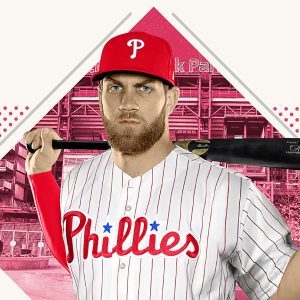
Bryce Harper is NOT a Superstar

I am not trying to be provocative; this is not a “hot take”; I am not in the business of taking unnecessary shots.

Bryce Harper is good, very good. Harper may, in fact, be great. But Bryce Harper is not a superstar. Now, past performance is no guarantee of future results. As such, Mr. Harper may become a superstar. He may start his ascent this season, keep getting better into his mid and late twenties, and retire as one of the best to ever play the game. Who knows? But with all of this talk of $300M, $400M, $500M contracts in the ether as Bryce heads into free agency, I think it is important to step back and look at the facts. And by facts, I mean numbers.

About eighteen months ago I wrote an article comparing Harper to Mike Trout (who IS a superstar; and who, barring injury, will be (if he isn’t already) one of the best to ever play the game). Nothing has fundamentally changed since that analysis was completed after the 2016 season.

What has changed is that Harper had another good, but not great, season; and Trout had another brilliant (if injury-shortened) one.

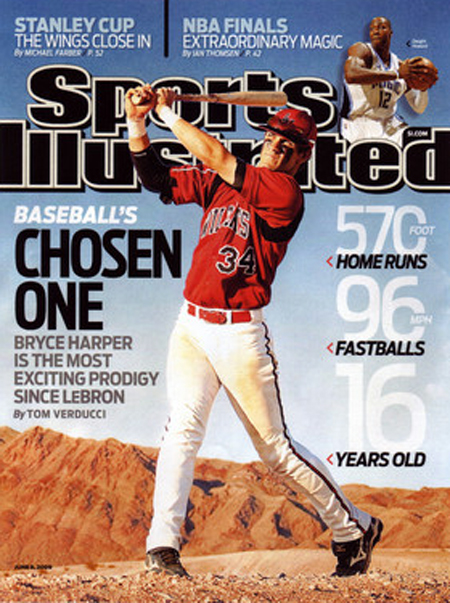
When people speak of Harper, they do so in hushed tones. They hearken back to the teenage phenom on the cover of Sports Illustrated and the reported 570-foot homerun in Las Vegas at age 15. And then, inevitably, the conversation turns to Harper’s 2015 season in which he led the league in homeruns, runs, slugging, OBP, OPS, and WAR. With those numbers, he was the league’s Most Valuable Player.

Every season Harper is a perennial MVP candidate. And every season – save for 2015 – something happens to dash those hopes. In 2013 it was a knee injury; in 2014 it was a thumb injury; in 2016 it was a slew of walks by the Cubs in May that through him off the scent; in 2017 it was another knee injury. And this season – which started with a lot of promise with eight homeruns and a 1.265 OPS in his first 17 games – it seems like impending free agency is causing him to press, expand the strike zone, thus leaving him hitting .232 (albeit with a tie for the league-lead in homeruns with 13 and a .931 OPS*).

But if we break down Harper’s first six years, we see the following:

fWAR OPS RUNS
2012 4.4 0.817 98
2013 4.1 0.854 71
2014 1.6 0.767 41
2015 9.3 1.109 118
2016 3 0.814 84
2017 4.9 1.008 95


These numbers are fine, but they are not half a billion dollars’ worth of fine.

And let’s take a look at that illustrious 2015 campaign – the one that is always referenced to reflect Harper’s potential, the reason people believe he is a superstar.

Harper had an 1.109 OPS that season, which ranks 79th all time. Here are the names of a few players who have recorded higher single-season OPS numbers:

  • Jeff Bagwell
  • Larry Walker (three times)
  • Todd Helton (twice)
  • Albert Belle
  • Carlos Delgado
  • Luis Gonzalez
  • Kevin Mitchell

Now, these are great players. And yes, some did this in the steroid era. But, numbers are numbers.

How about that 9.3 fWAR, which is Harper’s best season by nearly 200%? In the last 20 years, there have been 31 individual seasons of 9.3 fWAR or better. In fairness, that list is filled with Hall of Famers, future Hall of Famers, and should-be Hall of Famers (save for PEDs). But Jacoby Ellsbury is also on that list (a 9.4 season); and Kevin Brown recorded a 10-win season. Those numbers make a 9.3-win season, if not pedestrian, at least less stratospheric.

In any given year (again, save for 2015), Harper’s conventional stats are lumped in with the likes of:

  • Mark Reynolds and JJ Hardy (HRs in 2012)
  • Adam Lind (OPS in 2013)
  • Trevor Plouffe (Slugging in 2014)
  • Dexter Fowler and Jayson Werth (Runs in 2016)
  • Didi Gregorius and Kyle Seager (RBI in 2017)

If it seems like I cherry-picked those specific stats for those specific seasons, I did not. You could go year-by-year (excluding only 2015) and find Harper bunched with other good ballplayers in each column of his baseball-reference page. Last season Harper once again showed his potential, finishing in the top six of slugging, on-base, and OPS – but only if you set the parameters at 100 games. Harper played in only 111 games in 2017 due to the aforementioned knee injury. While stepping on a slick bag may not have been his fault, maybe running into a wall at full speed is; and diving head-first into a base definitely is. Regardless, we live in a no-fault world – and if you are paying a ballplayer $30M, or $40M, or (gasp) $50M per year, he needs to be on the field putting up those numbers over 150+ games. Harper has played that many games only once in his first six seasons.

Quiz time. Below is the average output of two different players through their first six years^ in the Big Leagues. Which would you choose?

  GAMES RUNS HR RBI OBP SLUG OPS fWAR
Player A 135.5 86.2 13 60.2 0.344 0.429 0.773 4.1
Player B 128 84.5 25 76.7 0.383 0.512 0.895 4.55


They are pretty close, and if you squint, I think you would prefer Player B. Player A – also known as the aforementioned Jacoby Ellsbury – got a 7/$153M deal when he entered free agency at age 30, and that deal has been derided in the Bronx since the ink dried.

Does Player B – also known as Bryce Harper – look like he is worth two-times Ellsbury (based solely on performance to date)? Three-times?

Does your answer change if I told you that Harper would sign this deal at age 26 (rather than age 30)? Do those four years of production make him $150-$250M more valuable? One could argue that, at $11M per each single WAR, those four years (assuming Ellsbury is a zero-win player during the same period) make Harper worth about $50M more than Ellsbury. But $50M is a far cry from $150M, let alone $250M or $350M. Add $50 million to Ellsbury’s deal, round it up so the AAV looks good, and Harper could (should?) get 7/$210M. That seems reasonable.

Numbers are numbers, and facts are facts. Bryce Harper is not (yet) a superstar. Can we please dispense with that talk; and can we please dispense with the idea that Harper should get anywhere between one-third and one-half of a billion dollars when he signs next off-season?

Now, if we start talking about Manny Machado? Well, that would be an interesting conversation…

PLAY BALL!!
*All stats current as of May 17

^Ellsbury’s 2010 season was omitted as he played only 18 games that year.

Let It Slip Away

Watch sports long enough, and you know.

Your football team is down four with three minutes to go and they give up a first down on third and long. You know.

Your favorite golfer has a five-foot birdie putt to go one back with two to play, and it lips out. You know.

Your basketball team has made a furious comeback to cut the lead to two in the last seconds, gets a loose ball, and then misses a wide-open three. You know.

Watch enough sports and you can just sense when a team had their chance, and let it slip away.

“There is a lot of baseball left to play.” I cannot count how many times I have uttered those words. My wife makes fun of me because she knows better than to assume a win any time before the 27th out is recorded. If she so much as attempts to assuage my anxiety, I will hit her with: “There is a lot of baseball left to play.”

And yet, even though we are only in the second week of May, and even though we are only 25% of the way through the schedule, and even though anything can happen between the time spring turns to summer which turns to fall, and even though “there is still a lot of baseball left to play,” in a 24-hour period earlier this week, both of my teams let it slip away. And I know. I know that my teams are now playing for second place. History may prove me wrong, but I believe – in my soul – that the NL West was lost on Tuesday, May 8th and the AL East was lost on Wednesday, May 9th. Allow me to explain.

National League West

The Los Angeles Dodgers were the prohibitive favorite to win their sixth consecutive NL West title this season. Their only real competition was the Arizona Diamondbacks, who lost their best player to free agency and lost their second best pitcher to Tommy John surgery. It should have been a cakewalk. But then a funny thing happened: they started playing the games.

The Diamondbacks began the season 24-12, and won their first nine series – including two against the Dodgers (they went 5-1).

Meanwhile, the Dodgers started the season 16-20, lost their best player to Tommy John surgery and their best pitcher to tendinitis. As of this writing, the Dodgers find themselves in fourth place, eight games behind the D’Backs.

Tuesday night could have changed things. The Dodgers had a two-game home set against their rival, hoping to reduce their deficit to six. Trailing 5-2 in the bottom of the 5th, the Dodgers scored two runs to cut the lead to one. And then, with one out in the bottom of the 9th, Kike Hernández hit a dramatic game-tying homerun. With one swing of the bat, the momentum shifted.

In the bottom of the 10th, the first two Dodgers reached base, and Matt Kemp came to the plate with a chance to win the game. Kemp proceeded to hit a bomb just to the right of centerfield. Off the bat it seemed like a walk-off three-run homer, and a happy night at Chavez Ravine. But the cool air held the ball up, and A.J. Pollock corralled it at the wall. Pinch-runner Ross Stripling (yes, you read that correctly) moved to third, but for reasons that pass understanding, Cody Bellinger went halfway* and didn’t move to second. Luckily for Cody, the D’Backs walked Joc Pederson to load the bases with one out. All Kyle Farmer had to do was lift a fly ball and the Dodgers would be seven games back. Alas, he struck out on splitter in the dirt. And with the bases still loaded, Old Man Chase Utley struck out looking to end the inning.

(*Coaches Note: With the winning run tagging at second, Bellinger’s run meant literally nothing, so he had no reason to go halfway. Rather, with the winning run moving to third, Bellinger had value in precluding a potential inning-ending double play. With a ball hit to the wall, he should have been tagging all the way and cruised into second base, forcing the Diamondbacks to walk Pederson, and thus creating what we eventually got: a bases loaded, one-out situation. But the Bums got there by chance, not by choice.)

Hope continued to spring eternal in the bottom of the 11th, as the first two Dodgers reached base. Alex Verdugo struck out, failing to move the runners over; Kenta Maeda pinch-sacrificed, and now the winning run was 90 feet away. But Cody Bellinger flew out to end the threat, and we played on.

The Diamondbacks, after averting disaster the prior two innings, got two on with one out in the top of the 12th. Daniel Descalso brought them all in with a three-run homer. The Dodgers went meekly in the bottom half, ending the game, and, for all intents and purposes, the NL West race. The Dodgers fell to nine back; but worse, they seemed to have lost their luster. If Arizona plays .500 baseball from here on out (doubtful), the Dodgers will need to go 74-53 the rest of the way to win the West. Not inconceivable, but not likely either.

When the teams left the field Tuesday night, you just knew. The Dodgers had let it slip away.

American League East

This one in trickier, but stay with me. The Boston Red Sox got off to a blistering start, winning 17 of their first 19 games; while the New York Yankees started a pedestrian 9-9. On the morning of April 21st. the Yankees were 7½ games behind the Red Sox; but then they started winning, and they really haven’t stopped. There was a blip against the Astros on April 30th, but other than that, they have been perfect. 17-1 over that span, passing the Red Sox for first place on Wednesday night. And that is when it was over.*

The Yankees and Red Sox entered Wednesday night tied for first place, and played a back-and-forth affair, with four lead changes through seven innings. In the eighth, leading 6-5, the Red Sox had runners on second and third and no outs. This was the moment; this was the Red Sox’ chance to put the Yankees away. A ground ball or a lazy fly ball, and the Red Sox have an insurance run. A base hit and they have two. What transpired over the next four batters ended the AL East race: K, K, IBB (to Mookie Betts), 6-3. Bases left loaded, no runs scored. What made this considerably more painful was that the third out was a shot by Andrew Benintendi right up the middle that could/should have scored two. But it was hit into the teeth of the shift, and Didi Gregorius made the easy throw to first to retire the side.

You know – even if you don’t know – what happened next.

The Yankees got two one with one out in the bottom of the 8th; closer Craig Kimbrel came in for the five-out save; Brett Gardner hit a two-run triple (fifth lead change); Aaron Judge hit a ball about as hard as you can (117 MPH exit velocity/429 feet) to the monuments in dead center. And just like that, the Red Sox trailed 9-6. Boston went meekly in the top half of the ninth, ending the game, and, for all intents and purposes, the AL East race.

Sure, when the teams left the field there were still 126 games left in the season, including 14 head-to-head.* But I have watched sports long enough. I know. I know that in that eighth inning, the Red Sox let it slip away.

(*Panic Note: The Red Sox beat the Yankees in a nail-biter on Thursday night, so that, as of this writing, the teams are tied for first place with 125 games (13 head-to-head) left to play. That fact does not change my view on the matter.)

PLAY BALL!!