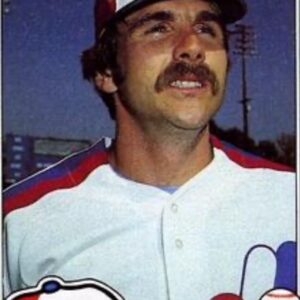
On Episode 2367 of the Effectively Wild podcast, host Ben Lindbergh made reference to David Laurila’s newsletter and his weekly trivia quiz. One question revolved around the three pitchers who have won at least 100 games for the Expos/Nationals franchise. Ben got the first two, and essentially got the third, but could not place the name. The name that eluded him was Steve Rogers.
The right-handed pitcher was originally selected by the New York Yankees in the 60th round of the 1967 draft. Instead, he elected to attend the University of Tulsa, where he helped the team get to the Men’s College Baseball World Series his sophomore year. Rogers played all four seasons, graduating with a degree in petroleum engineering. But rather than drilling for oil, he again registered for the MLB draft, where the Expos took him with the fourth pick in 1971.
Just about two years later he made his debut, throwing eight innings against the Astros in the famed Astrodome, allowing two runs on four hits, getting a no decision on a game that went ten innings.
Rogers pitched from 1973 to 1985, but from 1973 to 1983, he was one of the five best pitchers in baseball. As Ben referenced on the podcast, those top five pitchers – as measured by Fangraphs WAR – were Steve Carlton, Bert Blyleven, Nolan Ryan, Gaylord Perry, and Rogers. Only one of these guys is not in the Hall of Fame. Just to add to the list, after Rogers, you have Phil Niekro, Tom Seaver, and Don Sutton – Hall of Famers, all.
In 1973, Rogers came in second in Rookie of the Year voting (to Gary Matthews). In 1974, he was named an All-Star for the first time.
Between 1980 and 1983, Rogers was a top-five finalist for the Cy Young Award three times. In 1982, he came in second to Carlton.
From 1973 to 1984, he had only one season (1976) when he didn’t have double-digit wins, and yet he never won twenty games (he topped out at 19 in 1982). From 1973 to 1983, he had an ERA of 3.07 while winning 150 games and accruing 46.3 bWAR. All told, Rogers was an All-Star five different times, always among the best of the best.
As a National League pitcher before the universal designated hitter, Rogers wasn’t much of a batsman, hitting .138 with in 881 career at-bats. Amongst his 122 hits, he had eight doubles and two triples, but no home runs.
Rogers is not a Hall of Famer by any rational or analytical metric. His statistics are about 50% of what is required to be elected (his career is most similar to Burt Hooten, another blast from the ‘80s past). And, true to form, in 1991, his first (and only) year on the ballot, he failed to receive even a single vote. Fans north of the border may view that as a bit harsh.
Because Rogers toed the rubber during a golden age of pitchers (many of whom are enshrined in the Hall of Fame), he may not be that memorable to anyone other than his family and those of us who grew up assiduously watching baseball in the eighties. Unfortunately, Rogers may be best remembered for giving up a game-changing, and ultimately game-winning, home run to Rick Monday in Game 5 of the 1981 National League Championship Series.
But that on at-bat should not detract from a career of durability and viability that spanned two decades and brought smiles to the faces of many a Canadian.
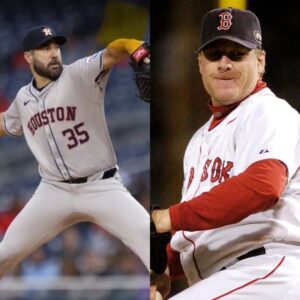
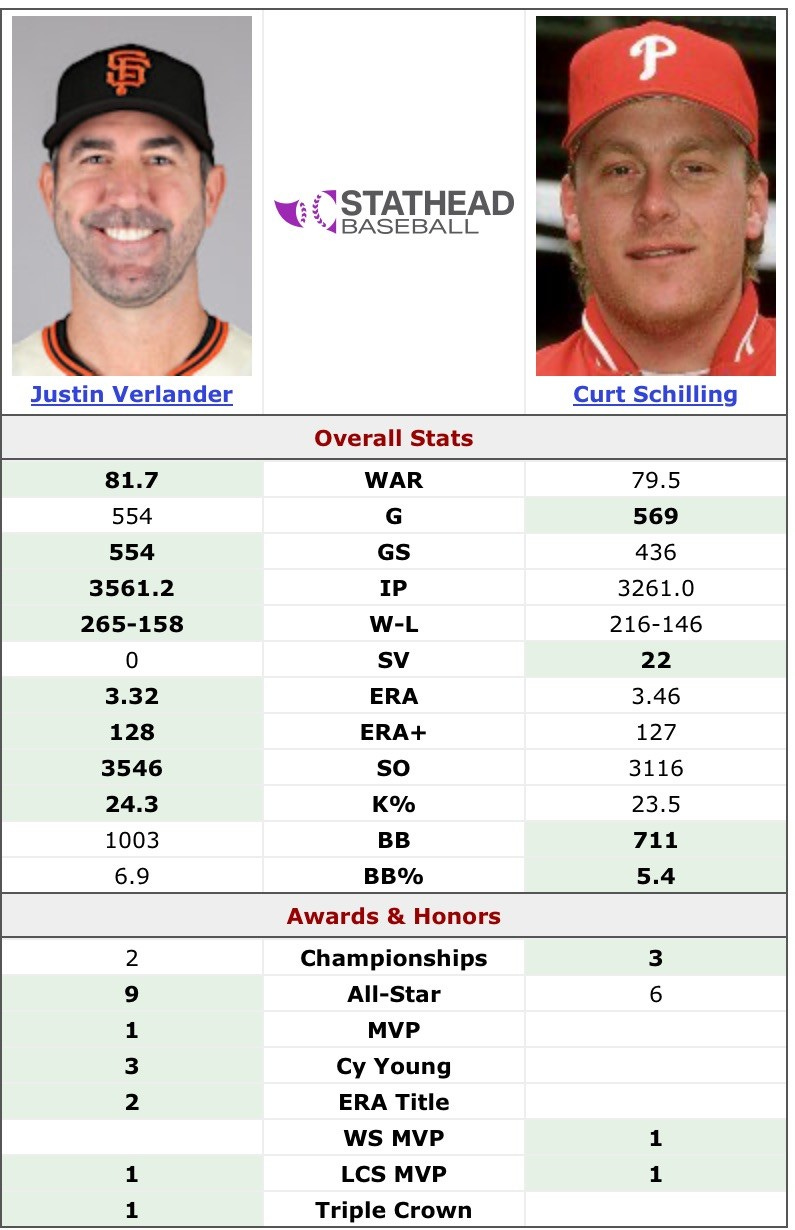
Curt Schilling was selected out of Yavapai College in the second round of the 1986 MLB draft by the Boston Red Sox. In July of 1988, Boston traded Schilling, along with outfielder Brady Anderson, to the Orioles in return for veteran pitcher Mike Boddicker. Ironically, Schilling made his major league debut just five weeks later — throwing seven innings of six-hit/three-run ball in a Baltimore win against those same Red Sox.
In a little-remembered transaction, Baltimore traded Schilling to the Houston Astros in January of 1991. He threw 75-2/3 innings for the Astros over 56 games out of the pen, before Houston sent Schilling to Philadelphia in return for Jason Grimsley. Schilling went on to re-sign with the Phillies when he became a free agent at the end of the 1995 season. And it was in Philadelphia where Schilling became a star. In his first eight years in the City of Brotherly Love, Schilling won 95 games with a 3.31 ERA and a 127 ERA+. He went to three All-Star games (1997-1999), twice led the league in complete games, and twice led the league in strikeouts.
At the trade deadline in 2000, Philadelphia shipped Schilling to the Arizona Diamondbacks, where he teamed with Randy Johnson to become one of the best 1-2 combinations in the history of the sport. In 2001, Schilling went 4-0 over the NLCS and the World Series, with a 1.12 ERA, and 56 strikeouts against only six walks. Schilling famously started Game 7 of that Fall Classic, going 7-1/3 innings, leaving the game with the D’Backs trailing 2-1. Miguel Batista came in to record one out, and then Johnson got the next four Yankee batters to set up Luis Gonzalez’s dramatic walk-off single in the bottom of the ninth. Johnson and Schilling were honored as World Series Co-MVPs.
At the end of the 2003 season, over Thanksgiving dinner at Schilling’s Arizona home, Theo Epstein, the Red Sox’ general manager, convinced Schilling to waive his no-trade clause and come back to where it all started: Boston. It worked. And in 2004, the big righty helped Boston “reverse the curse” and win their first World Series in 86 years. In four games over that post-season, Schill went 3-1, including the dramatic “Bloody Sock” Game 6 of the ALCS against the Yankees. He followed that up with a win in Game 2 of the World Series against the Cardinals.
Schilling won three more games in the 2007 post-season, helping the Red Sox win their second World Series in four years. A shoulder injury ended his career after that 2007 season. When all the ink was dry, Schilling had a career record of 216-146, an ERA of 3.46, an ERA+ of 127, and is one of 20 pitchers to record 3,000 strikeouts (3,116). His career bWAR sits at 79.5.
JUSTIN VERLANDER
The Detroit Tigers selected Justin Verlander with the second overall pick in the 2004 draft out of Old Dominion University in Virginia. He made his major league debut 13 months later against Cleveland, striking out four, while giving up seven hits and four earned runs over 5-1/3 innings. He pitched in only one other game that year, going six innings and giving up five earned runs. When the 2005 season ended, Verlander had an 0-2 record, a 7.15 ERA, and a total of seven strikeouts to his name.
It didn’t take long for the future Hall of Famer to hit his stride. In 2006, Verlander went at least six innings in 22 of his first 24 starts, going 15-6. For the season, he went 17-9 with a 3.63 ERA and 124 strikeouts. That would be the last time he had less than 150 strikeouts in a season for next eight years, including leading the league in 2009 (269), 2011 (250), 2012 (239). When this streak broke in 2015 (only 113 Ks in 20 games), he came back in 2016 to again lead the league with 254, and a league-leading 7.4 bWAR. That was good enough to garner him his second Cy Young runner-up, which was in addition to his Cy Young and MVP wins in 2011.
At the trade deadline in 2017, Detroit sent Verlander to the Houston Astros for three players that didn’t amount to much (a pitcher who never made the big leagues, Daz Cameron (career -1.7 bWAR), and Jake Rogers (2.6 bWAR)). After arriving in Houston, Verlander went 5-0 with a 1.06 ERA, with 43 strikeouts against five walks. In the post-season, he went 4-1 with a 2.21 ERA, helping the Astros beat the Dodgers to win the World Series.
In 2018, he had a career-high 290 strikeouts in 214 innings, and once-again was the Cy Young runner-up (to Blake Snell). It was the sixth time he finished in the top five.
In 2019, after signing a 2-year, $66 million contract to stay with Houston, he won 21 games with a 2.58 ERA. He was an All-Star for the eighth time and won his second Cy Young Award. And, oh-by-the-way, he also threw his third career no-hitter, shutting down the Blue Jays in Toronto. After such a fantastic regular season, Verlander was off his game in the playoffs, going 1-4 with a 4.33 ERA. He lost both Games 2 and 6 of the World Series, which the Astros eventually lost in seven games to the Washington Nationals (a series in which every game was won by the visiting team).
Verlander’s Covid-shortened 2020 season was even shorter due to a groin injury and then Tommy John surgery. He didn’t pitch in 2021. But he came roaring back in 2022, going 18-4 with a career-best 1.75 ERA. He struck out 185 batters in just 175 innings. For his efforts, he was the American League Comeback Player of the Year, and won his third Cy Young Award.
After the 2022 season, Verlander signed a two-year, $86.7 million contract with the Mets. But he made only 16 starts in Queens before being shipped back to Houston, where he went 7-3 over eleven starts. In the post-season, he went 1-1 with one no-decision, while the Astros fell to the eventual World Series champion Texas Rangers.
In 2024, Verlander moved into the top-ten in career strikeouts, passing Greg Maddux. He also won his 260th career game.
Verlander signed with the San Francisco Giants for the 2025 season, hoping to somehow eek out the final 38 wins he needs to become the 25th pitcher to reach the 300-win plateau. As of this writing, he has added only three to the ledger, making the final 35 seem near impossible for the 42-year old hurler (who will be 43 on Opening Day next season).
As of this writing, Verlander has a career record of 265-158 with a 3.32 ERA, and ERA+ of 128, with 3,546 strikeouts. He has won two World Series, been a league MVP, ALCS MVP, won the Rookie of the Year. He has three no-hitters and won three Cy Youngs. He has accumulated 81.7 bWAR to date.
COMPARISON:
When you put these two careers side-by-side, and squint just a little bit, they look awfully similar. And Schilling, without question, was the better post-season performer. Verlander, as mentioned above, has more career black ink (79 vs. 42) and has more wins, more strikeouts, and a better ERA. However, it is how they have conducted themselves off the field and with the press that is the major separator. Schilling has no one to blame but himself for how he is viewed in the public sphere, while Verlander has gone about his career with class and respect every step of the way. Maybe not so similar after all.
On Episode 2375 of the Effectively Wild podcast, co-host Ben Lindbergh — no fan of the “Manfred Man” (aka the “Ghost Runner,” which is a misnomer; aka the “Zombie Runner,” which is an insult to the guy actually standing on second base) — pointed out how the rule instituted in 2020 (during Covid) produced a great injustice about a week ago in a game between the Dodgers and the Giants.
Here is the scenario: With one out in the ninth inning of 1-1 tie, Blake Treinen came in from the bullpen to replace Jack Dreyer with the winning run on third. Manager Dave Roberts immediately ordered an intentional walk to Willy Adames (this begs the question as to why Roberts didn’t do that with Dreyer on the hill, as, alas he created the mess and should be charged with the walk). With the bases now loaded — but the only runner that mattered standing on third base — Treinen got Wilmer Flores to fly to short center field, where Andy Pages caught the ball and threw a strike to catcher Ben Rortvedt to complete the double play. That ended the threat, ended the inning, and ended regulation baseball.
Treinen came back out for the bottom of the tenth, which meant that Christian Koss (who pinch-ran for Flores) took his rightful place at second base to start the inning as the aforementioned “Manfred Man.” Treinen induced Matt Chapman to ground to second baseman Tommy Edman for the first out of the inning, while Koss moved to third. At this point, with left-handed hitting Jung Hoo Lee scheduled to bat, Roberts removed Treinen for lefty Tanner Scott. To summarize, Treinen had faced two batters (technically three, as the intentional walk to Adames counts as a batter faced), and recorded three outs (one via a double-play). Suffice it to say, he had done his job.
Scott took the mound and actually struck out Lee, but home plate umpire Bill Miller ruled that Rortvedt didn’t catch strike three, so he called it a foul ball. Lee walked on the next pitch. With runners on the corners, and again, the only runner that mattered standing on third base, Roberts order an intentional walk to Casey Schmitt. Two pitches later, catcher Patrick Bailey sent a 97 MPH fastball into the left field bleachers for a walk-off grand slam. For purposes of deciding who takes the loss, the only runner that matter was on third — Koss, the “Manfred Man” — who took his place while Treinen was on the hill. As such, Treinen took his fourth loss of the season.
Sure, pitcher wins are an antiquated stat in today’s sabermetrically inclined world. Sure, advanced stats will protect Treinen at contract time (although his actual stats may truly hurt him), and no one will be looking at this loss on this Friday night in September when he becomes a free agent at the end of next season. But, come on! It is right there is the box score in every paper in America, on every website that covers the sport. It just isn’t right. Lindbergh (and others) offered up that this should, if nothing else, be a “team loss,” and not dropped at the feet of the pitcher who literally did nothing wrong and everything right.
Per Lindbergh, who was relying the research of Michael Mountain, this exact situation has occurred ten other times between 2020 and 2024. This would be the 11th, and those eleven pitchers have a reason to gripe, even if they are just shouting into the wind where no one — not fans, agents, managers, or general managers — give one good darn about a pitcher’s win-loss record. But still!
Note: This is a guest column by my son, Jake Freedman
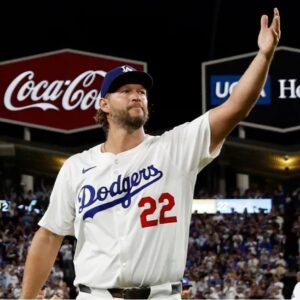
Yesterday, the baseball world got news that was widely-expected: Dodgers pitcher Clayton Kershaw announced his retirement following this season.
Kershaw doesn’t throw as hard as the new generation, yet still has figured out a way to get guys out. With four kids and a fifth on the way, the timing made sense for the big lefty to hang up his cleats. As a fellow lefty who grew up in Los Angeles during his prime, it was not a shock that Clayton Kershaw was my favorite pitcher. His motion was too crazy for me to emulate on the mound and his “Uncle Charlie” curveball had too much curve for my dad to let me throw, but he was still the pitcher I looked up to the most. He never got too high, never too low, just good-ol’ Clayton Kershaw.
When I was younger and went to games with my dad and/or grandfather, I always remember missing Kershaw by one day; in fact, I don’t think I ever saw him pitch with my grandfather, we were always one day late and saw Zack Greinke pitch. But the first time I remember seeing number 22 on the mound, was a game against another giant of this generation and a guy who played just down the I-5, Mike Trout. It wasn’t just the battle of LA, it was a battle between the best pitcher and the best hitter of my childhood.
I have since seen Kersh pitch many times, most notably in Game 1 of the 2017 World Series and then in Game 5 of the 2018 World Series where we rooted against him and then celebrated the Red Sox fourth championship in my 15-plus years (at the time). And I saw him pitch a few times after that Fall Classic game.
This past summer, my dad had a press pass for a random Saturday night game and asked me if I wanted to go. It was a lazy Saturday, so I decided to make a trip to Chavez Ravine, and it just so happened that Clayton Kershaw was on the bump that night. My dad was in the press box so I wandered around and, of course, made my way by the bullpen to watch him warm up. I didn’t realize how many others had thought the same thing, so I watched his bullpen from the bleachers. After he finished, he tossed his ball to the ground and it just sat there. So once he walked towards the dugout the crowds dispersed, I walked down and saw another pitcher walking over to where the ball was and asked him if I could get it, and he tossed it to me. Yes, the ballhawk in me was thrilled to have a ball in my hands, but this one was different, this was most likely the last time I would see one of my childhood idols in person, and I had a little piece of that in my hand.
So, to Matt Sauer, thank you for tossing me that Kershaw warm up ball that no one else seemed to notice; you made this lifelong Kersh fan very happy. And to Uncle Chuck, thank you for giving that young lefty someone to look up to and this now little bit older lefty, a lifetime of Dodger baseball memories.
An owner buys a team and hires a general manager. The general manager hires a field manager and together they go about building a championship team. Along the way there are hiccups and bumps, and wonderful and happy moments. The road is never straight, but the trials and tribulations — the journey — are what make the culmination that much sweeter.
Those same sentiments also pertain to parenthood. You and your spouse build a family. You raise your kids — you give them the basics, and allow them to grow into their own human beings. Then you teach them the advanced stuff, and allow them to grow into self-sufficient and self-confident teens. And then you send them off to college and allow others to get them to the next level — both in the classroom and out — about life and making your way in it.
Parenthood, like a baseball season — whether it ends in a World Series or the first pick in the draft — is neither straight nor smooth. But it is a joy to behold. Raising your children — whether they follow your guidance and rules and in your footsteps, or branch out on their own — is life’s greatest achievement.
Four years ago I wrote about a trip I took through the Midwest attending baseball games with my son as I prepared to send him off to college. Baseball is and has been our north star, which is the same for me and my dad. From tossing a rolled up sock to an oversized plastic bat in the living room to throwing batting practice at the state championship to playing catch in front of the house as recently as last month; from sitting on the couch watching a random game on a Saturday afternoon to being in Dodger Stadium when our beloved Boston Red Sox won their fourth World Series since his birth; from baking in the Progressive Field heat right before college to soaking up the beauty of Camden Yards on the eve of his crossing the next rubicon. Our story goes from me explaining the game to him, to him sending stats and highlights and pithy tweets to me. Baseball is and (hopefully) always will be our glue.
After that trip to the Midwest in the summer of 2021, we snuck in one more game in Anaheim — the Angels vs. the Red Sox. Boston squeaked out a one-run victory, and we left with smiles on our faces. As we drove home, I thought (and wrote) then that he dreamed of the future, while I remembered the past.
Well, dammit if it didn’t happen again. You see, four years of college — four years filled with baseball games in Milwaukee and Chicago and Oakland (to see the Coliseum before the A’s left town), in Boston and Anaheim, and of course, Chavez Ravine — only tightened that bond. Baseball continues to be the glue.
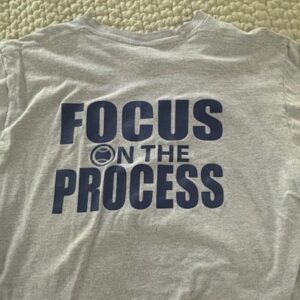
As a parent you hope you give your kids the building blocks for a successful future. You hope you have taught them how to deal with adversity and how to succeed. You hope that you have provided them with the resilience gene and a motor to make it in a world that is confusing and confounding and increasingly contrary to everything we were taught is fair and right. Self-doubt is part of the process; fear is part of the process; anxiety about their well-being is part of the process. One year, I gave all of the kids on my son’s travel ball team t-shirts that read: “Focus on the Process.” I wanted them to do things the right way — the way they were taught — and not worry about the outcomes, as those will take care of themselves. The same is true for parenting, to a degree. You have to worry about outcomes — about health, and a decent job, and surviving on their own. But you have to focus on and trust the process of your tutelage, too.
Last week I moved my son “to life.” He found the apartment, and I provided the furniture and the fridge full of food. He secured the job — in a field very different than my own, but which is his passion — and I explained to him the value of setting up his 401(k) on day one. My boy has done everything I ever could have asked from a son. He has excelled at school, worked hard, made good friends, and readied himself for success. The process seems to have worked. And, in keeping with a theme, he decided to live a literal stone’s throw from Nationals Park.
When he scheduled the date for his big move, he reminded me that the Red Sox would be in Baltimore. So I extended my trip by a day. We finished hanging his pictures, broke down the boxes, and made one more run to the grocery store before we headed north to Charm City. Camden Yards is one of the great treasures in baseball. We visited there years ago before I dropped him at camp. This was a decidedly different trip. The two of us sat behind the Red Sox dugout and watched a Boston team that is oftentimes infuriating and sometimes exhilarating. We ate Boog’s BBQ and watched a kid 18 months younger than my son hit a lead-off homer for our team. We saw a player who has overcome mental health issues slug a game-changing three-run homer. And, once again, we saw the Red Sox squeak out a one-run victory.
I was supposed to drop my son at the train station for his thirty-minute ride back to D.C. But I decided to drive him all the way back. We sat in the car and discussed the Red Sox, and life, and the future. I explained to him that if all goes as planned, you do well enough in high school to go to a good college, where you then learn to live and find something that you love. And then you graduate and begin “adulting” for real. It is all part of the process. And it is beautiful to watch, if not difficult to confront.
When we pulled in front of his apartment, he asked me when I thought I would be back. I said probably in the spring — “we’ll go to a Nats game.”
Standing on the street we hugged, hard. He thanked me for giving him the best childhood he ever could have imagined (and for building all of his furniture!). I thanked him for all of the joy he has brought to me and our family; and I told him how so very proud I am of him. He is 22, full of dreams and wonder and nerves and anxiety. I am much older and full of all the same…for him.
It was a wonderful and tearful moment on a small street in a big city on the verge of a new life. And while I have doubts that the Red Sox have what it takes to win it all this season, I have no doubt that he will succeed.
As I was about to get back into the car for the drive back to Baltimore, my son turned and said to me: “Remember to send me my glove; my roommate has his, and we want to play catch.”
For twenty-two years I focused on the process. The outcome took care of itself.
Sometimes it is fun to look at two wholly different players and see how very similar they were. Today we will look at two guys who essentially played on opposite sides of second base*, one of whom stayed on the Hall of Fame ballot for 15 years, topping out at 28.2% of the vote; and one of whom barely made it to year two, and then fell off the ballot the following year after receiving only 1.8% of the vote.
DON MATTINGLY
Don Mattingly – “Donnie Baseball” – was an institution in New York in the ‘80s. The sweet swinging first baseman came up for seven games at the end of the 1982 season, played in 91 games in 1983, and then made his mark in 1984. That year, Mattingly led the league in hits (207), doubles (44), and won the batting title hitting .343. He came in fifth in MVP voting.
That was just a stepping stone to his 1985 campaign, when he had 211 hits, 48 doubles, 35 homers, led the league with 145 RBI and 370 total bases, had a 156 OPS+, made his second All-Star team, won a Gold Glove, won a Silver Slugger award, and then won the AL MVP.
All of which set the stage for 1986, when all Mattingly did was again lead the league with: 238 hits, 53 doubles, a .573 slugging percentage, a .967 OPS, 388 total bases, and a (career high) 161 OPS+. This got him all of the same awards as 1985, except he came in second in MVP voting to Roger Clemens.
1987 was pretty much more of the same for the mustachioed slugger, as he smashed 30 home runs and accumulated 318 total bases, while still slashing .327/.378/.559, for a 146 OPS+. That was good enough for seventh in MVP voting.
A back injury in the middle of 1987 was the beginning of the end. While he still put up impressive numbers the rest of that year, things began to slow down in 1988. Over the 1988-1989 seasons, Mattingly hit a total 41 homers and had 201 RBI, and still won two more Gold Gloves.
In 1990, Mattingly’s back caused him to miss a big chunk of the season, and he ultimately played in only 102 games. That was the first of his two negative bWAR seasons (-0.3, along with -0.2 in his final year, 1995).
Mattingly bravely played out the final years of his career. From 1991-1995, he managed 752 hits and 154 doubles. But the power was zapped – he hit only 53 homers over those five seasons, and only drove in 340 runs. He hit .291, but slugged just .416. (By way of comparison, from 1984-1989, he hit .327 with a .530 slugging percentage.)
Mattingly went on to coach and manage in the big leagues, and still does not have to buy a drink anywhere in New York. The man is a legend, who many believe would have been a surefire Hall of Famer but for the bad back.
*Mattingly played third base when play resumed for the infamous “pine tar” game.
NOMAR GARCIAPARRA
The Boston Red Sox drafted Nomar Garciaparra with the 12th pick in the 1994 draft out of Georgia Tech. He made his major league debut in 1996, playing in 24 games. In his official rookie campaign, 1997, “Nomah” led the league in hits with 209, and triples with 11. He was an All-Star, won a Silver Slugger award, finished 8th in MVP voting, and was the American League Rookie of the Year.
In his sophomore season, he hit more homers, drove in more runs, had better slash numbers, and a higher OPS+. That was good enough for second place in MVP voting.
In 1999 and 2000, Garciaparra won back-to-back batting titles, while also hitting 48 home runs, smacking 93 doubles, and accumulating 638 total bases over the two seasons. That gave him two more All-Star appearances and two more top-10 MVP finishes.
A wrist injury postponed the start of his 2001 season until July 29th. The injury reared its head again at the end of August, and Garciaparra finished the year with just 83 at-bats.
The shortstop was healed in 2002, slashing .310/.352/.528, with 56 doubles to lead the league. He was, once again, an All-Star. 2003 – his last full year in Boston – was very similar to 2002. Unfortunately, negotiations between the team and the player for a long-term extension stalled, leaving the shortstop’s future with the club in limbo.
Garciaparra started the 2004 season on the injured list with an Achilles issue. When he got back to action, his bat returned to normal, but his defense faltered. And the requirement of extra rest to keep him healthy meant that even his bat could not be counted on every day. At the trade deadline, Boston’s youthful and ambitious general manager, Theo Epstein, decided that he could replace Garciaparra’s bat and improve the team’s defense by sending the fan favorite to the Chicago Cubs as part of a four-team trade, which netted the Sox Orlando Cabrera (a much better defensive shortstop) and Doug Mientkiewicz (a fine defensive first baseman).
Epstein was not wrong. Starting in 2004, Garciaparra became negative total zone rated shortstop (-12 in 2004; -5 in 2005). He did have a +4 in 2008 when he played 31 games at short for the Dodgers. But, as with many aspects of the game, Epstein could see the future, and he planned for it. It is not lost on Red Sox fans that Cabrera had a 10-game hitting streak between Game 1 of the 2004 ALCS and Game 3 of the World Series; nor is it lost on them that Mientkiewicz recorded the put-out that ended an 86-year World Series drought.
Garciaparra signed free agent contracts with the Los Angeles Dodgers for the 2006-2008 seasons, and has become an institution with the team. He has been a broadcast mainstay for years — he now does commentary for local stations — and can be seem at the ballpark most days.
WHO YOU GOT?
But if you were to ask the average fan on the street who had a better career, Mattingly’s name would roll off tongues. You wouldn’t hear many arguments that “but for” anything in particular that Garciaparra would be in the Hall of Fame. You don’t see many Nomar jerseys in the stands at either Fenway Park or Dodger Stadium. Both players had “what-if” careers. It is just how they are viewed that is so different. However, when you look at them side-by-side, they are not that different at all.
Bryce Harper became a sensation when he was 16 years old, appearing on the cover of Sports Illustrated.
He forewent his final two years of high school (obtaining his GED) to enroll in junior college, making him draft eligible at the age of 18. He was selected 1/1 in the 2010 draft by the Washington Nationals. Harper signed a very unconventional deal — $9.9 million over five years, which included a $6.25 million signing bonus and eight semesters of college.
The Oakland Athletics selected Aaron Judge, a high school kid playing less than 90 minutes away in Linden, California, in the 31st round of that same draft, a mere 934 picks after Harper. Judge elected to go to Fresno State instead. Three years later the New York Yankees took Judge in the first round, with the 32nd pick. He received a $1.8 million signing bonus.
Harper made his MLB debut in 2012 at the tender age of 19. That season he played in 139 games, slashed .270/.340/.477, with 22 home runs, and a 118 OPS+. He was an All-Star and won the Rookie of the Year.
Judge made his MLB debut in 2016, at the seasoned age of 24. That year he played in just 27 games, and looked overmatched, slashing .179/.263/.345, with four home runs. He had an OPS+ of 61, and was worth -0.3 bWAR. But, with his rookie status still intact, he corrected whatever ailed him, and came out guns-a-blazing in 2017. Playing in 155 games, he slashed .284/.422/.627, with 52 home runs and a 171 OPS+. It was an 8.1 bWAR season that saw him become an All-Star, win a Silver Slugger Award, come in second in MVP voting, and win the Rookie of the Year.
Because they started at different times, Harper is now in his 14th season, while Judge is in just his tenth. As of Tuesday morning, Harper’s baseball card looks like this:
.280/.387/.521; 142 OPS+; 357 HR; 1034 RBI; Rookie of the Year; 8x All-Star; 2x MVP
Judge’s looks like this:
.293/.410/.613; 177 OPS+; 354 HR; 807 RBI; Rookie of the Year; 7x All-Star; 2x MVP
In March of 2019, Harper signed a 13-year deal with the Philadelphia Phillies for $330 million, which, at the time, was the largest free agent contract in terms of total dollars, in baseball history. The deal has no opt outs, so Harper will play in the City of Brotherly Love through the 2031 season, when he will be 38 years old.
In December of 2022, Judge signed a 9-year deal with the Yankees for $360 million, which, at the time, was the largest free agent contract in terms of total dollars, in baseball history. The deal has no opt outs, so Judge will play in the City that Never Sleeps through the 2031 season, when he will be 38 years old.
When Judge’s contract expires, he will have earned a hair less than $400 million. Harper’s deal nets him just under $378 million, but his contract includes a handful of incentives ($500K for an MVP; $100K for a World Series MVP; and $50K for each of certain seasonal awards), which have given him another $800,000 with six years still to go.
By many accounts, Aaron Judge is the best right-handed hitter of his generation, and potentially of all-time. He is averaging 52 home runs per every 162 games. If he kept that pace going for the next six seasons (highly unlikely, but worth the analysis), he will become a free agent sitting somewhere around 650 homers. That is one good season away from A-Rod (696) and Albert Pujols (703); and a remarkable season away from The Babe (714). Extrapolate those numbers out, and he would be two good seasons (by Judgian standards) away from Henry Aaron and Barry Bonds.
Harper, on the other hand, will not reach such lofty heights. He is not the best left-handed hitter of his generation (but he is probably in the top-five), and most certainly not the best of all-time. His power will not allow him to amass the types of numbers that Judge has in his sights, but 500 dingers are well within reach (he needs to average less than 25-per-year over the next six seasons to join that club). Harper may have been the “Chosen One,” and will most likely fulfill all of his promise and more. But his career stats may ultimately pale in comparison to Judge’s.
Yet, to date, neither player has brought a World Series title to their city. Do that – and do it more than once – and the rest of the stats will fall by the wayside when local legends are written. As it stands, Harper’s home run in the eighth inning of Game 5 of the 2022 National League Championship Series to push his team to the World Series
probably ranks higher than Judge’s 62nd home run in Texas to break the American League single-season record, in terms of stories people will tell their grandkids about.
Both the Phillies and the Yankees have been built for post-season success. As of right now, Philadelphia looks like the best team in the National League, while the Yankees are faltering. That all could change over the next two months. And both players still have six more years to burnish their credentials. Only time will tell who has the better overall career. But, in the end, it may not matter, as we fans are just lucky to get to enjoy two of the best who have ever done it.
In the history of Major League Baseball, there have been nearly 21,000 players. Of those, 278 are enshrined in the National Baseball Hall of Fame and Museum (which will increase to 283 this coming weekend), and scores more currently playing will be there some day.
That leaves many, many players who have come and gone; gotten their proverbial “cup of coffee,” and then moved on to selling insurance or teaching middle school or coaching. Some players make an appearance, and we have no recollection of them ever being there. You might find an old baseball card and be reminded of seeing them play a game in Milwaukee in 1987, but nothing else comes to mind (looking at you, Steve Kiefer). For others, despite uninspired career statistics, they leave a mark – they are fondly remembered by the fans of the teams for which they played.
One such player is Brock Holt, the “Brockstar.” Holt is from Fort Worth, Texas, graduating from Stephenville High School in 2006. Undrafted, and with no formal collegiate offers, Holt attended Navarro College in Corsicana, Texas, about 80 miles southeast of his hometown. After two years there, he transferred to Rice University in Houston, putting up great stats, hitting .348 with 12 home runs, 67 runs scored, and 11 stolen bases — all in just 59 games. He was named to the All-NCAA Regional Team and the All-Silver Glove Trophy Series team.
His one-year success at Rice led Holt to be selected by the Pittsburgh Pirates in the 9th round of the 2009 draft. He spent parts of four seasons in the Pirates’ minor league system before being called up the “bigs” when rosters expanded on September 1, 2012. He immediately saw action, walking and scoring a run in his first major league game.
The next day he was Pittsburgh’s lead-off hitter, playing second base. After a strike out looking and a line out, he recorded his first big league hit — a single to center off Yovani Gallardo. Before the day was over, he would have his second hit and first run batted in.
Two days after that, Holt became only the second Pirate to ever have a four-hit game within his first four major league games (Jack Merson did it in 1951, but you knew that already).
When the season ended, the Pirates traded Holt (and Joel Hanrahan) to the Boston Red Sox in return for Jerry Sands, Stolmy Pimentel, Mark Melancon, and Iván DeJesús Jr. After starting the season at Triple-A Pawtucket, Holt got called to the big club to face the Angels right before the All-Star break. He ultimately played in 26 games, but was not on the post-season roster for the team that won its third World Series in ten years.
2014 was Holt’s breakout season, playing in 106 games and finishing 8th in Rookie of the Year voting. He built on that foundation with a strong 2015, making the All-Star team while accruing 2.8 bWAR (which would turn out to be a career-high).
A concussion derailed his 2016 season, limiting him to 94 games. But, in a sign of things to come, Holt hit .400 in the Division Series, which Boston lost to Cleveland.
Concussion symptoms and vertigo slowed his 2017 season, and he only played in 64 games. In 2018, Holt played six different positions (missing only pitcher, catcher, and center field). He hit .277, and was a spark plug for a team that won yet another World Series.
Holt may have reached folklore status with fans in New England in Game 3 of the 2018 American League Division Series against the New York Yankees. Becoming the first major league player to ever hit for the cycle in the post-season, he thumped the hated rivals, going 4-for-6 with five RBI. He saved the best for last, slamming a two-run dinger into the stands in right field in the top of the ninth to finish off a 16-1 boat race in the Bronx. In many ways, that game was the apex of Brock Holt’s major league career.
A scratched cornea and shoulder impingement limited his 2019 — his final year before free agency — to 87 games. He signed a one-year contract with Milwaukee that off-season, but was designated for assignment after just 16 games, after slashing .100/.222/.100. The Washington Nationals gave him a look in 20 games, where his slash line improved to a meager .262/.314/.354.
In a full-circle moment, Holt signed a minor league contract with the Texas Rangers prior to the 2021 season. In 76 games, he slashed .209/.281/.298, hitting just two home runs. On August 7th, he made his third career pitching appearance, retiring all three Athletics batters he faced.
During Spring Training of 2022, Holt signed a minor league deal with the Braves, but just eleven days later he requested his release. He officially retired from baseball in October of 2022.
Despite the late-career journey, Holt will always be remembered as a member of the Red Sox. As the club’s Jimmy Fund captain for five seasons, he and his wife Lakyn became the face of that charitable organization raising money for and the spirits of people getting treatment at the Dana-Farber Cancer Institute. And nearly two years after his retirement, Holt was named the co-chair of The Jimmy Fund, serving alongside broadcaster Tom Caron.
Two weeks ago, Holt found himself back at Fenway Park, this time wearing a totally different uniform. He was a special guest hitter of the Savannah Bananas, and participated in the Banana’s traditional “Dance Her Home” routine, once again entertaining 37,000 Boston faithful.
Some players come and go, and barely leave a mark. Others, like Brock Holt, live on in the hearts and the minds of a fanbase for years to come.
July 4th marked the 40th anniversary of what has colloquially become known as the “Rick Camp Game.” But, as you will see, it was a whole lot more than that.
As is typical for a 4th of July game, this battle between the visiting New York Mets and the hometown Atlanta Braves, was scheduled to begin around 7:30 p.m., with a fireworks show planned upon its conclusion.
Rain in the Atlanta area pushed the first pitch back about 90 minutes, which may have been a sign of things to come. The Mets started Dwight Gooden, who was off from the start, while the Braves countered with Rick Mahler. Gooden couldn’t get through the third inning, and Mahler couldn’t get through the fourth, which may have been a sign of things to come.
Both teams scored in the first inning, and the Mets led 6-4 after six. The Mets extended their lead by scoring one run in the top of the eighth, but the Braves roared back with four in the bottom half — three on a Dale Murphy bases-clearing triple —to take the lead, 8-7. At this point, Atlanta and their faithful were just three outs away from a come-from-behind win and a spectacular fireworks display. But the Mets had other ideas.
With future Hall of Famer Bruce Sutter on the mound looking for his 15th save of the season (and 275th of his career), third baseman Ray Knight struck out. Two outs away. But three consecutive singles by Howard Johnson, Danny Heep, and Lenny Dykstra brought in the tying run. It may have been a sign of things to come.
The teams went scoreless in innings ten through twelve. In the top of the 13th, after a Ray Knight single, HoJo his a two-run homer to stake the Mets to a 10-8 lead. But, in the bottom half, Rafael Ramirez led off with a single, and after two outs (meaning the Mets were just one out away from ending this game and giving the fans at least 50% of what they came for), Terry Harper hit a game-tying two-run dinger. After thirteen innings, the score stood 10-10.
The 14th through 17th innings were uneventful, although the Bravos did get two runners on with two outs in the 16th. Alas, a Paul Runge fly out ended the threat. On they went.
Johnson led off the 18th with a single, and moved to third on a sacrifice bunt plus a throwing error. Dykstra followed with a sac fly to make it 11-10 in favor of the Mets.
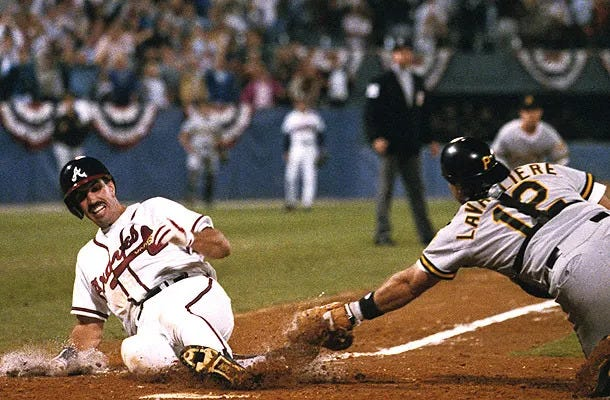
In the bottom of the 18th, Gerald Perry grounded back to the box, and Harper grounded to first unassisted. The Braves, now completely out of position players, had no choice but to send pitcher Rick Camp to the plate. Atlanta was again down to its last out. And this time they had a player with a career .060 batting average and 83 strikeouts in 167 at-bats, with nary a single home run to his name. So, what did Camp do? To the Mets? To the long-suffering fans? You already know the answer. He hit an 0-2 curveball over the wall in left field to tie the game. Prior to the second pitch of the at-bat, Pete van Wieren said to his broadcast partner:
“Ernie, if he hits a home run to tie this game, this game will be certified as absolutely the nuttiest in the history of baseball.”
Well, consider it certified.
The jog around the bases may have tired Camp out, as he allowed a Gary Carter single to start the 19th, and then, after a sacrifice and an intentional walk, Knight doubled in the Mets’ 12th run. Another intentional walk preceded another Danny Heep single, which ultimately cleared the bases due to a Claudell Washington throwing error. Two batters later, Wally Backman’s singled plated Heep, extending the Mets lead to 16-11. Ironically, Keith Hernandez, who hit for the cycle in the game (it took him 12 innings and seven plate appearances to pull it off), grounded out to end the threat.
Even trailing by five; even though it was well past 3 o’clock in the morning, the Braves were not yet done. After a ground out, Hernandez committed the rare error, allowing Washington to get to second. A Ramirez fly out got the Mets — once again — one out away. But then Ron Darling walked Dale Murphy, and then walked Gerald Perry, before a Terry Harper single combined with a Howard Johnson error allowed two runs to score. The Braves were then just one batter away from bringing the tying run up to bat. Unfortunately, Rick Camp didn’t have any additional magic in his bat, and he struck out struck out to end the game.
What may be the most shocking tidbit from this game is that the Braves gave the remaining fans exactly what they were promised: a fireworks show. At just about 4 a.m. it commenced, scaring local residents who thought that war with Russia had begun.
I played first base from the time I first held a mitt until my freshman year of college. And in all those years, there was never a time when I was holding a runner on first and a left-handed batter came to the plate, that I didn’t get just a little bit nervous. Less than ninety feet separated me from a ball smashed off a bat that, because of the angle, you really couldn’t pick up immediately. It did not matter the level of competition — high school, American Legion, collegiate fall ball — it was still a scary prospect.
And that was at first base, which is most definitively not the “hot corner.” That designation is reserved for the other side of the diamond. That is where careers are made. Just ask Brooks Robinson and Mike Schmidt; Graig Nettles and Chipper Jones; Adrian Beltre and Nolan Arenado. There are more names you could add to this list who dug their spikes into the dirt — and sometimes on the grass — and dared sluggers to get one past them.
Considering my trepidation at first base, I have often wondered what third baseman were thinking when Dick Allen or Dave Winfield or Frank Thomas came to the plate. Today, that guy would be Giancarlo Stanton, with his severely closed stance and a career average exit velocity of nearly 94 MPH.
But when I was growing up, the guy who instilled the most fear, the guy who wiggled his bat above head in a taunt of the damage he was about to inflict, the guy who smashed 467 doubles and 509 home runs, and who won five Silver Slugger Awards, was Gary Sheffield. If someone had ever asked me to play third base when Gary Sheffield came to bat, I would don catcher’s gear; and I would play deep, like outfield grass deep. Imagine having Sheffield at the plate with the infield in? Better yet, don’t imagine that…that is the stuff of nightmares.
It’s unfortunate that Sheffield’s career ended before Statcast began measuring exit velocities, because there is no doubt he would he would be amongst the hardest hitters in the history of the game. But Sheffield was more than just a violent swinger — he was a complete hitter.
In 1992, his fourth full season in the big leagues, he won a batting title with San Diego, hitting .330. That .330 also included 34 doubles and 33 home runs, with 323 total bases for the season. That garnered him his first All-Star appearance, his first Silver Slugger, and third place in MVP voting (behind some guy named Bonds and Terry Pendleton).
Three years later, in 1995, he slashed .324/.467/.587, for a 177 OPS+.
The next year — 1996 — he was even better. He slashed .314/.465/.624, for a 1.090 OPS (which led the league), and a 189 OPS+ (which also led the league). He was again an All-Star and a Silver Slugger, but came in sixth in MVP voting. That was the last season that any black ink (leading the league in a category) appears on Sheffield’s Baseball Reference page.
But, rest assured, the next thirteen seasons of his career were nothing to sneeze at. Playing until his age-40 season, all he did over those years was slash .292/.400/.521, for a .921 OPS and a 141 OPS+. The man could flat out hit.
Unfortunately, Sheffield’s seasonal and thus career bWAR calculation was hampered by his woeful defense. He started his career as a shortstop, soon moved to third base, and then retreated to the outfield starting in his seventh full season. How about this for an ignominious stat: In each of his 22 years in the game, Sheffield never had a positive dWAR. It didn’t matter what position he was playing; his worst season was -2.9, playing third base in 1993, and his best was -0.2, playing third in 1990.
But Sheffield didn’t earn more than $168 million over the course of his career for his fielding gloves, just his batting gloves.
His career .907 OPS is 65th all-time. His 140 OPS+ informs us that over all those seasons, he was 40% better than the average major league hitter. He hit 509 home runs, and yet never struck out more than 83 times in a single campaign. In fact, he has considerably more walks (1,475) than strike outs (1,171).
Sheffield petered out on Hall of Fame voting last year, earning just 64% of the vote, 11% shy of induction in his final year on the writers’ ballot. His candidacy is a Rorschach test for baseball fans.
Bill James’ Hall of Fame Monitor gives him a score of 158, where a likely HOFer scores 100.
By James’ Hall of Fame Standards, he scores a 61, which is above the 50 for the average Hall of Fame inductee.
But Jay Jaffee’s JAWS index shows Sheffield below Hall of Fame average in career bWAR (60.5 vs. 69.7); 7-year peak bWAR (38 vs. 42.2); 5-year peak bWAR (49.3 vs. 56); and bWAR/162 (3.8 vs. 4.9).
However, when you check Baseball Reference’s Similarity Scores, of the ten players listed as the players whose careers most closely resembled Sheffield’s, only Carlos Beltrán isn’t already in the Hall.
Sheffield’s career is weighted down by his lousy defense and the fact that his name appeared in the Mitchell Report, the 2007 investigation into steroids in major league baseball. Sheffield has freely admitted that he utilized “the cream” while recovering from knee surgery, but adamantly denied that he ever used steroids. He also admits to buying vitamins from BALCO, the lab at the heart of the steroids scandal, but calls any other allegations of illegal drug use “fabricated.” Sheffield, in fact, was one of the first players to speak out publicly about steroid use in baseball, appearing on HBO’s real sports alleging that each team has six or seven players “juicing.”
Unfortunately, what’s done is done. Sheffield’s only hope for Hall of Fame admittance now rests with the Contemporary Baseball Era Committee, which meets again in December of this year.
But regardless of that outcome of that vote, or any votes in the future, it is important that we, as baseball fans, fondly remember the career of Gary Sheffield.