Patience is a Virtue in Dodgertown

Living in Los Angeles this winter, after two consecutive seasons of “what-ifs,” two consecutive years of watching other teams celebrate on the green grass of Chavez Ravine, two consecutive years of sitting idly by, waiting for the deep-pocketed, second-largest market, mega-TV deal, Dodgers to spend on an impact free agent, has been trying, to say the least.

Sure, the Dodgers ponied up an additional $28M to keep “the franchise” in town for an additional year. Sure, they guaranteed A.J. Pollock $60M over four years to patrol center field for those games (how many, TBD) that he is not injured. Sure, the team made a qualifying offer to Yasmani Grandal, who elected to take $325K more to catch for openers in Milwaukee, rather than Kersh, Buehler, Ryu, and Jansen in SoCal.

But all we have heard for a few years now is that the Bums were looking to get under the luxury tax threshold so that they could reset the penalty and start spending like drunken sailors when the free agent class of 2018-19 became available. Fans and front offices were salivating over the likes of Kershaw, Kimbrel, Keuchel, Corbin, and, of course, Harper and Machado.

But since the Dodgers never intended to let Kershaw get to the open market, he came off the board. And since they signed Jansen to the second-richest relief contract in history, they didn’t have room for Kimbrel. And since they didn’t want or need another left-handed starting pitcher, Keuchel didn’t make much sense. And since Corbin decided to get off the market as quickly as possible, the Dodgers may never have had a chance to make a bid.

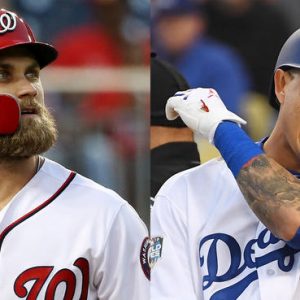
Which brings us to the two crown jewels. The two 26-year old free agent stars who were looking to set AAV and total compensation records. The two guys who were looking to be locked up for a decade or more. The two guys who the league has been waiting for to reverse two years of moribund free agency. And yet, a funny thing happened on the way to the market – the market changed and their performance waned.

It is a truism that players shine in their walk year. I guess these  guys didn’t get the memo. Harper decided to hit .239 with a career high in strikeouts and his worst defensive season to date. Machado told the world that hustling is for suckers, and showed the world that other teams’ defenseless infielders were open prey. So when Machado turned a shot off the top of the wall in the World Series into a single, and when Harper more than hinted that ten years was not a long enough contract, the market reacted. Just not in the way that either player or the MLBPA had hoped.

According to Chelsea Janes of the Washington Post, the Nationals offered Harper 10/$300M before the hot stove got cooking. There are some who believe that the Nationals made that offer so their fans knew they “tried,” all the while knowing that Harper would pass. And those same people believe Harper’s agent, none other than Scott Boras, leaked the offer to set a floor for future offers. To date, we have heard of none (except, maybe, the Nationals increased their offer).

According to Bob Nightengale of the USA Today, the White Sox offered Machado 7/$175K. To you and me, a cool $25M/year is pretty good scratch. For a guy who was expecting $300M and hoping for $400M, the numbers seemed a little underwhelming. And his reps were quick to condemn the reporting, but nothing has happened since, so who knows.

Which brings us back to the Dodgers.

Should they jump in with both feet and a large checkbook to sign either star? Are either worth the money? If you are the Dodgers, does – should – money even matter? Stan Kasten, in a clumsy interview with the Los Angeles Times seems to think so; but he doesn’t think enough of the average fan to explain why.

If you have followed the Dodgers under their new ownership group, and with Andrew Friedman at the helm, you know that signing long-term deals over $100M is anathema to them. You had to see this coming – that the team would be considerably more circumspect about spending upwards of $200 or $300M for either guy. And that was before Machado fell down striking out to end the World Series and Harper turned in a 1.3 bWAR season.

So before we castigate the front office for sitting on its hands and having short arms, let’s look at this unemotionally.

I am not a huge Corey Seager guy (I tend to think, advanced metrics aside, that he is overrated). But, would you rather have Seager at $4M for 2019 or Machado for $34M (guesstimating)? And keep in mind, Seager has two more years before he is a free agent. Even assuming he gets Mookie Betts-type arbitration money (say, $10M in 2020 and $20M in 2021), you are still $68M ahead of the game going into 2022, without having another seven-ish years of commitment to a player heading into his thirties. A player you have seen up close and know he ain’t the hustling type.

And, this analysis is only necessary because Machado insists that he is a shortstop – not a third baseman. This, despite the fact that he is in the conversation for the best defensive third baseman in the entire game (I see you Nolan Arenado and Matt Chapman). Let’s assume Machado gets over himself and agrees to play third base. What do you do with fan-favorite Justin Turner, who is owed $39M over 2019 and 2020? Do Dodgers fans think Machado is $31M better at the hot corner over the next two seasons?

Before any of you Boys in Blue answer, look at this:

Turner bWAR Machado  bWAR
2014 4.3 2.3
2015 4.0 7.1
2016 4.7 6.9
2017 5.8 3.4
2018 4.5 5.7
TOTAL 23.3 25.4


And from 2016-2018, Machado laps Turner by a whopping 1.0 bWAR. Still want Machado?

Now let’s talk about Harper.

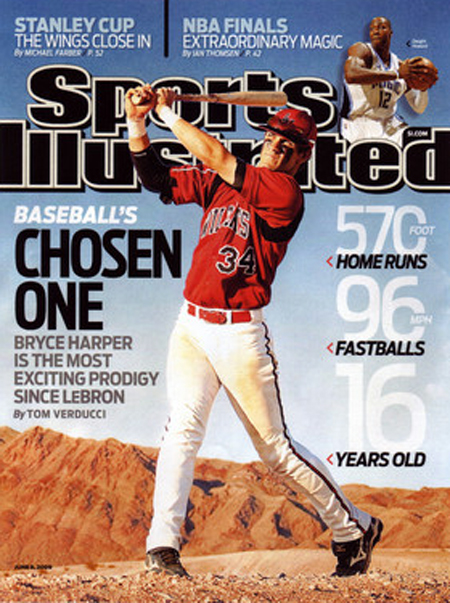
When the Dodgers shipped the corpse and dead money of Matt Kemp and the rollercoaster that is Yasiel Puig to the Reds for a bag of balls and a contract they immediately ate, the conventional wisdom was that they were opening up right field for the slugger from Vegas with the flowing locks. But Andrew Friedman seemed to ask himself the following question: “Why would I do that?”

He must be thinking: “I have made it to the World Series the past two years without him, and Harper would not have made Yu Darvish pitch any better in Game 7 or Kenley Jansen pitch any better in Game 4.”

He might be thinking: “$300M is a lot of depth, a lot middle relievers, a lot guys who can carry us deep into October again…and again.”

The truth is that Harper is good, and may one day become great. But he ain’t “great” today. And it doesn’t matter what Scott Boras includes in his 75-page briefing book, it cannot change the fact that Harper came into the league in 2012 with a 5.2 bWAR, had a 10.0 in his MVP year of 2015, and has never cracked 5.0 in any other season. Is that guy worth $35-$40M per year? Maybe. Is he worth that for 8-10 years? You don’t need to be Harvard-educated (or even Tulane-educated) or a quant to answer that question.

So it seems, as per usual, the Dodgers are playing this smartly. They are keeping their powder dry and giving themselves payroll flexibility (insert billionaire joke here) so that they are ready to pounce before the July trade deadline. The Dodgers have gotten a ton of grief for being parsimonious, but to quote Bob Sugar, “it’s not show friends, it’s show business.” And these guys have shown, time and again, they know the business of baseball better than most. Have they made some mistakes, sure. Have they missed some opportunities, of course. But ask yourself this, do the Dodgers want to be spending $35-$40M/year on a 35-year old Bryce Harper in 2027? If you need some help with that one, drive a few miles down I-5 and ask Arte Moreno about paying Albert Pujols the back half of his contract. And before you tell me that Pujols was older when he signed his deal, know that in his age-35 season, Pujols had a 3.0 bWAR and earned $24M (and followed that with seasons of 1.3, -1.8, and 0.5, all while taking home $78M).

The Dodgers play the long game – both for the season and for their future. By not overspending in the winter, they can properly spend in the summer. At the 2017 deadline, they grabbed Yu Darvish, Tony Cingrani, and Tony Watson – all helpful pieces on their way to the pennant. Last year they acquired Machado and Brian Dozier – great and needed additions. People revere the Patriots for thinking long-term and building for sustained success. The Dodgers front office deserves the same benefit of the doubt.

Relax Blue Nation, patience is indeed a virtue.

PLAY BALL!!

Hall Worthy?

It’s that time of year…again. When honors are given out and people feel snubbed and hackles get raised. Critics get on their high horse and tell the collective voters what they did wrong, and in doing so, how certain people were wronged. There is no shortage of soapboxes, and there is certainly no shortage of ink spilt about what the right choices were, that we need to fix the system, and how we need to be better next year. It’s essentially a January rite of passage. But enough about the Oscars. Let’s deal with important matters – a museum in Central New York that houses the greatest to ever play the game, as well as a few others.

The festivities kicked off in December, when the Today’s Game Committee voted to induct Harold Baines (as well as Lee Smith) into the Hall of Fame. That’s right. In case you were not paying attention, a guy who never received more than 6.1% of the BBWA vote was chosen to have his plaque in the hallowed first floor Gallery. Suffice it to say, there was much pearl clutching about this decision. There were countless articles written asking if Harold Baines, then why not ______ (fill in your favorite player); and how allowing Baines in lowers the bar and thus dilutes the exclusivity and specialness of the Hall of Fame. Hell, my boyhood idol – Will Clark – was thrown around as deserving of induction if the likes of Harold Baines can get the call.

But after all the Sturm und Drang, we really need to ask one basic question: Should Harold Baines be in the Hall of Fame? By all accounts, no. Here are the facts:

  • It used to be 3,000 hits punched your ticket, but the PED era upended that assumption. Baines collected 2,866.
  • 500 homeruns was another key threshold. Baines had 384.
  • His career OPS of 121 is 340th on the all-time list, tied with Jason Bay, Jeff Burroughs, Ron Cey, and Cecil Cooper. Not exactly a list of Hall of Fame hopefuls.
  • He did make six all-star appearances and won the Silver Slugger Award in 1989 (at DH). So he has that going for him.
  • It seems Baines best qualification is that according to Bill James’ Similarity Score, his career looks a lot like that of Tony Perez, Al Kaline, Billy Williams, and Andre Dawson – all Hall members. So I guess, based on that standard, if it looks like a duck…

In short, Baines should not be making reservations at the Otesaga Hotel in mid-July, but he will be.

**********


Yesterday, the results of the BBWA voting were released (it’s hard to understand why they don’t coordinate the Today’s Game Committee vote with the BBWA vote, but considering all of the other issues with this process, that seems like the smallest nit to pick). Lost in the ballyhoo of Mariano Rivera being the first unanimous inductee was a former third-baseman turned designated hitter who made it to Cooperstown in his last year of eligibility. This, of course, was not lost on the denizens of Seattle, who have spent countless hours in the Kingdome and T-Mobile Park (née Safeco Field) lobbying for Edgar Martinez’s induction. For a baseball town that has suffered many slings and arrows, Tuesday was a banner day. And yet, the question resounds: Is Edgar Martinez Hall-Worthy (h/t to Elaine Bettis). He is right on the edge, but when put into the proper context, he makes the grade.

Edgar has a career OPS+ of 147 (meaning, for his career, he was 47% better than the average MLB player). That is 42nd on the all-time list. Here are the players with a higher career OPS+ who are not in the Hall of Fame:

  1. Barry Bonds (for obvious reasons)
  2. Mike Trout (still active)
  3. “Shoeless” Joe Jackson  (not eligible, for obvious reasons)
  4. Pete Browning (1882-1894)
  5. Mark McGwire (for obvious reasons)
  6. Dave Orr (1883-1890)
  7. Dick Allen (no one knows why)
  8. Joey Votto (still active)
  9. Manny Ramirez (for obvious reasons)
  10. Charlie Keller (1939-1952)
  11. Miguel Cabrera (still active)
  12. Gavvy Cravath (1908-1920)
  13. Charley Jones (1875-1888)
  14. Benny Kauff (1912-1920)
  15. Albert Pujols (still active)

Edgar had a career bWAR of 68.4. This is 115th all-time. Here is the list of players who have more career bWAR and are not in the Hall of Fame:

  1. Bonds
  2. Alex Rodriguez (not yet eligible)
  3. Pujols
  4. Pete Rose (not eligible, for obvious reasons)
  5. Curt Schilling (if he stops tweeting, he probably makes it)
  6. Jim McCormick (1878-1887)
  7. Bill Dahlen (1891-1911)
  8. Lou Whitaker (should be, and when he is inducted, it will be the subject of many think pieces)
  9. Larry Walker (his prospects are getting better each year)
  10. Derek Jeter (will be the second unanimous selection next year)
  11. Rafael Palmeiro (PEDs, smh)
  12. Scott Rolen (another controversial vote)
  13. Carlos Beltran (not yet eligible)
  14. Rick Reuschel (yeah, I can’t figure this one out either)
  15. Miggy
  16. Manny
  17. Robinson Cano (still active)

When you look at the above lists, it’s hard to justify not having Edgar in the HOF.

And if that is not enough to back up his candidacy, let’s go to Jay Jaffe’s JAWS analysis (Jay being the foremost expert on Hall of Fame worthiness), which compares career bWAR, a player’s 7-year peak, and total JAWS:

bWAR 7-Yr Peak JAWS
Edgar Martinez 68.4 43.6 56.0
Avg HOF 3B/DH 68.4 43.0 55.7


As I stated above, it’s close, but Edgar deserves to give a speech in July.

**********

Since Baines got in last December, and leading up to yesterday’s announcement, living in Los Angeles, I have heard the following question numerous times: If Harold Baines is a Hall-of-Famer, and Edgar Martinez is a Hall-of-Famer, then isn’t Steve Garvey a Hall-of-Famer?

Now, for some of you, that is a name you have neither heard nor thought of in quite some time. For others, his name evokes “Not My Padre” bumper stickers. But for many, those of you donning your #6 jerseys at Chavez Ravine, you are taken back to that perfect chin dimple, that mop of wavy brown hair, that slick glove, and that ever-so-clutch bat. The true fans can still see his golf swing outside the batter’s box, and his pigeon-toed stance inside it. We all remember the hand above his head as he rounds first base in a Padres uniform in the end credits of This Week in Baseball. For many of you, the answer is yes, sure, of course; if Baines and Martinez are in the Hall, you think, then my man Garvey certainly deserves to be enshrined.

Well, not so fast. Memory is a funny thing. The baseball saying “the older you get, the better you used to be” is perfect for Steve Garvey. We tend to remember with a longing for an easier time, and the ’70s and ’80s, with three basic statistics emblazoned on the screen each time a player came to bat, made it simple to discern the good from the great. But upon deeper inspection, Garvey is many miles and many mistresses from Cooperstown. Herewith, Garvey’s career stats:

Hits HR RBI OPS+ bWAR
2,599 272 1308 117 38.1


Garvey never got more than 42.6% of the BBWA vote while he was HOF eligible.

He did win the 1974 NL MVP, which gives him one more MVP than Baines, but he never won a Silver Slugger Award. Winning four Gold Gloves seems impressive, but when you consider the NL first baseman of his era, I don’t think Tony Perez or Willie Stargell or Pete Rose provided much defensive competition. And once Keith Hernandez joined the league, Garvey’s reign was over.

And, for the coup de grâce to all “Garvey for the Hall” campaigns, let’s again take a look at Jay Jaffe’s JAWS analysis:

bWAR 7-Yr Peak JAWS
Steve Garvey 38.1 28.8 33.4
Avg HOF 1B 66.8 42.7 54.7


To quote Jeff Spicoli, “not even close, bud.”

So there you have it. Edgar is in because he earned it. Garvey is not because he didn’t. And Baines somehow got in because his former manager (Tony LaRussa) and former owner (Jerry Reinsdorf) were on the committee that chose him after-the-fact. But, at the end of the day, the Hall of Fame is still an incredible place; it remains a bucket list destination for any true baseball fan; and – warts and all – it still represents (nearly) all of the best our favorite game has to offer.

Now, about those Oscar nominations…

PLAY BALL!!
In Our Day

I’m lying in bed Saturday morning, minding my own business. I’m scrolling through Twitter, as I am wont to do. And then I come across this beauty:

In the sixty-two seconds it took to watch that video, I was magically transported back to 1985. I’m sitting on the couch, enjoying the waning seconds of This Week in Baseball, sad that it will be a whole ‘nother week until Mel Allen regales us with tales from across the league; but equally excited that the Game of the Week is about to start.

I don’t want to be the “in my day” guy. And I certainly wouldn’t say “it was better when.” But there was something thrilling about that 31-minute sequence, This Week in Baseball followed by the first moments when you would learn which of the two Games of the Week would be airing in your area. If you checked the TV Guide, it would give you two potential games, and you never knew which was yours. The “A” game was called by Vin Scully and Joe Garagiola; the “B” game by Bob Costas and Tony Kubek. Either was a treat. Living in Los Angeles, we took Vinny for granted, so Bob and Tony was a nice change of pace.  No matter which, we were in for two and half hours of sheer bliss (Note: The average time/nine innings in 1985 was 2:39 (3:00 in 2018).)

Our kids have no idea. They have the At Bat app and the MLB Network. They have national broadcasts and games available every night. They can see and follow any player and any team their heart desires. But in our day, unless you had basic cable and were a fan of Dale Murphy or Ryne Sandberg, you didn’t get a whole of lot of mid-week baseball. And pity the American League fan. There were no interleague games. If you wanted to see your favorite Tiger or Indian or Twin, you had to wait until the All-Star game in July. Think about that – there was 50% of MLB that you could only see (a) if you lived in an American League town or (b) when a specific player appeared in the mid-summer’s classic. It is a concept I can barely get my head around – there is no way my kid could.

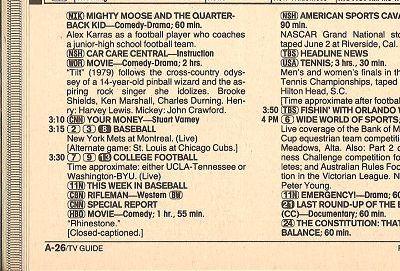
To make matters worse, in 1985 we didn’t have night baseball in Chicago. So, even if we were lucky enough to have this classic

on top of our television, you had to stay home from school in order to watch the Cubs’ home games. Living on the West Coast meant that, at best, we could catch new Hall of Famer Lee Smith on the hill in the eighth or ninth inning after the bus dropped us off. But, more often than not, we were relegated to Pete Van Wieren (RIP) and Skip Caray (RIP) and the WTBS Superstation (RIP) (now known simply as “TBS”) broadcast of the Braves game from Fulton County Stadium or Olympic Stadium or Three Rivers or The Vet.

But Saturdays were different. Saturdays lent us a world of possibility. Saturdays gave us a chance to see the Royals in their powder blue unis, or the Rangers in theirs. It gave us a chance to see Bell, Barfield, and Moseby roaming the vast expanse of Exhibition Stadium. For me, the moment the mailman delivered the TV Guide on Thursday, I checked to see if I would get another glimpse of Fenway Park. Would my beloved Red Sox at least get the Costas and Kubek treatment? My fingers absorbed a whole lot of ink flipping those small pages searching for who, and when, and where.

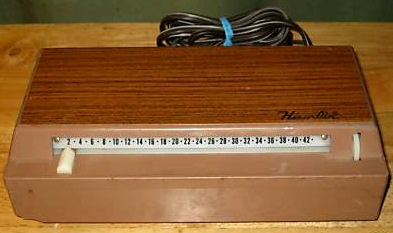
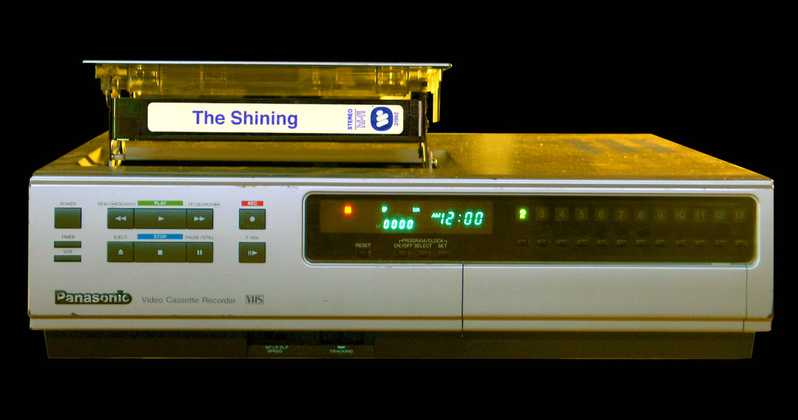
Like most kids, I played baseball on Saturdays, and thus was forced to missed many a TWIB and many a GOTW. That is why, even to this day, I still have certain VHS tapes in my attic (not that I have a machine on which to play them). A post-Pony League Carl’s Jr. Happy Star, crinkle-cut fries, and then a spot on the couch with the remote in hand. My spine still gets a tingle as I type these words.

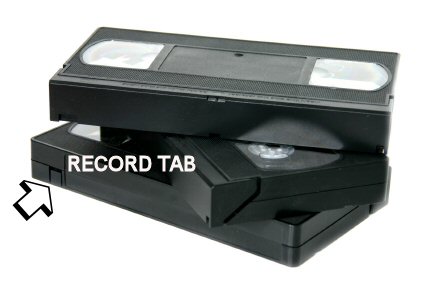
Then, the moment of truth when you walked in the door – never certain that the new-fangled VCR did what it was supposed to do. And you were never sure if someone had pulled out that little tab on the cassette that rendered the tape useless. Tell me something more devastating than coming home and finding that your program didn’t record? The viscerality (yes, I made that word up) of those memories courses through my veins to this day.

I don’t imagine I am alone in this. If I am, please don’t tell me. I am comforted by the idea that there were hundreds, maybe thousands, of other thirteen year old kids who had the same Saturday morning/afternoon routine as me. And when I hear those dulcet chords, when I watch Doc Gooden pitch and Gary Pettis crashing into the wall and Tony Peña in his crouch, when I see Mike Boddicker’s curveball and Steve Garvey in the Padres brown and gold raise his right arm as the music crescendos, I am taken back to an easier and simpler time. I am not saying it was a better time, but I’m not not saying that either.

PLAY BALL!!
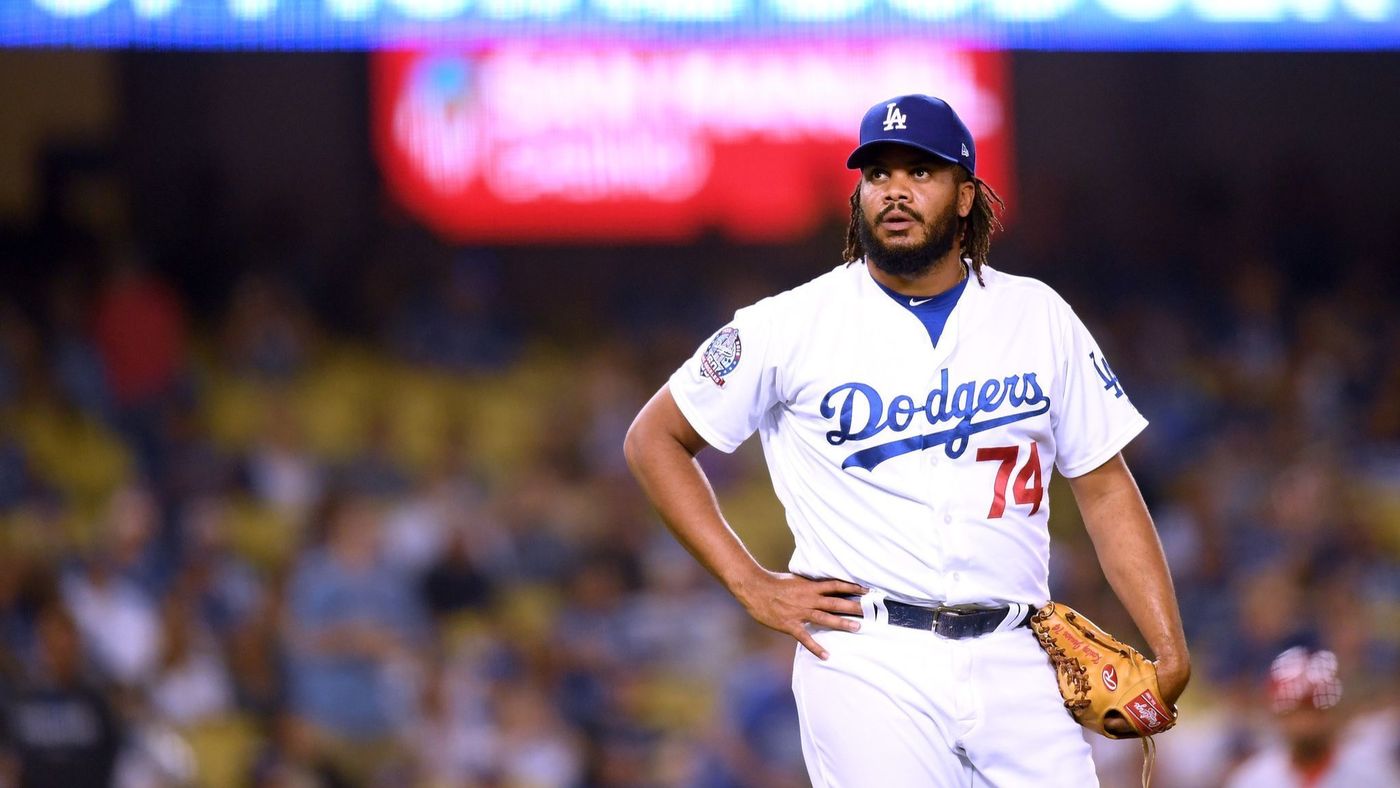
Green Fields and the Stories That We Tell

The baseball season ended on Sunday, October 28th. I knew the end was nigh, so even when Manny Machado succumbed to Chris Sale’s slider, it had, at most, three more days and two more games. But the ending is always abrupt. I awoke Monday morning to a final Baseball Tonight podcast. My “friends” Buster and Josh, the gents who informed and entertained my mornings from March through October are now gone from my life…for a few months, anyway.

My finger no longer reflexively finds the At Bat app on my phone. There are no box scores to check, no Joey Votto OBP to track. There are no more Premiere Plays or magic numbers. No, baseball is on hiatus. The game on the field is comfortably hibernating for the next four months while we, the obsessed fans, are left…to our memories. And football, and basketball, I guess.

I love this time of year. I love the changing weather and the coming holidays. But I do miss baseball. And I know I am not alone.

Baseball is more than a hobby, more than the National Pastime (a disputed fact at this point, I am aware). It is part of our daily culture – it is just there. There are no real days off; no Monday-morning quarterbacking or off day between a home and home. It is a metronome over seven months. And it is beautiful. Better writers than me have discussed this ad naseum, so there is no need to expound.

The aforementioned Buster Olney concludes each season – after the final World Series game, after the final interviews, after the final analysis – by playing Bart Giamatti’s reading of his poem The Green Fields of the Mind. If you have never heard it, click here now;  if you have never read it, click here now. It is the perfect capstone to the season gone by; it is the perfect ease into the long off-season. It is just…perfect.

I have read that poem too many times to count. I believe, in many ways, there can never be a better encapsulation of the game.

But there is even more to the game than what is in Bart’s prose. As I wrote last week about attending the World Series, first with my father, and then with my son, baseball is about time, and history, and family. It is about reliving memories, and creating ones anew. I am not skilled enough to fully express the emotions I have felt at a ballpark – be it when I was five years old or pushing fifty. But I write this column in an attempt to articulate my feelings and have a place for my kids to go one day (now? soon?) to understand the how and why of my love for baseball – in all its storied splendor. But I fall short in my depiction.

Then I heard Larry Wilmore interview the highly-lauded historian Doris Kearns Goodwin. In addition to being one of the world’s great political biographers (Team of Rivals, The Bully Pulpit, No Ordinary Time, The Fitzgeralds and the Kennedys, Every Four Years, etc.), she is also an avid baseball fan, born and raised in Brooklyn. When an audience member asked her what she does in her free time, after discussing her love of murder mysteries, she said this (and it is my hope and dream to ever be so eloquent):

I went to Fenway Park when I was at Harvard; so reminiscent of old Ebbets Field, and a team so reminiscent of the old Brooklyn Dodgers. We would almost always win but lose in the end. And I became an equally irrational Red Sox fan. We’ve had season tickets now for more than 35 years. And I must say, when I go to Fenway Park sometimes – my father died before I got married and had my three sons – so I have been able, when I go to Fenway Park, now to imagine myself a young girl once more – when my sons are by my side – in the days of my youth with Jackie Robinson, Pee Wee Reese, Duke Snider, Gil Hodges. Fabulous days.

And then when I see my sons, sitting in the place where my father once sat, I feel this invisible loyalty and love linking my sons to the grandfather whose face they never had the chance to see, but whose heart and soul they have come to know through all the stories I have told. Which I think is why in the end I have this curious love of history that I have had my whole life. Allowing me to spend a lifetime looking back into the past. Allowing me to believe that the private people we have loved and lost in our families and the public figures we have respected in history, just as Abraham Lincoln and all these guys wanted to believe, really can live on so long as we pledge to tell and retell the stories of their lives.

I can only hope that, through my words on this page, I am telling and retelling some of these stories.

PLAY BALL!!

I Lied

There is a lyric in the most popular (but not the best) Blues Traveler song that goes as follows:

“I’ve tried – well, no, in fact, I lied.”

That one line sums up the emotions I have had to deal with since the Dodgers won the NL pennant. Last week I explained how I was Torn Between Two Lovers and simply hoping for an entertaining and exciting seven game World Series. And then, channeling the Mike Tyson principle, the first pitch happened. Maybe not the first pitch, but definitely the first game. I now can truly understand what people mean when they say “the heart wants what the heart wants.”

Once balls were hit, pop-ups missed, cut-offs overthrown, and guys started circling the bases, I found myself rooting for the Red Sox. Maybe it is just Pavlovian. Maybe it is a reflex. Maybe it is so ingrained that no desire to see my hometown team win their first title in thirty years can outpace my love of the BoSox. It started early, and it has stuck – for more than 40 years. It is out my control…I cannot be blamed…don’t judge me.

But, like John Popper said, “I tried.” I went to Dodger Stadium on Friday night wearing a Dodger hat (so what if I was wearing a Red Sox shirt). I sat there for 7 hours and 20 minutes, braving nearly nine additional innings and more than four additional hours of no food or drink (not by choice, and more about that in another column at another time), knowing in my soul that the game would end with a Dodgers walk-off. And when it happened, I was excited for Max Muncy. If you love baseball, if you love the journeyman, if you love redemption stories, what is there not to love about Max Muncy going from his high school batting cage to only the second World Series walk-off homerun in franchise history?

I was there last season, during Game 2 of the NLCS, when Justin Turner walked the Dodgers off with a monstrous three-run dinger against the Cubs. I went berserk; I could not have been more excited. But when I didn’t have that same reaction in the bottom of the 18th inning on Friday night (actually Saturday morning), I knew I was a fraud. I knew, in that moment, “well, no, in fact, I lied.” I wasn’t rooting for the Dodgers at all. I didn’t want the series to go a thrilling seven games. I wanted the Red Sox to win…every game…and take home the title for the fourth time in fifteen years. And when that wasn’t happening, I was bummed.

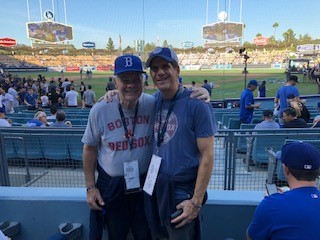
To be perfectly candid, I left Friday’s game with a smile on my face because (a) it was finally over, but more importantly, (b) I got to take my father to his first World Series game ever. And he got to see the team of his childhood battle the team of his last 60 years. And he essentially got two games for the price of one. That is an experience that I (nor he) will ever forget.

We witnessed history. We endured the longest (by time and by innings) World Series game in 114 Fall Classics, dating back to 1903. We saw a mini-Buckner and a mini-Gibby, which book-ended a relief pitching performance for the ages. As Ben Lindbergh astutely pointed out, this was a classic game that will never be shown on ESPN Classics. But we survived; we stayed until the end; I can tell my grandkids – and my dad actually told his grandkids – “I was there!”

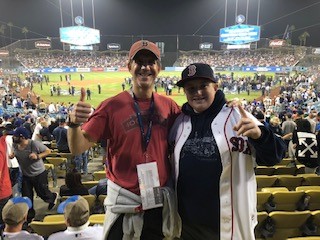
But walking into the ballpark Sunday afternoon, knowing we were one away from winning it all; walking in amongst a sea of red jerseys and navy blue hats; walking in with scads of visiting and transplanted Massholes, I felt a connection. We all wanted the same thing.

And then there is this: I wanted to be there with my son to watch the Red Sox win the World Series. How many times in my life will I get that opportunity? How many times will I get to share that type of special moment? And it was essentially happening in my backyard.

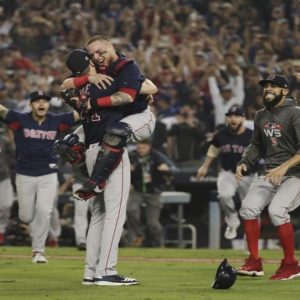
So when Manny Machado corkscrewed himself into the batter’s box on a nasty Chris Sale slider, and the “Red Sahx have won the world championship” (h/t Joe Castiglione), we high-fived, we rejoiced, we yelled, and we screamed. And whereas last year we couldn’t get out Dodger Stadium fast enough – not wanting or caring to see the Astros celebrate their title – this year we lingered. We watched the league officials set up the stage and deliver the Commissioner’s Trophy to John Henry; we listened to Steve Pearce as he accepted his MVP award and his shiny red truck; and then we experienced the players and their families soaking in the thrill of victory all across the field.

I wanted to want the Dodgers to win three games and push this battle to seven. But once I saw Craig Kimbrel try to high-wire his way through the playoffs, including a shaky 1-1/3 innings in Game 3 and an even shakier inning in Game 4, I knew in my heart of hearts that my heart of heart could not bear to watch his sweaty right wing try to retire the final batters on a cold Halloween night in Boston. No, despite my original protestations to the contrary, I wanted and needed the Red Sox to win this series and win it fast. Fortunately for me, my cardiologist, and the health and well-being of an entire region, they did just that.

We have 108 days until we say…

PLAY BALL!!
 

Three Plays – Two Losses – One Player

If the World Series was going according to plan, it would be tied at one game apiece, and we would staring down the barrel of a five-game series starting Friday afternoon in Los Angeles. As it stands – as you all know – the Dodgers find themselves in an 0-2 hole trying to get fat on some home cooking.

With two losses in two nights, there have been a lot of negative pieces written about the Dodgers:

  • Kershaw again having a rough outing in the playoffs.
  • The Dodgers’ bullpen once again letting Kershaw down and allowing inherited runners to score.
  • Roberts pulling Baez only to have Wood give up a three-run homer.
  • The Dodgers electing to keep a collective regular season total of 110 homeruns on the bench because there was a lefty on the hill.

But there is one player who seems to be getting off scot-free.

Before the series, Buster Olney did a breakdown of the key match-ups in the series. Number 1 on that list was “The Dodgers Outfielders vs. The Weirdness of Fenway Park.” Olney opined that insofar as none of the Dodgers outfielders (Matt Kemp excluded – is he still an outfielder?) had ever played at Fenway Park, learning on the fly might prove very difficult.

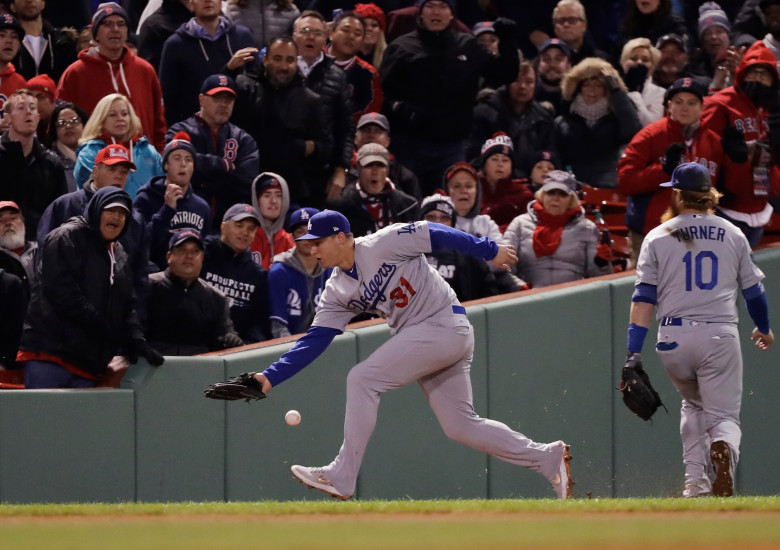
We did see Kiké Hernandez play a J.D. Martinez liner off the garage door perfectly. And we did see Cody Bellinger make an incredible sliding catch heading towards the Monster in left center. But we also saw Joc Pederson be too tentative going towards the left field line, allowing an Andrew Benintendi looper to nick off his glove and bounce into the stands for a double.

No one has really mentioned those plays, but I would aver that is because none of them were game-changers. But here are three plays that, in my estimation, were. And had the main culprit in all three been either better coached, or more prepared, or had the inclination to fully hustle, or the disinclination to show off, this series could easily be 1-1, or even 2-0 Dodgers. Allow me to explain.

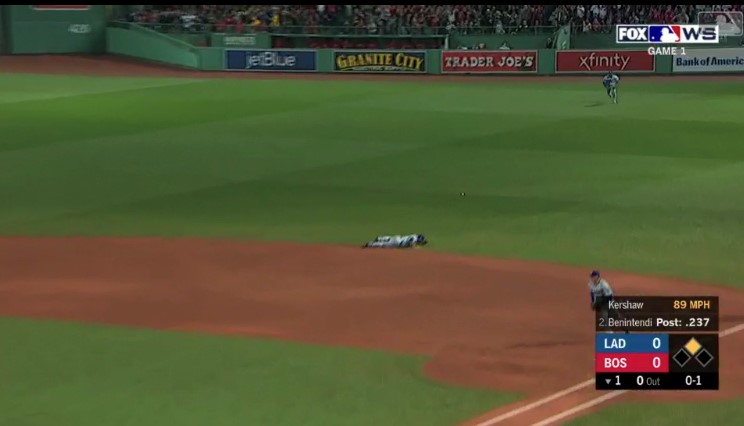
Remember back to the second pitch of the bottom of the 1st inning of Game 1. The presumptive AL MVP at the plate. He hits a pop-up down the right field line. David Freese – never to be confused with Keith Hernandez at first base – tentatively goes back, worried about the jutting wall, the slick track, the tarp, and the swirling wind, and allows the ball to fall untouched. We all know what Betts did with his second chance.

I have two questions:

(1) Where was Brian Dozier? Before the trade deadline, Dozier played his entire career in the American League. That included 26 games at Fenway Park. He surely knew the surroundings, and, arguably, that is his play. I guess, positioned in the shift and playing behind second base made it impossible for him to get there. So, we will let Dozier off the hook.

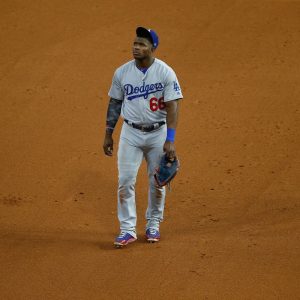
(2) Where was Yasiel Puig? He was playing VERY deep in right center. He was essentially playing no doubles defense against the first batter of the game. He was playing too deep for the situation. And while he did sprint towards the ball, in typical Puig fashion, he slowed up when it looked like Freese was camped under the ball.

Five pitches later Betts was in scoring position. Benintendi then lined a single to right, and Puig came up throwing. Again, Puig was playing VERY deep, and was obviously paying very little attention to (a) where he was standing or (b) who was on base. Had he internalized either, he never would have played hero-ball and airmailed a throw to the plate. But Puig ALWAYS wants to show off his arm, and the World Series is not a time for the Wild Horse to be put back in the barn. But, in doing so, he allowed Benny to go to second. So, when two batters later, Martinez singled up the middle, the Red Sox had a two-run lead and Kershaw was on the ropes.

That inning, and that game, could have and would have been wholly different had Betts been retired. Or, even if we assume that the pop-up was uncatchable, what does the game look like if Benintendi doesn’t go to second on Puig’s throw? Alas, Kershaw’s defense let him down…again, and no one has written about Puig’s complicity in those two plays.

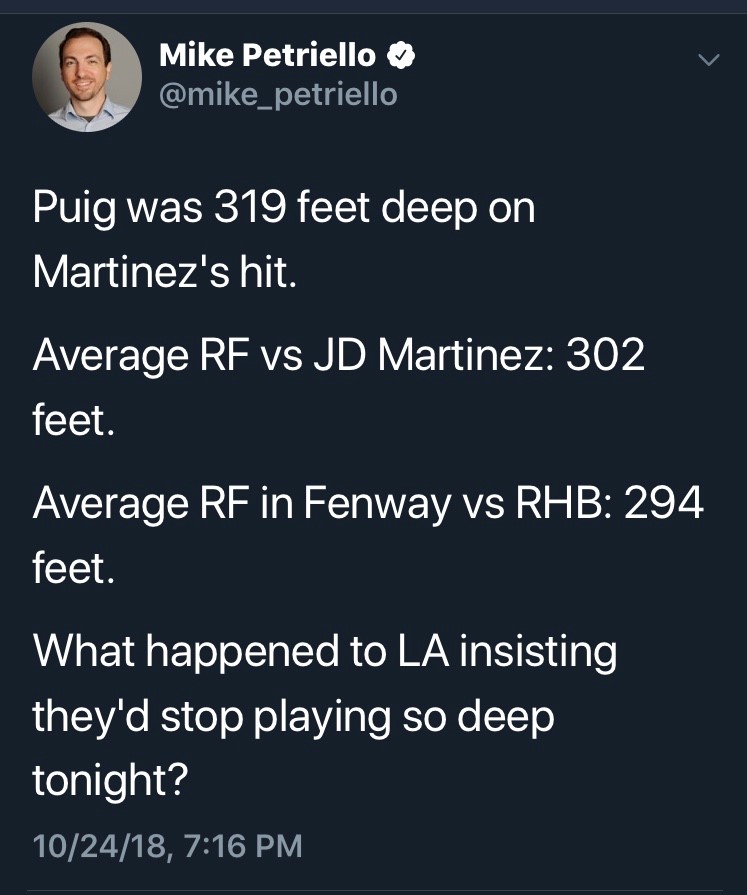
Prior to Game 2, Dave Roberts was asked about the Dodgers outfield positioning, and he confirmed that they had been playing too deep. So riddle me this, Batman, how and why was Puig playing 319 feet from homeplate when J.D. Martinez came up with the bases loaded and two outs in the bottom of the 5th?

Don’t think he was out of position, allow Mike Petriello of MLB.com to shed some light:

Had he been positioned properly, there is a fair chance Puig catches that ball. Sure, it would have been a great play, but haven’t we seen great plays in the playoffs? Hasn’t Puig made great plays? Is it that far-fetched to think Puig gets dirty, keeps the game tied, and leaps, hollers, and gallops his way off the field with his tongue hanging out?

But let’s assume Puig plays it safe and pulls up short. With his arm, he holds Benintendi at third, and keeps it a one-run game. Doesn’t a one-run game change the entire complexion of the next four innings? Do Red Sox fans feel as comfortable with Kimbrel in the 9th protecting a one-run lead against Machado, Taylor, and Kemp?

Who knows? Well, I think I do.

It is incredible to me that Yasiel Puig, he of the going to the World Series guaranty; he of the massive game-breaking three-run homer in Game 7 of the NLCS; he of the wild and impetuous antics, is getting a free pass for how he – in the span of three plays – so adversely affected the Dodgers chances to win the World Series.

Friday is new day. Walker Buehler could shut down the BoSox offense, and then Rich Hill could dash the hopes of his hometown team, and we could go into Sunday looking at a three-game series. As Jayson Stark likes to say, “Baseball.” There is only one way to find out.

PLAY BALL!!
Torn Between Two Lovers (2018 Edition)

Anyone who has ever read this site, or walked into my office, or seen me out and about on weekends, knows that I am a die-hard Red Sox fan.

Although I was born in Southern California, our family moved to Connecticut when I was a toddler. That, alone, didn’t make me a BoSox fan. It was my father’s nearly forty years of fandom (at that point) that cast the die. But living in New England, and visiting Fenway Park as a young child, cemented my love.

We moved back West before my seventh birthday, and since that time, I have been what Bill Simmons would call a “sports bigamist” – I love two teams: one in the American League and one in the National. For my entire life this has been easily managed, as neither was good enough to result in a battle on the largest stage. In fact, the Red Sox and Dodgers played each other in the 1916 World Series (to be technical, it was Wilbert Robinson’s Brooklyn Robins against Babe Ruth’s Boston Red Sox), and then didn’t face each other again for 86 years – until the Dodgers swept the BoSox at Dodger Stadium in 2002. In the last 16 years they have only played twelve more games against each other. The only team the Red Sox have faced less than the Dodgers in the interleague era is the Cincinnati Reds.

But those fifteen games were mere squabbles, not even close to royal rumble that is and will be the 2018 World Series.

So here I sit, on the eve of the Fall Classic, torn between two lovers. What is a sports bigamist to do?

When the Brewers pushed the NLCS to Game 7, I started looking into flights to Boston for Games 1 & 2. But once Yasiel Puig’s liner caromed off the top of the center field wall and he crotch-chopped his way around the bases; and once Dave Roberts’ over-managing didn’t come back to bite the team in the ass; and once Kenley Jansen got four outs over the 7th and 8th; and once the Dodgers once again failed to do the little things to tack on insurance runs; and once Clayton Kershaw pushed his post-season demons back into the closet for another night to clinch the pennant and potentially a new/extended contract, I began to think that traveling 3,000 miles, when I could travel 13, seemed like a bad idea.

Sure, Dodger Stadium is one of the worst places for fans (exterior views and sightlines notwithstanding). And sure, Fenway Park is an America treasure. But there are some bridges (and transcontinental flights) that are just too far.

My family is divided. As I have previously written, my father came to Los Angeles with the Bums in ’58. He’s been a Dodger fan ever since. But his heart still resides in Southie.

My sisters and their husbands don’t have any particular affinity for the Red Sox, and have fully embraced their hometown team. My friends – many born and raised in L.A. – bleed Dodger blue. The gents with whom I share season tickets have been waiting 30 years (and anxiously since November 1, 2017) for a Dodger parade in DTLA (since long before DTLA was even an abbreviation).

So I will be tuned in Tuesday and Wednesday, and most likely in attendance at some of the games next weekend, knowing that whatever happens I will be happy…and sad. I will be excited…and disappointed. For the first and potentially only time I ever write these words, my and Fox Broadcasting goals are aligned: just give me seven games.

Seven nights of thrilling October baseball, with umpteen pitching changes and countless bat flips and bat licks.


Seven nights of Citgo signs and palm tree views.

Seven nights of exorcised demons for two of the game’s greatest lefties.


Seven nights of minority managers making major decisions on the game’s biggest stage.


Seven nights of Mookie smiles and Kiké joy.


Seven nights of high-wire closers doing their level best to keep cardiologists on both coasts employed well into the winter.


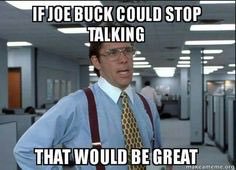
Seven nights of people complaining about Joe Buck.

And seven nights where three hours will never be enough; where four hours won’t be too much; where we get to savor those last drops of baseball before acknowledging to our kids, our spouses, and ourselves, that winter is coming, and spring is so, so far away.

Two years ago I wrote about the 2016 playoffs, envisioning a Cubs-Red Sox showdown. I said this would make me happy:

[A]ll I can hope is that the Red Sox and Cubs are tied at three games apiece, tied after nine innings, and then someone cuts the Eversource/NStar power grid. Then, after a collective groan, everyone calmly and politely exits Fenway Park, gets on the “T”, and goes on with their life. Hope can always spring eternal.

Replace Dodgers with Cubs, and you know how I feel today.

In 2004, I was over the moon when my team celebrated at Yankee Stadium, but I feared that my heart would be ripped out again (see, 1986). 2007 was exciting, but Red Sox fans were still basking in the glow of 2004, and the Rockies didn’t pose much of a threat. 2013 had a totally different feel, as it seemed like the BoSox were playing with house money, getting outplayed in the ALCS save for two massive and timely homeruns. Last year was special as it was the first time in my adult life my hometown team was in the World Series; but it ended with a whimper – a Game 7 that was essentially over before the Dodgers came to bat.

This year – for obvious reasons – is just plain different. Two huge payroll teams who have beaten the best to get to this stage. Two managers who, as players, have already experienced World Series glory. Two franchises steeped in tradition with rabid fanbases who always want more.

We haven’t seen this match up in 102 years. We’ve been waiting a long time. Enough talk.

PLAY BALL!!

The Demons Are Gone

October 16, 2003, bottom of the 11th inning of Game 7 of the American League Championship Series, Tim Wakefield on the mound for his second inning of work.

We all know what happened next.

That night, as we recall, the Red Sox held a three-run lead with six outs to go to advance to the next round (in this case, the World Series). And then the slow motion car crash began.

As a lifelong Red Sox fan, you could feel it: horrific dread; impending doom; we had seen it all before and there was no good way for this to end. Over the years the soul-crushing details may have been different, but the denouement was always the same: Red Sox players alone in the dugout, another team celebrating on the field; Red Sox fans in the stands or on their couch, hands on their heads and tears in their eyes. It hurts just to write the words.

Regardless of the vantage point, the outcome was preordained: the Red Sox were destined to fail.

A year later the heartbreak stage was set yet again, but maybe less painfully. After a 19-8 drubbing in Fenway on a cold Saturday night, it was a fait accompli that the season would be over the following night. A humiliating sweep at the hands of our archrivals, in our park, a year and a day after having our guts ripped out in New York. Game 3 of the ALCS ended at 12:30am local time, so technically, the misery ended Sunday morning.

Now I don’t want to get ecclesiastical, or discuss divine intervention, but something happened in the 19 hours and 50 minutes before the next game began. Maybe it took a wee bit longer; maybe it took nearly twenty-four hours…until 12:01am Monday morning for the planets to shift, for the stars to align, for something otherworldly to happen. But make no mistake, something did happen on that fall New England day of worship.

At 12:01am Monday morning, EVERYTHING changed. It was at that moment that Kevin Millar drew a leadoff walk off Mariano Rivera.

We all know what happened next.

The 3-1 pitch that missed up and in was the first tremor. In years past, Millar takes a hack at ball four, runs the count full, and Ks on a 3-2 cutter off the plate for the first out of the ninth. But now he was standing on first base.

The earth really started to move at 12:03am, when Dave Roberts barely made it back to the bag after a quick pick-off throw. In years past, he would have been a hair slow, allowing for an ignominious and yet fitting way to lose the potential tying run. But now, he just exhaled with relief, wiped the dirt off his jersey, and took another massive lead.

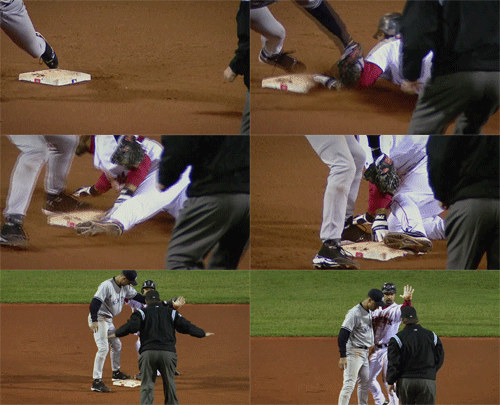
The waters began to recede from the shore at 12:04am, when Roberts’ left hand touched second base a millisecond before the shortstop’s glove. In years past, pundits would forever be talking about how it took the perfect Posada throw and the perfect Jeter tag to get Roberts, and unfortunately for the Fenway Faithful, the Red Sox were denied again. But now, the tying run was in scoring position.

The earth tilted on its axis at 12:05am, when Bill Mueller singled up the middle to tie the game.

And buildings began to fall at 1:22am, when David Ortiz launched a walk-off two-run dinger into the Yankees bullpen to force a Game 5.

Somewhere between 12:01am Sunday morning and 1:22am Monday morning, the fate of an entire organization – an entire city, hell, an entire region – undeniably changed forever.

We all know what happened next.

And so it was that we found ourselves in Yankee Stadium on Tuesday, October 9, 2018. The Red Sox again leading by three runs with six outs to go to get to the next round (in this case, the ALCS). In this version, the Red Sox managed to narrow the margin to three outs to go with a three-run lead and their (the league’s?) best closer on the hill. And then the slow motion car crash began again.

As a lifelong Red Sox fan, you could feel it: horrific dread; impending doom; we had seen it all before and there was no good way for this to end.

But wait. Although we have suffered the ill effects of sports PTSD, we have now come out the other side. We have won three World Series titles in the last 14 years; we have vanquished the Yankees – at Yankee Stadium, no less – on multiple occasions. We knew – in our head if not our hearts – that this time could be different.

A four-pitch walk to Aaron Judge (none were even close) followed by a Didi Gregorius single on a 1-2 pitch that could have been a groundout to first but for the previous walk. Pre-2004, Giancarlo Stanton would not have just represented the tying run, he would have become it. Alas, that world no longer exists. He struck out, meekly.

Another four-pitch walk loaded the bases, and a hit batter made it a two-run game. The ghosts were stirring, but their appearance was not certain.

Gary Sanchez – the Red Sox’s current nemesis – came to the plate. A single ties it, an extra base hit wins it, and a homer crushes the spirit of New England. In years past, we all know what would have happened.

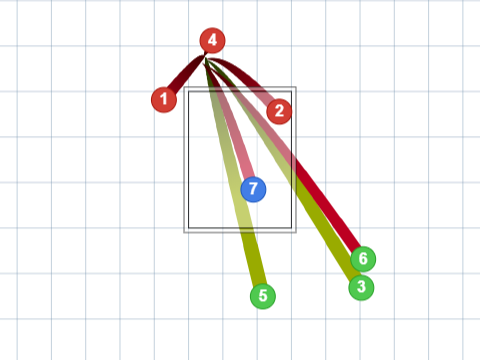
Craig Kimbrel got Sanchez 0-2 with two great fastballs, and then proceeded to run the count full with three pitches nowhere close to the strike zone (#3, #5, #6, to the right). The seventh pitch of the at bat was a dead red, center-cut, fastball (see #7) that Sanchez somehow just missed. Off the bat it didn’t look like much, but it kept carrying deeper and deeper into the New York night. On hits like this, I watch the fielder, as he will give you a good indication of whether or not the ball is playable; but I also watch the fans. In this case, the further Andrew Benintendi drifted towards the wall, the more excited the fans became, the sicker I began to feel.

That play lasted a LONG time. In fact, from the moment the ball left the bat until it landed in the glove, nearly seven second elapsed.

To put that in perspective, the longest hang time of an NFL punt last week was less than six seconds. If we were driving down the highway at 60 MPH, we would travel nearly 600 feet before that ball landed. If our eyes were trained on the game, we would have blinked at least twice between contact and the out being recorded. There is a lot one can do in seven seconds, including, apparently, hold your breath.

The Red Sox 108-win season could have been upended if Sanchez’s ball had flown five more feet. But that would have been a pre-2004 outcome. That was before the world changed.

When super-rookie Gleyber Torres hit that little roller to third (not to be confused with “a little roller up along first”), any number of things could have gone wrong, to wit:

  • No throw and the bases are loaded for Andrew McCutchen;
  • The throw pulls Steve Pearce off the bag for the same result;
  • The throw pulls Pearce off the bag and in his splayed state, Adeiny Hechavarrria scores from second to tie the game; or
  • The worst case scenario – which I envisioned in that split second – the throw pulls Pearce off the bag, Pearce tries to right himself and throw Hechavarrria out at the plate, but airmails it home allowing Neil Walker to cruise in with the winning run.

Any of those things could have or would have happened prior to 12:01am on October 18, 2004. And we, as Red Sox fans, sat there Tuesday night ever-fearful that history was going to repeat itself. That the good times were over and that David Price (in Pedro Martinez’s stead) would be on the receiving end of “Who’s Your Daddy?” chants for the rest of time.

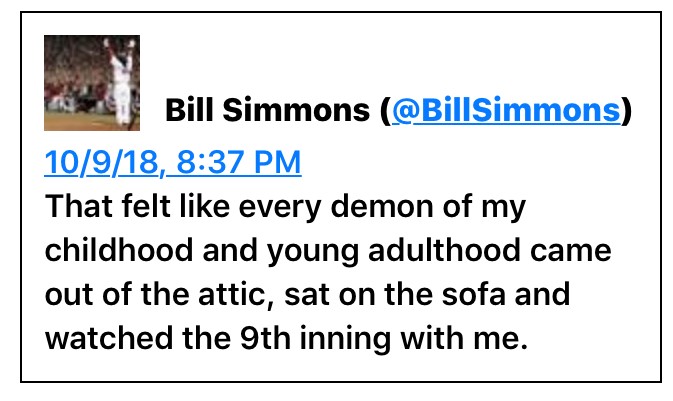
When the final out was recorded and the Red Sox had won, Bill Simmons tweeted:

Alas, those demons are gone; they have retreated to the attic or the basement or the Bronx. Sure, the Red Sox will at some point rip our hearts out again; sure, the Yankees will at some point trounce the BoSox again; sure, not every break will go our way forevermore. But, this is not a pre-2004 world. We as Red Sox fans do not live with the knowledge (only the presumption) that the worst will inevitably occur. Now we can be rational, calm, measured, knowing that the only certainty is that bad things will happen to…the Indians.

PLAY BALL!!
Being There

There is something about just “being there.” So, when my buddy Darin texted me an invitation to Friday night’s NLDS Dodgers vs. Braves game, I quickly texted back an emphatic “yes.”

He then sent me a picture of where we would be sitting – very far from homeplate – and I just as quickly texted back that being there is what matters most.

I was so eager to respond and lock down a free ticket to a playoff game, that I didn’t even realize that I had said “yes” to Clayton Kershaw. In an incredibly unusual move – a move that had not happened since Kershaw’s 21-year old season in 2009 – the Dodgers started the post-season with a pitcher who did not wear #22 on his back. The team decided it was best to give Kersh an extra day’s rest, which allowed him to be ready for Game 5 if necessary, and started Hyun-Jin Ryu in Game 1. It worked out perfectly, as Ryu threw seven innings of four-hit ball, allowing no runs in a dominant appearance.

Kershaw, as always, was diplomatic about the team’s decision. When asked if he agreed with the rotation choice, he offered a lengthy pause, and then said: “They had their reasons and I accepted them.” When asked if it was a gut punch not to be on the mound for Game 1, the fiery Texan said: “I don’t really think of it like that. I think: I get to pitch in another playoff series for the sixth year in a row. I’m looking forward to it.” This guy is a pro, and has done this long enough to know what to say and when. He must have decided, in that moment, to let his arm do the talking.

At 6:37pm on Friday night, Clayton Edward Kershaw walked out of the dugout, across the grass to, in the words of Vin Scully, “the mound at Dodger Stadium…the loneliest place in the world.” History was both Kershaw’s friend and enemy, the playoffs – not the Braves – his greatest nemesis.

Kershaw’s first pitch of the beautiful and cool Los Angeles evening was a 92-MPH fastball that Ronald Acuña Jr. promptly smacked to the wall in left center for a leadoff double. You could feel the tension in the air. Would this, could this, be another playoff disaster for the Hall of Fame-bound lefty? In a word, no; no it would not.

After giving up that leadoff double, Kershaw was masterful. He retired the next 14 batters before an infield single broke the streak. Being a baseball nerd, I watched and calculated his pitch count each inning: 29 through three and 39 after four; 55 through five and 60 after eighteen outs; 73 heading to the stretch, and just 85 when eight innings were in the books. When the Dodgers came to bat in the bottom of the 8th, I felt certain that we were about to see a playoff version of a “Maddux”: a complete game shutout with less than 100 pitches. To paraphrase the great Tim Kurkjian, that is something have never seen before.

There were 54,452 of us sitting on the edge of our seats when Kershaw climbed the stairs of the Dodger dugout and jogged out to pitch the ninth. We were about to witness history.

Alas, it was not meant to be. Kershaw took the mound to warm up as a diversion, a ploy, a chess move in the mental game between managers. If the Braves allowed left-hand hitting Lucas Duda to lead off the ninth, Kershaw would have pitched to him. If Braves manager Brian Snitker, seeing the gangly lefty on the hill, announced a right-hand hitting pinch hitter (in this case, Tyler Flowers), Roberts would pull Kershaw in favor of Kenley Jansen.

Of course, sitting in the upper reaches of the ballpark, we had no idea what was going on. We were just wholly disappointed (a) to watch Kershaw abdicate his thrown and (b) to see him to do so for the gas can that is the current incarnation of the Dodgers’ closer. True to form, Jansen gave up a hard hit to the second batter he faced. After a pop out, Jansen ran the count to 3-2 to the dangerous Freddie Freeman. A fastball off the corner would have brought the tying run to the plate, and potentially put Kershaw’s gem in peril. But Kershaw – and by extension, Jansen – was not to be denied. Freeman swung through a 93-MPH cutter, and the Dodgers had a 2-0 series lead.

I have been to a lot of baseball games, and I have seen a lot of gamesmanship. But I have never seen a manager send the face of the franchise, throwing one of the games of his life, to warm up on the mound just to compel the other team to make a move. Love or hate Dave Roberts, and many people do, this was pure genius. As we learned later, he got Kershaw’s blessing before executing the plan – the manager and the player were on the same page.

Kershaw could have pulled rank – he could have gone all Matt Harvey and essentially refused to give up the ball; he could have said to Roberts: “One day there will be a statue of me outside this stadium and a bust of me in upstate New York, I have been dominant for eight innings and have thrown only 85 pitches; I went along with your cockamamie idea and allowed Ryu to start Game 1, but if you want this baseball, you have to pry it out of my meaty left hand.” And you know what, he would have been totally justified in saying so. But he didn’t. He put team ahead of self; he put winning ahead of personal accomplishments; he was, quite simply, a pure pro.

Kershaw left the mound to a standing ovation and an anxious crowd. Jansen didn’t let him down, he didn’t let any of us down.

Walking out of the park last night I remained sad that we didn’t get to see Kershaw pitch a Maddux on a massive stage. But that is what separates fans from superstars. Michael Jordan passed up the shot, twice, giving the ball to Jim Paxson and Steve Kerr, because he knew it was about winning championships, not accolades. Kershaw didn’t care that I couldn’t boast about what I had seen; he cared that his team gets to the next round, and then the ultimate round, again.

But you know what, upon further reflection, I’m not sad. Greatness is greatness, whether it goes eight innings or nine. And when people talk about one of Kershaw’s all-timers, I will be able to say “I was there.”

PLAY BALL!!
163

I missed Opening Day. I was traveling with my family, on an island far from where any game was being played, and did not have the opportunity to partake in any of the pomp or pageantry.

Because of that, there was no way I was going to miss “Closing Day.” I made sure I was in the park – Anaheim Stadium, as it turns out – to watch the sun set on the regular season. And what a way to end it: the pre/early/mid/late season phenomenon named Shohei Ohtani led off the bottom of the ninth with a rocket single to center. He then flew around the bases to score from first on a double to left, making it a one-run game. And then, when a Mike Scioscia-led team would normally have made the rookie shortstop bunt the tying run to third, we come to find out that Scioscia relinquished his managerial duties for the final game in his 19-year run. So whoever was calling the shots in the Angels dugout threw caution to the wind, tossed out that two decade-old playbook, and let the kid hit. And hit he did. Taylor Ward is no Freddie Patek or Tim Foli or even David Eckstein. So it wasn’t a massive surprise when Ward hit a game-winning, season-ending, walk-off two-run homerun and was met at home plate by a mob of teammates and two buckets of Gatorade.

The Angels’ celebration was a much needed final image in what was yet another disappointing (some might say wasted Mike Trout) season. What a joy to watch two rookies being interviewed on the field in two different languages, while one of the last old-school managers was being interviewed for the final time. The cycle of baseball life.

But for me, I was thwarted. It turns out that I wasn’t at “Closing Day.” While the Angels were rallying to beat the A’s, the Dodgers (15-0) and the Cubs (10-5) were beating their hated rivals; and the Rockies (12-0) and Brewers (11-0) were destroying the Scherzer-less Nationals and the hapless Tigers, respectively. Put another way, all the teams that had to win on Sunday did so, by a collective score of 48-5. The lack of excitement on Sunday meant we would get a ton of excitement on Monday with not one, but two Games 163. To paraphrase the great Jayson Stark: Do you know how many times that has happened before? You would be correct…none!

Now I had to make new plans; I had to get to a Game 163. Lucky for me, there was a one being played down the street. So I sat in the 90-degree sun and watched yet another rookie, pitching sensation and potential heir apparent Walker Buehler throw 6-2/3 innings of one-hit ball; and watched the 28-year old breakout success Max Muncy launch his 35th homerun; watched Kenley Jansen hold a lead he simply could not lose; and watched as the Dodgers celebrated their sixth straight NL West title. As you know, the Brewers knocked off the Cubs earlier in the day, so when Gerardo Parra struck out on a high cutter, Games 163 were in the books, and so too was the 2018 regular season.

To be perfectly candid, there was something anticlimactic about the Dodgers’ win. Sure, winning six division titles in a row makes it seem almost rote. But I think it was the fact that both teams were going to the playoffs, regardless. The game had stakes – the winner got two days off and a guaranteed five-game series while the loser had to hop a flight to Chicago for a one-game playoff. But it seemed inevitable that the Dodgers, with their payroll and their stars and their lineage and their home field advantage, would get the W. And, in Hollywood, things tend to follow the script. We watched the players celebrate on the field, but they had already celebrated when they were assured a playoff spot; and they had already celebrated when they were assured a chance to win the division. How many bottles of champagne does it take just to get to October?

Now the real fun begins. Two do-or-die games for the right to play the Brewers and the Red Sox, respectively. An A’s team that no one saw coming. The Braves at least one year ahead of schedule. The Astros trying to defend their title. The Indians hoping to erase 70 years of futility. So hang onto your hats, as per usual, October should be a wild ride.

So how do we follow two 163s? Well, we have two single elimination games; four potential Games 5; and three potential Games 7, including a finale on Hallows’ Eve! A boy can hope…

PLAY BALL!!