A Deal Fit For a Kingery

When we last met, we were discussing the Philadelphia Phillies and their deft contracting for a seasoned veteran. In today’s installment of the Matt Klentak diaries, we will look into the Phillies’ deft contracting for an unproven rookie.

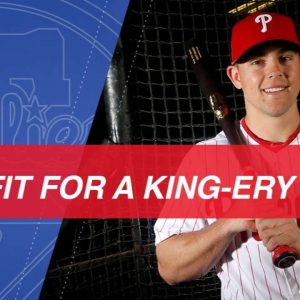
We begin our tale as Spring Training was winding down. The Phillies multi-faceted prospect Scott Kingery was preparing himself to head down to Lehigh Valley for Triple-A opening day. For various reasons – more on those below – Kingery didn’t think he would be breaking camp with the big club.

Kingery was a drafted in the second round in 2015 out of my alma mater, the University of Arizona. At 5-10/180, Kingery came into professional baseball playing multiple positions, with a great hit tool and plus speed. At his size, no one expected him to hit for power. But last year, Kingery hit 26 homeruns, stole 29 bases, and had a .889 OPS across two Minor League levels. Such production allowed Kingery to rise quickly up the ranks of the Baseball America and MLB prospect charts. And yet, no one expected young Scott to be wearing a Major League uniform on March 29th.

Kingery came to Florida in March and knocked the ball all over the yard. He hit .411, with 5 dingers and a 1.226 OPS during the spring. And yet, even with that performance, no one expected young Scott to be in the Majors on Opening Day.

As previously discussed here and elsewhere, even if the Phillies wanted Kingery with the big club, they had a financial incentive to keep him in the Minors for the first few weeks of the season. By doing so, the Phillies would delay Kingery’s service-time clock, giving the club an extra year of player control. In short, the Phillies planned to purposefully make themselves worse for a short period of time (three or four weeks) in order to potentially save some money six years down the road. The merits of this practice have been openly debated in many fora, but until the players change the CBA, teams are incentivized to take advantage of the rules, and disincentivized to bring young players to the big leagues – even when they are ready (see, Trout, Mike; Bryant, Chris; Acuña, Ronald; etc.). That, however, is a discussion for another day.

So, in order to avoid this “lose-lose-maybe we win some time in 2024” proposition, Klentak and Kingery’s reps at PSI Sports Management elected to negotiate a long-term contract for a youngster who had never played a Major League game. The Phillies and Kingery agreed to a deal that potentially runs for nine years, worth no less than $24M, and possibly as much as $65M (if the team exercises its three options). Here is an overview of the deal:

Year Salary
2018 $1,000,000
2019 $1,500,000
2020 $1,750,000
2021 $4,250,000
2022 $6,250,000
2023 $8,250,000
2024 $13,000,000

(Team Option; $1,000,000 buyout)

2025 $14,000,000 (Team Option)
2026 $15,000,000 (Team Option)

Why would the Phillies do that? And why would Kingery?

From the Phillies’ perspective, this was a no-brainer. If everything goes sideways, and Kingery is an all-time bust, they have a player on their roster through the 2023 season at an AAV of $4M. If you consider that the going rate for Wins Above Replacement (WAR) is $11M, Kingery could be a .06 WAR player for each of his six seasons and the Phillies still break even (Note: this math does not account for the price/value of WAR going up between now and 2023, which means Kingery could be even worse and the deal would still make dollars and sense).

And if Kingery is the real deal, the Phils have him under control for nine years at an AAV of $7.2M, which would rank him as the 180th highest paid player in the league (at current levels). To take this to its illogical conclusion, using 2018 values, if Kingery is worth exactly $15M (i.e., making him a 1.4 WAR player) in his ninth season (which begs the question as to why the Phillies would continue to exercise their options, but bear with me), the contract would still be a good value. If Kingery’s worst case is that he turns into Trevor Story or Max Kepler – by Year 9 – the Phillies will have won the deal.

One last thing: the Phillies got to bring Kingery, his wheels, his Swiss Army knife versatility, and his promise to the big leagues on Opening Day. They got a young ballplayer his baptism by fire, with a chance to help the club right away; he didn’t have to languish in the Minors, waiting for the sands in the hourglass to run out before getting “the call.”

So now we know why the Phillies would sign this deal, but why would Kingery? Why would a player with future “star” (if not “superstar”) written all over him give away not some, but all, of his negotiating leverage – three years of arbitration and three years of free agency – for a deal that, as shown above, is most likely way below market? One thing is certain, the MLB Players Association tried to talk him out of it. But the MLBPA doesn’t get to balance Scott’s checkbook or plan for Scott’s future (the MLB Pension notwithstanding, which kicks in if Kingery plays 43 days in the Majors).

Kingery was set to start the season in the Minors, and earn about $2,150/month. By signing this deal, he gets a first-year salary of $1 million, or $166,666/month (players are paid over a six-month schedule). A pretty nice raise. Sure, Kingery probably would have been in the Majors by May, and thus would have received the MLB minimum ($91K/month) for the remainder of the season. But that total salary would still be less than 50% of what he will make this year under the new contract.

What about Evan Longoria, people are yelling from the empty bleachers at the Trop? For those of you who don’t recall, Longoria signed a 6/$17.5M deal in 2008 after playing only six games for the (then) Devil Rays. Longoria protected himself with life-changing money, and played well enough to garner another 6/$100M deal four years later. Sure, Evan left a lot of money on the table by giving up three years of arbitration eligibility, but he still stands to make roughly $150M over the course of his career. That’s nothing to sneeze at.

To those screaming “Longoria”, I (and maybe Kingery, too) would scream “Singleton.” In June, 2014, Jon Singleton, a first base prospect in the Astros’ system (the third best prospect in the organization) got the call, and elected to sign a 5/$10M deal before he even put on his jersey. Singleton hit .168 in 95 games with the Astros in 2014; and .191 over 19 games in 2015. And that, my friends, is the sum total of Singleton’s Major League career. Singleton would have made a prorated MLB minimum over those two seasons, or about $320,000. By signing that contract – by mitigating his risk – Singleton made more than 30 times what he would have made otherwise. He protected his family and his future by signing early. If he not signed, do we believe that the MLBPA would be helping with grocery money today?

Had Singleton lived up to his potential, he may have been in line to be compensated like another Astros player who signed a similar contract a year earlier. A light-hitting second baseman secured his retirement by signing a 4/$17M deal in 2013. He then outperformed the deal, won some batting titles and an MVP, led the Astros to a World Series championship, and this off-season Jose Altuve was rewarded with a 5/$151M contract. But those riches were but a pipe dream in 2013 for a guy who, in 2006, had to sneak himself into a second tryout with the team. Altuve had no way of knowing that nine figures awaited him, so he took the sure money, and then earned the rest.

Other players, including Mookie Betts, Bryce Harper, and the aforementioned Ronald Acuña, have all been offered long-term deals at team-friendly prices, only to bet on themselves. And that is their right.

But more than a handful of players took the insurance policy that a long-term contract provides, and then bet on themselves to get even more money down the road. Among those who have done so: Salvador Perez (5/$7M initially, 5/$52.5M later); Troy Tulowitzki (6/$31M initially, 10/$157.5M later); Ryan Braun (8/$45M initially, 5/$105M later). And the following guys are in line to make plenty of money in the coming years: Paul Goldschmidt (5/$32M, expires after 2019); Madison Bumgarner (5/$35M, expires after 2019); Anthony Rizzo (7/$41M, expires after 2021).

We think we know these players, but we don’t. We don’t know their financial situations; we haven’t run around the bases in their cleats; we don’t know what motivates, drives, or frightens them. None of us – not the yahoos sitting in the stands, the MLBPA officials in New York, or even teammates in (theoretically) similar situations – can pass judgment on any other human being who accepts an offer of generational money, an eight-figure fortune – with no guarantee that any more will ever be available – just for the privilege of playing a kid’s game in a park six months of the year.

Not to be overlooked is the dearth of free agent signings this off-season. Was this year merely a blip on the radar, a bump on the road to riches; or was it a sign of the times? Many players (Jose Bautista, Melky Cabrera, Andre Ethier, Matt Holliday, John Lackey, Brandon Phillips, Mark Reynolds, Jayson Werth, and more) found this year’s free agent waters quite choppy, and, as of today, only a few have found buoys. Maybe Scott Kingery looked to the horizon and didn’t like the view. Maybe he chose safety and security over luck and the lottery.

As a baseball fan, I hope Kingery lives up the contract, becomes a star, and signs a massive deal the next time around. But on the off-chance that he flames out and finds his name on the list of all-time flops, I will be happy for him and his family that, if nothing else, he has financial security and the ability to buy a round drinks while he regales everyone at the bar with his stories of what might have been.

PLAY BALL!!

Playing Checkers

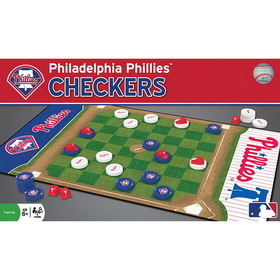
There are very few things more satisfying than the “jump” in checkers. And it’s rare when you can incorporate a kids’ board game into Major League Baseball, but Phillies GM Matt Klentak and uber-agent Scott Boras did just that in March when they negotiated for free-agent pitcher Jake Arrieta. Unless you were deep in the weeds of the Hot Stove (which was considerably cooler this winter), you may have missed the unique deal the Phillies and the right-hander closed a month into Spring Training (a deal unlike any I’ve seen before).

Before we get into the deal, a little background. Arrieta, the 2015 Cy Young winner, coming off four-plus successful years on the north side of Chicago, was arguably the most coveted starting pitcher on the open market this off-season. His agent, the aforementioned and inimitable Scott Boras, was looking for a five- or six-year deal of at least $200 million.

But as Thanksgiving rolled into Christmas, and the new year begat pitchers and catchers reporting to camps in Arizona and Florida, Arrieta found himself unemployed. This was a point on consternation for baseball fans and writers, but apparently not for Arrieta himself. If I were a betting man, I would wager that Boras assured his client that he – Boras – would pull another rabbit out of his hat, as he had so many times before.

When position players reported to Spring Training in March, however, it seemed as if the Copperfield act was getting stale. The Yankees and the Dodgers elected not to spend money and stay within the Competitive Balance Tax; the Cubs signed Yu Darvish; the Braves are still rebuilding; the Rangers elected to take a year off from contending; the Astros have a World Series title, two Cy Young winners (Dallas Keuchel and Justin Verlander), and landed Gerrit Cole in a trade; the Tigers are still in tear-down mode; the Angels won the Shohei Otani sweepstakes; and the Mets are chock-full of starting pitchers. The curtain was about to rise, and Jake didn’t have a ticket to the show.

The potential landing spots for Arrieta eventually narrowed to Washington and Philadelphia. The Nationals seemed like a natural fit, as Boras and Nats owner Ted Lerner have a great relationship. And this is “the” year for the Nationals, with Boras client Bryce Harper going into his walk season. It is win now…or potentially never.

The Phillies were an intriguing home, but they are not yet in win-now mode. Their rebuild is still in process, and are about two years away from contention. That said, one could argue that signing Arrieta would give them a rotation anchor who could lead them into their future. But one could just as easily argue that signing a 32-year old pitcher to a long(ish) deal does not comport with modern analytics and the conservative approach recently taken by the Phillies.

There has been very little reporting about any actual negotiations between the Nationals and Arrieta. And since neither Ken Rosenthal nor Buster Olney made mention of it, it’s plausible none ever occurred.

As a result, Boras found himself stuck with Klentak and the Phillies.

With but one buyer, Boras needed to be creative. For starters, Boras is well known for inserting opt-out provisions into his clients’ contracts. These give the player leverage if he over-performs his deal. In fact, just a few weeks earlier, Boras negotiated a contract for another client, J.D. Martinez, which gives the slugger not one, not two, but three opt-outs over a five-year period. As such, it stood to reason that if Arrieta wasn’t going to get a $200 million guarantee, Boras would want as much flexibility, and as many outs, as possible.

But Klentak and the Phillies understand market forces as well; and they could count the number of chairs available when the music stopped on Opening Day. They knew they potentially were the only game in town. Additionally, Klentak didn’t want to find himself paying a pitcher to (re)build his value, just to lose him – or be held hostage for huge dollars – right when his team is vying for the post-season.

So, Boras and Klentak decided to play checkers, and negotiated what, on its face, looked like a simple, front-loaded 3/$75 million contract. The deal would have $30 million payable in Year 1, $25 million payable in Year 2, and $20 million payable in Year 3.

But a deal like this had two problems for Boras: (1) If Arrieta performs in accordance with his pedigree, an average annual value (AAV) of $25 million is below market; and (2) Even if Arrieta performs, Arrieta will have earned only $75 million over the course of the contract, and will find himself a free agent as a 35-year old pitcher.

This deal had one major problem for the Phillies: They could lose their ace right when they become a force in the National League East.

It thus became time to start moving pieces around the checkerboard.

Boras bought himself protection. He, in my parlance, “jumped” Klentak by negotiating an opt-out after Year 2. Doing so made this a 2/$55 million deal ($27.5 million AAV), which is more in line with what other pitchers of Arrieta’s ilk make, and would allow Arrieta to go back into the market as a spry 34-year-old, not an old-timey 35-year-old.

But Klentak wanted and needed some protections as well, and this is where things get very interesting. He “jumped” Boras by giving the Phillies the right to “buy out” the opt-out by locking in Year 3 at $20 million (thus trumping the opt-out) and also extending the deal for two additional years at $20 million each. If Arrieta performs, and the Phillies are contending, they would have Jake on a 5/$115 million contact ($23 million AAV). And even if Arrieta under-performs in Years 4 and 5, that deal is below market and doesn’t crush their payroll.

But Boras can do math as well as I, and he understood that if Arrieta performs well enough for the Phillies to lock him in for three additional years (five in total), then Arrieta would be worth more than a $23 million AAV. So Boras needed to “jump” Klentak by building $5 million escalators into the deal based on (a) the number of starts Arrieta makes in 2018 and 2019, and (b) how Arrieta fares in Cy Young voting those seasons. If Arrieta lives up to his past level of greatness, he can add up to $20 million to the deal, making it 5/$135 million, and back to a $27 million AAV. And if that is how it ultimately ends, the Phillies will be more than happy with the deal.

With those final moves, all of the checker pieces were off the board, the game was over, and the parties signed the contract.

One last note: As we look ahead to a slowing free agent market, as teams become more cognizant of Competitive Balance Tax implications, and as front offices become ever more risk-averse, look for more contracts with this level of creativity. I may even dissect another one soon.

PLAY BALL!!

Skullcaps and C-Flaps

About four years ago I was pitching batting practice to my then 11-year-old son’s team. One of his teammates, a nearly fully-grown 12-year-old (who, in his sophomore year of high school, already committed to play at Vanderbilt) hit a line drive back through the box that nearly decapitated me. I have played baseball my entire life, am pretty athletic, and have decent reaction time. And yet, it was just dumb luck that I didn’t end up in the hospital – or worse.

When we got home that night I told my son that if he wanted to pitch that season, it was not his arm I was worried about – it was his head. And then I informed him that I was invoking my “father’s prerogative” and requiring him to wear a skullcap when he took the hill. You can imagine how that went over. But I could not, in good conscience – after seeing what had happened at the Major League level (watch below), what had happened in the Minors, and what nearly happened to me – allow him to take the mound unprotected.

https://www.youtube.com/watch?v=qQyJ01qT94I

There was some confusion in the league the first time my son donned the skullcap, but it soon became his “thing.” He then took pride in being the first to do it. (After my son’s debut, another parent bought one and forced his son to wear the helmet on the mound, so now my son was a trend-setter.) My kid wore the skullcap all season and through all-stars. But, truth be told, the concept didn’t hold, and I did not require him to wear it the next season. And, truth also being told, I regret that decision.

Image result for c-flap

It was with that as the backdrop that I found myself in the garage a few weeks ago affixing a C-Flap to my son’s batting helmet. If you don’t know the C-Flap by name, you certainly know it by sight – they are ubiquitous this season. The history of the C-Flap is set out in this great Paul Lukas article, with much more background and detail than I could muster. An interesting fact, found about halfway through the piece, caught my unprotected eye: the C-Flap has not yet been approved for high school baseball. This insanity can be filed under the “bureaucracy run amok” heading, and is putting our children at risk. Personally, I don’t care about the regulation, and have thrown caution to the batter’s box. If my son’s school or league wants to ban his helmet, let them tell me that to my face (to date, there have been no issues).

I imagine that, with literally the best players in the game (Trout, Harper, Stanton, Correa, Cabrera, Lindor, and more) now wearing C-Flaps, it won’t be long until our kids are begging for the C-Flap. In the not-too-distant future, your preseason trip to the local sporting goods store (do they still exist?) will include batting gloves, multiple Evoshields, cleats, and a C-Flap-adorned helmet. As Paul states in his article, Rawlings and Easton are already working on prototypes; and we all know that where there is demand, there most certainly will be supply.

What is shocking to me is that no leagues require kids to wear skullcaps on the mound or C-Flaps at the plate.

Image result for little league world series kid hit in hat gif

What is shocking to me is that we all watched a pitcher at the Little League World Series almost have his life forever altered, saved only by the happenstance of less than a ¼ inch of plastic and wool. And yet, no rules were changed.

What is shocking to me is that we don’t allow our kids to play Pop Warner football for fear of head injury, but we allow our kids to stand 54 feet (closer after release) from post-pubescent 12- and 13-year-olds-with metal bats in their hands. We teach our kids to turn away from an inside fastball while also imploring them to “wear one” for the team, but we don’t think about the impact (both long and short term) of taking a fastball to the orbital bone.

Sure, I am soft; we as a society, are soft.

I can already hear the Don Drysdale, Bob Gibson, Goose Gossage, Roger Clemens, Randy Johnson, skirt-wearing, softball-playing shots coming my way.

Fine. I will “wear” those. Just know I will be wearing a skullcap and a C-Flap as those shots come in.

PLAY BALL!!

Too Soon…To Panic?

I worked on a movie that came out last week (note: you should see it, it is really funny). The premise of the film is that three parents venture out to stop their daughters from losing their virginity on prom night. As we confront this over-protectiveness, we are forced to grapple with the question: “How soon is too soon?”

For reasons that at this point need no explanation, this question got me thinking about baseball. And for me, this year, the answer was “about two hours and thirty minutes.” That’s how soon is too soon…to panic.

A little background: March 29th was Opening Day. Yes, I capitalized it because this year, Opening Day was akin to a national holiday, with all thirty teams scheduled to play on that Thursday – none of this ESPN Sunday Night Baseball; no mid-Spring Training-but-all-too-real games in Australia; no Reds getting the first crack at the new season. No, this was a genuine Opening Day for everyone (which, of course, was thwarted in Detroit and Cincinnati because it is often snows in late March).

Although I was invited to attend Opening Day, my plans were thwarted not by weather, but by travel. I essentially missed all of the bunting-filled, flyover-honored, banner-raised festivities. My only outlet was the MLB App.

As my family and I packed our bags and headed to the airport, I was treated to my beloved Red Sox getting a Chris Sale gem, an inside-the-park homerun, and a 4-0 lead going into the eighth inning. I am a Red Sox fan and a pessimist (is that redundant?), so I certainly didn’t feel confident going into the last two frames, but I did allow for a glimmer of hope. What a fool!

After one last check of the hotel room for the wayward toothbrush or wet swimsuit, I was informed the BoSox were trailing 5-4 (they would eventually lose 6-4). Upon hearing the news that my team had blown a four run lead with five outs to go, in the very first game of the year – with 161 (and hopefully more) to go – I declared: “I’m done. I cannot watch this team this season. I cannot have my heart ripped out every night.”

That declaration was approximately 150 minutes into a season that will last roughly seven months. How soon is too soon? Well, I think 150 minutes may qualify.

All the Red Sox did over the next week and a half was win eight straight, including a 5-run comeback in the eighth inning of this past Sunday’s game – all with two outs. It was clearly “too soon.”

My hometown team, the Dodgers, started the season 3-6, and were a duck-fart away from starting 2-7, with Clayton Kershaw 0-3, despite a 2.39 ERA*. With the winning run 90 feet away from another loss, it was looking pretty bleak for the Bums. I am certain that after losing the first two games of the season 1-0 (both on Joe Panik homeruns); after being swept by the Diamondbacks; after losing the first game of their series with the Giants; after the bullpen couldn’t hold Kershaw’s one-run lead in the eighth; after the winning stood on third base; after J.T. Chargois moped off the hill with a blown save; many a diehard Dodger fan was on the “too soon” bandwagon. (*To be clear, the Dodgers stranded that runner on third, scored in the tenth, won the game, and kept Kershaw’s ERA at 1.89.)

And how about Yankee fans after the team started 5-5, with a bullpen ERA of 4.89, and Giancarlo Stanton registering not one, but two five-K games in the first ten (Sunday was a doozy: his last strikeout capped an 0-7 day with two outs in the bottom of the 12th and the tying and winning runs on base…ouch!). Too soon?

Or fans of Joey Votto, the guy who has led the league in OBP six of the last eight seasons and led the league in walks five of the last seven, has a total of two walks (and one run) in the Reds’ first nine games. Too soon?

There is one “too soon” that is definitive. Towards the end of Spring Training, a hot takein the baseball world was that Shohei Ohtani was not ready for the Bigs, and that he might be better suited to start the year in Triple-A (or lower). Since that time, he has recorded a base hit in his first MLB at bat; hit three homeruns (including one in his first home at-bat, and one off Corey Kluber) in between two pitching appearances; won two games and took a perfect game into the seventh inning of his home pitching debut; has a 9/1 strikeout-to-walk ratio; and is batting .389 with a 1.310 OPS. So yes, naysayers, it was too soon!

Now, the Red Sox could get swept by the Yankees at Fenway Park this week; the Dodgers could lose three to the lowly A’s; Votto could continue to swing at pitches outside the zone; Stanton could whiff in more than 40% of his plate appearances; and Ohtani could come crashing back to Earth. All of those things could happen just in the next few days. And guess what, even if they do, it still would be too soon.

PLAY BALL!!

California Tie-Breaker: Not the End of the World

If you have ever coached a youth tournament game, you are familiar with the California Tie-Breaker. The genesis of the name is unknown, but one must assume it got its moniker on the fields of the Golden State because more youth baseball is played there than anywhere else.

For the uninitiated, the California Tie-Breaker works as follows: If, at the end of regulation (6, 7, or 9 innings), the game is tied, each team begins their half of the extra inning(s) with a runner on second base. Customarily, the last out from the previous inning is the runner placed on second. Of course, there are many ways to manipulate this system, but at the youth level, there are rarely enough players, or enough variance in players, to make this truly feasible.

But what happens when you implement the California Tie-Breaker on a larger stage? We are about to find out. In an effort to improve the pace of play (one of Rob Manfred’s biggest issues), Minor League baseball has elected to utilize the California Tie-Breaker for the coming season. (This rule is in addition to (a) a 15-second pitch clock with no runners on base, and a 20-second pitch clock when runners are aboard; and (b) the six mound visits per game limit that will be used at in the Majors as well.)

Now, there are many Cassandras out there (Michael Wilbon, anyone?) who will tell you that the use of the California Tie-Breaker is the end of baseball as we know it. These are the purists who believe that any change to “the way the game is played” means the downfall of Western Civilization. Putting aside that the President is doing that on his own, this is merely an experiment. There is no need to lose your mind, or too much sleep, about this – at least for the time-being.

For starters, how many of you dear readers have ever stayed for extra innings of a Minor League baseball game? My guess is the number is somewhere less than Pi. We don’t stay because we don’t care. The outcomes of these games don’t matter; the health and welfare of the players do.

Image result for bottom of 33rd

Sure, we have all read “Bottom of the 33rd” by Dan Barry. It is a great story. But that was also nearly 40 years ago. A lot has changed in sports; a lot has changed in fandom; and a lot has changed in baseball in that time. Sam Miller of ESPN recently wrote an article about a 50-inning game – truly a great piece of writing and story-telling. And, for the foreseeable future, this thought experiment could still happen in a Major League game.

But in the Minors, where the players get a shower, a PB&J sandwich, and a ten-hour bus ride between games, playing for more than three hours on a given night doesn’t make sense for anyone involved.

Let’s start with the players, who, on average make somewhere between $1100-$2150 per month (yes, that breaks down to about $4/hour, and doesn’t look like that will be changing any time soon). Staying on the field until all hours of the night is neither fair nor prudent. The longer a player plays, the later the night gets, the more the temperature drops, the more likely a player gets injured. And that is good for neither the player nor the organization.

The more innings played, the more pitches thrown. Again, neither good for the players nor the organization. This one actually has a tremendous domino effect, as each level of the Minors feeds the level above. So, to the extent a team expends their available pitching (say, to finish an 18-inning game), the more stress it puts on the level below, as that team will be required to send pitchers “up” to fill holes for a day or two. Throw in the cost of additional travel, the wear and tear on the players, the clubhouse chemistry disruption, and this does nothing to help achieve the ultimate goal of a World Series championship.

How about the owners? Although many corporate groups own a slew of Minor League teams (as of 2014, nearly 40% of the 160 affiliated clubs were controlled by groups that own two or more teams), the vast majority are individuals and family-owned. They pay most of the ballpark crew on an hourly basis. And, most city ordinances proscribe how late they can sell beer. So, when a game rolls into its fourth or fifth hour, and the players are still on the field, but there are only thirty fans left in the stands, this would be the opposite of “free baseball”, and more like “expensive baseball.” There is no benefit to team owners to have the lights glow late into the night; to have the soda vendors working double shifts; to have the buses driving in the wee hours of the morning. The cynic might claim that if the game goes late enough, a team could save money on hotel rooms by arriving at the next city after daybreak, but I doubt anyone is looking for that type of efficiency. In short, the later a Minor League game goes, the worse it is for everyone.

Now, if this rule were to worm its way into the Big Leagues, then we would have a different conversation. At that level, the games mean something; the statistics mean something; the sanctity of the sport means something. Some will tell you that this is a slippery slope, and if they are experimenting with it at the Triple-A level, it is only a matter of time until we see Dee Gordon hugging second base as Matt Bush takes the hill in the top of the tenth. Yes, it could happen. But before we bring out the pitchforks, let’s take a minute and enjoy the subtle craziness of Minor League baseball. Books have been written about the weird stuff that happens at those games that doesn’t happen in The Show.

Image result for minor league baseball promotions  Image result for minor league baseball promotions     Related image

So live a little. You already know that when you go to a Hartford Yard Goats game, you are going to see something you won’t see 100 miles down the road at Yankee Stadium. Revel in the oddity – including a runner on second to start the top of the tenth.

Just for kicks, I am going to a few Minor League games this summer with the hope that one is tied after nine innings. After coaching the California Tie-Breaker, I want to see how it works when you can actually employ a little strategy. And yes, I know, it will almost always be sacrifice bunt, intentional walk, and then…something. But that won’t always happen or always work. And then what? That is what I will pay to see.

PLAY BALL!!

2018 Season Preview: Oakland Athletics

It’s a beautiful Saturday night in April, and you can think of ten different places you would rather be. But propriety and parental obligation find you walking into your kid’s school spring fundraiser.

You do a quick assessment of the bar to the left (they gave you two whole drink tickets for your $65 admission fee), the lukewarm buffet to the right, and an array of tables directly in front of you. As far as the eye can see are scores of “gifts” that the fundraising committee was able to procure for this special night.

If you like movies, there is a DVD set, Orville Redenbacher, and two pairs of 3-D glasses. If you are into trinkets, there is a jade necklace and matching ring from the family-owned jeweler down the street. You want a little “me time,” there’s a gift certificate to the local spa, including a mani/pedi and some relaxing bath salts. On and on it goes.

And when you are just about at your wits’ end, with the picnic basket/wine bottle/cheese plate/corkscrew combo, you find the section set up for dads. A tastefully framed photograph of the local team’s basketball star; an over-sized sneaker signed by a basketball legend; jerseys from the ’90s. And there, at the end of the table, a pair of tickets (with parking pass) to a baseball game in your hometown ballpark.

The parent who made the latter donation looked up and down the schedule, determined the least exciting game he could imagine, and offered up the tickets as a show of goodwill for his kid’s school. Some schmuck will overbid to sit in seats not otherwise available to the general public, for a game he either couldn’t, or didn’t want to, attend. In one fell swoop, he has one less set of tickets to worry about, and one nice write-off.

You, the schmuck, check your calendar and realize that (a) you are free that Tuesday night in July (as of now), (b) they really are good seats, (c) you planned on going to a few games this summer anyway, and now you can buy tickets, reduce your taxes, and help the school. You quickly jot down your name and your bid. For the next forty-five minutes you circle the table, checking back to see what other parent had the same idea, but was willing to be $25 more generous. As time winds down, as the PTA president announces the final moments of the silent auction, you find yourself hovering. Before you were interested in the tickets; now you need them. One last bid seals the deal, and you find yourself the proud owner of two tickets to the … A’s game. Really, the A’s!? They finished 26 games out of first place last year, and won barely a third of their games on the road. Is it too late to cross out your name/bid?

Yes; yes it is. But fear not; all is not lost. The group of players donning Kelly Green, Wedding Gown White, and Fort Knox Gold (those are the official colors) are a lot more fun and a heck of lot more interesting than you might imagine. Granted, in 2018 they will be little more than a 4-A squad, but the donation has already been made, the tickets are yours to keep.

Let’s get this out of the way: Depending on what the Rangers do between now and Opening Day and/or the trade deadline, the Athletics are and will be either the fourth or fifth best team in the AL West. There are no post-season aspirations for 2018. But no matter. You can dig in to Billy Beane’s thinking and hop on the bandwagon early. The players you see on that Tuesday night in July may very well be playing in October in the not so distant future. And with this handy guide and your in-person account, you will have the ability to say: “I knew them when…”

SCHOLAR ATHLETES: Since you bought the tickets at a school event, there is no better place to start than with these big-brained ballplayers:

If you are lucky to see a start by Kendall Graveman (#49, nickname “Digger”), know that he studied Mechanical Engineering at Mississippi St., is an avid supporter of STEM education, and regularly assists the team with “Science of the Game” demonstrations and clinics. He came to the A’s from the Blue Jays in the Josh Donaldson trade, and went 6-4 with a 4.19 ERA last season. He throws a 93 MPH fastball approximately two-thirds of the time, and strikes out roughly two batters for every one he walks. He should keep the game close.

If Graveman isn’t pitching, maybe Andrew Triggs (#60, “Triggonometry”) will be. Triggs earned a degree in Political Science from USC before he finished his baseball eligibility, so he enrolled in the school’s MBA program. In 2012, young Andrew was the Pac-12 Baseball Spring Scholar Athlete of the Year. Had he not signed with the Royals, who knows what company or country he would be running today. As it stands, last season he won six games with a 4.29 ERA, and had better than a three-to-one strikeout-to-walk ratio. Triggs literally throws nothing but hard stuff (99.5% of his pitches last year were fastballs, sliders, or cutters), so bring a glove to the game and be on the lookout for foul balls hit the other way.

One thing is certain: Absent an injury, Stephen Piscotty (#25, “Momo”), who has a degree in Atmosphere and Energy Engineering from Stanford, will be patrolling right field. More about him below.

HOMETOWN HEROES: The tickets you hold in your hot little hand were the product of you giving back to your community. For that reason, let’s take a look at some local kids doing good:

 Marcus Semien (#10, “Mahkus”) should be the A’s everyday shortstop. Marcus attended St. Mary’s High School in Berkeley, then went to Cal. He originally signed with the White Sox, but came back to the East Bay in 2014. He may not be sure-handed (an MLB-leading/Oakland-record-setting 35 errors in 2015; an additional 21 in 2016), but he can hit – 27 dingers in 2016 and ten more in just 85 games last season. And if you bring your kid to the game, be sure to have her keep a watchful eye on Marcus. In 2016, he won the team’s Heart & Hustle Award, which honors the player who demonstrates a passion for, and best embodies the values, spirit, and traditions of, the game. He is a true role model.

Back-up outfielder Mark Canha (#20, no known nickname), grew up in San Jose and also attended Cal. He was drafted by the Marlins, but escaped to the Rockies, and found his way back home in 2014. Mark missed most of last season with a hip injury, but the A’s have high hopes for the guy who led all rookies in RBI in 2015. And, for kicks, you can follow Mark’s Instagram (@bigleaguefoodie) to get a taste of what and where this big league foodie likes to eat.

The aforementioned Stephen Piscotty learned to walk, run, hit, and throw in Pleasanton (29 miles southeast of Oakland), and as noted above, graduated from Stanford. Piscotty had been a rising star in the Cardinals’ organization since 2015, and played 153 for the Red Birds in 2016. Stephen had an off year last season, as he dealt with his mother being diagnosed with amyotrophic lateral sclerosis, otherwise known as ALS or Lou Gehrig’s Disease. The Cardinals, cementing their “class act” bona fides, agreed to trade Piscotty to the A’s so he could be closer to home, and allow his mom to watch him play all summer. A special green and gold hat tip to Bill DeWitt and John Mozeliak for their humanity and kindness.

The Athletics have another hometown hero that you cannot root for on the field, but in the front office. The A’s scouting coordinator is a 24-year old out the University of Virginia. And she may one day become baseball’s first female general manager. Haley Alvarez was Virginia’s team manager for four years, has worked for the Red Sox, the Reds, and the MLB central offices; and now she finds herself back home in Northern California (she grew up in San Francisco, a Giants fan), helping one of the most progressive teams in the sport to use scouting and analytics to build a team of and for the future. Make sure to tell your kids about her while watching the action on the field.

GOOD CITIZENSWe often view athletes only through the prism of their on-field accomplishments. However, this group of Athletics are more than just athletes. They each utilize their unique place in society to make the world a better place. Whether or not their activities make them philanthropists is open to debate, but each should be judged by more than OPS, DRS, and WAR:

There are many categories into which Jed Lowrie (#8, “Low”) would fit (for instance, he played at Stanford), but for our purposes, let’s take a look at the good deeds of one of the roster’s elder statesmen. This season will be Low’s fifth with the A’s, which comes after stints with the Astros (both NL and AL), as well as his first four seasons in Boston. Jed played 153 games last year, batted .277 with 14 homeruns and was second in the AL with 49 doubles, so the man can hit. But it is off the field where Lowrie makes his greatest contribution. In 2015, he traveled to Colombia as a sports envoy in the MLB’s “Diamond Diplomacy Program” in conjunction with the State Department. He and his wife, Milessa, founded the A’s “Jedi Warriors” program, which provides tickets, batting practice visits, and some pocket cash to spend in the park for families of wounded veterans. Jed and Milessa first founded the Jedi Warriors when Lowrie was playing in Houston, and they brought the program to the bay. In 2014, Jed was the A’s nominee for the prestigious Roberto Clemente Award, given to the player who “best exemplifies the game of baseball, sportsmanship, community involvement and the individual’s contribution to his team.”

On March 9th, the A’s added a stabilizing force to their lineup and their pitching staff when they acquired free-agent Jonathan Lucroy (#21, “Luc”). Luc has had an interesting career: an offense-first catcher when first called up to the Brewers who turned himself into the best defensive catcher in the game (worth 20 runs saved in 2014), to one of the worst defensive catchers in the league last season (costing his teams nearly 20 runs). This will be Lucroy’s fourth team in the last three seasons, as he was traded from Milwaukee to Texas in 2016 (after exercising his no-trade clause and scuttling a deal to Cleveland that would have given him a chance to play in the World Series), and traded from Texas to Colorado at the trade deadline last year.

But regardless of his output on the field, Lucroy may more value off the field. In each of the last two Novembers, Luc has participated in the Stars and Stripes Honor Flight, which allows veterans of World War II and the Korean War, as well as terminally-ill veterans, to go to Washington, D.C. to visit their respective memorials. In 2014, Jonathan contributed to the Open Arms Home, whose mission is to provide a loving residential environment that serves the emotional, physical, and developmental needs of orphaned, abandoned, and disadvantaged children in the Eastern Cape of South Africa. He also supports Fisher House Wisconsin, a facility for military veterans and their families receiving treatment at the Milwaukee Veterans Affairs Hospital. In seasons past, Lucroy provided military families with tickets to Brewers games. And in keeping with that theme, from 2011-13, Luc provided various $5,000 scholarships to military families. If that wasn’t enough, Jonathan is active with the Make-A-Wish Foundation and has served as a spokesperson for the Muscular Dystrophy Association Team Muscle Walk. And lastly, Jonathan is a supporter of the Miracle League, which allows all children to play organized baseball regardless of their ability.

So whether or not Lucroy returns to his hitting and catching dominance, he is worthy of your cheering and your praise when you see him behind the plate.

If Lucroy isn’t catching, you may see back-up catcher Josh Phlegley (#19, “PTBNL”) behind the plate. In 2006 Josh was named Indiana’s “Mr. Baseball,” which seems like a backhanded compliment until you see some of the previous winners. Josh was drafted by the White Sox in 2009, but played only 48 games in 2010 due to a rare autoimmune disorder called Idiopathic Thrombocytopenic Purpura (ITP), which lowers a person’s platelet count. The diagnosis resulted in Josh having his spleen removed. I don’t recommend heckling him about his missing body part, as he now works with the Platelet Disorder Support Association to help kids with the condition and to raise awareness about the disease. Phlegley has a cannon, and threw out 37.8% of the runners who tried to steal on him in 2015 (third best in the AL). A knee injury in 2016 limited him to 26 games; and a concussion, a new baby, and an oblique injury limited him to 57 games last season. Purely from a humanitarian perspective, let’s hope Josh can remain healthy in 2018.

Australian pitcher Liam Hendriks (#31, “Slydah”) is an animal lover and a man of the world who does well by doing good. Slydah was the A’s 2017 nominee for the Roberto Clemente Award, after his work with Athletes Brandand Food for the Hungry in an effort to end poverty in the Dominican Republic. And he can pitch, too. He was 4-2, with a 4.22 ERA, and a 3-1 strikeout-to-walk ratio in 70 games last season.

INTERESTING VETERANS: A team like the 2018 Oakland Athletics is going to be filled with youngsters making their way to “the show” and aging players on the downside of their careers. In the latter group, check out these guys:

This will be the eighth Big League season for Chris Hatcher(#44, “Hatch”). In 2006, the Marlins drafted Hatcher out of UNC Wilmington as a catcher (that’s right, Hatcher the Catcher). In 2009, the Jacksonville Jumbo Shrimp put Hatcher on the mound, and he retired the only batter he faced. Building on that success, the next season the Jumbo Shrimp put him on the hill for a full inning, which he finished in 13 pitches (including his first professional strikeout). Three months later Hatcher found himself in the Big Leagues…as a catcher. He went 0-for-6 with 5 Ks. In 2011, he made his first MLB pitching appearance, becoming the first player in 75 years to debut as a catcher and come back the next season as a pitcher (Art Doll of the Boston Braves was the other, in case you were wondering). Look for Hatch to come out of the pen throwing heat – he has a 3-1 strikeout-to-walk ratio, with 236 Ks in 216 career innings.

2018 will mark Yusmeiro Petit’s (#36, “Yus”) eleventh MLB season. His career has been somewhat of a rollercoaster, but he has had a few memorable moments: In 2013, Yus came within one out of throwing baseball’s 24th perfect game. Eric Chavez – the former Athletic – broke it up with a single to right. In 2014, Petit became just the third Giant pitcher to throw a nine-inning complete game with less than 90 pitches – he did it with 84. Petit is such a control freak that he once went 70 consecutive batters – over nearly a month – without going to a three-ball count. After starting his career in Miami, spending three seasons in Phoenix, and then four in San Francisco, Yusmeiro will now be on his fourth team in four years. The A’s locked him up with a 2 year/$10 million contract, hoping he will continue to throw strikes out of the ’pen.

Matt Joyce (#23, “DJ SS”) will be moving around the outfield and getting some ABs at DH. Joyce is one of only 107 players in the past 105 years to walk five times in a nine-inning game. DJ SS grew up in Tampa, and made his MLB debut with the Rays in July, 2010 (a Floridian hometown hero). In his first month in the Bigs, he hit two grand slams and a 3-run homer, all with two outs, and all game winners. He really had nowhere to go from there. In 2016, while playing with the Pirates, Joyce set a Major League record with 21 pinch walks (not a stat you see often). The A’s signed Joyce to a 2 year/$11 million deal last season, and he promptly hit 25 dingers for the club.

Any preview of the Oakland Athletics would be remiss if it failed to discuss Bruce Maxwell (#12, “Baby Prince”). Maxwell made news last season as the only Major Leaguer to kneel during the national anthem (Hometown Hero Mark Canha stood next to him with his hand on his shoulder). In some circles, this act made Bruce a pariah; and in others, a hero. Bruce was born in Germany; his father was stationed at the U.S. Army base in Wiesbaden at the time. Maxwell, an African American, stated that his decision to kneel represented concern for racial injustice as well as freedom of speech and the exercise of peaceful protest. The Oakland organization – true to its activist roots – supported his decision.

That story would be relatively interesting if it ended there. It does not. During this past off-season, Maxwell had two incidents that portray him in a much different light. First, Maxwell is alleged to have made up a story of racial profiling in a restaurant in Huntsville, Alabama. He claimed this incident was in retaliation for his decision to kneel; however, the accused waiter claims he had no idea who Maxwell was, and didn’t do anything wrong. As of this writing, the issue remains unresolved. Next, in November, Bruce was indicted on charges of aggravated assault with a deadly weapon for pointing a gun in the face of a female food delivery person. Maxwell has denied the allegations, but a grand jury disagreed.

By the time you see Maxwell play in July, all of this may have blown over, and Maxwell could be playing stellar defense and shepherding the pitching staff. Or, young Bruce might be serving 5-15 years in an Arizona prison, flushing his baseball career and a good chunk of his life down the drain because a waiter looked at him sideways and because his meat lovers pizza was ten minutes late.

One last point: Prior to Spring Training, Maxwell declared that he will no longer kneel for the anthem – so there is no need to get to the park early to witness his quiet protest.

THE FUTURE IS BRIGHT: To be compelled to buy a first-class seat on the bandwagon, you have to have hope in the future. These ballplayers lead you to think that Billy Beane has built something that will be blossoming just when Jose Altuve and Mike Trout become free agents, potentially opening the door for post-season baseball in the East Bay. And, let’s face it, you come to the ballpark to see great players, not just witness interesting stories. With that in mind, buy low on these guys:

First baseman Matt Olson (#28, “Oly”) hit 24 home runs in 189 at-bats last year. If he didn’t hit one the night before, there is a good chance he will circle the bases when you see him play – he homers once every 7.9 at-bats. But even when the ball doesn’t leave the park, it leaves a mark. Last season, only seven of 387 players who put at least 100 balls in play hit the ball harder. Oly averaged an exit velocity of 95 MPH. This guy should be fun to watch.

In 2016, Matt Chapman (#26, “Chappy”) led the Oakland farm system in homeruns, RBI, runs, extra base hits, and total bases; and he was ranked the A’s number three prospect by Baseball America. Those stats earned Chappy an invitation to the Big Leagues in 2017, where he hit fourteen homeruns in 84 games, with a .785 OPS. But it is Chapman’s defense that is really off the charts. In those 84 games, he turned 34 double plays and had 19 Defensive Runs Saved. The only third baseman with better defensive stats was Chapman’s high school teammate, Nolan Arenado. With Manny Machado moving back to his original position of shortstop this season, #26 is the early-season pick to win the AL Gold Glove at the hot corner.

The often-previously-mentioned Stephen Piscotty is one of baseball’s young great sluggers. In 2016, when Piscotty played 153 games, he hit 22 home runs and knocked in 85 with an .800 OPS. He looks to be an exciting player in right field for Oakland for years to come.

There are two Major League players with the last name “Davis” and the first name “Chris.” One plays in Baltimore, is overpaid and underperforms, and he spells his name “Chris.” The other will DH and play left field for the A’s, and he spells his name “Khris.” Khris Davis(#2, “Khrush”) hit 22 homers in 144 games in 2014; 27 homers in 121 games, including 21 dingers after the All-Star break, in 2015; Khris was tied for third in the AL with 42 home runs in 2016; and last season he hit another 43. He has also struck out 605 times over the last four seasons. So rest-assured, when you see Khrush, he will be swinging for the fences.

Late in the game, check the bullpen for Blake Treinen (#39, “B-Lockay”). Originally drafted by the A’s in 2011, he was traded to the Nationals in 2013, and then came back home in 2017. In 2016, Treinen established himself as one of baseball’s top relievers, appearing in 73 games, and was in the Top-15 in: ground ball percentage (3rd with 66.5%), ERA (8th, at 2.28), holds (12th with 22), and games (12th with 73). In those 73 appearances, he allowed only 51 hits. B-Lockay recorded a 2.13 ERA with the A’s last season in the 35 games he pitched after coming over from the Nats. If the A’s have the lead in the 9th, expect to see #39 take the mound.

Emilio Pagan (#15) pitched in 34 games for the Mariners last season, and was acquired by the A’s shortly after the World Series. Last season he struck out seven batters to every one he walked, and had a 0.93 WHIP. Look for Pagan to come into the game in high leverage situations and put out the fire. If you are rooting for your hometown team, you may not want to see Pagan jogging in the from the ‘pen with the game on the line.

Franklin Barreto (#1, “Kaki”) made his MLB debut last season, and in 2016 was ranked the A’s top prospect by Baseball America. Oakland is currently trying to figure out if he should play second, short, or in Nashville. He will need to hit – and not strikeout – to remain on the Big League roster, but expect him to be somewhere in Oakland’s middle infield when the A’s start to contend for an AL West title.

And lastly, an off-shoot of the interesting vet is the interesting rookie, whose future is bright. Herschel Mack Powell, IV (#3) is known as “Boog,” but he is no relation to the former Oriole. As a kid he was called “Little Mack,” but then his family starting referring to him as “Boog,” and it stuck. Boog signed with the A’s in 2012, but was traded to the Rays in 2015. He was came back to the Pacific Northwest at the end of 2015, when he was traded to the Mariners. If Boog was smart, he never would have unpacked his suitcase. The following is a list of his travelogue for 2017: MLB debut for the Mariners in Cleveland on April 29th; sent down to Tacoma May 5th (he actually flew to Las Vegas); recalled to play in Oakland on May 16th; sent down to Tacoma on June 11th; recalled to the big club in Anaheim on July 2nd; sent down to Tacoma on July 18th (he flew to Albuquerque); traded to the A’s on August 6th and was sent to Nashville (one can only hope he was able to fly from Kansas City, rather than routing through Oakland); called up to Oakland on August 11th where he finished the season. Powell will share time in centerfield this season, and looks to have a great future – if he ever gets to unpack his bags.

So there it is – a comprehensive list of reasons to be thrilled you scored those tickets to the A’s game in July. As is Billy Beane’s want, a handful of these players – and others not mentioned – could be traded at the July 31st deadline. But you should be able to see the squad before players start being sent hither and yon.

There is nothing like a night at the ballpark – be it Little League, Minor League, or the Majors. The lights have a certain way of belying the actual time of day; the grass, without the sun’s reflection, is the perfect shade of green; the beer, not needing to fight the daytime heat, goes down with just the right bite; and the hot dogs, serving as dinner rather than lunch, feel all the more decadent and taste all the more delicious. And a late game ice cream, at a time when you normally would be putting your kids to bed, is totally self-indulgent. Sure, traffic is insane, and you get home late and wake up tired, but no matter. Life’s short, enjoy yourself; and embrace the 4-A Oakland A’s – they should make for an entertaining night at the yard.

Cut out this handy chart, fold it up, and keep it in your wallet for that wonderful night in July when you get to see, in person, one of the most interesting teams in baseball:

PLAYER UNI # NICKNAME FUN FACT
Franklin Barreto 1 Kaki Smooth in the middle infield; will hopefully be in the Big Leagues by July
Khris Davis 2 Khrush Will either homer or strikeout
Boog Powell 3 Boog Traveling man should be in centerfield for years to come
Jed Lowrie 8 Low Seasoned vet who helps the Vets, and usually ends up at/on second base
Marcus Semien 10 Mahkus Local boy who may boot one (or three) at short; but will always be hustling
Bruce Maxwell 13 Baby Prince No longer kneels; may be in jail
Emilio Pagan 15 N/A 7-1 K/BB ratio
Josh Phlegley 19 PTBNL Mr. Indiana can hit even without a spleen
Mark Canha 20 N/A Local boy who loves to eat (@bigleaguefoodie)
Matt Joyce 23 DJ SS Will walk or homer
Stephen Piscotty 25 Momo Local boy comes home to rake in front of mom
Matt Chapman 26 Chappy Dazzling on defense and can hit bombs
Matt Olson 28 Oly 1 homerun every 8 at bats
Liam Hendriks 31 Slydah What’s Australian for strikeout?
Yusmeiro Petit 36 Yus Throws nothing but strikes
Blake Treinen 39 B-Lockay Ace closer
Chris Hatcher 44 Hatch Catcher-cum-pitcher
Kendall Graveman 49 Digger Engineer who puts on a clinic every 5th day
Andrew Triggs 60 Triggonometry Scholar who is calculating on the mound


PLAY BALL!!

The Call

There was a blood red moon – fitting he thought – which brightened the sky and symbolized this glorious moment. The road ahead – as far as the eye could see – was straight and dark. The hum of the tires could not drown out the cacophony in his head.

Just a little while ago, he sat sweaty and exhausted, dirt and disappointment strewn across his face, as he wrapped ice around his weary knees. The first pitch was a few minutes away, and he was finishing his pre-game routine. It was this same routine he had been performing since high school, always with one goal in mind.

From high school he took his talents to college, where he was a student-athlete in name only. While other kids drank beer and focused on their MFAs and MBAs, he drank beer and focused on MLB. Every day on campus was one day closer to “The Show.”

College begot the Minors. Long bus rides on empty highways, not so different from tonight. Twenty-four players cramped on a charter, hoping that the next stop would be the last stop before fame and riches. He made those trips for years, each spring telling himself that this was the year – either he made it or he quit. This was his fourth year making that declaration.

Those hard days that he thought would never end became the soundtrack to his life – the only life he had ever imagined, the only life he ever knew. But what if it didn’t happen? The odds were against him – only a select few ever get to be Major League baseball players, and time and circumstance were telling him that maybe he would not be one of the few.

But this season started well; he was hitting the ball to all fields, and with authority. Flyballs that had died on the warning track in years past began to find their way over the wall. Liners that magically found fielders’ gloves were now making it to the outfield, untouched. And people were noticing.

There was a different vibe around the batting cage before the game; coaches were keeping a more watchful eye and offering encouragement where they used to offer derision. Such was the way of the Minors – you needed to have thick skin and unrelenting confidence, or the pressure, the failure, would destroy you.

Last night he hit two homers, drove in five, and made a diving play in left field. He was clicking on all cylinders. When he got back to his raggedy one-bedroom apartment, the one with the torn couch, makeshift kitchen table, dish-filled sink, and 65-inch plasma on the wall, he flipped on SportsCenter. There, staring him in the face, was John Anderson, quipping that his one roadblock had been removed. On an otherwise innocuous night in the Midwest, the Cardinals’ starting left fielder had gone down with a pulled hamstring; a trip to the DL looked certain. The door appeared to open.

He said his first prayer in months that night. He rarely prayed, believing that G-d had more important things to worry about than professional baseball. But he figured, “what the hell.” He never would have prayed for an injury or for anything bad to befall a fellow player – he had too much respect for the game for that. But the die had been cast, and he had earned his shot. Now he needed to literally pray that the powers-that-be up north felt the same way. Excited and yet exhausted, he turned off the TV and went to bed.

He awoke with his phone on this chest – no calls from the 314 area code. “Don’t sweat it,” he thought, “it’s still early.” He made breakfast, and went through his morning routine. Around 2pm – still without a call or a text or a “breaking news” alert from the MLB app – he headed to the ballpark. He checked in with his manager, who did not betray anything out of the ordinary; so he changed into workout gear and hit the weight room.

He bench-pressed 250, then 260, and then 275, anything to work out the anxiety. When that wouldn’t do, he hit the field and began running poles. Back and forth he went. Try as he might, he could not rid himself of the feeling that it just wasn’t go to happen.

Back in the clubhouse, drenched in sweat and spent, more mentally than physically, he made himself a PB&J and plopped himself on the couch in front of the television. As per usual, it was tuned to the MLB Network, and they were going over the day’s action. At a certain point, the announcer listed the current transactions – trades, injuries, players sent to and from the Minors. His nemesis was listed on the injury screen; confirming what he learned last night, the Cardinals clean-up hitter was out six-to-eight weeks with a Grade 3 hamstring pull, and the pundits were sure it would be much longer.

He slowly chewed his sandwich, and slowly chewed his thoughts. If it didn’t happen now, it was never going to happen. Maybe this was the sign; maybe this was the end.

He told himself he could live without getting the call, but not if they called up that rube from Double-A over him. That, he could not bear.

The sandwich finished, and his confidence nearly the same, he decided to cool off. He trudged off to the showers he had secretly hoped to never use again, and grabbed one of the stiff towels he had secretly hoped to never touch again. As he let the warm water splash through his hair, over his taut and tense muscles, and down his back, a montage of memories spun through his head.

There was draft night, 2014, when Greg Amsinger announced that the St. Louis Cardinals, with their second pick, selected Bryce Johnson out of the University of Georgia. And that first night in Rookie Ball, when he went 0-5 with four Ks, and went back to his hotel thinking this whole thing was a mistake. There was the night in Peoria when he hit three dingers and thought maybe, just maybe, he belonged. There was the unexpected call to Memphis, when he made the unprecedented leap to Triple-A, and then the call from Springfield, when he was sent back down. He remembered the smell of the grass on the backfields of Roger Dean Stadium last February, his first Big League Spring Training; and the sting of showing up early one morning to see his name on the list of players transferred to Minor League camp. And then he thought about last night, when it seemed like all signs were pointing north, and how it now seemed that the rug was being pulled out from under him and his dreams.

He finished his shower feeling no better. He stopped by the training room and grabbed two bags of ice – the knees needed to be ready, even if the mind wasn’t able. Walking back to his locker, Skip called him into his office. “What now?” he wondered. “Johnson,” Skip bellowed with his stentorian voice, and he was immediately a five year old looking into his father’s disappointed eyes. Skip continued: “This is the best part of my job. Forget the money, the championships, the stale bread in the kitchen. There is nothing better than when I tell a deserving ballplayer he is now a Big Leaguer.”

“Wait…What!?” Johnson asked. Before Skip could repeat the words, tears were streaming where defeat had been just a few moments prior.

“You’ve earned it,” Skip said, “and the guys in St. Louis noticed. They want you there ASAP. Now the bad news,” Skip said, “there are no flights tonight, so if you want to make it the Major Leagues, you need to drive there yourself.”

At that moment, he would have swam to St. Louis; driving was nothing. “Now pack your bags and get out of here,” Skip said. “I don’t want to see your ugly face in this clubhouse ever again.”

He sprinted out of the office, grabbed the nearest bag, threw in his gloves, spikes, a handful of batting gloves, and left the rest for the next guy. He assumed that the clubby in St. Louis would give him whatever else he needed.

He floated to the parking lot and jumped in his truck. As he left the ballpark and headed for his apartment, he gave himself exactly ten minutes to pack. A toothbrush, a change of underwear, and he would deal with the rest of the shit later. He had somewhere important to be.

Not twenty minutes later, he was heading north on I-55, on his way to “The Show.”

There was a blood red moon – fitting he thought – which brightened the sky and exemplified this glorious moment. The road ahead – as far as the eye could see – was straight and dark. The hum of the tires could not drown out the cacophony in his head. Nearly twenty years of baseball, from playing catch with his dad, to backyard Wiffle ball with his brother, to conference championships in the SEC, to four cutthroat seasons in the bushes. As the wind blew through the open window he thought to himself, “This is what it feels like to be one of 750, a Major League baseball player.”

In a few short hours, he would arrive at the gates of that famous ballpark, and pull into the player’s lot where his heroes park their cars, and enter the clubhouse as a member of the St. Louis Cardinals. Busch Stadium was his field of dreams; and after all those years, and all that work, after all the fears and all those doubts, he realized: some dreams do come true.

PLAY BALL!!

Hall Worthy: You Decide


My father has his own blog. In it, he writes his thoughts, feelings, and opinions, and concludes with “that is my take – you decide.” I have always thought this a clever writing tool, as you make the reader an active participant. So, as with apples and trees, I want to let you decide.

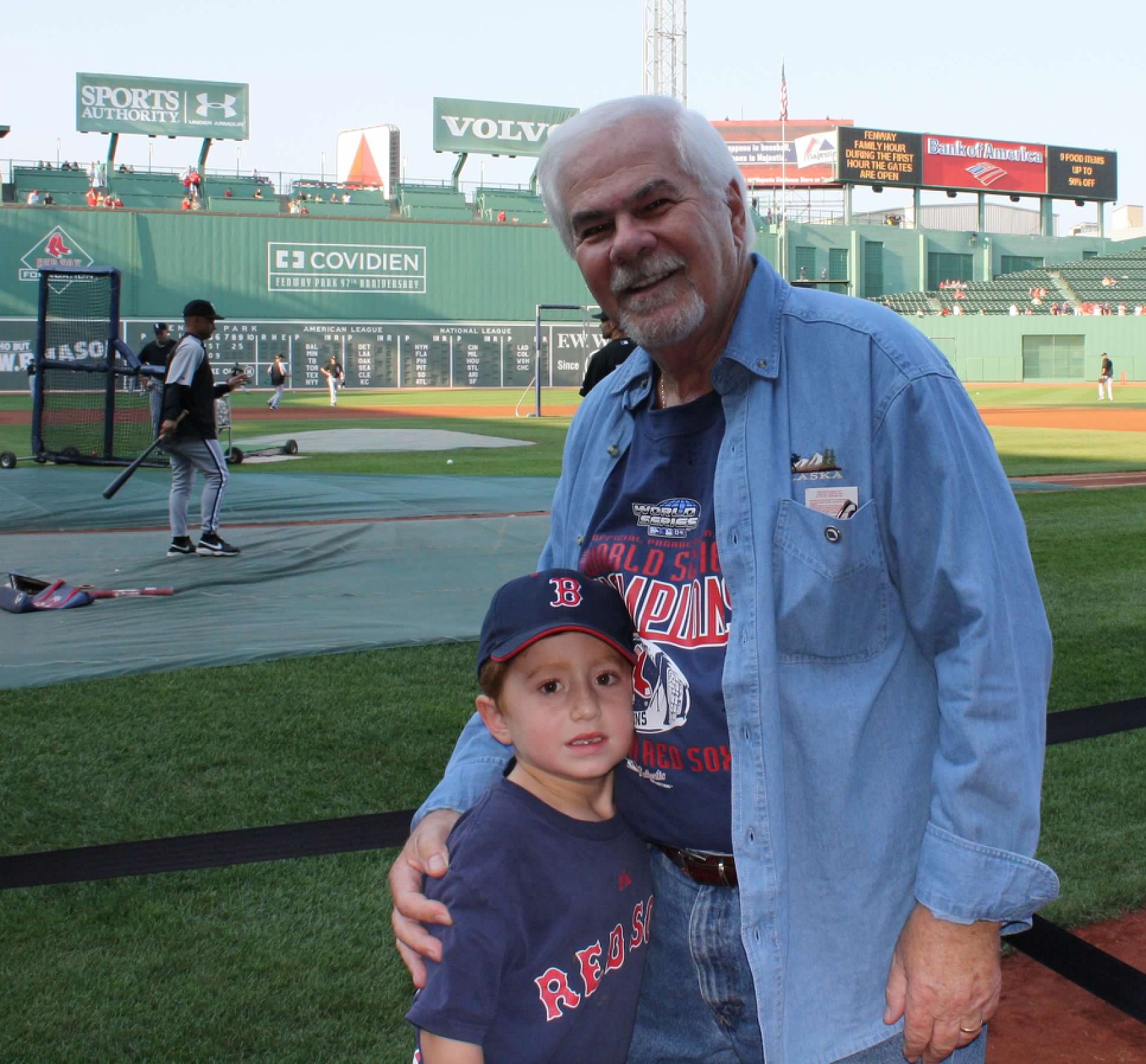
In 2012, said father, my son, and I were lucky enough to be invited on the field at Fenway Park for batting practice. Alas, it was the visiting team’s BP, but a blast nonetheless. As we stood behind the ropes and my son begged for balls, and my father reveled in his surroundings, taking a trip down memory lane to when he was younger than my son, sitting in the cheap seats at “America’s Most Beloved Ballpark,” I found myself mesmerized by the goings-on at shortstop.

If you have ever been at the yard early enough to catch batting practice, you are treated to a coordinated symphony of activity. Hitters, obviously, are hitting. But for a few moments every afternoon, they are Little Leaguers, subject to the clarion call of: “balls up.” Some pitchers dot the outfield and shag flyballs in the merriment of times gone by; while other pitchers use the dwindling light to get in sprints along the warning track. Fringe players and stars alike take a moment to check in with reporters, front office personnel, and the occasional fan. And stationed on either side of the batting cage is a coach hitting fungoes to players at second base and shortstop, respectively. Yes, even the big leaguers have to take infield practice.

On this late afternoon in July, Toronto was in town. This Blue Jays team was somewhat non-descript, hovering around .500 at that point, eventually finishing the season in fourth place, twenty-two games behind the Yankees. Yunel Escobar started 145 games at shortstop for the Jays that year, hitting .253 with a swarthy .644 OPS. But it was not Escobar who caught and held my eye. No, it was – at that time – the 45-year old backup shortstop, with nearly 3,000 games under his belt.

Watching Omar Vizquel during batting practice was, in a word, sublime. I gladly would have forfeited the game, and paid for my ticket just to watch Vizquel field grounders for three hours. He grabbed balls between his legs, he took throws behind his back, he made catches over his shoulder, he stood at short facing left field and still made plays. On a few occasions – and this is not hyperbole – he threw his glove in the air, knocking down line drives headed for the outfield. Try that some time. It was a wonder to watch, so watch I did. When my son wanted to fetch an autograph, I let him roam free. When my father wanted to look around, I did not join him. This was a once-in-a-lifetime (it turns out Omar participated in BP approximately 2,968 times in his career) opportunity to watch genius in action. Sure, it was batting practice and not a live game, but no matter. Sure, there were no stakes so he could be free to try any stunt he wanted, but who cares. It is why, in 2015, the Golden State Warriors opened the arena hours early so fans could watch Stephen Curry get ready to play. The pregame is often more enjoyable than the real thing.

For me, an unapologetic baseball fan, who loves Web Gems more than “chicks dig the long ball,” this was watching Picasso paint, Brando emote, MLK preach, Jordan dunk. This was more than worth the price of admission.

In a few days the 2018 Baseball Hall of Fame class will be unveiled. This is Vizquel’s first year of eligibility. Spoiler alert: he will not be enshrined this year. But the larger question is whether he ever will be? The interwebs are filled with articles citing the pros and cons of his qualifications, and I am truly on the fence. If there was a Hall of Fame for pregame mastery, Omar is a first-ballot inductee. Unfortunately, the BBWAA limits its vote to in-game results.

Unlike my father, I have not proffered an opinion, just an appreciation of the player. You decide!

PLAY BALL!!

Happy Wife: Free Agency is a Family Matter


I have always been intrigued by the athlete’s wife. Before anyone paints me a misogynist, as of this morning, there are no women playing any of the four major sports, and also as of this morning, there are no openly gay players on any of those teams (we can be certain there are some closeted gay players, but I digress), so this discourse is reserved for the wives.

You always hear about players, in the off-season, going to a celebrity golf tournament in Lake Tahoe, or a “boys trip” to Las Vegas, or a booze cruise off South Beach. And every time I wonder: “What do their wives think?” If my job required that I be gone – corporeally and/or mentally – for six months of the year, and then no sooner than I got home I told my wife I was leaving for the weekend with my teammates or buddies, I am pretty sure she would have an abreaction. Suffice it to say, it wouldn’t go over so well.

But such, I guess, is the life of the athlete’s wife. Which leads me to latest curiosity: where are we going to live; where are the kids going to school; where are we spending our spring?

As of this writing, there are at least nine high-priced free agents still awaiting new contracts. I won’t get into the lower-tier players, as for some/most of them, they do not have a Chinese menu of team options. But for the likes of Jake Arrieta, Eric Hosmer, J.D. Martinez, and Yu Darvish, there are options aplenty. And, as some point, they will need to make a decision.

Many of these players, like Jake Arrieta, have wives and kids. The Arrietas have made Chicago their home since 2013. Jake rejected the Cubs’ qualifying offer, so, ostensibly, they will be moving. But where?

The rumor is that Arrieta is looking for a long-term deal valued at somewhere in the neighborhood of $200 million.  The conventional wisdom holds that the deal will be somewhere around $150-$175 million. At some level, the difference between $175 and $200 million may be less important to Jake than a happy wife and a stable life. For reference, Jake has made nearly $32 million in his career, and he will make an additional nine figures whenever and wherever he signs. And while it is easy for me to be blasé about $25 or so million, it is really easy for him to be as well. Any way you shake it, he will make generational, legacy, eff you money. The same is true for J.D. Martinez, Yu Darvish, and the others.

So the question then becomes where do Jake and his family want to spend that money? Where do they want to make a home? Which city has the best schools, the best golf courses, the best night life? Where do their friends live? Their extended families? In a life centered around the husband – his career, his training, his travel, his schedule – it seems to me (again, maybe it is just me) that the “where” question is one the wife gets to answer (or at least have a vociferous voice in deciding).

If Brittany Arietta were my wife, I am pretty sure she would be asking me, on a daily basis, what the hell is happening. Which means I, in turn, would be asking Scott Boras, on a daily basis, what the hell is happening. And I am pretty certain my wife would want more than five weeks’ notice to know if we are heading east or west for the spring, and east or west for the summer and the next five, six, or seven years.

But, again, this draws me back to my fascination with the athlete’s wife. This topic is ripe for – due for – a book, one that I am not qualified to write. My short analysis is that this is what they signed up for. With the trappings come the shortcomings; travel (and moving on short notice) is just part of the package. But what I would give to be a fly on the wall in the Arrieta’s kitchen – I want to know how his other half lives.

78 days until we hear:

PLAY BALL!!


Free Agency Has Begun: The QO Rule

Last year I wrote about the Qualifying Offer (“QO”) rule, and how it affected player mobility. And just when you thought you had a handle on how it worked, the owners and players went ahead and renegotiated the CBA. In the process, they bolloxed up the QO in a way that hardly anyone can comprehend. However, if you enjoy this stuff as much as I do, and have the patience and curiosity to know how it will work for at least the next five years, read on.

A bit of history. Under the old CBA, if a team made a QO to a free agent player (the amount of the QO is predicated on the average of the top 125 salaries from the previous year; for 2017, the amount is $17.4M), that player had seven days to accept and sign a one-year deal; or reject, and become an unrestricted free agent. The term “unrestricted,” however, was a misnomer, because any team acquiring that player had to forfeit its first round draft pick the following season (the only exception being teams with picks 1-10; they had to relinquish a second-rounder); and the offering team was compensated with a so-called “sandwich pick”, which is between the first and second rounds.

One more thing: the QO draft pick penalty was only applicable to players who played the entire season for their prior team (if you were traded mid-season, or joined the team after the amateur draft, an acquiring team did not face the penalty). Got it?

Well, if Occam’s Razor applies in most circumstances, its bizarro brother applies to MLB. Here is the system that will apply until 2021:

For starters, the owners and players split the world into three sets of teams: (1) those over the luxury-tax threshold (i.e., teams whose payroll exceeded $189 million last season, $195 million this coming season, escalating in later years); (2) those from the 15 smallest markets that receive revenue sharing money; and (3) teams that don’t fit into either category. These tiers will be helpful as we move forward.

Here we go: A team offers a player a QO. That player now has ten (not seven) days to accept or reject. If he accepts, all is right with the world, he signs with his current team, and there is no confusion. If he rejects, we must follow the Rube Goldberg contraption put in place to see what happens.

Let’s start with the team losing the free agent (herein, “the Loser”):

If the free agent signs a contract of $50 million or more (regardless of number of years), the Loser gets draft pick compensation. However, the form of compensation is dependent on the Loser’s good or bad deeds.

  • If they are over the luxury-tax threshold, they receive a draft pick at the end of the fourth round.
  • If they are one of the small market teams, they receive a pick at the end of the first round.
  • If they don’t fit into either category, they receive a pick at the end of the second round.

With me so far?

If the free agent signs for less than $50 million, then:

  • If the Loser is over the luxury-tax threshold, they receive a draft pick at the end of the fourth round.
  • If they are below the luxury-tax threshold, they receive a pick at the end of the second round.

Now to the team acquiring the free agent (herein, “the Buyer”):

  • If the Buyer is over the luxury-tax threshold, they lose their second and fifth highest draft picks, plus $1 million in international pool money.
  • If they are one of the 15 small market teams, they lose their third highest draft pick, but no international money.
  • If they are none of the above, they lose their second highest draft pick, plus $500,000 in international pool money.

Under the old CBA, if a Buyer already acquired a QO free agent, and thus gave up their first round pick, there wasn’t much pain involved in acquiring a second QO player, as they only had to then forfeit a second-round pick. Not anymore:

  • A Buyer over the luxury-tax threshold acquiring a second QO player now forfeits all of the following: their second, third, fifth, and sixth highest picks, plus $2 million in international bonus pool money.
  • If they are one of the 15 small market teams, they lose their third and fourth highest draft pick, but no international bonus pool money.
  • If neither, they lose their second and third highest draft picks, plus $1 million in international pool money.

One additional wrinkle that the Player’s Union was able to extract from MLB: A player may not receive more than one QO in his (or her) career. This rule change looked to be a boon to José Bautista, who received a QO last season, rejected it, and then signed a 1-year deal with Toronto knowing he couldn’t be offered another QO. He then went out and hit .203, with a -1.7 WAR and a OPS+ of 76. Oh how he wishes he could get a $17.4 million offer this off-season.

Much time and effort went into revising the QO rule in an attempt to free up the free agent market by taking the onus off of Buyers. Time will tell if that goal was achieved, but for this season at least, here is the list of the prominent players potentially affected by the new QO rule: Jake Arrieta, Lorenzo Cain, Zack Cozart, Wade Davis, Greg Holland, Eric Hosmer, Lance Lynn, and Mike Moustakas. It certainly seems like a lot of calories were burned and a lot of ink spilled to solve an issue for these eight players.

But there you have it. Everyone understand? Are the implications perfectly clear? Great!

PLAY BALL!!