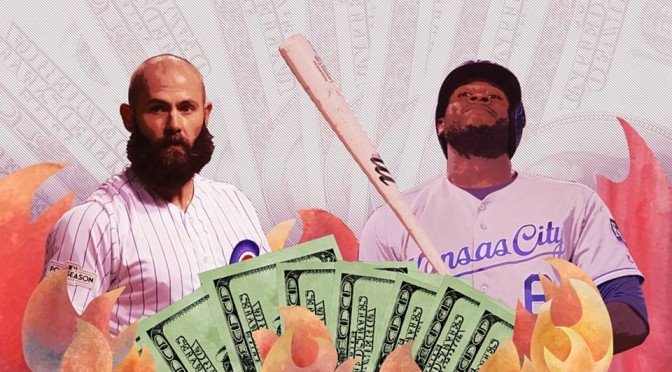
Free Agency Has Begun: The QO Rule

Last year I wrote about the Qualifying Offer (“QO”) rule, and how it affected player mobility. And just when you thought you had a handle on how it worked, the owners and players went ahead and renegotiated the CBA. In the process, they bolloxed up the QO in a way that hardly anyone can comprehend. However, if you enjoy this stuff as much as I do, and have the patience and curiosity to know how it will work for at least the next five years, read on.

A bit of history. Under the old CBA, if a team made a QO to a free agent player (the amount of the QO is predicated on the average of the top 125 salaries from the previous year; for 2017, the amount is $17.4M), that player had seven days to accept and sign a one-year deal; or reject, and become an unrestricted free agent. The term “unrestricted,” however, was a misnomer, because any team acquiring that player had to forfeit its first round draft pick the following season (the only exception being teams with picks 1-10; they had to relinquish a second-rounder); and the offering team was compensated with a so-called “sandwich pick”, which is between the first and second rounds.

One more thing: the QO draft pick penalty was only applicable to players who played the entire season for their prior team (if you were traded mid-season, or joined the team after the amateur draft, an acquiring team did not face the penalty). Got it?

Well, if Occam’s Razor applies in most circumstances, its bizarro brother applies to MLB. Here is the system that will apply until 2021:

For starters, the owners and players split the world into three sets of teams: (1) those over the luxury-tax threshold (i.e., teams whose payroll exceeded $189 million last season, $195 million this coming season, escalating in later years); (2) those from the 15 smallest markets that receive revenue sharing money; and (3) teams that don’t fit into either category. These tiers will be helpful as we move forward.

Here we go: A team offers a player a QO. That player now has ten (not seven) days to accept or reject. If he accepts, all is right with the world, he signs with his current team, and there is no confusion. If he rejects, we must follow the Rube Goldberg contraption put in place to see what happens.

Let’s start with the team losing the free agent (herein, “the Loser”):

If the free agent signs a contract of $50 million or more (regardless of number of years), the Loser gets draft pick compensation. However, the form of compensation is dependent on the Loser’s good or bad deeds.

  • If they are over the luxury-tax threshold, they receive a draft pick at the end of the fourth round.
  • If they are one of the small market teams, they receive a pick at the end of the first round.
  • If they don’t fit into either category, they receive a pick at the end of the second round.

With me so far?

If the free agent signs for less than $50 million, then:

  • If the Loser is over the luxury-tax threshold, they receive a draft pick at the end of the fourth round.
  • If they are below the luxury-tax threshold, they receive a pick at the end of the second round.

Now to the team acquiring the free agent (herein, “the Buyer”):

  • If the Buyer is over the luxury-tax threshold, they lose their second and fifth highest draft picks, plus $1 million in international pool money.
  • If they are one of the 15 small market teams, they lose their third highest draft pick, but no international money.
  • If they are none of the above, they lose their second highest draft pick, plus $500,000 in international pool money.

Under the old CBA, if a Buyer already acquired a QO free agent, and thus gave up their first round pick, there wasn’t much pain involved in acquiring a second QO player, as they only had to then forfeit a second-round pick. Not anymore:

  • A Buyer over the luxury-tax threshold acquiring a second QO player now forfeits all of the following: their second, third, fifth, and sixth highest picks, plus $2 million in international bonus pool money.
  • If they are one of the 15 small market teams, they lose their third and fourth highest draft pick, but no international bonus pool money.
  • If neither, they lose their second and third highest draft picks, plus $1 million in international pool money.

One additional wrinkle that the Player’s Union was able to extract from MLB: A player may not receive more than one QO in his (or her) career. This rule change looked to be a boon to José Bautista, who received a QO last season, rejected it, and then signed a 1-year deal with Toronto knowing he couldn’t be offered another QO. He then went out and hit .203, with a -1.7 WAR and a OPS+ of 76. Oh how he wishes he could get a $17.4 million offer this off-season.

Much time and effort went into revising the QO rule in an attempt to free up the free agent market by taking the onus off of Buyers. Time will tell if that goal was achieved, but for this season at least, here is the list of the prominent players potentially affected by the new QO rule: Jake Arrieta, Lorenzo Cain, Zack Cozart, Wade Davis, Greg Holland, Eric Hosmer, Lance Lynn, and Mike Moustakas. It certainly seems like a lot of calories were burned and a lot of ink spilled to solve an issue for these eight players.

But there you have it. Everyone understand? Are the implications perfectly clear? Great!

PLAY BALL!!
When Safe is Out

I am an attorney.  As such, my bookcases are stocked with legal tomes, filled with confusing text, obscure events, and various and sundry arcana.  After practicing for nearly twenty years, I rarely reach for any of these dusty books, as it is often difficult to discern the meaning of anything written in them.

Among the those littering my office is the Official Baseball Rules.  This softback, covering 240 pages, is also filled with ambiguous regulations, bizarre concepts, and wacky examples.  The amazing thing is, armed with this book, not one of us could stump an MLB umpire.  Wake an umpire in the middle of the night, and he could opine on the specifics of Rule 6.01(g) (Interference With Squeeze Play or Steal of Home) before he rubs the crust out of his eyes.

But umpires are limited by what they find in those 240 pages.  So, from time to time, it is incumbent upon the MLB Rules Committee to enact some new rules to deal with the evolution of the game.  This became painfully obvious late last week.

Blog_Base_1

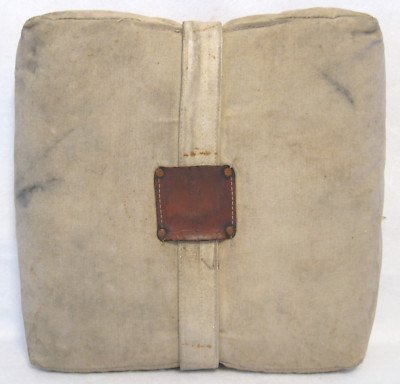
Years ago (before any of us were watching or playing baseball), bases were soft and billowy, filled with sand or sawdust, affixed to the ground via a leather strap attached to a wooden spike.


Today, bases are made of hard rubber and have a metal attachment that connects to a steel tube anchored by concrete in the ground.  Suffice it to say, today’s bases are considerably less hospitable to the players trying to reach them.

In the hundred plus years or so between the advent of baseball and the current incarnation, players – on average – have gotten about 5 inches taller (average height in 2010 was nearly 6’2” vs. 5’9” in the 1870s) and about 23 pounds heavier (190 now vs. 167 then).  Now, I don’t want to get all Sports Science here, and I certainly don’t want to start doing math or coefficients, but I think we can all agree that players today are faster than they were in the 19th century, and because they are taller and heavier, they run with more force than players from the Rutherford B. Hayes-James Garfield-Chester Arthur-Grover Cleveland era.  And yet, today’s ballplayers are required to interact with a base that has considerably less (read: no) give.  This is where many problems arise.

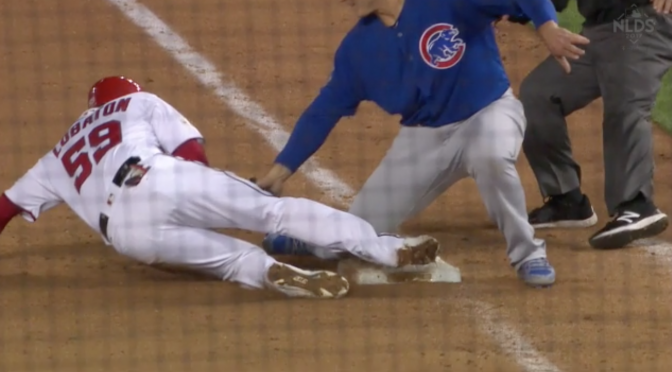
I have written (extensively) about the dangers of sliding head first into bases (as well as home plate), but neither José Lobatón nor the Washington Nationals care about injuries right now.  They are more concerned with basic physics.  And here’s why:

With two outs and the Cubs leading 9-8 in the bottom of the 8th inning of Game 5 of the NLDS, the Nats had one run in and two runners on when Willson Contreras threw a back-pick to Anthony Rizzo at first base, hoping to catch Lobatón napping.  He wasn’t, and got back safely.  Or so we thought.

Upon further review, when all 73 inches and 205 pounds of Lobatón slid feet first and impacted the 15×15 inch rubber square that is essentially bolted to the earth, the result was not flawless.  Lobatón’s right leg hit the bag and then, ever-so-slightly, lost contact with the base.  When bodies of considerable mass make contact with immovable objects, these types of things tend to happen.  Rizzo adroitly held his tag, and the replay guys in New York were able to find a fraction of an inch of daylight between the foot and the base.  Rally over…inning  over…season essentially over.

This is not an issue of fair vs. not fair.  Those are the rules, have been since time immemorial, and Lobatón was correctly called out.  But when something like this happens, in a game of this magnitude, it just means we need to change the rules.  As players get bigger and bigger and faster and faster (either naturally or otherwise), we need to make sure that the game is in a position to make accommodations, and we need to allow for umpires to make reasonable calls in relation thereto.

Because disconnecting with the bag for a fraction of a second and being called out certainly is not in the spirit of the game, Dave Cameron of Fangraphs came up with a solution last year that he reposted again after Thursday night’s debacle in Washington.  In short, he wants a vertical “safe space” above the bag to account for these types of plays.  It is an interesting concept, and I encourage you to give it a read.

I would augment, supplement, or replace Dave’s idea with the following (taking out the concept of verticality or any other plane):

If a base runner, sliding either head first or feet first, reaches the base prior to the application of the fielder’s tag, and the base runner loses contact with the base, in the umpire’s judgment, for reasons other than his own volition (i.e., only due to the impact of his body to the base), and in the umpire’s judgment the base runner had no intent to advance to the next base, provided the loss of contact is for a de minimis period of time, the base runner shall be ruled safe.  The foregoing shall not be applicable to instances wherein the base runner slides past the base in question, regardless of the period of time he loses contact with the base.  In such event, provided the tag is applied when the base runner is off the base, he shall be called out.

My version of the rule incorporates Dave’s vertical concept but allows for a player to go off to the side as well.  I can imagine, without the benefit of a direct overhead camera, replay officials debating whether or not the impact caused the runner to bounce to the side of the base, in which event Dave would have him called out, or remained atop the base, resulting in ultimate safety.  I guess I am just more liberal with my body movement allowance.

Take Dave’s idea, take my idea, or come up with another.  But, sometime before the first pitch is thrown for the 2018 season, the MLB Rules Committee needs to fix this glaring omission, and get us back to what the rules intended, not what 4K Ultra HD digital technology discovered.

PLAY BALL!!

Net Over Yourself

On Wednesday afternoon, Aaron Judge hit his 45th homer, which was followed by Gary Sanchez’s 32nd.  The Yankees cruised to a 11-3 win over the Twins, completing a three-game sweep and keeping the pressure on the division-leading Red Sox.

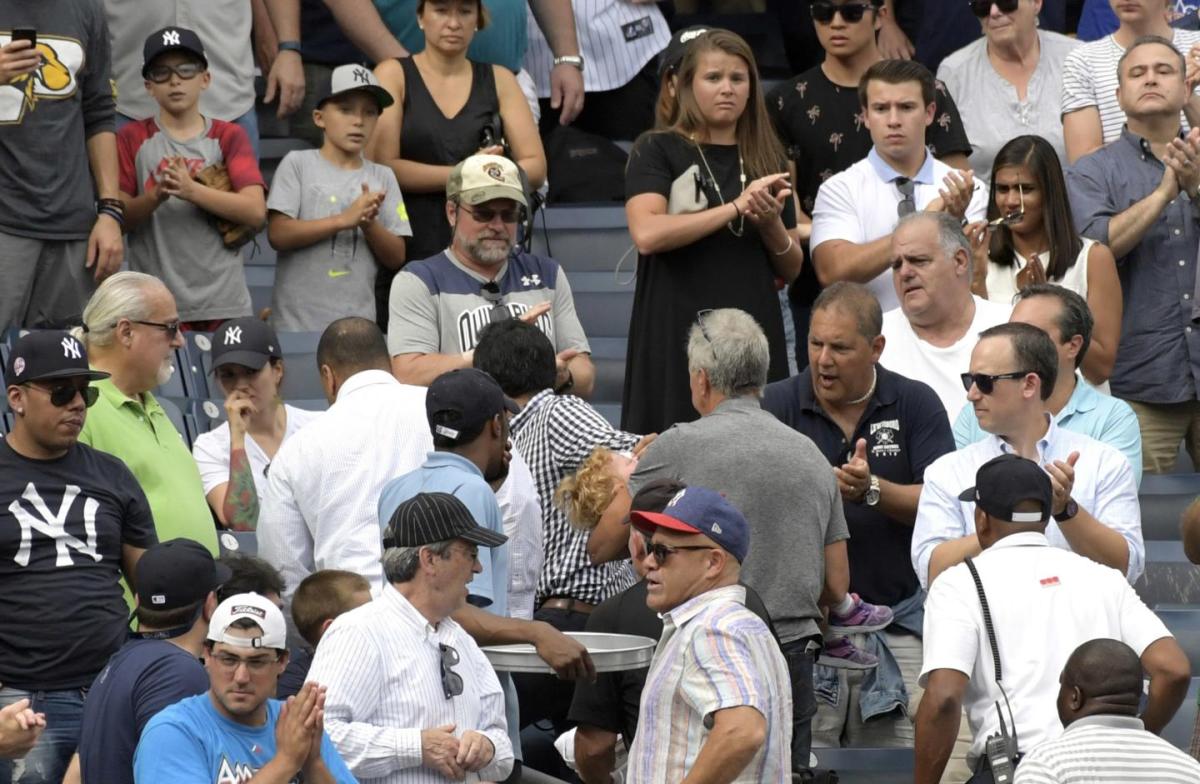
But the Yankees’ win was overshadowed by what happened in the seats behind the third base dugout in the fifth inning.  As I am sure many of you have seen by now, Todd Frazier rocketed a foul ball into the stands at 105 miles per hour.  The ball struck a young girl sitting with her grandparents.  Bloody and bowed, she was carried to the first aid station, and then transported to New York Presbyterian-Columbia Hospital.

Blog_Netting_2

As of this writing, per her father, the girl is “doing all right”, but he could not (or would not) confirm whether or not she would need surgery for her injuries.

After impact, the game came to a halt.  Frazier, a father of two children under the age of the three kneeled in the batter’s box, shaken and concerned.  Twins’ second baseman Brian Dozier actually cried when he saw her hit by the screaming liner.  The game did not resume until the little girl was taken from her seat; she, the fans around her, and the players on the field, all the worse for the wear.

This horrific incident has, once again, brought the issue of protective netting back to the forefront.  And this one is an absolute no-brainer.  In fact, since just Wednesday afternoon, the Reds, Padres, and Mariners have all committed to extending their netting for the 2018 season.

Now, for those of you who have not followed this closely, here is a little primer: There are about 1,750 incidents of fans being hit by foul balls at Major League stadiums each season.  Put differently, in a typical season, every time Mike Trout gets a base hit, about 10 fans get nailed by a foul ball.

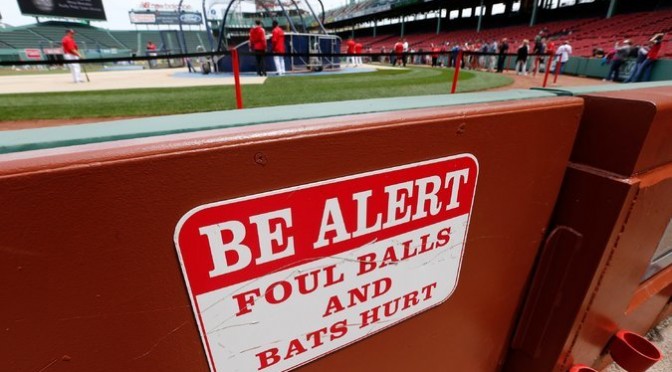
After the 2015 season, Commissioner Rob Manfred “encouraged” teams to extend their netting to the “near end of both dugouts”.  Let’s unpack that a bit.  Through the 2015 season, many teams only had netting directly behind home plate; and despite the rash of injuries from foul balls and flying bats, the best MLB could muster was a gentle prod that the netting be extended to the near end of the dugout?!?  In fairness, MLB did offer some guidance about extending it even farther.  Nothing was required.  In fact, the Commissioner was clear that he wanted this to be a “localized process”, with each team working with its own fan base to determine the best course of action for safety and enjoyment of the game.  What a bunch of hooey.

The truth of the matter is that baseball – and all of its teams – have been hiding behind the protective netting of a legal theory known as “assumption of risk”, and colloquially known as the “Baseball Rule”.  In short, fans come to the game knowing it is dangerous, and thus assume the risk that they may be hurt.  And for years, courts have upheld this doctrine.  But the times, they may be a changin’.

A few years ago an appeals court in Ohio reversed a lower-court ruling in favor of the Cleveland Indians in a fan injury case.  In Idaho, the state Supreme Court elected not to impose the Baseball Rule and allowed a fan at a minor league game (who lost an eye) to present his case to the jury.  A fan who was badly injured at – get this, Yankee Stadium – is currently in litigation with the team and the league regarding the fine print on the back of the ticket and this outdated legal theory.

Michael Moran, an Atlanta lawyer who has litigated these types of cases, previously stated: “The game is different now. Ballparks are configured differently than they were 20 or 30 years ago; the foul lines are closer to the stands. Pitchers throw harder. Batters hit the ball harder. All these things increase the risk.”

Are we to believe that even the most adroit fan can (and should) react to a ball that is on top of them in less than a second? If that were so, why would teams put netting in front of the dugouts?  Shouldn’t the best athletes in the park – individuals who are paid to pay attention and who don’t have the myriad diversions and distractions that are intended and encouraged for the fans – be prepared to avoid a foul ball or a hurtling bat?

The most common refrain from the teams is that fans don’t want to sit behind the netting.  Really?  The next time you watch a game and they show the centerfield camera angle, please pay attention to the dearth of fans sitting behind home plate (where there is netting in every park), and the masses sitting behind each dugout?  What, you say?  The seats behind home plate (except, ironically, at Yankee Stadium) are full; and fans have paid upwards of $1,000/ticket to sit there?  Now I am thoroughly confused.

I will acknowledge that fans find the netting a distraction…at first.  But then they get used to it.  I speak from experience, as I sit behind home plate, behind a net, and now barely notice it.  Don’t believe me?  Where do baseball executives and scouts sit?  People who are literally paid to watch and analyze the game do so behind the net; but Joe Six-Pack cannot enjoy watching Aroldis Chapman pitch through 3/16 of an inch of braided nylon?

Hockey harbored this same fear about their fans.  And then a 13-year old girl was killed by an errant hockey puck in 2002.  You know what they did?  They added netting around the goals.  And you know happened?  Nothing.  Attendance was, and remains, virtually unchanged on a year-to-year basis.

There is a reason why they stop selling beer after the seventh inning.  There is a reason why bottles aren’t allowed in the park.  There is a reason why mini bats are no longer given away.  Fan safety has trumped the fan experience for years – except in this one area.  And is there is simply no (reasonable/rational) excuse.

So here is what should happen.  After the 2015 season, the Commissioner asked the teams to do their own research.  Ostensibly, the Yankees did this.  And, ostensibly, they made a business decision that, by installing/expanding their netting, they would lose X dollars from fans who no longer wanted to sit between the dugouts.  That little girl’s family needs to sue the Yankees; and through discovery, obtain that analysis and determine the value of X.  And then a court should award damages equal to three times X.  The Yankees should lose all that they hoped to avoid losing, three times over.

The little girl should get the first X.  She is the Neil Armstrong, the Rosa Parks, the Jackie Robinson of ballpark safety.  She earned X with the damage to her tiny nose and her little eye.

The next X should go to a fund for all fans injured at the new Yankee Stadium since it opened in 2009.  By that time, everyone – including the Yankees’ brass – knew that seats closer to the field + insufficient netting = unnecessary and potential serious risk.

The final X should go to building and refurbishing baseball fields all over New York.  Show the kids of the Empire State that baseball cares about them, their safety, and their fandom.

And one last thing: the Commissioner must issue an edict – not a suggestion, not a recommendation, not guidance – but an actual rule.  Every team must install protective netting to at least the far end of each dugout prior to the commencement of the 2018 season.  Each team that fails to do so is fined $1 million per game until the same is properly installed.

We have big, complicated, unwieldy problems in this country.  Fans having to worry about their life being altered/in jeopardy in less than the blink of an eye while trying to enjoy America’s favorite pastime shouldn’t be one of them.

Enough is enough.

PLAY BALL!!

BLOOM BACK ON THE ROSE?


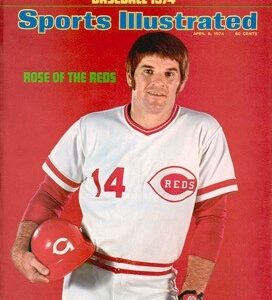
Last Monday, Peter Edward Rose made a formal request to be reinstated by Major League Baseball and asked that his lifetime ban be lifted. Newly-minted Commissioner Rob Manfred responded by stating he would consider the request “on its merits”. Spoken like a true attorney.

To be or not to be.

He loves me, he loves me not . . .

Will he or won’t he.

What’s with taking the oath of Commissionership that requires a bombshell be thrown in your lap within the first few months? Adam Silver had V. Stiviano and now Rob Manfred has Pete Rose.

So what to do with Pete Rose? If Manfred pulled out a legal pad, drew a line down the middle, and starting listing pros and cons, he might have to cut down a few yellow trees before he came to a conclusion. The simple question is: Has Pete Rose paid enough of a penalty? He has been banished from baseball – his one true love (replaced in recent years by money) – for over 25 years. Does that punishment fit the crime?

Apropos of nothing, as of 2013, 30% of murderers convicted and sent away on life sentences are let out of jail in less than 10 years, with an overall average of 16 years of incarceration. Now, I am not comparing Pete Rose’s betting on baseball to murder – not at all – I am just trying to show, for hyperbolic effect, how long a 25-year (and counting) sentence actually is.

It can be readily acknowledged that Pete Rose did something that we, as a society and as fans of baseball, feel is inherently wrong. We can also agree that in the years leading up to and following his banishment, Rose did not acquit himself very well. Time and again, when the powers-that-be were looking for contrition, they got stubbornness. When they were looking for remorse, they got obstinacy. He held his ground for nearly 15 years. Who knew you could hold your breath for that long?!?

It was not until 2004 when Pete finally admitted what everyone knew all along. Unfortunately, the timing of his (ahem) confession was marred on two fronts:

(1)  It was done not in the service of baseball, but in the service of making a buck. Pete made his confession three days before his autobiography “My Prison Without Bars” was released. People could not help but think this was less about seeking forgiveness than about seeking book sales.

(2)  It was done on the eve of the announcement of the 2004 Hall of Fame class. Knowing that he most likely would never be enshrined in Cooperstown, Pete took the occasion to piss on the Hall’s doorstep.

Stay classy, San Diego.

But, for the past decade, Pete has been a relatively model citizen. He has not ruffled too many feathers (other than setting up card tables for autographs on Hall of Fame weekend), and has basically kept as low a profile as one could ever hope/expect from the Pete Rose.

Here is the real: Baseball is better when Pete Rose is involved. You cannot deny what he brought to the diamond for nearly 25 years.  The hustle, the heart, the hits (both the Harrelson and base varieties).

(3:16 mark)

The fact of the matter is that Pete Rose played in more games, had more at bats, and got more hits, than any player in MLB history. Chew on that for a moment. He is an icon in Cincinnati, and he is a legend of the game. He has paid his penance. He should be allowed back in . . . with conditions.

Many people considerably smarter and more knowledgeable than I have written extensively on this topic, but I think I agree with the following premise: Pete Rose should be allowed back into the game on a limited basis. He should be allowed to come to the park, participate in team activities, and be honored at major events (e.g., the All-Star Game this summer in Cincinnati). He should not be allowed to be an executive or an on-field coach. He should not be allowed to be in a position to affect the outcome of any game. That seems easy enough, and Manfred could tailor this reinstatement in a way that preserves Bart Giamatti’s original intentions, without looking like he is reversing his predecessor’s course.

Little Known Fact #1 (that would be more widely known if you read Jayson Stark’s columns or his book “Wild Pitches”): In 2003, former teammates Mike Schmidt and Joe Morgan arranged a meeting between themselves, Bud Selig, and Pete, for Pete to fall on his sword, acknowledge his mistakes, apologize, and then, ostensibly, be reinstated. For reasons that a whole school of psychologists could spend semesters debating, Pete could not bring himself to the table. No meeting, no apology, no reinstatement. And here we sit today.

Okay, so let’s assume Manfred is inclined to let Rose back in. That always leads to the $64,000/bronze-plated question: Should Pete Rose be in the Hall of Fame? Sure, of course, without question, maybe. The answer is multi-layered, but before we go to the merits, we need to know who will be hearing the evidence.

Little Known Fact #2 (that would be more widely known only if you are a total and complete baseball nerd and/or live in upstate New York and/or write a blog that maybe a few people read): While the Baseball Writers Association of America is the organization we customarily associate with Hall of Fame voting, they will not play any part in the Pete Rose discussion because he has been retired for too many years (this form of eligibility expires 15 years after retirement). Thus, his election (or lack thereof) will be determined by one of the Veteran Committees. There are three (Pre-Integration Era (1876-1946), Golden Era (1947-1972), and Expansion Era (1973-Present). Pete overlaps the last two, but would most likely fall under the Expansion Era Committee.

This Committee is comprised of 16 people, including prior HOF inductees, executives, and veteran media members. And, if you are looking for a quick resolution, don’t. The Committee doesn’t meet again until the Fall of 2016 for potential induction in 2017. Manfred has some time to cool his heels and ponder reinstatement.

To quote Vin Scully, “it goes without saying, but I’ll say it anyway”. Pete Rose’s on-field achievements are Hall of Fame worthy. It truly comes down to his integrity. Do we believe he should be excluded from the Hall of Fame because his lack of integrity (at least with respect to betting on baseball) potentially affected the integrity of the game?

Little Known Fact #3 (and by little known, I mean widely known): The Hall of Fame is filled with people who lacked integrity, who were scofflaws, liars, cheaters, racists, and drug addicts, guys who through actions and deeds potentially affected the integrity of the game. It must be really hard to get a good view of all that when standing on top of Mount Pious. But I digress.

Little Know Fact #4: Pete Rose retired in 1986, and (but for being banned from baseball in 1989) would have been eligible to be on the Hall of Fame ballot in 1992. Shockingly, in 1991 the Hall ruled that players on the permanently ineligible list could not be voted in. Coincidence? I think not.

Here is where I land on the issue: The Hall of Fame is a baseball museum. It is not intended to be a home for the better angels of the game, but rather a collection of the game’s history. It should include the whole story, warts and all. (And, by the way, many pieces of Pete’s equipment already reside in the Hall’s permanent collection.)

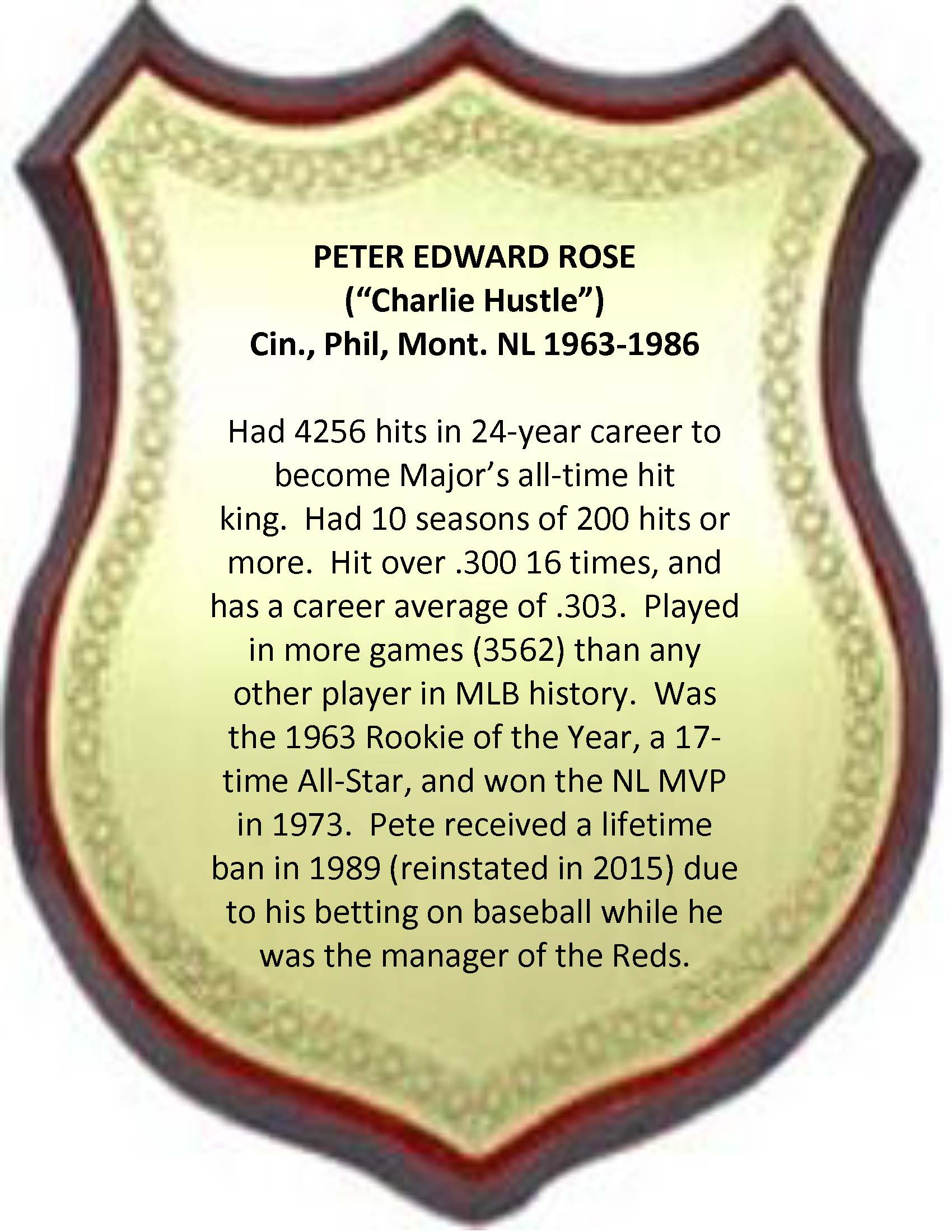
My solution is easy: Let him in, and put it all on the plaque. Pete’s plaque could look like this:

Pete Rose Plaque 3

That is what I would do. And, while we are on the topic, I would do the same thing for everyone who is Hall of Fame worthy but has been suspected of PED use. Put them in the Hall of Fame, tell the story, allow us to bring our kids to the museum so we can share our and their stories with the next generation – the good, the bad, and the suspected. I believe that is what Cooperstown was originally intended to represent.

Because, whether the baseball purists like it or not, try as they might, we simply cannot just ignore history.

Opening Day is just 2 weeks from Sunday.

PLAY BALL!