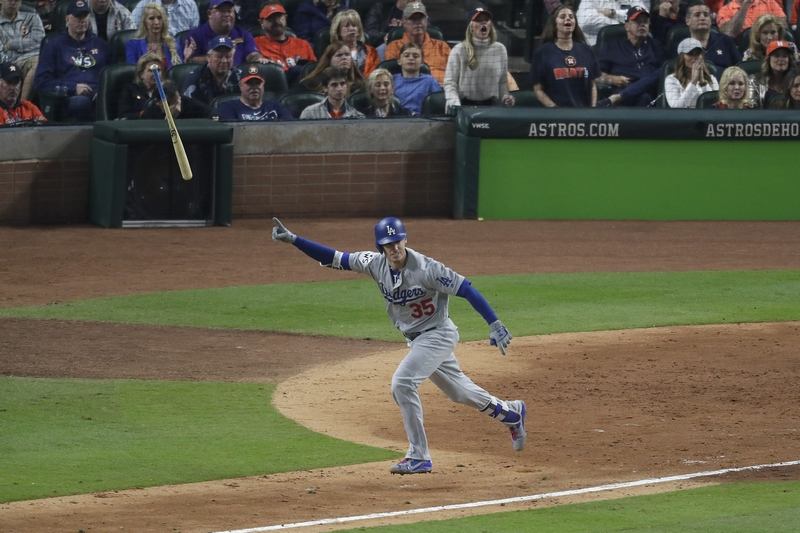
The Call

There was a blood red moon – fitting he thought – which brightened the sky and symbolized this glorious moment. The road ahead – as far as the eye could see – was straight and dark. The hum of the tires could not drown out the cacophony in his head.

Just a little while ago, he sat sweaty and exhausted, dirt and disappointment strewn across his face, as he wrapped ice around his weary knees. The first pitch was a few minutes away, and he was finishing his pre-game routine. It was this same routine he had been performing since high school, always with one goal in mind.

From high school he took his talents to college, where he was a student-athlete in name only. While other kids drank beer and focused on their MFAs and MBAs, he drank beer and focused on MLB. Every day on campus was one day closer to “The Show.”

College begot the Minors. Long bus rides on empty highways, not so different from tonight. Twenty-four players cramped on a charter, hoping that the next stop would be the last stop before fame and riches. He made those trips for years, each spring telling himself that this was the year – either he made it or he quit. This was his fourth year making that declaration.

Those hard days that he thought would never end became the soundtrack to his life – the only life he had ever imagined, the only life he ever knew. But what if it didn’t happen? The odds were against him – only a select few ever get to be Major League baseball players, and time and circumstance were telling him that maybe he would not be one of the few.

But this season started well; he was hitting the ball to all fields, and with authority. Flyballs that had died on the warning track in years past began to find their way over the wall. Liners that magically found fielders’ gloves were now making it to the outfield, untouched. And people were noticing.

There was a different vibe around the batting cage before the game; coaches were keeping a more watchful eye and offering encouragement where they used to offer derision. Such was the way of the Minors – you needed to have thick skin and unrelenting confidence, or the pressure, the failure, would destroy you.

Last night he hit two homers, drove in five, and made a diving play in left field. He was clicking on all cylinders. When he got back to his raggedy one-bedroom apartment, the one with the torn couch, makeshift kitchen table, dish-filled sink, and 65-inch plasma on the wall, he flipped on SportsCenter. There, staring him in the face, was John Anderson, quipping that his one roadblock had been removed. On an otherwise innocuous night in the Midwest, the Cardinals’ starting left fielder had gone down with a pulled hamstring; a trip to the DL looked certain. The door appeared to open.

He said his first prayer in months that night. He rarely prayed, believing that G-d had more important things to worry about than professional baseball. But he figured, “what the hell.” He never would have prayed for an injury or for anything bad to befall a fellow player – he had too much respect for the game for that. But the die had been cast, and he had earned his shot. Now he needed to literally pray that the powers-that-be up north felt the same way. Excited and yet exhausted, he turned off the TV and went to bed.

He awoke with his phone on this chest – no calls from the 314 area code. “Don’t sweat it,” he thought, “it’s still early.” He made breakfast, and went through his morning routine. Around 2pm – still without a call or a text or a “breaking news” alert from the MLB app – he headed to the ballpark. He checked in with his manager, who did not betray anything out of the ordinary; so he changed into workout gear and hit the weight room.

He bench-pressed 250, then 260, and then 275, anything to work out the anxiety. When that wouldn’t do, he hit the field and began running poles. Back and forth he went. Try as he might, he could not rid himself of the feeling that it just wasn’t go to happen.

Back in the clubhouse, drenched in sweat and spent, more mentally than physically, he made himself a PB&J and plopped himself on the couch in front of the television. As per usual, it was tuned to the MLB Network, and they were going over the day’s action. At a certain point, the announcer listed the current transactions – trades, injuries, players sent to and from the Minors. His nemesis was listed on the injury screen; confirming what he learned last night, the Cardinals clean-up hitter was out six-to-eight weeks with a Grade 3 hamstring pull, and the pundits were sure it would be much longer.

He slowly chewed his sandwich, and slowly chewed his thoughts. If it didn’t happen now, it was never going to happen. Maybe this was the sign; maybe this was the end.

He told himself he could live without getting the call, but not if they called up that rube from Double-A over him. That, he could not bear.

The sandwich finished, and his confidence nearly the same, he decided to cool off. He trudged off to the showers he had secretly hoped to never use again, and grabbed one of the stiff towels he had secretly hoped to never touch again. As he let the warm water splash through his hair, over his taut and tense muscles, and down his back, a montage of memories spun through his head.

There was draft night, 2014, when Greg Amsinger announced that the St. Louis Cardinals, with their second pick, selected Bryce Johnson out of the University of Georgia. And that first night in Rookie Ball, when he went 0-5 with four Ks, and went back to his hotel thinking this whole thing was a mistake. There was the night in Peoria when he hit three dingers and thought maybe, just maybe, he belonged. There was the unexpected call to Memphis, when he made the unprecedented leap to Triple-A, and then the call from Springfield, when he was sent back down. He remembered the smell of the grass on the backfields of Roger Dean Stadium last February, his first Big League Spring Training; and the sting of showing up early one morning to see his name on the list of players transferred to Minor League camp. And then he thought about last night, when it seemed like all signs were pointing north, and how it now seemed that the rug was being pulled out from under him and his dreams.

He finished his shower feeling no better. He stopped by the training room and grabbed two bags of ice – the knees needed to be ready, even if the mind wasn’t able. Walking back to his locker, Skip called him into his office. “What now?” he wondered. “Johnson,” Skip bellowed with his stentorian voice, and he was immediately a five year old looking into his father’s disappointed eyes. Skip continued: “This is the best part of my job. Forget the money, the championships, the stale bread in the kitchen. There is nothing better than when I tell a deserving ballplayer he is now a Big Leaguer.”

“Wait…What!?” Johnson asked. Before Skip could repeat the words, tears were streaming where defeat had been just a few moments prior.

“You’ve earned it,” Skip said, “and the guys in St. Louis noticed. They want you there ASAP. Now the bad news,” Skip said, “there are no flights tonight, so if you want to make it the Major Leagues, you need to drive there yourself.”

At that moment, he would have swam to St. Louis; driving was nothing. “Now pack your bags and get out of here,” Skip said. “I don’t want to see your ugly face in this clubhouse ever again.”

He sprinted out of the office, grabbed the nearest bag, threw in his gloves, spikes, a handful of batting gloves, and left the rest for the next guy. He assumed that the clubby in St. Louis would give him whatever else he needed.

He floated to the parking lot and jumped in his truck. As he left the ballpark and headed for his apartment, he gave himself exactly ten minutes to pack. A toothbrush, a change of underwear, and he would deal with the rest of the shit later. He had somewhere important to be.

Not twenty minutes later, he was heading north on I-55, on his way to “The Show.”

There was a blood red moon – fitting he thought – which brightened the sky and exemplified this glorious moment. The road ahead – as far as the eye could see – was straight and dark. The hum of the tires could not drown out the cacophony in his head. Nearly twenty years of baseball, from playing catch with his dad, to backyard Wiffle ball with his brother, to conference championships in the SEC, to four cutthroat seasons in the bushes. As the wind blew through the open window he thought to himself, “This is what it feels like to be one of 750, a Major League baseball player.”

In a few short hours, he would arrive at the gates of that famous ballpark, and pull into the player’s lot where his heroes park their cars, and enter the clubhouse as a member of the St. Louis Cardinals. Busch Stadium was his field of dreams; and after all those years, and all that work, after all the fears and all those doubts, he realized: some dreams do come true.

PLAY BALL!!

It’s Better to Be Lucky Than Good (or Smart)

The Dodgers and the Astros are two of the most analytically-driven organizations operating in baseball today. Andrew Friedman has a background in finance, and ran the low-budget Rays for years on a diet of limited dollars and copious spreadsheets. Jeff Luhnow came to the Astros (from the Cardinals) in 2011, armed with degrees in Economics and Engineering, and revamped the Astros’ front-office, installing a lose-to-win strategy (read: “tanking”), which paid off handsomely Wednesday night.

We, as fans, are not privy to the scores of data that are provided to the manager, coaches, and players before each series, ahead of each game, during each inning. So we are often left scratching our heads at decisions that look, to us, irrational. But to the managers, coaches, and players, they are all part of a master plan. We may not love this form of baseball; we may prefer decision-making from the good ol’ gut or based on something imperceptible to us, but glaring to someone who has spent a lifetime sitting on the top step of a dugout. Welcome to baseball in 2017.

For executives like Friedman and Luhnow, it is about having the world’s best inputs, the most rigorous analysis, and then trusting the #process to produce the most advantageous results. These types of leaders strive for outcomes derived from a thoughtful plan, which is predicated on the aforementioned input and analysis. Outliers are unimportant; what matters most are the aggregate fruit plucked from a well-planted decision tree.

However, even with all of the statistical back-up, the iPad on the bench, and laminated cards in the players’ back pockets, we witnessed a handful of, um, strategies, during the World Series that defy explanation. These were decisions that did not seem to flow from a thoughtful process or with a strong statistical advantage. After a thrilling World Series, seven games filled with tension, lead changes, and many, many homeruns, we won’t talk about these moments as they somehow ended in the team’s favor. Yet if these decisions had produced a different result, we may be discussing them for years to come. I guess sometimes it is better to be lucky than good (or smart).

Because Buster Olney, Joe Sheehan, Tom Verducci, Bob Nightengale, and Jerry Crasnick don’t have time to write about these; and before Jayson Stark finds the novelty in each one; and before Ben Lindbergh and Michael Baumann and Jeff Sullivan break them down to their most granular level; and before Joe Posnanski writes something pithy about them, allow me to address some of the 2017 World Series’s most head-scratching moments:

GAME 5

7th Inning: With the score tied at seven , Justin Turner led off with a double. Kiké Hernández hit only .159 against right-handed pitching this season, so asking him to bunt may have seemed like the correct call. But for a guy with nearly 1,000 career at bats, Hernández has a total of 2 sacrifice bunts. And it showed. Kiké bunted right to Brad Peacock who wheeled and threw out Turner at third. One out, runner on first. When Cody Bellinger tripled three pitches later, Hernández scored, and Kiké’s bunt and Turner’s out did not matter. But all of that begs the larger question: In a slugfest wherein 14 runs had been scored in the first six innings, did Dave Roberts honestly believe that one run over the next three would win the game?

9th Inning: This one doesn’t fall on the manager, per sé, but coaching may have played a role. After Yasiel Puig’s one-out, one-handed two-run homer in the 9th inning to cut the Astros’ lead to 12-11, Austin Barnes stretched a long single into a way-too-close-for-comfort double. Being aggressive is great, being reckless is not. A slightly better throw leaves the Dodgers with the bases empty, chasing a run, down to their last out. Chris Taylor singled home Barnes, tying the game, and now Barnes looks daring, not careless.

GAME 6

5th Inning: Rich Hill threw four innings in Game 2. After the epic Game 5 in which the Dodgers used seven pitchers throwing a total of 195 pitches, the conventional wisdom held that Hill needed to go deep into Game 6. Dave Roberts eschewed convention and scoffed at wisdom. After getting himself into a second and third no-out jam, Hill struck out Josh Reddick and Justin Verlander. That turned the lineup over with two outs. Roberts elected to intentionally walk George Springer to face Alex Bregman. I guess this was a lesser-of-two-evils dilemma with first base open: at that point, Springer was 8-23 with four homers and two doubles; Bregman was 7-24 with two homers, a double, and a walk-off hit the game before. Heads you win, tails I lose. With Springer now on first and the bases now loaded, Roberts pulled Hill after 58 pitches (45 strikes). So much for going deep. And he replaced Hill with the gassed Brandon Morrow. The same Brandon Morrow who gave up four runs over six pitches in his last outing. What did Morrow do? He induced Bregman to ground out to end the inning. Great result, but I’m not too sure about the process.

6th Inning: With the Dodgers trailing 1-0 and the pitcher due to bat second in the bottom half of the inning, Roberts elected to make a double-switch in the top half. Going by the book, Roberts removed the player who had made the last out. In doing so, he replaced Logan Forsythe, who was hitting .313 in the series, with Chase Utley, who was 0 for his last 29. Huh? Of course, no harm was done as Utley got hit by a 2-2 breaking ball and eventually scored on Corey Seager’s sac fly. (Side note: Can someone please explain to me how Seager’s flyball didn’t land ten rows into the Pavilion?)

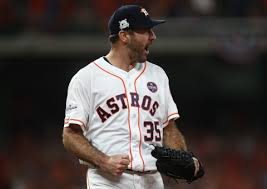
7th Inning: The sixth inning ended with the Dodgers leading 2-1. Verlander was due to bat second. He had thrown 93 pitches, so he probably had another 35 in him. Upon leaving the field, Hinch told Verlander he was done for the night. Justin donned his jacket and got a drink of water. My question is why not wait to see what the leadoff hitter does? If Reddick gets on base, Verlander could (attempt to) bunt him over; and if Reddick fails, then you simply pinch hit for Verlander. But at least give yourself the option. Of course Reddick walked, and instead of having Verlander bunt him to second (or, at worst, strike out with Reddick stuck at first), Evan Gattis pinch-hit and rolled into a force out. After a Springer single, Hinch was forced to use Derek Fisher as a pinch-runner. Kenta Maeda then retired Bregman and Jose Altuve; and now the Astros had one less pinch-hitter and one less pinch-runner available. Oh, and they now had to go to the leaky bullpen instead of getting a little more out their horse while trying to keep the game in check. Joc Pederson hit a homerun off Joe Musgrove in the bottom of the 7th, so that didn’t work out so well. But the Astros won the World Series, and Verlander was available (?) out of the pen in Game 7, so I guess all’s well that ends well.

8th Inning: Two on, two out in the bottom half, Dodgers lead 3-1 with a chance to break it open. A.J. Hinch replaced Luke Gregerson with Francisco Liriano to face Cody Bellinger. At that moment, Liriano had not pitched in nearly two weeks – his last appearance was in Game 5 of the ALCS. In Liriano’s career, he has fared just slightly better against lefties than righties, and in Bellinger’s rookie season, he has a higher batting average against lefties than righties. So, yes, this was an odd decision. And, of course, Liriano struck out Bellinger (his fourth K of the game; his sixth in his last ten plate appearances; and in the midst of what would be nine out of fourteen to end the World Series).

8th Inning: Dave Roberts went to the Kenley Jansen well early in Game 6. Sure, this was a must-win. Sure, Jansen had been the best closer in baseball the past few seasons. But Jansen had also thrown in four of the last five games, he had thrown 90 pitches in the World Series, he already had one loss and one blown save, and given up a garbage-time homerun. So Roberts asked Jansen to record six outs, and then be ready to do the same in Game 7. Had the Dodgers been protecting a one-run lead, an argument could be made for this move. But shouldn’t a 104-win team with bullpen strength at least try to get an out or two out of Cingrani, Fields, McCarthy, and/or Stripling? Jansen went on to get six outs using 19 pitches (18 strikes), forcing a Game 7, and made Roberts look like a genius.

GAME 7

7th Inning: Speaking of misusing Jansen, what is the thinking behind having him take the mound so early in Game 7, while trailing 5-0? I get that you want to keep the Astros at bay, but Alex Wood did that in the 8th and 9th, and ostensibly could have done so an inning earlier. Assume – for the sake of making the game more exciting – that the Dodgers mounted a rally and scored four, five, or imagine, six runs in the seventh and eighth innings. Who was Roberts going to use to close the game after burning Morrow and Jansen? This seems like a risk not worth taking in a deciding game. Alas, the Dodgers couldn’t muster any offense and the issue became moot. But what if…?

THE WORLD SERIES

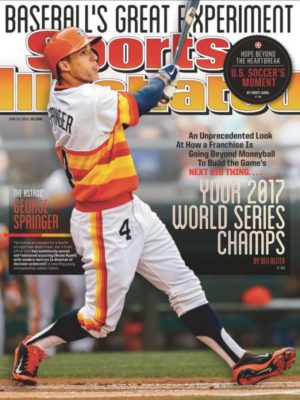
One would think – but I cannot opine with certainty – that big corporations have really smart people using really advanced data to make really difficult decisions every day. And I assume that publishers, in this subscription-troubled, online-centered, fragmented marketplace, are careful about what and how they market their wares. So it seems to me that making a bold prognostication – three years in advance – on the cover of one of your flagship magazines, is not in keeping with a conservative approach to investment returns. And yet, that is exactly what Time Inc. did with Sports Illustrated in June, 2014. Not only did SI get it right, they had the World Series MVP on the cover. Yup, sometimes it is better to be lucky than good.

PLAY BALL!!

Game 5: A Long Day’s Journey Into Morning

At about 11pm Eastern time on Saturday night, as the Dodgers wrapped up Game 4, my wife asked me the following question: “Do you want to go to the game tomorrow night?”

I dismissed the idea out of hand; but she was already fingers-deep into Travelocity, attempting to change flights out of Florida and into Texas. Before I could even ponder the imponderable, she had a plane ticket and a hotel room on hold. Her next question was the big one: “Can you get a ticket?” I explained to her that in today’s world, you can always get a ticket. As the old adage goes, “it’s just a question of price.”

After querying friends and family, I elected to sleep on the time-consuming and expensive decision. I woke up Sunday morning wholly ambivalent; I cannot recall the last time I was so torn. Mark Twain once opined: “Twenty years from now, you will be more disappointed by the things you didn’t do than by the ones you did do.” Twain sat on my shoulder and whispered in my ear. The idea that I might miss something magical (I was thinking a Kershaw no-hitter), and regret it forever, was too much to bear. So, as Mr. Clemens implored, I threw off the bowlines and sailed away from the safe harbor of Palm Beach airport.

When I arrived in Charlotte to switch planes, I learned my 4:50pm flight to Houston (which would have gotten me there in time for the national anthem) was delayed until 7pm.

Crestfallen. That is the only word I can use. Despondent, crushed, hopeless? Those work as well. I was trapped in North Carolina with a stupidly-priced ticket burning a hole in my pocket, and no way to get deep in the heart of Texas. 7pm became 7:15pm, which became 7:25pm, which became an 8pm take-off. Doing the math – which I had been doing for three hours – I knew I would arrive at the park, at best, in the 6th inning, but if Kershaw and Keuchel duplicated Game 1, I would get there in time to help clean the stands.

I considered bagging the whole plan and grabbing the next flight to L.A., but I had come this far (and didn’t want to spend more money changing another flight). Like it or not, this was my journey; destiny my guide.

The 2 hour and 37 minute flight to Houston came in 11 minutes early – minor miracle. Channeling my inner Ezekial Elliott, I charged to the front and was the first to deplane at 9:29pm. Channeling my inner Jerry Maguire, I sprinted through George Bush Intercontinental Airport, literally threw my suitcase into a cab and told the cabby – in a cliché – “there is something extra if you get me downtown in twenty minutes.” I was standing in the Crawford Boxes at 10:04pm – it was the top of the sixth.

I had missed the first five innings. I had missed the Dodgers blow 4-0 and 7-4 leads. I had missed Bellinger’s three-run homer and Altuve’s counter-punch. I had missed Kershaw and Keuchel. I was not about to miss another pitch.

Before the bottom of the sixth, I walked down the third baseline and found a family leaving Section 116 (mind you, it was nearly 10:30pm on a school night). They gave me a seat in Row 20, and I did not move for more than two hours. No bathroom breaks; no beer runs; no seventh-inning-stretch ice cream. Hell, I barely sat down. The Astros fans in Row 19 decided this was a “stand all game” situation, so I followed suit.

What I witnessed, endured, and withstood for next five innings was unlike anything I have ever experienced. If you are like me, you have obligations outside of sports. You have wives/husbands, kids, a job. You cannot devote your life to a sporting event. How many times have you wished a game would just end because you have a meeting early the next morning? Or the anticipation of post-game traffic fills you with so much dread that it interferes with your enjoyment of the game? But on this night, 1,500 miles from home, with no wife and no kids to attend to, a hotel room across the street, my only concern being a flight more than ten hours away, I was all-in. When Chris Taylor came to bat with two outs in the top of the 10th and the tying run on second, I wanted the base hit because I was rooting for the Dodgers; I wanted the base hit because a three-run ninth to tie the game would be epic; but mostly, I wanted the base hit because I simply didn’t want this game to end. I. Could. Not. Get. Enough!

Many writersall more skilled than I, have written about this game. You all watched it. You know the highs and lows, the ins and outs, the excitement and disappointment, and all the moments in between. But being there was something else. It was an emotional roller coaster with no end in sight. One of the beauties of baseball is the lack of a clock, so there are no constraints on the potential end point. This game could still be going, with Bob Knepper pitching against Tom Niedenfuer. In the stadium, we weren’t privy to the statistical oddity we were witnessing, we just had to intuit it. We didn’t have the replays and the commentary available to those watching at home, so we relied on one another to talk ourselves through what just happened. Did that actually happen? It was a communal experience, and I wasn’t even a real member of the community.

As good as the coverage and analysis has been, there are certain things you cannot appreciate watching the game on television. An in-person observer’s account:

  • Angela Matthews, a 10-year veteran of the Texas Air National Guard sang “God Bless America” as part of the 7th inning stretch. She was joined by 43,000 back-up vocalists, who made this rendition one of the coolest I have ever heard. Houstonians and Angelenos joined together as Americans for three minutes of beautiful harmony in the midst of a gut-wrenching battle of wills.
  • From my angle, George Springer’s homerun on the first pitch of the bottom of the 7th was still rising as it left the yard. It was gone instantaneously, and landed – as many have pointed out – with an explosion on the train tracks above the left field seats. It seems implausible you could hit a ball harder.
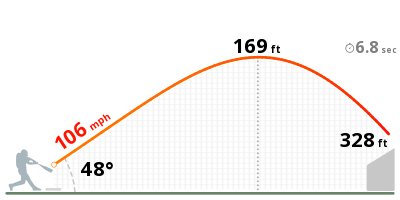
  • I have never seen a ball hit higher than Carlos Correa’s homerun three batters later. Off the bat, I was excited to finally see a ball hit the roof. It went so high, and hung in the air so long, that I had time to track the ball, then track Kiké Hernández tracking the ball, then track the ball again, then watch Kiké drift back to a few feet in front of the left field wall, and then watch the ball drop into the second row of the Crawford Boxes as if discarded by a wayward seagull. StatCast tells us that the ball went 169 feet in the air and stayed there for 6.8 seconds. It was unreal.

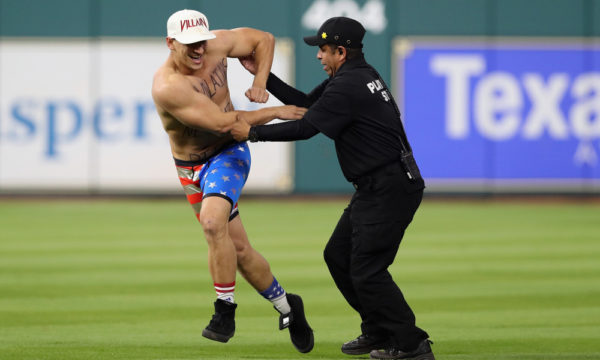
  • At one point, an overzealous fan in American flag boxers (and not much else) sprinted onto the field. He juked and jived, pissed off Houston’s finest, and ultimately found himself hogtied with multiple knees in his back. Bummer he missed the rest of this game to win a sophomoric bet.
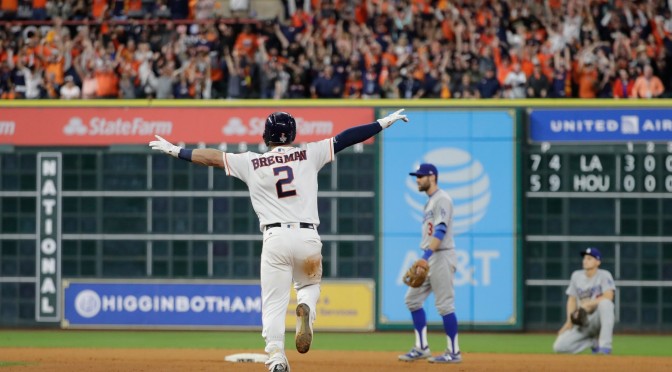
  • With two out in the bottom of the 9th, Asia’s public enemy number one hit a long drive to left center. Off the bat, I was certain this was a walk-off homerun. This was Gibby, Kirby Puckett, David Freese, and a handful (13) of others who ended a World Series game with a dinger. As sure as I was that Cody Bellinger had ended Game 2, there was no doubt that the guy who should have been suspended just ended Game 5. The ball hung in the air for what seemed like forever, only to touch down in the one place – the only place – in the entire ballpark where it was not a round-tripper. While that ball traveled nearly 400 feet, 43,000 people held their collective breath. It was an odd sensation. Somehow the ball hit just below and just to the left of that all-determining yellow line. Karma? Gurriel was left in scoring position and we had free baseball.
  • When little-known Derek Fisher slid home with the game-winning run following Alex Bregman’s 10th inning single, the roar in Minute Maid Park was extraordinary. Equal parts exultation and exhalation, the Houston Hopeful were going home Monday morning one win away from a World Series title. I am told you could get a feel for the crowd noise on television; I cannot imagine that is even half true. It was thunderous, raucous, cacophonous; and it stayed that way for a long time.

This game had ties in the 4th, 5th, and shockingly, the 9th inning. Three 3-run leads were blown. There were 11 runs scored from the 7th inning on. The Dodgers scored three runs (to tie the game) in the top of the 9th, each time with two strikes. So many crazy, insane, incomprehensible things happened in this game that we can hardly remember the merely extraordinary. In time, we will remember, and we will look back with awe.

My Sunday started in Florida, and ended on Monday morning in Texas. In between I experienced more emotions than I can recount. Upon leaving the park well after 1am local time, I called my wife – the instigator of this odyssey – and she asked me: “Was it worth it?”

If you love baseball as much as I do, and if you have read this far I am assuming you do. And if so, then such a question needs no response!

PLAY BALL!!

Addendum: The foregoing was written in the haze of Game 5. In that time, Game 6 was played. Dave Roberts did all sorts of weird things, and they all seemed to work. Joc Pederson continued to only get extra-base hits. And the Dodgers beat Justin Verlander. By 2017 standards, this game was somewhat quotidian. As such, Game 7 stands to be one for the ages. As I write these words, I feel tonight much like I did early Monday morning: unsure how I will be able to fall asleep! An incredible season has but one game left, winner take all.

Glass House of Emotion

When I coached my son’s baseball team, the kids would often have “big league” moments – trying to do it like the pros. Whenever I saw it, I would tell the player: “Just show me your professional contract, and you can do that. Until then, you have to do it my way”. The inference, of course, was to play fundamentally, be a good sport, and never show up the other side.

Due to what many view as overly stringent celebration rules, the NFL has derisively become known as the “No Fun League”. The same hasn’t been said of Major League Baseball, where pitchers police such behavior with a 5-ounce sphere hurled at 90+ miles per hour.

But there are times when fun and emotion should enter the sacred space between the lines. And the World Series is one of those times. And, if that is the case, there was no better time than Game 2 of this year’s Fall Classic, which some are calling the greatest non-clinching World Series game of all time. It’s hard to quibble with that assessment.

The beauty of Game 2, besides the lead changes, the ties, and the wacky bounces (the bill of a centerfielder’s cap, the groin of an umpire), was found in the many moments that, if they happened in our kid’s Little League game, would cause an uproar in the stands and a stern talking-to on the drive home. But, under the bright lights of the game’s largest stage, each was transcendent in their own right.

As great as Game 2 was, I believe it all started with the last out of Game 1. With the Dodgers clinging to a 3-1 lead, Kenley Jansen induced the dangerous Jose Altuve to fly out to right to end the game. One would think – for younger players we would demand – that securing the last out of a World Series game should be a by-the-book two hand reception, making certain nothing goes awry. If you were expecting that, you haven’t seen Yasiel Puig play. Puig caught the ball around his left hip with his tongue out (but he at least he used two hands). Puig was just warming up.

Verlander vs. Hill provided us with a handful of emotional, triumphant, and in light of the stakes, glorious moments that wouldn’t be acceptable if the bases were only 60 feet apart, but were spectacular because they are 90. A random sampling:

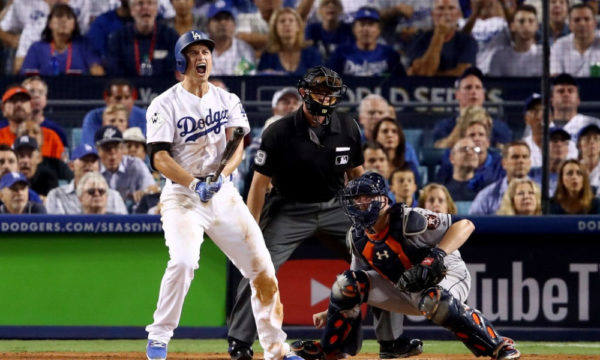
Corey Seager’s Primal Scream.
It’s one thing for a guy to make contact, and by the time he leaves the batter’s box to know he got it all. It is quite another for a hitter to let it all out immediately after contact. If any of our kids had done that, they wouldn’t have made to it to first base before being properly reprimanded. But when you take Justin Verlander deep to give your team the lead in the World Series, primal screams are the order of the day.

Carlos Correa’s Bat Flip.
I (and everyone else) previously wrote about the all-time bat flip in the 2015 ALDS. And there is no question that Jose Bautista still retains his position on the Mt. Rushmore of post-homerun-bat releases. But Carlos Correa joined the pantheon in the 10th inning of Game 2. And man did he earn it.


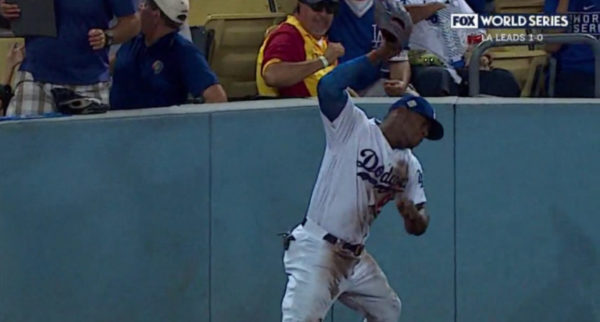
Yasiel Puig’s Glove Slam.
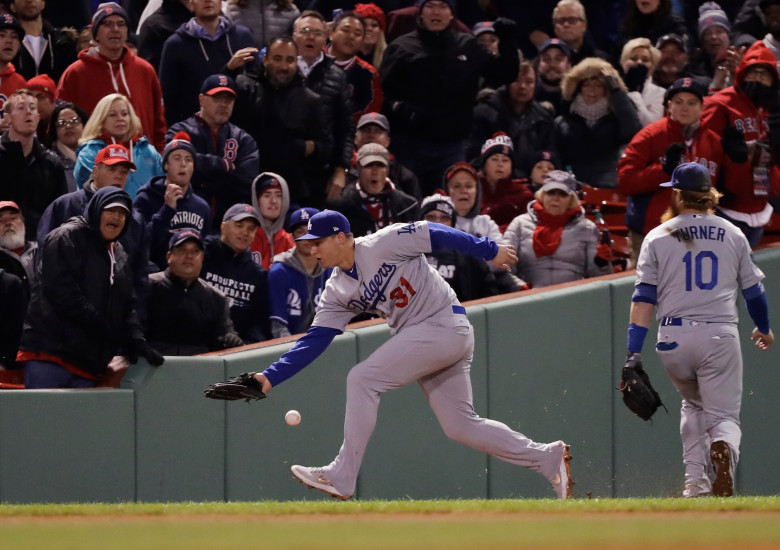
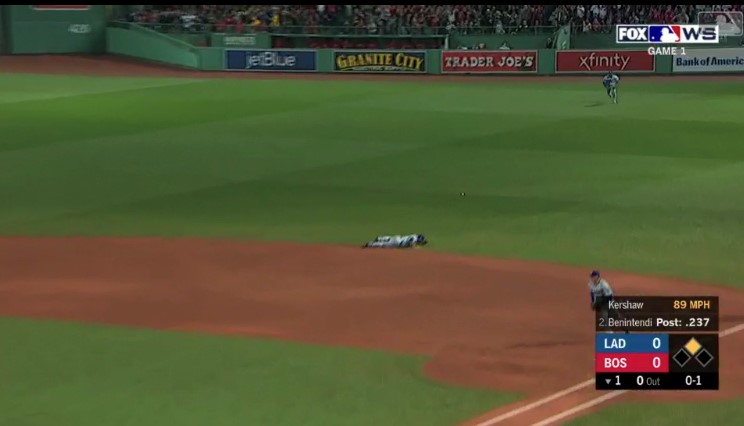
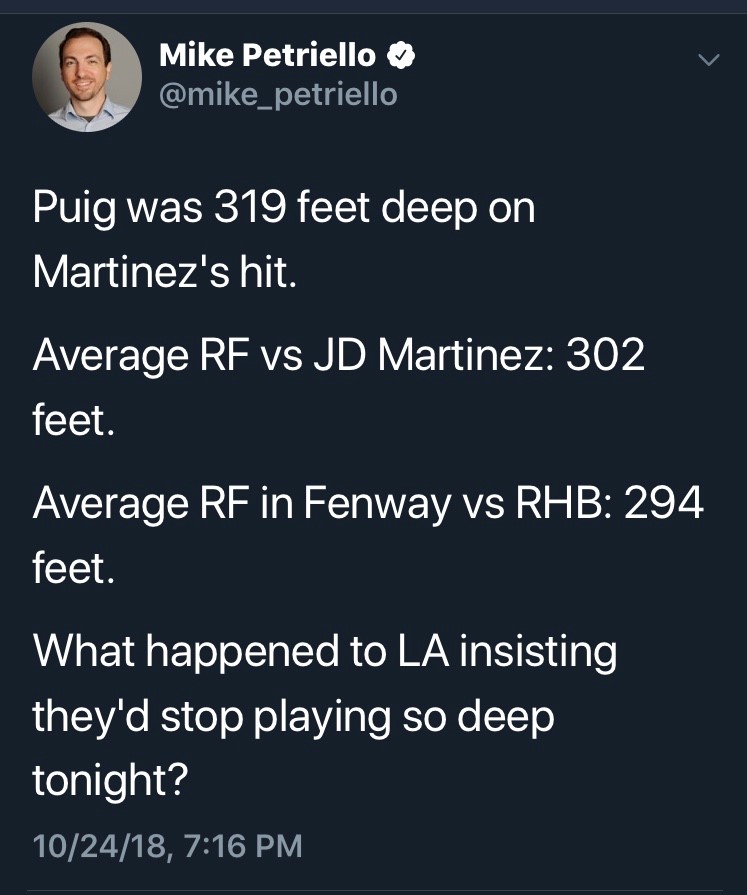
Alex Bregman led off the top of the 8th with a line drive to the rightfield corner. Puig went all out (or did he?), and with his run and dive, covered approximately 64.5 feet. Unfortunately, according to Stat Cast, he needed 65 feet to make the play. The ball flicked off the end of Puig’s glove and into the stands for a double. Yasiel leaped to his feet and slammed his glove down with such force that I half thought the grounds crew would need to be called to level off the warning track. Watching the game live, I thought Puig had nothing to be angry about – it would have been an amazing catch. However, in the world we now live in, we can determine things at the most granular level. According to Mike Petriello of MLB.com, during the season, Puig’s average “Sprint Speed” this season was 28 feet per second. In the 8th inning of Game 2 of the World Series, Puig’s “Sprint Speed” was 27 feet per second. Puig was running for approximately two seconds (probably a touch more). Had he been running at his average speed, he would have covered at least an additional two feet, and most likely made the catch. So maybe he had good reason to be angry. Either way, if your child or mine slammed his glove like that, ooh boy! (As an aside, maybe there is something about playing the outfield in the playoffs at Dodger Stadium the impels a glove slam.)

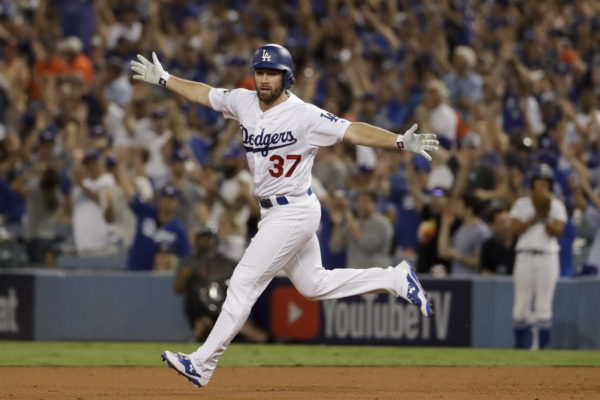
Charlie Culberson’s Rambunctious Trot.
We may never know what was going through young Charlie’s mind as he rounded the bases with two outs in the bottom of the 11th inning. Maybe he forgot that George Springer had hit a two-run homer, so he thought he had tied the game with his blast. Maybe he forgot all about George Springer and thought that he had won the game. Or maybe, after being inserted into Cody Bellinger’s spot in the lineup as part of an 11th inning double-switch, and after only getting two hits the entire season, and after only being on the post-season roster because of Corey Seager’s balky back, he was overcome with emotion hitting a homerun with two outs in the bottom of the 11th inning of a World Series game. Had a 12-year-old done that, his coach would have said two things: “We haven’t won anything yet” and “Act like you’ve been here before”. For Culberson, while the former was accurate, there was simply no way for him to fake the latter.

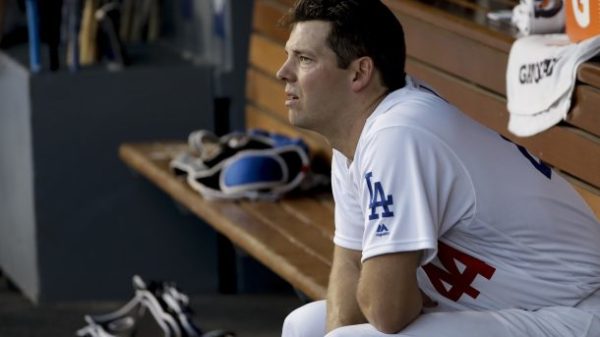
Rich Hill’s Reaction.
This picture doesn’t tell even half the story, but I think the Dodgers have scrubbed the internet of the images that the Fox cameras caught when Dave Roberts told Hill he was done after four innings and 60 pitches. Suffice it to say, Hill was none-too-pleased. I can certainly understand why. Twelve outs recorded, seven via the strike out, only one run allowed. I am sure Hill felt like he had many more bullets in the gun and, as a career journeyman who just started getting good at age 36, I can appreciate that he didn’t want this moment to pass without leaving it all on the field. However, this is how the Dodgers ran their staff all season. The top of the lineup – a heavily right handed lineup – was due to face Hill for the third time. And, truth be told, he was really one New Era bill away from being down 3-0 after 2½ innings. Roberts made the right call; but that doesn’t make Hill’s reaction any less human. We just wouldn’t tolerate the same from our kids.

We are just getting started in what stands to be an epic battle. I am predicting the Dodgers in seven; but it could easily go the other way. One thing is for sure: it will be a wild ride. So let’s continue to give these “kids” (by normal societal standards) the latitude they deserve to play with as much heart, excitement, and yes, emotion, as they can muster. Ask Cal Ripken – they may never be here again.

PLAY BALL!!

One Pitch


The Astros won the AL pennant on Saturday night.  A clean 4-0 victory over the one-season-too-soon Baby Bombers.  However, one pitch could have changed it all.

If you checked Sportscenter Friday night, you would have seen that the Astros beat the Yankees 7-1 in Game 6 of the ALCS.  “Wow”, you would have thought, “the Astros got their mojo back and blew out the upstart Yankees”.

But if you were watching the game, and specifically the 7th inning*, you might have an entirely different view on the matter.

As a quick reminder, the Astros won the first two games of the series, and led 4-0 in the 7th inning of Game 4.  The Astros were six outs away from a commanding 3-1 series lead, with Dallas Keuchel and Justin Verlander set to pitch the next two games.  In the space of less than two innings, that all came crashing down; the Yankees scored six unanswered runs, won the game 6-4, and then won Game 5.  And, just like that, the ‘Stros had their backs against the wall.

So when the Astros found themselves leading 3-0 in the 7th inning of Game 6, the ghosts of the Bronx had to be floating about the home dugout.  Verlander had been cruising – 75 pitches through six innings.  But he started the top of the 7th by walking Greg Bird on six pitches.  Two pitches later he had hit Starlin Castro.  Now the Yanks had the tying run at the plate with nobody out.

In case you haven’t been following, the Houston bullpen is a minor dumpster fire at this point.  It is not a Cubs-level conflagration, but it is smoldering.  So A.J. Hinch desperately wanted to get seven innings out of Verlander and just find a one-inning bridge to Ken Giles.  However, when Verlander started Aaron Hicks with three straight balls, things were not going according to plan.

I have previously written that the two-strike pitch is what makes me love baseball.  There is nothing like it in all of sports. However, it need not be a two-strike pitch that changes the entire complexion of a game – or a series. Sometimes, it is just one pitch. And in Game 6 of the 2017 ALCS, we saw that one pitch, over and over again.

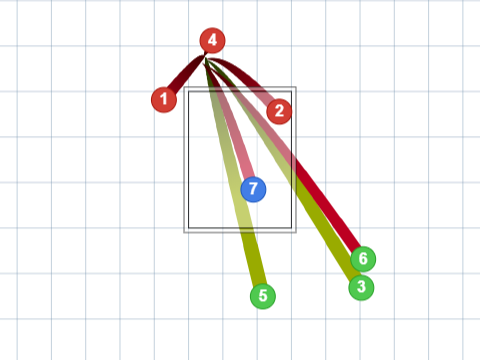
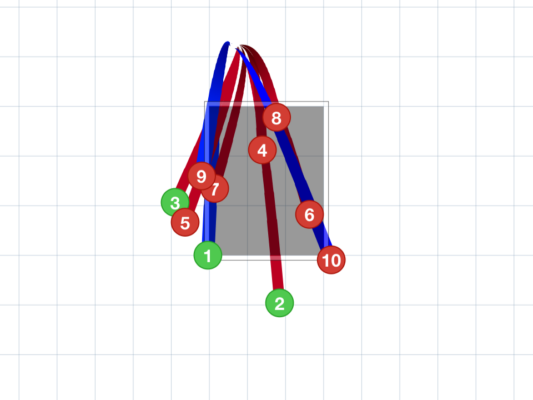
Two on, no outs, a 3-0 count to the batter representing the tying run. If Verlander throws one more ball, the bases are loaded for the Todd Father, who has had a career resurgence – just in these playoffs. Verlander throws a strike down Main Street. But we are still dealing with one pitch. On 3-1, home plate umpire Jim Reynolds calls on a strike on what is clearly a ball (see pitch #5 above). Rather than loading the bases, he loaded the count. What happens if that call is made correctly?

Now we have one pitch writ large – it is now a two-strike pitch. So what does Aaron Hicks do, he fouls off four straight. On the tenth pitch, and by my count, the seventh one pitch, Hicks strikes out swinging. But we are hardly out of the woods.

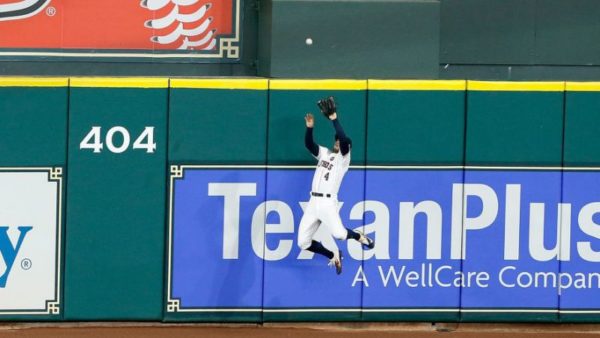
Verlander is clearly tiring. He is now up to 93 pitches (and 217 over his last two appearances). Verlander’s second pitch to Frazier is rifled to dead-center. George Springer makes a leaping catch against the wall to, in my estimation, save the season. If that ball lands, the score is 3-2, and the Yankees have the tying run in scoring position with one out. And, if that shot turned into a double, Hinch has no choice but to go to his leaky bullpen. Shades of Game 4 all over again.

But that one pitch is turned into the second out of the inning. Verlander then starts out the #9 hitter, Chase Headley (who already had two hits on the night), with two balls. And here we go again. The next pitch to Headley is one pitch that can change everything. As of 2016, batters hit .282 on 2-0 counts; and that jumps to .301 on 3-0 counts. As a general rule, hitters “love to hit 2-0”. Headley took a 2-0 slider at the upper end of the zone for strike one. With the count 2-1, batters hit .247, and Headley was no different, grounding to Jose Altuve to end the end inning and end the rally.

Verlander was done after throwing seven scoreless innings, giving up five hits, and striking out eight. He threw 99 pitches. However, he threw one pitch at least 9 times. Had that one pitch gone differently in any of those nine chances, it is quite possible that Verlander’s effort would have been wasted, and in all likelihood the Yankees are the AL Champions, prepping for a rematch of the 1977, 1978, 1981 World Series.

One pitch.

PLAY BALL!!

*The 3-0 slider to Gary Sanchez with two on and two in the 6th inning may be the subject of any entirely different article.

Absolution or Ignominy

Some moments are indelible.  When they happen, we know we have witnessed history.  And no matter what happens after, those moments will be lodged in our memory, forevermore.

“The Giants win the Pennant…the Giants win the Pennant…the Giants win the Pennant” is arguably the most famous moment in baseball history.  And yet, the memory of that moment is no way diminished – in any manner – by the fact that the Giants lost the Series, the Giants lost the Series, the Giants lost the Series.

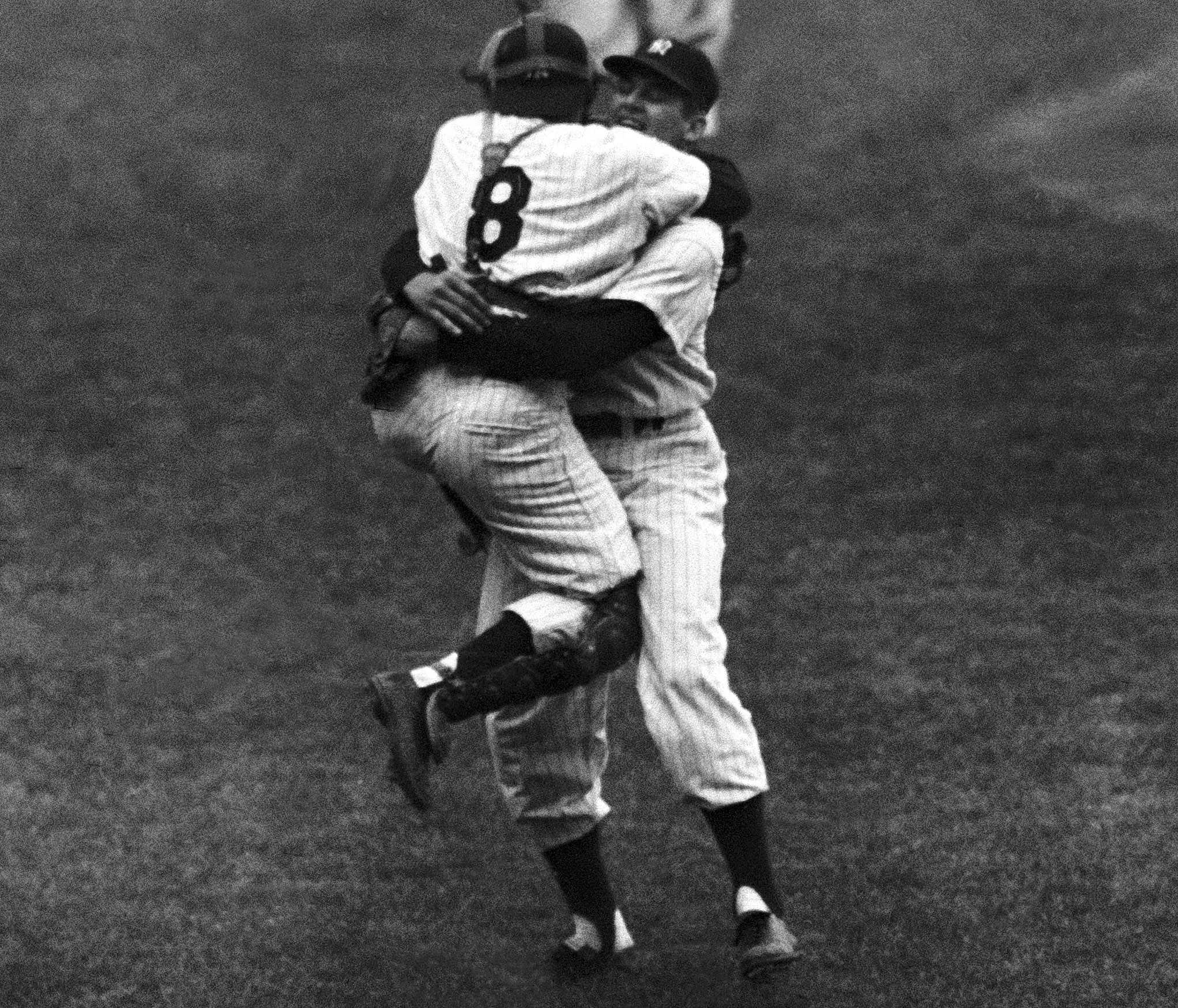
Regardless of the outcome of the 1956 World Series, no baseball fan can forget Yogi Berra leaping into Don Larsen’s arms after the only perfect game in World Series history.

New York Yankees' catcher Yogi Berra leaps into the arms of pitcher Don Larsen after Larsen struck out the last Brooklyn Dodgers' batter to complete his perfect game during the fifth game of the World Series, Oct. 8, 1956. Racing up in the background is Joe Collins. (AP Photo)

Has there ever been a better match-up than Bob Welch v. Reggie Jackson in Game 2 of the 1978 World Series?  I have written about that match-up many times, and we all know the outcome, which is not diminished in any way by the fact that Reggie took Welch deep in Game 6 as the Yankees finished off the Dodgers winning their 22nd world title.

I would argue that the outcome of the 1988 World Series is wholly irrelevant to our reverie for Kirk Gibson’s Game 1 heroics.

And, as of Sunday night, regardless of who wins the 2017 NLCS, I don’t anyone in Los Angeles will ever forget Justin Turner taking John Lackey deep to walk-off Game 2.

But there are other moments that stick in our craw because of the ultimate outcome of the game/series.  In short, some people are granted absolution and some people are granted ignominy due to matters wholly outside their control.  I was thinking about a handful of these (I am certain there are many more) after watching the playoffs this week.  It makes me think that some people have horseshoes, and some people have bad pennies.

To wit:

If Rick Sutcliffe was able to retire Alan Wiggins, Tony Gwynn, and/or Steve Garvey, do North Siders forgive a meager grounder through Bull Durham’s legs in the bottom of the 7th inning of Game 5 of the 1984 NLCS?  Does the Curse of the Billy Goat end thirty-two years earlier?

If Todd Worrell could have extricated himself from a runner on first, no out situation in the bottom of the 9th inning of Game 6 of the 1985 World Series, and then didn’t give up a single (a single?!) to Steve Balboni; and if Darrell Porter didn’t allow a passed ball, and if Dane Iorg hadn’t singled; and if the Cardinals hadn’t been blown out in Game 7, would Don Denkinger still be persona non grata in St. Louis?

If Alex Gonzalez turns a routine double play on Miguel Cabrera’s ground ball, and the Cubs get out of the 8th inning of Game 6 of the 2003 NLCS leading 3-1, would anyone ever learn or know the name “Bartman”?  Would we all now laugh at a grown man’s temper tantrum?  Would the Lovable Losers have found yet another way to rip the hearts out of their fans, resigning them to “wait til next year”.

If the Red Sox could have pushed across a single run in the 9th, or the 10th, or the 11th inning of Game 7 of the 2003 ALCS, does Grady Little lose his job for keeping Pedro Martinez in the game an inning and many batters too long?  Would Aaron “Bleeping” Boone roll off the tongue of New Englanders?

If the Rangers could have eked out a Game 7 victory in the 2011 World Series, how would we remember David Freese or Nelson Cruz?  Would Game 6 just be a blip on the radar, only important to Cardinals’ fans and David Freese’s friends and relatives?  That said, I believe Joe Buck’s “We will see you…tomorrow night” call would still be Hall worthy.

https://www.youtube.com/watch?v=4GQlkLSyCTA


Most flagrantly, if the Red Sox had not blown a 3-0 sixth inning lead in Game 7 of the 1986 World Series, and gone on to win their first championship in 68 years, would Bill Buckner have been vilified on the Back Bay for nearly two decades; the subject of an E:60 documentary; parodied on Curb Your Enthusiasm; and forced to move to Idaho?  Or would that play just been a clip on the highlight reel “Reversing the Curse” – the moment (in hindsight) when it all could have slipped away?

And, of course, we never would have even had “a little roller up along first” if Doug DeCinces’ flyball had reached the seats or Bobby Grich’s liner had fallen in the bottom of the 9th inning of Game 5 of the 1986 ALCS; or if the Angels could have won either Game 6 or Game 7 in Boston.  If any of that happens, maybe Donnie Moore doesn’t take his life less than three years later.

If Jason Kipnis’ line drive down the right field line in the bottom of the 9th inning of Game 7 of last year’s World Series not drifted foul, do we spend the entire off-season dissecting every decision Joe Maddon made, second-guessing him through Christmas and into Spring Training?  Does he lose his job like Grady Little?  Jason Kipnis would have become the modern-day Bill Mazeroski / Joe Carter, as beloved in Cleveland as LeBron.  One wonders if the Cuyahoga catches fire again?

Similarly, if Jayson Werth’s flyball down the left field line in the bottom of the 9th inning of Game 5 of this year’s NLDS doesn’t curve foul; or if Bryce Harper could have channeled his inner Michael A. Taylor and tied the game with one mammoth swing, do we spend this off-season castigating Maddon for trying to get seven outs from Wade Davis?  Those things didn’t happen, so Broad Street Joe gets off Scot free and lives to fight another day/series.

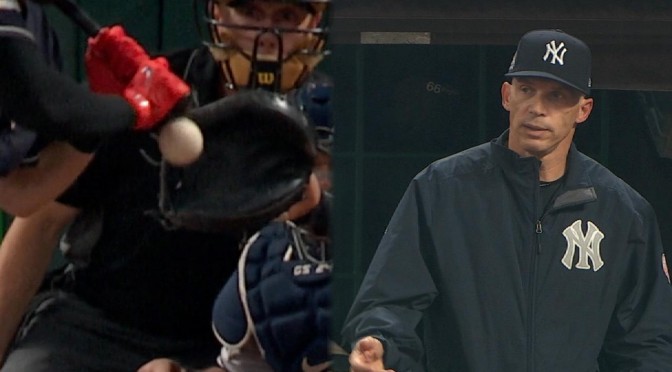
With the Yankees winning three games in four days against the best team in the American League, against the prohibitive favorite to win the pennant, I wonder if anyone will member Joe Girardi failing to challenge Lonnie Chisenhall’s foul tip that wasn’t?  Will the hit-by-pitch that wasn’t, which led to a Francisco Lindor grand slam, which led to a Jay Bruce homerun, which led to an Indians 9-8 victory in Game 2, be lost to the scrap heap of history now that the Baby Bombers find themselves in the ALCS?  Only time will tell.  But for now, Girardi keeps his job, Yankee fans are allowed to forget, and time marches on.

Who will be granted absolution?  Who will live with ignominy?  We potentially have fourteen games among four teams over two series to find out.

PLAY BALL!!
BLOOM BACK ON THE ROSE?


Last Monday, Peter Edward Rose made a formal request to be reinstated by Major League Baseball and asked that his lifetime ban be lifted. Newly-minted Commissioner Rob Manfred responded by stating he would consider the request “on its merits”. Spoken like a true attorney.

To be or not to be.

He loves me, he loves me not . . .

Will he or won’t he.

What’s with taking the oath of Commissionership that requires a bombshell be thrown in your lap within the first few months? Adam Silver had V. Stiviano and now Rob Manfred has Pete Rose.

So what to do with Pete Rose? If Manfred pulled out a legal pad, drew a line down the middle, and starting listing pros and cons, he might have to cut down a few yellow trees before he came to a conclusion. The simple question is: Has Pete Rose paid enough of a penalty? He has been banished from baseball – his one true love (replaced in recent years by money) – for over 25 years. Does that punishment fit the crime?

Apropos of nothing, as of 2013, 30% of murderers convicted and sent away on life sentences are let out of jail in less than 10 years, with an overall average of 16 years of incarceration. Now, I am not comparing Pete Rose’s betting on baseball to murder – not at all – I am just trying to show, for hyperbolic effect, how long a 25-year (and counting) sentence actually is.

It can be readily acknowledged that Pete Rose did something that we, as a society and as fans of baseball, feel is inherently wrong. We can also agree that in the years leading up to and following his banishment, Rose did not acquit himself very well. Time and again, when the powers-that-be were looking for contrition, they got stubbornness. When they were looking for remorse, they got obstinacy. He held his ground for nearly 15 years. Who knew you could hold your breath for that long?!?

It was not until 2004 when Pete finally admitted what everyone knew all along. Unfortunately, the timing of his (ahem) confession was marred on two fronts:

(1)  It was done not in the service of baseball, but in the service of making a buck. Pete made his confession three days before his autobiography “My Prison Without Bars” was released. People could not help but think this was less about seeking forgiveness than about seeking book sales.

(2)  It was done on the eve of the announcement of the 2004 Hall of Fame class. Knowing that he most likely would never be enshrined in Cooperstown, Pete took the occasion to piss on the Hall’s doorstep.

Stay classy, San Diego.

But, for the past decade, Pete has been a relatively model citizen. He has not ruffled too many feathers (other than setting up card tables for autographs on Hall of Fame weekend), and has basically kept as low a profile as one could ever hope/expect from the Pete Rose.

Here is the real: Baseball is better when Pete Rose is involved. You cannot deny what he brought to the diamond for nearly 25 years.  The hustle, the heart, the hits (both the Harrelson and base varieties).

(3:16 mark)

The fact of the matter is that Pete Rose played in more games, had more at bats, and got more hits, than any player in MLB history. Chew on that for a moment. He is an icon in Cincinnati, and he is a legend of the game. He has paid his penance. He should be allowed back in . . . with conditions.

Many people considerably smarter and more knowledgeable than I have written extensively on this topic, but I think I agree with the following premise: Pete Rose should be allowed back into the game on a limited basis. He should be allowed to come to the park, participate in team activities, and be honored at major events (e.g., the All-Star Game this summer in Cincinnati). He should not be allowed to be an executive or an on-field coach. He should not be allowed to be in a position to affect the outcome of any game. That seems easy enough, and Manfred could tailor this reinstatement in a way that preserves Bart Giamatti’s original intentions, without looking like he is reversing his predecessor’s course.

Little Known Fact #1 (that would be more widely known if you read Jayson Stark’s columns or his book “Wild Pitches”): In 2003, former teammates Mike Schmidt and Joe Morgan arranged a meeting between themselves, Bud Selig, and Pete, for Pete to fall on his sword, acknowledge his mistakes, apologize, and then, ostensibly, be reinstated. For reasons that a whole school of psychologists could spend semesters debating, Pete could not bring himself to the table. No meeting, no apology, no reinstatement. And here we sit today.

Okay, so let’s assume Manfred is inclined to let Rose back in. That always leads to the $64,000/bronze-plated question: Should Pete Rose be in the Hall of Fame? Sure, of course, without question, maybe. The answer is multi-layered, but before we go to the merits, we need to know who will be hearing the evidence.

Little Known Fact #2 (that would be more widely known only if you are a total and complete baseball nerd and/or live in upstate New York and/or write a blog that maybe a few people read): While the Baseball Writers Association of America is the organization we customarily associate with Hall of Fame voting, they will not play any part in the Pete Rose discussion because he has been retired for too many years (this form of eligibility expires 15 years after retirement). Thus, his election (or lack thereof) will be determined by one of the Veteran Committees. There are three (Pre-Integration Era (1876-1946), Golden Era (1947-1972), and Expansion Era (1973-Present). Pete overlaps the last two, but would most likely fall under the Expansion Era Committee.

This Committee is comprised of 16 people, including prior HOF inductees, executives, and veteran media members. And, if you are looking for a quick resolution, don’t. The Committee doesn’t meet again until the Fall of 2016 for potential induction in 2017. Manfred has some time to cool his heels and ponder reinstatement.

To quote Vin Scully, “it goes without saying, but I’ll say it anyway”. Pete Rose’s on-field achievements are Hall of Fame worthy. It truly comes down to his integrity. Do we believe he should be excluded from the Hall of Fame because his lack of integrity (at least with respect to betting on baseball) potentially affected the integrity of the game?

Little Known Fact #3 (and by little known, I mean widely known): The Hall of Fame is filled with people who lacked integrity, who were scofflaws, liars, cheaters, racists, and drug addicts, guys who through actions and deeds potentially affected the integrity of the game. It must be really hard to get a good view of all that when standing on top of Mount Pious. But I digress.

Little Know Fact #4: Pete Rose retired in 1986, and (but for being banned from baseball in 1989) would have been eligible to be on the Hall of Fame ballot in 1992. Shockingly, in 1991 the Hall ruled that players on the permanently ineligible list could not be voted in. Coincidence? I think not.

Here is where I land on the issue: The Hall of Fame is a baseball museum. It is not intended to be a home for the better angels of the game, but rather a collection of the game’s history. It should include the whole story, warts and all. (And, by the way, many pieces of Pete’s equipment already reside in the Hall’s permanent collection.)

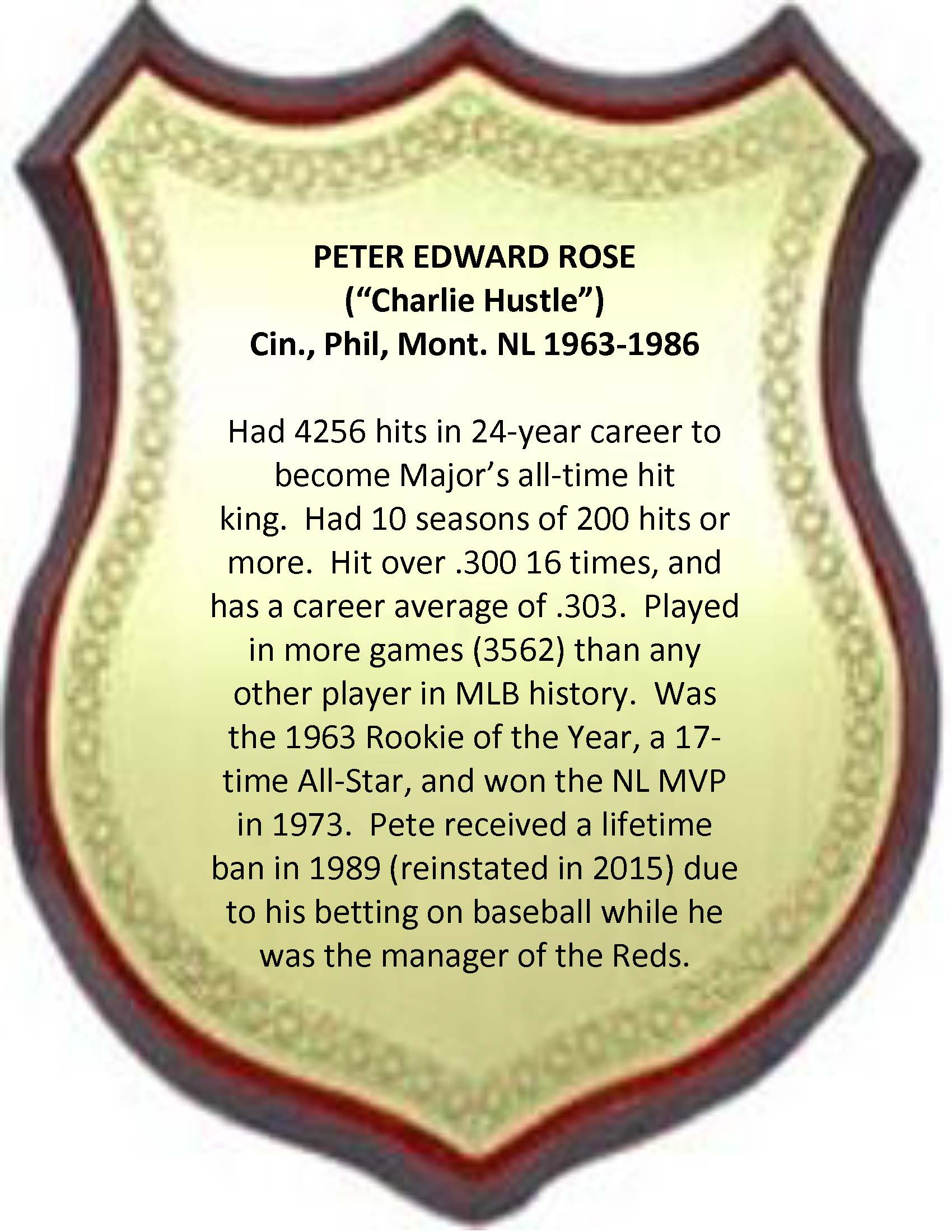
My solution is easy: Let him in, and put it all on the plaque. Pete’s plaque could look like this:

Pete Rose Plaque 3

That is what I would do. And, while we are on the topic, I would do the same thing for everyone who is Hall of Fame worthy but has been suspected of PED use. Put them in the Hall of Fame, tell the story, allow us to bring our kids to the museum so we can share our and their stories with the next generation – the good, the bad, and the suspected. I believe that is what Cooperstown was originally intended to represent.

Because, whether the baseball purists like it or not, try as they might, we simply cannot just ignore history.

Opening Day is just 2 weeks from Sunday.

PLAY BALL!