
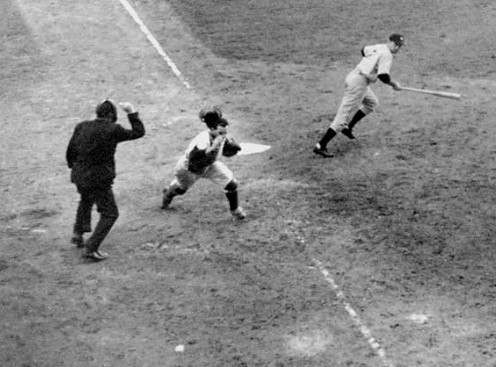
I have a baseball bugaboo. I wrote about it nearly ten years ago. Shockingly, the feedback I received was mostly negative – people thought I was being overwrought and/or clutching my pearls too tightly. Unfortunately, it is something that I still see today – and it still drives me crazy. But I cannot just shrug it off. And it has happened at least twice in this year’s playoffs – with two very different outcomes.
It drives me crazy when a player doesn’t run to first on a dropped third strike. We can spend all day debating the merits of the rule (I believe Sam Miller has broken this down way better than nearly any writer ever could), but it is a rule. And it is a potential free base if the batter is savvy and quick enough to take advantage.
In a time when league batting average is hovering in the .240s, and getting base runners is as hard as it has been since the ‘60s, you would think teams and players would take anything additional they can get.
But putting aside the analytic benefits, let’s just start with torpor. Why do coaches, fellow players, and we fans tolerate this level of laziness? When a ball gets by the catcher, he has to throw the ball – at minimum – ninety feet. And, at times, it’s a whole lot farther, and often around a moving target (the batter). Contrast that with a comebacker to the mound, where the pitcher only has to throw the ball less than 64 feet; and there is no runner in the way.
How about a ground ball directly to the first baseman, who only has to toss the ball – oftentimes underhanded – to the pitcher just 15-25 feet away?
Or a ground ball to second? That one is, on average, 95 – 115 feet. So potentially a little bit farther, but, again, no one in the way.
Imagine a world in which a batter grounded the ball back to the pitcher, or to first or second base, and then just turned and walked back to the dugout. How loud would the boo birds be? What would the manager say? How badly would the beat reporters crush the guy in the next day’s newspaper? How long would he last in the big leagues?
And yet, that is totally acceptable behavior when the catcher drops a third strike. More often than not, the forlorn batter drops his head and turns tail back to the dugout, allowing the catcher to either tag him on the rump or throw unfettered to first to record the out.
In Game 2 of the Wild Card series between the Yankees and the Red Sox, the Yanks held a 2-1 lead going into the bottom of the sixth inning. Boston brough in Garrett Crochet to pitch for the first time in five months. On his fifth pitch he got Spencer Jones to strikeout on an 85-mph sweeper. One down with a confidence-building strikeout. Except, the ball slipped by catcher Adley Rutschman and Jones sprinted to first, beating the throw. Jones then stole second and went to third when Rutschman threw the ball into center field. The next three batters all singled, chasing Crochet before he recorded an actual out. Garrett Whitlock inherited two runners, proceeded to allow them and four more to score, and when the inning was over, so too was the Red Sox season, as the Yankees led 8-1. Was it all because Jones hustled to first on strike three? Probably not, but it certainly helped start the rally.
In the deciding Game 3 of the Wild Card series between the Braves and the Phillies, Atlanta led 6-2 in the top of the eighth inning after a Trea Turner sacrifice fly. Kyle Schwarber then flew out, leaving Philadelphia just four more outs to score four runs to save their season. Bryce Harper struck out on a nasty Chris Sale slider that went all the way to the backstop. At first, Harper just reached down to unfasten his shin guard. Then he realized, “oh, maybe I should try to run to first.” Meanwhile, catcher Drake Baldwin raced to the backstop, picked up the ball, and fired to first to end the inning.
According to sources, the backstop at Truist Park is 53 feet from home plate, meaning that Baldwin had to run that 53 feet, and then throw the ball approximately 140 feet to first to record the out. There was ample time for Harper to get to first, and potentially start a two-out rally. I get it, it’s a long season. Harper played in all 162 regular season games; that was his 706th plate appearance of the year; it is fair to say he was tired. But, the #4 hitter, Alec Bohm was due next, and then Bryson Stott. Could they, would they, have gotten hits and pushed Sale, who had already thrown 18 pitches in the inning, off the hill? Could Harper simply have extended the inning, forcing Sale to throw additional pitches such that he could not come back for the ninth, or come back for the ninth in a diminished capacity? We will never know because Harper at first didn’t run, and when he did run, it was more of a jog.
The $25,000 fine I once proposed for failing to give your team a chance to prolong its season is a small price for a player making more than $25 million this year and every year through 2031. Or, maybe, just like the last time I raised this issue, people simply don’t care.
PLAY BALL!!