THE CALL THAT COULD HAVE BEEN


THE CALL THAT COULD HAVE BEEN

*Editors Note: The words you will read below are what you might have heard when we came back from commercial Thursday night, starting as  Clayton Kershaw finished up his warm-up pitches.

As best you can, read this in Vin Scully’s voice, in Vin Scully’s cadence.

“When Kershaw takes the hill, you get the sense he is not pitching against Daniel Murphy, he is not pitching against the Nationals, nor is he pitching against the Phillies, the Cardinals, the Mets, the millions of people who have written and spoken about Clayton’s troubles in the post-season.

No, you must imagine that Clayton is pitching against those doubts that bubble up in the head of every athlete – at one time or another – those doubts that ask, “Am I really that good?”

Anyway, enough about that.

Daniel Murphy digs in and Kershaw comes set at the belt.

Fastball, up and in.

Whoa! So much for fatigue.

That fastball had a little extra something on it. In fact, I don’t think Kershaw hit 95 even once on Tuesday afternoon but, sure enough, fatigue is no match for adrenaline.

Kershaw stares in at Ruiz, shakes his head, once, now twice. Kershaw comes set at the belt, and the one and oh pitch is fastball in on the hands; short pop on the infield, Culberson takes a few steps back and just like that, Daniel Murphy is retired.

You have to wonder if Dave Roberts will go out and get Kershaw, having got the one man he was brought in to get.

Well, I guess we have our answer.

Roberts is staying put, and you get the feeling that it would have taken Roberts, Honeycutt, and a team of coaches to pry the ball out of Kershaw’s hand at this point.

So the chess game continues.

Well, fresh out of options, Dusty Baker has gone to the last man standing.

Wilmer Difo, the rookie shortstop is Baker’s and the Nationals’ last hope.

Wilmer, from Santiago de los Caballeros in the Dominican Republic, made his major league debut on May 19th, and here he finds himself square in the eye of the hurricane.

Difo, a switch hitter, digs in from the right side against the left-handed Kershaw.

Fastball, way inside. Difo had to do a little dance to avoid that 93 MPH heater. Difo must be wondering how he got himself into this situation, and wondering if he can pull a Houdini act and get himself out of it.

Kershaw is ready, Harper leads from second and Werth off of first. Gonzalez is playing behind Werth, and Seager is bird-dogging Harper, trying to keep him close.

The 1-0 delivery is a fastball fouled away. And Kershaw has squared his account.

When you look out in the infield, Seager is doing his best to keep Harper from getting too big of a lead, hoping to keep him from scoring on a single.

Of course, with two outs, the runners will be off on contact. Harper runs pretty well, and knowing the way Harper plays the game, there will be no holding him at third if the opportunity to score arises.

Here comes the 1-1 pitch, Difo swings through a 91 MPH slider. I tell you, that just isn’t fair.

Difo started the season in AAA, and now, in the biggest moment of the year, in quite possibly the biggest moment of his life, he has to face arguably the best pitcher on the planet.

Kershaw brings his hands high above his head, and slowly brings them down and settles at the belt. He takes a look at the runners, and the runners GO.

Difo dribbles it foul up along third, and the runners have to return from whence they came.

Difo really had a defensive swing on that pitch, and really, who can blame him. He is doing his level best just to stay in the box at this point.

You know, this is the 167th game that each of the Nationals and the Dodgers have played this season; they have split the first two games of this series; and here we are in the bottom of the ninth inning of a one-run game. Folks, it doesn’t get much closer than this.

Kershaw has rubbed up a new ball and is now ready to go.

Difo digs in while Harper and Werth take their leads. The 1-2 delivery is a BREAKING ball in the DIRT, SWUNG ON and MISSED. Ruiz keeps the ball in front of him and guns it to Gonzalez covering first to complete the strike out.

At 12:41 in the morning, East Coast time, the Dodgers have won the division series; and maybe, just as importantly, Clayton Kershaw has slayed his demons.

I tell you folks, just when you think you have seen it all – you get Clayton Kershaw saving a game in which Dodger CLOSER, Kenley Jansen, threw nearly three innings and 51 pitches.

And, not for nothing, but the last time Kershaw, the three-time Cy Young winner recorded a save – it came ALL the way back in 2006, in  rookie ball in the Gulf Coast League. His catcher that day…Kenley Jansen.

Well, that’ll do it from the nation’s capital where the Dodgers have defeated the Washington Nationals 4-3 to advance to the National League Championship Series.

For Charlie Steiner, Rick Monday, and the rest of our crew, this is Vin Scully wishing you a very pleasant good evening.”

GAME 5

GAME 5

NLDS-Game 5-The Los Angeles Dodgers celebrate. The Dodgers defeated the Nationals 4-3. Wednesday, October 13, 2016. Photo by Jon SooHoo/©Los Angeles Dodgers,LLC 2016

There is truly no reason to add to the multiple canons that have been or will be written about last night’s Dodgers-Nationals game. That said, and while it is still quite early, after reading and listening to a ton of commentary, I have yet to hear anything about the following three points, which may mean they are only interesting to me. However, on the off-chance that others will find them notable, allow me to throw my hat into the ring:

I.

Two years on, I guess Mike Jirschele is officially exonerated. Who is that, you ask? Mike Jirschele was the Royals’ third base coach in Game 7 of the 2014 World Series who held Alex Gordon. As you may recall, there was great consternation about whether or not Jirschele should have sent Gordon with a chance to tie the game. All metrics showed he made the right call, but some people were still dubious.

Well, after Bob Henley decided to send Jayson Werth to the plate in the bottom of sixth inning last night, and after Werth got thrown out by anywhere from 15–30 feet (depending on the calculation), any and all dubiosity about Jirschele’s decision should go by the wayside. Now we can know, with pretty good certainty, how the 2014 World Series would have ended had Jirschele waved Gordon around. Pop-outs to third notwithstanding, that would have been a tough way to lose.

II.

A lot of ink was spilled — by this writer as well — about the Dodgers’ pre-deadline move to send A.J. Ellis to Philadelphia in return for Carlos Ruiz. Well, I guess Andrew Friedman and company knew something a bunch of us didn’t. It is impossible, of course to know whether or not Ellis would have come through in the same way, but we do know that Ruiz went 2–4, with three RBI in the series, including the tie-breaking single in the decisive seventh inning last night. Oh, and he blocked the hell out of that filthy “Public Enemy #1” to end the game.

As I wrote back in August, Friedman makes $7 million/year to make difficult decisions. There is a reason he is paid like one of the best executives in the sport — because he is. No, he didn’t have a crystal ball, but he certainly knew the Dodgers needed better production from their back-up catcher, and that they got. (Ironically enough, after the trade, Ellis and Ruiz had virtually identical numbers with their respective new teams (Ellis: .313/.371/.500; Ruiz: .278/.350./.683)). But, if you are a Dodger fan, ask yourself who you would have rather had at bat with the game tied and a runner in scoring position in a deciding game. Ruiz felt — to me — like the safer choice.

I am sure there are a lot of people out there who will claim that Ellis would have been better for Kershaw in Game 1 (where he grinded through five innings) or Game 4 (when he just couldn’t get the third out in the seventh) or even last night as he worked against Daniel Murphy. Maybe. All we know is what happened, and Ruiz got the hit and made the block and the Dodgers won.

III.

In all the ballyhoo about Dave Roberts’ managing (every compliment well-deserved), Dusty Baker’s 0–9 record in win-or-go-home games, Kenley Jansen’s miraculous 51-pitch effort, and Clayton Kershaw’s incredible save, I have yet to hear or read this comparison: This was pretty damn close to a Kirk Gibson moment.

Calm down, let me explain. By all accounts, and on nearly every list, Gibby’s dinger was the greatest moment in Los Angeles sports history. Vin Scully’s call of that moment has been played ad nauseum the last few weeks. But hear me out.

Did we have an injured player? Check. Kershaw was on the 60-day DL. When was the last time a player — let alone a pitcher — was on the 60-day DL and then came back to have a meaningful impact on the playoffs?

Did we witness a gutty prior performance? Check. We often forget about the 1988 NLCS against the Mets, but Gibson fought through that, including a home run off Sid Fernandez in the fifth inning of Game 5 at Shea Stadium. Putting aside the final box score, Kershaw was remarkable in Game 4 of this series. He should have been done after six innings, giving up only two runs. He should have been done after seven innings, giving up only two runs. Umpires, shortstops, and relievers are the only reason he was charged with five. Nonetheless, he was awesome (considerably better than Gibson was prior to the ninth inning of Game 1 of the ’88 World Series).

Did we have a player unlikely to appear? Check. When directly asked about Kershaw pitching to even one batter in Game 5, Dave Roberts replied: “Absolutely not”. Hell, Kershaw didn’t even have his cleats on for the first seven innings of Game 5. When Kershaw told Roberts he was okay to go, Roberts first had to check with the trainer to get permission.

We can all hear Vinny saying: “Look who’s sitting in the dugout”. Now imagine that same voice, that same cadence, saying: “Look who’s heading to the bullpen”. It wasn’t just improbable, it was impossible. Clayton Kershaw, the man with the closet filled to the brim with October demons, the man who missed ten weeks with a herniated disk, the man who had thrown 110 pitches just 48 hours earlier in a stadium clear across the country, would not only come in to the game, but would come in to face the hottest post-season hitter on the planet; a batter who took Kershaw deep not once, but twice, in the playoffs last year; a batter who represented the winning run. No, this just couldn’t happen.

Think back. Had Gibby flailed at a few sliders against the best closer in the game and walked back to the dugout with the Dodgers down 0–1 in the World Series, no one would have said “boo”. He did his best just to get to the plate. What a gamer. Ultimate team player.

But had Kershaw come in and served up a gofer ball to Murphy, it may have been the final nail in Kershaw’s playoff coffin. Could any player ever come back from that much heartbreak, that much back luck, that much failure? When Kershaw asked into the game, and jogged to the mound, as Bill Simmons tweeted: “The legacy of his legacy’s legacy is gonna be at stake”. Simply put, a LOT was riding on that Texan’s broad shoulders. Seven pitches; a weak pop-out and a nasty K, a massive monkey off a weakened back.

When Clayton threw his hands in the air and hugged Carlos Ruiz, the Dodgers had felled the Nationals, those demons were exorcised, and Los Angeles had its second Gibby Moment. The only shame: Vin Scully was at home, watching, just like the rest of us.

Championship Series, here we come.

PLAY BALL!!

BROADCAST BLUES (Playoff Edition)

BROADCAST BLUES (Playoff Edition)

A few months ago I wrote how I felt that baseball broadcasters (save for Vin Scully) were hurting the game. They were making it considerably less enjoyable for fans to experience the experience while watching on television or listening on radio. I was brought back to that sentiment – in the words of one presidential candidate – “bigly”, yesterday afternoon.

I will begin by saying that I believe Kenny Albert, Harold Reynolds, Tom Verducci, and Jon Morosi are doing a nice job on FS1. But . . . come on.

Allow me to set the stage; and then you tell me if an opportunity was missed. On October 11, 1978, at Dodger Stadium, a stud pitcher named Bob Welch took the mound (in the World Series) with the game on the line against (one of) the most ferocious hitters in baseball, Reginald Martinez Jackson. (For those of you paying attention, you will note that I have dubbed this one of the greatest two-strike situations in the history of baseball). The pitcher and hitter battled to a 3-2 count, and a few pitches were fouled away. For the purposes of this analysis, the outcome of the at bat is irrelevant.

On October 11, 2016, 38 years to the day, at Dodger Stadium, a stud pitcher named Clayton Kershaw took the mound (in the playoffs) with the game on the line against (one of) the most ferocious hitters in the game, Bryce Aron Max Harper. The pitcher and hitter battled to a 3-2 count, and a few pitches were fouled away. For the purposes of this analysis, the outcome of the at bat is irrelevant.

So how many times, do you think, the FS1 broadcast booth made reference to that epic battle 38 years prior, and how history seemed to be repeating itself? That Kershaw-Harper at bat lasted 8 pitches and nearly five minutes. Did they overrun the telecast with nostalgia? Did they pepper the broadcast with flashback highlights? Did they talk with longing of times past? Nope! They did none of it. Not once did they mention the ’78 World Series. They didn’t show a single clip. I was screaming at my television: “38 years, TO THE DAY!” “Welch v. Jackson!” “Same exact damn location!”

Fairytales don’t get written better than that. And yet, the entire broadcast team missed it. In my anger, frustration, annoyance, I quickly tapped out a text to some baseball friends stating, “Somewhere, Vin Scully is so upset about this missed opportunity”.

Kershaw ended up walking Harper (he should have been called out on the 1-2 pitch, but I digress), and the moment passed. But, the point is, the moment was less because the broadcasters didn’t do more. Only true baseball nerds like me know/remember those moments/dates and tie them back in real time. For me, the moment was beautiful. But what about the 99.8% of the other viewers who needed a little primer, a littler reminder, of the moments that have made baseball so great?!?!

You want to increase baseball viewership, have the broadcasters bring the game to life by reminding us how our collective past oftentimes looks exactly like our collective present.

PLAY BALL!!

TORN BETWEEN TWO LOVERS

TORN BETWEEN TWO LOVERS

Anyone who knows me, knows that I have an undying love of the Boston Red Sox.  (Not for nothing, being a Red Sox fan can better be described as a “close to dying” love.)  Anyone who reads me, knows with absolute certainty of my love of the game of baseball.  So, as we embark on the best month in sports – which started with a bang last night (and with apologies to March, as it really only has three quality sports weeks), and begin the best tournament in sports (with apologies to hockey, whose playoffs simply go on too long), I find myself sitting squarely on the horns of a dilemma.

See, even when the Curse of the Bambino was in full swing, when the names Bucky “Fucking” Dent, Bill “Slow Roller” Buckner, and Aaron “Bleeping” Boone” rolled off the tongues of New Englanders, there was a fan base on the North Side of Chicago that was in even more pain – they just didn’t get the same publicity.  As a reminder, the Cubs’ era (eon?) of futility started a full decade before the Red Sox’.

The BoSox came close in ’86 (at 68 years and counting), but the Cubbies came damn close in ’84 (then in the midst of a 76-year drought).  And while Grady Little and the aforementioned Aaron Boone were ruining the Fall of 2003 for New England, Steve Bartman was doing the same for Chicago.  Had things turned out differently (foul balls and pitching changes are the darndest things), had the outcomes been as the pundits predicted, the 2003 World Series would have pitted 95 years of misery vs. 85; and at long last, either the Billy Goat or the Babe would have been absolved.  Alas, we don’t live in such a world.

We all know that the Babe (really, Harry Frazee and Bill Buckner) got off the schneid the next year, and it has been nothing but sunshine and roses on the Charles for the past ten plus years.  Not so much in Chi-town.

Since Bartman, the Cubs have made the playoffs thrice, and have yet to win a game.  Including the Bartman game, that is 12 in a row over four playoff series.  But Theo Epstein, the Exorcist of the Back Bay, has the Cubs as the heavy favorite to win it all this year.  A close second in those odds . . . Theo’s former employer.  Which has me torn between two lovers.

Would there be a better story in baseball?  Theo Epstein gets (part of) the BoSox band back together with Jed Hoyer (GM), Jason McLeod (Sr. VP of Player Development), Jared Porter (Director of Pro Scouting), Jon Lester, David Ross, and John Lackey, adds a whole crop of incredible young talent, the most unconventional manager in the game, and brings a title 108 years in the making back to the banks of Lake Michigan.  As a true baseball fan, how can you not root that?  Hell, even President Obama would be rooting for it.

The only problem with this fairytale, for me, is that the Red Sox decided to have the bounce back year many people predicted.  And behind Betts, Bogaerts, Bradley, Benintendi, Price, Porcello, Pomeranz, a rejuvenated Pedroia, and the most epic swan song in the history of the game for Big Papi, the Red Sox have a legitimate to chance to (a) make the showdown we missed in 2003 a reality and (b) squash the hopes and dreams of another generation of Cubs fans.  So what do I do?  For whom do I root?

I have often said that the 1991 World Series should have been called a tie when neither team scored after nine innings of Game 7.  Both teams deserved to win; and neither team deserved to lose.  But we all know Jack Morris went out for his tenth inning, shut down the Braves, and then Gene Larkin (you all remembered that, right?) got the game-winner, bringing home Dan Gladden (you remembered that, too?), and the Minnesota fans nearly blew a hole in the Hubert H. Humphrey Homer Dome.  (As an aside, how much better would it have been if Kirby Puckett had knocked in or scored that winning run?)

Which brings me back to this season – a quarter of a century later.  As I stare down the barrel of the next four weeks, all I can hope is that the Red Sox and Cubs are tied at three games apiece, tied after nine innings, and then someone cuts the Eversource/NStar power grid.  Then, after a collective groan, everyone calmly and politely exits Fenway Park, gets on the “T”, and goes on with their life.  Hope can always spring eternal.  Hey, it’s not that much of a stretch – the Cubs do have one tie this season!

However, more likely than not, they will both lose in the division series, and then we could end up watching the Blue Jays and the Giants in a World Series battle of two highly unlikable teams.  That said, what would you pay to see Jose Bautista take Madison Bumgarner deep, flip his bat, saunter around the bases, only to get drilled in his next at bat?  That would be appointment viewing.

So as we dive headlong into the playoffs, as the Red Sox fly to Cleveland and the Cubs host either the Giants or the Mets, a man can dream about what may come . . . and fear being torn between two lovers.

PLAY BALL!!

THE VOICE OF GENERATIONS

THE VOICE OF GENERATIONS

Image result for vin scully

In the world of psychology, it is a given that the sense of smell is the most evocative of prior experiences.  Who am I to dispute the science?  But if sense of smell is number one, for me, the sense of hearing is a close second.  I can hear a horn, an alarm, or a voice, and be transported back to my childhood as fast as, well, the speed of sound.

In the world of sports psychology, there is a school of thought that your prime sports fandom years are between ages 12-14.  For boys, this is oftentimes pre-puberty, pre-girls, pre-high school, and pre-real pressures.  It is when you are introduced to fantasy sports and advanced stats, and when you still have an innocent and healthy love of players and teams – unsullied by what we, as adults, know to be true about both.

Recently, I have given a lot of thought to this topic – how the sound of a voice can bring back memories of childhood.

Billy Crystal, and many others, have told tale of walking out of the tunnel of Old Yankee Stadium and seeing – for the first time – the bright green grass.  Who hasn’t been moved to hunger by the smell of a Fenway Frank as you walk up concourse from Yawkey Way?  How many stories have you heard about the taste of a cold Old Style while sitting in the bleachers at Wrigley Field?  Can you feel the grit of peanut shells in your hands as you mow through an entire bag before the third inning?  All are true.  But for me, it’s the sounds.

And certain sounds, certain voices, resonate more than others.

Imagine you were, like my father, born in 1941.  By 1955, you were in the prime of your sports fandom.  And if you happened to live in New York, you were lucky enough to listen to Vincent Edward Scully announce to the world: “Ladies and gentlemen, the Brooklyn Dodgers are the champions of the world”.

But let’s say you were born ten years later, in 1951, at the tail end of the Truman Administration.  If you lived in Los Angeles and were fourteen years old, you would know – with absolute certainty – that “the mound at Dodger Stadium … is the loneliest place in the world”.

And what if you born a decade later, say 1962, and were watching a game the first week of the season of your twelfth year?  You would be too young to have heard the words of Dr. King, but you would remember, with absolute clarity: “What a marvelous moment for baseball. What a marvelous moment for Atlanta and the state of Georgia. What a marvelous moment for the country and the world. . . A black man is getting a standing ovation in the Deep South for breaking a record of an all-time baseball idol”.   And it is a great moment for all of us”.

Or, like me, you were born in 1972.  And maybe you aren’t a Red Sox fan, but you are 14 years old.  Can you still picture – even without the benefit of a VHS tape – “A little roller up along first. Behind the bag. It gets through Buckner!”?

Or two years later, if “She is . . . gone” doesn’t get you dusty, maybe it takes, “In a year that has been so improbable, the impossible has happened” to start the waterworks.

If you were born in 1981, and lived north of the border, and were about to enter your teen years, you probably can never forget this from 1993: “A fastball is hit to leftfield, down the line, in the corner . . . homerun.”  And then you and an entire nation celebrated for a total of 45 seconds before another word was uttered.

How about someone born after the turn of the century (like my son), 60 years and three full generations after that kid (like my dad) in 1941.  And at 12 years old you hear the words: “The Wild Horse”.  Who/what do you imagine?  Unless you love dressage as much as baseball, I defy you tell me that this doesn’t fill your mind’s eye.

And, no matter your age, no matter your hometown, when you hear: “It’s time for Dodger baseball”, an amazing alchemy happens – a paradox that cannot be duplicated by any drug.  When you hear those words, when you hear that voice, your blood pressure immediately rises with unmitigated excitement, and immediately drops as you know you are in store for mellifluous sounds for the next 2½ hours.  When you “pull up a chair”, sit back and enjoy a “very pleasant good evening”, it is that voice – that sense of sound – that transports you to a happier, simpler, and more contented time.  It’s not the photographic memory, the Mark Twain-esque story-telling, nor the “deuces wild”, that I will miss the most.  No, what I will miss the most is the sound of being 12-14 again – when turning on the TV or the radio meant there was no need to long for easier times, easier times were ahead for the next nine innings.  That, for me – and for decade upon decade of baseball fans – is what we will lose this Sunday when the best there ever was says “and a very pleasant good afternoon to you, wherever you may be” for the very last time.

I miss him already.

PLAY BALL!!

RACISTS IN OUR MIDST

RACISTS IN OUR MIDST

Colin Kaepernick is on the cover of this week’s Time Magazine.  Did he win a Super Bowl, or save a drowning baby?  No.  He merely took a knee.  A small gesture, no larger or physically more significant than raising a gloved hand to the sky.  But sometimes small gestures have a long and lasting impact.

There is no reason to re-hash what Kaepernick started, the implications of the movement, the rightness or wrongness of the act, or the legality thereof.  All of those issues have been addressed, many times over, by people smarter, better read, and more articulate than me.  What I will say, however, is that by speaking (kneeling) his mind, Kaepernick may have opened the door to other, less thoughtful, athletes thinking that they, too, should speak (or Tweet) their minds.

Rosters and scrapheaps are strewn with athletes making (or attempting to make) righteous political stands.  Sometimes these hit the mark and lead to real change; and sometimes they are epic fails.  The best example of the latter may have happened just yesterday.  Take a journeyman catcher with a misguided view of the world, a poor grasp of facts, and a smart phone, and you have a combustible combination.

Steve Clevenger began his career with the Cubs in 2011 (2 games/5 ABs), moved to Baltimore in 2013, and is now in Seattle.  His illustrious career includes a .227 BA, 4 HRs, 48 RBI, and a .608 OPS.  So who better to thrust himself into the limelight and do and say something utterly contemptible while his teams is vying for a Wild Card birth?

As this election season has shown us, people are angry and they seem to have no compunction about expressing that anger in public.  And this has led people to do and say things that, in a more genteel time, they would never think to do or say (publicly, at least).  The Trumpifcation of our national discourse has left us with the idea that nothing is out of bounds.  Well, this morning, the Seattle Mariners reminded us that some things are still out of bounds.

When a black man was shot and killed in Charlotte, North Carolina, people protested.  There are many questions about the circumstances of the shooting (how and why we cannot know the difference between a book and a gun is beyond me, but I will leave that to those with more forensic experience than I).  In any event, a community felt aggrieved, and they utilized their First Amendment right to peaceably assemble.

By all accounts – and as these things are wont to do – the expression of First Amendment rights led to an expression of Second Amendment rights, and soon a State of Emergency was called.

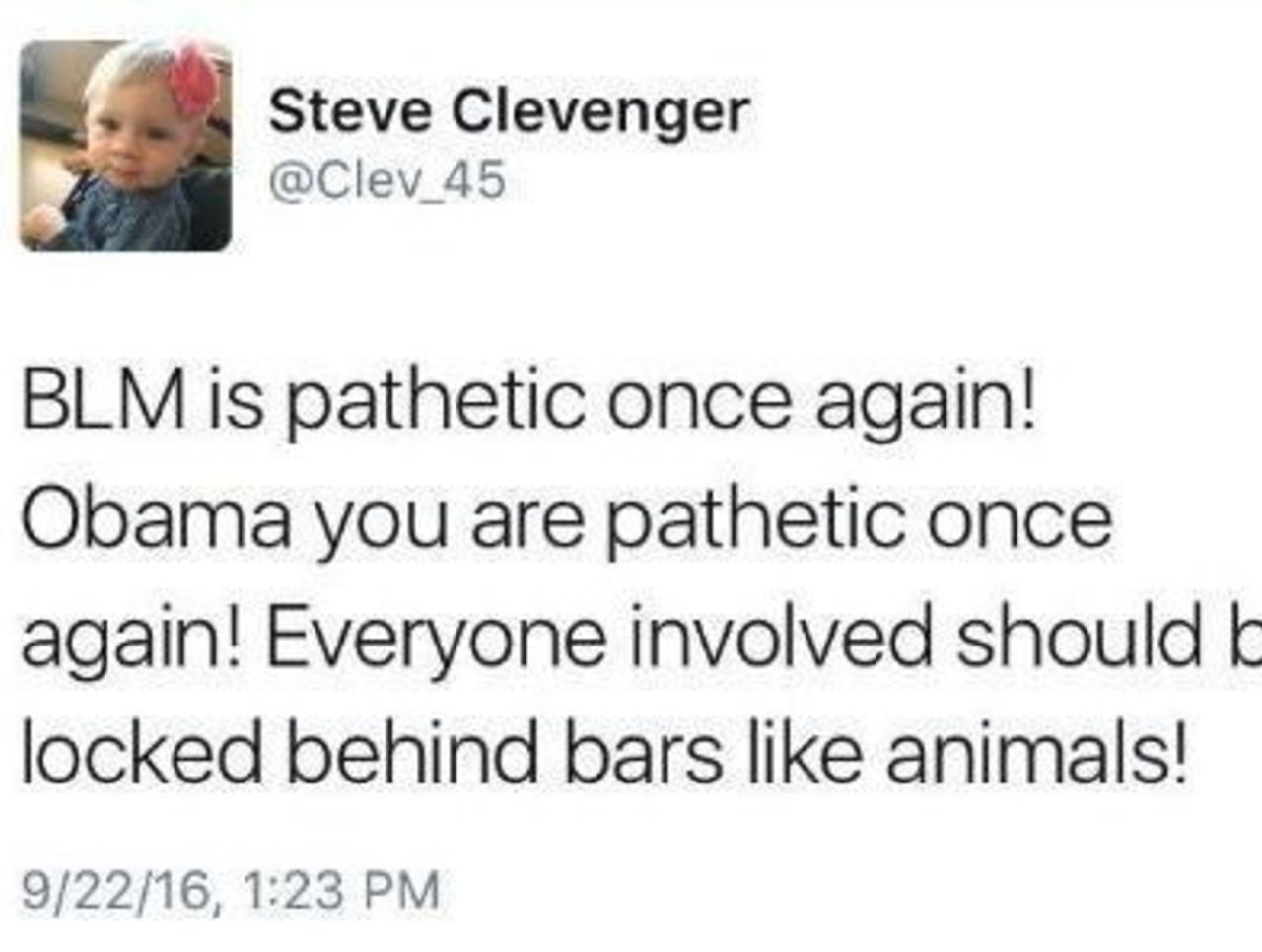
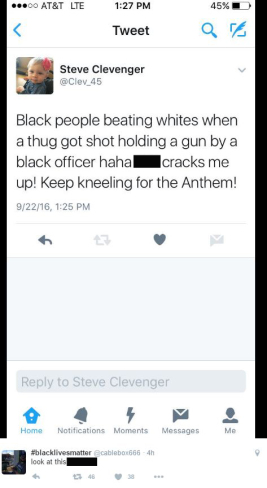
After seeing, hearing, reading about the goings-on in Charlotte, Steve Clevenger deemed it important to shed some light on the topic.  He felt that he, a white, professional athlete from an affluent suburb of Baltimore, who makes more than half a million dollars per year, had a particularly insightful view of this situation; and, in a sign of the times, felt compelled to share the same with his 2,480 Twitter followers.  Herewith, his elegant prose:

blog_clevenger_tweet_2

blog_clevenger_tweet_3

The Mariners acted swiftly.  Ostensibly under Article XII.B. of the MLB Collective Bargaining Agreement (Conduct Detrimental or Prejudicial to Baseball), the Mariners effectively fired Clevenger, suspending him for the rest of the season without pay.  Kudos to Jerry Dipoto and the entire organization.

Now it is up to the other 29 teams to not sign this piece of trash next season.  He is a free agent; and any team that employs him is willingly making him their representative – on the field and off.

We seem to live in a world where words have no consequences.  People – political figures included – can compulsively lie, and we shrug our shoulders.  People can go on television and the Internet and race bait and not get called out.  People can incite violence, and not feel the wrath of that which they have provoked.

I told my son, just the other day, in real life you have certain freedoms, but you must be prepared to deal with the consequences of exercising those freedoms.

It is time for the Steve Clevengers of the world to deal with the consequences of exercising their freedoms.  I whole-heartedly defend Clevenger’s right to write that which he wrote; but I also whole-heartedly believe that a private institution – like Major League Baseball – need not avail itself of the racists in its midst.

So, here’s to hoping that this is something that Steve Clevenger will never again hear on a Major League diamond . . .

PLAY BALL!!


7 Innings is Perfect…Enough

I have previously written about the excitement and anticipation of sitting in the stands watching a no-hitter.  How the crowd holds its collective breath on every pitch; how the fielders focus their attention just a little more; how the manager wears a hole pacing the dugout.

For those of you paying attention to my prior writings, you know that, since 1901, there have been 252 no-hitters.  However, there have only been 23 perfect games in the history of the sport.  The last one happened a month before Mitt Romney uttered the phrase “47%”; and there have been seventeen no-hitters since then.  Suffice it to say, the perfect game is the rare bird.

When newly-acquired Dodger Rich Hill recorded his 21st consecutive out in Miami on Saturday night, he was six outs away from perfection and a place in the history books.  He was at 89 pitches – a mere pittance by MLB standards – and cruising along.  This one was a no-brainer.  This wasn’t Johan Santana coming off shoulder surgery, throwing 147 pitches to give the Mets their first-ever no-hitter.  This was a 36-year old with a relatively fresh arm and no signs of distress.

Ah, signs of distress.  Rich Hill had – as of Saturday night – pitched in only 21 games over the past two seasons, and only two with the Dodgers since he was acquired on July 31st.  Why so few, you ask?  Because Rich Hill is injury prone in general, and specifically, has a predisposition to blisters.

Now, for you and me, a blister is an annoyance and something that stings in the shower.  For a Major League pitcher, a blister (or blisters) is/are career threatening – they keep you from executing the pitches you are paid millions of dollars to execute.  And Rich Hill doesn’t have a predisposition to just one blister, but two – one that comes from throwing his fastball and one from throwing his curve.  In short, blisters are Rich Hill’s kryptonite.

But on Saturday night, Rich Hill had no such blisters.  Under normal circumstances, Hill would have headed to the mound for the 8th inning; in a perfect world, Dave Roberts could have sat comfortably, waiting for a hit, a walk, or a certain pitch threshold, and then yanked him.  However, these are not normal circumstances, and the Dodgers don’t live in a perfect world.  As of Saturday night, the Dodgers faced the following facts:

  • They had 22 games left, with just a 4-game lead over the recently-surging Giants (in an even year, no less);
  • The greatest pitcher on the planet has made one appearance in six weeks, and his health is a question mark;
  • They have utilized 15 different starting pitchers this season;
  • They currently have 6 pitchers on the DL;
  • After Kershaw and Hill, the five Dodger pitchers on their depth chart have combined for a total of 64 MLB starts; and
  • If Dodgers have any chance of holding off the Giants and making a deep run into October, they need a healthy Rich Hill.

Take those six pre-game factors into consideration, add to them the trainers claimed one of Hill’s blisters was “getting hot”, and that Kershaw had pitched a mere three innings the night before, and, indeed, this was a no-brainer.

If we take as gospel that the sole goal for a team is to win the World Series, Dave Roberts’ decision should be lauded.  If, as many have written, there are other goals – including individual goals – that make up a season and a career, then we need to reconsider.

Earlier this season Joe Girardi spoke of his role in “farewell tours”.  Could the same be said of Dave Roberts for no-hitters and perfect games?

What would the chattering class have said if Hill completed the perfect game, but was then on the shelf for the rest of the season because of the blister(s)?  Could Roberts – a first-year manager – survive that outcome?  Would Dodger fans be okay with a perfect game in Miami in September, but a quick out in Washington or St. Louis in October?

One last point(s): Hill needed to record six more outs to achieve perfection.  There have been thirteen perfect games spoiled by the 27th batter; ten perfect games spoiled by a fielding error; only 65.8% of perfect games through 8-2/3 have been completed; and only 73.7% have even survived as no-hitters.  As of today, Hillary Clinton has a 78% chance of winning to the election.  Does anyone feel super-confident about any of those odds?

Thus, a Nate Silver tip-o’-the-cap to Manager of the Year, Dave Roberts.

PLAY BALL!!

WHO’S THE BOSS

WHO’S THE BOSS

You agree to guarantee an employee nearly 10% of your company’s valuation.  You – and your industry – put that employee on a pedestal, and for good reason, as by all verifiable measures, that employee is the best in the world at what he does.  Some fear that that employee verges on becoming larger than the sum of the company’s parts.  Management realizes that is no way to run a company.  So what do you do?

If you are the Los Angeles Dodgers, and you have committed $215 million to Clayton Kershaw, and you know that the one thing he values above all else on the team is his friend and personal catcher, A.J. Ellis, you restore order by getting rid of A.J. Ellis.  And that is what the Dodgers did yesterday, sending Ellis to the last place Phillies in return for Carlos Ruiz.

For the team, this cannot be a capricious decision.  You must have a valid justification.  If you are going to (a) risk upsetting the team chemistry while in the thick of a pennant race, (b) lose one of the most liked players in decades, and (c) irritate and potentially forever alienate the best pitcher in a(ny) generation, you damn well better have a good reason and you damn well better get it right.

When confronted with various and sundry questions about the move, Andrew Friedman stated – accurately – that Ruiz is an offensive and defensive upgrade over Ellis.  Ruiz’s OPS against left-handed pitching (which is against whom each would bat) is 214 points higher than Ellis.  Ruiz is considered a better pitch-framer than Ellis.  Ruiz has a higher WAR.

And now that Ellis is gone, Yasmani Grandal becomes Kershaw’s primary catcher.  How does that look: Kershaw has a 1.97 ERA with Ellis catching, and a 1.98 ERA with Grandal behind the plate.

So far, Friedman’s thinking seems spot on.

But if you dig deeper, you will note that Ellis has been in the Dodgers’ organization for 14 years, and is beloved by his teammates.  Ruiz is known to be a catalyst, a leader, and nothing less than a great teammate.  On paper, it’s a wash.  But can Friedman – or Dave Roberts, or anyone else – expect Ruiz to join the team on August 27th and command the clubhouse (as a back-up catcher no less) in the same way that Ellis did?  To think so would be foolhardy.

WAR, UZR, and OPS aside, this conversation neglects to mention the elephant in the room – Clayton Kershaw.  Lest we forget that, while Kershaw is under contract through the 2020 season, he has an out after 2018.  It is highly likely (a certainty?) that Ellis will not be a Dodger in 2019, but that is beside the point.  It comes down to respect and consideration.  Maybe Kershaw shouldn’t have the right to dictate who catches him every fifth day (if/when he pitches again), but he at least should have been part of the conversation.  He has earned that right, that respect.

Friedman claims he thought about getting Kershaw’s feedback, but chose not to out of fear of information leaking to Ellis ahead of the trade.  This is a dubious claim.  If you would trust Kershaw in Game 7 of the World Series, if you trust him with a $215 million contract, you could trust him to keep a secret for a few days.  Kershaw has every right to be feel hurt by the front office’s lack of candor.

Kershaw is currently on the DL; he has not performed to his standards in the post-season; and Ellis has been atrocious at the plate.  In a vacuum, trading Ellis for Ruiz makes sense.  But it certainly feels like there is more to this deal.  It seem that, at this moment, Andrew Friedman needed to show his team and his star player who is in charge.  Friedman is getting paid $7 million per year to make difficult decisions and to give his team the best chance to win, hurt feelings be damned.

In the aftermath of the trade, Buster Olney said this move will be judged solely on the results.  Win the Pennant or the World Series, all will be forgiven.  Lose the NL West or the Wild Card, everyone will point to August 25th as the day the season changed.  (And getting one-hit on your home field hours after the trade is an inauspicious start to the Post-Ellis Era.)

I rarely disagree with Buster, but I do here: Even if the Dodgers win, I don’t think all will be forgiven.  I think this decision will resonate for some time, and may play a role in Kershaw’s decision after the 2018 season, and in the free agent market in the years ahead.

Friedman will always – and, in this case, rightly so – hang his hat on making the tough trades to improve the ball club.  And players (including Kershaw) will be free to decide if that is the type of ball club for whom they want to play.

But make no mistake, by trading Ellis for Ruiz without consulting Kershaw, Friedman declared, unequivocally, Who’s the Boss.

PLAY BALL!!

NO HITTER NO MORE

NO HITTER NO MORE

A little over a year ago I wrote about what I truly love about baseball, the two strike pitch.  Nothing can really top that.

However, last night at Dodger Stadium, I witnessed a close second.  In July of 1991, on a hot Sunday afternoon, I was lucky enough to watch “El Presidente” throw a no-hitter.  It was 91 degrees that day, which is something like 200 degrees in the yellow box seats at Chavez Ravine), and yet nearly all of the 45,560 in attendance stayed until the final out.

There is really nothing like what happens at a ballpark around the seventh inning when the second column of the scoreboard reads “0”.  It doesn’t matter if it is the home team or the visitors – the crowd begins to sense history.  Each pitch, each swing, each slow roller, takes on even more importance.  If the game is close (1-0, 2-0), then every at bat has dual meaning, and fans aren’t really sure for which outcome they are rooting.

And typically, because the Baseball Gods are a fun-loving group, these games include at least one (and often more) incredible play by a defender – a play that probably would not have been made if the pitcher had already given up 5 hits; a play that could not have been made if the ball had been hit off a middle reliever.  But there is something about that moment, when the back of the seat is superfluous and finger nails become a thing of the past, that brings out the best in each competitor.  Last night was no different.

We need not even get into the conversation of the Perfect Game.  Players will tell you how nervous they are on defense – how, for the first time since Little League, they are praying the ball does not get hit to them.  Imagine a football player ever saying he doesn’t want the ball thrown to him; imagine a basketball player saying he doesn’t want the final shot.  For sheer honesty and candor, baseball players are the best.  But I digress.

ESPN has taken to sending No-Hitter Alerts to your phone.  The MLB Network will cut into games where a no-no is in progress.  But you cannot properly explain what it is like to see/feel a no hitter in person.  There have been 252 no hitters thrown since 1901; nearly two per season, so they are not that rare.  (By contrast, there have only been 4 twenty-strikeout games…in history.)  No matter.  No-hitters are still a thing of beauty.

The tension begins to build around the time we sign “Take Me Out to the Ballgame”; if you are watching closely, you will see that teammates avoid the pitcher in the dugout.  The spectators start to gets antsy, and beer lines begin to get considerably shorter.  And fans who would normally make an early exit to beat traffic, find themselves safely ensconced – in for the duration.

Last night, on one of those Chamber of Commerce, picturesque evenings above downtown Los Angeles, Matt Moore came within one pitch of adding another name to the list of 252.

“A little flair into right field, it’s gonna drop.  A bloop single to right field . . . 133 pitches, and a blooper to right . . . and so it goes in this great game.  It seems almost unfair.”  The poetry of Vin Scully.  Of course Vin Scully would be smack dab in the middle of this game; the Baseball Gods would have it no other way.  Vinny fell just shy of calling his 21st no-hitter in the waning days of his storied career.

While it was “almost unfair” to Matt Moore, it was quite unfair to these guys:

On June 3, 1995, Pedro Martinez threw a perfect game for nine innings.  27 up, 27 down.  But then Bip Roberts dropped a line drive just inside the right field line to lead off the 10th, and the perfecto was no more.

That may sting, but that ain’t no Harvey Haddix: On May 26, 1959, Haddix retired the first 37 batters he faced (37!!) before Joe Adcock doubled and eventually scored in the 13th.  No perfect game, no no-hitter, no shut out, and no win for Poor Harvey.

Blog_Stieb

But, for my money – and my memory – nothing can or will top the week of September 24-30, 1988.  Before Kirk Gibson jump-started his legs and hooked a Dennis Eckersley slider into the right field pavilion; before Orel Hershisher cemented his place in baseball lore, there was Dave Stieb.  Some made not remember the mustachioed right-hander from Toronto, but I sure do.

Coming off a 4-hit complete game shutout against the Indians, Stieb was throwing a gem at the old Municipal Stadium in Cleveland on September 24, 1988.  He had recorded 26 outs, and had Julio Franco 0-1.  Franco hit a slow bouncer up the middle that took one of the weirdest hops in the history of the game (see video below), ending the no-hit bid.  Stieb then retired Dave Clark to secure the 1-0, one-hitter.

Six days later, Stieb took the hill at the old Exhibition Stadium in Toronto.  He proceeded to record the first 26 outs before Jim Traber came to the plate.  At this point in his career, Traber had played less than 200 games and recorded about 125 big league hits; he wouldn’t record even 50 more.  But on this night, on a 2-2 pitch, Traber flared a ball into the no-man’s land behind first base, bringing heartache (x2) to Dave Stieb.  How could that happen?  Why did that happen?

Well, the Baseball Gods were not yet done with Mr. Stieb.  Not a year later, Stieb was throwing a Perfect Game with two outs in the 9th, when Roberto Kelly lined a double down the left field line.  The third time was not a charm.

However, Stieb was not to be denied.  In 1990, Dave finally bested the Indians and the Gods, throwing his one and only career no-hitter.

One other fun fact: After the back-to-back one-hitters to close out 1988, in Stieb’s second start of 1989 he took a no-hitter into the 5th inning, and finished his third one-hitter in four starts.

So Matt Moore is in illustrious company.  And, when he thinks back on what might have been, he can take just a touch of solace in the fact that – since 1961 – there have 148 other no hitters broken up in the ninth inning or later.  And in the last five seasons, six no-hit bids have been broken up with two outs in the ninth.

And, lastly, he can take some cold comfort that he is not Armando Galarraga:

PLAY BALL!!

A-ROD NOT THE VILLAIN

A-ROD NOT THE VILLAIN

The rain cleared, the game ended, the chanting stopped, and the door closed.  Last Friday night, A-Rod said goodbye to the Bronx; and the Bronx said goodbye to one of the most polarizing athletes in the history of the sport.

Love him or hate him, A-Rod had a storied (steroid?) career.  And while we can debate whether or not Friday night was the last time we see him in uniform (my bet: not), it cannot be denied that his final week in pinstripes was as unusual as any player in (recent) history:

  • The Yankees gave him a 5-day warning before he was fired.
  • Joe Girardi gave him assurances he could play as much as he wanted and then went back on his word(s), twisting himself into a pretzel to declare “my job description does not entail farewell tours”.  I guess Joe conveniently forgot 2013 and 2014.
  • The Red Sox fans chanted “we want A-Rod”, and then watched him go 0-5 over 2 games at Fenway.
  • Rain nearly washed away Rodriguez’s final game (Mother Nature has a warped sense of humor).
  • Girardi denied A-Rod’s request to play third base in his final game; then Girardi denied the request was even made.
  • And then, although in the lineup as DH, Alex played third base in the top of the ninth for one out (a strikeout).  He left to a standing ovation.

The curtain dropped.  And then it rose again . . .

The moment A-Rod’s odd Sunday morning press conference ended, every talking-head seized on his failure/refusal to utter the word “retire”.  Once officially released, any team can have A-Rod for a pro-rated minimum salary (as of today, approximately $135K; $507.5K for next season).  When Giancarlo Stanton went down for the year, the chattering class started in earnest, speculating whether or not A-Rod could lead his hometown Marlins to the Wild Card as a right-handed/platoon option at first base.  A-Rod’s publicist quickly kiboshed that idea, issuing a statement that he would not play for another team in 2016.  2017 was conspicuously absent from the release.

But enough about all of that.  Small forests have been felled discussing L ’Affairs A-Rod.  This guy has been pilloried and derided, battered and abused, sixty feet six inches from Sunday.

But if you are able to look past the mirror he kissed; the centaur painting; the PEDs; the makeup; the slap; the Jeter diss; the general and all-around douche baggery, you can find a moment that never gets enough coverage, and for which Alex never gets enough credit:

Before the 2004 season, Rodriguez signed a deal memo wherein he would have given up nearly $30 million of the $179 million remaining on his contract to facilitate a trade from the (then) moribund Rangers to the 5-outs-away-from-the-World Series (thanks, Grady) Red Sox.  Sure, a 16% sale at Nordstrom may not move your needle, but giving up 1/6 of a guaranteed contract for a chance to play with a contender was essentially agreeing to play more than a season for free.  The MLBPA nixed the deal, the Yankees figured out the trade, and the rest is history.

Sure, Red Sox fans (in hindsight) breathed a sigh of relief; sure, the Red Sox won two World Series without A-Rod before the Yankees won one with A-Rod, and then added another for good measure; sure Manny Ramirez (who would have been traded to Texas for A-Rod) became a legend before he became a pariah in Boston; sure Jon Lester was instrumental in two World Series championships for Boston and he would have been gone but for the MLBPA’s veto of the deal.

But sliding doors notwithstanding, one can never forget that in an era of me-first players, an era of ever-increasing salaries, an era of opt-out clauses, and billion dollar team valuations, A-Rod offered to give back $30 million to play in the harshest media market in America.  It is unfortunate that all of the negative stories (and, to be sure, there are many) will resign this story to the scrap heap of baseball history, buried in the rubble of deals that never happened, agate-type never printed.

So the next time we cheer Robinson Cano (who left NY for an additional $65 million); or Albert Pujols (who left the Cardinals for an additional $44 million), or Zack Greinke (who left the Dodgers for an additional $51.5), or Johnny Damon (who left the “Idiots” for the “Evil Empire” for an additional $12 million), remember the one guy who offered to take less – way less – just for a chance to win.  It won’t make you love A-Rod, but it might make him a skosh less hateable.

PLAY BALL!!