Clayton’s Dad

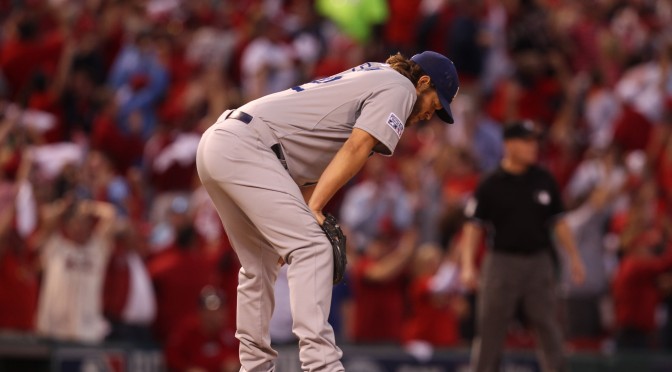
Clayton Kershaw was born my sophomore year of high school. For reasons that we need not get into here, I cannot possibly be his father. However, when he takes the mound — and especially when he takes the mound late in the game — and especially when he takes the mound late in a post-season game — I may as well be.

The nerves I feel for Clayton are not dissimilar to those I feel when my own son toes the rubber for his JV team or when my daughter is astride the balance beam. My hope for them to do well is only surpassed by my desire that they not be in that  moment at all. I sometimes wish I had taught them that life can be a spectator sport.

I am, by nature, a pessimistic fan. I expect the worst to happen, and am only relieved when it doesn’t. I guess this is the product of a lifetime of Red Sox fandom and having the Arizona Wildcats as my alma mater.

I have no doubt, at 730pm Friday night, when Clayton Kershaw takes the field, in the words of Vin Scully, “in the loneliest place in the world, the pitcher’s mound at Dodger Stadium,” I will be biting my nails to the nub.

It will be for the same reason that when Clayton gave up a lead-off double to David Freese in the bottom of the fifth inning of Game 2 of the 2013 NLCS, with the score 0-0, I got a pit in my belly. This “dad” knew something wasn’t right. Runner on second with no outs!? When Kersh struck out Matt Adams, it looked like he had a way out. But then there was an A.J. Ellis passed ball, and the air got a little cooler. A harmless (had the runner been on second) flyball made the score 1-0, which is where it stood when the 27th out was recorded.

Who can forget October 3, 2014. Kershaw gave up solo homers to the second and eighteenth batters he faced; he retired all 16 in between (including seven Ks). The sixth inning ended with the Dodgers up 6-2. “Pull Kershaw,” this dad yelled from my kitchen, where I was helping prepare the Sandy Koufax-approved Erev Yom Kippur meal. Preserve the beauty of this performance and allow the bullpen to get the last nine outs. Alas, it wasn’t meant to be. We all remember the disaster that was that fateful seventh inning; the inning that, in many respects, defines Kershaw’s post-season career: 1B, 1B, 1B, 1B, K, 1B, K, 2B, BB, HR, 5-3. The top of the seventh ended with the Dodgers trailing 10-6, with Dodgers eventually losing 10-9.

But Kershaw had a chance to atone not four days later in St. Louis, and he was ready: K, K, K / BB, DP, K / 3, 5-3, K / 7, 1B, 4-3,  K / 8, 5-3, BB, 2-1 / K, K, K. Six innings, twenty batters faced, one hit, nine Ks, one BB. To this dad, it certainly seemed like he earned a hot shower and a cold beer. Yet again, it wasn’t meant to be. Kershaw trotted out for the seventh, and the pit starting forming in my belly. Matt Holliday (he of the 295 career homeruns to that point) led off with an infield single. By the time Jhonny Peralta knocked a clean single to center, I had a full-blown stomachache. Then three pitches later, Matt Adams hit a 3-R bomb to right. Game, set, match, and season over; reputation cemented.

Kershaw had to wait another 367 days to avenge those two Cardinals games. In Game 1 of the 2015 NLDS, Kershaw had made one bad pitch (a homer to Daniel Murphy to lead off the fourth), but was otherwise cruising into the seventh (23 batters faced, 4 hits, 1 walk, and 11 Ks). But then he walked Lucas Duda to open the inning; and we all know about leadoff walks (I know that the actual statistics show a walk isn’t any likelier to score than a hit, but it certainly feels that way). A ground out and then another walk, and my Spidey senses were on high alert.

Why couldn’t Mattingly have pulled him after six? Kershaw didn’t need to be out there for another trip through the order. Hadn’t he learned anything from the year before? Once again, I was no longer a baseball fan, I was a dad watching his son implode – in slow motion. In my alternative universe, this is when I would have excused myself from the stands and taken that long walk behind the bleachers, down beyond the dugout to watch this nightmare unfold in private – away from the prying eyes of the other parents, and where the coach wouldn’t hear me cursing him for keeping my kid on the hill too long.

A Jacob deGrom sacrifice bunt followed by yet another walk, and Kershaw’s night was over. Sacks full with Pedro Baez in to save the day…fat chance. David Wright singled in two, and my boy took the loss. In this alternate universe, I prepared for our long drive home.

It happened again a few weeks ago, in Philadelphia. Kershaw had retired 15 of the first 17 batters he faced, and had a 2-0 lead going into the sixth. But then Ty Kelly lead off with a walk (see above for that pit and that irrationally useless research). A pop-out (phew); single (uh-oh); K (nice); BB (uh-oh, again). This is when the baseball fan in me stepped back and said: “In 103 career chances, Kershaw has allowed five bases loaded doubles, and six bases loaded walks. But he has never allowed a bases loaded homerun.” And then my inner monologue went to Aaron Altherr – a career .234 hitter with a total of 25 big league dingers – and I just knew Kershaw could retire the side and turn a 2-0 lead over to the bullpen. But, the dad in me was still nervous. Father knows best.

When Kershaw hung a 1-1 slider and Altherr hit the ball 418 feet, and four runs scored, and the Dodgers now trailed 4-2, and Kershaw had been out there a few batters too long once again, and all the other parents in the stands were consoling me, I just knew it would be another long drive home.

I don’t know why I have such a filial connection to Clayton Kershaw. I certainly don’t feel this way about Tom Brady, or Andrew McCutchen, or Steph Curry. I want them to do well, but I am not heartsick about the prospect of them not. I don’t secretly hope Brady hands the ball off, or McCutchen draws a walk, or Curry passes up the big shot – I want them in there and I want them to succeed.

Maybe it is because I believe – in my soul – that Kershaw has been the victim of bad luck, and a player of such great quality (both on and off the field) deserves better. Maybe it is because I want the best pitcher alive to always be the best pitcher alive. Maybe it is just because I am a fan, which is short for “fanatic”. I have no idea.

But whatever the answer, I sit in the stands or on my couch holding the theoretical pillow, hoping to provide a soft landing for a grown man; a man with a wife and two kids; a professional athlete making more than $30 million per year. Which begs the question: What is wrong with me?

I guess that’s what makes sports great – we love the game, and we love the players that we root for/idolize/lionize – literally – beyond reason.

And so, when David Peralta or A.J. Pollock digs in for that first pitch of the NLDS on Friday night, rest assured that my heart will be in my throat.

PLAY BALL!!

TOTAL ECLIPSE OF THE PARK

TOTAL ECLIPSE OF THE PARK

Blog_Eclipse_Fest

Shortly after the first of the year, while listening to one of my favorite podcasts, I was clued in to an event happening in Keizer, Oregon, eight months hence.  At the time, I had little knowledge of the impending total solar eclipse; had never heard the phrase “path of totality”; and didn’t know the city of Keizer, Oregon even existed.  But the idea of travelling to a baseball game, to meet a bunch of baseball writers, and to be part of a communal event that happens maybe twice in a lifetime, was all simply too much to pass up.

After a few keystrokes, I learned that the Salem-Keizer Volcanoes – a Short-Season Class-A affiliate of the Giants – would be holding a four-day event around the first solar eclipse to run from coast-to-coast in 99 years.  The long weekend was to be hosted by the Volcanoes, baseball writers from FanGraphs, and a team of engineers and scientists from NASA.  This stood to be entertaining and educational.

I quickly contacted the Volcanoes ticket office and bought the Eclipse Package: tickets to Sunday’s and Monday’s games; breakfast at the park Monday morning; a parking pass; and a guaranty of NASA-approved eclipse viewing glasses.  Little did I know, at the time, what a global phenomenon the eclipse would become; what it would cost to travel to Oregon; and what an amazing experience this would be.  Now I know.

Last Saturday our whole family traveled to Portland.  After a night in the Rose City, we headed 45 miles south to the state’s capital.  Repeated warnings had braced us for Carmageddon-level traffic, but the ride was smooth and we got to town in less than an hour.  On Monday morning, my son and I woke at the crack of dawn to meet 5,000 like-minded fans/sky-watchers at Volcanoes Stadium.  We grabbed ballpark breakfast (think: camp) and milled amongst baseball fans and science nerds.  The air was cool, the sky was blue, and the crowd was atwitter.  We were three hours from “totality”.

Monday morning’s game against the rival Hillsboro Hops – scheduled to start at 930am – was delayed because the opponents got stuck in traffic.  (You’ve got to love Single-A baseball!)  The Volcanoes gave up four runs in the top of the first, while we sat in the stands wondering if it was the sight-lines at the stadium, the game time, or the encroaching moon, that caused the viewing experience to be less than optimal.  NASA soon answered the question, delaying the game before we reached the home half of first, due to lack of light.

Blog_Eclipse_Sundown

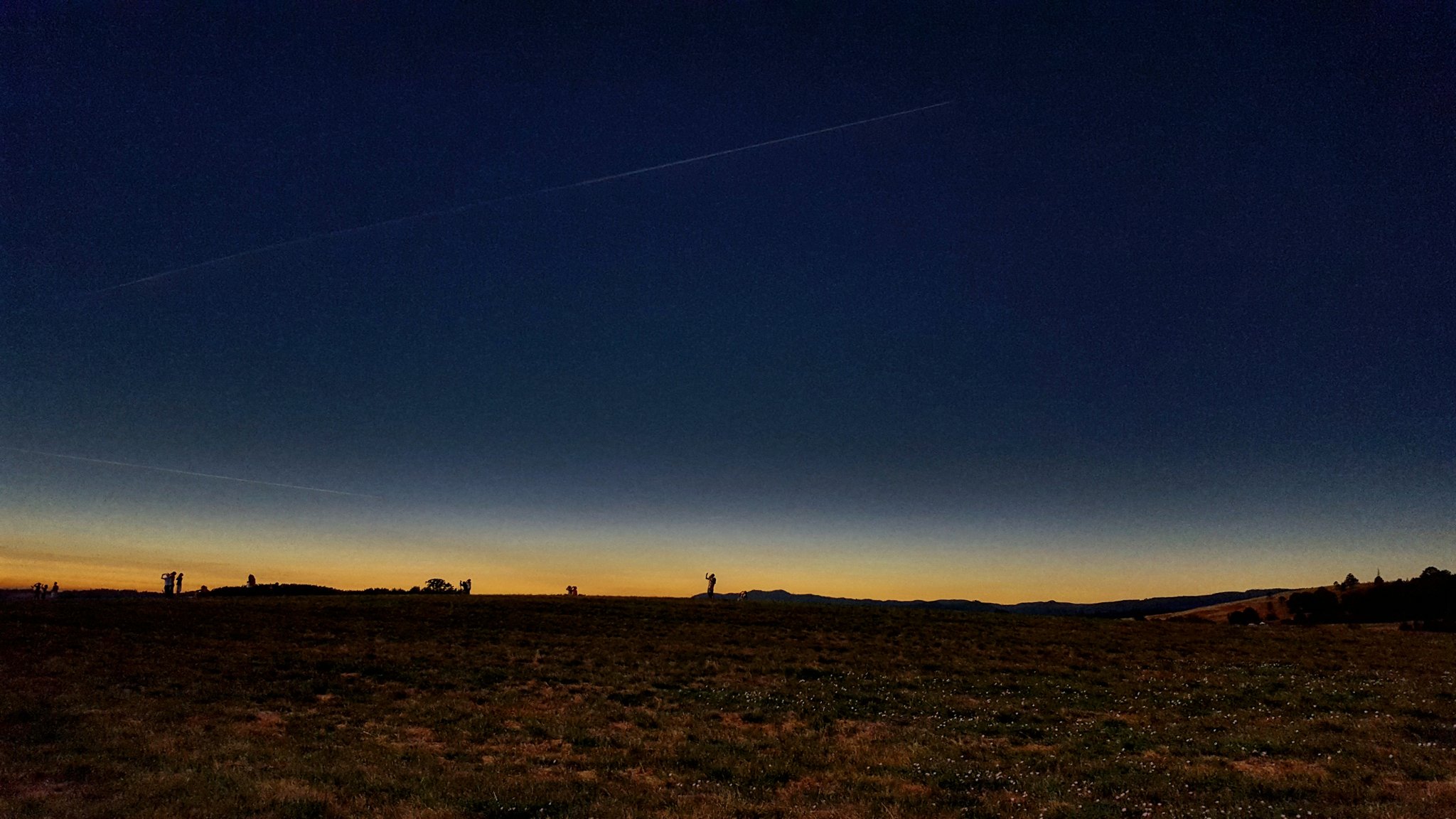
And that is when the suspense really took hold.  Players dropped their gloves and copped a squat along the baselines.  There was a buzz in the stadium as we donned our glasses and felt the air drop by as much as 12 degrees.  There was a light breeze, and we watched what appeared to be a sunset along the horizon – at 1015 in the morning.

Blog_Totality_1

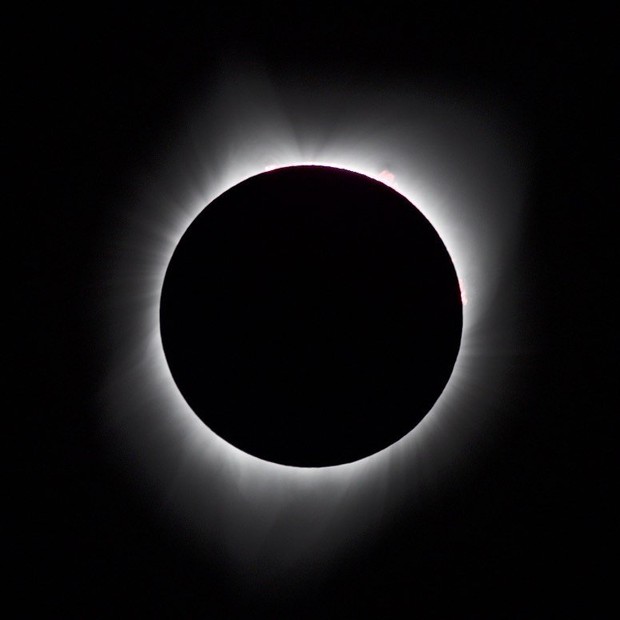
And then, within moments, the NASA engineers instructed us to remove our glasses, and we witnessed “totality”.  For nearly two minutes, the sun fought valiantly to overcome the moon’s obstruction, to little avail.


People who know of our trip have asked how it was.  Unfortunately, I am not a skilled enough writer to properly explain the experience, other than to state that I have chills just remembering it.  But, lucky for us, Ben Lindbergh was there – as part of the FanGraphs host committee – and he articulated with such prose that it makes me want to hang up my keyboard.  Please read his account.

I have joked with my sisters about Niagara Falls in 2024; and I now think there is a fair chance I will be there (April 8th, if you are planning ahead).

PLAY BALL!!

LITTLE BIG LEAGUES

LITTLE BIG LEAGUES

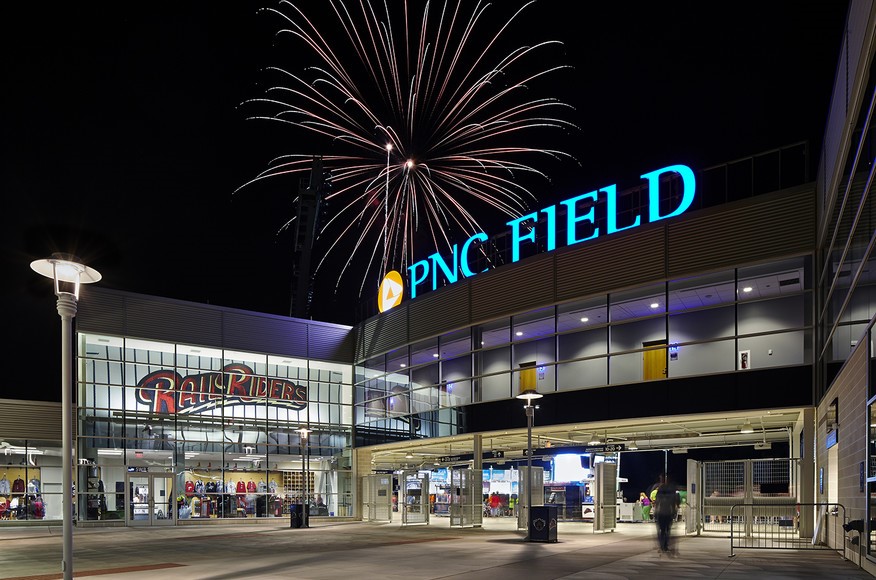
Blog_PNC_Field

On a recent Saturday night I found myself in the small town of Moosic, in northeast Pennsylvania.  Unless you grew up or went to school in the hills of the Keystone state, you probably never have heard of Moosic.  But if you are a baseball fan, you definitely have heard of the surrounding towns: Scranton and Wilkes-Barre (which, to be clear, is pronounced like “bear”).

Scranton Wilkes-Barre (S/WB) has been home to Minor League Baseball (MiLB) since 1919, and the Triple-A affiliate of the New York Yankees since 2007.  Over the past nearly 100 years, S/WB has hosted eight different organizations (nine if you count both the Philadelphia and Kansas City Athletics), and played in eight different parks.  In 1989, the team – then known as the S/WB Red Barons – moved into Lackawanna County Stadium, marking its eighth and (current) final “home” for S/WB baseball.

In 98 years, S/WB has had fourteen different team names, with the Red Barons having the longest tenure (from 1989 through 2006 as the Phillies’ Triple-A club).

In 2007, the Yankees moved to town, leaving Columbus, Ohio for facilities closer to the big club (just a 30-minute private flight away).  With the switch, the Red Barons became the Yankees.  But even the most valuable franchise in baseball (second most valuable in all of sports according to Forbes) cannot maintain naming dominance forever.  More about that in a moment.

At this point it would be helpful to provide a little insight into the business of Minor League baseball.  For our purposes, let’s refer to Major League organizations as “Organizations” and Minor League teams as “Affiliates”.  Or, as I like to think of them, the MLB club is the hot dog and the MiLB team is the bun.

Here is how it works: the MLB Organization “owns” the players (the hot dog), and controls all player-personnel matters.  The MiLB Affiliate owns the ballpark, and controls everything else, including ticket sales, concessions, promotions, travel, and accommodations, essentially everything that surrounds the players (the bun).

In order to be affiliated with each other, an MLB Organization signs a Player Development Contract (PDC) with an MiLB Affiliate.  The PDC has a two-year term, and renews automatically unless the Organization or the Affiliate notifies MLB that changes are afoot.

When an MLB Organization decides to find a new bun for its hot dog, it informs MLB, and the game of musical chairs begins.  That is because there are only 160 MiLB Affiliates, and unless/until an Affiliate-owner sells his/her affiliation to another location, when one Organization moves to a new location, the displaced Organization will need a new home; as such, the MiLB Affiliate owner is always entitled to some team.

For instance, when the Astros decided to leave Lancaster, California after last season, the owners of the Jethawks were not worried…they just needed to wait for the music to stop to find out which wandering soul would land in the California high desert.  (It was the Rockies).

Which brings us back to the Yankees.  After the 2006 season, the Phillies ended their PDC with S/WB in preparation for their move to Lehigh Valley (they had a two-year stop in Ottawa while their new stadium in Allentown was built).  The Yankees seized on this opening, moving their club (the hot dog) from Columbus (the bun) to the mountains of Pennsylvania (a new bun).  Now Columbus had to find a new Organization, which they did with the Cleveland Indians.  You get the idea.

When the Yankees’ Organization came to town in 2007, they compelled the S/WB owners to plaster their moniker on everything, most importantly, on the front of the S/WB jerseys.  But this is where the Affiliate and the Organization often have differing goals and incentives.  On the one hand, why wouldn’t the S/WB owners want to be associated with the Bronx Bombers, one of the most storied franchises in the history of the sport?  On the other, there is no guaranty that the team will stay beyond the two-year PDC, so the Affiliate needs to establish its own identity in the community, regardless of the Organization with whom they are currently affiliated.

And to further complicate matters, insofar as the Organization controls all player personnel issues, determining who plays and when, promoting and demoting players on a weekly (if not daily) basis, the Affiliate cannot market and advertise any individual player, as they never know for how long or how often they can trot that player onto their field.

The S/WB Affiliate was sold after the 2012 season, and the new owners decided they needed their own branding.  Keeping with their Pennsylvania roots, the Yankees were scrapped and the RailRiders were born.  For the first time since 2006, the S/WB team had its own identity.

Blog_Railriders_2 Blog_Railriders_4


Ironically, the decision to rebrand the Affiliate was made even though the new ownership group was a joint venture between Mandalay Baseball Properties and the actual New York Yankees.  But Mandalay was put in charge of managing the Affiliate, and having had great success with the Oklahoma City RedHawks, the Frisco RoughRiders, the Erie SeaWolves, and the Dayton Dragons, the Yankees wisely chose to allow the experts guide the team’s marketing.

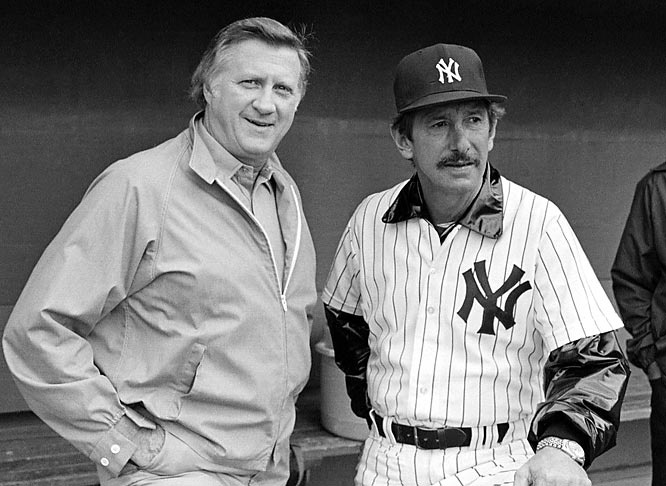
As an aside, if the name “Mandalay” sounds familiar, it is because its Chairman, Peter Guber, is a part owner of the Los Angeles Dodgers (as well as the Golden State Warriors).  So, after this sale in 2012, you had, in effect, the S/WB Affiliate co-owned by the Dodgers and the Yankees.  Somewhere George Steinbrenner and Billy Martin were spinning in their graves.
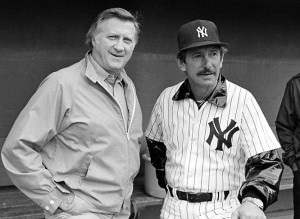
Blog_George_Billy

Mandalay ended up selling their share of the Affiliate in 2014 to a group of local investors, who now manage the club.

And managing an MiLB Affiliate is not for the faint of heart.  It requires ingenuity, gumption, chutzpah, and a whole lot of luck.  By way of example, on a soggy Saturday night a few weeks back, the Affiliate in Moosic was faced with a four-pronged problem:

(1) Call a rainout and lose a night’s gate, as well as the concessions.  The impending rain had huge financial ramifications as it has been a wet summer, so the RailRiders have already lost a handful of games; and Saturday is one of their best attendance nights.  A rainout also raised the prospect of wasting the “bucket hat” promotion.  The team would hate to give out thousands of S/WB hats to fans who didn’t see a game and who didn’t buy at least a couple of beers.

(2) If they called the rainout, the RailRiders would be forced to play a twin-bill on Sunday (assuming the weather held), putting them in a bind with respect to pitching.  This issue was further complicated by the fact that the big club has had a rash of injuries this season, forcing players to go back and forth between the Bronx and S/WB (and Trenton, the Double-A club), which put a limit on the available arms.

(3) Their opponent, the Charlotte Knights, did not want to start the game as they feared the weather wouldn’t hold, the game would be called, and they would burn some of their valuable pitching.  So the RailRiders management had to be cognizant of their potentially unhappy counterparts, who have short fuses and long memories.

(4) The RailRiders had promised their fans a post-game fireworks show.  This one was easy; in the hour before the first pitch was scheduled to be thrown, team president Josh Olerud decided the fireworks would go off regardless – Mother Nature might scuttle the baseball, but she couldn’t stop the light show.  Again, the Affiliate knows that, oftentimes, the product on the field is ancillary to the experience at the ballpark.  S/WB has fans/customers, and the management wants/needs them to keep coming back each week and each season.

Fortunately for Olerud, the team, and the fans, the clouds dispersed and the game was played.  It turned out to be a great – if damp – night at the yard.

The ballpark itself is another area of collaboration and conflict.  Per MLB rules, a facility has to have a certain number of seats, a certain level of lighting, and a certain level of amenities to be deemed acceptable to house a Triple-A team.  But being acceptable to Major League baseball is often different than being acceptable to an MLB Organization.  So, to woo a team to its town, MiLB clubs often agree to make substantial improvements/alterations to their parks.  And the inverse if also true: if an MLB Organization wants to be in a certain location, they might entice the MiLB to sign a PDC by offering incentives to improve their facilities.

When the Yankees moved to Moosic, they were content to play at Lackawanna County Stadium – one of the largest in the entire MiLB.  And S/WB was more than happy to have the Yanks – they sold 47,000 tickets on the day the move was announced.  But changes were coming.

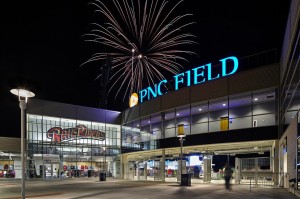
The first order of business was to remove the cumbersome name: Lackawanna County Stadium.  (For people of my generation, LCS hearkens back to “Milwaukee County Stadium” and Harvey’s Wall Bangers, or Dale Murphy and Bob Horner hitting dingers at Fulton County Stadium.  But I digress).  The naming rights were sold to PNC Bank, who dubbed the stadium “PNC Field” (not to be confused with PNC Park in Pittsburgh).

Within a few years, the owners decided that the stadium needed more than just a new name.  And so a $43 million renovation project began in 2012, completely modifying the look and feel of the park.  In a nod to history, the owners decided not to tear down the entire stadium and start anew.  Rather, they kept the location (as pretty as you can imagine, nestled right against the mountains), and ripped out everything but the lower bowl and the playing field.  The “monstrosity” (not my word) that was the upper deck was removed, as were many of the 11,000 seats.  In their place were installed a considerably smaller second-level with three rows of seats, luxury suites, and a stadium club.  They modified the seating in the lower level, and added group spaces in the outfield.  Part of the park reconfiguration was a 360-degree concourse, which gives fans full access to the park (and makes getting to the beer garden and BBQ pit in right field considerably easier).  The club also added grassy berms in the outfield that are utilized every day, but especially on “Dollar Dog” nights, where a ticket to sit on the lawn costs just $1, admission for your canine costs just $1, and the hot dogs around the park are just, you guessed it, $1.

“Dollar Dog” night should not be confused with “Two Dollar Tuesdays”, where lawn seats and Tallboys cost just two bucks.  Or “Wine and Dine Wednesdays”, a ladies night with a pregame wine tasting and wine specials during the game.  The RailRiders cater to the local college kids with “Thirsty Thursdays”, that have pre-game music and $1 Bud Lights.  And to make sure families are covered, there are “Kids Eat Free Sundays”, sponsored by Jersey Mike’s; and if your child is a member of the Champ’s Kid’s Club, they don’t even have to buy a ticket to get in.

As would be expected, the team has a slew of bobblehead nights, their “Legend Series” where former players come and sign autographs, as well as a handful of the aforementioned fireworks extravaganzas.

None of these promotions or marketing plays makes S/WB unique – you can get them at MiLB parks all over the country.  What makes S/WB special is that in 2013, after the remodel, PNC Field was honored as the Best New Ballpark by Ballpark Digest.  In the four seasons since, after shepherding Luis Severino, Greg Bird, Gary Sanchez, Clint Frazier, Jordan Montgomery, and Aaron Judge through the clubhouse to the Bronx, the RailRiders have barely missed a beat, with attendance figures within 2.5% of that much ballyhooed first season in the new park.

I have spent a lot of time, and driven a lot of miles, visiting MLB and MiLB and Independent League parks over the past few summers.  Not many have had the beauty combined with the amenities combined with the friendliness combined with the value for the dollar combined with the high quality fan experience, that I had at PNC Field.  But that does not mean I won’t keep looking.

There are more than five times as many Affiliates as there are Organizations, so wherever you live, there is bound to be one close by.  Take a drive, park a hundred yards (or less) from the gate, buy an unconscionably low-priced ticket, gulp down an ice-cold beer at a fraction of the typical $12, and enjoy a treasure-trove of local eats and standard ballpark fare.  The play on the field may not be ready for primetime (it might be as good as the A’s or the White Sox), but the fan experience most certainly will be.  The lines are short and the traffic is light.  I defy anyone to leave an MiLB game – whether in the heat of the California desert, or in the bustle of downtown Louisville, or in the verdant mountains of Pennsylvania – without a smile on their face.  Head on out to the Little Big Leagues and watch them…

PLAY BALL!!
THE $25,000 FINE

THE $25,000 FINE

Blog_Uncaught_1

Baseball is a beautiful and peculiar game, filled with majesty, intensity, and a whole lot of oddity.  If you are not a dedicated fan, you may find yourself confused by the varied and arcane rules that govern the game.  To that end, one day I may dedicate an entire post just to the most bizarre and inexplicable, but today I have  in mind just one.

A few weeks back I was sitting behind home plate at Minute Maid Park (a small humble brag?), and I witnessed something I am certain I have seen hundreds of times before, but maybe not in this manner.

In fact, we have all seen it, and probably not paid too much attention.  It has become such a routine part of the game, we forget to be annoyed.

According to Major League Baseball Rule 6.05(b), a batter is out when a “third strike is legally caught by the catcher”.  The third strike does not need to be “legally caught” if there is a runner on first base with less than two outs.  Otherwise, it does.  Got that?  Don’t be shocked if the guy sitting next to you is equally confused.

How many times have we seen a Major League baseball player strike out on a ball in the dirt, and not run?  Whether out of frustration, anger, or just plain laziness, batters take that third strike – caught or not – as a fait accompli.  Why?

The comments to Rule 6.05(b) add an additional piece of color: “A batter who does not realize his situation on a third strike not caught, and who is not in the process of running to first base, shall be declared out once he leaves the dirt circle surrounding home plate”.  This is where my trip to Houston comes in.

With two outs in the top of the fourth inning, Gary Sanchez struck out on a pitch short-hopped by Brian McCann.  As the comment to 6.05(b) suggests, Sanchez turned left and headed for the dugout.  McCann, the seasoned (grizzled?) Astros’ catcher began a slow walk back to his dugout, ball in glove, keeping an eye on Sanchez.  I watched this all unfold not fifty feet in front of me.  As soon as Sanchez left the dirt circle and stepped onto the grass (Side Note: Minute Maid Park is a dome that has natural grass – very cool), the umpire signaled “out” and the inning was officially over.

For years I have watched Big Leaguers big league this play; and for years I have yelled “Run!” at the television or to the field.  I have always wondered why this is acceptable practice, and what Gary Sanchez and his ilk are teaching our kids about hustle and heart?  Seeing this up close got my blood boiling.

With two outs in the seventh inning of that same game, rookie Clint Frazier hit a comebacker to pitcher Michael Feliz.  Frazier hustled down the line and was retired 1-3.  But imagine if Frazier simply conceded the play.  Imagine Frazier saw the ball in Feliz’s glove, knew he was out, turned left, and headed back to the dugout.  Mike and Mad Dog (I know, they aren’t together any more) would have lit up the radio waves; Buster Olney would have dedicated ten minutes of his Monday podcast to this; Quick Pitch would have had Harold Reynolds giving us a re-creation in Studio 42; and the Daily News would have had Frazier emblazoned with something pithy like “Redheaded Rookie Too Cool to Run”.  And they all would have been right.  But, since this is just a hypothetical, none of that happened.

But nary a word was said, nor an article written, nor a segment dedicated, to a barely not-a-rookie’s refusal to run to first base.  Why?

Not a week earlier, the Angels beat their cross-town rival Dodgers on this exact play.  With two outs in the bottom of the ninth, Camrin Maybin struck out on a Pedro Baez pitch in the dirt that skipped to the backstop.  Initially, Maybin, being a Big Leaguer, big leagued the play and didn’t run.  Then he realized where the ball was and high-tailed it to first base.  Yasmani Grandal chased down the errant pitch, and then airmailed it into right field, allowing the winning run to score from second.

Maybin when from goat to hero, just by doing what we expect every player on the field to do: hustle.  The amazing thing about this play is that even though the ball rolled all the way to the backstop, and even though Grandal had to chase it down, and even though Yaz had to throw the ball approximately 120 feet, and even though Maybin is one of the fastest guys on the Angels, a decent throw still would have beat him (by a lot).  It took Maybin so long to do the right thing – hustle – that he was nearly out as the result of his own indolence.

I truly believe (and I defy anyone to tell me otherwise) that a catcher – loaded with shin guards, a chest protector, and a mask – has a more difficult, and no matter what, a longer, throw to first base than a pitcher does on a comebacker.  Assume Sanchez had taken off on his third strike.  McCann would had to have corralled the ball, stepped into a throwing lane, avoided the runner heading down the line, and thrown a strike at least ninety feet.  That is no easy task.

After Feliz fielded Frazier’s grounder, he took three steps toward first base, and tossed the ball less than sixty feet with no obstructions.  And yet, Frazier sprinted down the line.  That, we expect.  That is what we demand, from Little League through college.

But we don’t blink an eye when a player concedes the out – when he’s not out.  Imagine a runner heading directly to the dugout when his teammate grounds into a tailor-made 6-4-3.  How would that go over?

Now, I don’t claim to know what penalties are assessed in Kangaroo Courts in clubhouses across the league.  However, I am willing to bet a handsome sum that not running to first on an “uncaught third strike” (the proper nomenclature) is not subject to a fine.

And it happened again last night.  With two on and two out in the top of the 9th, and the Yankees trailing the Red Sox 3-0, Chase Headley chased a Craig Kimbrel knuckle-curve that Christian Vazquez trapped.  So Headley tried to keep the game alive with a mad dash down the line, right?  He made Vazquez throw the ball – equipment and all – ninety feet with two runners on the move, right?  Headley, the twelve-year veteran provided an example to a young and up-and-coming team of how the game should be played, right?  Or he simply headed back to the dugout, allowing Vazquez to tag him for the third and final out of the game?  You tell me…

So here is my idea: Every time a Big Leaguer fails to run to first on an uncaught third strike, he is fined $25,000.  Further, the infraction and the fine are announced to the crowd.  After MLB collects the fine, the money is then donated to the Boys & Girls Club of America (the player should get the shame but not the write-off).

Sure, if you are making $25 Million, 25 large is but .1% of your salary.  But can you put a price on public humiliation?  That fine would have represented 4.4% of Gary Sanchez’s income – a hefty portion of his early-career pay.

Hit a guy in his wallet, and then hurt his pride, and see how quickly his behavior changes.  Tell to the kids at the ballpark and those watching on television that failure to play the game the right way is a punishable crime.

Have the Fenway Park PA announcer explain to the crowd that the Red Sox completed their 52nd win of the season, Kimbrel recorded his 24th save, and that the Boys and Girls Club of America is now $25,000 richer because Chase Headley chose not to hustle.  That would be the cherry on the egg on his face.

I know, I know, this is a slippery slope.  But is it, really?  There are few other instances so egregious, and so obvious.  Sure, we could fine guys for not running out a pop up, but even when they feign hustle, they still make their way to first base.  When was the last time you saw a player retired after a botched pop-up?  Had he hustled he would have been on second base, but he didn’t completely surrender the play.

This one is easy.  Join me in the quest to make “The $25,000 Fine” the order of the day.

And then we can tell Big Leaguers, just like we tell our kids, even if you strike out, you need to…

PLAY BALL!!

Postscript: After I wrote this piece, but before I published it, I watched the Sunday night highlights.  With one out in the bottom of the 7th of the Astros-Twins game, Josh Reddick struck out on a nasty curveball.  The ball skipped away from catcher Chris Gimenez.  Reddick sprinted down the line, forcing a throw.  Jose Altuve, who had been on third, took off for home on the throw to first, and by the time Kennys Vargas got the ball back to a sprinting Gimenez, Altuve had slid home with the Astros fifth run.  Brian McCann struck out to end the inning; thus Reddick’s failure to “big league” (read: play the game the right way), helped the Astros add a run they wouldn’t have otherwise scored.


A FIGHT NOT WORTH FIGHTING

A FIGHT NOT WORTH FIGHTING

Blog_Harper_Strickland

In the eighth inning of Monday’s Giants-Nationals game, with the Nats ahead 3-0, Hunter Strickland decided to seek revenge.  For what, you ask?  For an overly-aggressive slide into Brandon Crawford at second base?  For a little chin music too close to Joe Panik’s baby face?  How about a bat flip and slow trot around the bases by Hunter Pence.  Any of the above would be “justified” (if, by justified, we mean baseball’s anachronistic concept of frontier justice that we have seen on display all too often of late).  It would have been totally out of line, but it would have in keeping with the traditions of America’s Pastime.

If you guessed any of the above, you would be wrong.  And if you are reading this, my guess is that you already know the answer.  Back in the 2014 playoffs, Bryce Harper – he of the flowing locks and face paint eye black – hit two tape measure homeruns off Mr. Strickland.  One went about 450 feet, and the other landed in McCovey Cove.

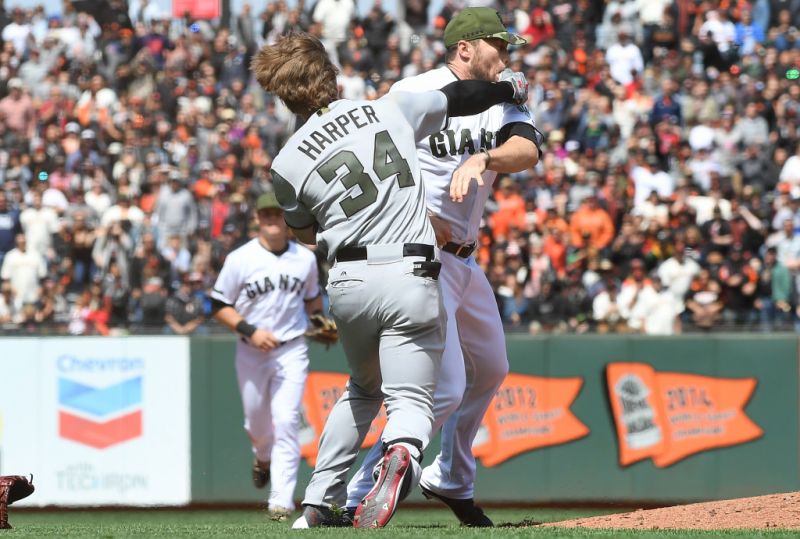
Strickland didn’t take too kindly to Harper’s appreciation of those dingers, nor his glance back to the mound as he rounded the bases.  So Strickland stewed in his juices for 30 months (baseball players have LONG memories and short fuses).  He waited until the time was just right, and then he drilled Harper in the hip with a 98 MPH fastball.  Now Mr. Harper is no shrinking violet, and he – in his own words – “saw red”.  First he pointed his bat, then he ran towards the mound, then he flung his helmet in what can only be viewed as the worst helmet toss of all time – and then he let loose with a fusillade of punches.


All the while, Buster Posey, the Giants catcher and the face of the franchise, didn’t move.  When Harper started barking at Strickland, Posey made no effort to restrain him.  When Harper started running towards the mound, Posey calmly cleaned the dirt around home plate.  It was not until six seconds after the pitch hit Harper – and after the first punches were actually thrown – that Posey even feigned an interest in the melee.

https://www.youtube.com/watch?v=YNNj6TnIiv4

So, after the talking heads got done castigating Strickland for “getting even” (?) nearly three years and a World Series title later, and after they got done making fun of Harper’s helmet tossing skills, they turned their attention to Buster Posey.  Was Posey’s failure to intervene an act of cowardice, a show of grace, a selling out of a teammate, bad sportsmanship, good sportsmanship, just good ol’ common sense, or what?

When asked about it after the game, Posey said: “Well, I mean, after it happened, I kind of saw Harper’s point.  Next thing you know, he’s going out after him. Those are some big guys tumbling around on the ground. You see, [Giants first baseman] Mike Morse is about as big as they come, and he was getting knocked around like a pinball. So … (it’s) a little dangerous to get in there sometimes.”

Posey told his truth.  Strickland was out of line and Buster was having none of it.  Some have argued that players must have their teammate’s back, no matter what.  That Posey had an obligation to at least try to slow Harper down, if not tackle him outright.  Some have argued that this was a mess of Strickland’s making, and his teammates shouldn’t put themselves in harm’s way to settle a score that had no business being settled.

Old school vs. new school.

Although the Giants have been lackluster so far this season, Posey leads the team in hits, batting average, OBP, OPS, and WAR.  He is far and away their best player, and the player they can least afford to lose.  Should he risk an injury or a suspension to defend a red-assed teammate who was first offended back when Ebola was making news?

Some say, “Yes; yes he should”.  To them, I would ask that they indemnify the Giants for that portion of the $21.4M Posey is making this season and the additional $85.6M he owed through 2021 – all money potentially at risk if Buster got injured in that scrum.  This wasn’t defending honor or getting valid retribution.  This was a case of arrested development; a player too immature to deal with another player’s success against him.

If you don’t want guys hitting the ball a country mile and then enjoying it, pitch better.  Oh, and by the way, this wasn’t some Punch and Judy who took you deep.  This was the second best player in the game, who had a 1.251 OPS in those playoffs.  And, oh, by the way (Part II), you won the friggin’ World Series not three weeks later.  Get the hell over it.  And if you can’t, don’t expect others to join you in your little Bryce Harper-invited by a 98 MPH fastball pity party.

Serve your suspension, Hunter.  And when you come back, do us all a favor and just…

PLAY BALL!!

A DAMN SHAME

A DAMN SHAME

Blog_Trout_Injury

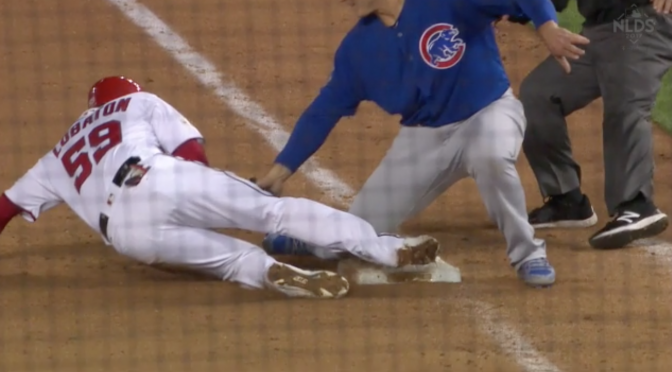
Many people remember Tuesday’s AL Wild Card game for the six first inning runs (including three homers); or the fact that the starters recorded a combined seven outs.  For me, I will remember a little-noted play in the bottom of the 7th inning.  Aaron Judge led off with a walk, and took off for third on a base hit by Gary Sanchez.  A decent throw by Eddie Rosario gets Judge (first out of an inning at 3rd base?!), but Rosario air-mailed it, allowing Judge to take second.  What was remarkable about the player, however, was Judge’s slide into third.  Putting aside the awkwardness of the actual landing, it was that Judge dove into third base.

This is the same Aaron Judge who hit 52 homeruns, led the AL in runs, slugging percentage, and on-base percentage; who had already left the yard earlier in the game.  A player who is a lock for Rookie of the Year and is in a dead heat for MVP.  And yet, in the first game of what Yankee fans hope will be a long post season, Judge put that all in jeopardy with a head first slide.  Why?

It is well-worn territory to say that Mike Trout is the best player in baseball.  By some metrics, he is on his way to being the best player of all time.  And even though it does not seem possible, he keeps getting better.

After the first two months of this season, Trout was off to his best start, leading the league in WAR (33% better than Bryce Harper).  In fact, the early-season disparity between Trout and Harper (#1 & #2 on Fangraph’s WAR list at the time) was the same as the disparity between Harper and #20 on the list (Mookie Betts/Nolan Arenado).

Trout was second in the league (behind only the aforementioned Aaron Judge) in homers; led in OBP and OPS; second in slugging; and in the MLB Top 12 of batting average, runs, stolen bases, and RBI (if you’re into that type of thing).  In short, we were on our way to witnessing greatness squared – Trout outperforming otherwise peak-Trout.  The Millville Meteor was well on his way to another first or second finish in the MVP race for the sixth straight season (besting Barry Bonds in the process).

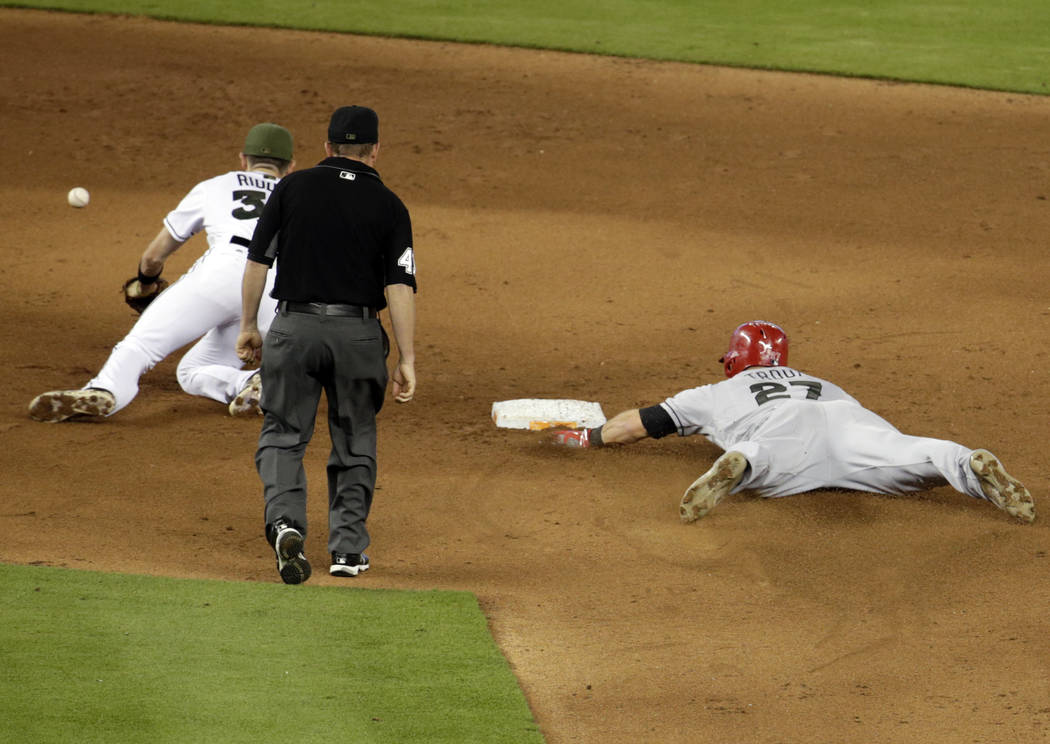
Alas, it wasn’t meant to be.  On May 28th, in completing his tenth stolen base, Trout dove head first into second.  He came up with a torn UCL in his left thumb; had surgery two days later, and didn’t return to the lineup until July 16th, after missing 39 games.  Trout made $19.2M this year, which means this dive into second cost the Angels about $6.5M of lost productivity (and, truth be told, that is a gross under-estimation of his true worth).  But, more importantly, the Angels lost their best player, their best hope for contention, their best draw, and the best reason to tune into an Angels’ game.  We as fans lost the best player in the game.  No more highlight catches; no turning on inside fastballs and hitting them to the rocks at Angels Stadium; no going from first to third on a single to left; and now no reason to pitch to Albert Pujols.

Two years ago I wrote a piece about the stupidity of sliding head first (“Using Your Head…By Using Your Feet”).  After watching Trout walk off the field that Sunday night in May, I went back to take another look.  The article was as relevant in May, as relevant this week, as it was two summers ago.  In case you missed it then, here it is again – maybe Judge can read it before he does something this stupid again.

Losing Trout for a quarter of the season (his first DL stint of his) for an injury that was self-inflicted; for doing an act we specifically prohibit kids from doing.  All you can say is that it’s a damn shame; just a damn shame!

Use your feet…

PLAY BALL!!

COARSENING OF CULTURE

COARSENING OF CULTURE

Blog_Adam_Jones

A few weeks ago, I gave a talk at my daughters’ school entitled Parenting in the Time of Trump.  The upshot of the conversation was: How do you relate to and/or protect your kids from the coarsening of our culture.  What do you do when “grab them by the pussy” is the coin of the realm?

In some ways, it is easy.  We don’t have to watch the news with our kids.  We can avoid discussing politics at the dinner table.  There is no reason to leave the front page of the newspaper on the kitchen counter.  But what happens when the sentiments either encouraged, or tolerated, by those holding the highest offices in the land permeate the culture at large?

What happens when hate crimes are on the rise and anti-immigrant and anti-Semitic graffiti becomes more pronounced?  Or when kids – being kids and thinking they are funny – ape what they see on television or YouTube and pretend to make “Heil Hitler” salutes?  Unfortunately, this is our current reality.

This issue really hit home the other night at Fenway Park.  The Red Sox organization likes to refer to those few acres at the corner of Yawkey Way and Lansdowne Street as “America’s Most Beloved Ballpark”.  Well, tell that to Adam Jones.  Or Carl Crawford.  Or CC Sabathia.  Tell that to the fans – with their kids – sitting in the center field bleachers on Monday night.

To be frank, what happened Monday night is nothing new.

A quick anecdote: When I was six years old, I stood outside the player’s gate at that same stadium, asking Jim Rice to give me an autograph.  He said, “I’ll be right back”, but he never came.  Not to hold a grudge, but more than 30 years later I recounted that story to Fred Lynn.  Without apologizing for his dear friend Jim, he did provide some context.  He told me, “You cannot imagine what it was like for a black man living in Boston in the ‘70s”.  It has been nearly forty years since that encounter, and my guess is that the same sentiment still holds true.

But this isn’t just about ignorant drunkards hurling racist epithets from the safety of the outfield stands.  This is about the jackasses sitting in front of me and my three kids at Dodger Stadium last month dropping F-bombs left and right.  This is about the crude behavior we witness and listen to at ballparks across our great nation.

We all hear these things.  Maybe we move to another section or cover our kids’ ears.  But what else can/should we do?  Bill Shaikin of the LA Times wrote a nice piece on Tuesday, asking a simple question: “Would you speak up?”

In the world in which live today, the answer has to be “yes”.  As I wrote above, avoiding political pitfalls is relatively easy.  The same could be said of avoiding stadium sociopaths.  No one forces us to go to games.  But who wants that?  Is that the Hobson’s Choice we have to make: in order to escape depravity, to protect our kids from hearing and seeing behavior that no one should have to endure, we have to avoid public performance; we have to shun the National Pastime?  That doesn’t seem correct; and it certainly isn’t right.

Jason Giambi once said that “fans boo because they want to cheer”.  I love that.  By all means, boo…and cheer.  Call a guy a bum and accuse the ump of being blind.  Tell the opposing manager he’s a coward when he raises four fingers and sends Mike Trout to first base.  Be an active fan.  But, like all things, do so within reason, taking into consideration what you say and who can hear what you say.

Buying a ticket is not a license to be a bigot.  Educate the kids around you about the game; don’t have them run in fear of “that crazy/mean/drunk guy over there”.

In the aftermath of “N-Word-Gate” (© DFF), Adam Jones suggested that, in addition to being ejected from the park, a transgressing fan should be fined “10 grand, 20 grand, 30 grand.  Something that really hurts”.  I am not sure how that would work, but if a fan who runs on the field can get a trespassing ticket, why can’t a racist, or homophobic, or anti-Semitic fan get charged with disturbing the peace?

Buster Olney suggested that this behavior be called out before games, in the same manner as fighting, or touching a live ball, or running onto the field.  This seems easy enough.

The Red Sox organization jumped on this immediately.  Principal owner John Henry and team president Sam Kennedy met with Jones in person to apologize on behalf of the club and to explain the steps they are taking to prevent another incident.  In fact, the next night a fan was caught making a racial statement.  He was ejected from the game and permanently banned from Fenway Park.

Commissioner Rob Manfred also issued a scathing statement, culminating with “The behavior of these few ignorant individuals does not reflect the millions of great baseball fans who attend our games”.

The bottom line, unfortunately, is that it really is up to us – the millions of great baseball fans who attend these games.  We cannot tolerate this behavior.  Whether it is the drunken lout spouting four-letter words or the outright racist throwing racial slurs.  We must– yet again – become citizen activists who are keeping our eyes and ears open and resisting this offensive behavior.  If the ushers and security guards can keep my son from standing behind the dugout and begging for balls, they can and should be called upon to keep belligerent fans from interfering with the majesty of (watching) the game.

In Baseball is America, Victor Baltov wrote “The state of baseball is the barometric pressure of America’s soul”.  After what we heard and saw in Boston this week, which opened the floodgates to many similar stories at parks across the league, it is up to us, on behalf of ourselves, our fellow fans, and our children, to collectively save America’s soul.

PLAY BALL!!

WHEN REPUTATIONS PROCEED YOU

WHEN REPUTATIONS PROCEED YOU

Blog_Yadi_Ball

Good reputations are earned.  Through hard work, dedication, and good public relations. They are earned over the course of years, decades, an entire career.  But the one sure way to earn a good reputation, to cement your stature into people’s hearts and minds, is by winning.

And once a winning reputation is earned, it is exploited.  And we, as consumers, become suckers for those reputations; lemmings lead to sometimes illogical conclusions because those reputations become hard-wired into our psyches.

I first became aware of this phenomenon back in 1988.  The Dodgers, coming off a 73-win, fourth place finish, brought in a winner.  They signed Kirk Gibson, and his hustle, heart, and (eventual) heroism to a 3/$4.5M contract (how quaint that seems today!).  Gibson, the former Michigan State football star, hitter of that dramatic homerun off Goose Gossage in the ‘84 Fall Classic, and owner of a World Series ring.  It was that Kirk Gibson; and he was bringing a certain “something” to the moribund Boys in Blue.

It took only a few weeks into Spring Training to find out what that “something” was.  The team’s official prankster, Jesse Orosco, decided to pull one over on the newest Dodger.  A little eye black around the inside of his cap; a player donning said cap; eye black on the forehead; hilarity ensues.  Well, maybe not.

Gibson didn’t take too kindly to the joke, and stormed off the field.  He had a few choice words for Hall of Fame manager Tommy Lasorda as he stomped away, and then – channeling his best Buddy Revell – he challenged the culprit to meet him in the cafeteria.  Orosco waited a day, let Gibson cool off, apologized, and we all know how the 1988 Dodger season ended.

Gibson explained away his tantrum by simply saying that game time was the wrong time to mess with him.  And I guess PFPs and infield-outfield the first week of March classify as game time in the world of Kirk Gibson.

Which brings me to my point.  By Spring Training 1988, Kirk Gibson had a reputation as a fighter, a leader, and a winner.  Nothing stood between him and the goal line or a 98 MPH heater.  He was the adult in the room; and anyone who disrespected that did so at their peril.

But what if it hadn’t been Kirk Gibson; what if had been Mike Marshall (the oft-injured first baseman, not the rubber-armed reliever); what if it had been Don Sutton or Steve Sax or John Tudor who lashed out over a silly prank?  The papers (there was no Internet in 1988) would have howled with “cry baby”, and “can’t take a joke”, and “prima donna”, and “get over yourself”.  But, because it was the exulted Kirk Gibson, the World Series hero with the tough guy moustache and the winning reputation, it was a case of “I am here to win…not play games”.  And we all ate it up.

Let’s change sports for a moment.  Tom Brady is arguably the greatest quarterback in NFL history.  He has won two MVPs, four Super Bowl MVPs, and five rings.  In short, Tommy is a winnah!  But watch Tom stalk the sidelines screaming at his teammates.  Will to win, or sore sport?  Demands excellence from all of his teammates, or casts blame on everyone else?  We know the answers to these questions because it is Tom Brady.  But change the paradigm ever-so-slightly, and ask yourself if Tom’s sideline tirades are all that different than those of the hated Jay Cutler.  Cutler “doesn’t care”, “isn’t a leader”, “has a bad attitude”, and is a “cry-baby”.  Really?


Reputation matters.  You wear them like a badge of honor, or they get hung around your neck like an albatross.

How about Joey Bats.  For years we have disliked that guy – for one reason or another – so when he had the bat flip heard ‘round the world, it became an international incident with pearls being clutched from sea to shining sea, across two sovereign nations.  But when lovable Manny Ramirez exalted with joy, it was just “Manny being Manny”, a slugger who plays the game with youthful exuberance.


This all become relevant during opening week when Yadier Molina was involved in one of the strangest plays you will ever see.  Now, Yadi is beloved in St. Louis – he just signed a 3/$60M deal that will take him to his age 37 year – and he is a two-time World Series champion.  He is beloved in Puerto Rico as a conquering hero and the captain of their highly successful WBC team.  And he is beloved in baseball circles for his throwing arm, his in-game acumen, his control of the pitching staff, and for being the best of a trio of catching brothers.

But when Yadi Molina is caught, not red-handed, but no-handed, using an illegal substance, we all laugh it off.  Broadcasters, writers, pundits, all effused with “Wasn’t that strange!” “How wacky!”  “We’ve never seen that before.”  Buster Olney and Derrick Goold called him out, but the whole incident essentially went away.  But imagine if that had been the hated A.J. Pierzynski?  Or the decidedly old-school Brian McCann? Or rookie Gary Sanchez?  Hell, what if it had been one of the other Molina brothers?  I doubt the public perception would have been:  ¯\_(ツ)_/¯.


But Yadi’s reputation precedes and proceeds him.  He is a leader and a winner.  We, as baseball fans, have decided that we love Yadier Molina, and – as such – are willing to overlook his “look ma, no hands” routine.

I guess the moral of the story is do good unto others (i.e., be a leader); treat people with respect (i.e., see their greatness and push them to achieve levels they never thought possible, even if it requires berating and harassment); play as hard as you can (i.e., if you ain’t cheating, you ain’t trying); but most of all, win.  Win and the world will shrug its collective shoulders, will avert its prying eyes, and will tolerate nearly any boorish, unethical, or illegal behavior.

And if you don’t believe me, take at a look at the current denizen of 1600 Pennsylvania Avenue.

And if it is not stuck to your chest protector, I say:

PLAY BALL!!

p.s.  It has taken me a bit to actually write and publish this piece.  In that time, at least in one instance, shoulders were not shrugged, eyes were not averted, and boorish and unethical behavior was not tolerated.  When I first penned this, the penultimate paragraph read:

And if you don’t believe me, take at a look at the men who work at 1600 Pennsylvania Avenue and 1211 Avenue of the Americas.

OPENING DAY

OPENING DAY

Image result for opening day

Is there anything more majestic, more momentous, more magnificent, than Opening Day?

I am old enough to remember when Opening Day was always the first Monday in April, with the first pitch being thrown by the Cincinnati Reds.  That tradition went away in 1994 when ESPN began airing a Sunday Night Baseball game ahead of “Opening Day” the next afternoon (it was slightly altered in 1990 when the Reds opened the season at Houston).  And this season the ESPN tradition  was expanded to three games on Sunday (morning, noon, and night on the West Coast).  But, regardless of the changes, the beauty of Opening Day remains.

Opening Day represents renewal, a reset when—for one day at least—“this is our year” still holds promise.  For some teams, it is the beginning of something magical (the 1984 Tigers started the season 9-0 and ended the season World Series champions); while for others, it is the beginning of an inexorable decline into utter catastrophe (the 1988 Orioles started 0-21 on their way to a 54-win, last-place season).  But for us fans, it is the birth of Spring and the harbinger of the long, easy days that lie ahead.

Contrast Opening Day with the beginning of the NFL season.  The most popular sport in America, which is inextricably linked to the Frozen Tundra (read in John Facenda’s voice) and Thanksgiving and the dead of Winter.  This past year, the average temperature in the cities hosting Week 1 games was 90.3 degrees – with six games fielding players in temperatures of 95 degrees or more.  Nothing screams football like heat stroke and massive sideline fans (and water shortages in the stands).  It takes a full month or two before football actually gets into “season”.

How about basketball?  It starts quietly on a mid-week night in late October, competing against the baseball playoffs and the now-in-full-swing football season.  People often lament the length of the baseball season, but remember that basketball begins before Halloween and ends around Father’s Day.  Does anyone outside of the NBA, Bill Simmons, or Chad Ford even know when the NBA officially tips off?

But everyone knows about MLB Opening Day.  That is something special, something sacred.  Thomas Boswell once wrote a book called Why Time Begins on Opening Day.

On that first Monday, otherwise reliable employees feign illness to leave work for an afternoon in the sun; kids play hooky to spend a few hours at the yard with mom and dad; fringe players vie for that last roster spot just so they can line up on the chalk while armed forces veterans unfurl an American flag across the entirety of the outfield, before a famous singer or a local icon sings the National Anthem.  And, with the toss of a pearl, a swipe of the plate, an adjustment of the mask, a man (to date, it has only been a man) says those two words that start the proverbial engine; that change everything for the next seven months; those two words that inspire hope and engender heartache; that are as old as the hills but as fresh as the infield grass; those those two words that embody a kid’s game; and that remind us that there is beauty in simplicity and purity in potential.  Those two words…

PLAY BALL!!


My Great White Whale

MY GREAT WHITE WHALE

For years I have wondered, and have done a decent amount of research.  I have checked the newspapers and the interwebs.  I watched interviews and read everything I could during the 25-year anniversary.  And yet, the answer to my question – my great white whale – remains elusive.

Who was driving this car:

Blog_Gibby

This picture represents so many things.  Let’s start with the easy one: It represents one of the greatest and most improbable moments in World Series history.

It also represents the classic Los Angeles sports fan who arrives late and leaves early.  This is done, ostensibly, to beat LA traffic.

It represents the power of sports radio.  There is no world in which the driver of that car wasn’t listening to AM 790 when Dennis Eckersley tried to slip a 3-2 slider past a hobbled Kirk Gibson.

It represents the beauty of “what if” and “only if”.  It represents opportunity lost.

This moment – this specific scene of the right field bleachers and the parking lot of Dodger Stadium – is so indelible, is so burned into my psyche, that it has become a meme in my life.  “You don’t want to be the guy in the parking lot when Gibby hit the dinger” is a phrase that I have uttered on countless occasions over the past nearly thirty years.

My boss suffered this indignity just this past weekend.  With the Clippers up 18 and five minutes to go, he left Staples with his son, and victory, in tow.  When he turned on the highway, he realized that things aren’t always what they seem.  He was the “guy in the parking lot when Gibby hit the dinger”.  Sure, a basically meaningless basketball game in March is by no means the first game of the World Series, but the theory still holds.

But this mantra was clearly in play on the first weekend of February.  With a little bit of luck, considerable Expedia alacrity, and a willingness to pay the price, on just three days’ notice, we were headed to Houston for the Super Bowl.  We arrived very late Saturday night, spent all Sunday morning at FanFest, and then headed to NRG Stadium.

By the time we got there, my son – who hadn’t slept Friday night out of sheer excitement; who got little sleep Saturday night because of late arrival/time change/more excitement/early wake-up – was suffering from a pretty bad headache.  I thought food might solve the problem; it didn’t.  I thought Sprite might solve the problem; it didn’t.  A trip to First Aid for a pair of ear plugs didn’t do the job either.  As the game wore on, and the contest became even more lopsided, the headache grew worse.

By the middle of the third quarter, with the Patriots down 28-3, my son sent me the following texts (he was sitting with his cousin at the time): “Not sure if I can make it through the rest of the game”; “I’m ready to go to bed”; “Can we leave early”; “The game is pretty much over”.

By the time I met back up with him, the Pats had scored a touchdown (but missed the extra point, natch), and were trailing 28-9.  He was in a bad way.  Now, as an aside, I suffer from migraines; and I know that feeling when the headache literally takes over your body and you have no energy to even think.  All you want/need is a quiet, dark room with a cool washcloth on your head.  What you most definitely don’t need are the bright lights of a domed stadium, with a cacophonous crowd losing their shit on every play.

We met on the concourse with about two minutes to go in the third quarter, and the Falcons in Patriots’ territory.  We had the following exchange:

  • Jake: “Can we go?  I really don’t feel well.”
  • Me: “I hear you buddy, but this is the Super Bowl, so I really need you to try to rally.”
  • Jake: “But the game is essentially over.”
  • Me: “Okay.  Let’s see what Atlanta does on this drive.  If they score, we should go.  But if they don’t, you don’t want to be the guy in the parking lot when Gibby hit the dinger.  You will never forgive yourself.”
  • Jake: “Okay.”

While we were having this conversation, there was a holding call, an incomplete pass, and a sack.  Atlanta punted.  We stayed.  And the rest, as they say, is history.

We are twenty-nine years removed from the day after my 16th birthday.

Twenty-nine years have passed since what has been deemed the greatest moment in Los Angeles sports history.

It has been twenty-nine years since we heard two of the all-time great calls: “She is . . . gone” and “I don’t believe what I just saw”.

And we are twenty-nine years from the greatest steering-wheel punch of all time; when one guy’s desire to beat traffic became the most ignominious break slam of all time.

I just wish I knew who that guy was.  He is my white whale.

The search continues…

PLAY BALL!!