7 Innings is Perfect…Enough

I have previously written about the excitement and anticipation of sitting in the stands watching a no-hitter.  How the crowd holds its collective breath on every pitch; how the fielders focus their attention just a little more; how the manager wears a hole pacing the dugout.

For those of you paying attention to my prior writings, you know that, since 1901, there have been 252 no-hitters.  However, there have only been 23 perfect games in the history of the sport.  The last one happened a month before Mitt Romney uttered the phrase “47%”; and there have been seventeen no-hitters since then.  Suffice it to say, the perfect game is the rare bird.

When newly-acquired Dodger Rich Hill recorded his 21st consecutive out in Miami on Saturday night, he was six outs away from perfection and a place in the history books.  He was at 89 pitches – a mere pittance by MLB standards – and cruising along.  This one was a no-brainer.  This wasn’t Johan Santana coming off shoulder surgery, throwing 147 pitches to give the Mets their first-ever no-hitter.  This was a 36-year old with a relatively fresh arm and no signs of distress.

Ah, signs of distress.  Rich Hill had – as of Saturday night – pitched in only 21 games over the past two seasons, and only two with the Dodgers since he was acquired on July 31st.  Why so few, you ask?  Because Rich Hill is injury prone in general, and specifically, has a predisposition to blisters.

Now, for you and me, a blister is an annoyance and something that stings in the shower.  For a Major League pitcher, a blister (or blisters) is/are career threatening – they keep you from executing the pitches you are paid millions of dollars to execute.  And Rich Hill doesn’t have a predisposition to just one blister, but two – one that comes from throwing his fastball and one from throwing his curve.  In short, blisters are Rich Hill’s kryptonite.

But on Saturday night, Rich Hill had no such blisters.  Under normal circumstances, Hill would have headed to the mound for the 8th inning; in a perfect world, Dave Roberts could have sat comfortably, waiting for a hit, a walk, or a certain pitch threshold, and then yanked him.  However, these are not normal circumstances, and the Dodgers don’t live in a perfect world.  As of Saturday night, the Dodgers faced the following facts:

  • They had 22 games left, with just a 4-game lead over the recently-surging Giants (in an even year, no less);
  • The greatest pitcher on the planet has made one appearance in six weeks, and his health is a question mark;
  • They have utilized 15 different starting pitchers this season;
  • They currently have 6 pitchers on the DL;
  • After Kershaw and Hill, the five Dodger pitchers on their depth chart have combined for a total of 64 MLB starts; and
  • If Dodgers have any chance of holding off the Giants and making a deep run into October, they need a healthy Rich Hill.

Take those six pre-game factors into consideration, add to them the trainers claimed one of Hill’s blisters was “getting hot”, and that Kershaw had pitched a mere three innings the night before, and, indeed, this was a no-brainer.

If we take as gospel that the sole goal for a team is to win the World Series, Dave Roberts’ decision should be lauded.  If, as many have written, there are other goals – including individual goals – that make up a season and a career, then we need to reconsider.

Earlier this season Joe Girardi spoke of his role in “farewell tours”.  Could the same be said of Dave Roberts for no-hitters and perfect games?

What would the chattering class have said if Hill completed the perfect game, but was then on the shelf for the rest of the season because of the blister(s)?  Could Roberts – a first-year manager – survive that outcome?  Would Dodger fans be okay with a perfect game in Miami in September, but a quick out in Washington or St. Louis in October?

One last point(s): Hill needed to record six more outs to achieve perfection.  There have been thirteen perfect games spoiled by the 27th batter; ten perfect games spoiled by a fielding error; only 65.8% of perfect games through 8-2/3 have been completed; and only 73.7% have even survived as no-hitters.  As of today, Hillary Clinton has a 78% chance of winning to the election.  Does anyone feel super-confident about any of those odds?

Thus, a Nate Silver tip-o’-the-cap to Manager of the Year, Dave Roberts.

PLAY BALL!!
WHO’S THE BOSS

WHO’S THE BOSS

You agree to guarantee an employee nearly 10% of your company’s valuation.  You – and your industry – put that employee on a pedestal, and for good reason, as by all verifiable measures, that employee is the best in the world at what he does.  Some fear that that employee verges on becoming larger than the sum of the company’s parts.  Management realizes that is no way to run a company.  So what do you do?

If you are the Los Angeles Dodgers, and you have committed $215 million to Clayton Kershaw, and you know that the one thing he values above all else on the team is his friend and personal catcher, A.J. Ellis, you restore order by getting rid of A.J. Ellis.  And that is what the Dodgers did yesterday, sending Ellis to the last place Phillies in return for Carlos Ruiz.

For the team, this cannot be a capricious decision.  You must have a valid justification.  If you are going to (a) risk upsetting the team chemistry while in the thick of a pennant race, (b) lose one of the most liked players in decades, and (c) irritate and potentially forever alienate the best pitcher in a(ny) generation, you damn well better have a good reason and you damn well better get it right.

When confronted with various and sundry questions about the move, Andrew Friedman stated – accurately – that Ruiz is an offensive and defensive upgrade over Ellis.  Ruiz’s OPS against left-handed pitching (which is against whom each would bat) is 214 points higher than Ellis.  Ruiz is considered a better pitch-framer than Ellis.  Ruiz has a higher WAR.

And now that Ellis is gone, Yasmani Grandal becomes Kershaw’s primary catcher.  How does that look: Kershaw has a 1.97 ERA with Ellis catching, and a 1.98 ERA with Grandal behind the plate.

So far, Friedman’s thinking seems spot on.

But if you dig deeper, you will note that Ellis has been in the Dodgers’ organization for 14 years, and is beloved by his teammates.  Ruiz is known to be a catalyst, a leader, and nothing less than a great teammate.  On paper, it’s a wash.  But can Friedman – or Dave Roberts, or anyone else – expect Ruiz to join the team on August 27th and command the clubhouse (as a back-up catcher no less) in the same way that Ellis did?  To think so would be foolhardy.

WAR, UZR, and OPS aside, this conversation neglects to mention the elephant in the room – Clayton Kershaw.  Lest we forget that, while Kershaw is under contract through the 2020 season, he has an out after 2018.  It is highly likely (a certainty?) that Ellis will not be a Dodger in 2019, but that is beside the point.  It comes down to respect and consideration.  Maybe Kershaw shouldn’t have the right to dictate who catches him every fifth day (if/when he pitches again), but he at least should have been part of the conversation.  He has earned that right, that respect.

Friedman claims he thought about getting Kershaw’s feedback, but chose not to out of fear of information leaking to Ellis ahead of the trade.  This is a dubious claim.  If you would trust Kershaw in Game 7 of the World Series, if you trust him with a $215 million contract, you could trust him to keep a secret for a few days.  Kershaw has every right to be feel hurt by the front office’s lack of candor.

Kershaw is currently on the DL; he has not performed to his standards in the post-season; and Ellis has been atrocious at the plate.  In a vacuum, trading Ellis for Ruiz makes sense.  But it certainly feels like there is more to this deal.  It seem that, at this moment, Andrew Friedman needed to show his team and his star player who is in charge.  Friedman is getting paid $7 million per year to make difficult decisions and to give his team the best chance to win, hurt feelings be damned.

In the aftermath of the trade, Buster Olney said this move will be judged solely on the results.  Win the Pennant or the World Series, all will be forgiven.  Lose the NL West or the Wild Card, everyone will point to August 25th as the day the season changed.  (And getting one-hit on your home field hours after the trade is an inauspicious start to the Post-Ellis Era.)

I rarely disagree with Buster, but I do here: Even if the Dodgers win, I don’t think all will be forgiven.  I think this decision will resonate for some time, and may play a role in Kershaw’s decision after the 2018 season, and in the free agent market in the years ahead.

Friedman will always – and, in this case, rightly so – hang his hat on making the tough trades to improve the ball club.  And players (including Kershaw) will be free to decide if that is the type of ball club for whom they want to play.

But make no mistake, by trading Ellis for Ruiz without consulting Kershaw, Friedman declared, unequivocally, Who’s the Boss.

PLAY BALL!!

NO HITTER NO MORE

NO HITTER NO MORE

A little over a year ago I wrote about what I truly love about baseball, the two strike pitch.  Nothing can really top that.

However, last night at Dodger Stadium, I witnessed a close second.  In July of 1991, on a hot Sunday afternoon, I was lucky enough to watch “El Presidente” throw a no-hitter.  It was 91 degrees that day, which is something like 200 degrees in the yellow box seats at Chavez Ravine), and yet nearly all of the 45,560 in attendance stayed until the final out.

There is really nothing like what happens at a ballpark around the seventh inning when the second column of the scoreboard reads “0”.  It doesn’t matter if it is the home team or the visitors – the crowd begins to sense history.  Each pitch, each swing, each slow roller, takes on even more importance.  If the game is close (1-0, 2-0), then every at bat has dual meaning, and fans aren’t really sure for which outcome they are rooting.

And typically, because the Baseball Gods are a fun-loving group, these games include at least one (and often more) incredible play by a defender – a play that probably would not have been made if the pitcher had already given up 5 hits; a play that could not have been made if the ball had been hit off a middle reliever.  But there is something about that moment, when the back of the seat is superfluous and finger nails become a thing of the past, that brings out the best in each competitor.  Last night was no different.

We need not even get into the conversation of the Perfect Game.  Players will tell you how nervous they are on defense – how, for the first time since Little League, they are praying the ball does not get hit to them.  Imagine a football player ever saying he doesn’t want the ball thrown to him; imagine a basketball player saying he doesn’t want the final shot.  For sheer honesty and candor, baseball players are the best.  But I digress.

ESPN has taken to sending No-Hitter Alerts to your phone.  The MLB Network will cut into games where a no-no is in progress.  But you cannot properly explain what it is like to see/feel a no hitter in person.  There have been 252 no hitters thrown since 1901; nearly two per season, so they are not that rare.  (By contrast, there have only been 4 twenty-strikeout games…in history.)  No matter.  No-hitters are still a thing of beauty.

The tension begins to build around the time we sign “Take Me Out to the Ballgame”; if you are watching closely, you will see that teammates avoid the pitcher in the dugout.  The spectators start to gets antsy, and beer lines begin to get considerably shorter.  And fans who would normally make an early exit to beat traffic, find themselves safely ensconced – in for the duration.

Last night, on one of those Chamber of Commerce, picturesque evenings above downtown Los Angeles, Matt Moore came within one pitch of adding another name to the list of 252.

“A little flair into right field, it’s gonna drop.  A bloop single to right field . . . 133 pitches, and a blooper to right . . . and so it goes in this great game.  It seems almost unfair.”  The poetry of Vin Scully.  Of course Vin Scully would be smack dab in the middle of this game; the Baseball Gods would have it no other way.  Vinny fell just shy of calling his 21st no-hitter in the waning days of his storied career.

While it was “almost unfair” to Matt Moore, it was quite unfair to these guys:

On June 3, 1995, Pedro Martinez threw a perfect game for nine innings.  27 up, 27 down.  But then Bip Roberts dropped a line drive just inside the right field line to lead off the 10th, and the perfecto was no more.

That may sting, but that ain’t no Harvey Haddix: On May 26, 1959, Haddix retired the first 37 batters he faced (37!!) before Joe Adcock doubled and eventually scored in the 13th.  No perfect game, no no-hitter, no shut out, and no win for Poor Harvey.

Blog_Stieb

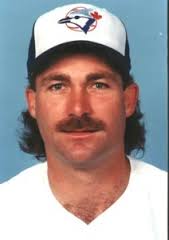
But, for my money – and my memory – nothing can or will top the week of September 24-30, 1988.  Before Kirk Gibson jump-started his legs and hooked a Dennis Eckersley slider into the right field pavilion; before Orel Hershisher cemented his place in baseball lore, there was Dave Stieb.  Some made not remember the mustachioed right-hander from Toronto, but I sure do.

Coming off a 4-hit complete game shutout against the Indians, Stieb was throwing a gem at the old Municipal Stadium in Cleveland on September 24, 1988.  He had recorded 26 outs, and had Julio Franco 0-1.  Franco hit a slow bouncer up the middle that took one of the weirdest hops in the history of the game (see video below), ending the no-hit bid.  Stieb then retired Dave Clark to secure the 1-0, one-hitter.

Six days later, Stieb took the hill at the old Exhibition Stadium in Toronto.  He proceeded to record the first 26 outs before Jim Traber came to the plate.  At this point in his career, Traber had played less than 200 games and recorded about 125 big league hits; he wouldn’t record even 50 more.  But on this night, on a 2-2 pitch, Traber flared a ball into the no-man’s land behind first base, bringing heartache (x2) to Dave Stieb.  How could that happen?  Why did that happen?

Well, the Baseball Gods were not yet done with Mr. Stieb.  Not a year later, Stieb was throwing a Perfect Game with two outs in the 9th, when Roberto Kelly lined a double down the left field line.  The third time was not a charm.

However, Stieb was not to be denied.  In 1990, Dave finally bested the Indians and the Gods, throwing his one and only career no-hitter.

One other fun fact: After the back-to-back one-hitters to close out 1988, in Stieb’s second start of 1989 he took a no-hitter into the 5th inning, and finished his third one-hitter in four starts.

So Matt Moore is in illustrious company.  And, when he thinks back on what might have been, he can take just a touch of solace in the fact that – since 1961 – there have 148 other no hitters broken up in the ninth inning or later.  And in the last five seasons, six no-hit bids have been broken up with two outs in the ninth.

And, lastly, he can take some cold comfort that he is not Armando Galarraga:

PLAY BALL!!

A-ROD NOT THE VILLAIN

A-ROD NOT THE VILLAIN

The rain cleared, the game ended, the chanting stopped, and the door closed.  Last Friday night, A-Rod said goodbye to the Bronx; and the Bronx said goodbye to one of the most polarizing athletes in the history of the sport.

Love him or hate him, A-Rod had a storied (steroid?) career.  And while we can debate whether or not Friday night was the last time we see him in uniform (my bet: not), it cannot be denied that his final week in pinstripes was as unusual as any player in (recent) history:

  • The Yankees gave him a 5-day warning before he was fired.
  • Joe Girardi gave him assurances he could play as much as he wanted and then went back on his word(s), twisting himself into a pretzel to declare “my job description does not entail farewell tours”.  I guess Joe conveniently forgot 2013 and 2014.
  • The Red Sox fans chanted “we want A-Rod”, and then watched him go 0-5 over 2 games at Fenway.
  • Rain nearly washed away Rodriguez’s final game (Mother Nature has a warped sense of humor).
  • Girardi denied A-Rod’s request to play third base in his final game; then Girardi denied the request was even made.
  • And then, although in the lineup as DH, Alex played third base in the top of the ninth for one out (a strikeout).  He left to a standing ovation.

The curtain dropped.  And then it rose again . . .

The moment A-Rod’s odd Sunday morning press conference ended, every talking-head seized on his failure/refusal to utter the word “retire”.  Once officially released, any team can have A-Rod for a pro-rated minimum salary (as of today, approximately $135K; $507.5K for next season).  When Giancarlo Stanton went down for the year, the chattering class started in earnest, speculating whether or not A-Rod could lead his hometown Marlins to the Wild Card as a right-handed/platoon option at first base.  A-Rod’s publicist quickly kiboshed that idea, issuing a statement that he would not play for another team in 2016.  2017 was conspicuously absent from the release.

But enough about all of that.  Small forests have been felled discussing L ’Affairs A-Rod.  This guy has been pilloried and derided, battered and abused, sixty feet six inches from Sunday.

But if you are able to look past the mirror he kissed; the centaur painting; the PEDs; the makeup; the slap; the Jeter diss; the general and all-around douche baggery, you can find a moment that never gets enough coverage, and for which Alex never gets enough credit:

Before the 2004 season, Rodriguez signed a deal memo wherein he would have given up nearly $30 million of the $179 million remaining on his contract to facilitate a trade from the (then) moribund Rangers to the 5-outs-away-from-the-World Series (thanks, Grady) Red Sox.  Sure, a 16% sale at Nordstrom may not move your needle, but giving up 1/6 of a guaranteed contract for a chance to play with a contender was essentially agreeing to play more than a season for free.  The MLBPA nixed the deal, the Yankees figured out the trade, and the rest is history.

Sure, Red Sox fans (in hindsight) breathed a sigh of relief; sure, the Red Sox won two World Series without A-Rod before the Yankees won one with A-Rod, and then added another for good measure; sure Manny Ramirez (who would have been traded to Texas for A-Rod) became a legend before he became a pariah in Boston; sure Jon Lester was instrumental in two World Series championships for Boston and he would have been gone but for the MLBPA’s veto of the deal.

But sliding doors notwithstanding, one can never forget that in an era of me-first players, an era of ever-increasing salaries, an era of opt-out clauses, and billion dollar team valuations, A-Rod offered to give back $30 million to play in the harshest media market in America.  It is unfortunate that all of the negative stories (and, to be sure, there are many) will resign this story to the scrap heap of baseball history, buried in the rubble of deals that never happened, agate-type never printed.

So the next time we cheer Robinson Cano (who left NY for an additional $65 million); or Albert Pujols (who left the Cardinals for an additional $44 million), or Zack Greinke (who left the Dodgers for an additional $51.5), or Johnny Damon (who left the “Idiots” for the “Evil Empire” for an additional $12 million), remember the one guy who offered to take less – way less – just for a chance to win.  It won’t make you love A-Rod, but it might make him a skosh less hateable.

PLAY BALL!!

MOUND BALL

MOUND BALL

Blog_Mound_Ball

Before he took some flak for assaulting/accosting a fan the other night, Joey Votto took some flak for denying batting gloves to a kid sitting behind the dugout at AT&T Park.  Votto’s told the kid that he was sitting in the front row, he is elite, and didn’t need the swag.  We can debate the merit of the response, but it got me thinking about a related topic, which got me thinking about a related topic.

First related topic: At the end of each inning, the player who recorded the last out (or his teammate as part of some bizarre lob around the diamond ritual) is now ethically bound to toss the ball into a throng of awaiting fans.  Gone are the days when fans only clamored for a foul (or homerun) ball.  Now they want the result of a ground ball to short.  I have always thought this was the classic “rich get richer” situation, where people who can afford to sit in the best seats get – in addition to better views and better food – more souvenirs.

But what about the kid sitting in the upper deck, who maybe attends a single game per season, and is in the best seat her family can afford.  Why is she left out?  Wouldn’t it do more for the fan experience if it was less about the haves/have nots, and more about spreading the proverbial wealth to kids of all stripes?  Why couldn’t a player toss the ball to an usher who then randomly selects a cute kid in the cheap seats to be the beneficiary of Joe Panik’s toss to Brandon Belt?  This seems all too easy.

Which brings me to the second related topic: The lost art of the third out ball flip.  Now, I won’t get all sepia-toned nostalgic on you – or maybe I will – but the third out ball flip was one of my (and many others’) great joys in the game.  As a former first baseman, more often than not I found the ball in my glove at the end of an inning.  If I were a current Big-Leaguer, my only (?) joy would be in finding the right fan and hoping to guide the ball to her before some horse’s ass in a Jeter Sucks t-shirt bowls her over for a 5oz. piece of a horse’s hide.

But back in the day, having that ball in your glove opened up a world of possibilities.  There is and was the age-old, pedestrian roll back to the mound.  Some players (think Howie Mandel) might have been inclined to drop the ball directly from his glove onto the mound as he made his way to the dugout.  But there were so many other great options that all sorts of players (this writer included) took advantage of.  And, because only real weirdos like this stuff, there is virtually no stand-alone footage.  Memory will have to serve:

Pete Rose was known for his ball spike.  Johnny Bench would occasionally flip an inning-ending strike out back to the umpire.  Greg Maddux, he of the 900 lifetime non-strikeout outs, often had the first baseman flip the ball to him when he made the third out.  I still love that move.

If a team was in the first-base dugout, it was always cool when the first baseman flipped the ball to the opposing team’s first base coach.  Let him (a) chew on that last out and (b) figure out what to do with the ball.

When Will Clark would make a nice pick to his glove side to end an inning, he would allow his momentum to carry him such that he had an easy toss to the first base umpire.  Always a slick move.

Some catchers would play a game – now known as Mound Ball in the “new ball every half inning era” – wherein he would try to roll the ball up the hill hoping to have it stop at the rubber.  Man, it’s the little things . . .

Now, I will acknowledge that player approbation has won out over player artistry.   But if canvass is going to be ripped from the third-out easel, let’s at least get more fans in on the fun.  And if we can’t do that, can we at least mandate that every player, at least once per season, needs to do an “Andrew McCutchen”:


PLAY BALL!!

MORALITY vs. IMMORTALITY

MORALITY vs. IMMORTALITY

The Mets won their first pennant in 15 years last season.  They had high hopes for this year.  And then the cornerstone of their franchise – and their infield – went down with a season-ending injury.  What is a contender to do?

The Cubs haven’t won a playoff game since 2003 (cue, Bartman).  They are the odds-on favorite to win their division, win the pennant, and win the World Series this year.  But, if they had one weakness, it was bullpen depth.  What is a team with a 108-year championship draught to do?

Winning helps a team’s valuations  Furthermore, winning in the post-season really helps bottom lines; to the tune of $20-$30M/season.

According to Statista.com, the Mets franchise value was $850M in 2014, which rose to $1.35B after the 2015 season, and their current value is $1.65B.   (For some added context, the Royals went from $457M in 2013 to $865M today, after two WS appearances and one title.)

The Mets needed a third baseman.  The Colorado Rockies had no use for the shortstop they had under contract for 2+ years and owed $38M, so they fired him.  Cynics might say the Rockies decision to release Jose Reyes was due to rookie sensation Trevor Story (who hit 14 HRs while Reyes was under league suspension).  The optimist would say the Rockies cut ties with Reyes because his behavior in a Maui hotel room against his wife was wholly unacceptable;  and an organization that doesn’t hide its Christianity wanted no part of such a player.  If the Rockies didn’t put morality above winning, they certainly put it above their bottom line.

The Mets had no such compunction.  They signed their former player, sent him to the Minors to get some reps at third base, and re-introduced him to the Flushing Faithful two weeks later.  The Mets – morality be damned – had a division (Wild Card?) to win.  Anyone who has watched the Doc & Darryl 30 for 30, or read Jeff Pearlman’s book, or Ron Darling’s book, or Lenny Dykstra’s book, shouldn’t be surprised.  As we have learned this election season, New Yorkers love “winnahs”, and how you go about “yuge” success is beside the point.

The aforementioned Cubs didn’t need a closer – Hector Rondon was doing quite well, thank you very much.  But the Cubbies are all-in for 2016.  On July 25th, according to FanGraphs, they had a 98% chance to make the playoffs.  But the playoffs aren’t the World Series, and the World Series doesn’t guarantee a parade.  The biggest “game changer” on the market was Aroldis Chapman – with his unhittable 105MPH fastball and his (allegedly) very hittable girlfriend.  Would Theo Epstein put the prospect of immortality over the simple concept of morality?  As we all know, yes he would.

Theo joined the Cubs in 2011, when the team’s valuation was $773M.  Since that time, it has risen nearly 300%, to $2.2B.

Blog_Wait_Til

“Wait ‘til next year” was selling tickets and moving the needle.  The team didn’t need a championship to add value.  But this move was about winning a title.  And if a few people looked askance at the player they acquired, if those people were not overwhelmed by his tepid apology after coming back from his 30-game suspension, if fans would rather “wait ‘til next year” than win with “that guy”, well, Epstein was not going to be deterred.  Break the Curse of the Bambino and the Curse of the Billy Goat, and Epstein could pick his Hall of Fame induction date. Win at all costs – potentially even your soul; remember, flags fly forever.

But one has to wonder what a parent in Queens or a parent on the North Side says to their kid when they are asked why Reyes and Chapman had been suspended, and why the Rockies and the Dodgers didn’t want these guys around, and why their hometown teams did?  All of that may be forgotten in October, when chants of “Let’s Go Mets” and “Go Cubs Go” ring in the streets, but it doesn’t make the questions any easier to answer.  I guess the answer is: “we root for laundry, and the laundry won; so, HOORAY!”

And, for better or worse, our society seems just fine with that answer.  When we plunk down our hard-earned money to go to the park to cheer for our team, we aren’t worrying about morality, we are praying for immortality.

PLAY BALL!!

KEEPING SCORE

KEEPING SCORE

We all know the old adage: The difference between a .250 hitter and a .300 hitter is a hit a week.  One minor duck fart, quark, Baltimore Chop, Texas Leaguer, or frozen rope per week, and a guy is on his way to All-Star games and the possibility of mega-riches; one less and a guy is on his way to Triple-A – potentially out of baseball forever.

There is no corollary (in baseball adages, anyway) for pitchers; but the same concept applies.  One less earned run per week, he goes from a 4.00 ERA to a 2.9 ERA.  Again, one earned run less per week is the difference between the chance to make $1M per start, and being in the Minor Leagues, making about $85K per year.

Whether a hitter reaches base via hit or error, or whether a run is deemed earned or unearned, can have major financial implications.

And it’s not just hits and errors, but wins, losses, saves, and a whole litany of other potentially lucrative statistics.  (Take a look at MLB Rule 10 for all kinds of nuggets.)

Simply put, a lot rides on one person’s assessment.  Of course, with Sabermetrics and advanced stats like OPS and WRC and FIP and WHIP and BABIP, standards like AVG and ERA may be antiquated, but they are still oft-used and oft-relied upon – especially in contract negotiations.

Blog_Scorebook_1

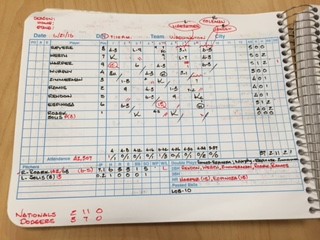
That means that the men and women who sit in the press box – more specifically, in the scorer’s box – and jot down dashes and dots, using multiple pens in multiple colors, creating chicken-scratch in small squares in a small pad of bound paper – have enormous power, whether they know it or want it.

We all know how to keep score.  It started at our kid’s Little League game when you either drew the short straw or looked like someone who (a) knew the game or (b) paid attention or (c) didn’t have a ready excuse not to.  You took “the book” with all those little diamonds, filled in the lineup, and did your best to keep up and keep track.  No one really cared what you did as long as you got the score right and didn’t issue too many errors to the youngsters on the field (“come on, that was a hit . . .”).  Easy enough.

But, for the many men and women who sit high above Major League stadiums every day, the stakes are considerably higher.  And more people rely on that snap judgment than you can imagine.  The scoreboard operator needs to signal to the fans; the television and radio announcers need to tell their respective viewers/listeners; hitters need to know if their batting average just went up or down; and pitchers need to know if what just happened on the field will affect their ERA.  It all matters.  And it all must be decided in a matter of seconds.  How is it done?

Ed Munson, one of three official scorers for the Dodgers and Angels (he alternates), has been doing this for 37 years and scored over 3,500 games.  He will tell you that he knows baseball, and goes with his gut.  I was lucky enough to sit in the box with Ed one night not too long ago, and watch a master do his job.  He made it look so easy.  Trust me, as I kept my book next to his, it is not.  And when Joc Pederson hit a shot up the middle into the shift, and Danny Espionza either couldn’t or wouldn’t get in front of it, Ed made the call immediately.

Up in the box, we had a short post-call debate.  In the end, I begrudgingly agreed with his call (hit).  And when Yasiel Puig grounded into an inning-ending double play on the next pitch – while it didn’t become moot (see AVG, above) – it became considerably less controversial.  No one would have gained from that being ruled an error.

But, the official scorer cannot make decisions based on bias or potential value.  He/she needs to make instantaneous calls based on angles, speed, skill, experience, and the rules of the game (a copy of which Ed keeps next to him every night – even though he knows the book cold).

Until about five years ago, it was not unheard of for a manager – or a player – to so vehemently disagree with a scorer’s decision that they would call up from the dugout to plead their case.  While some viewed this as a Bush League move, others simply viewed it as too distracting to someone trying to do their job in real time.

In an effort to quell any such base instincts, the 2011 CBA gave the players a quiet, but important “win” and – in this process – essentially removed the term “official” from a scorer’s job description.  Because now, rather than simply being subject to the whims of the official scorer, a player (or, more typically, his agent) has 72 hours to file an appeal.  This involves an actual application, often accompanied by a video clip and an explanation as to why the call should be changed.

The appeal is sent to Joe Torre, MLB’s Chief Baseball Officer.  Torre has full discretion, but – according to the rules – the call should only be changed if it was “clearly erroneous”.  Torre customarily sends an email to the official scorer to get his/her interpretation of the play and their reasoning behind the call.  He then has the option of consulting with other MLB officials to get their input; but when Torre renders his decision, it is final, it is “official”.

While you might think that longtime scorers feel usurped by Torre’s ultimate authority, the opposite is actually true.  Mark Jacobson, who has been scoring Orioles games since 1992, told the Baseball Hall of Fame: “It is not a perfect system but … it takes it out of having to deal with the endless ‘did not, did so’ arguments in the press box because now you send it in, let Joe sort it out … and I can go home and not have to worry about whether I’m going to look at that play tomorrow”.

Stew Thornley, who scores for the Minnesota Twins, likes the new process because it is better than confrontations with players or team officials over a contested call.

Scorers have up to twenty-four hours to change any of their calls.  Some, like Munson, record all of their games and go back and review any controversial play to make sure they got it “right” (or, at least, that their call was justifiable).  But most scorers take their ego out of it – they don’t really care if their call is overturned by Torre, as long as there is sound reasoning.  While that may seem counter-intuitive, it really isn’t.  Think about the person who is willing to sit still for 3+ hours and watch every single pitch and record the outcome of every such pitch in a little notebook, with but one goal in mind: making sure that the plays on the field are judged correctly.

They aren’t doing it for the money: They get $170/game (some teams provide food, others don’t; they all provide parking).

They aren’t doing it for the accolades: Michael Duca, who scores for the Giants, told the SF Gate back in 2012: “If you’re doing the job right, you irritate all 50 players in both dugouts”.

They aren’t doing it for the fame: Ask any – even avid – baseball fan if they can name a single scorer.  See what I mean?

No, they are doing it for their love of the game and their belief in getting things right.  As Duca artfully put it: “We act as curators for the history of the game”.

This idea of being a curator of the game really hit home when I learned that Jim Gates, the official scorer of the Oneonta Outlaws (a member of the Perfect Game Collegiate Baseball League, which gathers college players from across the country to play games in Upstate New York in June and July), is none other than the Library Director at the Hall of Fame – a man responsible for more than 3,000,000 documents related to the National Pastime.  In his day job he curates the past, and in his night gig he curates the present.

These men and women, who show up every day and every night have earned a certain amount of respect; and it would be a massive error not to tip your cap to these unheralded stewards of our game.

PLAY BALL!

EXORCISING DEMONS

EXORCISING DEMONS

On October 16, 2003, Aaron “F*&^%ng” Boone added to the Boston lore by hitting a walk-off, game-winning, series-ending homerun in the bottom of the 11th inning, sending the Yankees to the World Series and the Red Sox home without a championship for the 85th consecutive year.

The Boston faithful had reason for hope in the 8th inning that night, up 5-2 with but five outs to go.  As a lifelong Red Sox fan, I have no need to relive (or write about) what transpired next, it being forever seared into our brains by one of the worst managerial decisions in the history of the game.  Suffice it to say, Red Sox fan’s hearts were ripped out, yet again.

In 2004, the script seemed to be re-written.  The Red Sox wiped the slate clean, hired a new manager, and brought themselves into the ALCS with more than just a hope that “this is the year”.  And then the Yankees stepped on the field.  Before you could blink an eye, the Yankees were up three games to none, and a long, cold, dreary winter in the Northeast was again on the horizon.

As a lifelong Red Sox fan, I have much need to relive (and write about) what transpired next, it being forever seared into our brains by the greatest comeback in the history of the sport.  The Red Sox looked into the abyss; there was nothing staring back; at that moment, they found their character; and that is what kept them out of the abyss.  On the shoulders of David Ortiz, the Red Sox rode to victory after victory after victory, ultimately vanquishing the Yankees in Game 7.  The BoSox kept that momentum and swept the Cardinals to win their first world championship in 86 years.  Their demons were exorcised on a cold, Fall night in St. Louis.

So why am I writing about the 2004 Red Sox in the middle of the 2016 season?  Fair question.  The answer (hopefully) will become clear in a moment.

“Red Right 88”

“The Drive”

“The Fumble”

“The Shot”

Jose Mesa and Edgar Renteria and Craig Counsell

“The Decision”

Is it becoming any clearer?

The City of Cleveland has had its share of heartache and heartbreak. Probably a whole lot more than their fair share. The links listed above represent nightmares – literal and figurative – for people of Northeast Ohio.  They represent opportunities squandered and seasons wasted.  They represent the downward turn in the Rust Belt and lakes on fire.  They represent the DNA in multiple generations who have known nothing but loss – and pain.  It has been 52 years since the City of Cleveland has sniffed the sweet smell of success; tasted the sweet wine of winning; drank the sweet champagne of championship.  Clevelanders have grown weak not having to lift trophies over their heads; and have filled landfills with unused ticker tape.

But all of that was supposed to change with “The Letter”.  After the 2014 season, the Cavaliers decided that “this will be the year”.  They brought in a new coach and lured back the hometown hero – and this time he brought with him championship experience.  Just as the Red Sox hired a new manager and brought in an ace with championship experience for 2004, their script was due for a rewrite.

The Cavaliers had a great season and brought themselves to the Finals.  But two of their three best players got hurt, they ran into the buzzsaw that was the Golden State Warriors, and their championship hopes were thwarted for yet another year.  Cleveland fell into another malaise.  Countless stories were written. Documentaries were made.

But Cleveland is a resilient town, and the Cavs are a resilient team.  They battled a sluggish start, fired their “bad-fit” (read: didn’t see eye-to-eye with LeBron) coach, and slowly rounded themselves into a championship-caliber team.  And, just like the 2004 Red Sox, they brought themselves all the way back to the championship.

And just like the 2004 Red Sox, facing the same opponent, they looked overmatched and outclassed.  And just like the 2004 Red Sox, they found themselves on the brink of elimination in the most ignominious and embarrassing of ways.  And just like the 2004 Red Sox, in order to win, in order to hoist a trophy, in order to exorcise their demons, they would have to do something that no other team in the history of the sport had ever done.  The Chinese proverb states: Go straight for the heart of danger, for there you will find safety.  These teams live in that danger.  This is not just a way for these franchises, this is the only way.

So, for those reasons; because the sports gods work in strange and (un)predictable ways; because momentum is a fickle bitch and cannot be denied; because winning on your opponent’s turf makes the victory that much sweeter (just ask Steph Curry); because there simply cannot be any other outcome; the Cavaliers will win tonight.

Or, Steph will do Steph things.  Klay will do Klay things.  Draymond will stop doing Draymond things, and the Dubs will repeat.  What the hell do I know?

For my money, take the 4.5, take the Cavs on the money line, and be prepared for the Cuyahoga to catch fire again.  Someone wake up Barry Goldwater, the City of Cleveland is ready to party like it’s 1964!

PLAY/JUMP BALL!!

EATING CASH

EATING CASH

Eating cash is the new eating crow.  I am not sure when the tide turned and teams decided it was better to eat cash and release or trade a player rather than rolling him out day after day (or start after start) and suffer the indignity of a deal gone bad.  But it definitely has happened.  We have seen this phenomenon a few times just this past week.  To wit:

After an on-radio tirade by the team’s general partner, Padre GM A.J. Preller thought it best to rid himself of James Shields.  The problem, Shields is still owed about $58M (from the 4/$75M deal he signed last season).  The White Sox, knowing they had a ton of leverage, required the Padres to eat $31M of that.  The ChiSox get an innings eater at $7M/year for the next three years.  (However, he only went 2 innings and gave up 7ER in his White Sox debut, so maybe it wasn’t such a good deal.)

Last week the Dodgers did a two-fer: First they released Alex Guerrero.  The Dodgers finally resigned themselves to the idea that this was just a bad deal for a bad player.  There is plenty of blame to go around on this one: While playing shortstop in Cuba, the scouts felt that he didn’t have the skills to play that position in the big leagues.  The Dodgers game him some work at second base, but never enough reps to get proficient (that is partly due to Dee Gordon’s little-anticipated ascendance at the position in 2014); and then they moved him around the diamond like he was playing a game of musical chairs.  Unfortunately for both the player and the team, the music has stopped.  The front office thought it made sense to take a 4/$28M risk on a mid-level hitter with no real Major League defensive position.  Now the Dodgers are forced to pay about $7M to make this mistake go away.

But Guerrero is a drop-in-the-bucket compared to the debacle that is and was Carl Crawford.  With the hand-writing on the wall for seasons, the Dodgers finally bit the bullet and ate the remaining $35M on this deal.  Red Sox fans rejoiced when the Dodgers took over this $142M albatross in 2012, and now the Dodgers are left holding the bag.  Time will tell if Crawford can ever be serviceable Major League player, but he will still be paid like one through the end of next season.

These two teams are tied in ways other than the 5 Freeway and the NL West.  When Dodgers dumped Matt Kemp on the Pads before last season, they agreed to pay $3.5M of the $21.5M Kemp is entitled to until the end of the 2019 season.  However, when (if?) the Padres can dump Kemp on some other unsuspecting team prior to the August 1st trade deadline, it seems pretty clear that they will have to eat some money.  Thus, there is a great chance that, come August, Matt Kemp is wearing yet another uniform and getting paychecks from three different clubs.

One team unwilling (yet) to eat cash, and choosing instead to eat crow every other day or so is the Philadelphia Phillies.  They still owe Ryan Howard about $16M for this season, and then $10M to buy out his option for next year.  Rather than release a fan favorite (?) and someone who has meant a lot to the team and the community, they give Howard spot starts and pinch-hitting opportunities.  How has that worked out: 9 HRs, 9 singles, .150 BA, .559 OPS, and strike outs in 1/3 of all plate appearances.  There is no sign that Matt Klentak or the owners are willing to embarrass Howard by releasing him; they would rather embarrass him by allowing him to try to hit.

Of course, as I have written previously, the grand-daddy of all “eating cash” deals is still a guy who was back in the news today: Josh Hamilton.  As of the moment the Angels shipped Hamilton to the Rangers, they remained on the hook for $73.5M of $79.5M Hamilton was due through 2017.  It was announced today that, after it had been previously announced that Hamilton would miss the entire season, he had surgery to totally reconstruct his ACL.  He may never play again.  I guess, since he was traded in-division, this may be the best news the Angels could have received.

As television deals get richer, and as revenues continue to grow, and as GMs cannot help themselves from making long-term dumb (?) deals (see Greinke, Zack; Pujols, Albert; Cabrera, Miguel; Sabathia, CC; Sandoval, Pablo; Ramirez, Hanley; Ellsbury, Jacoby; etc., etc.), in the years to come you may see more and more teams electing to eat cash rather than eat crow.

PLAY BALL!!

UNDERVALUED ASSETS

Last week we set out to determine which team was carrying the worst contracts for the 2016 season.  As we saw, there were many contenders.  We ended by making reference to the great value in Noah Syndergaard’s $535K deal.  The great news for baseball owners and GMs is that there are many more Thor-like contracts out there – deals for impact players WAY below 2016 market value.

From the start, understand that the average MLB salary this season is $4.4M.  Now, that is not a median, just the mean.  There are a ton of over-priced players making more than $4.4M (see last week’s article); and there are a ton of players making substantially less – while their numbers would indicate they deserve substantially more.

The Major League minimum salary for 2016 is $507.5K (as a point of reference: in 1967 this was $6,000).  As you may know, for the first few years of a player’s career – prior to becoming arbitration eligible – the team dictates the player’s salary.  So, for the sake of simplicity, we will count any player making in the $500Ks a minimum deal.  Here is just a sampling of who falls into this category:

  • Dellin Betances (Best set-up man in baseball?)
  • Mookie Betts (Five-tool future of the Red Sox)
  • Jackie Bradley, Jr. (AL Player-of-the-Month; 29-game hitting streak)
  • Gerrit Cole (Ace of Pirates)
  • Carlos Correa (Rookie of the Year)
  • Sonny Gray (Come July, will be the most sought-after pitcher in baseball)
  • Kevin Kiermaier (Gold Glove winner)
  • Francisco Lindor (Rookie of Year runner-up)
  • Kevin Pillar (Gold Glove runner-up)
  • Addison Russell (Cornerstone SS for World Series favorite)
  • Corey Seager (Ranked top prospect in baseball)
  • Trevor Story (2016 Rookie of the Year?)
  • Marcus Stroman (Ace of Blue Jays)
  • Noah Syndergaard (No further description necessary)

If you raise the bar to the $600Ks, you also get Xander Bogaerts, Kris Bryant, and Jacob deGrom.

But those guys are mere pups.  Let’s seek out some real value under the league average:

  • Jose Fernandez: $2.8M
  • Chris Archer: $2.9M
  • Kenta Maeda: $3.125M
  • Jose Altuve: $3.68M
  • Matt Harvey: $4.325M
  • Corey Kluber: $4.7M (slightly above average, but worth including here)

For between $5-$10M, you could trot the following All-Star lineup:

  • P – Dallas Keuchel: $7.25M
  • P – Chris Sale: $9.15M
  • P – Madison Bumgarner: $9.9M
  • P – Yu Darvish: $10M
  • C – Devin Mesoraco: $5M
  • 1B – Anthony Rizzo: $5.28M
  • 2B – Paul Goldschmidt: $5.83M (some creative license)
  • SS – Manny Machado: $5M (back to his natural position)
  • 3B – Nolan Arenado: $5M
  • LF – Bryce Harper: $5M
  • CF – Yasiel Puig: $7.2M (opinions on the value of this deal vacillate from week to week)
  • RF – Giancarlo Stanton: $9M (his $325M deal is heavily backloaded; if he doesn’t opt-out, he gets $25M+ from 2018-2028)

If you wanted to spend more than $10M, but didn’t want to get to the list of 38 players making $20M or more this season, you could make do with these guys:

  • P – Stephen Strasburg: $10.4M
  • P – Jake Arrieta: $10.7M
  • C – Josh Donaldson: $11.65M (have to move him back to his original position)
  • 1B – David Ortiz: $16M
  • 2B – Ben Zobrist/Neil Walker: $10.5M (each)
  • SS – J.J. Hardy/Jhonny Peralta: $12.2M/$12.5M
  • 3B – Evan Longoria: $12.6M
  • LF – Alex Gordon: $12M
  • CF – Mike Trout: $16M
  • RF – Andrew McCutchen: $13.2M

Said differently, there are 55 players making more this season than this particular All-Star team.  So, all is not lost for the owners; there is still hope (and value) to be found on each 25-man roster.  Well, for this season anyway . . .

PLAY BALL!!