I have written here and elsewhere – as recently as a few weeks ago – about the family aspect of my baseball fandom. My grandfather passed along his love of the game and the Red Sox to my father, who bequeathed it to me; I, in turn, gave it to my son. Four generations, more than a hundred years. Mission accomplished. For us, it is a family affair.
But a few weeks ago, I was asked the following question: “Dad, can we go to a baseball game?” My son is currently living in Washington, D.C., so it was not him asking. Rather, it was my nearly 18-year-old daughter; she wanted to go to a game. Here we had the epic battle of nature vs. nurture, and I didn’t care who won.
All those years of being dragged to her brother’s Little League games; or being dragged by her father to Spring Training and regular season MLB games; or having the family room television co-opted by Sunday Night Baseball or the World Series; or all those long debates with friends and grandparents while she was held captive at the dinner table; had rubbed off and rubbed in. She is now a baseball fan. Now, let’s not get carried away, she doesn’t have a FanGraphs subscription, and she certainly doesn’t read all of my baseball writing, but she does check the scores and knows which teams have won on a given day.
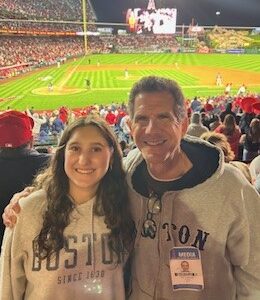
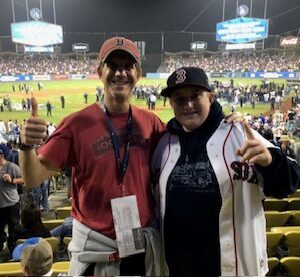
And, to be fair, TikTok also gets a hat tip. It is through that infernal social media platform that she learned of the Savannah Bananas, who are, in many/most respects, a baseball team. The entry point is not important; her love of the game is what matters. So, a couple of weeks ago, she put on her Fenway Park T-shirt and her Boston sweatshirt, and drove down with me to Angel Stadium to see our beloved Red Sox take on the hometown club. I was on the field prior to the game to get an interview, but there she was standing right behind the dugout, taking in batting practice and marveling at the scene in front of her. And – like her brother – she requested that I get her a ball. (Narrator: He got her a ball.)
We found our seats and enjoyed the hell out of the game on a chilly night in Orange County. Her favorite part of the game is the seventh-inning stretch, so we were sure to stand for God Bless America and Take Me Out to the Ballgame. We saw a back-and-forth contest, a grand slam (which was just one of six home runs), a season-ending injury, and another Kenley Jansen save in a Red Sox victory.
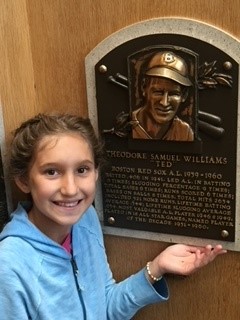
Showing her appreciation for greatness
My daughter is about to graduate high school and head off to college. I know days and nights like this are fleeting. I know that we cannot stop time, as it marches on for all of us. But I also know that bonds formed early, and reinforced often, are hard to break. The bonds I have with my daughter run deeper than just baseball, but it does bring joy to my heart knowing that my game, my family’s game, and now her game, are part of the stew.
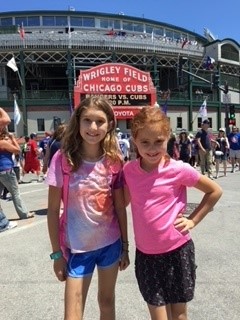
The writer’s girls at his happy place
Somewhere around the eighth inning, a thought popped into my daughter’s head. And with this thought, I knew I had done my job as a baseball dad. She looked at me and asked, “Now that I am going to go to school in Colorado, do I have to become a Rockies fan?!” I smiled and told her that it was a fair question, but that under no uncertain terms is that required or even advisable. But, I did add that Coors Field is a great place to see a game, so any chance she has to go, she should.
I have no doubt that at some point in the not-so-distant future, she and I will be sitting in the Denver sun on a beautiful spring day, enjoying one of the 27 draft beers on offer, and laughing at the product the Rockies have put on the field (and wondering what happened to poor Kris Bryant). And in that moment, I will be happy, proud, and, as a baseball dad, perfectly content.
This article first appeared in the IBWAA Here’s The Pitch newsletter on April 11, 2024
I have written many times in this space about my family connection to baseball. My grandfather, the stalwart Max, lived in Boston and was a Royal Rooter. My father, Saul, grew up in Beantown, sneaking into Fenway (but no hot dogs on Yom Kippur), and cheering on Ted Williams. I was born and raised in Los Angeles, but the love of the Red Sox was passed straight down to me. Joe Posnanski and others have said that your baseball fandom is formed between ages 12 and 14. Well, I was fourteen in 1986, so heartache and heart break were injected into my early teen veins, never to be metabolized. For my first child, I was lucky enough to be bequeathed a son, and into his hands went a glove and a soft Red Sox baseball. The fourth generation of fan was created.
While my love for the BoSox has never waned, the four championships in 14 years lessened the urgency. Moreover, age softens everything, including your edges. As an avid baseball fan, and as an observer and writer about the sport, I have slowly taken a more 35,000 foot view – enjoying all aspects of the game, respecting players of every team (I’m not ashamed to say that I got a little dusty when the previously-hated Derek Jeter hit a walk-off single in his final Yankee Stadium at-bat), appreciating the finer points and constant evolution, but also calling out the game when it fails its players and its fans (e.g., the Cubs desire for a ring allowing them to justify trading for Aroldis Chapman; anything related to John Fisher; the Dodgers putting more value of analytics than morality in signing Trevor Bauer; etc.). Truth be told, I like my current perch better than my youthful exuberance and constant frustration.
But my son, my 21-year old progeny, is now truly coming into his own as a baseball fan. And I am here for all parts of it. There is nothing better than the nature vs. nurture argument. And, as I laid out above, nature came out of the gate with a three furlong lead. But nurture slowly gained ground. Maybe it was the behind-the-scenes tour of Fenway at age six; or the Home Run Derby and All-Star Game at age seven; or Wrigley Field at age ten; or going to the World Series at fifteen. Who knows? But he’s got the baseball bug, and got it good.
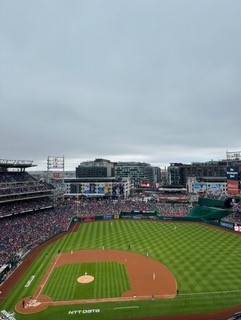
So a couple of weeks ago I was visiting him in Washington, D.C. where he is interning for the semester. He – not me – asked if I could extend my stay for an additional day to go to the Nationals’ opening day. Alas, I could not. But he could; and he did. He got himself a ticket, hopped on the Metro, and took in the game all by himself; just as I have done on so many occasions. I was standing at my desk that Monday afternoon, literally minding my own business, when a text popped up on my phone. It was a picture of Nationals Park taken from the 400 level, with a two-word caption: “So back.”
Jake’s view from the 400 Level at Nat’s Park
As a parent, all you really want is for your children to be happy (and safe). You want them to find their passions and explore them. And if those passions line up with your own, all the better. My son beat me to the ballpark this season (but only by a few days). While there twinge of envy, there was more than a dollop of pride. You get to a point in life where you pass the torch. I am not quite yet ready to do so – nor is he, as he still wants me to buy tickets, hot dogs, and beer – but it is so good to know that when I am, he will be ready. He is already checking train schedules for Baltimore and Philly – just like his father has done.
Soon my son will graduate college and become a bona fide adult. And at some point he may have a son of his own. At this point I feel perfectly confident that he will carry the torch, teach the game to his kid, and then, when the time is right, he will pass it along to the next generation.
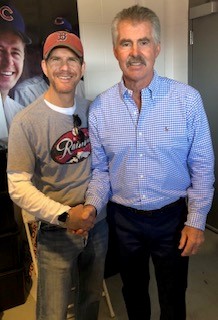
We are deep into Spring Training, which got me thinking about a trip to Arizona we made about six years ago. While visiting Sloane Park in Mesa, I was lucky enough to meet Bill Buckner. Billy Buck, he of the 2,715 hits and career .289 batting average, but also he of the “slow roller up along first.” As a lifelong Red Sox fan, it was an honor to meet Buckner and have an ever-so-brief conversation with him about his career and the exemplary example he set for athletes dealing with adversity. I was deeply saddened when he passed away the following year.
The author and the consummate professional.
In the aftermath of the 1986 World Series, but contrary to reported stories, and despite haranguing from irredeemable baseball fans, Buckner did not flee Boston. Rather, he moved his family to Idaho, where he had previously purchased a ranch, and began buying real estate. However, Buckner will always be remembered for the most ignominious “meg” in the history of Major League Baseball.
The whole Buckner saga never sat right with me, as (1) I am not sure Buckner, even if he fielded the ball cleanly, with his addled ankles and sore feet, beats the speedy Mookie Wilson to first base, and (2) even if he does get there in time, that just pushes the game to the 11th inning. There were no guarantees from there. In short, I never believed that Buckner lost that game for the Red Sox. But the “goat” label stuck to Buckner nonetheless.
There have been many goats in baseball history – guys who make the wrong play at the wrong time, and ostensibly cost their team the game. And because baseball (as well as life) is about sequencing, it is often the last guy standing that gets the condemnation. However, before that goat ever has a chance to “blow” the game, some other player or players need to make some mistakes. I call this “the swallow before the choke.” And, fortunately for the swallower, history often forgets their names, their failures, and their role in the gut-punching final moment. Those players need to bear some of the brunt and share the blame.
Let’s take a look at a few:
2003 NLCS: Game 6 / Top of the 8th Inning
Steve Bartman may be the biggest goat never to don an MLB uniform. His attempt to catch Luis Castillo’s foul ball, which resulted in Moises Alou not catching the foul pop for the second out of the inning, opened the floodgates for the Marlins. Putting aside whether or not Alou would have actually caught the ball, there is still a ton of blame to go around. For our purposes, the swallows are Mark Prior and Álex González.
Prior had already given up a one-out double to Juan Pierre, so the inning wasn’t clean. Further, not only was he not able to recover after the “Bartman Incident,” his ball four to Castillo went to the backstop, allowing Pierre to take third. Prior then gave up a single to Ivan Rodriguez on an 0-2 count. But, even at that point, the Cubs still led 3-1. Enter Alex González.
Prior induced Miguel Cabrera to bounce into a tailor-made 6-4-3 double play to put the Cubs three outs away from the World Series. But, as we know, González booted the grounder, loading the bases for Derrek Lee. Lee – who became the Cubs’ first baseman the following season – promptly doubled home the tying runs (off Prior, natch). Kyle Farnsworth then came into the game to intentionally walk Mike Lowell, give up a sacrifice fly to Jeff Conine, intentionally walk Todd Hollandsworth, and then give up a three-run double to Mike Mordecai. Pierre batted again, and singled to cap off the scoring, and the Marlins ultimately won the game, 8-3. Bartman needed a police escort out of the stadium, and was forced to move out of state; documentaries have been made about him. But other than an amazing reference to González in this season’s finale of television’s “The Bear,” it would seem that González and Prior have escaped the ignominy of that fateful eighth inning.
1951 Final Game of the Season / Bottom of the 9th Inning
Ralph Branca’s name will always live in infamy in baseball circles. Despite a 12-year career that saw him win 88 games, make three All-Star teams, and finish with a 3.79 ERA and a 105 ERA+, Branca is known for one pitch, swung at by one batter, ending one pennant chase.
Ironically, the Dodgers and Giants never should have been playing in that three-game playoff, as the Dodgers were 11.5 games ahead of the Giants on August 11, and still up 4.5 games on September 20, with ten to play. There are any number of reasons that the Dodgers should have won the pennant in 154 games*, saving Branca from his vilification.
*Note: MLB did not expand to 162 games until 1961.
Very few people remember that Don Newcombe took a 4-1 Dodgers lead into that fateful ninth inning. Newcombe gave up two singles to start the frame, got a pop-out, and then surrendered a double to Whitey Lockman. Branca came in from the bullpen (pitching on one day’s rest) up two, with the tying runs in scoring position. Bobby Thomson hit his second pitch over the wall in left for the “Shot Heard Round the World.” Branca threw the final pitch, but Newcombe threw many before him, and the Dodgers as a whole wrapped their hands around their collective throats.
1986 ALCS: Game 5 / Top of the 9th Inning
Much has been written about Boston’s incredible comeback against the then-California Angels with two outs in the top of the ninth inning of Game 5 of the 1986 ALCS. And many people have mourned the sad tale of Donnie Moore, who gave up Dave Henderson’s two-run home run, and the lead, in that ninth inning. But, many people forget two important facts about that game (aside from Reggie Jackson putting his glasses away and hugging Gene Mauch with one out to go, and putting aside the police on horseback lining the field, both of which tempted Moira, the Greek God of Fate):
(1) After Mike Witt gave up Don Baylor’s two-run homer to make it a 5-4 game, Gary Lucas came in to face Rich Gedman. Lucas promptly hit Gedman in the head with his first pitch, putting the tying run on base and bringing the lead run to the plate; and
(2) The Angels tied the game in the bottom of the ninth
In fact, even after giving up four runs and the lead in the top of the ninth, the Angels were in prime position to win this game a half an inning later. They went single, sacrifice, single, single, intentional walk. With the game now tied at six, the Angels had the bases loaded with one out, and Doug DeCinces and Bobby Grich coming up.
DeCinces hit 26 homers in 1986, and also had four sacrifice flies. But on this occasion, all he could muster was a weak fly to right field, not deep enough to score Rob Wilfong from third. Grich, in his final season, only played 98 games, but still managed an OPS+ of 109. In the sixth inning, Grinch hit a two-run home run to give the Angels a 3-2 lead. But, with two outs in the bottom of the ninth, with the bases loaded and the pennant on the line, Grich hit a soft liner back to Steve Crawford on the mound to end the threat.
Had either DeCinces or Grich knocked in the winning run, the Angels would have gone to their first World Series; Henderson’s home run would have become merely a footnote; and Donnie Moore would never have been required to pitch the 10th and 11th innings.
2011 World Series: Game 6 / Bottom of the 9th Inning
Buster Olney (and others) have called this the greatest baseball game of all time. It ended with David Freese’s walk-off home run in the bottom of the 11th. But it was the bottom of the ninth where fate laid its hand.
We all remember how feeble Texas Rangers right fielder Nelson Cruz looked going back to the wall on Freese’s opposite-field line drive with two outs, two strikes, and two on. We all want to blame Cruz for costing the Rangers the World Series. Sure, had Cruz looked more like Steven Kwan than Michelle Kwan on that play, the Rangers may very well have won their first World Series title 12 years earlier.
But, if Neftali Feliz hadn’t given up a first-pitch double to Albert Pujols with one out, or hadn’t immediately walked Lance Berkman on four straight pitches, then there wouldn’t have been the tying runs on base for Freese to drive in. Feliz owes a ton of gratitude to Cruz for making people forget.
1986 World Series: Game 6 / Bottom of the 10th Inning
There is simply no need to go into further detail about the bottom of the 10th inning of Game 6 of the 1986 World Series, as Buckner carried the weight of Calvin Schiraldi and Bob Stanley for nearly 20 years – at least until the Red Sox reversed the “Curse of the Bambino” in 2004. In the hearts of many in New England and around the world, Buckner was the reason that the Red Sox lost that game and lost the World Series. The facts, however, tell a different story.
Recency bias works in both the positive and the negative. We remember the last thing we saw, good or bad. We tend to forget the moments leading up to the final moment. We burn in effigy the player we deem to be the “goat.” But history has shown us, time and again, that there is nearly always some other player or players swallowing hard before the final choke.
*A version of this article first appeared in the IBWAA “Here’s the Pitch” Newsletter on February 16, 2024.
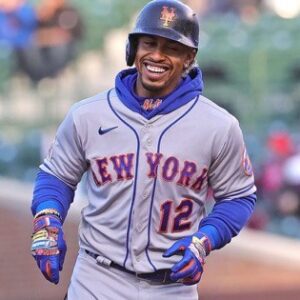
Please don’t allow us to forget about or overlook the splendor and greatness of Francisco Lindor.
When Lindor was in Cleveland, his brilliance was appreciated. In fact, he was beloved, but always with the jaundiced eye of: “This small market team will never be able to afford this magnificent player long-term.” And that turned out to be correct.
Before the 2021 season, then Guardians sent Lindor (with Carlos Carrasco) to the Mets for Amed Rosario, Andres Gimenez, and two prospects. And in typical big-market fashion, the Mets immediately signed Lindor to a 10/$341 million contract.
Under the white hot lights of the Big Apple and the pressure a $341 million contract thrusts upon a player, Lindor hit under .200 over the first two months of the 2021 season. The fans in Queens didn’t totally sour on him by Memorial Day, but it certainly wasn’t a great first impression. And New York fans are a difficult lot to win over, or win back, if you make a poor first impression.
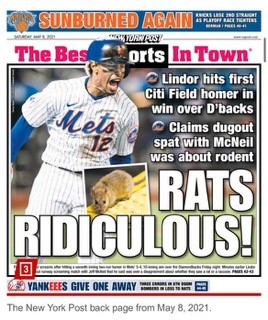
And then, while batting .158, slugging .200, with one home run under his belt in his first 26 games with the Mets, Lindor grabbed second baseman Jeff McNeil by the throat in an altercation behind the dugout.
While this kerfuffle played out in the New York tabloids, the story changed from a fight to a mild argument to a simple disagreement over whether they saw a rat or a raccoon in the bowls of CitiField. Regardless of the actual story (one which we may never know), it was a bad look for the $300 million guy with the sub-Mendoza batting average.
Lindor tried to redeem himself over the course of the rest of the season, but he didn’t exactly set the world on fire. Playing around an oblique injury that thwarted him in parts of July and August, Lindor hit .252 with 16 home runs after May. “Mr. Smile” ended 2021 with an OPS+ of 100, and his worst career statistics in nearly every offensive category.
2022 was much closer to a standard Lindor season. He hit .270, tallied 26 dingers, drove in 107 runs, and had a 125 OPS+. He even came in ninth in MVP voting.
But to the fans and the media, the first two months of 2021 (on the field and just off of it), and his $34 million salary, still loomed large. So heading into 2023, Lindor had a target on his back, justified or not. Lindor, with his huge smile and flashy batting gloves, seemed made for New York, but to the victor goes the spoils, and you must perform to get the love. According to Mets fans, he had not yet performed.
If Lindor hoped to get that giant apple-shaped monkey off his back early in 2023, he didn’t do himself any favors. He came out of the gate hitting .218 in March/April, but did slug four home runs. May and June weren’t much better: .227 and .230, respectively. He did hit 6 dingers each month, and was trending in the right direction. In mid-June, Lindor’s wife, Katia, gave birth to their second daughter. And the sleep deprivation did him some good. In the twelve games after becoming a “girl dad” twice over, Lindor hit .310, belted four home runs, and had an OPS of 1.035.
In July, he hit another five round-trippers, with an OPS of .923. In August, he kept it going, collecting 32 more hits, nine for extra bases, with a .371 OBP. And then in September (of a wasted season for the club), Lindor continued to build. Seven home runs, eleven extra base hits, 19 RBI, and an OPS of .868.
When the season was done, Lindor had made the Flushing fans smile with 31 homers, 98 RBI, a 120 OPS+, and his first time joining the 30/30 club (actually 31/31). All of which led to Lindor winning the Silver Slugger award for the third time (but his first in New York). From the time of his second child’s birth, only four players had more bWAR than Lindor, and all of the other players laced them up in Los Angeles and Atlanta.
With the exception of a few bumps in the road, if you looked closely and in the aggregate, the Lindor that we all knew and loved has been there all along. It is just that sequencing in sports matters, and that may have allowed the fans in New York to miss it.
So, now Lindor enters Year Three of his massive contract in a good place, ostensibly physically as well as mentally. The team – despite a rough 2023 – is built to win, with a strong rotation and depth at nearly every position. It is all set up for the All-Star shortstop to have another MVP-caliber season, the type that the Mets faithful all anticipated when the club acquired him and then signed him to the largest deal in franchise history. The Lindor of old has been there all along, but now is the time for him to take it to the next level.
*This article first appeared in the January 11th edition of the IBWAA “Here’s the Pitch” Newsletter; and prior to the Cubs finalizing their deal with Shota Imanaga and acquiring Michael Busch and Yency Almonte from the Dodgers.
When the calendar turned to 2024, the hot stove began to cool. We are just a month away from pitchers and catchers reporting, and then the rest of the squads will be on the field a few days later. For some teams, their offseason work is done. The Dodgers have tried to win the winter, spending more than a billion dollars on two Japanese players. But they have made a few additional moves as well.
The Braves have been quite active, shoring up their lineup for a deep run into October. Early on, the Mets made some deals, signing Luis Severino, Jorge López, and Joey Wendle. And now they have signed Harrison Bader to play somewhere in their outfield. The Royals have made all sorts of deals that no one saw coming, adding Michael Wacha, Seth Lugo, Hunter Renfroe, and others.
Many teams have tried to be active, only to be thwarted or left at the altar on numerous occasions. The Giants thought they had a strong chance to acquire Shohei Ohtani or at least Yoshinobu Yamamoto, and the Blue Jays thought they had Ohtani in their crosshairs as well. The Mets and Yanks thought the young Japanese fireballer could land with them, but alas, it was not meant to be for any of them.
But certain teams have been relatively quiet. Until last week, the Red Sox had been all but dormant. Same for the Guardians. If you are a member of any number of fanbases, you may be beginning to wonder “when is the time to panic.” When it is time to consider that it may be too late for your club to make sufficient moves in order to contend next fall.
Pennants, of course, are not won during the winter (see the Padres and Mets), but they can be lost. With the expanded playoffs, with so many teams believing they have a shot at the postseason, the trade deadline is more muted than ever. As such, the ability to remake your roster midseason is all the more difficult. If a team has obvious holes, those need to be filled when players are unsigned and all 30 teams are potential trade partners.
The Red Sox went into the offseason in desperate need of pitching. They signed Lucas Giolito, but then immediately traded Chris Sale. Maybe not a one-for-one in production, but definitely a one-for-one in roster spots. It is unlikely that Cooper Criswell will be pitching meaningful innings for the BoSox down the stretch. Signing Jordan Montgomery or Blake Snell would definitely move the needle and would turn around their winter and their outlook for 2024. But as of this writing, neither have signed with Boston.
The Giants were able to sign Japanese first baseman Yoshi Tsutsugo on a Minor League deal, and they inked catcher Tom Murphy to a two-year deal. But neither will help them on the mound or – most likely – at the ticket window. Getting Robbie Ray from the Mariners (for former Mariner Mitch Haniger and pitcher Anthony DeSclafani) may help them in the short run. But none of those moves will make them contenders in the packed NL West.
The Orioles made a surprise run to win the AL East last season. The Yankees and Red Sox had bad seasons, and the Rays fell off after an amazing start. To compete again in 2024 – the first year they were supposed to make noise – they need more pitching. Adding Jonathan Heasley and Craig Kimbrel will not keep the beasts of the east at bay.
And then there are the Cubs. They started the offseason with a managerial splash, wooing Craig Counsell to travel south from Milwaukee with the richest contract for a manager in MLB history. But, since then, pretty much crickets … until Tuesday night. The Cubs reportedly have signed Japanese left-hander Shōta Imanaga to (according to Jon Morosi) a multi-year deal at about $15 million per season.
With Imanaga potentially taking the place of free agent Marcus Stroman, the Cubbies still have needs on the mound. But the most important question for fans on the North Side is, will they re-sign Cody Bellinger? Are they waiting for the $200 million-plus asking price to come down? Could they re-sign Stroman? Is Matt Chapman a possibility? Rumor has it that they are eyeing Rhys Hoskins. The NL Central is a winnable division, and the team has arguably the best manager in baseball, but he needs some names to write on the lineup card each day.
The same analysis could be done for a handful of other teams. As the snow falls, and then melts, and fans begin to dream of warm summer days in their favorite ballparks, they need something upon which to hang their hopes. Right now, because of their team’s lack of moves, some fans are beginning to panic.
I recently read “Faithful,” by Stewart O’Nan and Stephen King. Sure, I am nearly two decades late to the party; and sure, you might revoke my membership in the Red Sox fan club for waiting so long to read this charming tome, but what can you do?
For those of you who have not read the book, here is a very brief summary: O’Nan (a Pirates fan living in the Boston area) and King (a lifelong Red Sox fan) decided to watch and chronicle every game of the 2004 Red Sox season. They did this coming off the soul-crushing end to 2003, with Grady Little and Aaron (“Fu%&*ng”) Boone. There was simply no way for the writers to know what 2004 had in store; that 2004 would see the Red Sox win the Wild Card, then come back from 0-3 in the ALCS against the hated Yankees, and then sweep the Cardinals for Boston’s first World Series title in 86 years. In the spring of 2004, they were just two baseball fans who were gluttons for punishment; two men who embarked on a journey that neither will ever forget.
All of which got me thinking: If you were a writer, or a baseball fan, or maybe both, which team would you follow for the 2024 season on the off-chance the you could catch lightning in a bottle and witness a season for the ages? It turns out that there are a few extremely worthy candidates.
Cleveland Guardians
Any list wherein one might potentially witness history has to start in Cleveland. This past season marked 75 years since this organization won the World Series. They have been to the Fall Classic four times in that span, most recently in the epic 2016 clash with the Cubs. The Guardians are a perennial threat to win the weak AL Central, and have a good chance to do so in 2024, even though both ESPN and MLB.com have the Tigers finishing ahead of them.
But, like O’Nan and King, if you could hang with this club for 162 games, and they were to win it all, then that book could easily be a best-seller. Plus, watching José Ramirez man third base all summer would be nothing short of delightful.
Seattle Mariners
There are teams with longer dry spell than the Mariners, but none that offer more potential intrigue. Seattle ended a 21-year playoff drought in 2022, but not only have they never won the World Series, in their 47 years, they have never even been there. The Mariners’ President of Baseball Operations, Jerry Dipoto, has never met a trade he wouldn’t do, or an hour of the day he wouldn’t do it.
So, despite the club’s miserly ways (and the fact that they already inferred that they are out on Shohei Ohtani), you can count of Trader Jerry making things interesting and doing everything possible to keep the team in contention. Plus, there are considerably worse places to spend 81 days over the summer than T-Mobile Park.
Baltimore Orioles
The O’s got to the playoffs a year ahead of schedule, and then got thumped by the eventual World Series champion Texas Rangers. But few teams in baseball have a better, more exciting core of young players than the Orioles. Their largesse is such that they may trade a few of their prospects for pitching, as they simply don’t have enough room on the roster, or the infield, to play them all.
The team revolves around their catcher, Adley Rutschman, whose best comp is Buster Posey. Rookie of the Year Gunnar Henderson plays short, but will probably move to third to make way for phenom Jackson Holliday. Colton Cowser, Heston Kjerstad, and Joey Ortiz are on their way. Ryan Mountcastle and Cedric Mullins are veteran anchors in the lineup, and if the team gets some additional pitching, they will be extremely dangerous in 2024. Plus, like T-Mobile, who could balk at spending every night this coming summer at Camden Yards?
New York Mets
The Mets’ World Series title drought is nine years shorter than the Mariners’ existence, but in New York, you need to calculate the same like dog years. As such, it essentially has been forever since the Mets paraded down the Canyon of Heroes. When billionaire Steve Cohen bought the Mets in November, 2020, he claimed that it would be “slightly disappointing” if the team did not with the World Series in three to five years. Well, this will be his fourth year of ownership, and last season was an unmitigated disaster.
With new President of Baseball Operations, David Stearns, and with new manager, Carlos Mendoza (stolen straight from bench of the crosstown rivals), and with Max Scherzer and Justin Verlander mostly off the books, the Mets have even more of Steve’s money to throw at free agents and/or salaries to absorb in trades. The team has already been active (Luis Severino, Joey Wendle), and are rumored to be in on Japanese pitching star Yoshinobu Yamamoto. If the Mets were to take down the Braves and the Phillies, win the NL pennant, and then bring another championship to Queens, the book could join a long list of great ones written about The Miracle Mets.
Cincinnati Reds
Like the Orioles, the Reds broke out a year early, and also employ too many great young players for their limited roster. Yes, the team appears to have lost lifelong Red, the legendary Joey Votto, but that just opened up first base for another young stud. The Reds play in the feeble NL Central, where 83 wins was enough for second place, and the low 90’s should win the division. Hunter Greene and Andrew Abbott will anchor a starting rotation that could use one more solid arm; and Alexis Díaz may be every bit the closer that his brother is.
The excitement with this team starts with wunderkind Elly De La Cruz, who made his presence known with a vengeance last season, and then spreads to the likes of Spencer Steer (23 homers in his rookie campaign, arguably their best player), Christian Encarnacion-Strand (13 home runs in 222 at bats), Matt McLain (5’9”, .864 OPS in his rookie year), and TJ Friedl (who hit 18 home runs in 488 at bats, while playing a great center field). It does get a touch swampy at Great America Ballpark during the summer, but the breeze created by these swingers and De La Cruz’s sprinting around the base paths should make it more than tolerable. This team hasn’t won a World Series since my freshman year of college. If they did so this year, while you were chronicling it, you would have quite the tale to tell.
There are, of course, many other teams worthy of your daily diary (the Tigers stand to be much-improved; any team that lands Ohtani; maybe even the woebegone Padres). Just know that whoever you choose, it is a massive commitment, with no guaranty of a 2004 Red Sox anxiety-inducing, brink-facing, record-breaking payoff at the end. Regardless, it sounds like a hell of a lot of fun.
*This article first appeared in today’s edition of the IBWAA Here’s the Pitch newsletter.*
I visited Tropicana Field last year. And, as a glutton for punishment, I gave into to my son’s wish to visit an equally squalid ballpark: The Oakland Coliseum. This wouldn’t check any stadium off my list, but it did seem like a fun day trip.
I first visited what was then the Oakland-Alameda Coliseum in the late ‘80s. Even back then the park left a lot to be desired, but (a) the team on the field was something to behold (winning the AL West four of five seasons between 1988–1992; Mark McGwire, Jose Canseco, Dave Stewart, Dennis Eckersley, etc.), and (b) we had nothing of great import to compare it to (Fenway hadn’t yet been remodeled; Wrigley had recently installed lights but not clean restrooms; Pittsburgh, Cincinnati, and Philadelphia all played in the exact same multi-purpose cement stadium; a single Giants game was a four-season experience, requiring sunscreen and a parka; etc.). Ignorance, in 1989, was bliss.
Commissioner Rob Manfred has repeatedly stated that MLB will not consider expansion until the stadium issues in Tampa Bay and Oakland are resolved. It seems the Rays have landed on a new park plan and design (here’s to hoping it will be a massive improvement), while the A’s have all but started packing their bags for Vegas. So, before they leave The Town, my son wanted to see The Coliseum in all of its lack of grace and never-present glory.
Now, I will not get into the many and varied ways that a move to Sin City is a horrible idea and is not in keeping with what A’s ownership claims they actually want to do with the team, their ballpark, and the surrounding environs. What I will get into is the current state of where the A’s – for the time being – still call home.
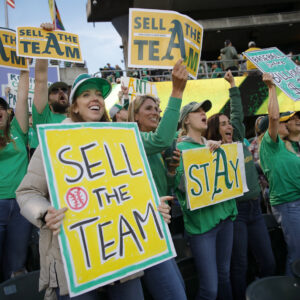
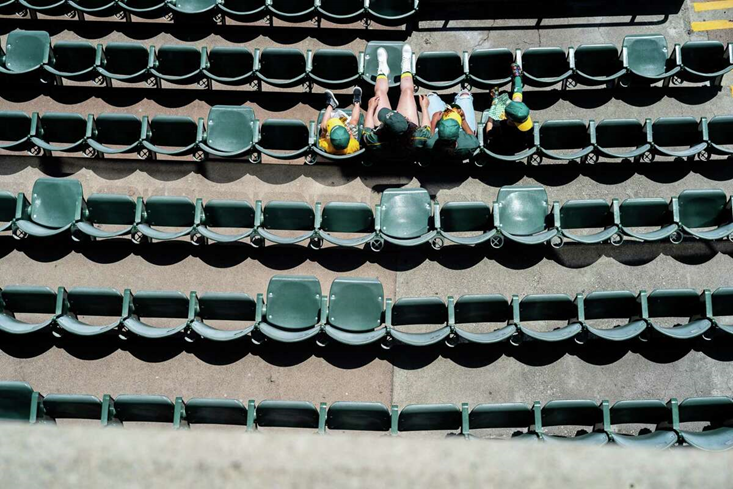
Like I stated, it’s been more than 30 years since I last saw a game in Oakland. Suffice it to say, time has not been kind to the ballpark. We flew up on a Saturday afternoon, and went through the gates as soon as they opened so that we would have plenty of time to observe the stadium from every angle. We circled the park at the lowest and the highest points; we walked the concourse from the 100 to the 300 level. We climbed to the tippy top and got a view of San Francisco and a vertigo-inducing view of the field below. We stood in the bleachers amongst the “Sell the Team” signs and the drums. We found ourselves in dark hallways and bright bleachers. In short, we took it all in.
If there is one word I would use to describe the park, it would have to be: “janky.” The stadium itself is just horrible. Now, here is where I need to state – without equivocation – two undeniable facts:
(1) The A’s fans are amazing. They are spirited, excited, and into their team. I did not witness any of the deplorable behavior that I have heard tale about at Raiders games. The tailgate, and tailgaters, were epic. The dancing to live music before the game was intoxicating. And the fans’ absolute unity in their love of their team and their antipathy toward the current ownership is impressive. These fans deserve more; they deserve better.
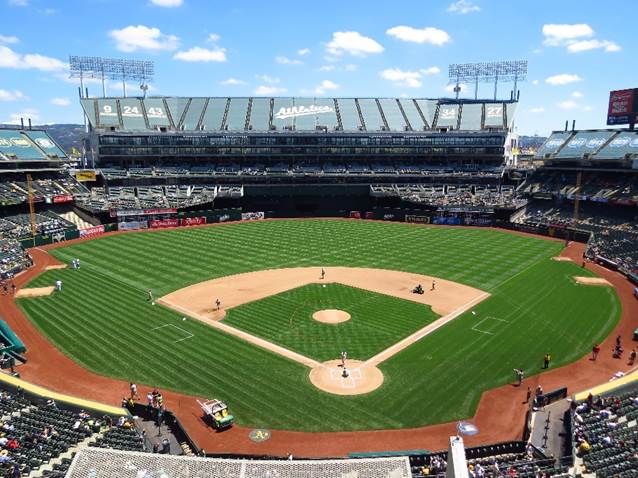
(2) The field itself is beautiful. From nearly any location inside the park, you can look out and take in the vast expanse of the field itself (but don’t let your eyes wonder), and it is impressive. Maybe the splendor was enhanced by this being a gorgeous afternoon in The Bay, with a blue sky above. But, regardless, the groundskeepers in Oakland deserve a raise.
The Coliseum grounds crew may be the most professional part of the organization.
Now, back to the park. Boy oh boy. Where to start? How about at the beginning? We took the BART to the yard, and walked across the bridge to get in. With the chain link fence on the outside and massive cement exterior walls, it was hard to know whether we were heading into a ballpark or a maximum-security prison.
Once inside, the concourses were narrow but fine. The concessions on offer were actually pretty good (and, when compared to Dodger Stadium, downright plentiful); however, you need to go to the deepest recesses of the outfield to find decent ice cream (but I digress).
When we arrived, the A’s were taking batting practice (this was about 2½ hours before first pitch). Some of the ushers were great (one even gave a ball to my son). But others acted as if we were trying to get onto the floor for the Showtime Lakers. At one point I asked an usher: “If your team is averaging 8,500 fans per game [about 18% of capacity], why do you care where the fans – who actually show up – go or sit?” The answer was less than satisfying. According to a few diehard fans I chatted with, this has been a theme for a while.
As we walked through the aisles, we noticed three things we had never seen in a major league park:
(1) Duct tape holding various items in place. This includes wires, cables, and seats. Everywhere you looked you caught sight of grey tape in places where cement or bolts or paint would otherwise be.
(2) Rusted, broken, and discolored seats. And it was not just one or two; it was more like one or two per section. When walking through the aisles, we had to maneuver around seats that could no longer be folded up. The seats lay there, open and faded, as if to say, “We have seen some things, but we are going down with this rusted ship.”
The seats – like the team – have seen better days.
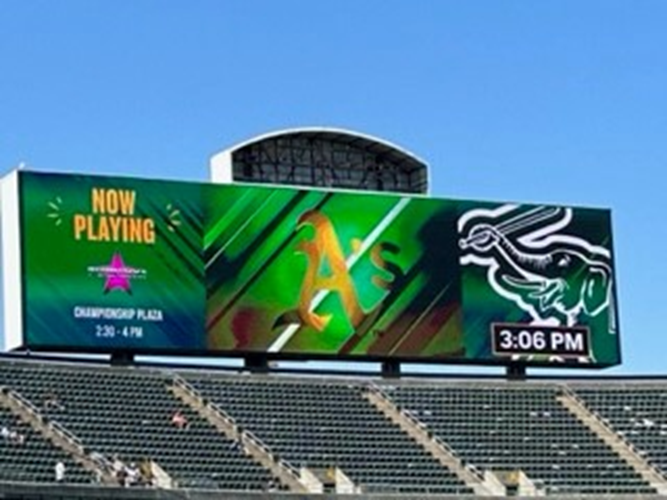
(3) A scoreboard missing signage on one side, and on the other side, a panel wherein the former name (O.co) could still be seen through a bad paint job.
Either John Fisher is too cheap to fix the scoreboard, or no one is willing to advertise there.
It’s truly hard to square the circle of the Oakland A’s. A team with a storied history in three different cities, potentially on its way to a fourth. The team spent 54 years in Philadelphia, but has now spent 55 in Oakland, and will most likely be there for at least a few more. They won five World Series in Philadelphia and four in Northern California – and whether or not they move, it will be at least a few more years before they win another.
But, regardless, the fans of Oakland have lost their football team (to Las Vegas, natch) and their basketball team (across the bay to San Francisco) – they deserve better. According to reports, only about $30 million separated the team and the City of Oakland when John Fisher abruptly informed the Mayor they accepted a proposal from Las Vegas. While $30 million may seem like a lot, it is only one quarter of one percent of the $12 billion dollar intended project. And the team has already gone back on the deal they originally closed in Las Vegas, opting for a much smaller plot of land and considerably less state money. None of this makes any sense.
It is not too late for Oakland. Commissioner Manfred expects the final owners’ vote to approve the move will happen in November. There is no reason that 22 owners need to assent to the relocation. The owners could hear the rallying cry from the fans who have made themselves heard time and again and reject the move; or they could listen to the admonition of now-retired A’s pitcher Trevor May, who had the following to say as part of his retirement announcement:
“Sell the team, dude. Sell it man. Let someone who actually takes pride in the things they own, own something. There’s actually people who give a shit about the game. Let them do it.”
Here’s to hoping that in Oakland, for years to come, they will be saying:
Next month marks the nine-year anniversary of my writing about baseball. It started innocently enough. At a work lunch following an incredible Wild Card game, I gave my colleagues a spirited recap. One co-worker said that someone who has so much passion and excitement for the game needs to write about it. Nearly 300 articles later, that is exactly what I have been doing.
One of my goals in writing about the sport is to point out overlooked or under-observed matters. I want people to see the small details that enthrall me, the plays and stories that make me smile. Simply put, I want to convey to readers how much joy I get from the game of baseball.
Shortly after I started writing, I realized that someone was already on my corner – and he had a near monopoly on joyously writing about baseball. In 2015, I found Joe Posnanski on NBCSports.com. From my first read, I knew I had a kindred spirit in the love of the game, but he lapped me in reach, experience, knowledge, and skill. Truth be told, after first reading Joe’s writing, I nearly unplugged my keyboard. For whatever reason, I kept at it. Maybe I did so just so I could ultimately write this article.
If you are a fan of Joe Posnanski, you can probably stop reading now. If you aren’t, know that he is arguably the best sportswriter walking the planet today (he won such an award from the AP Sports Editors in both 2002 and 2005, and the National Sportscasters and Sportswriters Association named him the same in 2012). But that doesn’t tell even half the story. Joe is the best sportswriter because he loves sports, and he loves writing, and both of those sentiments jump off the page/screen.
As a young man, Joe didn’t think he could write, and yet he took a job as a stringer for the Charlotte Observer covering high school sports. While there, he wrote articles in his free time just for himself. But (to his amazement and embarrassment) an editor happened upon these stories and thought they were pretty good. And so it began.
Joe worked at the Cincinnati Post, then the Augusta Chronicle where he started covering golf (rumor has it that there is an important tournament there). In 1996, the Kansas City Star hired Joe, and his career took off. He spent more than a decade at The Star before becoming a senior columnist at Sports Illustrated. From there he went to the USA Today and then Sports on Earth (the long-form website run by MLB Advanced Media). All of which led Joe to NBC Sports, where I first encountered him (how I missed the previous iterations is a mystery to be solved another day). Since that time, Joe has ventured out on his own, writing a daily newsletter called JoeBlogs. The through-line, regardless of where his writing is published, is the simple joy that oozes from his fingers and into his work.
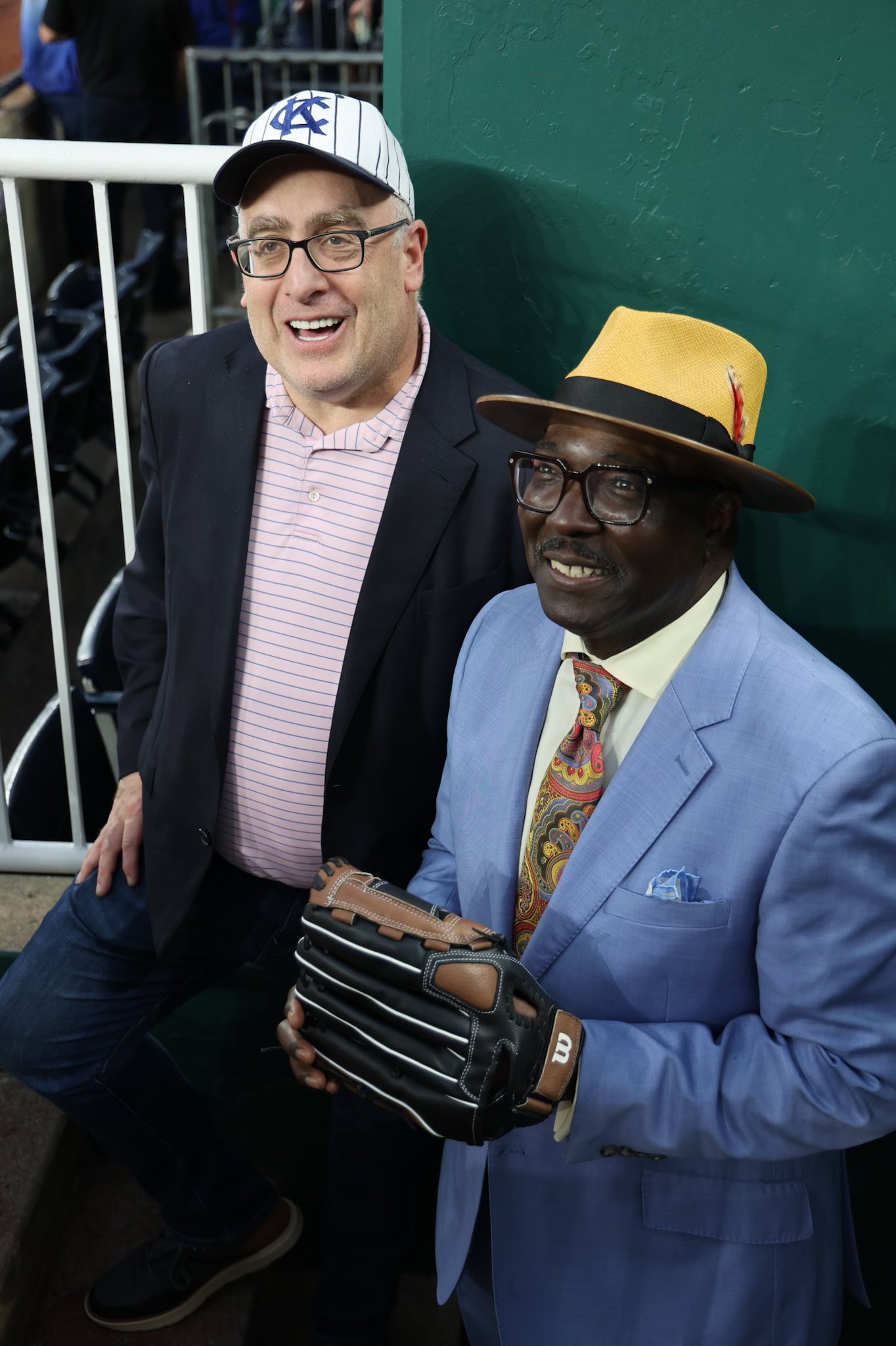
That excitement is never more apparent than when Joe writes about the Negro Leagues. Feel free to disagree, but no writer alive today has written more extensively, more exhaustively, or more reverently about the Negro Leagues than Joe Poz. The Soul of Baseball, written in 2007 after a cross-country trip with the legendary Buck O’Neil, is a must-read for any baseball fan. That book introduced Joe to Bob Kendrick, president of the Negro Leagues Baseball Museum in Kansas City, who Joe now calls his brother from another mother. This past Saturday night, at the “Salute to the Negro Leagues” in Kansas City, Joe – wearing a Monarchs hat – threw out the first pitch of the game to Mr. Kendrick.
But Joe was not content. After writing nearly 900 pages counting down the 100 greatest baseball players of all time, injecting his unique perspective and asides into each name on the list, he decided we all needed to learn Why We Love Baseball, which was released earlier this month. Joe has been promoting this book for months, repeatedly saying that this one was the most fun to write, and that he could not wait for readers to dig in.
For another author, this might have seemed untoward or braggartly; for Joe, it was wholly natural. He was like a kid dragging his dad into the house to show him the Lego he built – he was so excited and proud of what he produced, he could not wait to share it with the world. I can testify (as can nearly every editorial publication) that each story is thoroughly researched, each player lovingly feted, each tangent seemingly unknown and unknowable and yet discovered. You cannot read the book and not feel how much joy Joe took in writing it, and how much joy he takes in having us read it.
Which brings me to last week. As part of the release of WWLB, Joe went on a whirlwind nationwide tour, meeting fans from Charlotte to Los Angeles, and many places in between. When too many people signed up to hear him talk about his book at Chevalier’s Books in L.A., they moved the event to the fabled Wilshire Ebell Theatre. It was only fitting – the venue has hosted artists since 1927, the year that Babe Ruth hit 60 home runs as part of the “Murderer’s Row.” A group of about 50 gathered to listen to Joe (along with Mike Schur, Molly Knight, and Nick Offerman) all talk lovingly about baseball.
When we moved to the Q&A portion of the night, Joe requested that each questioner tell the crowd how they fell in love with the game before asking their question. For Joe, the origin story of baseball is about family; it is about passing along the love from one generation to the next. And true to form, nearly every person who stood up had a tale to tell about a father, a son, or a friend who introduced them to the game, and kept that flame lit when they or their favorite team or player fell on hard times.
It is no less delightful to hear Joe speak about baseball in person than it is to read him on the page or to listen to his wonderful Poscast podcast. And that is because Joe is both a delightful human being and a charming raconteur. He has an encyclopedic knowledge about the history of the game, the players, and their individual stories.
Reading and listening to someone who loves baseball even more than I do is such a rarity, and such a pleasure. But, for my money, it is Joe’s non-baseball, non-sports-related essays that go right to my heart, and tug on the strings. After waiting more than 30 minutes to finally introduce myself to the man, I mentioned to him that my favorite story of his was the one about taking his daughter to see Hamilton in New York (click the link – it’s worth the price of a subscription). I could tell that that was not what he expected. And, for a brief moment, I believe I shocked him – and he seemed quite pleased. It is my sincere hope that in that moment, Joe got the same jolt of excitement, as fleeting as it may have been, that I feel each time I open JoeBlogs or flip the pages of one of his books.
They tell you to never meet your heroes. Well, last week I met one of mine. It lived up to all of my expectations; his stories, his humor, his warmth, didn’t disappoint. He may be the exception that proves the rule. The world needs more Joe Posnanskis; we need more people who are nothing short of delightful; we need more people with passion to spare and who are willing to share; we need people who simply bring a smile to your face. Do yourself a favor, buy one of his books, subscribe to his Substack, delve into the archives and the ephemera. You won’t regret it.
This past weekend, there was a hurricane watch in Southern California. Two weeks ago, people fled rather than vacationed in the paradise that is Hawaii. Soon we will be awash in political ads telling you to believe or disbelieve truths and untruths in equal measure. In short, the world is off kilter. Taylor Swift had it partially right: It’s “weird,” but I’m not too sure it’s “fu*^ing beautiful.”
There are many theories for what is happening today – from global warming to massive income inequality to hyper partisanship. But I have a much simpler explanation: In the space of about four minutes on October 17, 2004, the universe tilted off its axis. Nothing has been the same since.
In the bottom of the ninth inning of Game 4 of the 2004 ALCS, Mariano Rivera – the only unanimous Hall of Fame selection – walked the leadoff batter. In 19 regular seasons, Rivera walked only 286; in 96 playoff games over 32 series, he only walked 21; in over 1,000 career games, he gave a free pass to the first batter a mere 43 times. In short, it basically never happens, and then it did. That was the first glitch.
The second came just two minutes later when pinch-runner Dave Roberts stole second base by a hair’s breath. After days of flatlining, the Red Sox had a heartbeat.
Bill Mueller then singled Roberts home to tie the game. The rest, as they say, is history. But really, it is not. The Red Sox still needed a David Ortiz dinger in the 12th inning; and then they still needed to win three more games. But, what we didn’t yet know was that the walk + the stolen base + the single were three distinct acts that changed everything … forever.
There was Tony Clark’s ground-rule double that should have been a run-scoring triple. There was Mark Bellhorn’s homer that was first called a double. There was Alex Rodriguez’s “slap heard ‘round the world” that was reversed. There was the Yankees refusing to bunt on the obviously incapacitated Curt Schilling. There was the silence of Yankee Stadium in a Game 7 blowout. All of which was a prelude to the sweep of the Cardinals for the first World Series title in 86 years.
After Bill Buckner, Bucky “Fu*^in’” Dent, and Aaron “Bleeping” Boone, and decades of heartbreak, the Red Sox were on top. And they would be on top three more times over the course of the next 14 seasons. The Yankees tried to square the ledger with a World Series win in 2009. But we are now at 14 years and counting since the Yanks’ last championship, and after this past weekend, they may have hit rock bottom.
To say the Yankees have been listless this year would be an understatement. And yet, prior to their recent nine-game losing streak (which ended with a win on Wednesday over the Nationals), they were four games over .500, on their way – maybe not to the playoffs – but to their 31st consecutive winning season. So, when the Red Sox rolled into the Bronx last Friday night, I had this nagging fear that all of the old tropes would come back; the Yankees would sweep the BoSox to go back over .500 on their way to a late Wild Card push. And, when the Yankees hoisted the World Series trophy later this fall, we would all point back to this weekend as the turning point. Pre-2004, that is exactly what would have happened.
But on Friday night, the first four batters of the game reached base, culminating with a Masataka Yoshida three-run homer. The Red Sox tacked on three more in the second inning. But – true to form – 17 out of the next 19 Boston batters were retired, as the Yankees chipped away, making the score 7-3. The Red Sox scratched out a run in the top of the ninth to give a little more cushion, but I was still not relaxed.
Gleyber Torres led off the bottom of the ninth with a single. That was followed by Jarren Duran misplaying an Isiah Kiner-Falefa single into a double. In pre-off-kilter times, two runners in scoring position with no outs would have led to a six-run rally, netting the Yankees a series-opening victory and a ton of momentum. But the world no longer spins like that. Rather, Harrison Bader and Anthony Volpe struck out looking and Ben Rortvedt (who?) flew out to end it.
Gerrit Cole took the hill on Saturday to square the series. Cole is the current AL Cy Young front-runner. If anyone could right the ship, it was he. Instead, Cole gave up Luis Urías’ second grand slam in three games. Cole went only four innings on his way to his fourth loss, while the Red Sox pushed his ERA over 3.00 for the first time all season.
Sunday offered the faltering Bombers one last chance at redemption, and they did their level best. The Yankees fell behind on three different occasions, and tied the score each time (much to the consternation of Red Sox Nation). Pre-2004, the Yankees would win this game and thwart a Red Sox sweep. Post-2004, the following happened:
With the score tied in the bottom of the eighth, IKF led off with a single.
Somehow, Bader’s 107 mph liner landed in Adam Duvall’s glove.
There was a lazy fly to right for the second out.
IKF was running when Volpe singled to left. Rob Refsnyder – just into the game for the injured Duran – fell down fielding the ball, which allowed IKF to come all the way around. Trevor Story’s relay throw was low, but Connor Wong picked it and applied the tag. The call on the field was “safe,” giving the Yankees their first lead of the entire weekend.
The Red Sox challenged the call, and after an interminable wait, with the NESN announcers predicting the run would count, IKF was called out and the game remained tied.
But now the Yankees wanted to check to see if Wong illegally blocked the plate. In times of yore, the “safe” may have become “out,” but then the call would go against Wong, allowing IKF to be “safe” again. It’s just that we no longer live in those times.
Alas, we went to the ninth knotted at 5.
The Red Sox took a 6-5 lead in the top half.
Greg Allen led off the bottom half smacking an 0-2 fastball to within two inches of a game-tying home run. In my day, a next generation Jeffrey Maier reaches over the wall, but no one sees it, and the game would be tied. Today, Allen found himself standing on second base. After plunking DJ LeMahieu, Kenley Jansen had the winning run on base with Aaron Judge coming to the plate. Before Dave Roberts, Judge would have done what he had already done twice in the series.
But after DR, he struck out looking on three pitches. Torres (then hitting .367 with a 1.221 OPS vs. the Red Sox this season) followed with his own strikeout. But, Jansen still needed to get past Rortvedt. He lined one hard, but right to Duvall who corralled it to complete the sweep.
As of Tuesday night, the Yankees had lost nine straight – doing so for the first time in 41 seasons; were five games under .500; and in last place in the AL East. I will NEVER claim the Yankees are done, but they are getting ever-so-close. Before Rivera walked Kevin Millar, none of this ever could have happened. The Red Sox may not make the playoffs this year, but if they effectively ended the Yankees’ season, well, that is pretty good consolation.
The BoSox swept the Yankees in the Bronx. Multiple New York threats were squelched before they began, and Boston got both clutch pitching and hitting. The Red Sox are alive, and the Bombers are in disarray.
Maybe Taylor Swift had it right after all: “Weird, but fu*^ing beautiful.”
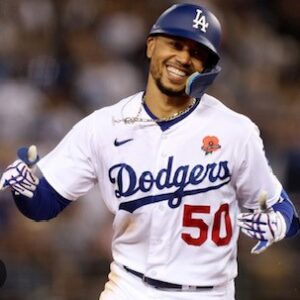
About six weeks ago, after watching Mookie Betts go 0-for-5, with 2 strike outs and leaving a couple of runners on base, I had a thought bubble. At the time, Mookie was hitting roughly .240 and slugging below .500. This was the thought bubble: “Has Mookie lost it? Did the Red Sox avoid a catastrophe, and are the Dodgers stuck with a $365M contract for a player who once was?”
Maybe it was just wishful thinking. Maybe it was just me hoping that my favorite team didn’t make an all-time blunder. Maybe I just didn’t want this to be Babe Ruth Part Deux for Boston fans.
Truth be told, at the time I took the long, and unpopular, view that the Red Sox were correct in trading Mookie Betts. I didn’t think he would sign long-term in Boston (despite his now, after-the-fact, protestations to the contrary) and that he wanted to test the free agent market. He then came to my hometown team, allowing me to see him up close each and every day. And he has been terrific. Or has he? This is where my bias may have kicked in.
I have been watching Mookie for his entire career, but even more so now that he is in Los Angeles. And I could have sworn that – as stated above – he had lost a little something. He seemed to be striking out slightly more often; he seemed to be getting runners in from scoring position slightly less often. He seemed to be just a tick or two off the guy we all love and adore. But the eye test is not nearly enough – I had to do the work.
Now, for purposes of this analysis, I put aside the fact that Mookie is a 6-time Gold Glove winner in right field and offered to play second base and shortstop to solidify the Dodgers’ defense. The intangible of that type of leadership – and the ability to play those positions so adroitly – cannot be quantified (well, the analytics department in any organization can quantify it, but we as mere mortal fans have a harder time putting “actual” value to such versatility). I wanted to just look at the offensive numbers to see if Mookie, now into his thirties, was losing a step or two. Let’s take a look:
H
2B
HR
BB
SO
BA
OPS
OPS+
bWAR
2015
174
42
18
46
82
.291
.820
117
6.1
2016
214
42
31
49
80
.318
.897
133
9.5
2017
166
46
24
77
79
.264
.803
108
6.4
2018
180
47
32
81
91
.346
1.078
186
10.7
2019
176
40
29
97
101
.295
.915
134
7.3
2020*
64 (173)
9 (24)
16 (43)
24 (65)
38 (103)
.292
.927
147
3.6
2021^
123
29
23
68
86
.264
.854
126
4.0
2022
154
40
35
55
104
.269
.873
139
6.4
2023+
86 (164)
20 (38)
23 (44)
52 (99)
64 (122)
.272
.937
148
3.9
*The stats for 2020 are over the 60-game season, with the number in parentheses representing a 162-game season.
^This is the first year of Mookie’s 12/$365M extension.
+All stats current through July 4th, with the numbers in parentheses representing a full-season projection.
According to the above, maybe – if you squint a lot – you might be able to see some flaws in Mookie’s overall batting profile.
Putting aside his 2016 season when he had 214, Betts has lived between 160 and 180 hits. Those numbers were down the past two seasons, but he is back on pace this year. The lower hit totals caused his batting average to dip (and even with his current hit totals, he is still at the lower-end of his career averages). Mookie is no longer a perennial (or even close to a perennial) .300 hitter. And you can call it causation or correlation, but his BABIP has also dropped every year since hitting a high of .368 in 2018 (.309 –> .289 –> .276 –> .272 –> .269).
But the number of doubles is essentially the same across seasons; and he is on pace for a career high in home runs, which may be part of the reason why he agreed to participate in this year’s Home Run Derby. His OPS is pretty darned consistent for his entire career. His OPS+ is elite, every season.
The quick review of the above shows that he is starting to strike out more often. He first broke 100 Ks in 2019, was on pace for the same in 2020, did it again last year, and this season is heading for an all-time high. Is there any substance to that noise? Only time will tell. But going back to the eye test, it seemed to me, as a casual observer, that those strike outs have come in inopportune moments.
Baseball Reference has a metric called BRS% (the percentage of all baserunners who scored by the batter, but not necessarily resulting in an RBI). Mookie’s career average is 17.7% (including 17.6% in his MVP season). In 2019 it was 14.9%, then jumped to 18.6%, then fell to 13.7%, coming back to 16.1% last season. This year, he is living at 19.8%. So maybe my “clutch eye” was tuned in the last couple of years, but this year he is pushing for a career best. Hmm?
Other than 2019, Mookie never grounded into double plays at a 10% clip (i.e., what percentage of opportunities to ground into double plays did the player do so). This year he is just under at 10% (4/45).
I decided to take a look at one more advance stat (also from Baseball Reference): Productive Outs, which means advancing any runner with no outs; driving in a run with the second out; with failure meaning not advancing the runner(s) with an out. And here Mookie is close to a career low. His percentage of Productive Outs is 28.6%. For context, his career average is 30.5%, and his career median in 33.3%. One might argue that the above is within the margin of error; and this writer might agree with that assessment.
So what does all of this mean? It means that Mookie is still fantastic. He is still a joy to watch and, by all accounts, an even better teammate. He is still going to give the Dodgers about 7 bWAR this year; will still hit around 40 HRs; and will still be 30-40% better than the average Major League player. Regression or not, father time sneaking up on him or not, he is still one of the greats of the game. We can quibble about strike out rates, but need to read them with walk rates (nearly at a career high). And then we need to factor in what I told you to forget above. This guy has repeatedly traded in his gold outfielder’s mitt to play middle infield, and has arguably done it better than Kiké Hernández has in Boston (Mookie: 3 errors in 102 chances at 2B/SS; Kiké: 14 errors in 246 chances at 2B/SS).
As we age, our eyesight gets worse, and it would figure that so too does the eye test. Maybe he wouldn’t have stayed in Boston, and so the Red Sox were smart to trade him; but that is irrelevant to the current analysis. Mookie Betts was and remains an all-timer.