*This article first appeared in theIBWAA Here’s the Pitch Newsletter.
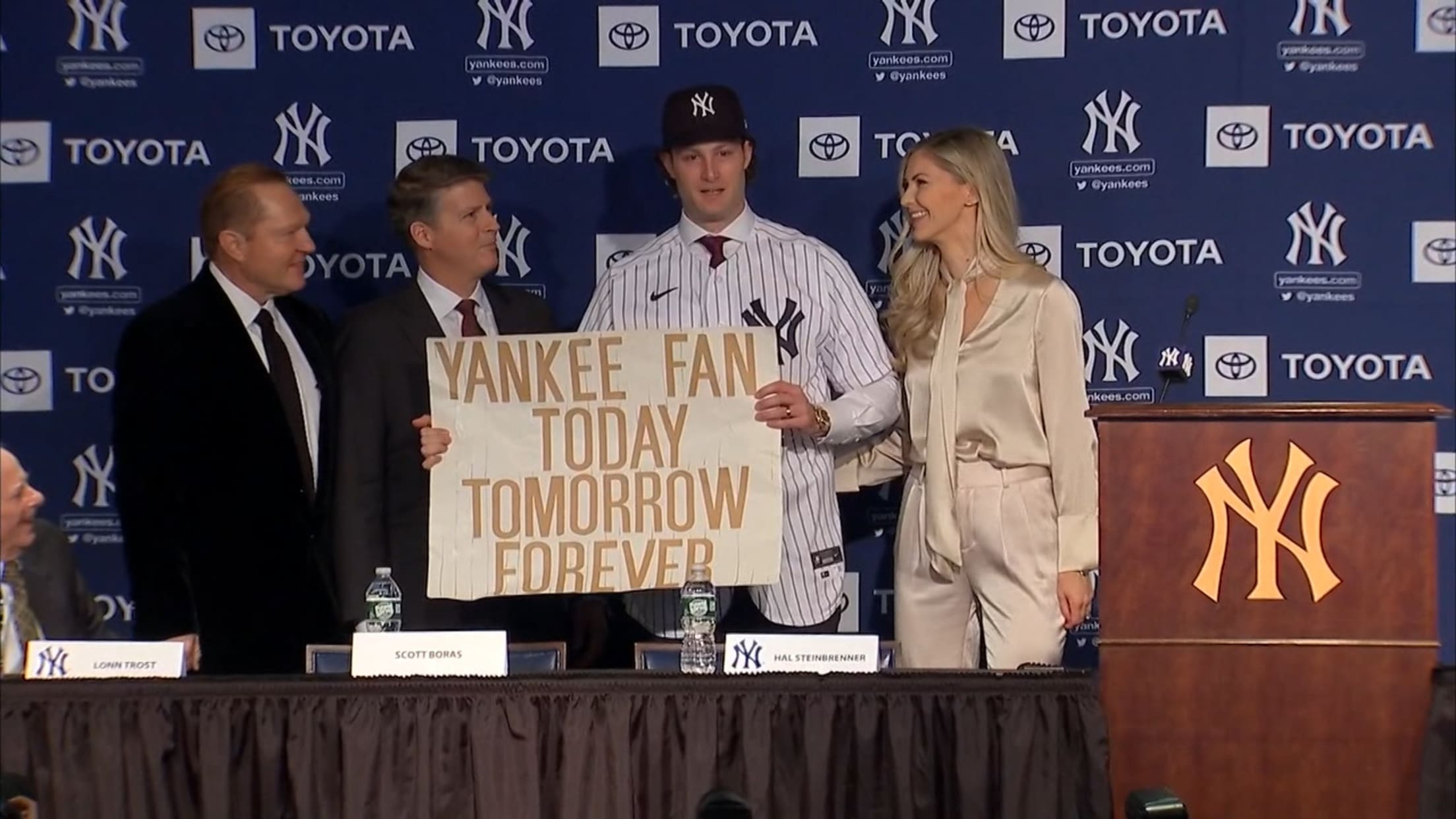
In the lead-up to the 2024 World Series, much was made about the sign Gerrit Cole made and brought with him to the 2001 fall classic. Although he was born and raised in Southern California (but considerably closer to Angel Stadium than Dodger Stadium), and he went to college at UCLA, Cole is a lifelong Yankee fan.
In fact, Cole brought the sign with him when he signed his $324 million contract with the Yankees in 2019. This past October, Cole got the chance to play for his beloved team on the largest stage. This is truly what dreams are made of.
The same is true for Yankees shortstop Anthony Volpe. The second-year player grew up on Manhattan’s Upper East Side, his family had a share of Yankees season tickets, and he attended the last World Series New York won—in 2009. With his team on the brink of elimination in Game Four of this year’s edition, Volpe hit a game-changing grand slam home run to give the Yankees a 5-2 lead, one that they would not relinquish in their only victory against the Dodgers.
The homer might have changed the whole complexion of the Series had the Yankees not booted away the fifth inning of Game Five, allowing the Dodgers to come back from a 5-0 deficit, and ultimately win the game and the title.
Marcus Stroman grew up on Long Island and was on the Yankees roster for the World Series. Unfortunately, he did not make any appearances. He was, however, afforded a front-row seat to cheer on—and to be ready if needed—his hometown team. Stroman played for the other New York team (which is about seven miles closer to his hometown) in 2019 and 2021 (he opted out of the 2020 Covid year), but neither of those Mets teams made the playoffs.
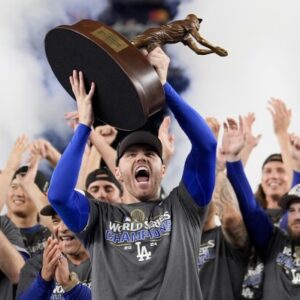
For the Dodgers, the story is slightly more complicated. World Series hero and MVP Freddie Freeman grew up in Southern California, but, like Cole, much closer to Angel Stadium. In fact, he was an Angels fan and attended the 2002 World Series match-up against Barry Bonds and the Giants. But, when Freeman signed with the Dodgers in 2022, he felt as if he was “coming home,” getting to be closer to the father who raised him after his mother passed away when Freddie was ten years old. There is no doubt that Freeman is a Dodger legend (and fan) now.
Austin Barnes was born in Orange County, California, which makes him like Cole and Freeman, and he grew up in Riverside, which is roughly 55 miles east of Los Angeles. He played three innings in Game 5 of the NLCS against the Mets, but never came to bat. That said, he was on the World Series roster and got to celebrate the Dodgers victory. We should note that Barnes played in five of the Dodgers’ six games in the 2020 World Series against the Rays. Unfortunately, all of those games were played in Texas, so there wasn’t any sort of hometown crowd to cheer him on.
Joe Kelly, who was not on the Dodgers’ World Series roster, also hails from Orange County. But his performance on the field, and his pouty face against the Astros in the 2020 season, has made him a low key Dodger legend. Like Barnes, after nearly starting a mid-season brawl in Houston, he played for the Dodgers in the 2020 World Series in Dallas.
The true hometown hero is pitcher Jack Flaherty. Acquired by Los Angeles at the trade deadline, Flaherty was given the opportunity to pitch on the same mound from which he threw a 1-0 shutout to give the Harvard-Westlake School the Southern Division CIF State Championship in 2013.
After Game One of the National League Championship Series, I had the opportunity to ask Flaherty how it felt to pitch in front of his Little League buddies at the stadium he frequented as a kid. He said it was great to know they were there and to have their support. Flaherty then had the good fortune to pitch Game One of the World Series in front of those same fans. He threw 5-1/3 innings, scattering five hits, surrendering only two runs, while striking out six. After a rough start to Game Five (four ERs over 1-1/3 innings), Flaherty cheered on and celebrated with the Dodgers as they won their second World Series in five years.
Every day across this great land a kid goes into their backyard and envisions hitting the game-winning home run or striking out the final batter. This year, Gerrit Cole, Freddie Freeman, Anthony Volpe, and Jack Flaherty got to move those stories from their backyards to the most hallowed ballfields in the game. Maybe next season Kyle Hendricks will pitch his hometown team, the Angels, to the World Series.
In 2012, I took my son’s travel ball team to a Lancaster Jethawks game. I had arranged for each kid to run out on the field with his positional counterpart in the top of the first inning.
As the kids gathered, the second baseman circled the boys up and told them to sprint to the outfield immediately after the national anthem and high-five the center fielder. The publicity person told the kids not to do it, but at the behest of this fun-loving Jethawk, they did so anyway.
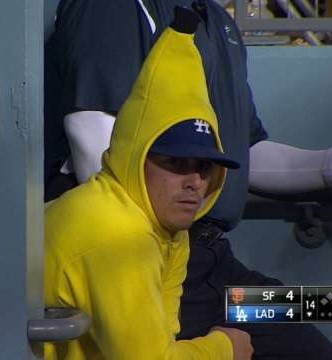
Two years later, that second baseman would make his major league debut with the Houston Astros; and , then he was quickly traded to the Miami Marlins. The next season, after a trade to the Los Angeles Dodgers, he made his postseason debut, going 4-for-13 in the National League Division Series, which the New York Mets won three games to two. That .308 batting average in four games was a sign of things to come for this versatile young ballplayer. Kiké Hernández has made a name for himself in MLB by being a carefree guy who is not afraid to don a banana suit to lighten the mood. More than that, he has made a name for himself by coming through on the biggest stages when the lights are the brightest.
In 1,183 regular-season games so far during an eleven-year career, Hernández has slashed .238/.308/.405, hitting one home run every 32.5 plate appearances. But in the postseason, those numbers go up to .278/.353/.533, with one home run every 17.3 plate appearances. And this is no small sample size—he has done it over 86 games.
When Hernández has been asked the difference between the regular season and the post-season, he has replied that he has the ability to slow his heartbeat. But it has to be more than that. Average players don’t just change into superstars when the calendar flips to October because of their heartbeat.
Here is a brief chart of active player postseason home run totals:
Player
Home Runs
Plate Appearances
Jose Altuve
27
484
Kyle Schwarber
21
278
Alex Bregman
19
434
Corey Seager
19
346
George Springer
19
309
Giancarlo Stanton
18
172
Carlos Correa
18
358
Bryce Harper
17
232
Aaron Judge
16
262
Kiké Hernández
15
259
The only name on this list that is remotely similar to Hernández is Alex Bregman, who (a) played in a hitter’s park with a very short porch (the Crawford Boxes in Houston), and (b) has nearly twice as many post-season plate appearances as Kiké. You don’t sit one home run behind Aaron Judge, and two home runs behind Bryce Harper, just by controlling your breathing.
But Hernández wasn’t and hasn’t always been Señor October. After that .308 in the 2015 NLDS, he went hitless in eight at bats in the 2016 National League Championship Series, which the Dodgers lost to the Chicago Cubs.
But in Game 5 of the following year’s NLCS, against the same opponent, Hernández had his coming out party. He crushed three home runs into the Chicago night and raised millions of dollars for hurricane relief for his native Puerto Rico in the process. Over the five-game series, he slashed .444/.546/.1444 with seven RBI. The legend of October Kiké was born.
Unfortunately, after that breakout, Hernández went 8-for-54, with just two home runs and four RBI over his next 21 post-season games in four additional playoff series, slashing .148/.258/.259 in the process. Maybe the hype was just that. But in the Covid year of 2020, after going 0-for-5 in the Division Series, Hernández began a resurgence that has not slowed down.
He slashed .308/.357/.769 for the Dodgers in the 2020 NLCS. Then, after a soft 2-10 in the World Series, he left the Dodgers for the Boston Red Sox. The following year he led the BoSox to Game 6 of the ALCS, going 20-for-49, slashing .408/.423/.837, with five home runs and nine RBI for the entire post-season.
This year Hernández was back with the Dodgers and doing what he does best. Over three series he hit .294 while playing great defense at three prime positions: center field, second base, and third base. And the lights and pressure of New York didn’t cow him one bit: he hit .286 over the NLCS and the World Series while smashing yet another post-season home run.
As of this writing, Hernández is a free agent. But after two highly successful runs with the Dodgers, after winning two World Series titles in Los Angeles, after being the Swiss Army knife willing to play any position—including pitcher—and play them all well above-average, there is a very high likelihood that Kiké is back in Dodger blue next season, and at a salary considerably higher than the $4 million he earned last year.
Color me a socialist. Not in the political sense, but in the idea that people who come to sporting events should, by and large, be treated equally and fairly.
It truly bothers me when – at the ballpark – the rich only get richer. I certainly understand that the more you pay for your ticket, the better your seat, and thus the better your view.
Where my hide starts to get chapped is when the more you pay for your ticket, the better concessions that are available to you. For this thought exercise, I am putting aside the various and sundry stadium clubs that have premier seating and premier services, and thus premier food and beverage. I am talking about sitting in what used to be referred to as “box” seats as opposed to reserved, loge, or the bleachers. It should not be that hard to make sure that the same food is available to all fans, regardless of the price they paid for admission.
Where this bee really gets into my bonnet is with balls thrown into the stands by the players. Sure, you pay more for a ticket, you are closer to the action, and you are more likely to catch a foul ball. That is just how it works.
And that is pretty democratic – no one controls how many or how far foul balls will be hit, and thus many times per game a ball reaches the upper deck where a fan with a lower-cost ticket has a chance of in-game glory and long-term bragging rights; not to mention an incredible souvenir.
But over the past five to 10 years, we have seen a proliferation of players throwing balls into the stands after the mid-inning toss-around and after the third out is recorded. And nearly every one of these balls ends up in the seats closest to the action, where the rich fans get richer.
I have given this a ton of thought, and was heartened when Steve Ballmer, the exuberant owner of the Los Angeles Clippers, announced that at the team’s new arena there will be T-shirt cannons that reach the upper decks. The T-shirt cannon is the basketball corollary to the between-innings ball toss into the stands. These predominantly go to fans in the most expensive seats. Well, not at the Intuit Dome, and, if I had my way, not at your local ballpark, either.
A couple of weeks ago, I was lucky enough to be invited to sit in the Dodgers’ Dugout Club. This is the premier seating I referenced above. I was sitting close enough to hear the players chat on their way to and from the field. After the last out of the top of the third inning, the Dodgers tossed the ball around the infield and it ended up in the glove of second baseman Gavin Lux. True to form, Lux tossed the ball into the stands. But, he didn’t just lob it into the luxury seats. He gave it a heave and sent it up to the loge level, where eager fans were shocked and excited to be getting the ball. I remarked to the people I was sitting with that the kid from Wisconsin gets it. With his Midwestern values, Lux understands the importance of hard work and the need for everyone to have a chance to be rewarded. I wish more players did this.
However, I am not naïve enough to believe that players will suddenly start chucking balls to the farthest reaches of the stands. That is why I previously recommended to the Dodgers’ chief marketing officer that at least a few times each game, a player should toss the ball to an usher (rather than the fans in general) and that usher should deliver the ball to a fan in another section. I cannot state with any authority that the ball would mean more to the kid in the upper deck than the kid in the lower bowl, but I can state that it would somewhat level the non-playing field for fans. Just because your parents cannot afford four tickets at $150 each doesn’t mean you automatically lose the chance to go home happy with a game-used souvenir.
It is the small things that teams can do to grow the game. Give that kid in the far reaches a ball, and she is a fan for life. Her family tells that story to their friends and neighbors, and they are more likely to shell out for tickets, parking, hot dogs, peanuts, and beer. Attendance would increase. Equally as important, fan engagement would increase. Fan excitement would increase. And, if those things continue to occur, team values would increase, which, let’s face it, is what owners truly care about.
One more minor suggestion: A premier seat owner knows they will not be using their tickets on Tuesday night. They call the team and inform them that the seats will be empty. In return for opening up the seats, the seat owner is given a credit to be used for future tickets or concessions. The team then sends an usher to the upper deck and presents a family with a special surprise: You all get to sit in the unoccupied premier seats for the duration of the game, and you get all of the goodies that go along with that. Heck, the team can even mention the name of the premier seat owner who bequeathed the seats to this unsuspecting family.
With electronic ticketing and so much information known about attendees, this is low-hanging fruit. It would not take very much to make this happen every night. The marketing boon derived from changing a family’s game-viewing is nearly unquantifiable. Some team – maybe the Yankees, who always seem to have tons of seats open in their most expensive section – needs to institute this plan. And soon. Attendance may be up in MLB this year, but if the sport we love is going to continue to be relevant for future generations, we need to use every tool available to create fans for life.
Crash Davis says that strikeouts are fascist. I think seats and souvenirs need to be socialist. In today’s game, we cannot do much about the former; but teams certainly can fulfill the dream of the latter.
If you are a regular listener to the Effectively Wild podcast, or if you are a fan of college baseball, you know there is one strategy that is available to major league managers, but that is rarely utilized.
There are multiple (potential) reasons this strategy is avoided: To avoid embarrassment; to give pitchers “clean” batters”; because it might be viewed as “bush”; or, more likely, because no one else does it.
So what is this unsung tactic, this trick of the trade that is shunned in the big leagues? That would be the mid-batter pitching change. Ask yourself the last time you saw one (absent an injury).
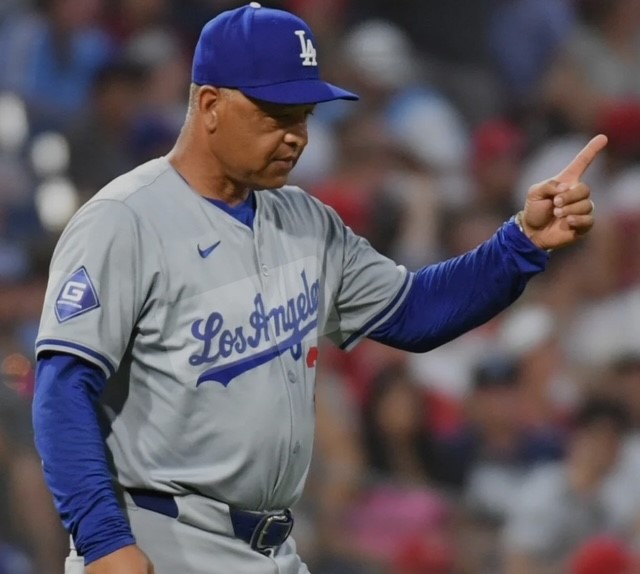
And yet, Dave Roberts, the manager of the Los Angeles Dodgers, used it to brilliant effect a few weeks ago in a game against the rival Diamondbacks. Here is the scenario:
Top of the 7th inning, and the Dodgers already trail 8-4. If the club has any chance of coming back in their final three at bats, they need to keep the D’Backs at bay.
Unfortunately, Yohan Ramírez walked Eugenio Suárez to start the inning. He then allowed a single to Gabriel Moreno. After a pop-out, left-handed hitting Corbin Carroll came to the plate. Ramírez got ahead of Carroll 1-2, and then threw a sweeper to the backstop, pushing the count to 2-2 and sending the runners to second and third, still with only one out. Carroll had seen six pitches and fouled off three of them. Dave Roberts had seen enough.
With a 2-2 count and rights against a lefty, Roberts could have chosen to walk Carroll to load the bases, and kept his right-handed pitcher in to face the right-handed Ketel Marte who was waiting in the on deck circle. Rather than do that, Roberts surveyed the chess board and elected to bring in left-handed Anthony Banda.
The gambit worked. After seeing so many pitches from the righty, Banda struck out Carroll with his first pitch – an 85 MPH slider in the dirt. Banda then intentionally walked the right-handed Marte to load the bases for the left-hand hitting Joc Pederson. But the Diamondbacks have a savvy manager of their own, so Torey Lovullo countered by pinch-hitting with the right-handed Randal Grichuk. Because Banda had only faced two batters, he was required to remain in the game. Banda induced Grichuk to ground out to third to end the inning, leaving the bases loaded and the score at 8-4.
Now, in the end, all of these machinations were for naught, as Arizona tacked on four additional runs in the eighth and ninth innings, and won the game 12-4. But the final score is of little significance to the in-game brilliance and moxie of Dave Roberts. Oft-criticized for his game management, Roberts had a perfect handle on the rhythm of the game and the strengths of his personnel. He understood the situation and the significance of the timing, and didn’t hesitate to try something unorthodox to help his team win.
After the game, Lovullo was asked about the move. He acknowledged that he had never seen it before, but said he might consider using it in the future. College coaches have been doing it for ages. Ben Lindbergh of Effectively Wild has been clamoring for it for years. And Dave Roberts finally introduced it at the highest level. Whether others will join in is anyone’s guess. But, now that the Dodgers have broken the seal, there is a non-zero chance that this is not the last time you see a pitcher walking off the mound while a batter remains standing in the batter’s box.
In the interest of full candor, I have an addiction. I am addicted to great defensive plays. Sure, most of us are. We baseball fans delight in watching highlights of a home run robbery or a player diving into the stands to make a great catch. But my compulsion runs deeper.
For instance, I can tell you – within a minute or two – when Baseball Tonight’s Web Gems, the ESPN Top 10, and MLB Network’s Capital One Premier Plays, will appear on my screen. And I plan my viewing of other programs around this schedule. Every day I receive MLB’s Morning Lineup newsletter. I skim the stories and then click on the link for Top Plays. I do this EVERY. SINGLE. DAY. In fact, when I once realized that I had missed some, I went back and watched Top Plays from weeks before.
I believe this inclination follows on from my own baseball career, as I was always better with the glove than the bat. Watching a batter hit a ball a country mile is very cool; but watching a defender cover a ridiculous amount of ground, leave his feet, jump up, and throw a laser across the diamond, is just something special.
However, because I watch replays of anywhere from 10 to 30 great plays every day from April through October, I often feel sympathy for some of the hitters who are denied the fruit of their labor because their counterpart has done something mind-boggling. To that end, I mentally put these gems into six different categories:
1. Robbery of an Underserved Hit (Outfield Edition): There are a surprising number of these. A batter hits a flair behind the infield, and the right fielder comes racing in to make a sliding catch. Or a shortstop ranges well behind third, up the line, to take a duck snort hit away from a batter who got jammed on a cutter. I love this version, as the batter has no valid justification to hang his head. He shouldn’t have been rewarded for this particular swing of the bat, so the fielder making a Web Gem makes this a simple transaction in my mind.
2. Robbery of an Undeserved Hit (Infield Edition): Like it’s outfield cousin, this one involves a swinging bunt or a slow roller. Here the batter deserves slightly more credit, as he at least busts down the line to beat it out. Whatever the negative feelings are for his soft hit are made up for by his hustle for an infield single. But time and again we see Matt Chapman (or his ilk) attack the ball, barehand it, and throw on the run to beat the batter by a step. I also love when a shortstop charges behind the mound and throws on the run. But my favorite version of this is the ‘tweener between first and second, because now you have three players in action, with either the first baseman or the second baseman fielding off-balance, and then throwing to a moving target – the pitcher – covering, catching, and stepping on the bag while a runner bears down on him from behind. The beauty of these plays, when combined with weak exit velocity, allows me to feel like the ledger is even.
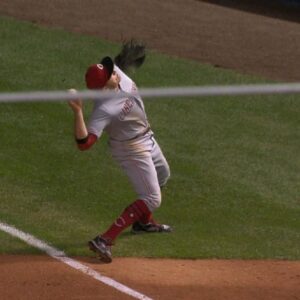
3. Great Catch In Foul Territory: This one stings just a little more. The batter fought off a tough pitch, and in some ballparks he would be rewarded with another swing or two. But, the third baseman somehow heads straight back and makes an over-the-shoulder catch on top of or behind the tarp, robbing the player of his at bat. Or a second baseman ranges deep behind first and makes a sliding catch in foul territory. These plays have gotten even more interesting in the past few years with the advent of netting down the baselines. Now we have outfielders acting like Spiderman, diving into the net to make the catch. Again, my heart goes out to the batter, but these plays sure are great to watch.
4. Robbery of a Sure Hit: We all love this one. A batter smacks a ball into deep left center; it has double written all over it. And then, seemingly out of nowhere, the center fielder appears on our screen, leaps with an outstretched glove, and makes an impossible catch possible, as he rolls over and shows the world that he has the ball. Or a batter smacks a surefire single up the middle, only to have the short stop range too far to his left, dive, leap up, and make the throw to record the out. There is the scorched line drive that the third baseman dives for and takes out of the air with his glove actually behind him. Or maybe the worst version (from the hitter’s perspective): the stab of a line drive to first base that is turned into an unassisted double play. Two outs on one swing with a 100+ exit velocity may seem like the worst, but then there is…
5. Home Run Robbery: This is the coup de grâce. A pitcher throws a ball 90+ MPH, the batter, in his 0.45 seconds to react, engages his swing and squares the ball up (he may or may not “barrel” it), and hits it 350+ feet. From the moment it leaves the bat, the hitter feels confident that he may have gotten – if not all – enough of it to take a slow trot around the bases. Meanwhile, the outfielder is ranging back, his feet hitting the soft dirt of the warning track, his non-glove hand feeling for the wall, and then he leaps. At that moment, it is truly a leap of faith. Faith that he has timed it right; faith that he has measured it right; faith that the wall will not inflict injury when he makes contact; faith that an overzealous fan will not obstruct his momentum or his potential catch (see, Hample, Zack). And then he does it. He reaches over the wall and takes a souvenir away; takes a run (maybe more) away; takes the fans’ breath away. Ask any outfielder, and they will tell you that this is the pinnacle of their profession, this is what they all hope and practice for, and you can see it on their face when they actually pull it off. And you can feel the batter’s pain. He is usually somewhere between first and second base when he realizes that his moment has quickly, and inexorably, become someone else’s moment. They typically drop their head. But, every-so-often, the batter will doff his helmet to the fielder, a show of mutual respect. I simply love that.
6. Robbery of a Needed Hit: For years I thought the robbed home run was the greatest indignity for a batter. But, as I have grown older, and watched more and more baseball, I have come to learn that there is an even worse fate. Some batters are in a slump – they simply cannot buy a hit. Some guys are fighting for playing time, and need to make the most of every at bat. Some guys have been victimized by a slick fielder earlier in the game, and need to even things out. Now, to be clear, “Undeserved Hits” don’t fall into this category. To get my sympathy, they have to be sure hits. And the play has to befall a guy who can’t afford it. Chris Taylor, barely hitting .100, cannot have Francisco Lindor go into short left and make a jump-throw to first. Zack Gelof, hitting below the Mendoza line, with three dingers in 143 at bats, cannot have Jose Siri take a home run away from him. Every time I watch Web Gems, or MLB’s Top Plays, I keep a steady eye on the batter. It is rare, but also so very sad, when the same batter appears more than once in the same highlight package. I don’t care if you are Luis Arraez, Aaron Judge, or Randy Arozarena (the current holder of the worst batting average in baseball), having two righteous hits taken from you in one game is too much to bear.
Baseball is a marathon, and things tend to even out – for every snagged line drive there is a Baltimore Chop for a single; for every diving play in the outfield, there is a squib over the first baseman’s head. But, baseball is also a game of confidence. And it is easy to go into a downward spiral when nothing seems to fall – even well-hit baseballs. Hitting is hard enough with pitchers throwing at insane speeds, with unseen movement, from crazy arm angles. When a batter does well enough to do well enough, but repeatedly gets thwarted by the best defense on offer, it just doesn’t seem fair.
Not every series of Web Gems or Top Plays contains all six categories, but they usually check at least four of the boxes. To wit, last Sunday’s and last Friday’s editions:
My nephew is living my dream. Unlike me, who – many, many years ago – had to walk on, he was recruited to play Division I baseball. He did a workout for the coaches, and joined the team. It wasn’t that easy – most things never are. He – like me – had to endure tryouts in the fall to see who would actually make the club. But, unlike me, when all of the players were culled and all the cuts were made, when the final spring roster was determined, when the coaches decided who they wanted to wear the swanky new uniforms and get the team-issued mitts, my nephew’s name was on the list. Alas, when that final cut happened more than 30 years ago, my name was not.
None of this brings even an ounce of jealousy or envy. My nephew worked hard for this (way harder than I ever did); he earned it; he passed up other opportunities and took risks and they paid off. Kudos to him all around. And now he is living the life of a collegiate athlete, with the early morning wake-ups and the long days and the missed classes due to team travel. And he seems to be loving it.
Recently I went to see him play a game at Pepperdine University in Malibu. If you have never seen a game at the Eddy D. Field Baseball Stadium, which sits on a mountain above the Pacific Ocean, get thee there quickly. There may be no better place to watch a ballgame in the U.S. of A. To get to the field, I needed to travel on Malibu Canyon Road and then turn right onto Pacific Coast Highway. At that intersection, just a few hundred yards to the west, is a single set of baseball fields that may offer an even nicer view than the one at Pepperdine. At that corner sits the perfectly named Bluffs Park, the home of Malibu Little League. On the right day, you can hear the waves crashing while shagging balls in the outfield at Bluffs Park. Here you feel like you could actually hit a ball into the ocean (Note: You can’t).
As I made the right turn, and saw the baseball complex out of the corner of my eye, a chill went up my spine. You see, it was there, on the Pony diamond, in midst of all that beauty, where I had the worst game of my entire baseball career (and that is saying something). It was a Saturday afternoon; I was 12 years old. We were playing a scrimmage against a team from Malibu Little League, and were happy to be the visitors at their incredible facility.
Now here it is important to note that from the time I picked up a bat until the final time I slammed one down at Sancet Stadium in Tucson, Ariz., I could always hit the baseball. I was a contact hitter – I didn’t hit for much power, but I did hit for average. On days that I wasn’t feeling it, I could work a walk like Juan Soto. I never struck out much. To me, the only thing worse than making an error in the field was the slow walk back to the dugout after swinging through (or, G-d forbid, looking at) strike three. (Note: In the ‘80s and ‘90s, strikeouts were frowned upon, not something simply to be expected as one of the three true outcomes. In fact, the year this story occurred, MLB players suffered nearly 50% less strikeouts than they did in 2023.)
But this day in Malibu, with the breeze blowing in and the sun shining bright, was something special. On this Saturday, I came to the plate four times, which is not bad for a seven-inning game. I saw 14 pitches over those four at-bats. Last season, the MLB average was 3.91 pitches per plate appearance, so my 3.5/PA wasn’t too shabby. The difference is that I struck out four times, with my 29” aluminum bat never making contact with that 5 oz. piece of leather. Breaking it down, I struck out on three pitches twice, and on four pitches twice. I batted four times and accomplished a golden sombrero needing only two pitches over the minimum to get there. Suffice it to say, there was no ice cream for me afterwards.
The game was so awful, my performance so dreadful, that I actually shook it off pretty quickly. I couldn’t do much more than laugh. One of my coaches said to me, “It’s just one of those days.” In the moment, I sincerely hoped that the plural would never be necessary. And lucky for me, it never was. But that day, nearly 40 years on, still lingers, still sits like a pit in my stomach, and still brought a shiver when I passed that infernal baseball diamond on my way to watch my nephew do great things.
Baseball is the best sport. It sticks with you. It brings you joy and pain. I recently started playing in a Sunday softball league, and I was astonished by my muscle memory. Having spent the better part of my childhood fielding grounders and chasing fly balls, my body intuitively knew where to go and how to react and when to bend. Drop-stepping and making a play on a fly ball to left field at 52 years of age nearly brought more joy than striking out four times on 14 pitches brought pain, if that makes sense. The game, once ingrained, never leaves you.
My nephew is having a terrific year. He cracked the starting lineup a few weeks back, is hitting over .300, and was nominated for the WCC Freshman of the Week at the end of April. He will have good days and bad days ahead, but hopefully he never experiences a day like I had in 1984 at Bluffs Park. But even if he does, he can hang his hat (rather than his head) on the fact that he is a legitimate Division I college baseball player, he is living his dream. And, in so many ways, he is living mine.
I have written here and elsewhere – as recently as a few weeks ago – about the family aspect of my baseball fandom. My grandfather passed along his love of the game and the Red Sox to my father, who bequeathed it to me; I, in turn, gave it to my son. Four generations, more than a hundred years. Mission accomplished. For us, it is a family affair.
But a few weeks ago, I was asked the following question: “Dad, can we go to a baseball game?” My son is currently living in Washington, D.C., so it was not him asking. Rather, it was my nearly 18-year-old daughter; she wanted to go to a game. Here we had the epic battle of nature vs. nurture, and I didn’t care who won.
All those years of being dragged to her brother’s Little League games; or being dragged by her father to Spring Training and regular season MLB games; or having the family room television co-opted by Sunday Night Baseball or the World Series; or all those long debates with friends and grandparents while she was held captive at the dinner table; had rubbed off and rubbed in. She is now a baseball fan. Now, let’s not get carried away, she doesn’t have a FanGraphs subscription, and she certainly doesn’t read all of my baseball writing, but she does check the scores and knows which teams have won on a given day.
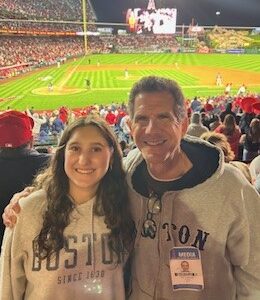
And, to be fair, TikTok also gets a hat tip. It is through that infernal social media platform that she learned of the Savannah Bananas, who are, in many/most respects, a baseball team. The entry point is not important; her love of the game is what matters. So, a couple of weeks ago, she put on her Fenway Park T-shirt and her Boston sweatshirt, and drove down with me to Angel Stadium to see our beloved Red Sox take on the hometown club. I was on the field prior to the game to get an interview, but there she was standing right behind the dugout, taking in batting practice and marveling at the scene in front of her. And – like her brother – she requested that I get her a ball. (Narrator: He got her a ball.)
We found our seats and enjoyed the hell out of the game on a chilly night in Orange County. Her favorite part of the game is the seventh-inning stretch, so we were sure to stand for God Bless America and Take Me Out to the Ballgame. We saw a back-and-forth contest, a grand slam (which was just one of six home runs), a season-ending injury, and another Kenley Jansen save in a Red Sox victory.
Showing her appreciation for greatness
My daughter is about to graduate high school and head off to college. I know days and nights like this are fleeting. I know that we cannot stop time, as it marches on for all of us. But I also know that bonds formed early, and reinforced often, are hard to break. The bonds I have with my daughter run deeper than just baseball, but it does bring joy to my heart knowing that my game, my family’s game, and now her game, are part of the stew.
The writer’s girls at his happy place
Somewhere around the eighth inning, a thought popped into my daughter’s head. And with this thought, I knew I had done my job as a baseball dad. She looked at me and asked, “Now that I am going to go to school in Colorado, do I have to become a Rockies fan?!” I smiled and told her that it was a fair question, but that under no uncertain terms is that required or even advisable. But, I did add that Coors Field is a great place to see a game, so any chance she has to go, she should.
I have no doubt that at some point in the not-so-distant future, she and I will be sitting in the Denver sun on a beautiful spring day, enjoying one of the 27 draft beers on offer, and laughing at the product the Rockies have put on the field (and wondering what happened to poor Kris Bryant). And in that moment, I will be happy, proud, and, as a baseball dad, perfectly content.
This article first appeared in the IBWAA Here’s The Pitch newsletter on April 11, 2024
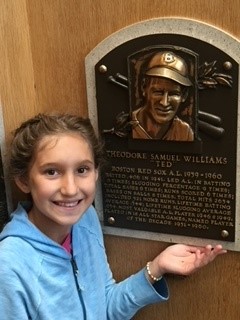
I have written many times in this space about my family connection to baseball. My grandfather, the stalwart Max, lived in Boston and was a Royal Rooter. My father, Saul, grew up in Beantown, sneaking into Fenway (but no hot dogs on Yom Kippur), and cheering on Ted Williams. I was born and raised in Los Angeles, but the love of the Red Sox was passed straight down to me. Joe Posnanski and others have said that your baseball fandom is formed between ages 12 and 14. Well, I was fourteen in 1986, so heartache and heart break were injected into my early teen veins, never to be metabolized. For my first child, I was lucky enough to be bequeathed a son, and into his hands went a glove and a soft Red Sox baseball. The fourth generation of fan was created.
While my love for the BoSox has never waned, the four championships in 14 years lessened the urgency. Moreover, age softens everything, including your edges. As an avid baseball fan, and as an observer and writer about the sport, I have slowly taken a more 35,000 foot view – enjoying all aspects of the game, respecting players of every team (I’m not ashamed to say that I got a little dusty when the previously-hated Derek Jeter hit a walk-off single in his final Yankee Stadium at-bat), appreciating the finer points and constant evolution, but also calling out the game when it fails its players and its fans (e.g., the Cubs desire for a ring allowing them to justify trading for Aroldis Chapman; anything related to John Fisher; the Dodgers putting more value of analytics than morality in signing Trevor Bauer; etc.). Truth be told, I like my current perch better than my youthful exuberance and constant frustration.
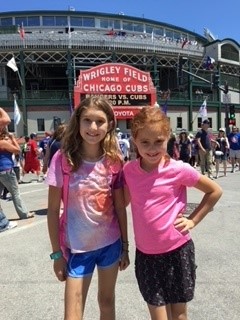
But my son, my 21-year old progeny, is now truly coming into his own as a baseball fan. And I am here for all parts of it. There is nothing better than the nature vs. nurture argument. And, as I laid out above, nature came out of the gate with a three furlong lead. But nurture slowly gained ground. Maybe it was the behind-the-scenes tour of Fenway at age six; or the Home Run Derby and All-Star Game at age seven; or Wrigley Field at age ten; or going to the World Series at fifteen. Who knows? But he’s got the baseball bug, and got it good.
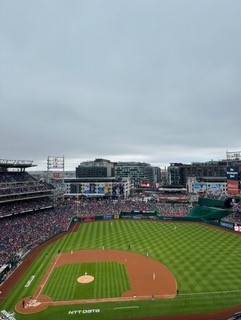
So a couple of weeks ago I was visiting him in Washington, D.C. where he is interning for the semester. He – not me – asked if I could extend my stay for an additional day to go to the Nationals’ opening day. Alas, I could not. But he could; and he did. He got himself a ticket, hopped on the Metro, and took in the game all by himself; just as I have done on so many occasions. I was standing at my desk that Monday afternoon, literally minding my own business, when a text popped up on my phone. It was a picture of Nationals Park taken from the 400 level, with a two-word caption: “So back.”
Jake’s view from the 400 Level at Nat’s Park
As a parent, all you really want is for your children to be happy (and safe). You want them to find their passions and explore them. And if those passions line up with your own, all the better. My son beat me to the ballpark this season (but only by a few days). While there twinge of envy, there was more than a dollop of pride. You get to a point in life where you pass the torch. I am not quite yet ready to do so – nor is he, as he still wants me to buy tickets, hot dogs, and beer – but it is so good to know that when I am, he will be ready. He is already checking train schedules for Baltimore and Philly – just like his father has done.
Soon my son will graduate college and become a bona fide adult. And at some point he may have a son of his own. At this point I feel perfectly confident that he will carry the torch, teach the game to his kid, and then, when the time is right, he will pass it along to the next generation.
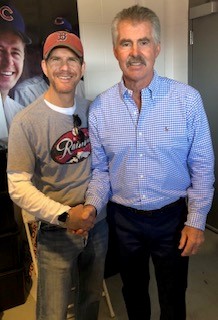
We are deep into Spring Training, which got me thinking about a trip to Arizona we made about six years ago. While visiting Sloane Park in Mesa, I was lucky enough to meet Bill Buckner. Billy Buck, he of the 2,715 hits and career .289 batting average, but also he of the “slow roller up along first.” As a lifelong Red Sox fan, it was an honor to meet Buckner and have an ever-so-brief conversation with him about his career and the exemplary example he set for athletes dealing with adversity. I was deeply saddened when he passed away the following year.
The author and the consummate professional.
In the aftermath of the 1986 World Series, but contrary to reported stories, and despite haranguing from irredeemable baseball fans, Buckner did not flee Boston. Rather, he moved his family to Idaho, where he had previously purchased a ranch, and began buying real estate. However, Buckner will always be remembered for the most ignominious “meg” in the history of Major League Baseball.
The whole Buckner saga never sat right with me, as (1) I am not sure Buckner, even if he fielded the ball cleanly, with his addled ankles and sore feet, beats the speedy Mookie Wilson to first base, and (2) even if he does get there in time, that just pushes the game to the 11th inning. There were no guarantees from there. In short, I never believed that Buckner lost that game for the Red Sox. But the “goat” label stuck to Buckner nonetheless.
There have been many goats in baseball history – guys who make the wrong play at the wrong time, and ostensibly cost their team the game. And because baseball (as well as life) is about sequencing, it is often the last guy standing that gets the condemnation. However, before that goat ever has a chance to “blow” the game, some other player or players need to make some mistakes. I call this “the swallow before the choke.” And, fortunately for the swallower, history often forgets their names, their failures, and their role in the gut-punching final moment. Those players need to bear some of the brunt and share the blame.
Let’s take a look at a few:
2003 NLCS: Game 6 / Top of the 8th Inning
Steve Bartman may be the biggest goat never to don an MLB uniform. His attempt to catch Luis Castillo’s foul ball, which resulted in Moises Alou not catching the foul pop for the second out of the inning, opened the floodgates for the Marlins. Putting aside whether or not Alou would have actually caught the ball, there is still a ton of blame to go around. For our purposes, the swallows are Mark Prior and Álex González.
Prior had already given up a one-out double to Juan Pierre, so the inning wasn’t clean. Further, not only was he not able to recover after the “Bartman Incident,” his ball four to Castillo went to the backstop, allowing Pierre to take third. Prior then gave up a single to Ivan Rodriguez on an 0-2 count. But, even at that point, the Cubs still led 3-1. Enter Alex González.
Prior induced Miguel Cabrera to bounce into a tailor-made 6-4-3 double play to put the Cubs three outs away from the World Series. But, as we know, González booted the grounder, loading the bases for Derrek Lee. Lee – who became the Cubs’ first baseman the following season – promptly doubled home the tying runs (off Prior, natch). Kyle Farnsworth then came into the game to intentionally walk Mike Lowell, give up a sacrifice fly to Jeff Conine, intentionally walk Todd Hollandsworth, and then give up a three-run double to Mike Mordecai. Pierre batted again, and singled to cap off the scoring, and the Marlins ultimately won the game, 8-3. Bartman needed a police escort out of the stadium, and was forced to move out of state; documentaries have been made about him. But other than an amazing reference to González in this season’s finale of television’s “The Bear,” it would seem that González and Prior have escaped the ignominy of that fateful eighth inning.
1951 Final Game of the Season / Bottom of the 9th Inning
Ralph Branca’s name will always live in infamy in baseball circles. Despite a 12-year career that saw him win 88 games, make three All-Star teams, and finish with a 3.79 ERA and a 105 ERA+, Branca is known for one pitch, swung at by one batter, ending one pennant chase.
Ironically, the Dodgers and Giants never should have been playing in that three-game playoff, as the Dodgers were 11.5 games ahead of the Giants on August 11, and still up 4.5 games on September 20, with ten to play. There are any number of reasons that the Dodgers should have won the pennant in 154 games*, saving Branca from his vilification.
*Note: MLB did not expand to 162 games until 1961.
Very few people remember that Don Newcombe took a 4-1 Dodgers lead into that fateful ninth inning. Newcombe gave up two singles to start the frame, got a pop-out, and then surrendered a double to Whitey Lockman. Branca came in from the bullpen (pitching on one day’s rest) up two, with the tying runs in scoring position. Bobby Thomson hit his second pitch over the wall in left for the “Shot Heard Round the World.” Branca threw the final pitch, but Newcombe threw many before him, and the Dodgers as a whole wrapped their hands around their collective throats.
1986 ALCS: Game 5 / Top of the 9th Inning
Much has been written about Boston’s incredible comeback against the then-California Angels with two outs in the top of the ninth inning of Game 5 of the 1986 ALCS. And many people have mourned the sad tale of Donnie Moore, who gave up Dave Henderson’s two-run home run, and the lead, in that ninth inning. But, many people forget two important facts about that game (aside from Reggie Jackson putting his glasses away and hugging Gene Mauch with one out to go, and putting aside the police on horseback lining the field, both of which tempted Moira, the Greek God of Fate):
(1) After Mike Witt gave up Don Baylor’s two-run homer to make it a 5-4 game, Gary Lucas came in to face Rich Gedman. Lucas promptly hit Gedman in the head with his first pitch, putting the tying run on base and bringing the lead run to the plate; and
(2) The Angels tied the game in the bottom of the ninth
In fact, even after giving up four runs and the lead in the top of the ninth, the Angels were in prime position to win this game a half an inning later. They went single, sacrifice, single, single, intentional walk. With the game now tied at six, the Angels had the bases loaded with one out, and Doug DeCinces and Bobby Grich coming up.
DeCinces hit 26 homers in 1986, and also had four sacrifice flies. But on this occasion, all he could muster was a weak fly to right field, not deep enough to score Rob Wilfong from third. Grich, in his final season, only played 98 games, but still managed an OPS+ of 109. In the sixth inning, Grinch hit a two-run home run to give the Angels a 3-2 lead. But, with two outs in the bottom of the ninth, with the bases loaded and the pennant on the line, Grich hit a soft liner back to Steve Crawford on the mound to end the threat.
Had either DeCinces or Grich knocked in the winning run, the Angels would have gone to their first World Series; Henderson’s home run would have become merely a footnote; and Donnie Moore would never have been required to pitch the 10th and 11th innings.
2011 World Series: Game 6 / Bottom of the 9th Inning
Buster Olney (and others) have called this the greatest baseball game of all time. It ended with David Freese’s walk-off home run in the bottom of the 11th. But it was the bottom of the ninth where fate laid its hand.
We all remember how feeble Texas Rangers right fielder Nelson Cruz looked going back to the wall on Freese’s opposite-field line drive with two outs, two strikes, and two on. We all want to blame Cruz for costing the Rangers the World Series. Sure, had Cruz looked more like Steven Kwan than Michelle Kwan on that play, the Rangers may very well have won their first World Series title 12 years earlier.
But, if Neftali Feliz hadn’t given up a first-pitch double to Albert Pujols with one out, or hadn’t immediately walked Lance Berkman on four straight pitches, then there wouldn’t have been the tying runs on base for Freese to drive in. Feliz owes a ton of gratitude to Cruz for making people forget.
1986 World Series: Game 6 / Bottom of the 10th Inning
There is simply no need to go into further detail about the bottom of the 10th inning of Game 6 of the 1986 World Series, as Buckner carried the weight of Calvin Schiraldi and Bob Stanley for nearly 20 years – at least until the Red Sox reversed the “Curse of the Bambino” in 2004. In the hearts of many in New England and around the world, Buckner was the reason that the Red Sox lost that game and lost the World Series. The facts, however, tell a different story.
Recency bias works in both the positive and the negative. We remember the last thing we saw, good or bad. We tend to forget the moments leading up to the final moment. We burn in effigy the player we deem to be the “goat.” But history has shown us, time and again, that there is nearly always some other player or players swallowing hard before the final choke.
*A version of this article first appeared in the IBWAA “Here’s the Pitch” Newsletter on February 16, 2024.
Please don’t allow us to forget about or overlook the splendor and greatness of Francisco Lindor.
When Lindor was in Cleveland, his brilliance was appreciated. In fact, he was beloved, but always with the jaundiced eye of: “This small market team will never be able to afford this magnificent player long-term.” And that turned out to be correct.
Before the 2021 season, then Guardians sent Lindor (with Carlos Carrasco) to the Mets for Amed Rosario, Andres Gimenez, and two prospects. And in typical big-market fashion, the Mets immediately signed Lindor to a 10/$341 million contract.
Under the white hot lights of the Big Apple and the pressure a $341 million contract thrusts upon a player, Lindor hit under .200 over the first two months of the 2021 season. The fans in Queens didn’t totally sour on him by Memorial Day, but it certainly wasn’t a great first impression. And New York fans are a difficult lot to win over, or win back, if you make a poor first impression.
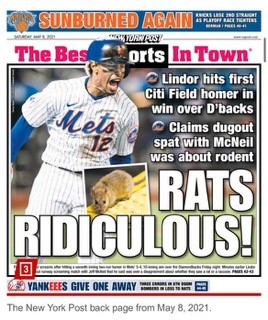
And then, while batting .158, slugging .200, with one home run under his belt in his first 26 games with the Mets, Lindor grabbed second baseman Jeff McNeil by the throat in an altercation behind the dugout.
While this kerfuffle played out in the New York tabloids, the story changed from a fight to a mild argument to a simple disagreement over whether they saw a rat or a raccoon in the bowls of CitiField. Regardless of the actual story (one which we may never know), it was a bad look for the $300 million guy with the sub-Mendoza batting average.
Lindor tried to redeem himself over the course of the rest of the season, but he didn’t exactly set the world on fire. Playing around an oblique injury that thwarted him in parts of July and August, Lindor hit .252 with 16 home runs after May. “Mr. Smile” ended 2021 with an OPS+ of 100, and his worst career statistics in nearly every offensive category.
2022 was much closer to a standard Lindor season. He hit .270, tallied 26 dingers, drove in 107 runs, and had a 125 OPS+. He even came in ninth in MVP voting.
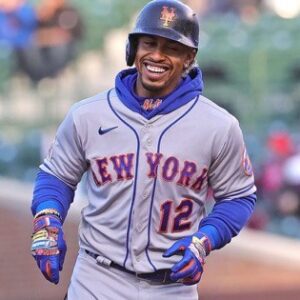
But to the fans and the media, the first two months of 2021 (on the field and just off of it), and his $34 million salary, still loomed large. So heading into 2023, Lindor had a target on his back, justified or not. Lindor, with his huge smile and flashy batting gloves, seemed made for New York, but to the victor goes the spoils, and you must perform to get the love. According to Mets fans, he had not yet performed.
If Lindor hoped to get that giant apple-shaped monkey off his back early in 2023, he didn’t do himself any favors. He came out of the gate hitting .218 in March/April, but did slug four home runs. May and June weren’t much better: .227 and .230, respectively. He did hit 6 dingers each month, and was trending in the right direction. In mid-June, Lindor’s wife, Katia, gave birth to their second daughter. And the sleep deprivation did him some good. In the twelve games after becoming a “girl dad” twice over, Lindor hit .310, belted four home runs, and had an OPS of 1.035.
In July, he hit another five round-trippers, with an OPS of .923. In August, he kept it going, collecting 32 more hits, nine for extra bases, with a .371 OBP. And then in September (of a wasted season for the club), Lindor continued to build. Seven home runs, eleven extra base hits, 19 RBI, and an OPS of .868.
When the season was done, Lindor had made the Flushing fans smile with 31 homers, 98 RBI, a 120 OPS+, and his first time joining the 30/30 club (actually 31/31). All of which led to Lindor winning the Silver Slugger award for the third time (but his first in New York). From the time of his second child’s birth, only four players had more bWAR than Lindor, and all of the other players laced them up in Los Angeles and Atlanta.
With the exception of a few bumps in the road, if you looked closely and in the aggregate, the Lindor that we all knew and loved has been there all along. It is just that sequencing in sports matters, and that may have allowed the fans in New York to miss it.
So, now Lindor enters Year Three of his massive contract in a good place, ostensibly physically as well as mentally. The team – despite a rough 2023 – is built to win, with a strong rotation and depth at nearly every position. It is all set up for the All-Star shortstop to have another MVP-caliber season, the type that the Mets faithful all anticipated when the club acquired him and then signed him to the largest deal in franchise history. The Lindor of old has been there all along, but now is the time for him to take it to the next level.