Dan Freedman is the Executive Vice President of Business & Legal Affairs at Lionsgate Films. This is his unique (?) perspective on baseball, and how the same oftentimes relates to life.
The following was written at approximately 3pm, on Monday, July 20, 2015:
Around 7pm tonight, regardless of what the scoreboard reads, regardless if our boys are racing around the outfield holding yet another banner (that would be eight, by my count) or wiping their eyes in the outfield grass, tears will be shed. If the latter, by the boys; if the former, by the parents and family members in attendance.
It is fitting, in so many ways, that this game is being played on our field, in our park, in our town.
If we are on the wrong end of the game, our boys will finish their Little League careers right where they started, and bring to a close a chapter – more like a book – of their lives that has provided us and them with too many memories – and smiles – to count. They will leave their field one last time, knowing that they left it all out there. Rare is the group of kids who could do what they have done just to get to this moment. Three wins in three days; battling against bigger and stronger opponents (did anyone see Rose’s thighs?), freaky weather (who has ever had a summer game delayed in Southern California for lightning and thunder?), and a blind and capricious umpire. And yet, they did it. They played together – the Fearless Fourteen – each making a contribution to help us travel the “Road to Monday”.
If we are able to pull this off, it will be one of the greatest stretches of baseball I have ever witnessed. On Thursday night I texted Mike to say that the documentary, “Four Days in October” was required viewing by the team. I am not sure who watched, but I know Jake and I did. Over four nights in October, 2004, the Red Sox “shocked the world” (in the words of Kevin Millar) and came back from a 3-0 deficit to the Yankees, winning four straight, winning the pennant, allowing them to eventually win the World Series. Those were the same odds we were facing Thursday night. And, if we win, we will have done what the Red Sox did – battling the elements (Game Six was delayed due to rain – sound familiar?), dealing with fatigue (Derek Lowe pitched Game 7 on 2-days’ rest, and then pitched 6 innings giving up 1 run – sound familiar?), and overcoming questionable umpiring (however, in Game 7 in New York, the umpires overruled themselves twice to get the call right – as of now, we have not been so lucky). Thus, in so many ways, we have taken the road of the 2004 Red Sox, and if we win, will have followed in their championship footsteps.
Win or lose, it has been a pleasure to watch these boys play for the past seven years; it has been amazing/exhausting/exhilarating/years-off-life-taking to watch these boys play these past three summers; and it has been an honor to have made such good friends and watch all of us grow – as players, parents, and a community.
And now we know what happened. Duke threw the game of his life (and yet, we hope he has a few more of those in him); Jagger led off with a game-tying homerun; our opponent stopped fielding the ball; and we kept piling on runs. When Jack’s liner softly fell past a drawn-in infield, the fight was officially over, and the celebration began.
These “Four Days in July” are something that we won’t soon forget. 4 days, 3 mercies, 2 walk-off homeruns, and 1 opponent essentially having their hearts ripped out to the point that they simply had no heart left to even make a routine play.
Over the past three years we have been treated to so much, there is really no telling when and where this journey will end. Dan Chasek asked this back in June, 2013: “Why not us?” After what I witnessed last weekend, I have no earthly reason why not.
Ryan Seacrest makes $15M per year for “American Idol”.
Alex Trebek earns $10M a year for “Jeopardy”.
David Letterman was making about $20M per year when he retired from “Late Night”.
Katie Couric got paid $15M a year – for 5 years – to host the CBS Evening News.
Suffice it to say, people a heck of a lot smarter than me think that there is value in having a qualified host. The above people, and countless others, wouldn’t be paid so much if they didn’t make the viewing experience even better for the consumer.
Which begs the question, why don’t Major League teams live by the same credo? Why do they believe they can hand any ex-ballplayer a microphone and call it a broadcast?
There is a lot of talk in the ether about baseball being boring and hard to watch and that the games are too long. I cannot necessarily disagree with any of that, but I do think that viewing the game could be immeasurably improved by making changes in the broadcast booth.
On way too many occasions I have had to turn off a Wednesday evening or a Sunday afternoon game because of the long pauses or disjointed rants or annoying conversations or pointless patter of the broadcast team. It often feels like they are up there having a great ol’ time, the audience be damned. And a great many of these so-called “broadcasters” get a pass for past performance on the field.
We tolerate Hawk Harrelson because he was a decent ballplayer and tells great stories about golfing with the legends. Truth be told, he should “Be Gone!”
We were forced to listen to Joe Morgan tell us how he did it – which was always better than any current player.
Steve Stone often just served as the straight man for Harry Caray, who was too sauced to know the difference (I know, I know, Harry was a legend and a billy goat will shit on my pillow for even implying that Harry was a Cubs fan and Bud man).
Don’t even get me started on Don Sutton in the TBS booth. He is only marginally better than Pete Van Wieren, but the whole lot of Braves announcers could have their own wing in the Broadcasters Hall of Shame.
Turn on the TV in any hotel room in any city in America and you are almost guaranteed to be turned off to baseball. Why do we, why do to the teams, why does MLB, allow this? Do you think GM runs out a bunch of former mechanics to the showroom floor and expects people to buy cars?
A few weeks back I was watching Sunday Night Baseball on ESPN. In the broadcast booth were John Kruk, Curt Schilling, and Dan Shulman. Now, I could give you chapter and verse about Curt Schilling the bombast, the holier than now personality, and the right-wing kook. But, say what you will, the guy knows baseball – and he knows how to communicate it. That night – watching in my family room – I was treated to a master class in the game of baseball.
Krukkie and Schill talked pitch-by-pitch strategy – from both a hitter’s and a pitcher’s perspective. They discussed defensive alignments and how and why shifts were or were not used. They explained why the call on the 1-1 pitch was so important. They talked about different preparation techniques that play a significant role in the actual game. They called the viewers’ attention to the catcher making adjustments based on the batter’s positioning in the box. And they called pitches – Schilling was able to decode the catcher’s signals with runners on base and proceeded to call each pitch for half an inning; and he then explained to the viewers how he did it. The guys looked ahead to later innings and potential reliever-pinch hitter match-ups, and why it made sense to at least get pitchers throwing in the bullpen – if for no other reason than mental strategy. When there was a slight lull in the game, they discussed issues related to team travel and how those affected the players and the manager’s in-game decisions. All the while, Dan Shulman kept us abreast of the play-by-play.
It was like watching Da Vinci paint; it was like Robert De Niro discuss acting or Martin Scorcese explain directing; class was in session, and we were all students of the game. Had your less-obsessed significant other been tuned in, he/she would have learned more about baseball over two innings than they would with season tickets. Had your son or daughter been watching, they would have left the room a considerably better baseball player. It was that great. And, if the people in power actually cared about the consumers, it could almost always be that great.
Why can’t a broadcast booth be lively and alive? It should be as if we have stumbled into a bar where two or three guys are watching a game and we are allowed to eavesdrop on their conversation.
If MLB wants to grow the sport; if they want people to become students of the game such that young kids prefer it to (or like it just as much as) football or basketball; if MLB wants to appeal to a new generation, they need to make the game fun and interesting. And if they want the whole family to enjoy the game, then they need for people to at least have a cursory understanding of everything that is going on in the twenty seconds between pitches, and the often minutes that elapse between any meaningful action. How can this be accomplished?
This is so easy: Get better announcers. Demand that each team employ quality play-by-play guys and gals and color commentators who not only understand the game but understand how to explain it to the masses. Would it shock you to know that the average NFL game is twenty minutes longer than the average Major League game? MLB games just feel longer.
Our viewing habits on Sunday afternoons during the fall tell us that we have no issue sitting on the couch for long stretches of time watching a sporting event. It’s just that the producers of Major League Baseball seem to go out of their way to ensure that the viewing experience is akin to watching grass grow – and that just gets you to the 7th inning stretch.
Who couldn’t listen to Vin Scully wax poetic for hours on end? Sure, there is only one Vinny, but there are many Dan Shulmans, and Jon Millers, and Duane Kuipers and Mike Krukows, and Boog Sciambis, and Gary Thornes, and Joe Bucks, and Tim McCarvers (I know this may roil some of you), and Dave O’Briens, and Bob Costases, and Steve Physiocs, and Sean McDonoughs, and Victor Rojases, and Al Leiters, and Steve Berthiaumes, and Thom Brennamans, and many many more out there. How many do we need? 30, 60? That is all. Cast the net wide; t hey can be found.
If I have to hear John Sterling announce another “A-Rod with an A-Bomb” or “Gardner plants one in the seats”, or listen to Suzyn Waldman drone on like a bitter housewife at her Tuesday night Mahjong game, I will go crazy. Do we really need Ted Leitner butchering the English language or Jerry Remy homering all throughout tha yahd?
There are at least 194 colleges in the United States offering Radio and Television Broadcasting programs. There are at least 240 Minor League baseball teams. There are countless guys like me who sit in the stands or on their couch and give a running commentary on the game. Are you – and by you, I mean MLB and the individual teams – saying that you cannot find 60 people better than our current crop? And we don’t even need a full 60 – I listed eighteen above and you all could probably list a handful more.
We need to be rebel against this onslaught of mediocre announcing.
We need to make listening to the game fun again. We need the days of Red Barber and Mel Allen. How about that?!?
We need to have people with microphones in their hands that will educate, excite, and entertain. We need a little showmanship combined with a lot of knowledge. We need “great communicators” (Ronald Reagan actually did play-by-play of Cubs games that he had never seen – he “recreated” them via telegraph feed).
So write to your cable company; write to your favorite team; write to Rob Manfred; hell, write to your congressman. Or, better yet, write to the sponsors of the games – tell them you will stop watching and listening and stop buying their products unless and until they change the quality of our product.
Or, if all else fails, turn down the volume on the TV, turn up the volume on the radio, and let Vinny carry you home from “wherever you may be”.
People ask me all the time why I love baseball so much. And to that question, I have a very simple answer.
It’s not the beauty of 60 feet + 6 inches, and the fact that those additional 6 inches make all the difference in the world. It’s not that each ballpark is different, and the various dimensions play a role in the game – often serving as a tenth player. It’s not that the defense starts each play and is the only side allowed to touch the ball. It’s not that each campaign stretches over three calendar seasons, which allows the season to unfold in a languorous manner, wherein no one game is dispositive, and yet every game counts.
No, the number one reason why I love baseball so much is the two-strike pitch.
I love the build-up, the excitement, the payoff, the let-down, and the repetition of the moment. I find nothing more exciting, and nothing that takes more time off my life, than the two-strike pitch. And, for maximum agita, there is nothing better than the 3-2 pitch. No other sport has a similar moment.
Sure, in basketball you have last second shots (see Sampson, Ralph or Fisher, Derek). But once that ball has been in-bounded and the shot released, the moment either happens or it doesn’t. Either way, the moment is gone. There are no do-overs.
Football has the two-minute drill and the Hail Mary Pass (see Flutie, Doug). And again, save for a penalty calling the play back, once the play is done, it’s done. I will grant you that football may be the closest facsimile, as a team can repeatedly stare down its fate and continue its march to eventual pay-off or heartbreak. But again, each moment is slightly different (different down, different field position, different personnel, different amount of time on the clock, etc.).
Hockey, golf, tennis, soccer? None of them have “it”.
But in baseball, you can – and often do – relive the same moment over and over again. A virtual Groundhog Day (Moment?) that can happen on what seems to be a perpetual loop, and you never quite know when it will end.
The two-strike pitch provides that anticipation. The 3-2 pitch is great because there is no room for error; the pitcher has to come in or the batter will stroll to first base. On a 3-2 count, the batter is especially attuned to the pitcher, knowing the small margin, and is fighting for his (or her, hello Mo’ne Davis) proverbial life.
If you are an active viewer of the game, you see this coming. The batter either takes a first pitch strike our “just misses” one. The cat and mouse game has begun. Maybe the pitcher gets ahead and now the batter is in a defensive posture; or maybe the pitcher starts behind and the batter has the upper hand. But, some how, some way, we end up at a two-strike count. And we, as fans, try to guess who will outsmart whom; or, as they say on MLB Network, “who kept their cool?”
This is where the lack of a clock (game, pitch, shot, or otherwise) makes baseball beautiful. The batter keeps one foot in the box (per the new rules) and readjusts his helmet and batting gloves; he smacks some dirt off his spikes; digs in and waggles his bat. Meanwhile, the pitcher goes behind the mound and picks up the rosin bag; steps to the rubber and takes a deep breath; he checks the sign from the catcher, and either shakes him off, in which event the excruciating delay is further prolonged, or he nods in assent. With his glove poised in front of his face, the pitcher begins what seems to be an interminable windup, and then lets the horsehide fly. We watch this with agonized anticipation; and time seems to slow to a stop. Our hearts find their way into our throats, while our stomachs somehow move southward. The tension could not be any greater.
And then, in the blink of an eye, the batter breaks the air with his massive swing. And we, with breath bated, watch as . . .
He fouls the pitch back to the screen; or down the line; or just off the catcher’s glove.
And we still have a two-strike count. Rinse and repeat. And then deduct another 10-15 minutes from the back end of your life.
In no other sport can you get this type of anticipation, build-up, release, and, ultimately, failure to produce an outcome. And, in baseball, you cannot run out of time. Time is both your best friend and your worst enemy.
In football, you know that one way or another, this pain will end in 30 seconds; 24 seconds (or less) in basketball (of course, a team could always call a timeout, but that is a red herring). In baseball, this moment of stress can last for what seems like forever.
And as desperately as you want it to end, some part of you wants it to last evermore. Can you imagine any other moment in your life where you are on the brink of exultation, but it is staved off over and over again, being postponed indefinitely? People would (and do) pay good money for that kind of thrill. And yet, you can get is for free on television every night for nearly seven months. You can get it for free at your local Little League ballpark nearly every afternoon every spring.
The letdown we all experience when the season ends is partly attributable to this feeling. Rock stars rely on drugs to approximate what they feel on stage. Athletes refer to the camaraderie of the clubhouse, hanging on for a season or two too long, not wanting to lose that feeling.
For us, the fans, it is the two-strike pitch that forces us to dedicate way too much of our free (and not so free) time watching a languid game played in a park where players in their home whites go to battle using pearls and maple wood and fine leather. It is the anticipation of the moment, the prolonged absence of action followed by a glimmer of hope, culminating in the lack of culmination. Let’s face facts, we are flat out junkies.
Baseball will never be football, nor basketball, nor soccer, nor tennis; and for that, we are grateful.
In case you have forgotten, in case you haven’t had a hit for some time, below are – for my money – the two best two-strike moments in baseball history (added bonus for occurring in the World Series).
(This is simply the best when you add up foul balls + power + youth vs. experience + the situation):
(A razor-close second best when you add up foul balls + injury + experience vs. experience + the situation):
What is your first reaction when you hear the word “fanatic”? Is it positive or negative?
With the possible exception of the Phillie Phanatic, who brings joy to patrons, players, and the occasional coach, I would imagine the properly-spelled “fanatic” doesn’t conjure too many kind thoughts. Outside of that oversized, fluffy green doll, I think it is safe to say that we tend to have a jaded – if not fearful – view of fanatics. Whether it is religion, politics, war, or sports, we don’t want to live next door to – let alone share a meal with – a fanatic.
With that in mind, would it surprise you to know that the word “fan” is derived from the word “fanatic”? Makes perfect sense, no? Some sources actually believe that the word “fan” was, in the late 19th century, a shortening of the word “fanatic”, relating specifically to baseball enthusiasts. I guess that’s fitting.
Over the last 125 years, society has mellowed (one would hope). And excepting 10¢ beer night (https://www.youtube.com/watch?v=DeTpnOzoPdw) and some unruly people in the bleachers, it seems that, in time, baseball “fans” on the whole have become something different/better than “fanatics”. (As an aside, I am not sure the same can be said of soccer “fans” who seem to be every bit the “fanatics” of years past.) But before we start to feel too good about ourselves, remember that – even though we have lost the fanatic tag – we still follow our teams and the game with the devotion of a fanatic.
According to Webster, a fanatic is a person “marked by excessive enthusiasm and often intense uncritical devotion”. And a fan is “an enthusiastic devotee, follower, or admirer of a sport, pastime, celebrity, etc.”
This all begs the $64,000 question: Where is the line; at what point do you stop being a fan and become a fanatic?
For instance, is it “excessive enthusiasm” or just plain “enthusiastic devotion” when you paint your face with your favorite team’s colors/logo? How about naming your child after your sports hero? Or decorating an entire room of your house? Having season tickets or watching every game on television (70% of Los Angeles cannot do that with the Dodgers, natch)? In a vacuum, it is very difficult to draw the line.
We know, of course, when someone leaves that line in the dust: When you throw batteries at opposing outfielders; when you beat the other team’s fans in the parking lot; when you threaten to kill a guy for interfering (arguably) with a play on the field. In those instances, we are dealing with fanatics, and society needs to step in before someone gets (even more) hurt.
So, while we can sometimes see the line between “excessive enthusiasm” and “enthusiastic devotion”, how about “intense uncritical devotion”? Is dialing in to sports radio and calling for the manager to be fired considered “intense uncritical devotion”? Is burning a player’s jersey when he leaves the team “intense uncritical devotion”? Is wearing the same t-shirt for every game of the World Series to ensure that the Baseball Gods smile favor down on your team “intense uncritical devotion”? I guess “intense uncritical devotion” is in the eye of the beholder. And if you have ever tried to talk reason to a crazed sports fan (oftentimes referred to as a “fanatic”), try not to look into the eye of that beholder, as you might now like what you see. Napolean once said: “There is no place in a fanatic’s head where reason can enter.”
“Uncritical devotion”, as its own concept, is difficult to deal with. When intensity is added to the mix, look the hell out.
Intense uncritical devotion leads people to say and do things that – if they were in their right, logical, Namaste-inclined mind – they would never say or do. Sometimes we appreciate this intense uncritical devotion – these are the fans that still come to the ballpark in the dog days of August because, “you never know . . . string a few wins together and we might be right back in the race . . .” Sometimes we hate it, like when they call Clayton Kershaw “a bum” because he has walked two batters.
But what about when people start coming up with crazy conspiracy theories in support of their (or against someone else’s) team? Does that reek of “intense uncritical devotion”? These conspiracy theories are prevalent in all sports, and they – like the truth – are “out there”.
Celtics fans (as well as many others) believe the referees fixed Game 6 of the 2002 NBA Western Conference Finals to ensure the Kings lost.
The people of Arkansas think Sonny Liston was KO’d by Muhammad Ali’s “phantom punch” in 1965.
Red Sox haters still claim that Curt Schilling put ketchup on his sock in Game 6 of 2004 ALCS.
Any basketball fan outside of New York City thinks that the only way the Knicks got Patrick Ewing in the 1985 draft was because the NBA froze their lottery envelope.
Chicagoans can never believe that Michael Jordan took an early retirement to fulfill his lifetime dream of playing baseball, but that David Stern made him step away due to illicit gambling activities.
And, of course, Dodger fans on both coasts believe that the “Shot Heard ‘Round the World” would never have happened if the Giants hadn’t been stealing signs from the centerfield scoreboard.
It’s not just kids who say the darndest things.
So the next time you are sitting in the stands, or walking through the parking lot, or waiting on hold for some talk show, or typing a pithy reply to a Tweet or Facebook post, ask yourself the following questions: In the sober light of day, when all emotion has been stripped away, is what I am about to do or say reasonable? Am I being an enthusiastic devotee or am I showing intense uncritical devotion. If the former, fire away. If the latter, think twice, then a third time, and then go with discretion – it is always the better part of valor.
Be a fan, not a fanatic.
PLAY BALL!!
p.s. The inspiration for this post was some recent events I have witnessed and heard about. But, I guess this topic is in the zeitgeist, as in this week’s Sports Illustrated (you will get it in the mail in a few days) there is a review of a book entitled: “Fanaticus: Mischief and Madness in the Modern Sports Fan”. I wrote this before seeing that.
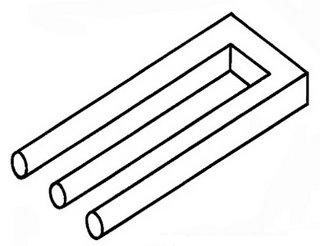
As an ode to my mom, who never missed an opportunity to say something whacky or just plain funny, I present to you the “blivet”. Sure, we could go with Webster, and tell you that a “blivet” is also known as a poiuyt, devil’s fork, or widget. I could explain to you that a blivet is an undecipherable figure, an optical illusion, and an impossible object; something that appears to have three cylindrical prongs at one end which then mysteriously transform into two rectangular prongs at the other end. Here, stare at it for a while.
But no, that is not what I am talking about.
Long before there was ever the concept of the Urban Dictionary, my mom was extolling the virtues and vices of the “blivet”, which, in her and UD’s world, is defined as 10 pounds of shit in a 5 pound bag.
What, on God’s green earth, you ask, does this have to do with baseball? Ah, I am glad you asked.
Every day I pick my son up from baseball – be it a game or a long practice – and each time I am treated to a protracted delay while he tries to put all of his equipment into what I deem to be an already very large bag. My son is truly shoving 10 pounds of shit into a 5 pound bag. He then turns it upright, rolls it to the car, and allows me to wrench my back lifting it into the trunk. Who needs all 10 pounds of this shit? Not to get all “get off of my lawn”, but in my day…
…In my day, we rode our bikes to the park and to practice. If we were lucky, we had a bat (usually wood, although that changed in the mid-’80s) that we held across our handlebars, with our lone glove on one end of the bat and our cleats tied to the other. We held on for dear life (no helmets required), and then rode home at dusk. In between, we played some pretty good baseball.
While I acknowledge that riding your bike to practice today is both impractical and against all societal norms, the rest of it could theoretically still hold true.
Alas, that is not the case. Here is a brief summary of what currently resides in my son’s baseball bag (and yes, I am 89.4% to blame for this): 1 very expensive, totally unnecessary, top of the line, aluminum (or composite, who the hell knows) baseball bat; 1 pitcher’s glove; 1 outfielders’ glove; 1 first baseman’s glove; 1 catcher’s glove; a set of shin guards; a chest protector; a catcher’s mask; a batting helmet; multiple pairs of batting gloves; 2 different arm sleeves; a few loose baseballs; 2 wrist protectors (one a custom Evoshield and another off-brand that actually provides more protection); an odd wristband; and a pair of cleats. He isn’t a player so much as he is a section of Sports Authority.
As I have previously written, I remember with great clarity the day I got my first first baseman’s glove, which upped my equipment tally by 33.3%. My son could lose a $200 mitt in his bag and forget it even exists.
Each kid today must have his own helmet – heaven forbid lice gets spread. Each must have his own bat – when did the Easton corporation perform a mind meld on every Little Leaguer such that his life is incomplete if he doesn’t have the latest SL or Mako model? Each kid must have multiple mitts. How could a fielder ever handle first base with a glove that has individualized fingers? Some players now sport two pairs of cleats – rubber for Little League and metal for travel ball. Cleats that, ostensibly, he will out grow before he wears out. And each player must have a high performance bag to carry all this swag – be it a cool backpack with slots for multiple bats (really?) or a bag with wheels to protect their precious lumbars. When did this happen? How did this happen? Why did this happen?
As to when, it must have been some time in the past 5-10 years, but maybe it happened even earlier.
As to how, that is simple. We, as parents, allowed it to happen.
As to why, I have a few thoughts, in no particular order:
Ubiquity. When I was a kid, sporting goods were the purview of a single aisle at Thrifty Drugs, a small section at Sears (where they also sold fishing rod and guns), the local sporting goods store (which didn’t open in my neighborhood until I was in high school), and the occasional mail-order catalogue that found its way into our mailbox. Today, kids are just a few clicks away from “what pros wear”. In fact, “whatproswear.com” is an actual website that contains links to everything you see on television or at the stadium. (And, not for nothing, this is an awesome site to get lost in, and which make you pine to be a kid again.) Everything they could want is within reach, all they need is . . .
Vicariousness. If you are anything like me, when you were a kid you wanted everything you saw, but for the reasons stated above, plus parents who didn’t really care what we wanted, plus the cost of such items, that gear was unattainable. So, if you are anything like me, you live vicariously through your kids in the swag department. Batting gloves that match the uniform, check; cleats with cool contrasting laces, check; glove with his name embroidered on the side, check, check, and check. If we couldn’t have that stuff, at least they can.
The Joneses. You gotta keep up. This has various permutations. The first is obvious – Little Timmy’s got it, so your guy should have it too. That story doesn’t get much traction in my house, but that story gets told nonetheless. But how about the fact that your kid won’t have a helmet to wear unless you buy him one? The league doesn’t provide them, and teammates (or their parents) are loathe to let someone borrow theirs. This is a real life issue. Or this one: Bobby and Mikey both have $40 custom-molded Evoshield elbow guards; your kid asks for one and you laugh him out of the room. And then he gets hit on the elbow and you feel (a) guilty, (b) like an asshole, (c) like a cheap asshole, and (d) a guilty, cheap asshole who has now lost all high ground in these future battles. I guess Bobby and Mikey have better parents than my kid.
Coolness. Truth be told, the equipment is just plain cool. Even if you never played the game, and thus have no vicariousness to deal with, you still want your kid to look cool on the field. And, let’s be honest, the Oakley Half Jacket 2.0 XL with Black Iridium lenses and team color sock kit just look damn good (even if they spend the majority of their time perched on top of the cap rather than on the player’s eyes). What 12-year old doesn’t need an arm sleeve – let alone a custom one with his initials or number on it? What group of 12-year olds doesn’t need matching $150 bags with their names and numbers embroidered on them so they can hang side-by-side on the back of the dugout? Let’s face it, the majority of the people reading this blog never wore Fonzie’s jacket, but we all hold out hope that our kid just might.
This phenomenon, rest assured, is not exclusive to baseball; it is just the world we live in today. When I pick my daughter up from her dance studio, after her two hour practice (which, of course, includes a private lesson), I am stuck waiting in the lobby while she jams all of her dance gear into a pink, embroidered (with her name), customized (for her dance team), wheeled blivet.
For generations people have had as their solitary goal that their children have a better life than they. In many ways, that is the American Dream. I just don’t think, when immigrants started landing on Ellis Island in the late 19th century, they could have ever envisioned that all of their worldly belongings – their own personal blivets – would fit into a knapsack smaller than the bag my son takes to the field every day.
And when the children of those immigrants first picked up a broomstick and a Spaldeen, and ran from manhole to manhole, avoiding parked cars and angry shop owners, I highly doubt they ever worried about modified trap webbings, BBCOR technology, or Pittards digital sheepskin leather. They cared about the game of baseball – and getting home before the streetlights came on.
Ah well, this is the monster we created; we could always say, “no”.
So, if you can find one at the bottom of that suitcase your player rolls into the dugout, I say to you . . .
I’m a Red Sox fan. There, I admitted it. And I have no shame in doing so. Of course, that is considerably easier today than it was 12 years ago. Over the past 11 seasons, the Red Sox have won 3 World Series championships. It’s not hard to be a fan. After 86 years of futility, after countless near-misses, after torturing not only a fan base but an entire region of this great country, it seems the Baseball Gods smiled down on the players housed in a musty clubhouse locked underneath the then 92-year old edifice erected between Lansdowne St. and Yawkey Way. Ah, the Baseball Gods.
Do they exist, these oft-quoted, oft-lamented, Baseball Gods? If you are a superstitious sort, like I am, you definitely believe. There has not been any qualitative or quantitative research done on the number of Atheist baseball fans who believe in the Baseball Gods, but I have to imagine there are more than a few. If not for the Baseball Gods, how could you explain the crazy turns of event that seem to happen over and over again?
And the corollary to the concept is that one must go to great lengths not to upset the Baseball Gods. It is a well worn fact that, in the midst of a no-hitter, you don’t deign to talk to the pitcher, and the announcers and fans are verboten from discussing the same. We have now taken this to its logical and technological conclusion, to the world of social media, where this edict is now writ large (small?). To wit:
SportsCenter @SportsCenter Jun 14: DEVELOPING: Nationals P Max Scherzer has not allowed a baserunner vs Brewers through 6 innings. He has 11 strikeouts on 67 pitches.
No one – with the possible exception of Buster Olney who, for reasons that are inexplicable, doesn’t believe – wants to be the guy who pissed off the Baseball Gods are caused a base hit to occur.
How about when the Baseball Gods have taken out their animus on entire organizations (see Cubs, Chicago; Red Sox, Boston)? The Baseball Gods were big fans of the Bambino in Boston and not so much Billy Goats on the ballfield. Is there any other way to explain, in no particular order:
Bucky “Fucking” Dent
Bill Buckner
Aaron “Bleeping” Boone
Steve Bartman
Leon “Bull” Durham (in case you forgot, a quick reminder)
And, to that end, is there any other way to explain how fortunes change? Go to Netflix and watch “Four Days in October” and tell me that some form of divine intervention wasn’t at play.
Or what about baseball’s biggest heel: Barry Bonds. Did anyone – mortal or otherwise outside the City by the Bay – want him and the Giants to win the 2002 World Series? Apparently not, as that series turned on a dime when Scott Spezio (yup, Scott Spezio, who later fell out of baseball in a haze of drug abuse and ended up being tased by the police a few months back) changed a player’s and a team’s fortunes with one swing of the bat.
The Baseball Gods are not fond of certain vices; gambling on the sport, for instance. The White Sox (er, Black Sox) fixed the 1919 World Series. They didn’t get back to another World Series for 40 years (losing to the Dodgers in ’59), and didn’t win one until 2005. It seems the Baseball Gods abide by some long-gestating statute of limitations.
The Baseball Gods are not kind to premature victory celebrations. Take, for instance, the 2001 World Series, wherein the Yankees were up a run going into the bottom of the ninth of Game 7, with Mariano Rivera on the mound. Some marketing mensa thought it made sense to cover the Yankees’ locker room with plastic and roll out cases of champagne. We all know what happened next, as the D-Backs got to Rivera and Luis Gonzalez duck-farted his way into World Series lore. I hope that same lackey was charged with clearing out the clubhouse before any shocked Yankee made it down the tunnel.
Nor do Baseball Gods take kindly to “Bush League” behavior. For a litany of examples, see the career high (low?) lights of one Alex Rodriguez. He ran across the mound in Oakland – much to the dismay of Dallas Braden; he yelled “Hah, I got it” while running past the third baseman in Toronto; he smacked the ball out of Bronson Arroyo’s glove in Game 6 of the 2004 ALCS, and then claimed he did nothing of the sort. We could do this all day with this guy. End result: A-Rod received the harshest drug punishment in the history of the sport – without ever failing a drug test. The Baseball Gods (this time in the form of Bud Selig) had spoken.
Lest we think the Baseball Gods only focus on the Big Leaguers, I personally pissed them off a few years ago. After the fifth run scored in extra innings of a win or go-home game, I started making weekend plans for the next round of playoffs. Wouldn’t you know it, the opposing team scored six times in the bottom half – culminating with a walk-off grand slam (which was preceded by a Bull Durham/Bill Buckner-esque ball through the first baseman’s wickets). I knew I had done wrong when I opened my mouth, but thought there was no way the Baseball Gods would bother with a 12-year old baseball game. As my daughter is apt to say, “I guess you were wrong”.
The Baseball Gods are also quick to punish what they believe are unfair outcomes. Last week we (re)learned about Merkle’s Boner. That mistake (read: properly but questionably enforced rule) allowed the Cubs to win the pennant and then the World Series. As we discussed, they haven’t won one since, and haven’t even been back in 70 years. Or, how about when a coach appeals and wins a questionable (albeit, by the rules, correct) interference call early in a series, only to end up losing that series in the final game? The Baseball Gods never forget; their power is always lurking right around the corner.
So forget Friday the 13th and black cats running across the field, it is not calendars and felines you need to be worried about. It is the omniscient, omnipotent, and omnipresent Baseball Gods with whom you must curry favor. So grab your glove (which, hopefully, no one else has touched), step over the baseline, touch second base on your way to the outfield, use the same bat over and again, draw a symbol in the batter’s box, carry a crystal in your back pocket, and then just go about your business. Because nothing can affect your performance or the outcome of the game . . . except the Baseball Gods.
It is often said that lawyers are the people in society who have read the inside of the box. We (ostensibly) know the rules, and we are charged with helping interpret those rules, enforcing those rules, and/or seeking remediation when someone violates those rules. But what happens when a rule isn’t a rule? What happens when there is another side of the box, the side with the rules that are seldom enforced? (As an aside, we will cover the unwritten rules at another time.)
Situation in Point: A shortstop, in attempting to turn a double-play, doesn’t touch the bag. This is so commonplace that is has its own name: “The Neighborhood Play”. Abide by the specific rules of baseball, and the base runner is safe. When was the last time that call was made?
Situation in Point: A third baseman swipes the tag down well ahead of a would-be base stealer. The throw and tag beat the runner by some distance, but the glove (with the ball) doesn’t actually make contact with the sliding player. We often chalk that one up to “the throw beat him”, so he should be out. With instant replay now being utilized at the Big League level, this is probably a safe call. But for the last 100+ years (prior to 2014), more often than not (read: nearly always), the runner was out. Was this the right call?
How many times have you seen the strike zone expand on a 3-0 count? Or when a pitcher is at the plate? Or shrink for a batter with a reputation for a great eye (see Boggs, Wade)? Again, with new technology and umpires under stricter scrutiny, this happens less often, but it still happens. Isn’t a ball a ball and a strike a strike, regardless . . .?
Umpires have an incredibly difficult job. The rule book looks like a phone book and reads like the Talmud. And yet, umpires are expected to know all of the rules, recognize the play, and make the right call, all in a split second. Not so easy to do. So, should they be forgiven for being lenient? Or for choosing when not to enforce the rules?
How about this one, a direct case on point: A college softball player hits her first and only homerun of her career. Coming around first base she tears a ligament in her knee, and cannot make it around the bases. By rule, if her teammates help her, she will be out; if she cedes to a pinch-runner, it will be a single. Isn’t this an instance when the rule need not be a rule? Apparently not, as it took the great sportsmanship and humanity of her opponents to help make the homerun happen for the injured player. By the way, this happened twice – on the same day, six years apart.
(After what we have seen recently in college softball, it is worth reading these to reaffirm your faith.)
A rule is a rule, even when the umpires need to use common sense to enforce it. A batter hits a swinging bunt down the third base line. It rolls and rolls. If the third baseman touches it, it will be a fair ball, and an infield single. So, he does what any right-thinking grown man would do: he drops to his knees and blows the ball into foul territory. Ingenious? Not so much; the umpires rule interference, the batter is safe, and now it is the hitter who gets to blow – a sigh of relief, that is.
But, sometimes, a rule is not a rule, and umpires (or league officials) have to use common sense not to enforce it.
In 1983, George Brett came to the plate at (Old) Yankee Stadium to face Rich “Goose” Gossage. The Royals trailed 4-3, there were two outs, and U.L. Washington (and his toothpick) were on first. We all know what happened next: Brett hit a bomb deep into the right field seats; Billy Martin contested the homerun claiming George had too much pine tar on his bat; Umpire Tim McLelland agreed (invoking MLB Rules 1.10(c) and 6.06) and called Brett out; game over; and then Mt. George erupted. By all accounts, Brett was in violation of the rule, and however bush it may have been, Martin (and McLelland) were right in their assessment. However, American League president Lee McPhail disagreed, claiming that was not the “spirit of the restriction”. McPhail overruled the rule, and allowed the homerun to stand. The teams had to finish the game nearly a month later (with Ron Guidry playing centerfield and Don Mattingly playing second base), and the Royals tallied the victory.
The “when is a rule a rule” debate has become heated the past two seasons with respect to “foreign substances” that pitchers use to get a better grip on the ball. Back in the day, Vaseline was the substance du jour, but that was used to gain a competitive advantage. Hell, Gaylord Perry, a self-described cheat (his biography is entitled “Me and the Spitter”), is in the Hall of Fame (see,Bloom Back on the Rose, March 21, 2015).
In my day, sandpaper and nail files were used for competitive advantage. Today, it does not seem that pitchers use the substances to cheat, but cheating it is (Rule 8.02(4)). But when? If Clay Buchholz loads goop into his hair and touches his flowing locks in between every pitch, why don’t the umpires call him out. When Kenny Rogers had a dark streak of something on his throwing hand in the World Series, or Jon Lester had some green substance on his glove during another World Series, why were those acceptable? And yet, when Michael Pineda loads up his neck with pine tar; or when Brian Matusz or Will Smith put a little rosin and sunscreen on their arms, let the suspensions begin. Which rule were they violating that the others were/have not?
(As an aside/on a related note, this is one of my favorite videos: Joe Niekro trying to fling away an Emery board.)
One thing we can all agree upon is that, with respect to the field, all of the rules must be enforced, right? Well, not always. How many times have you seen a batter wipe away the back line of the batter’s box before he digs in a little farther back. Rare is the umpire – at the MLB level, at least – who will redraw the batter’s box. I guess Rule 6.03 isn’t necessarily “a rule”. Or what about teams who over-chalk the baselines if they have especially proficient bunters? Or teams that over-water the infield if facing a team with speedsters? I guess umpires liberally interpret (i.e., don’t enforce) Rule 1.04.
Here is a famous one that could easily not have been enforced. To baseball aficionados it is known as “Merkle’s Boner”. If you don’t know the story, it’s pretty good one:
On September 23, 1908, Fred Merkle, all of 19 years old, having played in only 38 games all year, was called for his first big league start against the Cubs in the heat of the pennant race (Merkle’s Giants were tied with the Cubs for first place). With the game tied 1-1 in the bottom of the ninth, Merkle came to the plate with the winning run on first. This was only his 48th plate appearance of the season. Merkle promptly singled down the rightfield line, moving the winning run to third. The next batter, the light-hitting Al Bridwell, ripped the first pitch into centerfield for the apparent game winner. Giants fans poured out of the stands and mobbed the field. Merkle, advancing from first base, saw the onslaught of fans and (knowing what a crowd of unruly/overly excited New Yorkers might do to him) turned back to the dugout before ever reaching second base. The Cubs’ centerfielder, responding to his teammate’s pleas, tossed the ball to Johnny Evers, who stepped on second base to record the third out. Rule 4.09 was enforced, and “Merkle’s Boner” was born. So much chaos ensued that the game was ruled a tie, and the teams had to meet two weeks later to decide the pennant. The Cubbies won that game, on their way to winning the 1908 World Series. Which, as we all know, is the last time that happened. Which leads us to a topic for another day: The Baseball Gods . . .
As with most topics, we could go on and on. You watch enough baseball, you will see and learn something new nearly every day. Unfortunately, you oftentimes have to learn it by figuring out what rule was or was not enforced.
To some people, baseball is boring. To others, it is confusing. To us, it is beautiful. But even to the baseball lovers and cognoscenti among us, it is truly dizzying trying to determine “when is a rule a rule”.
The game is over, the dugout is empty, and the field has been dragged. One team is headed to the snack bar or the parking lot. And the other team is jumping into a dogpile in the outfield. The jubilation of a come-from-behind victory? Possibly the sweet relief of a hard-fought tournament championship? Nope, the end result of a 10-run, 4-inning mercy at the hands of a considerably stronger opponent.
In some circles, that dogpile would be players throwing haymakers at each other; blaming one player or another for not tagging up, or failing to cover a base, or over-throwing a cut-off man. But, in this particular dogpile, you had a bunch of players who had processed the loss and moved on. Quickly. Too quickly for some. Much too quickly for me.
Here is the rub: For the past few years, I have had the honor of coaching a travel baseball team. Now, I realize that many of you immediately recoil at the thought of travel ball (although, if you are reading this blog, probably not), and all that it entails. Trust me when I tell you that everything you have heard is exaggerated and yet totally on point. But I digress.
Coaching this group of kids has been one of my greatest pleasures. However, my biggest frustration with this team has not been the strike outs, or the dropped pop flys, or the sometimes circus-like throws about the field. No, my biggest frustration has been what appears to be a lack of caring. Now, I am not a psychologist, but I certainly play one in the dugout. And to my knowing eyes, our boys care more about what’s for lunch than they do who’s on first. That said, I could be wrong, and this could just be the loosest group of athletes ever assembled.
But I often ask myself (and others): How much better would we be if the boys cared more? If they had that fire in the belly, would the outcomes to our games be different? I see other teams where winning is the only thing. They seem to do well. But, I don’t live with them, and I certainly don’t coach them, so I cannot say with any certainty that that is accurate. And, even if it is, to what end? They are, of course, “only 12” (or 7, 8, 9, 10, or 11).
Would it be better – for the team, for the coach, for the player – if every strikeout resulted in a chucked helmet or a slammed bat? Would tears on the mound result in more batters struck out? Or would tears in the batter’s box mean less slow walks back to the dugout?
Can a group of young players care too much? Can they care too little?
A few weeks back, I and a bunch of coaches, players, and fans were treated to a spectacle not often witnessed on a Little League diamond. We got to see a young man slam his bat onto home plate with such ferocity that the dish nearly came loose (this, before a pitch was even thrown). We then saw outrage (genuine, eye-rolling, jaw-dropping, foot stomping outrage) when the umpire deigned to call a strike. When this young gentleman’s team lost, he threw his hat; chucked his glove; and went Paul O’Neill to the dugout. And, for the final indignity, the player tore out the outfield grass as his coach attempted post-game condolences. It was performance art at its most absurd. Suffice it to say, this young Sam Kinison cared a little too much.
Is there a happy medium? Can we get our kids to channel their desire for excellence into actual excellence, without the end result being tantrums and self-flagellation?
Or is this just hard-wired, and we cannot change the spots on our pre-teen leopards?
Or is it situational? In certain circumstances, kids will feel the weight of the world and squeeze the sawdust out of the bat (metaphorically speaking, of course); while in other situations they stroll back to the dugout after looking at strike three without a care in the world.
I tell the kids all the time that they have chosen a vicious sport, a sport predicated on failure. You all know the adage: Fail 7 times out of 10 and you an All-Star; only fail 6 times out of 10 and you are a Hall of Famer. Over the past 6 years, there has been an average of nearly 1.5 errors per MLB game. And that just counts the physical errors. Hell, Mike Trout (everyone’s All American) struck out looking 53 times in 2013 (and was 2nd in MVP voting). Julio Teheran picked off 8 baserunners in 2013; 5 more in 2014; and has already picked off 3 this season. If that isn’t mental failure on the part of baserunners (at this point they should know he is pretty good), I don’t what is.
So, with that much failure at hand, how much caring is enough? How much is too little? How do we – on behalf of our kids – attempt to regulate this. Should we be pleased when a player comes back to the dugout and slams his helmet but then, five minutes later, gathers himself and struts right back out to play defense? Or is that too much emotion? Should we be pissed when he allows a ball to go through his legs or overthrows his first base, and just laughs it off? Or is that a healthy reaction to a game predicated on failure? I wish I knew the answer(s).
Maybe the lesson here is that we, as coaches and parents, need to care less. Maybe we let them fail and/or succeed in their own way, provided they are not harming themselves, their teammates, or their team. If they do cross that line, then we pull them from the game (hard to do as a parent sitting in the stands; harder still when you are coaching your own kid).
All I know is that baseball is sheer joy. It is frustrating as hell; it can be humiliating and maddening; it can bring outright happiness and downright despair. But it is a beautiful thing. There is a reason that the vast majority of the readers of this blog get a little tingle when Vin Scully intones: “It’s time for Dodger baseball”. There is a reason we leave the office early to sit in the stands or on a bucket for 2½ hours a few times a week for months on end. There is a reason we plan our long weekends around baseball tournaments.
And what we should want, more than anything else, more than winning or losing, more than success or failure, what we should want is for our kids – 30 years (or more) down the road – to have this same love of baseball. We don’t want them to burn out or learn to hate the sport (as too often happens). So, whatever mechanism they need to get there – tears on the mound, batting gloves torn from hands, giggles on the walk from the batter’s box, or dogpiles after getting their asses handed to them – we should support wholeheartedly. Because, in the end, it is all:
Within the past week, two people who I love dearly each told me – separately – that they try to read this blog, but can’t always follow it. That didn’t bother me in the least, because, as I wrote in my very first entry, this ain’t for everyone. I was just happy that they tried. This got me to thinking about why they couldn’t follow. I write short paragraphs, and include pictures, videos, and graphics; so why is it so hard . . . ?
And then it hit me: There is a language barrier; they don’t speakbaseball.
Baseball, possibly more than any other sport, has its own language. Sure, football has crazy plays that are nearly impossible to decode/understand (real life sample: “Brown Right Over Flip Zac 73 Chicago F arrow X curl”). And basketball has “pin down screens” and “backdoor cuts” and “alley oops”.
But in describing the day-to-day of the game, listening to it on the radio, or casually having the television on in the background (not Dodger games in 70% of Los Angeles, natch), requires a base level of understanding of what certain oft-used terms mean. So, today I am reaching out to the uninitiated; the common masses who listen but do not hear; who try to understand, but have trouble comprehending.
The next time Vin Scully says any of the following, or Bob Costas starts “talkin’ baseball”, or Pete van Wieren interjects any of the below while being a homer (i.e., an announcer who roots for the team signing his paycheck) for the Braves, you will have a better understanding of what the hell just happened:
A batter hits a soft line drive into left field. What shall we call that? For starters, “line drive” typically means a hard hit ball – a ball hit “on a line”. So, by definition, a “soft line drive” is an oxymoron – let the confusion begin. Listening in the car, you may hear that described as a Texas Leaguer, a duck fart, a broken bat single, or a dying quail. Some refer to it as a flair. In all of the above instances, the batter will be safe at first base.
What about a bouncing ball that makes it into the outfield? Well that could be a seeing-eye single or a twelve hopper or a Baltimore Chop. Again, the batter will have safely made it on base.
And the slow roller that doesn’t even it make it to one of the infielders? A squib or a swinging bunt (another oxymoron). “Slow rollers” don’t normally make it into the outfield – only on special occasions, like Game 6 of the 1986 World Series.
And what to make of the aforementioned line drive? A screamer; laser; pea; seed; rocket; shot. If it leaves the yard then it is a homerun, which might be referred to as a dinger or tater, a dong or a round-tripper. Really hit it hard and it’s a bomb.
Players often refer to homeruns as Jimmy Jacks, which can be shortened to the more simplistic Jack (wherefore art thou, Jimmy?). Whatever you call it, the hitter can touch ‘em all. If hit particularly well, it is a no doubter because that one is not coming back (see, Stanton, Giancarlo). If it barely makes it out, it is a wall scraper or a cheap one:
If the bases happened to be loaded (i.e., runners of first, second, and third base), then that pedestrian homerun becomes a grand slam or a salami.
Sometimes a batter see four balls (as opposed to three strikes), and then he literally receives a base on balls (which, as a call back, is recorded in the scorebook as “BB”). That is also known as a free pass; and when done intentionally – whether at the Little League or another level – it is known as an intentional walk (pretty straightforward), but could also be called four wide ones. Where it gets tricky is when the pitcher doesn’t mean to walk the batter, but doesn’t mean not to walk him. We call that an unintentional intentional walk – again with the oxymorons. Got it?
The flip side is when a batter gets three strikes before anything else good happens. In that instance, he strikes out. Or is down on strikes. Or Ks. If he doesn’t swing at the third strike, he is caught looking and will suffer a ʞ (verbally: “a backwards K”). Old schoolers may say he fanned or whiffed (or, as Dan Patrick might say, “the whiiiiiff!”).
Then there are the pitches themselves. They sound so lame: fastball, curveball, change up. Let’s add a little baseball flair to each of them:
A fastball is a heater. If near the batter’s head, it’s a high/hard one. Some pitchers throw cheese or gas. Whether they throw a four-seameror a two-seamer, they bring the heat.
How about the curveball? Well, that is an Uncle Charlie (many theories, but actual origins unknown), a bender or, in the case of Clayton Kershaw and pitchers of his ilk, Public Enemy Number One. Some announcers can’t “read” the pitch from their lofty perch above the diamond, so they call everything that isn’t a fastball an off-speed pitch (be leery of any play-by-play guy who uses this term too often). Some call it the hammer or the hook, a yakker or a knee bender. They often come in through the back door, so be wary of a pitcher with a nasty deuce. And pitchers need to get on top of, own, sell, believe in, or bite it, lest it hang in which case the hitter will bang, often resulting in a bomb. Are you still with me?
Curveballs, like clockwork, often go from 12 to 6 or 9 to 3, and sometimes in different directions if the release is 3/4s (i.e., a somewhat sidearm motion) or submarine (i.e., a sidearm motion that borders on being underhanded). To wit:
Hurlers have so many pitches in their repertoire that it is sometimes hard to understand what the announcer says he threw. So, if you hear any of the following, this is what they saw:
A change-up or off-speed pitch is pitched with the same motion as the fastball, just slower.
The knuckleball is thrown(?) at a considerably slower speed, with the ultimate goal of taking all spin away from the ball, resulting in the ball acting a like a butterfly as it flutters toward the plate. This pitch has made more big league catchers and hitters look like little league players than anything else in the history of the game.
A slider is essentially a hard curveball, but with less “break”. It looks like a fastball, moves sorta like a curveball, and makes the hitter more often look like screwball (see, Gibson, Bob or Johnson, Randy).
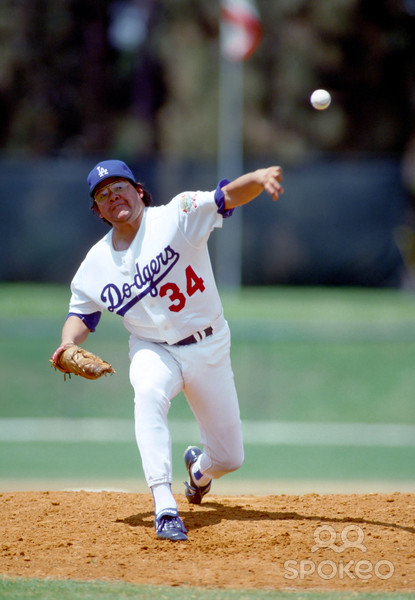
The screwball is the opposite of a curveball, meaning it breaks in the opposite direction. To get this to happen, a pitcher needs to twist his arm inward on release, such that his palm his facing outward (not a very sustainable motion). While baseball has had many “screwballs” over the years, over the years not too many pitchers could consistently throw screwballs. (Even if you don’t follow baseball, if you lived in Southern California in the early ‘80s, the name Fernando Valenzuela has special meaning. He is the greatest screwball pitcher of all time – a short list, to be sure, but an honor nonetheless).
Some pitchers load the ball with Vaseline, sunscreen, or good ol’ fashioned spit. Not surprisingly, those pitches are called spitballs. Other pitchers have gotten more creative and used nail files and sandpaper to doctor the ball. If you can control where you scuff the ball, you can make it do all kinds of fun things, and have great success (see, Scott, Mike).
And, in honor of a special birthday today (answer below if you cannot figure it out), one cannot forget the Eephus Pitch which looks like something you might see at a Sunday softball league. It is essentially lobbed to the plate with an arc of 20-25 feet. The goal is to catch the batter off-guard. (Side note: There is a theory that the term “Eephus” may come from the Hebrew word אפס (pronounced “EFF-ess”), meaning “nothing”.)
Pitchers pitch, and hitters hit, but not all hitters are created equal. Some hitters are mashers who hit seeds and frozen ropes all over the yard. Some studs put on laser shows and others are just plain feared. Some hitters are picky, and will only swing at strikes (see, Boggs, Wade) while others are free-swingers, whose only requirement is that the pitcher actually release the ball (see, Guerrero, Vladimir). Many of the former are said to sit and spit, meaning they sit back and spit on a crappy pitch, refusing to swing. Many of the latter hail from the Dominican Republic, where it is often said, you can’t walk off the island.
On the other end of the spectrum are Punch and Judy hitters. They go up to bat with a wet newspaper and don’t hit the ball very hard. Oftentimes their batting average hovers around the Mendoza Line (which is .200). So, to recap, a hitter sucks and is danger of being released and/or sent off to the Bush Leagues if he only gets 2 hits every 10 at bats; but if he can get 3 hits every 10 at bats, he is a Hall of Famer. Baseball is a difficult and strange game.
Okay. We have dealt with pitchers and their pitches, hitters and their hits. Now we have to deal with the fans. Like kids, they say the darndest things.
You may hear be tough with two and wonder what that means. Well, it means to battle with two strikes, trying not to get fanned. This should not be confused with let’s get two or roll a pair or twist it, all of which refer to the pitcher’s best friend, a double-play (1 pitch turns into 2 outs).
You may hear someone yell to the batter: pick a spot. This doesn’t have anything to do with measles; rather it means a batter should focus on one area, and if the pitch is in that area, they should swing away. A corollary to “pick a spot” is if it’s hangin’ you’re bangin’ which relates to the above-referenced Uncle Charlie. If the pitcher doesn’t get “on top” of the “deuce”, because of the nature of its spin, it may “hang” in the middle of the plate at which point a “stud” more often than not will hit a “seed”, and potentially “touch ‘em all”.
How about inside out. This means to keep your hands inside the baseball (i.e., your hands should stay between your body and the ball as you swing), causing the batter to hit the ball to the opposite field (i.e., right field for righties; left field for lefties).
When a lefty inside-outs a ball, he often hits it in the 5-6 hole which is the small swath of earth between the third baseman and the shortstop. Easier said (and understood) than actually done (unless you are Tony Gwynn). (Note: You never hear about the 3-4 hole.)
We often want the hitter to find a gap. And while some may do this post-game, in this context it means the hitter hits the ball to the left or right of the center fielder, to a place where the corner outfielders (i.e., right fielder and left fielder) cannot reach.
Speaking of corners, when a pitcher hits his corners or a batter takes a pitch on the corner it means that the pitcher is painting the black. Still don’t follow? Home plate is 17” wide, and retreats 8½” towards the catcher, and then meets at a point 12” later. All of the edges are black in color. When you hear any of the above, it means the pitch went through the strike zone above the black part of the plate.
Here is one that you may not hear often, but when you do, you are thoroughly confused: infield fly. Learn this one, and you can impress your friends and neighbors alike. Simply put: runners on at least first and second base and less than two outs, the batter hits a pop fly that can reasonably be caught by an infielder. The umpire immediately calls/signals “infield fly” and the batter is automatically out (regardless of whether or not the fielder actually catches the ball). The runners are then free to run at their peril, and no force play is in effect. Quick and easy. Thank me later.
“Ah, I get it now, but what is a force play” you ask? This can either be easy or complicated. For the casual viewer/listener/reader, let’s make it easy: Is/was the runner forced to go to the next base by the batter or another runner. If yes, the defensive player need only touch the base with the ball under his control, and the runner is “forced out”. If no, the defensive player must tag the runner (while controlling the ball) before the runner reaches the base.
(Editor’s Note: We will cover “tagging up” another time.)
Two more before we go:
When the aforementioned batter is up to bat with runners on first and second or the bases are loaded, it is said that there are ducks on the pond. When that is the case, the batter has a chance to get a steak or a rib eye by knocking the runner in and allowing him/them to score. (Note: When a batter’s hit allows a run to score, the hitter is awarded with a run batted in or an RBI for short; which term has now been bastardized to ribby or rib eye, which eventually led to “steak”. Got it?!?) (Discussion question: Is the plural “RBIs” or “RBI”?)
And lastly, an age old classic. The batter hits short pop fly – normally to the outfield – which is easily caught. That is known as a can of corn. Why, you ask? Because back in the day, grocers used to drop cans of corn (and, ostensibly, other canned food) from the top shelf and catch them in their aprons. Never saw Willie Mays do that!
As with most of these topics, I could write for days. And I am sure many of the readers out there will be quick to tell me about the 10 or 50 other ones I have missed. I look forward to it. But, in the meantime, I believe this is a great primer as we head into the summer. Share this with your loved ones . . .
PLAY BALL!!
Trivia Answer: Dave LaRoche
p.s. Under the rubric of “it takes a village”, I think it is important to note that many friends and readers offer up suggestions for these postings, and I want to make sure I give credit where credit is due. My friend Eva Cohen suggested this topic, and my sister and brother-in-law had confused looks on their faces, so they all should either be thanked or reprimanded.
According to School House Rock, Three . . . is a Magic Number.
https://www.youtube.com/watch?v=aU4pyiB-kq0
And while that may be the case, I think 12 may be as magical as it gets.
The old cliché is that youth is wasted on the young. Never is that writ larger than at age 12.
I am not exactly sure what inspired this analysis; it was either haircuts or haplessness. Or both.
Over the past few weeks, the boys (ahem, young men) in our sphere have gone to the barber to get ready for some bar mitzvahs. It turns out these guys clean up real good. And it also turns out that many – if not all – of them are really good looking. For now. You see, 12 is a magic number. Their faces still have the freshness of youth; while their mouths have the freshness of adolescence. Some still have baby fat; and some are actually able to start making babies. Acne has not yet hit full stride, so many of these guys are cresting into pretty boy status before the slow descent into puberty and teenage angst, where, potentially, they will be robbed of so much.
But for now, they are 12, with all that comes with that.
These kids have seen enough, heard enough, done enough, to be just dangerous enough. They are still children in so many ways. We cannot expect them to actually act as old as they may look; or make decisions in line with how they speak; or understand the consequences of the actions they are old enough to take. They have lived on this earth but a dozen years, but they have lived a bit.
And while they are but babes in the world, they are veterans on the ball field. Many of these kids have been playing baseball for at least seven years; more than half their lives. By the age of 12, they have played in more games (with league, travel, all-stars, etc.) than kids in previous generations played in their entire career. So, while it is fair to say, “he’s only 12,” it is equally fair to yell, “Dammit, you’re 12 years old!”
Talk about your razor’s edge.
In today’s environment – be it school, sports, gymnastics, dance, guitar, you name the other extracurricular activity – we put our kids in more stressful situations, and put more pressure on them individually, than we could have ever have handled at the same age. And you know what, more often than not, they succeed.
Jean Kerr once bastardized Rudyard Kipling by stating: “If you can keep your head when all about you are losing theirs, it’s just possible you haven’t grasped the situation.” I guess when you are 12, it is easy to not grasp the situation. But time and again, these kids prove to us that that is simply not true. These kids do know, and they achieve. Which makes the “he’s only 12” that much more difficult to swallow.
For instance, is it acceptable for a kid to both hit a game-winning walk-off homerun when all of his coaches, friends, and friends’ parents are watching and cry when he strikes out? How do we jibe the 12-year old who can strike out the other team’s best hitter with the bases loaded, but then chucks his bat, helmet, batting gloves, and the smallest kid in the dugout, when he pops out to short? Is he “only 12” or “dammit, you’re 12 years old”?
Our kids have so much to learn: about life, about school, about girls and boys, politics and being politic, about heartache and love. We so often forget that they are “only 12” when they say something pithy or are bigger than the moment. They aren’t “only 12” when they are sitting in the front seat on their way to see “Ride Along” and eating adult-sized meals. They aren’t “only 12” when they are texting profanities with their buddies and dancing with girls at the aforementioned bar mitzvahs. And yet, despite it all, they are “only 12.”
Of course they are “only 12”, but maybe . . . “dammit, they are 12 years old!” How long do we have to endure temper tantrums and tears; thrown equipment and dropped shoulders? When does that stop? We tried not to tolerate it at seven, got irritated at eight, got mad at nine, benched them at ten, and called them out in front of their friends and teammates at eleven. Now, “dammit, you are 12 years old”!
How many times have you watched a Major League game and the announcer says, “Well, that was a rookie mistake”? I have never bought that line of thinking. By the time you are a rookie, you have played baseball for nearly two decades. Whatever mistake that was made, that guy has made that play 50, 100 times before. Maybe in a smaller venue in front of less people, on a worse field in a less comfortable uniform, but he has made that play. Rookie mistake, my ass. You want to say he was nervous and couldn’t handle the pressure of the situation, fine. You want to say the moment was bigger than him, I can live with that. But he knew what to do and simply didn’t execute. Veterans make the same mistakes and no one lets them off the hook or creates a false narrative for failure.
Can the same be said for a 12-year old third baseman who doesn’t catch a pop-up with two hands? How about a 12-year old center fielder who doesn’t call off the second baseman on a short flyball? What about the 12-year old who consistently looks at strike three? Is he “only 12” or is “dammit, you’re 12 years old”?
Just like most of you, I watch more baseball from January through August than any good husband and parent to other children probably should. And it seems as if this topic comes up on a daily, gamely (Editor’s Note: I know that is not the proper usage) basis. I might say, “he just can’t do that” and a dad to my right might say, “he’s only 12.” Or the kid will look to his dad after every pitch outside the strike zone and the dad/coach will yell “don’t look at me, I don’t have the answer,” and someone will retort, “he’s only 12.” So which is it? Who is right?
Well, that’s a Clown Question, Bro.
It’s chicken and egg; both answers are right. They do know better, but that does not mean that they can react better. They are, after all, only twelve. We just need to revel in their 12-ness, as it is fleeting. Soon our opinion will matter considerably less. Soon a coach without a lifetime of relationship/friendship will be making the decisions and they will either straighten up or fly right (off the field/team/sport). Soon, their age and expectations will match up and they won’t have the crutch of lack of years to prop them up; and we will have the ability to look our young men in the eyes (without having to bend at the waist) and say with much chagrin, “it was so much easier when you were twelve!”