Taking the Low Road

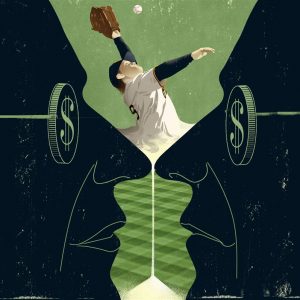
I have been negotiating deals for more than two decades. In fairness, I have never been involved in collective bargaining, nor have I had any multi-billion dollar deals cross my desk. But, there are some principles of negotiation that are applicable to all types of deals – regardless of industry, venue, or value. One of those principles is that the best place to be in any negotiation is on the high road. You may win some and you may lose some, but in the end, you can hold your head high if your side of the street is clean. Muddy the waters, hedge on the truth, or fail to be forthcoming, and you will either cower under a sword of Damocles for the life of the deal, or, in the event of an impasse, you will carry the burden of “what if.” Neither is a great way to go through life; and neither bodes well for a long and/or successful career.

As I watched what I guess can be called a “negotiation” between Major League Baseball and the Major League Baseball Players Association unfold over that past two months, I kept asking myself, “Who is going to take the high road?” I wanted to know which side – press coverage be damned – was going to present an offer or series of offers that would allow them and their constituents to sleep well at night, regardless of the outcome. Well, baseball is starting up again (maybe?), no “deal” was done, and neither side ever even hinted at taking the northern route.

I can understand and appreciate that many of you reading this didn’t follow this as closely as I did; and some of you may be confused by the outcome. So, at the risk of being pedantic, and without stepping on the thousands of fingers that have already written about the current state of the state of baseball, allow for this basic primer.

After spring training shut down and the prospect of an actual season became tenuous, the owners and the players – back in late March – came to an agreement about what to do for the coming season (or, what to do if there was no season). The problem is that once they pulled that contract out of the drawer, they couldn’t agree upon what they had previously agreed upon. That’s an inauspicious place to start. But we do know a few things for sure:

  • The players were provided an advance of $170M against their eventual 2020 salaries, to be divvied up based on service time. If the season didn’t happen (it still may not), this money was the players to keep, no give backs.


  • If the 2020 season happens, no matter how many games get played, each player would get credit for a full season of service time. (For the uninitiated, service time affects when a player is eligible for salary arbitration and free agency. This is obviously an important issue.) And if the season is scrapped, players would get the same amount of service time for 2020 as they received for 2019. So, Mookie Betts would still become a free agent next fall as he would get credit for a full season (he played a full season in 2019); and Gavin Lux would only get credit for about 1/7th of the 2020 season, as he only spent about that much time on the Dodgers’ roster in 2019.


  • The one issue that you have been reading about ad nauseam is what would happen if the teams played with no fans in the stands. The players believed the March contract was iron clad that they received a pro rata share of their salaries – with or without fans. The owners disagreed, and seized on this language: “[T]he Office of the Commissioner and Players Association will discuss in good faith the economic feasibility of playing games in the absence of spectators or at appropriate substitute neutral sites.” Somehow the players didn’t believe this says what we can all read it says. And this, my friends, was the first time the players could have taken the high road and chose otherwise.

My guess is that the players received some bunk legal advice. I think they were told that it was pro rata no matter what, and then the die was cast. There was no slinking back to the membership to say, “Um, guys, remember what we told you about that pro rata thing? Yeah, well, we forgot about that other provision that mentions economic feasibility and the absence of spectators.” Rather, they charged right ahead and essentially dared the owners to “prove us wrong.”

It seems that the owners must be afraid of heights as well, because they twisted themselves into various Wetzels trying to get out paying the players. First they claimed that pro rata was only if fans were in the stands (not an unfair reading). But then they said they could only play X number of games because they would lose $640,000 for each game played in empty parks. When asked to provide the proof such assertion, they hemmed and they hawed, but they didn’t bring any receipts. Then they dawdled. They fiddled while Rome burned. They took their sweet time responding to the players. And when they did respond, they simply dressed up the same offer in different clothes. When you drilled down on their offers, they presented the players with about $1B in salaries, payable either (a) over 82 games, or (b) over 76 games, or (c) over 60 games, or (d) to be allocated amongst the players based on how much they would otherwise be paid. But it was like a Taco Bell menu each and every time – all of the ingredients were the same, it was just a question of what shape you wanted it delivered. The players rejected each one.

“Wait a minute”, you may be saying. “Didn’t they come to an agreement? And isn’t that why we have an upcoming season?” Unfortunately, they didn’t. One of the provisions of that March agreement allowed the commissioner to set the schedule if no agreement could be reached. And it seems that this was the trump card the owners kept in their back pocket the whole time. If they could just delay the negotiations until only 50-ish games became feasible, they could implement the schedule and save a bunch of dough.

The players knew this; they knew that at the end of the day, they could be “forced” to play. But, they wanted to make sure if that ever happened, they would get their pro rata salaries. So, they continually pushed back against offers that would have actually earned them more money (e.g., 80% for 70 games vs. 100% for 50 games), because they should get “a day’s pay for a day’s work.” At some point in this battle (about two months too late), the owners realized two things: (1) the players were never moving off the pro rata concept (right or wrong, they were willing to die on that hill); and (2) the players were setting the owners up for a grievance.

A quick sidebar about grievances. These are available in labor situations when one side doesn’t believe the other side acted reasonably in a negotiation. They are long and costly. But, by the players estimation, if they could show the owners were being unreasonable, they could win a grievance and extract the value of the difference between the number of games the owners instituted, and what they could prove was a reasonable and feasible number of playable games. The players believe(d) this could be somewhere in the neighborhood of $1 billion. A grievance could and would happen while games are being played, so it would not result in any work stoppage.

Back to our story. Once the owners gave up on trying to reduce salaries below a pro rata share, they offered the players a 60-game schedule, but conditioned on the players waiving their right to file a grievance. The players countered at 70 games with the aforementioned waiver. The owners responded by saying they would not respond. The players then took to press releases and social media to proclaim, “Tell us when and where.” They told the owners to set the schedule and they would be there. So the owners did just that.

Low road, meet the players. The players then started to balk at some of the health and welfare provisions; they started to complain about the number of days in the schedule; they said they couldn’t necessarily be there “when and where” the owners wanted. Ultimately, the owners set a schedule the players would abide by, the health and welfare issues were resolved, and a season was set.

So now we have a season to look forward to. I am not a huge fan of Trevor Bauer – I think he is mercurial, not a great teammate, and oftentimes thinks he is the smartest guy in the room. But, I have to say he nailed it with this tweet:

“So we gave up shares of playoff money, eliminating the qualifying offer for 2021, paycheck advance forgiveness, Covid 19 protections, and protection for non-guaranteed arb contracts for next year in order to hold on to our right to file a grievance…”

As stated above, the grievance may ultimately be worth a lot of money, so waiving that right is a big deal. But, that is a roll of the dice. And it is money that if it comes, won’t come for years. And the players were willing to waive it for just an additional 10 games. So, to preserve their right to file a lawsuit, the players passed on the following (h/t to Jeff Passan), all of which were on the table at one point or another:

  • Expanded post season (from 10 to 16 teams) for 2020 and 2021. This was agreed. It was a done deal. More teams competing (which, over 60 (or 70) games, would have been incredible). More money for more playoff games (see below). Losing this was simply asinine.


  • Universal DH for 2020 and 2021. This was agreed. It was a done deal. As it stands, we will have it for 2020, but no guarantee beyond this season. This is an additional roster spot for an aging slugger, or a toolsy fringe prospect who can play various positions allowing a corner outfielder or first baseman to have an occasional day off. Losing this is taking money out of players’ pockets.


  • Forgiveness of $33M of the above-referenced $170M advance. This one was not agreed, but seemed playable. And it has real-life implications for certain players. If a player has a guaranteed MLB contract, he received a minimum of $286,500 from the $170M allotment. The players demanded pro rata compensation; and now they are playing 60 games, or 37% of the regular season. Some examples:

A player like Collin McHugh of the Red Sox has a guaranteed contract of $600K, of which he is only entitled to 37%, or $222,000. But he has already been paid $286,500. So, he technically owes the Red Sox $64,500 for the right to play this year. Yes, they figured that out, and he does not have to write a check to the team every two weeks. But save for incentives in his agreement, he will not be paid anything additional for playing in 2020. Cant’ see how that was a win for the players.

But McHugh is relatively rich (he has made about $16M so far). Take the case of Braves prospect Cristian Pache. He is entitled to $46K for a “split” contract (between the majors and the minors). If he doesn’t spend any time in the majors this season, he is entitled to $17K. Per the March deal and the $170M advance, he has already been paid $16,500. There is no minor league season this year, so no minor league salaries. But Cristian won’t go home to become a barista. He most likely will be on the 60-man “taxi squad” that is ready to fill in when a player gets hurt or gets Covid. For that right, for being a professional athlete required to remain in shape, for being ready to play at a moment’s notice and exposing himself to sickness with roommates and in the clubhouse, Mr. Pache will get an additional $500 over the next three months. Yes, that is correct. He will get about $40/week – pre-tax. I am sure Pache could have used some of that $33M in salary forgiveness.

According to Bob Nightengale of the USA Today, 19% of all players will be playing for virtually free this year, earning $25,000 or less since they already received their share of the $170M advance. Doesn’t seem like a good deal.


  • The players had asked for a 50/50 split of incremental playoff money. The league offered a flat $50M. They will get neither.


  • To protect future free agents in a down economy, the league offered to eliminate direct draft-pick compensation for free agents tagged with qualifying offers. Teams losing a top free agent would get a compensatory draft pick, but the signing team would not be penalized by having to give up a top pick. This would be a boon to the players and an extra incentive (or not a disincentive) for teams to sign a free agent. That proposal, too, went the way of the dodo bird.


  • And for the fans, the owners had asked and the players had agreed to additional commitments to wearing microphones on the field and other broadcast enhancements. The players had also offered to hold events such as an off-season All-Star Game or Home Run Derby to generate additional revenue. All gone in a fit of pique.


  • If there is one silver lining in all of this, it is that in the player’s final proposal, they offered to allow advertising on jerseys. Thankfully, that also died in their inability to close a deal.


Covid-permitting, there will be baseball in 2020. To crib Jayson Stark, ultimately they didn’t drive the bus off the cliff. But neither side passed the driving test. It is easy to stand on the sidelines and judge the parties and their various chess moves; it is much harder to be in the arena. And yet, some decisions seem quite simple on their face.

Joel Sherman, I believe, was the first to posit that the owners could offer pro-rated salaries, with a three-year deferment. Imagine how much more smoothly this could/would have gone if the owners offered that as soon as the players hardened their position with regard to further salary reductions. Sure, the owners didn’t want to take on additional debt in these trying times, but they could have made up the difference by offering smaller contracts and making fewer free agent signings in the future. Three years down the road, they could have been in an even better financial position. And they would have called the players’ bluff. And they could have started down the road to recovery with additional playoffs, and additional television revenue, and advertising on uniforms, and an extra-seasonal All-Star Game and Home Run Derby. And they would have taken the high road which would go a LONG way towards mitigating the risk of a potential $1B grievance award. They did none of that.

The players could have made the same deferment offer. They could have gotten more players, and more games, and more revenues, and more advantageous free agency, and more fun and excitement. They could have positioned the owners to make more money to give them less ability to cry poverty next off-season. And they could have shown strength by wisdom, not intransigence. Going into the 2021-22 labor negotiations, the players will have very little leverage; the game is somewhat damaged; the billionaires have the resources and capital reserves to hang on a whole lot longer than the vast majority of players. The owners’ assets will be there for decades, they have ample time to recoup any losses brought on by a strike or a lockout. But the players have just a few years to make their money, to monetize their asset. Lose (part of) another season to labor strife and the losses will be considerably more than the value of 10 games (which, due to Covid, may never get played).

The players won this battle in the court of public opinion, but they didn’t win anything else. They lost time, they lost money, and they lost the high road and any chance to win the next one. And whether they actually play the 2020 season or not, the next one portends to be a doozy.

July 23…

PLAY BALL!!
L’dor V’dor

It was the Spring of 2009; my wife had recently died. I wanted to do something special for my son. He was only six when she passed, and our relationship meant all that much more to me, as he – without knowing it – became my rock in those cold, dark days. With both the gloom of winter, and the grief of loss, starting to recede, I looked forward to longer, more joyful days ahead.

My son was, even at that young age, and still today, a massive baseball fan. As a doting father, I introduced him to the Boston Red Sox early on. He quickly became well-versed in the lore, the curse, the reverse, and – as of 2009 – the two championships in four years, after there being none the previous eighty-six.

I decided to plan a summer trip to Boston, a walk along the Freedom Trail, a visit to the Old North Church, shopping at Faneuil Hall, pizza in the North End, and, of course, his first visit to Fenway Park. This was going to be a father-son trip that neither of us would ever forget.

I casually mentioned my plans to my father. My father, born and bred in Dorchester. A man who still – throughout his sixties and well into his seventies – heads back to Boston at least once every year or two to visit friends and family; a man who – having lived in Los Angeles for 56 of the last 62 years – still drops the occasional “R” when speaking quickly or after a few too many cocktails; a man who proudly hangs a Ted Williams jersey in his dining room and brazenly wears his “B” hat into Dodger and Angel Stadiums. In short, my father is a man who loves himself some Beantown.

Moments after we spoke, my dad booked himself a flight, a rental car, and a hotel. And then he told me he was joining our trip. Truth be told, I was a bit miffed. This was going to be something special between me and my boy; a little father-son bonding time on the east coast. And now it was not that; now it was something different; and now it was not what I had envisioned. But it didn’t take long for that irritation to subside, and for me to see what this had now become, in its most simple form: a three-generation trip. In Hebrew there is an expression, “l’dor v’dor,” from generation to generation. This was that, personified.

Summer came, and so did the trip. Despite a nasty migraine on the flight to Boston, I rallied and allowed my dad to drive us forty-five minutes into the suburbs to his favorite Chinese restaurant. Calling it mediocre would be kind, but my dad insisted that the food was much better “back in the day.” There was no chance that one headache and one bad meal were going to ruin this trip.

The next day was straight out of Fodor’s, as we covered all of the tourist attractions. It is possible that I followed this same path when I was about my son’s age, but I have no recollection. So this turned out to be as much about my education as about his.

Credit where credit is due: my dad really knows the city. He knows how and where to drive – no easy feat with one-way streets and turnabouts at every intersection. He knows how and where to park – which can be tricky with narrow cobblestone and usurious parking lots. And he knows where to dine (save for one bad Chinese restaurant) – this is considerably easier insofar as you cannot throw a rock in Boston and not find something delicious to eat.

What originally seemed like my dad horning in on our vacation turned into him making it so much better. With grandpa in charge, we took a trip down (his) memory lane: we went to his old neighborhood and the vacant lot where his childhood home once stood; we strolled the halls of his middle school; and we drove to the temple where he became a bar mitzvah. My mom grew up in Boston as well, so he took us to her building, and we talked our way into a tour of her exact apartment, just two floors up. We got sodas at my father’s haunt – Simco’s on Blue Hill Avenue. We walked along the lonely roads of Southie where my father found trouble, and where trouble found him, so many years ago. Suffice it to say, I never could have done this alone; I never could have shown my son his grandparents’ childhood without my father leading the way. I never could have added the color or the context or the meaning of this heritage without my dad.

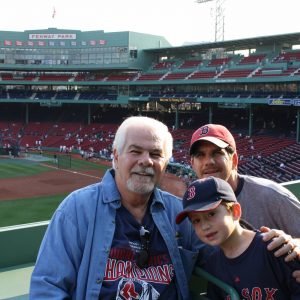
Saving his best for last, my dad had made arrangements with the Red Sox for us to have an exclusive tour of Fenway Park. The tour turned out to be not so exclusive, but it was one of the greatest afternoons any of us will ever have. As our guide led us down the grandstand to step onto the field of this beloved ballpark, I yelled out, “I am not who sure is more excited.” My father quickly responded, “I do! I am; I am excited for my grandson, my son, and for me!” He was right. He won. Three generations. L’dor v’dor, indeed.

While we were in Boston, as fate would have it, Ted Kennedy passed away. Our hotel was just down the street from the JFK Presidential Library, so we stood on line to pay our respects while Senator Kennedy lay in repose. This was the perfect historical bookend to our trip, and yet another opportunity to educate and bond with my father (who voted for Jack in 1960) and with my son (who was just old enough to conceptually understand the import of the Lion of the Senate).

As I begin to mentally and emotionally prepare for my son to leave home next year, to start his journey as a college student, I often think back to that trip. For a few days, it seemed my father reclaimed the reins on me that he had let go so many years before. I wonder if and when I will do the same with my son. And, if so, will it have the same resonance?

This much I do know: Not for the world would I trade those four days in Boston with my father and my son. Those experiences, those memories, they are with me forever, they will last for three lifetimes, they will last for generations.

PLAY BALL!!

Shame

These past few weeks I have been thinking a great deal about people. About what they do; what they think; how they act; what they say. I have been thinking about the how and why people post on social media; why they believe anyone cares about their point of view. I have been thinking about people’s inner beliefs and their inner monologues. And I have been wondering why people aren’t more judicious before they speak, before they post, before they tweet.

I get that we live in a “post it or it didn’t happen” world. I understand that people want to be heard and need that dopamine rush attendant to “likes.” But I also know that a whole lot of people do and say things that they wish they could take back – oftentimes moments, sometimes days, after they hit send or speak into a microphone.

We all know that the titular Commander in Chief has no such compunction. He has never uttered, thought, or tweeted a single thing that he regrets – there is nothing that hasn’t been “perfect.” But that is because he is completely incapable of introspection. That is because he is a narcissist, and narcissists simply don’t feel shame.

Merriam-Webster defines shame as “a painful emotion caused by consciousness of guilt, shortcoming, or impropriety.” We, as a society, use the word more often as a verb, and do so in a cynical fashion. And it is ugly. We, as a society, never fail to wag a finger, tsk-tsk, or hold people in contempt. We shame them. And often for no reason other than to make ourselves feel better. We don’t use shame as constructive criticism to achieve a better outcome, we do it to embarrass the wrongdoer, and make he or she feel less than.

But shame – the noun – if properly effectuated, if it forces people to look in the mirror and not like what they see, can lead to growth and change and progress.

While in quarantine I have considered the implications of shame. Specifically, I have wondered what it would look and sound like if Oliver Stone made a slight alteration in the words he wrote for Gordon Gekko. Herewith:

“Shame – for lack of a better word – is good. Shame is right. Shame works. Shame clarifies, cuts through, and captures the essence of the evolutionary spirit. Shame, in all its forms – shame for how you live, shame for money, for lack of love, for lack of knowledge – has marked the upward surge of mankind. And shame – you mark my words – will save that malfunctioning experiment called the United States of America.”

Some people march, and others riot. People scream and yell and quietly protest. But it does not seem that anything or anyone really changes until they feel shame. I take no pleasure in writing these words, but more and more it seems readily apparent that they are a truism. Time and again we have seen how shame has changed people’s behaviors and their thoughts and their reactions.

Drew Brees went on television and spoke from his heart. And then the backlash began. It is my sincere hope that he heard the words of the people in his community, in his sport, in his locker room, and gave himself that hard look in the mirror. And maybe, just maybe, he felt some level of shame for what he said and how he said it. And, as such, he woke the next day woke. He changed his view and his tone so much so that he was willing to take on that titular Commander in Chief.

Here, shame “worked.”

Why do we think Bill Barr, all high and mighty with his ordering the code red on peaceful protesters in Lafayette Square suddenly claimed “it wasn’t me”? Or Mark Esper going from standing next to the president in front of St. John’s Church for a photo-op to claiming he didn’t know where he was going, to giving a press conference wherein he denounced the president’s plan to use the military to police our city streets. They both saw the reactions to their actions and felt shame. And then they attempted to Ginger Rogers their way back into good social standing.

Per Gekko, “shame was right.”

A few weeks ago I (and many others) wrote about the owner of the Oakland Athletics, a billionaire named John Fisher, and his parsimonious decision to refuse to pay his minor league players $400/week throughout the summer. As of early last week, 29 of 30 teams had agreed to fund their minor league players through at least June. Fisher was the lone miser. When 29 other billionaires think you are being Scrooge McDuck, it is time to revise your thinking. So Fisher changed his tune and agreed to pay his players through August. And he agreed to set up a fund for furloughed employees.

This “shame for money” led Fisher to change course.

Shame is the cornerstone of everything happening in this country today. The City of Minneapolis feels great shame – not that their police committed an atrocious murder in broad daylight – but that the world saw them commit an atrocious murder in broad daylight. In all of the officer-involved killings from 2013-2019, only 1% have led to arrests, let alone convictions. Why, because they weren’t caught on tape; because the municipalities were not forced to feel shame.

Why were Ahmaud Arbery’s hunters finally arrested – two months after-the-fact? Because a videotape of the horrible incident went viral and the city officials felt shame. The world saw their inaction – their lack of investigation – and they felt compelled to do the right thing. In fact, the highly-regarded mayor of Atlanta, Keisha Lance Bottoms, acknowledged that but for the uprising, she wouldn’t have even reviewed the tape. She didn’t need to say it, but to not review the tape in the present environment would have been shameful.

She felt shame for her “lack of knowledge.”

Let’s take a look at the NFL. On May 30th the league issued an anodyne statement expressing condolences for George Floyd’s death and that they were “committed to continuing the important work to address these systemic issues.” It was roughly the same bromide as nearly every other organization. Unfortunately for “the shield,” they hold a unique position in this battle. Seventy percent of the league is black, the teams paid a massive collusion claim to Colin Kaepernick for effectively blackballing him for kneeling during the national anthem, and they are viewed as being behind the curve on issues of racial justice. The NFL players would not allow the league off that easy. So last Friday night, Commissioner Roger Goodell sat in his basement and offered a mea culpa. He apologized for the league’s past behavior. He said the magic words: “we were wrong” for not listening earlier and encouraging players to speak out. Did Roger find his inner DeRay McKesson in less than a week? Or was something else at play? From New York Magazine:

“[The league] was forced by a powerful video, shared Thursday night on social media, in which New Orleans Saints star Michael Thomas and numerous other black players called out the league, called attention to the killing of Floyd, Breonna Taylor, Ahmaud Arbery, and other African-Americans killed by police — and demanded the league stand behind them. ‘What if I was George Floyd?’ many of the players asked, insisting that they will ‘not be silenced’ anymore.

“Twenty-four hours later, with apparently little input from team owners, Goodell did what the players told him to do, in some cases saying verbatim what they had demanded he say. They published a ‘message on behalf of the NFL’ and forced the NFL to literally repeat what they said.”

Goddell saw he was on the wrong side of history (again), and as such, shame “cut through and captured the essence of the evolutionary spirit.”

The Buffalo Police Department claimed a 75-year old man tripped and fell and was injured in a confrontation with approaching officers. Then two different videos of the incident went viral. The BPD then suspended two officers. While the powers-that-be felt shame for their inaction, 57 fellow police felt no such embarrassment, as they resigned as a result of the suspensions. One can only hope that when those 57 officers go home or to church or to the grocery store, their neighbors can provide a level of opprobrium that their senior officials could not; maybe they will at some point feel shame for encouraging their comrades to walk past an old man bleeding from the head. Maybe that shame will cause them to un-resign and acknowledge that orders or not, their actions were not acceptable behavior on our streets or anywhere else on this planet. We need a some men in blue in western New York to feel a level of shame.

How about the NBA owners who looked the other way and turned a deaf ear to the racism spewing from Donald Sterling’s mouth for so many years? Or the Hollywood executives and actors who laughed off the “rumors” of Harvey Weinstein’s alleged indiscretions? This list could go on and on.

As we move into mid-June, as the NBA plans to resume its season at the end of July and the NHL some time shortly thereafter, we must ask ourselves if the MLB owners can be forced to feel some form of shame. What will it take for them to look in the mirror and realize that they are self-fulfilling their prophesy? They want to claim “baseball isn’t very profitable” (the Cardinals Bill DeWitt, Jr.) or “the league itself does not make a lot of cash” (the Cubs Tom Ricketts). Well one way to ensure both of those statements are true is to squander this opportunity to own the month of July – to be the first and only of the big four sports to be playing real games. You want to have your clubs lose money and lose value, either (a) not have baseball in 2020 over financial considerations and/or (b) have this dispute end so acrimoniously (e.g., Rob Manfred imposes a 48-game season) that we have a strike or a lockout after the 2021 season. If that were to happen, then these owners’ words will look prescient. But can someone, somewhere, say something that will force these billionaire penny-pinchers to feel the shame of their inaction, of their intransigence, of their…wait for it…greed?

Because that type of shame is what is needed to “save that malfunctioning experiment called Major League Baseball.”

PLAY BALL!!