Mike Trout: Angel in Right Field

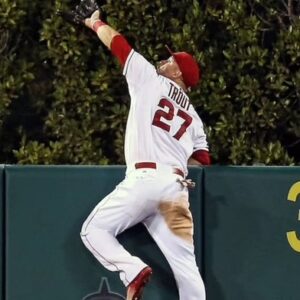
It finally happened. After years of speculation and too many years cut short due to injury(ies), future Hall of Famer Mike Trout is moving out of center field.

As you may recall, when Trout made his major league debut in 2011 at age 19, he played ten games in left field, and thirteen in each of center and right.

In 2012, he started 29 games in left (108 in center, none in right). In 2013, he started 40 games in left field and another 108 in center. The last time Mike Trout donned a glove and jogged out to play anywhere other than up the middle was on September 2, 2013, when he played seven innings in left field against the Rays at The Trop.

However, after missing 382 games over the past four seasons, after losing his place as the best player in the game, after his team suffered its worst season in franchise history (99 losses), and not having had a winning season since 2015, the Angels have decided that a change is in order. Trout, general manger Perry Minasian, and manager Ron Washington all discussed the matter and decided that for the health of their star that he would get the majority of his reps on the right side of the outfield, with an occasional stop in center field, and also some days as the team’s designated hitter.

Of the meeting, Trout was quoted as saying: “It went great and we just threw everything on the table, as in, what’s best for me, body-wise, to keep me on the field.” Ironically, Trout’s move to right gives Jo Adell yet another chance to prove that he is the player that the Angels hoped he would be when they drafted him with the tenth pick in the 2017 draft.

With Trout now becoming the everyday right fielder, he is clearly the best player in the team’s 64-year history to play that position. Or is he?

When the Los Angeles Angels debuted in 1961, Albie Pearson was their first right fielder. He slashed .288/.420/.400 that season, with seven home runs, 41 RBI, and a total of 31 extra base hits. Not exactly the prototype corner outfielder, but he did lead the Angels right fielders with 3.2 bWAR.

You may have missed or forgotten this, but Tony C. – Tony Conigliaro – started in right field for the Angels on Opening Day in 1971. After playing six years in Boston – he missed the entire 1968 season recovering from a Jack Hamilton fastball to the eye that nearly killed him – Conigliaro caught on with the Angels and played 74 games for them in 1971, hitting four home runs and driving in 15.

Bobby Bonds was an Angel in the outfield in 1976 and 1977. In the latter season he slashed .264/.342/.520, with 37 home runs, 115 RBI, 41 stolen bases (just shy of a 40/40 season*), which led to a 136 OPS+.

*In 1973, Bonds came this close to MLB’s first 40/40 season, slugging 39 homers and stealing 43 bases.

“Disco” Danny Ford was out there in 1979 and 1981.

In 1982, the original “Straw that Stirs the Drink” – Reggie Jackson – came to Anaheim on a very unique contract. He signed a four-year, $3.6 million deal, with a bonus of 50¢ for each fan in attendance beyond 2.4 million. When the Angels drew 2.8 million, Jackson earned an additional $200,000. In five seasons in Southern California, he hit 123 homers and drove in 374 runs, with a 114 OPS+. Suffice it to say, Jackson’s Hall of Fame plaque has him in a Yankees – not an Angels – hat.

Following in the Yankee footsteps was Dave Winfield. He patrolled right field in 1990 and 1991. His time in Anaheim was unremarkable, but when he left for Toronto in 1992, he came in fifth in MVP voting. He went into the Hall of Fame with a Padres hat.

One of the most beloved Angels came next. He played for the club for the entirety of his 14-year career, with nearly all of it in right field. Tim Salmon hit 299 home runs, drove in 1,016, with a career OPS of .886. He won Rookie of the Year in 1993, a Silver Slugger award in 1995, and had two Top-10 MVP finishes. He may be best remembered for the two-out, two-run homer he hit in the bottom of the eighth inning of Game 2 of the 2022 World Series to give the Angels a 11-9 lead over the Giants.

Following Salmon was the one player who entered the Hall of Fame wearing an Angels cap: Vladimir Guerrero. From 2004 through 2009, Vladdy roamed right field and crushed any pitch thrown in the vicinity of home plate. In those six seasons, he slashed .319/.381/.546, with 173 homers, 194 doubles, and a 141 OPS+. He was elected to the Hall of Fame on his second ballot.

Borderline Hall of Famer Bobby Abreu played right field for the club from 2009 through 2011. But his time there was not that interesting.

Torii Hunter played center field for two-plus seasons in Anaheim, and then moved to right. He left the Angels after five seasons and finished his career in right field for the Tigers and then the Twins.

When Josh Hamilton came to the Angels on a 5-year, $125 million contract in 2013, he played 83 games in right, but was traded to the Rangers after two lackluster years.

Cole Calhoun became Anaheim’s primary right fielder in 2014. In six seasons he had a perfectly pedestrian 104 OPS+, with 132 home runs and too many dirty uniforms to count.

Now here in 2025, right field for the Angels will be covered by the team’s all-time leader in home runs, walks, runs scored, OPS, and bWAR. He claims to be in good shape and excited about the new opportunity. Interestingly, he stated his first thought when he made the move to the right was former teammate Torii Hunter, who will be in Angels camp as a guest instructor.

Left field, center field, right field, and/or DH, it doesn’t matter. When Mike Trout enters the Hall of Fame five years after he retires, he will be wearing an Angels hat, making him the second Halo to do so.

PLAY BALL!!

We May Be In the Golden Age of “The Sound”

Last week, in his daily newsletter, Joe Posnanski wrote the following:

“You will remember how Buck O’Neil always talked about hearing that sound three times in his life — hearing it when the ball came off Babe Ruth’s bat, then hearing it when the ball came off Josh Gibson’s bat, then hearing it a third time when the ball came off Bo Jackson’s bat.”

Batting Practice

One of my favorite things to do is get to the ballpark early and watch – and listen – to batting practice. I love the sound of the fielders catching balls; but what I love even more is the rhythmic sound of the ball making contact with the bat. It is different during BP, as that is a concerto, not a one-off experience (more about that below). If you are so inclined, close your eyes during batting practice and just listen. If the bullpen catcher or whoever is throwing that day is on his game, then every five to ten seconds there will be a “thwap.” Some “thwaps” will be soft, and others will be hard. And then, every so often, without opening your eyes, without hearing anything else, you will know that a ball has left the yard. It just sounds different. And there is a consistency to it. Unfortunately, most clubs don’t open the gates until the final batting group is in the cage, and this cohort typically doesn’t have the big boppers, and thus the chances of hearing “the sound,” goes down. But do give it a try some time.

Game Time

During the game, this “sound off the bat” exercise takes on a different dimension. Because now it matters. And now it is the result of a mano a mano battle, with the hitter winning. And when you hear it, it normally means either a souvenir or an incredible play is about to be made. For obvious reasons, you don’t close your eyes during live action on the off-chance that you will hear something magical. Rather, you watch intently – and don’t leave your seat when the middle of the order is due up – and hope to hear the music.

The Hardest Hits of 2024

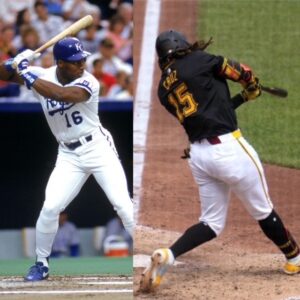
According to Statcast, the hardest hit ball last season came off the bat of Oneil Cruz of the Pittsburgh Pirates. With two outs in the bottom of the ninth inning in a game against the Giants, with the Pirates trailing 6-5 and runners on the corners, the shortstop laced a ball 121.5 MPH down the rightfield line for a game-tying double. It must be noted that he turned around a 100.3 MPH cutter from Camilo Doval. The ball was hit so hard that the runner on first had no chance to score on the play (Pittsburgh won the game in the bottom of the 10th). The laser to right was Cruz’s third hit of over 115 MPH that game, including a 116.5 MPH opposite field double in the third inning. He became the first player to ever have three such hits in one game.

The list of hardest hit balls last season is a who’s who of MLB sluggers, many of whom you would guess from the outset. Giancarlo Stanton comes in at #2 at 120 MPH. Shohei Ohtani is #3, at 119.2. Vladimir Guerrero, Jr. is #4, with 117.6. Aaron Judge is right behind at 117.5 MPH. Yordan Alvarez is #9 with a ball hit at 117 flat. Fernando Tatís, Jr., Pete Alonso, Adolis García, Juan Soto, Kyle Schwarber, and Manny Machado are all in the Top-20.

What is surprising about this list are some of the other names that most certainly were not on your bingo card. Coming in at #7 is Yandy Díaz of the Rays, with a ball hit 117.4 MPH – the hardest of his career by nearly three miles per hour.

Ketel Marte, a great player who came in 3rd in MVP voting last season, was #10 after hitting a ball 117 MPH. Marte is quite interesting. His career average exit velocity is 89.8, which is just slightly above the MLB average of 88.5. But, he has hit one ball at least 115 MPH every season since 2018. And 117 isn’t even his career best – he hit one 117.1 in 2023.

Coming in at #13 is José Ramírez, with a ball struck 116.6 MPH, far and away the hardest of his career. Ramírez was one of the most underrated players in all of baseball (until that trope was repeated so often that he has now become properly-rated), who hits for average, for power, and in the clutch. But his average exit velocity of essentially league-level (88.8 vs. 88.5) is probably how most fans view him. And yet, every year he laces a ball or two over 110 MPH.

Jo Adell of the Angels has been on the cusp of greatness for years. The former #10 pick in the 2017 MLB draft, he was Anaheim’s top prospect. FanGraphs gave him a future value of 60 (on the 20-to-80 scale) with 70 Raw Power. Many viewed him as the perfect companion to Mike Trout in the Angels’ outfield, but it just never came together for him. Over five seasons he has played in 308 games, hit .207, rapped 38 home runs, slugged .381, for a 79 OPS+. When he makes contact, he can make contact. But that’s the issue. By Statcast’s measurements, he is in the 98th percentile for bat speed, but in the 2nd percentile in “squared up” percentage. That is an awful combination. As a rookie, Adell hit a ball 115 MPH, and followed that up with shots of 117.2 and 115.6 in the coming years. Unfortunately, he simply cannot do that consistently enough to become even a good everyday player. That said, both FanGraphs and ESPN have Adell in Anaheim’s starting lineup come Opening Day, so hope truly does spring eternal.

To round out the Top-20 is new Texas Ranger Jake Burger. Last year, while playing for the Marlins, he hit a ball 115.5 MPH. But this one isn’t so shocking, insofar as Burger ranks in the 84th percentile in average exit velocity (91.3 MPH), and his hardest hit balls in each of his four big league seasons are: 115.2, 114.4, 118.2, 115.5. Burger has been penciled in as the Rangers everyday first baseman next season. If you want to hear “the sound,” head to the heart of Texas, where their lineup will include – in addition to Burger – the aforementioned Adolis García (78th percentile in exit velocity at 91 MPH), Corey Seager (91st at 92.1), and newly acquired Joc Pederson (93rd, at 92.3).

Hitting has never been harder in the major leagues. Last year we had the seventh worst overall batting average since 1871. But the players are in better shape and the hitters are more keen to swing from their heels than ever before (the 15 highest number of strikeouts per game have been achieved in the last 15 seasons). So, when they hit the ball, when they truly make contact, we as fans sitting in the stands or watching from our couches are treated to “the sound” – maybe not the same sound that Buck O’Neil heard – of greatness, the sound that draws us to the game, the sound that reminds us how truly special these guys really are. Forget batting average and strike out totals, we may be in the golden age of “the sound.”

PLAY BALL!!

If Joe Mauer Is a First-Ballot Hall of Famer, Shouldn’t Will Clark Get Another Look?

Two players appeared on the Hall of Fame ballot for only one year.

Player A was drafted 1/1 (first pick in the first round) by his hometown club. Player B was selected 1/2 (second pick in the first round) by a team far from his hometown.

Player A spent his entire career with one club, but changed positions mid-way. Player B played the first eight years of his career with one club, but then bounced to three other teams while remaining at one position the entire time.

Player A played in ten post-season games, never getting past the Division Series, while slashing .275/.341/.300. Player B played in 31 post-season games, including one trip to the World Series, slashing .333/.409/.547, and winning a Championship Series MVP.

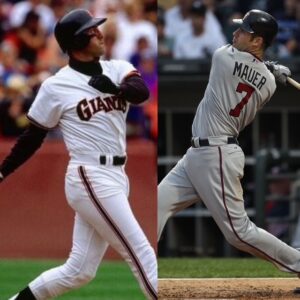
You have read the headline to this article, so you can probably guess which player is which. If you follow baseball, you know that Joe Mauer (Player A) was inducted into the National Baseball Hall of Fame last year after being named on 76.1% of the ballots. What you may not recall is that Will Clark (Player B) received only 4.4% of the vote in 2006, and thus fell off the ballot forevermore.

Why?

Joe Mauer

Mauer had a remarkable start to his career, and was arguably the best catcher in baseball (offense + defense) in his first seven seasons. Repeated concussions and a neck injury forced him to hang up the tools of ignorance and move to first base to prolong his career. And prolong it he did.

From 2004 through 2010, while catching nearly every day, Mauer slashed .327/.407/.481, won an MVP award, and had three straight Gold Gloves and Silver Sluggers. After he moved to first base full time in 2014, for the final five years of his career, he slashed .278/.359/.388, accruing an additional 10.5 bWAR.

Will Clark

But Will Clark was no slouch, as the above statistics attest. “The Thrill” hit a home run off Hall of Famer Nolan Ryan in his first big league at bat. By the end of his first season, he had a 121 OPS+, and came in fifth in Rookie of the Year voting. (Todd Worrell won with a 2.08 ERA and 36 saves. Interestingly, Clark came in behind then and future teammates Robby Thompson (2nd) and Kevin Mitchell (3rd).)

In 15 seasons, the slugging first baseman never had an OPS less than 101, and he logged a whopping 175 in 1989 when he came in second in MVP voting (behind then-teammate Mitchell and his 1.023 OPS). It is hard to track a prime of Clark’s career as he stayed good/great for the entirety. He hit .300 twelve of his fifteen seasons, including in all of the final six. He slugged over .500 eight times, and led the league with a .536 mark in 1991 (which was only his third best, trailing his .580 in 1987 and .546 in 1989). The Natural’s final All-Star appearance was in 1994, and after that he played six more seasons, slashing .306/.393./.492, while accumulating an additional 17.1 bWAR.

Hall of Fame

Hall of Fame voting is always a mysterious gambit. When you realize that 11 voters didn’t check the box next to Babe Ruth’s name; or 23 voters didn’t check the box next to Willie Mays’ name; or 28 voters omitted Rickey Henderson from their ballot, you get a sense that it doesn’t make sense why so many BBWAA writers have no sense. Heck, one unnamed scofflaw didn’t vote for Derek Jeter, and one did not vote for Ichiro Suzuki (it is unknown if it is the same culprit).

But Joe Mauer getting into the Hall of Fame on his first ballot and Will Clark falling off on his first ballot – when you break down their respective careers – simply feels unjust. I don’t know if either actually belongs in “The Hall,” but one is in and the other must wait for some Veterans Committee to review his case and find twelve votes for his induction. It does not seem likely. But, if nothing else, like Jim Edmonds and so many others, Will Clark deserved at least a second look.

PLAY BALL!!

Dustin Pedroia a Hall of Famer? A Case Can Be Made

The 2025 Hall of Fame votes are in. Ichiro Suzuki, CC Sabathia, and Billy Wagner will be celebrating in central New York at the end of July. Carlos Beltrán and Andruw Jones are on the cusp, and will be hoping for a better outcome next year.

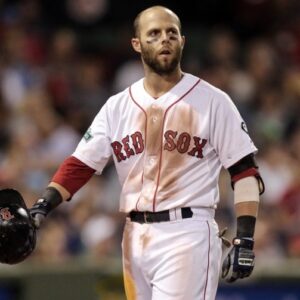
But there are certain players who deserve better (David Writer), who should have received more votes (Andy Pettitte), who should have remained on the ballot for at least one more year (Ian Kinsler). And then there are players such as Dustin Pedroia, the height-challenged second baseman who played his entire career for the Boston Red Sox, who received 11.9% of the vote this year.

Pedroia was drafted in the second round of the 2004 draft out of college baseball powerhouse Arizona State University. He made his major league debut in 2006, getting 98 plate appearances over 31 games, while preserving his rookie status for 2007. In 2007, Pedroia took the league by storm. He slashed .317/.380/.442, with 39 doubles and more walks than strikeouts, all on the way to becoming Rookie of the Year.

More importantly, he was a vital cog in Boston’s second World Series title in four years. Then, in 2008, Pedroia got even better. He slashed .326/.376/.493, with 213 hits, which included 17 home runs and 54 doubles. He also stole 20 bases while becoming a first-time All-Star, first-time Gold Glover, first-time Silver Slugger, and first (and only) time American League MVP.

In 2009, he led the league in runs with 115, while tallying another 185 hits and 48 doubles, to go along with 20 more steals. Pedroia was an All-Star in 2009 and in 2010. In 2011, he won another Gold Glove and finished ninth in MVP voting. He did not lead the league in any category, nor did he win any awards in 2012, but he did slash .290/.347/.449, with 57 extra base hits.

In 2013, with the Red Sox on their way to yet another world championship, Pedroia played in 160 games (after tearing a UCL in his thumb on April 1st) and led the league in plate appearances. He hit .301 with 53 extra base hits, was named an All-Star for the fourth time, won his third Gold Glove, and finished seventh in MVP voting.

His 2014 and 2015 were off years by comparison, as he only accumulated 3.9 and 2.6 bWAR in those two seasons, but he still had an OPS+ of 101 and 112 OPS, making him above average each season. In 2016, he regained his form, playing in 154 games and adding another 52 extra base hits to his .318/.376/.449 slash line, for a robust 117 OPS+.

On April 21, 2017, Pedroia’s left knee was injured while trying to turn a double play. Despite the fact that team doctors told him that playing with the injury could (and ultimately did) have long-term consequences, the diminutive second baseman gutted out a total of 105 games that season, still hit .293, still had a 101 OPS+, but he managed only 26 extra base hits (seven home runs), with his second-worst career slugging percentage.

Knee surgeries limited him to a total of nine game and 34 plate appearances over the 2018 and 2019 seasons. He recorded his last hit and his last RBI on April 11, 2019 in a 7-6 victory over the Blue Jays in front of the Boston faithful. He would go 0-for-12 over four more games. On April 17th, he came to bat at Yankee Stadium and lined out to right on an 0-2 pitch. That—fittingly, going the other way, refusing to concede a single pitch let alone an at bat—would be his final plate appearance.

Pedroia played in all or part of 14 seasons. His career slash line is .299/.365/.439, with a 113 OPS+. He was a Rookie of the Year and MVP and a four-time All-Star and four-time Gold Glove winner. In 1,512 games, he had 1,805 hits, 394 doubles, and 140 home runs. He had five seasons with at least 185 hits, and six seasons with at least 50 extra base hits. He was the emotional leader of a team that won three World Series. He was the loudest voice in the clubhouse, in the dugout, and on the field. He was beloved by his coaches, his manager, his teammates, and the fans.

But none of that—even when added up and given a high shine—probably makes Pedroia a Hall of Famer.

The average Hall of Fame player has black ink (leading the league in a specific category) 27 times, according to the Bill James Black Ink test. Pedroia had eleven.

According to James’ Hall of Fame Standards, where the average Hall of Fame player scores 50, the Red Sox second baseman merits only 32.

And Jay Jaffe’s robust JAWS system has Pedroia as the 19th best second baseman of all-time, well behind non-Hall players Lou Whitaker and Willie Randolph. Further, when compared to players of his ilk, here is how it shakes out:

  • Career bWAR: 51.9 (average Hall of Fame second baseman: 69.5)
  • 7-Year Peak bWAR: 41.0 (average Hall of Fame second baseman: 44.4)
  • JAWS: 46.5 (average Hall of Fame second baseman: 57.0)

Pedroia was on his way to a Hall of Fame career. But for the Machado slide in 2017 (a slide, it must be noted, that Pedroia felt was clean and for which he holds no grudges), he might have played out his contract through 2021 (through his age-37 season), accumulated another 750 hits (150 hits/season is not an unreasonable guess), plus another 60 home runs (twelve per season was well within range), finished up with a .300 batting average (not just .299), and collected more than 2500 lifetime hits.

Those additional five seasons, at let’s say 3.0 bWAR per year, gets him in the neighborhood of Roberto Alomar and Ryne Sandberg, and probably gets him a speaking slot one weekend in late July and a lifetime of cold beverages on the porch at the Otesaga Hotel in Cooperstown, New York.

It should be noted that Chase Utley received 157 votes for the Hall of Fame this year, which is 39.8%. He is definitely trending in the right direction. He compares to Pedroia favorably, too:

 UtleyPedroia
Hits1,8851,805
OPS+117113
HOF Monitor*9494
5.0 bWAR Seasons66

*Per Bill James Hall of Fame Monitor, 100 is a likely Hall of Famer.

Of course, a career is made up of more than the above stats. The good news is that by appearing on nearly 12% of the ballots this year, we can continue to analyze Pedroia’s Hall of Fame worthiness.

PLAY BALL!!

Should David Cone Be in the Hall of Fame?

Rob Friedman, the Pitching Ninja, recently did an interview with, and a deep dive into, David Cone, the variety of his nasty pitches, and the highs and lows of his long career.

For the uninitiated, over a 17-year career, Cone won 194 games (against 126 losses), finished with a 3.46 ERA, struck out 2,668 batters, and compiled 62.3 bWAR. He was a five-time All-Star, won twenty games on two separate occasions, led major league baseball in strikeouts twice, and won the 1994 Cy Young. From 1988 to 1999, only Roger Clemens and Greg Maddux had a higher bWAR than Cone, and only Randy Johnson and Clemens had more strikeouts. And oh, by the way, Cone through a perfect game in New York in 1999, won five World Series, with a 2.12 ERA in six appearances Fall Classic appearances. And yet, even with that résumé, Cone received only 3.9% of the Hall of Fame vote in 2009, making it his first and only year on the ballot (a player must receive 5% of the vote to be eligible the following year).

Granted, 2009 had some heady players eligible for induction. Namely, the recently-deceased Rickey Henderson, who cruised in with 94.8% of the vote; and Jim Rice, who squeezed in with 76.4%. Andre Dawson, Bert Blyleven, Lee Smith, Jack Morris, Tim Raines, Alan Trammell, Dave Parker (this year), and Harold Baines all fell short of the 75% threshold in 2009, but all eventually made it in. Cone’s 3.9% was behind Mark Grace’s 4.1% and Baines’ 5.9%. Grace and Baines both had fine careers, but none were as impactful or as laudable as Cone’s. To wit, Grace finished his career with 46.4 bWAR, Baines with 38.8.

For New York Yankees fans, Cone’s career looks eerily similar to Whitey Ford’s, as each were part of dynasties (Ford won six World Series in New York vs. Cone’s four). Cone bests Ford in bWAR: 62.3 vs. 57; Cone had two 7-bWAR seasons while Ford never achieved more than 6.7 (once, in 1964). Cone’s five-year peak bWAR was 33.3, while Ford’s was 25.6. Despite that, Ford was elected to the Hall of Fame on his second try – in 1974 – while Cone was knocked off the ballot on his first.

According to Baseball Reference, Cone had 19 instances of leading the league in a pitching category, while the average HOFer has 40. According to Bill James’ Hall of Fame Monitor, where a score of 100 means a “good possibility” of being elected and 130 is a “virtual cinch,” Cone scores 103.

James also has a Hall of Fame Standard, where the average HOFer scores 50. Cone comes in with 39 (Ford was at 56).

Jay Jaffe’s JAWS scoring system, which is to many the current gold standard in these assessments, ranks Cone as follows:

 Avg. HOF PitcherDavid Cone
Career bWAR73.062.3
7-Year Peak bWAR49.943.4
JAWS61.552.8
bWAR/1624.54.9

By those objective measures, Cone isn’t up to snuff. But, he most certainly should have gotten more than one look at it. If Cone were on the ballot this year, he would most likely be compared to Andy Pettitte, whose numbers are 128 on James’ Hall of Fame Monitor; 60.2 career bWAR; 34.1 7-year peak; 47.2 JAWS. Pettitte did win 256 games (vs. Cone’s 194), but his ERA is nearly half a run higher; he never won a Cy Young; and only led the league in any category seven times (again, Cone did this 19 times). And yet, Pettitte is currently on the ballot for the seventh time. With 13.5% last year, it is unlikely he will find enough votes to get to 75%. But the point is that he is still in the game. And David Cone deserved (and still deserves) that same consideration.

Frank Tanana Deserved At Least 1 Hall of Fame Vote!

I previously wrote about a former fire-baller who, midway through his career, became considerably more crafty, and pitched for nearly two decades, winning more than 200 games. My conclusion was that while David Cone may not have had a Hall of Fame resumé, he deserved at more than one year on the ballot.

This week we will look at another former fire-baller who, midway through his career, became considerably more crafty, and pitched for more than two decades, winning more than 200 games. My conclusion, as you will see below, is that Frank Tanana deserved at least one vote on the Hall of Fame ballot.

The then-California Angels made Frank Tanana the thirteenth pick in the 1971 draft. And two years later, at the tender age of 19, he made his major league debut. He threw four innings and gave up four earned runs in his first appearance, taking the loss against the Kansas City Royals. He faced the Royals again five days later, and didn’t relinquish the hill or the ball, going nine innings, giving up one earned run, en route to his first big league complete game and victory. Tanana would finish the season with a 2-2 record and a 3.08 ERA.

Tanana spent eight years in Anaheim, was traded to Boston for a year, then to Texas for three-plus seasons, before being sent to his hometown team, the Detroit Tigers. Tanana finished his career in New York – spending parts of the 1993 season in Queens and then the Bronx. When the final tally was done, he won 240 games against 236 losses, with a 3.66 ERA, 3.79 FIP, and a 106 ERA+. At first glance, with those stats, he was a just-above-average pitcher who played long enough to accumulate more counting stats.

But the truth is harder to parse. When Tanana first came on the scene, he was part of a one-two punch with Nolan Ryan that rivaled Warren Spahn and Johnny Sain (there was a common saying during the time: “Tanana and Ryan, and two days of cryin’”) and other local heroes, Sandy Koufax and Don Drysdale. In 1975, Tanana led the American League in strikeouts with 269 (Ryan had only 186), including 17 in one game against the Rangers, and came in fourth in Cy Young voting. He was an All-Star the next three seasons, leading the league in WHIP in 1976, and ERA and bWAR in 1977. But injuries started to take their toll, and by the end of his tenure with the Angels, he had gone from a fastball pitcher to one who relied on off-speed pitches and deception to get batters out. And yet, from 1981 through the end of his career in 1993, he still averaged 31 starts and 198 innings per season (which would make him a workhorse today). Despite a 138-158 record during that time, he pitched to a 100 ERA+ – perfectly average.

And although it was a different time, it is notable that Tanana completed more than twenty percent of his career starts: 143 of 638.

Unfortunately for the lefty, he only made two post-season appearances, both in the American League Championship Series. In the first, in 1979 for the Angels against the Orioles, he went five innings, surrendering two earned runs, taking a no-decision in his team’s loss. The second, eight years later while pitching for the Tigers against the Twins, he went 5-1/3, giving up three earned runs, and took the loss.

When sizing up Tanana’s Hall of Fame bona fides, he doesn’t really stack up. The average Hall of Fame pitcher has 40 instances of black ink (leading the league in a category) on his Baseball Reference page. Tanana has nine.

Bill James’ Hall of Fame Monitor, which has a score of 100 as a likely Hall of Famer, nets the lefty out at 55.

And according to Jay Jaffe’s JAWS measurement, Tanana comes up short in every category:

  • Career bWAR: 57.1 (Avg HOF Pitcher: 73.0)
  • 7-Year Peak bWAR: 38.1 (Avg HOF Pitcher: 49.9)
  • JAWS: 47.6 (Avg HOF Pitcher: 61.5)
  • WAR/162: 3.1 (Avg HOF Pitcher: 4.5)

Tanana appeared on the 1999 Hall of Fame ballot along with his former teammate Nolan Ryan, and other future Hall of Famers George Brett, Robin Yount, Carlton Fisk, Tony Pérez, Gary Carter, Jim Rice, Bruce Sutter, Jim Kaat, Dave Parker (this year), Bert Blyleven, and Minnie Miñoso. Even with Steve Garvey, Dale Murphy, Tommy John, Dave Concepción, Luis Tiant, and Dwight Evans on the same ballot, some writer – from the Orange County Register or the Detroit Free Press – from some publication, could have found some room on their ballot for one measly vote for a pitcher who, at the time, was eleventh all-time in left-handed pitcher wins. Alas, it was not meant to be, and Tanana joins the ranks of very good players who only got one shot at Hall of Fame induction.

PLAY BALL!!

Hometown Heroes

*This article first appeared in the IBWAA Here’s the Pitch Newsletter.

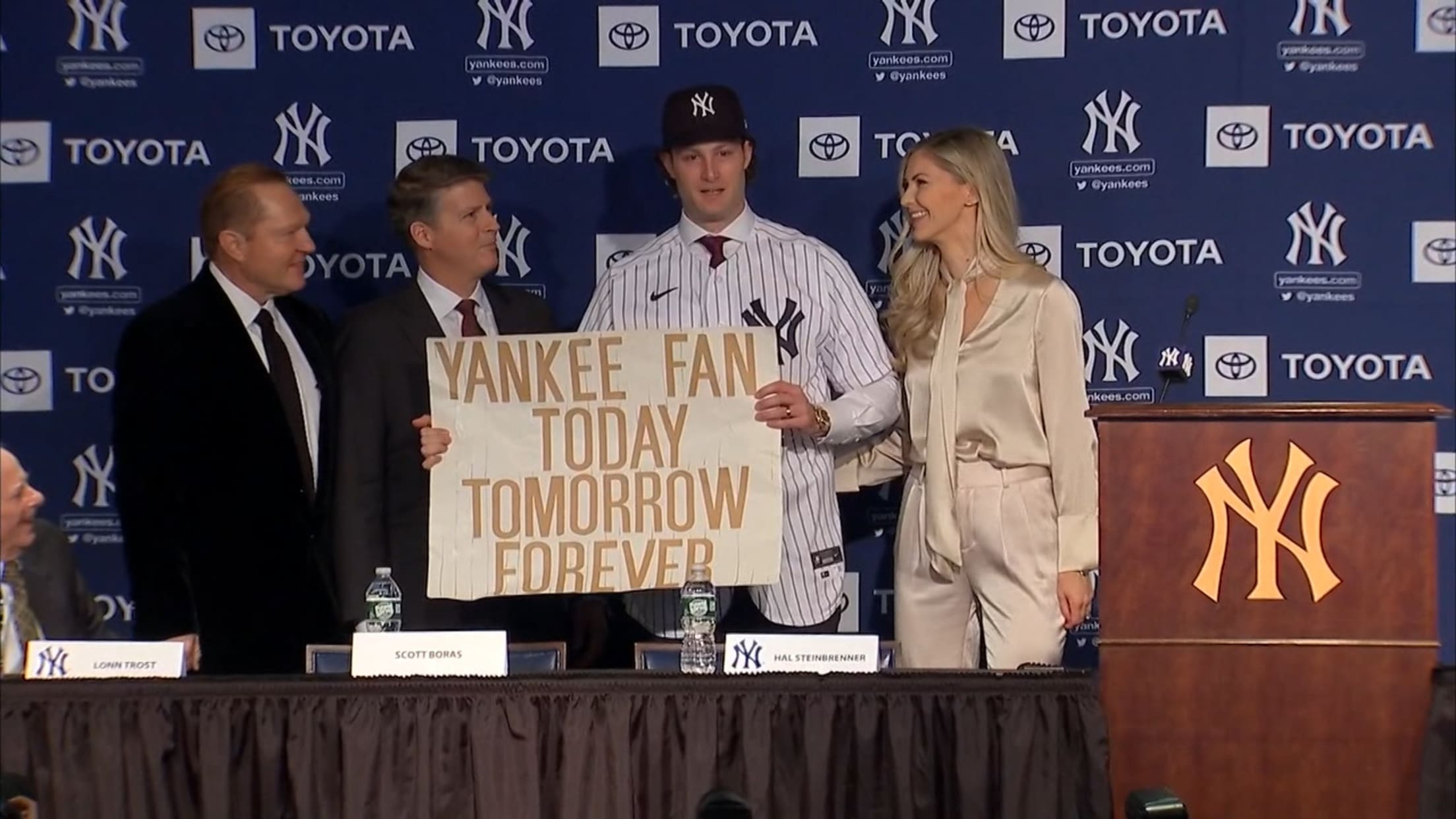
In the lead-up to the 2024 World Series, much was made about the sign Gerrit Cole made and brought with him to the 2001 fall classic. Although he was born and raised in Southern California (but considerably closer to Angel Stadium than Dodger Stadium), and he went to college at UCLA, Cole is a lifelong Yankee fan.

In fact, Cole brought the sign with him when he signed his $324 million contract with the Yankees in 2019. This past October, Cole got the chance to play for his beloved team on the largest stage. This is truly what dreams are made of.

The same is true for Yankees shortstop Anthony Volpe. The second-year player grew up on Manhattan’s Upper East Side, his family had a share of Yankees season tickets, and he attended the last World Series New York won—in 2009. With his team on the brink of elimination in Game Four of this year’s edition, Volpe hit a game-changing grand slam home run to give the Yankees a 5-2 lead, one that they would not relinquish in their only victory against the Dodgers.

The homer might have changed the whole complexion of the Series had the Yankees not booted away the fifth inning of Game Five, allowing the Dodgers to come back from a 5-0 deficit, and ultimately win the game and the title.

Marcus Stroman grew up on Long Island and was on the Yankees roster for the World Series. Unfortunately, he did not make any appearances. He was, however, afforded a front-row seat to cheer on—and to be ready if needed—his hometown team. Stroman played for the other New York team (which is about seven miles closer to his hometown) in 2019 and 2021 (he opted out of the 2020 Covid year), but neither of those Mets teams made the playoffs.

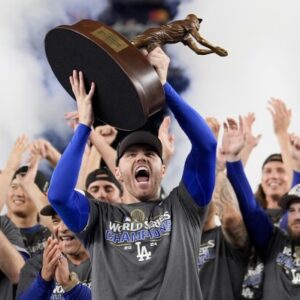
For the Dodgers, the story is slightly more complicated. World Series hero and MVP Freddie Freeman grew up in Southern California, but, like Cole, much closer to Angel Stadium. In fact, he was an Angels fan and attended the 2002 World Series match-up against Barry Bonds and the Giants. But, when Freeman signed with the Dodgers in 2022, he felt as if he was “coming home,” getting to be closer to the father who raised him after his mother passed away when Freddie was ten years old. There is no doubt that Freeman is a Dodger legend (and fan) now.

Austin Barnes was born in Orange County, California, which makes him like Cole and Freeman, and he grew up in Riverside, which is roughly 55 miles east of Los Angeles. He played three innings in Game 5 of the NLCS against the Mets, but never came to bat. That said, he was on the World Series roster and got to celebrate the Dodgers victory. We should note that Barnes played in five of the Dodgers’ six games in the 2020 World Series against the Rays. Unfortunately, all of those games were played in Texas, so there wasn’t any sort of hometown crowd to cheer him on.

Joe Kelly, who was not on the Dodgers’ World Series roster, also hails from Orange County. But his performance on the field, and his pouty face against the Astros in the 2020 season, has made him a low key Dodger legend. Like Barnes, after nearly starting a mid-season brawl in Houston, he played for the Dodgers in the 2020 World Series in Dallas.

The true hometown hero is pitcher Jack Flaherty. Acquired by Los Angeles at the trade deadline, Flaherty was given the opportunity to pitch on the same mound from which he threw a 1-0 shutout to give the Harvard-Westlake School the Southern Division CIF State Championship in 2013.

After Game One of the National League Championship Series, I had the opportunity to ask Flaherty how it felt to pitch in front of his Little League buddies at the stadium he frequented as a kid. He said it was great to know they were there and to have their support. Flaherty then had the good fortune to pitch Game One of the World Series in front of those same fans. He threw 5-1/3 innings, scattering five hits, surrendering only two runs, while striking out six. After a rough start to Game Five (four ERs over 1-1/3 innings), Flaherty cheered on and celebrated with the Dodgers as they won their second World Series in five years.

Every day across this great land a kid goes into their backyard and envisions hitting the game-winning home run or striking out the final batter. This year, Gerrit Cole, Freddie Freeman, Anthony Volpe, and Jack Flaherty got to move those stories from their backyards to the most hallowed ballfields in the game. Maybe next season Kyle Hendricks will pitch his hometown team, the Angels, to the World Series.

PLAY BALL!!

Kiké Hernández Shines When the Lights Are the Brightest

In 2012, I took my son’s travel ball team to a Lancaster Jethawks game. I had arranged for each kid to run out on the field with his positional counterpart in the top of the first inning.

As the kids gathered, the second baseman circled the boys up and told them to sprint to the outfield immediately after the national anthem and high-five the center fielder. The publicity person told the kids not to do it, but at the behest of this fun-loving Jethawk, they did so anyway.

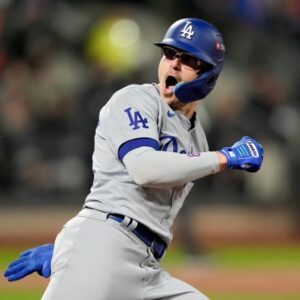
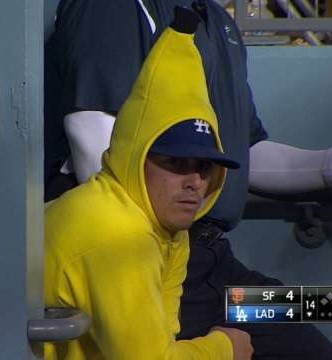
Two years later, that second baseman would make his major league debut with the Houston Astros; and , then he was quickly traded to the Miami Marlins. The next season, after a trade to the Los Angeles Dodgers, he made his postseason debut, going 4-for-13 in the National League Division Series, which the New York Mets won three games to two. That .308 batting average in four games was a sign of things to come for this versatile young ballplayer. Kiké Hernández has made a name for himself in MLB by being a carefree guy who is not afraid to don a banana suit to lighten the mood. More than that, he has made a name for himself by coming through on the biggest stages when the lights are the brightest.

In 1,183 regular-season games so far during an eleven-year career, Hernández has slashed .238/.308/.405, hitting one home run every 32.5 plate appearances. But in the postseason, those numbers go up to .278/.353/.533, with one home run every 17.3 plate appearances. And this is no small sample size—he has done it over 86 games.

When Hernández has been asked the difference between the regular season and the post-season, he has replied that he has the ability to slow his heartbeat. But it has to be more than that. Average players don’t just change into superstars when the calendar flips to October because of their heartbeat.

Here is a brief chart of active player postseason home run totals:

PlayerHome RunsPlate Appearances
Jose Altuve27484
Kyle Schwarber21278
Alex Bregman19434
Corey Seager19346
George Springer19309
Giancarlo Stanton18172
Carlos Correa18358
Bryce Harper17232
Aaron Judge16262
Kiké Hernández15259

The only name on this list that is remotely similar to Hernández is Alex Bregman, who (a) played in a hitter’s park with a very short porch (the Crawford Boxes in Houston), and (b) has nearly twice as many post-season plate appearances as Kiké. You don’t sit one home run behind Aaron Judge, and two home runs behind Bryce Harper, just by controlling your breathing. 

But Hernández wasn’t and hasn’t always been Señor October. After that .308 in the 2015 NLDS, he went hitless in eight at bats in the 2016 National League Championship Series, which the Dodgers lost to the Chicago Cubs.

But in Game 5 of the following year’s NLCS, against the same opponent, Hernández had his coming out party. He crushed three home runs into the Chicago night and raised millions of dollars for hurricane relief for his native Puerto Rico in the process. Over the five-game series, he slashed .444/.546/.1444 with seven RBI. The legend of October Kiké was born.

Unfortunately, after that breakout, Hernández went 8-for-54, with just two home runs and four RBI over his next 21 post-season games in four additional playoff series, slashing .148/.258/.259 in the process. Maybe the hype was just that. But in the Covid year of 2020, after going 0-for-5 in the Division Series, Hernández began a resurgence that has not slowed down.

He slashed .308/.357/.769 for the Dodgers in the 2020 NLCS. Then, after a soft 2-10 in the World Series, he left the Dodgers for the Boston Red Sox. The following year he led the BoSox to Game 6 of the ALCS, going 20-for-49, slashing .408/.423/.837, with five home runs and nine RBI for the entire post-season.

This year Hernández was back with the Dodgers and doing what he does best. Over three series he hit .294 while playing great defense at three prime positions: center field, second base, and third base. And the lights and pressure of New York didn’t cow him one bit: he hit .286 over the NLCS and the World Series while smashing yet another post-season home run.

As of this writing, Hernández is a free agent. But after two highly successful runs with the Dodgers, after winning two World Series titles in Los Angeles, after being the Swiss Army knife willing to play any position—including pitcher—and play them all well above-average, there is a very high likelihood that Kiké is back in Dodger blue next season, and at a salary considerably higher than the $4 million he earned last year.

PLAY BALL!!

Fans Need To Do Their Job

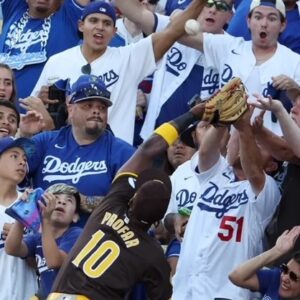
In the bottom of the first inning of Game 2 of the NLDS, Mookie Betts hit a ball 354 feet down the left field line. Jurickson Profar, a converted shortstop, went back to the wall, leaped into the stands extending his gloved left hand as far as he possibly could, and then retreated back onto the field of play, bouncing on both feet like a kid on Christmas morning. Betts was somewhere between second and third base when Profar finally divulged that he had caught the ball. His antics fooled Betts, the fans, and the television broadcast, which had displayed a home run graphic while Mookie circled the bases.

In the aftermath of Profar’s play, the Dodger fans were none-too-pleased, which led to jawing, and then ball-throwing, and then a nine-minute delay before the seventh inning while security encircled the outfield, led fans to jail, and cleaned up the beers dropped onto the warning track.

For starters, fan should NEVER act that way. Buying a ticket does not give you a license to say rude or offensive things to players (I understand some people may have a different view of this). Buying a ticket does not legally allow you to throw things – balls or beers – onto the field. In short, just because you buy a ticket doesn’t mean you automatically get to be a jerk.

But, buying a ticket, does give the fan a certain type of license.

MLB Rule 6.01(e), discusses “Spectator Interference” as follows: “When there is spectator interference with any thrown or batted ball, the ball shall be dead at the moment of interference and the umpire shall impose such penalties as in his opinion will nullify the act of interference.”

The penultimate two sentences of the official comment to the rule states: “No interference shall be allowed when a fielder reaches over a fence, railing, rope or into a stand to catch a ball. He does so at his own risk.”

As such, fans do have the right to catch a ball that comes into the stands. Fans are given license to mess with the player diving over the wall. Fans have as much right to the ball as the player, and if that means hitting an arm or knocking a glove off a hand, so be it.

Accordingly, while I blame the Dodger fans for their putrid behavior before the seventh inning, I also blame the fans for allowing Profar to make that catch. There is simply no world in which a visiting player, during a playoff game, in a packed stadium, should ever be able to make that play. In 1989, Bill Welch and Jeff Moses published “The Tenth Man: How Major League Baseball Teams Can Gain a 2 to 3 Run Advantage Every Game.” The Seattle Seahawks have made an industry out of the 12th man, as their fans have an adverse effect on visiting players. There is a real benefit to playing at home, but only if the fans do their job.

When you watch the video of Profar’s catch, you can clearly see multiple fans who had a clear shot to either catch the ball or interfere with Profar’s ability to do so. They all failed at their job. The poor security guard can be seen cowering, and he may have impeded some fans getting in Profar’s way, but there were plenty of others available.

Fernando Tatís had hit a home run in the top of the first inning of this pivotal game, and Betts was about to even the score. And, maybe more importantly, Betts was about to end his 0-for-18 post-season hitting woes. As it turned out, it took another full game – pushing the streak to 0-for-22 – before Betts got a hit, which was an actual homer over the outstretched arm of Profar (again). Who’s to say what the rest of Game 2, an eventual 10-2 Padres blowout, would have looked like had the score been 1-1 after 1, with Mookie feeling confident at the plate.

The Dodger fans cannot be blamed for the six home runs that Dodger pitchers surrendered in that game. But they can be blamed for the one home run that they allowed a Padres pitcher to not surrender. Fans can hoot and holler; they can sing and dance and call out their team’s name during “Take Me Out To The Ballgame.” Fans can wave rally towels and stand when their pitcher gets two strikes on an opposing batter. And they can – and should – do anything and everything possible to make sure that the opposing team does not reach into the bleachers and pull back an actual, verifiable, genuine home run ball. If they fail to do that when given that opportunity, then they have failed their team, they have failed to do their job. There is no question that the Dodger fans failed their team in the first inning of Game 2 of the NLDS.

PLAY BALL!!

Bring Socialism to the Ballpark

Color me a socialist. Not in the political sense, but in the idea that people who come to sporting events should, by and large, be treated equally and fairly.

It truly bothers me when – at the ballpark – the rich only get richer. I certainly understand that the more you pay for your ticket, the better your seat, and thus the better your view. 

Where my hide starts to get chapped is when the more you pay for your ticket, the better concessions that are available to you. For this thought exercise, I am putting aside the various and sundry stadium clubs that have premier seating and premier services, and thus premier food and beverage. I am talking about sitting in what used to be referred to as “box” seats as opposed to reserved, loge, or the bleachers. It should not be that hard to make sure that the same food is available to all fans, regardless of the price they paid for admission.

Where this bee really gets into my bonnet is with balls thrown into the stands by the players. Sure, you pay more for a ticket, you are closer to the action, and you are more likely to catch a foul ball. That is just how it works.

And that is pretty democratic – no one controls how many or how far foul balls will be hit, and thus many times per game a ball reaches the upper deck where a fan with a lower-cost ticket has a chance of in-game glory and long-term bragging rights; not to mention an incredible souvenir. 

But over the past five to 10 years, we have seen a proliferation of players throwing balls into the stands after the mid-inning toss-around and after the third out is recorded. And nearly every one of these balls ends up in the seats closest to the action, where the rich fans get richer.

I have given this a ton of thought, and was heartened when Steve Ballmer, the exuberant owner of the Los Angeles Clippers, announced that at the team’s new arena there will be T-shirt cannons that reach the upper decks. The T-shirt cannon is the basketball corollary to the between-innings ball toss into the stands. These predominantly go to fans in the most expensive seats. Well, not at the Intuit Dome, and, if I had my way, not at your local ballpark, either. 

A couple of weeks ago, I was lucky enough to be invited to sit in the Dodgers’ Dugout Club. This is the premier seating I referenced above. I was sitting close enough to hear the players chat on their way to and from the field. After the last out of the top of the third inning, the Dodgers tossed the ball around the infield and it ended up in the glove of second baseman Gavin Lux. True to form, Lux tossed the ball into the stands. But, he didn’t just lob it into the luxury seats. He gave it a heave and sent it up to the loge level, where eager fans were shocked and excited to be getting the ball. I remarked to the people I was sitting with that the kid from Wisconsin gets it. With his Midwestern values, Lux understands the importance of hard work and the need for everyone to have a chance to be rewarded. I wish more players did this. 

However, I am not naïve enough to believe that players will suddenly start chucking balls to the farthest reaches of the stands. That is why I previously recommended to the Dodgers’ chief marketing officer that at least a few times each game, a player should toss the ball to an usher (rather than the fans in general) and that usher should deliver the ball to a fan in another section. I cannot state with any authority that the ball would mean more to the kid in the upper deck than the kid in the lower bowl, but I can state that it would somewhat level the non-playing field for fans. Just because your parents cannot afford four tickets at $150 each doesn’t mean you automatically lose the chance to go home happy with a game-used souvenir.  

It is the small things that teams can do to grow the game. Give that kid in the far reaches a ball, and she is a fan for life. Her family tells that story to their friends and neighbors, and they are more likely to shell out for tickets, parking, hot dogs, peanuts, and beer. Attendance would increase. Equally as important, fan engagement would increase. Fan excitement would increase. And, if those things continue to occur, team values would increase, which, let’s face it, is what owners truly care about. 

One more minor suggestion: A premier seat owner knows they will not be using their tickets on Tuesday night. They call the team and inform them that the seats will be empty. In return for opening up the seats, the seat owner is given a credit to be used for future tickets or concessions. The team then sends an usher to the upper deck and presents a family with a special surprise: You all get to sit in the unoccupied premier seats for the duration of the game, and you get all of the goodies that go along with that. Heck, the team can even mention the name of the premier seat owner who bequeathed the seats to this unsuspecting family. 

With electronic ticketing and so much information known about attendees, this is low-hanging fruit. It would not take very much to make this happen every night. The marketing boon derived from changing a family’s game-viewing is nearly unquantifiable. Some team – maybe the Yankees, who always seem to have tons of seats open in their most expensive section – needs to institute this plan. And soon. Attendance may be up in MLB this year, but if the sport we love is going to continue to be relevant for future generations, we need to use every tool available to create fans for life. 

Crash Davis says that strikeouts are fascist. I think seats and souvenirs need to be socialist. In today’s game, we cannot do much about the former; but teams certainly can fulfill the dream of the latter.

PLAY BALL!!