
There is no baseball fan in America, maybe no person in America, who doesn’t know that Jackie Robinson broke the color barrier with the Brooklyn Dodgers in 1947. A slightly smaller circle of fans knows that Larry Doby came next, breaking the American League color barrier with Cleveland also in 1947, a mere eleven weeks after Jack.
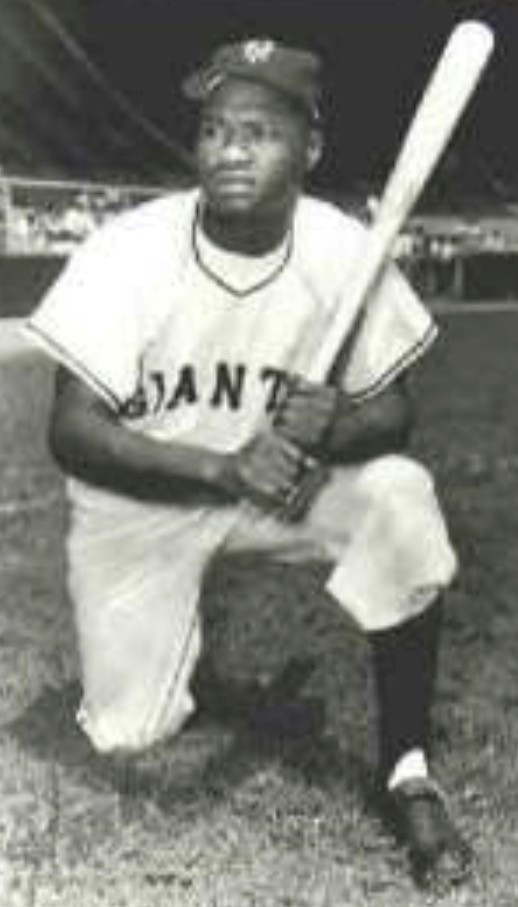
The third player to do so was Hank Thomspon, less than two weeks after Doby. I imagine the vast majority of baseball fans have never heard of Hank Thompson (I certainly hadn’t). And that is because Thompson lived a troubled life. Born in 1925 in Oklahoma City, he played for the Kansas City Monarchs in the Negro Leagues in 1943, and then went off to serve in World War II. When he came back from the Battle of the Bulge, after a brief stint back with the Monarchs, the St. Louis Browns signed him to play second and third base. Three days after his debut, he joined Willard Brown on the field, marking the first time two Black players appeared in the same major league lineup.
The Browns released him after 27 games, and he again rejoined the Monarchs, playing through the 1948 season. In 1949 he was with the New York Giants, making him the first Black player to integrate two different teams and the first to play in both the American and National Leagues. That same year, when he faced the Dodgers Don Newcombe, that was the first time a Black pitcher matched up against a Black batter. And in 1951, he moved to right field alongside Willie Mays and Monte Irvin for the first all-Black outfield.
Thompson had a tough upbringing, and was arrested for the first time at age eleven. He went AWOL for a few days while in the service, and found himself in the stockade after a drunken brawl. These were a precursor of future troubles.
After a nine-year career wherein he amassed 129 home runs and finished with a slash line of .267/.372/.453, Thompson left baseball and became a cab driver in New York. A few years after his career ended, Thompson robbed a liquor store and was convicted of armed robbery, burglary, and theft. That got him a 10-year prison sentence, but he was paroled after serving just three. After his release, Thompson moved to Fresno, California to become a city playground director. Unfortunately, a year later – 13 years to the day of his last game in the majors – Thompson suffered a seizure and died at just 43 years of age.
After his release from prison, Thompson had regrets but also took responsibility for his lot in life. “Don’t ask me to blame society. Or the fact I’m a Negro in a white world. Or the fact I have a grade school education. I’m the one who kicked society in the teeth.” And then he added, “Baseball was the only thing I’ve ever done well.”
Baseball is filled with so many players, and so many stories, and so many are forgotten. Thanks to the inimitable Joe Posnanski, I was introduced to Hank Thompson, a ground-breaking player and a law-breaking citizen. His story – like hundreds if not thousands of others – has been lost to history, and we baseball fans have an obligation to try to remember them when we can if for no other reason than to understand the complexity of the people who play the game we love so much.
PLAY BALL!!
