
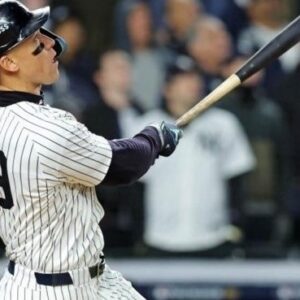
Aaron Judge, The 2024 World Series, and Sliding Doors

My wife is always giving me hard time about playing the sliding doors game. She thinks it’s a waste of time. I had a colleague who once gave me a t-shirt that reads: “What if there were no hypothetical questions?”. And one my favorite books is Mike Pesca’s anthology, “Upon Further Review: The Greatest What-Ifs In Sports History.” (As an aside, if you haven’t done so already, be sure to pick up a copy. The Muhammad Ali and Tom Brady stories alone are worth the cover price.)

Last week I streamed “Fight For Glory,” the three-part Apple TV documentary about the 2024 World Series. It is an incredible watch, as the cameras and microphones were able to see and hear so much that we as viewers of just the Fox telecast could not. Having cameras in Freddie Freeman’s house, being with his family, and then in the training room with him prior to a game, gives us fans an entirely different vantage point and appreciation for what he went through to become a World Series hero.

The documentary does a fantastic job of interweaving actual game footage and various broadcast feeds. And whether it was Joe Buck on Fox, or Michael Kay and Suzyn Waldman on WFAN, or Steven Nelson and Rick Monday AM570, there was one consistent theme we heard over and over as the World Series progressed: “If and when Aaron Judge gets hot, he can carry this team to a championship.” As the documentary makes clear, each broadcaster said this nearly every time Judge came to the plate over the first four games.

As a reminder, through the first four games (well, through his first three at bats of Game 4), the eventual AL MVP was 1-for-13 with seven strikeouts and seven runners left on base. In the first three games of the Series, Judge swung and missed 18 times.

In the bottom of the eighth inning of Game 4, Judge laced a 107.8 MPH single to left. That at bat, that swing, that hit, felt different. He would end game 1-for-3, but he had to be feeling good about coming to the plate four times and not swinging through any pitches.

Judge’s first at bat of Game 5 resulted in a 108.9 MPH missile to right center for his first home run of the Fall Classic. On the Fox call, Joe Davis proclaimed: “Sleeping giant has awoken.”

Two at bats later he hit a ball 101 MPH to deep left for a fly out. Then in the eighth, he hit a 100 MPH double to left. At that point, it was clear to everyone watching that Judge was locked in and doing damage. Unfortunately for Yankees fans, Judge never got another at bat in the series. As we all know, the Dodgers came back to win Game 5 and with it, the World Series.

But what if the Yankees had not lost Game 5. What if they had not choked away a no-hitter and a 5-0 lead? What if they had held on to their 6-5 advantage late in the game? What if the series went back to Los Angeles, with Yankees having won three straight and having all the momentum and with the Dodgers on the ropes? Well, we will never know.

The Dodgers never had to throw another pitch to the six-time All-Star, two-time MVP, American League single-season home run champ, the man who had hit 196 home runs the previous four seasons combined, while still batting .300 with a 1.056 OPS and a 191 OPS+. In a different universe, there would have been two more World Series games. How would Judge have fared? It is impossible to know for sure, but we can speculate based on his next two official games.

On Opening Day (which would have been Game 6), Judge went 1-for-4 with a double, striking out twice. The next day, the Yankees second game of the 2025 season (what would have been Game 7), Judge went ham. How about 4-for-6 with three homers, eight RBI, and 14 total bases. What would that have looked like in Chavez Ravine, on the biggest stage, in a deciding game, on national television?

Just for kicks, Judge hit a home run the following day as well, while walking three times and scoring four runs.

Would the Judge of early 2025 (.417/.481/1.167 with five home runs through his first six games) have been who the Dodgers would have contended with in the final two games of the World Series? Probably not. But they would have had to contend with the guy whose previous seven World Series at bats went like this:

  • 92.8 MPH fly out
  • 107.8 MPH single
  • 108.9 MPH home run
  • Walk
  • 100.9 MPH fly out
  • Walk
  • 100.1 MPH double

Does anyone think that the shaky Dodgers rotation and/or bullpen wanted to face that version of Aaron Judge with the title on the line? Does anyone think that Judge wouldn’t have had at least a couple of memorable at bats in Games 6 and/or 7? Does anyone think that the Dodgers weren’t thanking their lucky stars that they came home with the Commissioner’s Trophy rather than trying to figure out how to get the suddenly red hot Aaron Judge out eight or ten more times?

Sliding doors. They are fun to think about.

PLAY BALL!!

Opening Day Performances May or May Not Be a Sign of Long-Term Success

Last Thursday was MLB’s Opening Day. A day of renewal, as teams start the season with a clean slate and great hope for the future. The same is true for the players. While they all start with a .000 batting average, that can only go up from there.

Some players get their seasons off to brilliant starts, having Opening Days for the ages. This year was no exception, two players remarkable games:

Kyle Manzardo of the Cleveland Guardians walked in his first at bat of the year. In the top of the fourth, he tripled and ultimately scored. In the sixth inning, he hit a solo home run. After striking out looking in the eighth, Manzardo took advantage of extra innings, hitting a two-run double in the top of the tenth to ultimately win the game for the Guardians. When all was said and done, Manzardo was a single shy of the cycle—which would have been only the second Opening Day cycle in MLB history (more about that below)—with four RBI.

MacKenzie Gore of the Washington Nations threw six innings, allowing just one hit, while striking out 13 Phillies. Gore matched Bob Gibson (more about that below) as the only pitchers in AL/NL history with that many strikeouts and no walks in a scoreless outing on Opening Day.


While those were quite the performances for one guy who with 156 previous big league at bats and only 15 runs batted in before Thursday afternoon, and one guy who only has 73 big league starts to his credit, they pale compared to some of the greatest Opening Days of all time. Here are just a few, starting with the pitchers:

Walter Johnson, pitching for the Senators in 1926 tossed 15 innings, giving up no runs while striking out nine against three walks in the their 1-0 win over the Athletics (then in Philadelphia).

Bob Feller, throwing for the then-Indians in 1940 what is still the only AL/NL Opening Day no-hitter. He struck out eight but issued five walks.

In the first of his nine straight Opening Day starts in 1967, Bob Gibson threw a complete-game shutout against the Giants, allowing just five hits and striking out 13 without issuing a single walk. Pretty good company for Mr. Gore.

Future Hall of Famer Clayton Kershaw fell short of Feller and Gibson in 2013, allowing four hits, but he handed out no walks while striking out only seven. Kershaw also added his own home run. (At the plate, Feller went 0-for-3 in his gem; Gibson, alas, went 0-for-4.)


Now, for the hitters, including a few from Detroit:

In 1937, Gee Walker of Tigers hit for the cycle and went 4-for-4 while also scoring twice in the Detroit’s 4-3 win over Cleveland.

On Opening Day in 1986, future October hero Kirk Gibson went 4-for-4 without cycling: he hit two home runs and drove five home, helping push the Tigers past the Red Sox, 6-5.

On that same day, Jim Presley of the Mariners went 3-for-4 with two home runs and 6 RBIs in a ten-inning, 8-4 win over the Angels.

Coming off a 47-homer season in 1987, George Bell rang in 1988 with three dingers against the Royals in a 5-3 Blue Jays win.

On Dwight Gooden’s final Opening Day as a Met, Karl (“Tuffy”) Rhodes hit three homers off Doc at Wrigley Field. The bad news: it was not enough, as the Cubs fell to the Mets, 12-8.

In 1999, Dodgers’ outfielder Raúl Mondesi tried his best to match the best previous Opening Days: going 4-for-5 with two homers and six RBIs, plus a walk. That helped the Dodgers to an 8-6 win over the Diamondbacks.

Corey Patterson of the Cubs went 4-for-6 with two homers and seven RBIs as his Cubs drubbed the Mets, 15-2 in 2003.

Another Tiger, Dmitri Young went wild in 2005, hitting three home runs with five RBI in a 4-for-4 day (plus a hit-by-pitch) as Detroit throttled Kansas City, 11-2.

The Royals were victimized yet again in 2018 as Matt Davidson crushed three homers in the White Sox’s 14-7 win over the Royals.

Most recently, in 2023, Adley Rutschman went a cool 5-for-5 with a home run, a walk, and four RBIs, as the Orioles edged the Red Sox, 10-9.


Baseball analysts are always quick to downplay “small sample size” assessments, so there is no need to extrapolate anything from any of the above games. Johnson, Feller, Bob Gibson, and (eventually) Kershaw are Hall of Famers, so their Opening Day success is not shocking.

But Walker went on to slash .335/.380/.499 in 1937 for the second-highest OPS of his career, making his only All-Star team. Kirk Gibson’s 1986 turned out to be relatively pedestrian, but Presley’s was the second-best season of his career.

Bell’s 1988, Rhodes’ 1994, Mondesi’s 1999, Young’s 2005, and Davidson’s 2018 were all middle-of-the-road. Patterson’s 2003 was his best. And Rutschman ended 2023 as a Top-10 Most Valuable Player Award vote-getter while winning a Silver Slugger Award.

Long story short, it is best simply to appreciate these great Opening Day performances, as there are absolutely no conclusions that can be drawn from them. After that one great game, there are still 161 to go.

PLAY BALL!!

A version of this story appeared in the April 2nd edition of IBWAA’s “Here’s the Pitch” newsletter.