The wonderful baseball writer Joe Posnanski likes to say that baseball is never better than when you are ten years old. When I was ten years old, the Milwaukee Brewers won the American League pennant and played in the World Series against the St. Louis Cardinals.
The Brewers were up three games to two before the Cardinals won Game 6 by the score of 13-1 and Game 7, 6-3. It would be a long 44 years until the Brewers – now playing in the National League – would again be in the World Series.
I can still remember, with great clarity, the 1982 club – Harvey’s Wallbangers. And with the 2026 team winning their first title, I thought it would be interesting the re-live that group of grinders and sluggers and compare them to the team that just took out the Rays in five games in the World Series.
Catcher:
In 1982, Ted Simmons was the field marshal of the Brewers. Ironically, this was the one season between 1978 and 1983 that he didn’t make the All-Star team. But he still managed to slug .451 and hit 23 homers. In 2020, the Hall of Fame Veterans Committee gave him 81% of the vote, so now he has a plaque in Cooperstown.
William Contreras won the World Series MVP Award with his incredible bat (.381/.435/.429) and his control of the pitching staff (1.98 ERA over the full playoffs), the strike zone (10-13 on ABS challenges), and the running game (four runners caught stealing).
First Base:
Cecil Cooper held down first in 1982, slashing .313/.342/.528 with 32 home runs and 121 RBI. He was an All-Star, a Silver Slugger, and came in fifth in MVP voting.
This year, Jake Bauers found his footing all the way to the NLCS MVP. His at-bats against Yoshinobu Yamamoto (that ended with an 12-pitch walk) and Blake Snell (that ended in an 11-pitch home run) tilted the Championship Series in Milwaukee’s favor.
Second Base:
Jim Gantner was the prototypical Milwaukee lunchpail player. In 1982 he hit only four homers, but he held down the keystone for 17 years, and almost never left the field without dirt on his uniform.
Brice Turang is very much in the Gantner mold, but with more power. Turang was a first-round draft pick, but he, too, was considered undersized and has had to earn all of his accolades. He already had a Gold Glove to his name, and may win another later this week.
Third Base:
Hall of Famer Paul Molitor slashed .302/.366/.450 with 19 homers in 1982. He played ten more seasons in Milwaukee before signing with the Blue Jays, where he won a World Series in 1993.
The 2026 club split hot corner duties between David Hamilton and Joey Ortiz. Collectively, they hit .258, with 13 homers and 73 RBI. But Hamilton hit a clutch insurance home run in the clinching game of the NLCS and a game-tying homer in Game 3 of the World Series.
Shortstop:
Standing a few feet to the left of Molitor was fellow Hall of Famer Robin Yount, the unofficial captain of the club. In ’82 all he did was slash .331/.379/.578, hit 29 homers, drive in 114, collect 210 hits, and win the MVP Award with a 166 OPS+.
Young famously made his MLB debut at age-18. Cooper Pratt was way behind, as he did so at 21. He played his first game in June of this year and ended the season with a .281/.350/.369 slash line. But in the post-season, he rose to the occasion, slashing .354/.373/.479, including a record for consecutive hits by a rookie with six in row across Games 4 and 5.
Left Field:
Ben Oglivie is one of those names that baseball olds like me bring up when reaching for an arcane ‘80’s reference. 1982 was the second best season of Oglivie’s – as measured by bWAR and by home runs (he it 41 to lead the league in 1980, and 34 in ’82). He slugged .453 for the season, with 102 RBI.
Wunderkind Jackson Chourio got arguably the loudest hit in Brewers’ history when he smashed a game-winning single off Padres closer Mason Miller in Game 2 of the National League Division Series. He caught the final out of the NLCS. And in the World Series, he went 11-24. Oh, and he is still just 22 years old.
Center Field:
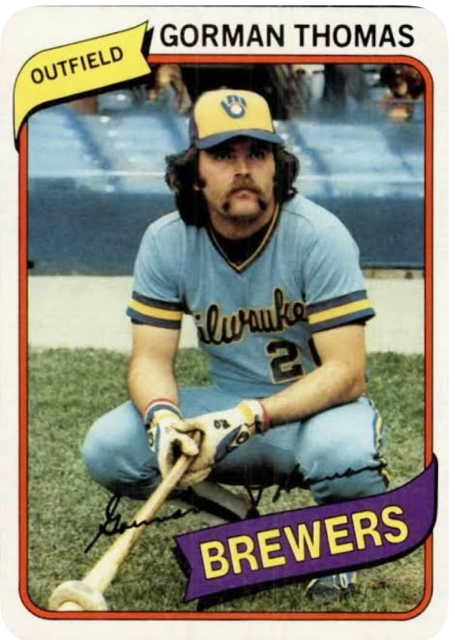
When one harkens back to “Harvey’s Wallbangers,” the first image that appears in your head is the mustachioed face of slugger Gorman Thomas. In 1982 he smashed 39 homers to lead the league (he also led the league with 45 in 1979). The mere fact that he roamed center field is a testament to the times.
Garrett Mitchell may be the Platonic opposite of Thomas, with his 98th percentile sprint speed and just 11 home runs this year. He was in the 93rd percentile in Baseball Savant’s Outs Above Average, and robbed Manny Machado of a potential game-tying home run in the bottom of the eighth inning of Game 4 of the Division Series, which helped propel the Brewers into the next round.
Right Field:
Charlie Moore collected a total of 10.3 bWAR over a 13-year career. He never hit double-digit home runs, and never drove in 50 runs, but he was good enough to play 115 games in right field for a team that made it to Game 7 of the World Series, where he slashed .346/.370/.462.
Sal Frelick, the 5’9”, 190-pound right fielder with five-hundred-pound heart puts his heart and soul into every play. He hit the game-tying home – to dead center, no less – in the sixth inning of Game 2 of the World Series, a game the Brewers would ultimately win 5-4 to take a commanding 2-0 lead. And then he made a diving catch in the eighth inning of Game 3 with Milwaukee leading 10-0. He even offered to drink one beer for every person in attendance at the Brewers World Series parade.
Designated Hitter:
Roy Howell and Don Money shared designated hitter duties for the Brewers in 1982, and neither set the world on fire. Collectively, while acting as the DH, they hit .255 with 11 home runs. Money did hit nine more while player first and third base.
The first official captain in Brewers history is Christian Yelich, who made sure the team cleared the honorific with Yount before affixing a “C” to his uniform. Yelich won the MVP in his first year in Milwaukee (2018), and came in second in 2019. In 2026 he served as the designated hitter in 112 games. His slash line (.234/.314/.372) and his home run count (11) don’t represent the impact he had on the club every day – on the field and off. It was only fitting that in the post-Game 5 celebration that he proclaimed: “Uecky [Bob Uecker], I love you, man, we did it!”
Pitching Staffs:
We can address these (including Rollie Fingers) in a later post.
PLAY BALL!!