HAPPY BIRTHDAY

HAPPY BIRTHDAY

On the day after my 16th birthday, as my street was filling with cars and my house was filling with teenagers (my parents were quite accommodating by leaving the continent shortly after I passed my driver’s test), Kirk Gibson gave us the greatest moment in Los Angeles sports history.  (Relax, Lakers fan.  This is not my opinion – it is based on many surveys on the topic.)  But, this happened on October 15th, so technically, not a birthday gift.

But on my 43rd birthday, the Rangers and the Blue Jays – two teams I really don’t care too much about – gave me a birthday gift of an entirely different sort.  They gave me the 7th inning (why is it always the 7th inning?) of Game 5.  A lot has been said and a lot has been written about that 7th inning, so I figured, why not . . .

If you have ever watched – or heaven forbid – coached a Little League game and seen the wheels come off the wagon, cued the circus music, and/or pulled your hair out in exasperation, you’re in good company.  Because Rangers fans and Jeff Banister (the Rangers’ manager) witnessed it all over a 53-minute period yesterday afternoon north of the border.

And the Rangers and Blue Jays gave us all a huge gift – one that I am sure Elvis Andrus wishes he could take back – by providing context to the difficulty of baseball.  Yesterday’s 7th inning gave us all a new appreciation for how hard the game of baseball is, why we cannot be shocked when our kids make errors, and new meaning to the phrase “that just can’t happen”.

A few angles, some of which have been covered, and some of which have not.

FAULTY THROW/HEAD’S UP PLAY

Russell Martin goes through the motion of doing something he has done probably hundreds of thousands of times – throwing the ball back to the pitcher.  No one would have expected the ball to careen off Sin-Soo Choo’s hand.  And yet, it did.  This happens in Little League, and we yell at our kid to be more careful.

But what got lost on that play, and I have only heard Jeff Banister reference it, is that Rougned Odor had his head up, saw the play unfold, and took off for the plate.  How often do we see Little Leaguers, and Big Leaguers alike, go back to the bag with their heads down, not paying attention to something as innocuous as a throw back to the pitcher?

If Odor had not sprinted down the line and crossed the plate before Josh Donaldson even picked up the ball, the play could have gone another way (e.g., the umpires could have ruled that their call of timeout did not affect the play because the runner didn’t attempt to score).  Odor was more than halfway down the line before home plate umpire Dale Scott called the play dead; and Odor finished his sprint and crossed the plate.  So, when Scott conferred with his colleagues and figured out that he spoke too soon, the guys in the replay booth confirmed that regardless of the time out call, Donaldson never had a chance to stop Odor, and thus the run was allowed.  We always teach that the one thing on a baseball field you can control is hustle.  For a few moments yesterday afternoon, it looked like hustle would be the difference between winning and moving on, and losing and going home.

THREE (ARGUABLY FOUR) TIME’S A CHARM

#1:  Watch enough baseball games and see enough six hoppers up the middle, and you begin to wonder why batters even bother running up the line.  Shortstops from the age of 10 or 11 make that play sliding to their left and throwing in line with their body so often, and so easily, that it has become the definition of “routine”.  Add to the equation the true hops one gets on a synthetic surface, and I would not be surprised if the official scorekeeper had already jotted down “6-3” before the ball even got to Andrus.  But, the reason they put erasers on the back of pencils is that sometimes people make mistakes.  It is just that when Andrus booted an easy groundball to start the bottom of the 7th, if felt like more than an innocent error.  There was a certain foreboding.  If the game had a soundtrack, that is when the scary music would have started.

#2:  But when Kevin Pillar hit an innocent groundball to Mitch Moreland, it looked – for a moment – like Andrus’ error would be wiped out with a 3-6-3 twin killing.  And remember (this is for Red Sox fans from the mid-’80s) that Moreland has played first base all season because he is a considerably better defender than Prince Fielder.  But Moreland never got a good grip on the ball, threw a tricky, across-the-body and across-the-runner short-hop to Andrus, and the ball bounced away.  Could Andrus have made the play?  Sure, but it would have been a heck of a play; it might even had made SportCenter’s Top 10.  Bottom line, he didn’t.  Two batters, two errors, tying run in scoring position, lead run on base, no one out.

#3:  Ryan Goins then laid down a horrible bunt.  That will be lost in all this – in fact, I have not really heard anyone speaking about how bad that bunt was.  You lay down a 40 foot one-hopper to arguably the best defensive third baseman in the history of the game (easy, Orioles fans; I said “arguably”).  Beltre makes an perfect toss to Andrus, who drops the ball.  What have we been telling our kids since Wee Ball?  If the ball is above your waist, glove down; below your waist, glove up.  Andrus apparently missed that lesson.  Three batters, three errors, tying and lead runs in scoring position, still no one out.  (By the way, prior to yesterday, no team had ever made three errors in one inning in a deciding game.)
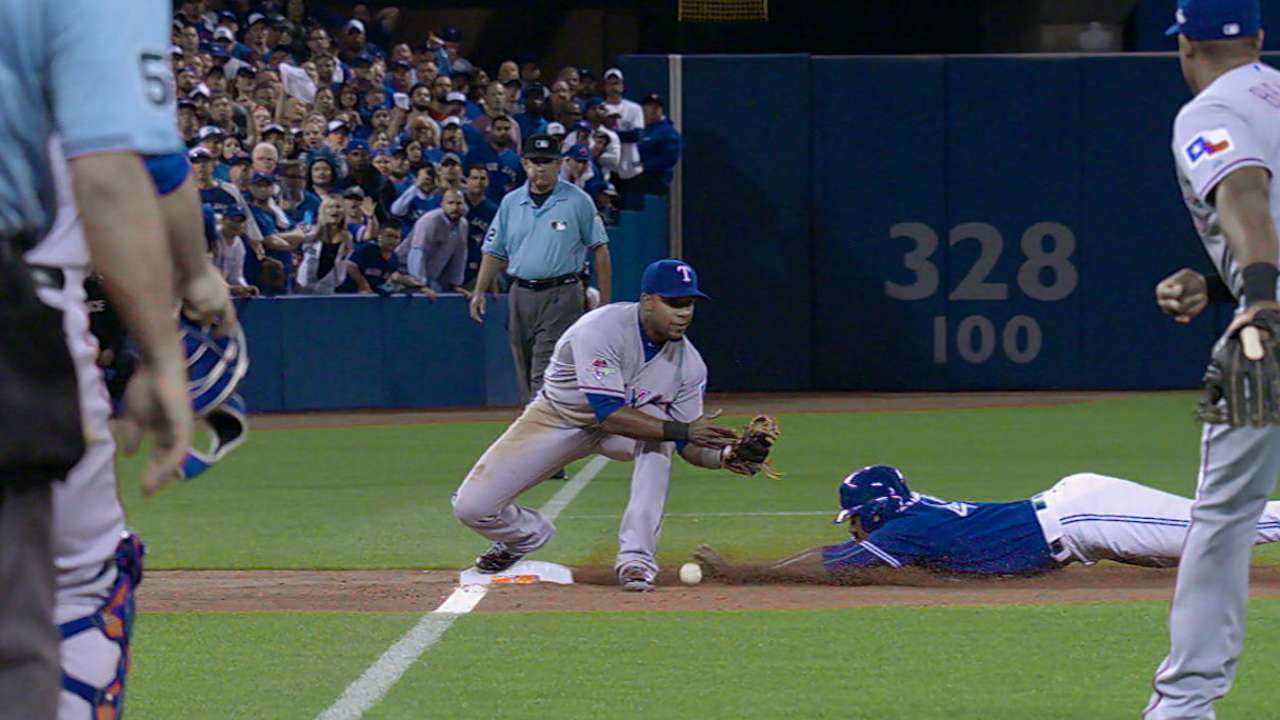
Ben Revere hits a hard shot to first.  For a moment, this looked truly to be the pitcher’s best friend: 3-2-3 and there would have been 2 out with 2 runners on.  But Dalton Pompey (on as a pinch runner) slides hard into the plate and takes out Chris Gimenez.  Legal play?  Dirty play?  Appropriate play?  Because so much happened in that inning, there has not been much talk of that.  The umpires did review it and decided it was legal (file that, Chase).  The game resumes; bases still loaded, but now – amazingly – a groundball could get the Rangers out of this.

#4:  Josh Donaldson hits a little looper behind second.  Infield fly?  The umpires ruled – instantly – it was not.  Catchable ball?  Odor determined – after a few backpedals – it was not.  Should Odor have done as he was taught – by coaches, not Robinson Cano – turned his shoulders and run back for the ball?  I think the outcome of the play inures to yes.

If Odor makes the routine catch, the bases remain loaded with two outs, and the Rangers still leading 3-2.  Would that have made any difference in Bautista’s at bat?  We will never know.

Better question: if the ball had been subject to the infield fly rule, would Pillar have taken off from third base after the ball landed in short right?  I have not heard that question asked of Blue Jays third base coach Luis Rivera, but my guess is he would not have run.

JOEY BATS (FLIP)

Depending on where you live on the baseball continuum, Jose Bautista’s bat flip was the greatest or worst thing you have ever seen.  Did Bautista disrespect Sam Dyson and the game of baseball?  Or did he do what we have been begging of baseball for a generation – provide some life, emotion, and excitement?  The answer to this question is really easy:

From April to August, Bautista is a showboat who should be drilled in his next at bat.  There is no place for that in that type of game.

In September and especially in October; and especially in the 7th inning of a deciding game; and especially in the 7th inning of a deciding game with the score tied; and especially in the 7th inning of a deciding game with the score tied that has already been fraught with emotions (both on and off the field); and especially in the 7th inning of a deciding game with the score tied, with emotions running high, when a batter hits a ball roughly 700 feet, then he damn well has the right to (a) admire the majesty of his shot and (b) toss his bat away with as much grandeur as he can muster in the moment.  Case closed.

Jose Bautista's bat flip

And Ranger fan, shut the hell up.  This isn’t on Bautista, Encarnacion (who was actually trying to be helpful), or Tulowitzki who did nothing (for the entire series, it would seem).

Thank you, Rangers and Jays.  You gave a baseball fan the best kind of birthday gift: an amazing inning that spawned another chance to writeabout the game I (we all) love.

Your turn, Dodgers and Mets.  Orel Hershisher (who will throw out the first pitch tonight), the Cy Young winning right-hander won the last deciding game played at Dodger Stadium, beating the Mets in Game 7 of the 1988 NLCS (is this starting to sound familiar?).

The next game was played at Dodgers Stadium three days later, 27 years ago today.  We all know how that turned out.

PLAY BALL!!


WORLDS/PLAYERS COLLIDE

WORLDS/PLAYERS COLLIDE

Two worlds collide, rival nations; it’s a primitive clash, venting years of frustrations.  Does the crowd understand?  Is it East versus West, or man against man?   (Extra points if you can reference the previous stanza (hint: it is a verse)).

It’s Biggie vs. Tupac.

It’s the Big Apple vs. Hollywood Glitz and Glamour.

It’s 1988 all over again, and the stakes are – in the words of the Mike and the Mad Dog – “uuuuuge!!!”

When the best pitcher on the planet could not – yet again – get a playoff W, Game 2 took on all that much more importance.  And when the Dodgers found themselves trailing 2-1 in the 7th inning (why is it always the 7th inning?) on Saturday night, with one out and runners on the corners, and Howie Kendrick at the plate, who knew – who could possibly have guessed – the firestorm that awaited in that otherwise innocent 100 feet between first base and just beyond second?

More than East Coast / West Coast, the battle that has ensued has spread to “old school vs. new school”.

It has extended out to guys who rub some dirt vs. the Sabermetricians who count every inning and every out in terms of dollars.

It has touched those who subscribe to the unwritten rules vs. those who abide by the official MLB rule book (see also, When is a Rule a Rule? June 10, 2015).

It has pitted in-game umpires against league officials.

It most likely has led to showdown between Matt Harvey and Chase Utley (or possibly Corey Seager and some other suspecting Dodger better).   (Editor’s Note: It has been reported that the Mets have specifically instructed Matt Harvey not to retaliate.  We shall see.)

And, the fact of the matter is, regardless of how much is said, how much is written, how many games Utley is forced to sit, no one and everyone is correct.

  • It was a dirty play.
  • It is how the game is played.
  • It was, depending on your interpretation, within the rules.
  • It was, depending on your interpretation, a violation of the rules.
  • It was, depending on your viewing angle, a “neighborhood play” not subject to replay review.
  • It was, depending on another angle, a force play perfectly subject to replay review.

Does that clear it up for everyone?  If not, and if you have not read and/or listened to everything written and/or said about this in the past few days, here is a brief summary:

Chase Utley breaks up a potential double play by sliding hard into Mets’ shortstop Ruben Tejada.  Hardnosed play?  Yes.  The way Utley has always played?  Yes.  A play that happens dozens of times every season?  Yes.  A potential rule violation?  Yes.  Could it have been ruled an inning-ending double play with no runs scored for the Dodgers?  Yes.

MLB Rule 7.09(e): It is interference by a batter or a runner when . . . [if], in the judgment of the umpire, a base runner willfully and deliberately interferes with a batted ball or a fielder in the act of fielding a batted ball with the obvious intent to break up a double play, the ball is dead.  The umpire shall call the runner out for interference and also call out the batter-runner because of the action of his teammate.  In no event may bases be run or runs scored because of such action by a runner.

Said differently if you are a Dodger fan with two working eyes: “uh oh!” and “phew!”

If you live in Queens or otherwise really like the color orange, you might also note Rule 5.09(a)(13):

A batter is out when a preceding runner shall, in the umpire’s judgment, intentionally interfere with a fielder who is attempting to catch a thrown ball or to throw a ball in an attempt to complete any play.

The umpires on the field had the right – but not the obligation – to call Utley and Kendrick out.  They chose not.  We can agree or disagree with that assessment, but now let’s head around the neighborhood.

Although not technically in the rule book, for the sake of safety, umpires will typically record an out (and typically at second base – has anyone ever seen it called anywhere else?) in the course of an attempted double play without the fielder actually touching the base while in possession of the ball.  For this to occur, it must look like an out, with the middle infielder catching the ball cleanly and then turning and throwing on to the next base.  It goes without saying “but I’ll say it anyway” (tip of the cap to Vin Scully) that this is done to protect players from the potential harm that could come from colliding with incoming base runners.

So, you ask, wasn’t Tejada in the “neighborhood” when he didn’t touch second base?  Well, according to the umpires, he was not, because he was not in the process of turning a double play.  Rather, he was reaching behind the bag to receive a throw coming from an odd angle, with very little likelihood of turning the double play (which, in hindsight, is quite ironic).  Thus, Utley was not out – in the first instance – on the front end of the “neighborhood play”.

As a side note, after the play Utley was laying on the ground beyond second base and Tejada was sitting on the ground with the ball in his hand.  Had Tejada been so inclined, and had Tejada not had a broken leg, he could have tagged Utley out, obviating the need for the instant replay review.  But, since the umpire called Utley out, Tejada had no need to do so.

As for the instant replay, as I am sure you all know, the “neighborhood play” is not reviewable.  That is a judgment call by the umpire in the moment, and no drone in New York can overrule that judgment.  However, that same guy sitting in a dark room in New York can opine on whether or not a player touched the bag with the ball on a force out.  Once the umpires ruled no “neighborhood play”, it became a typical force play, which is subject to review.  I can feel blood pressure rising at Coney Island.

But, you (and by “you” I mean Keith Olbermann and others) claim that Utley “abandoned his effort to run the bases” when he left the field and went to the dugout, so he should have been called out.  Au contraire, mon frere.  Once the umpire called Utley out, he has the right – and most likely the obligation – to leave the field of play.  After the review revealed him not to be out, he had the right to reassert his position – but where, exactly?  What is fascinating, and I have not been able to find anything written about or anything in the rule book, is that Utley was not technically “safe” after the review, he just wasn’t “out”.  In the same way a batter is not to out after a dropped third strike, but he is not safe either.  Or when a runner slides past home plate to avoid a tag – not safe or out, just in limbo.  Utley never touched second base and left the field from the shortstop position.  Could the Mets have tagged Utley on his way back on the field?  Like the reasoning behind New Coke . . . no one knows!!

A couple of quick questions/asides:

  • If Ruben Tejada does not get injured, just fails to turn the double play, are we having this debate right now?  I think not.
  • If Tejada does not get injured, but Utley did, what is the collective reaction?  It is amazing to me that Utley doesn’t have a concussion or something worse.  Check out the impact of his head on Tejada’s knee and then on the base path.  Some have averred that he ran off the field without his helmet because he was so dazed and confused from the collision.  Do we care?  Is that a case – like I say to my kids – “that’s what you get . . .”?

  • This same injury happened last month in Pittsburgh to Jung Ho Kang.  As far as I can tell, outside of Western Pennsylvania, the only person who made an issue out this play was Buster Olney.  Where was the outrage when a small market player went down?

https://www.youtube.com/watch?v=dF7bbQGe9xc

In fairness, however, a large market player got taken out at second base, and no one said a word.  Tell me if this play looks familiar:

But that was 38 years ago.  Some might say that times have changed.

Anyway, back to Saturday night.  The Mets claim a violation of Rule 7.09(e) and believe the discussion ends there.  Utley and Kendrick are out, the 7th inning ends, the Mets get six more outs and head home up two games to none with Harvey on the hill to close it out.

The Dodgers claim that the umpires properly interpreted the rules, Utley was within the baseline and within the rules of the game.  Tejada didn’t record the force out, everyone is safe, Kiké Hernandez scores, the game is tied, and the Dodgers score three more runs to even the series.

Joe Torre and MLB claim “[A]fter thoroughly reviewing the play from all conceivable angles, I have concluded that Mr. Utley’s action warrants discipline.  While I sincerely believe that Mr. Utley had no intention of injuring Mr. Tejada, and was attempting to help his Club in a critical situation, I believe his slide was in violation of Official Baseball Rule 5.09(a)(13), which is designed to protect fielders from precisely this type of rolling block that occurs away from the base.”

While I don’t necessarily disagree with Torre’s appraisal, I don’t believe we can have ex post facto interpretations or punishments.  If the crime warrants a punishment, it needs to be called a crime at the time.  Had the umpires invoked either 7.09(e) or 5.09(a)(13) on the field Saturday night, I would not have balked.  But, the fact of the matter is that they did not.  They were there, they saw it in real time, and they elected not to invoke the rule(s).  It is not appropriate for Torre to Monday Morning Quarterback and throw the book at Utley.  I feel pretty confident Utley’s representatives and the MLBPA will make a strong case that this play happens all the time without punishment.

As of this writing, Utley has appealed his suspension, and it will not be heard before Game 3.  Thus, Utley is free to play.  Whether or not he does will be Don Mattingly’s call (ostensibly, as the left-hand hitting second baseman, he should be in the lineup against right-hander Matt Harvey, but Utley hasn’t exactly been hitting balls as hard as he has been hitting shortstops, so Kendrick may get the start in any event).

But regardless of what happens in the Chase Utley Incident, this rule will be changed (or, as some might say, actually enforced).  In the same way that the home plate rule changed after Buster Posey’s collision was the straw that broken the catcher’s ankle, there will be a new rule for plays at second base.

The rule will most likely require that (a) runners actually slide, with at least one appendage fully extended (take a look at Utley’s leg when he made contact with Tejada); (b) runners must actually slide (i.e., their bodies must hit the ground prior to making contact with the fielder); (c) runners must slide directly to the base, not at the fielder; and (d) as my personal suggestion, a runner must be able to maintain contact with the base after he completes his slide (there is no reason it should be legal for a guy to end up near left field just because he could have touched the base at some point in his slide).  Some variation on the above theme will be in place before the first pitch is thrown next April 3rd.

And, as sure as I am typing this, old school guys will bitch and moan and complain that wimps are ruining the game.  And then the furor will die down, players will make plays and stay on the field, and the game will evolve in the same way it always has and always should.

For now, we have the Astros trying to out-Royal the Royals, who spent the 8th and 9th innings showing the Astros that the Royals are still the Royals.  We have the Rangers learning, first-hand, how/why the Blue Jays outscored their opponents by 221 runs this season (second most: the Cardinals with 122).  And we have Jake Arrieta – the most unhittable pitcher on the planet (he has allowed 4 runs in his last 97+ innings) – going against the Cubs’ arch-rival Cardinals in the Friendly Confines.  I know I say this often, but really, does it get any better than this?!!?

PLAY BALL!!

HAPPY ANNIVERSARY . . . WHAT’S NEXT?

HAPPY ANNIVERSARY . . . WHAT’S NEXT?

It seems like just yesterday – but it was actually more than a year ago – that I started writing this blog.

As I am certain you all recall, it was the A’s-Royals Wild Card game that inspired me to put fingers to keyboard and share my thoughts and musings with all of you.  I guess history will be the judge of whether or not that was a good idea.

In any event, I have now reached my Paper Anniversary.  When I first started writing, my goal was really just to share my random thoughts, and to see if I could tie them in some coherent manner to something related to pop culture, raising kids, middle (ahem) age, and, of course, baseball.  Again, history – and you all – will be the judge of whether or not I was successful in that endeavor.

So here I sit, at a crossroads.  Do I delve into Year Two, or close up the laptop and call it a career?  I arguably have now published more words than J.D. Salinger; so maybe now is the time to head into seclusion (don’t think I didn’t hear those sniggers).  However, before I head off to Cornish, I need to figure out “what’s next?”.

Starting on Friday, we will again see the St. Louis Cardinals in the playoffs – that ain’t news.  They have won the NL Central three years running, and, for good measure, they won 100 games this season.  And they did that while losing huge swaths of their lineup to injury.  Here is a brief sampling of starters who were out of action for considerable periods of time:

  • Adam Wainwright (P): Tore his Achilles in his fourth start, and then missed the next five months.  He has miraculously returned as a reliever for the post-season.
  • Jaime Garcia (P): 3 stints on the DL.
  • Randal Grichuk (LF): 2 stints.
  • Jordan Walden (P): 60-day DL.
  • Jon Jay (CF): Two stints (which may be a record low for him).
  • Matt Holiday (LF): He only went on the DL twice, but he was hobbled at all times in between.
  • Matt Adams (1B): Two stints, including the dreaded 60-day.
  • Lance Lynn (P): He escaped with just one appearance on the 15-day DL.
  • Carlos Martinez (P): He’s gone for the season.
  • Jason Heyward (RF): He goes on the DL at least once a season, and this year was no exception.
  • Yadier Molina (C): He avoided the DL, but that is just because his injury happened too late in the year.  They are somehow retrofitting a robo brace for the torn ligament in his thumb to allow him to catch in the playoffs.  Mike Marshall he is not.
  • Stephen Piscotty (LF): This guy somehow avoided both death and the DL after a massive collision with Peter Bourjos during the last week of the season.  In case you haven’t seen it:

https://www.youtube.com/watch?v=oMmWs6qFXyY

Suffice it to say, it was a rough year for the Cards.  But no matter.  Mike Matheny, the no nonsense, play ‘em as they lay, even-keeled Midwesterner just said, “Next man up”.  The team responded to adversity each and every time by looking forward, rather than behind.  Their goals never faltered, even when their health did.  That approach culminated in a division championship, a return the playoffs, and home field advantage through the NLCS (if they make it that far).

My favorite television show of all time – as anyone with whom I have ever discussed this topic knows all too well – had a lead character whose catch phrase was “what’s next?”.

As the series progressed, this “what’s next?” question was asked with considerably less derision, but it signified that, as the chief executive, he was done and ready to move ahead.

Can’t we have Jed Bartlet in the next presidential debate?  Sorry, I digress.

As I mentioned in a postscript to my last posting, I lost the stepfather of a dear friend last week.  Amongst this man’s many and varied qualities was his want/desire to keep looking forward.  After hearing of his death – as we are want to do – I began reminiscing about my interactions with him over the years.  Recall that I first met this man when I was 10 or 11 years old.  He housed me, fed me, drove me, and never missed an opportunity to parent me during my preteen and teenage years.  But, later in life, when I saw him less frequently, he never missed an opportunity to impart some pearl of wisdom.  The following is a story I related to his wife after his funeral:  I ran into Allan shortly after I graduated from law school.  He gave me a handshake that he twisted to assert dominance, and then turned it into a hug, and said “congratulations”.  He then said his version of “what’s next?”.  I remember in vivid detail his telling me that I had accomplished a great deal, but now I have to set new goals.  1 year, 5 year, 10 year goals.  He said the only way to accomplish anything in life is to look ahead and push yourself to achieve.  He wanted to know “what’s next?”.

At many times in my life I have had no choice (okay, I did have a literal choice, but not one a rational person would make) but to look ahead and ask “what’s next?”.  It was in the moments of doubt, of fear, of confusion, when the only way out was forward; the only salvation was what was next.  Even if it was just a short-term goal – a week, or a day, hell, even a few hours (newborn hours can feel like days and weeks), I had to keep moving.  In the words of W.H. Auden, I had to “stagger onward rejoicing”.

Now, I am no paragon of forward movement.  I, like everyone else, take time to wallow in the past, to have little pity parties, to remember with longing an easier time.  But I try not to dwell there.

Allan gave me great advice that, in my mid-twenties, I didn’t actually heed.  In fact, it wasn’t until my early thirties, when Martin Sheen – making what was supposed to be a guest appearance in the pilot episode of Rob Lowe’s new NBC drama – looked at his team in the Oval Office and directed them to push ahead.

Athletes, like pretend White House staffers, need to have a short memory.  They cannot dwell on prior failures, they need to look forward to the next shot, the next pass, the next at bat.

The Astros didn’t look back at three straight 100+ loss seasons between 2011-2013; they didn’t look back at their near collapse (14-16 in September) that forced them to play in the Wild Card game rather than winning the division outright; and they didn’t look back at the 27 World Series championships that their opponents has previously won.  They got in, and they won on Tuesday, and then they said, “what’s next?”.

For us, what’s next is an epic battle: Cubs v. Pirates; Arrieta v. Cole; NL Central v. NL Central.  By the time some/most of you read this, that game will be over.  And what’s next will be the rest of the playoffs and the Fall Classic.

For me, what’s next on this page will be more musings, more rants, more posts.  The laptop is open; the MLB post season is here; the stories will write themselves.

PLAY BALL!!

THE MORE THINGS CHANGE . . .

THE MORE THINGS CHANGE . . .

Here I was, dropping my son off for his bar mitzvah tutor, when I heard on the radio that the Royals had just won their division and were headed back to the playoffs.  If this had been a movie, everything around me suddenly would have been blurry and wavy, and the next thing I knew I would have been sitting in my mom’s Chrysler New Yorker, wearing brown corduroy OP jeans, and two Lacoste shirts (one inside the other for that ultra-cool double collar look).  My K-Swiss sneakers would have been tooth pasted to their finest white hue.

What the hell just happened?  Did I hitch a ride in Marty’s DeLorean?  (Apropos of this post, you get bonus points if you can recall the date Marty climbs into that time machine.  Answer below.)  The Royals winning the division, bar mitzvahs every weekend, a new Rocky movie about to hit theaters.  Is it 1985 all over again?!?

A few weeks ago I had my 25-year high school reunion.  As those things go, it was a really good time.  It’s always nice to see familiar (if slightly more aged) faces, and reminisce about times of yore.  In some ways, that never gets old – even if we do.  Fitting, I guess, that Bruce Springsteen’s “Glory Days” became a huge song and video (remember music videos?) in 1985.

My reunion, combined with having two kids in middle school, combined with the news that the Royals won their division, has made me somewhat nostalgic.  Is history repeating itself?  Am I doomed to relive my awkward early teens again.  Will I need 1.21 gigawatts to get back to normal?  Do those days really “pass you by”?

There is a little game a I like to play, either to put things in context or just to make me feel very old.  Here goes: we are as far today from 1985 as 1985 was from Rosa Parks refusing to give up her seat on a mid-town bus in Montgomery.  For some, flannel suits, fedoras, and fire hoses were as good as it gets.  But 30 years hence, a great deal had changed; and the 30 years after that, even more has changed – just not as much as you might think (just ask the good folks at the Today show, which has been on the air and seen it all (since 1952)).

  • In 1985, I was walking the halls trying to figure out if this or that girl liked me or was willing to “go” with me;
  • Today, I think/hope/fear that my boys walk the halls of their respective schools wondering what that sideways glance from this or that girl means.
  • Ronald Reagan was trusting but verifying at the beginning of his second term (Gorbachev became the leader of the Soviet Union in 1985);
  • In the current race for the White House, every politician worth his or her salt continues to throw around Reagan’s name as if they even remotely understand or represent his legacy.
  • Phil Collins played Live Aid in Philadelphia and London on the same July day;
  • In 2015 we are reduced to EDM shows and a bevy of I Heart Radio events all over the country.
  • For reasons still unexplained, New Coke was released in 1985;
  • Coke, trying to be healthy, recently introduced Coca-Cola Life, which is supposed to have less sugar and be made with more natural ingredients.  Let’s see how long that lasts.
  • “We Are the World” was recorded in 1985 (whatever happened to Kim Carnes?);
  • And yet, in 2015, people are still dying of hunger and disease in Africa.
  • If you walked into a restaurant in 1985, you heard this for the very first time: “smoking or non”;
  • I was just in the South, and it was shocking to be in any establishment that still allows smoking (note: they do exist).
  • Letterman presented his first Top Ten list in 1985;
  • Letterman presented his final Top Ten list a few months ago.
  • In 1985, we had one of the worst cases of police brutality in U.S. history: an aerial assault dropped by the Philadelphia PD on a house occupied by a black liberation group – killing 16 people including 5 children (anyone ever know about this?  I didn’t);
  • 30 years later (and 60 years after the Birmingham Bus Boycott), there have been more than 1,000 Black Lives Matter demonstrations held worldwide.
  • Shockingly, 1985 was the only year in the past 35 without a mass shooting in the United States;
  • We have had 45 this year alone (two on Thursday).  (Another topic for another time.)
  • We listened to “Like a Virgin” (and some of us thought that might be forever);
  • Madonna begot a whole industry of pop stars who writhe on stage and on YouTube (if you can name five or more, you have a preteen daughter).
  • At the theaters we watched The Breakfast Club and Rocky IV; and at home we rented our first movie from Blockbuster (“be kind and rewind” . . . or get charged);
  • Some our children have no idea what a “Blockbuster” is; hell, they don’t even know what a red Netflix envelope looks like.  But they certainly understand the concept of renting movies.
  • The name Rocky Dennis meant something to us in the mid-eighties;
  • Now the name Malala Yousafzai means something to us.
  • Scientists in 1985 discovered that Aqua Net was putting a hole in the ozone layer;
  • In 2015 it was reported that the hole in the ozone layer is finally closing up.  And the good news is that it looks to be completely shut by 2100!  Shares in Aqua Net sore.
  • Christa McAuliffe was selected to be the first civilian in space (she died with six other astronauts on January 28, 1986);
  • In March, Scott Kelly went to live on the Space Station for 6 months while his twin brother Mark stayed back on Earth to test the effects of space travel.
  • In 1985, kids the country over got their first taste for free (not crack, you sickos); Nintendo was introduced;
  • This year Oculus Rift was introduced so that our kids could give up their own reality and live in virtual reality.
  • And in 1985 adults got their own first fix (not coke, you deviants, that happened much earlier); Windows 1.0 was released;
  • In 2015, iOs 9.0 was introduced.  As my kids might ask, “what are Windows?”
  • In sports, we had “Da Bears” and a continuation of the Lakers/Celtics rivalry.
  • And today we have “Deflategate”, but neither the Lakers nor the Celtics are any good.
  • In 1985, Hulk Hogan, Mr. T., and Jimmy Snuka took on Roddy Piper, Paul Orndorff, and Bob Orton in WrestleMania 1  (Muhammad Ali was the special guest referee).
  • Roddy Piper, Dusty Rhodes, and 13 other WWF WWE wrestlers all died in 2015.  Since 1985, 62 current/former wrestlers died before their 50th birthday (27 before their 40th birthday).  And Ali is on a special cover of SI this week honoring his life.
  • Further to that thought, the first scene in Rocky V is a flashback to Rocky IV, wherein we find the Southpaw shaking uncontrollably in the locker room after beating Drago.
  • The end of 2015 will give us Concussion.  Have we had our addled heads in the sand for more than 30 years?
  • Side note related to Da Bears and Rocky and Concussion, have you seen 2015 Jim McMahon?  If not, don’t – just hold tight to your memory of 1985 Jim McMahon.

But the more things change, the more they stay the same . . . on the diamond.

Can you guess what year we had the following division winners?

Royals — Blue Jays — Cardinals — Dodgers

If you guessed 1985 and 2015, you would be correct.

Can you guess what year the following happened in baseball?

  • The Mets exceeded all expectations behind a young, stud, fireball-throwing right-hander.
  • The Dodgers won behind two pitchers who will finish in the Top 5 for the Cy Young Award.
  • The Blue Jays won with a team full of mashers.
  • The Royals won – for the second year in a row – with a combination of middling hitting, middling starting pitching, speed, defense, and an awesome bullpen.

Again, if you guessed 1985 and 2015, you would be correct.

Here are a few other similarities that make you wonder if you flipped to the wrong page on the calendar:

  • Don Mattingly is front and center.  In 1985, he was the AL MVP; in 2015, he managed a division winner and will be fired unless he wins the World Series (very Steinbrenner-esque, don’t you think?).
  • Pete Rose is in the news.  In 1985 he became the all-time hit leader.  In 2015, he sought reinstatement to the game from which we was banned.
  • A Van Slyke will be in the outfield in the playoffs (Andy begot Scott).
  • We may be looking at a Royals-Blue Jays ALCS.
  • We may be looking at a Cardinals-Dodgers NLCS.
  • We may be looking at an I-70 World Series – much to the chagrin of Fox executives.
  • Is that Jesse Barfield wearing #29 or Jose Bautista wearing #19; Lloyd Moseby (#15) or Edwin Encarnacion (#10); George Bell or Kevin Pillar (both #11)?  Sometimes it’s hard to tell.
  • Does the outfield of Lonnie Smith-Willie Wilson-Darryl Motley remind anyone of the outfield of Gordon-Cain-Rios?
  • Oh, and one last thing that hasn’t changed in 30 years: Vin Scully’s voice still makes everything okay.  (Appreciate him folks, it sounds like last year may be his last!)

Near the end of the 2015 season, we had a childish brawl in the Nationals dugout.  Near the end of the ‘85 season, we had what I believe to be the most childish – yet understandable – act I have ever seen on a professional baseball field.  In case you forgot, check out the 0:45 mark of this video:

As we turn the calendar from September to October, we enter my favorite month of the year.

Some may take April, with Opening Day, the Boston Marathon, and the end of the cold winter.  Others may take June and the beginning of long, warm days filled with BBQs and the beach.  You can have your November and your Thanksgiving feast.  I will give you December and your holiday cheer.

But for me, I will take October.  The weather starts to cool; shorts are put in drawers and sweaters are pulled off shelves; the sun may rise later and set earlier, but that just means cooler morning runs.  Besides my birthday and Halloween, October represents the crescendo.  We have all kept a keen eye (but maybe only a single eye) on baseball for the past six months; but now we focus our attention.  Starting next Tuesday, we will have meaningful baseball every night for two fortnights, with the lone exception being the answer to the above trivia question.  The playoffs are so close, I feel like Wolfman in “Top Gun”.

PLAY BALL!!

Trivia Answer: October 26, 1985/2015 (the former also being the date of my bar mitzvah; the latter being the only day in October this year without baseball).

p.s.  In 1985, I spent nearly as much time at my friend Josh’s house as I did my own.  Thus, I spent a great deal of time with Allan Sheinin, who died this week.  My thoughts and prayers are with the entire Sheinin/Smaler clan.  Rest in peace, Allan.  Now you can skip the Pritikin and have a whole new set of potential Amway customers!!

ATTITUDE OF GRATITUDE

ATTITUDE OF GRATITUDE

During these Days of Awe, I have been inspired to write a little off-topic.  I hope that does not offend too many of you (and if it does, I will atone), but I felt compelled to delve into the personal, even if just for a few hundred/thousand words.

As I have mentioned here before, I am a runner.  I’m no marathoner (although that is on the bucket list), and no one would confuse me with Edwin Moses or Dean Karnazes (kudos to you if you get that reference), but I enjoy a leisurely run a few days a week.  And because I run, I often find myself awake early on a Saturday or Sunday morning with hundreds, if not thousands, of like-minded people racing for a cause.  Whether it is ovarian cancer or multiple sclerosis or for better teen driving habits (strange, but true) or pediatric medical care, I find myself standing in the sun with a bib, a timing chip, and a distance to go.

These races have become so ubiquitous over the past few years that we have begun to see some blow-back.  “Why do I need to scratch a check every time you want an excuse to run 6.2 miles?”, some people ask.  “Why should the traffic patterns in pick your city be totally screwed up because hundreds of people decided to make themselves feel better about being misanthropes the other 51 Saturdays of the year?”, some people complain.  “Just ask me for a donation and save yourself the effort”, I have been told time and again.  And, truth be told, I get it.  But I think that misses the bigger picture.

This past weekend I participated in my favorite charity event of the year: the Nautica Malibu Triathlon.  There are many reasons why I love this race, including:

  • Over 5,000 people wake up well before dawn and trudge to the beach for the honor of jumping into the ocean just as the sun breaks.  If you are lucky – like we were this year – the water is warm and the waves are small.  You don’t always get so lucky.
  • In order to survive this event, you must get in some sort of shape.  So, thousands of people find themselves training for weeks and months to better themselves, and do so for a cause.
  • Each of the past few years, this event has raised over $1,000,000 for Children’s Hospital of Los Angeles.  This year, we collectively raised over $1.3M.  We literally do it for the kids.

In year’s past, I have been blown away by the efforts of all of the competitors in the Nautica.  But this year I saw – and really focused on – something amazing.  As I was slogging up and down the hills of Pacific Coast Highway on my road bike, I came across two paraplegics who were propelling themselves along this 18-mile course using nothing but their upper-body strength on their recumbent bikes.  Outfitted with super-human physical strength, super-human mental strength, and intestinal fortitude for days, these racers pushed themselves to the end.

How can any us complain about a cramp in our calf or a stitch in our side, when these people are willing to push so hard and give so much, just to help others?  This is a double mitzvah: people who have less physically, giving all that they do have, to help others.  Viewed through that prism, my completion of the road race was the equivalent of a walk in the park.

As a society, we have become jaundiced to the pink bats we see every Mother’s  Day, and the blue ribbons we see every Father’s Day, throughout Major League baseball parks.  At this point we find it cute and trite.  However, before we tsk tsk this too much, would it shock you to know that MLB has raised and donated over $40,000,000 from those initiatives?  Small gestures with huge consequences.

About 10 days ago my kids and I ran in the Second Annual (can you call it an “Annual” after only two years?  A bit ambitious at this point, don’t you think?) Los Angeles Dodgers Foundation 5K.  This event raised money for the LADF, which works with middle school students in STEM education, promotes sports activities to create leadership opportunities and character development, and addresses health challenges that prevent children from engaging in school or recreational activities.  They aren’t curing polio, but they are making an impact on the community.  I think that is worthy.

But, more than that, for my $250 donation, I got the joy of seeing my kids (ages 12, 9, 6) run our first family 5K.  I saw the twinkle in their eyes when they put on their bibs, and the nervousness in their knees as we lined up in the shoot, and the pride in their smiles when they crossed the finish line.  And we raised money for a good cause to boot.

So it was that in back-to-back weekends we got to feel good by doing good.  We saw people of all sizes and shapes, all ages and abilities, and they were out there, pushing themselves.

And then Monday morning I show up to the office, a little spring in my step (save for the shin splints), and there was pride in my bearing and a smile on my face (that stanza was cribbed from what? Answer below).  Shortly after I arrive, we learn that one of our colleagues, a very bright, quick-witted, hard-working young man, passed away – he was just 27 years old.  WTF!!  The cause of death is unknown, but it appears to be natural.  No matter; it is a tragedy that cannot be put into words.

Which brings me to my Attitude of Gratitude.  Open the Metro Section of your local newspaper (or click on the link) and you will be bombarded with daily tragedies in your community.   Watch the evening news and you will be hit with mass shootings and massive chaos the world over.  And yet, here we sit, in our comfortable homes, cars, and offices, as all of this unfolds around us.  Not to get too rabbinic, but how often do we take a moment to consider how lucky we are?  How often in our Waze has us getting there when?  Your homework isn’t done why?  We are having dinner with whom?  What do I have to do to get this damn thing to work? lives do we take 5 minutes – heck, 5 seconds – to just breathe in and acknowledge how great we have it.  Do we ever affirmatively have an Attitude of Gratitude?!?

This has become a mantra in our home, as we struggle to raise children who are appreciative of the blessed lives they live (at times it seems that they don’t have a clue).  We repeat this time and again so we don’t raise spoiled brats who have no concept of what something costs, or how other people feel.  Our goal is more than a pedestrian “thank you”; we want this concept to be instilled in our children, and we will beat it into them if we must.

But it doesn’t have to be that way.  We can do more to lead by example.

Unfortunately, I have faced many tragedies in my life.  And yet I try – all too often unsuccessfully – to have an Attitude of Gratitude.  Maybe that’s what drives me to sign up for races – even when no friends or family are around.  Maybe it’s my guilty conscience forcing me to push myself to show – even if I don’t verbally articulate – how grateful I am to be alive.  Maybe this is what it takes for me to display my gratitude for having two legs that work and can run 30,000 feet without stopping.  Maybe I am avenging my miserly grandmother when I write a check to a charity that I have never heard of just to get a crappy t-shirt, a flimsy piece of paper and four safety pins, and the chance to join a small community of strangers for less than an hour.  But, by doing so, I am showing my kids – by deed – that I am grateful.  Mother Teresa I am not, but it is something that I can do to express by Attitude of Gratitude.

Please don’t misread this – I take a great deal of pride in my accomplishments.  I believe it was Paul Newman who once asked: “If everybody tells you that you are accomplished but you don’t feel accomplished, then what the fuck good is that?”  I felt pretty damn good when I crossed that finish line Sunday morning; and I will feel great when I finish my next race(s).

But what made me even happier was seeing my kids’ smiling faces.  I have explained to them why I push myself to complete these races, and why players are using pink bats, and wearing blue ribbons.  They are starting to understand that they have it a lot better than most.  They are slowly beginning to display an Attitude of Gratitude for what they have.  The road is long, and the message doesn’t always stick, but like I did in the ocean this past weekend, you keep paddling because the payoff is worth the struggle.

So the next time you honk your horn at an intersection you didn’t expect to be closed at 7am on a Sunday morning; the next time you bemoan a mass email asking that you sponsor or support someone in this or that event; the next time you receive an invitation to participate in a walk for a cause, try to have an Attitude of Gratitude.  It just may change how you react, what you do, what you say, and, most importantly, what you teach!

We have less than two weeks left in the MLB season, and then October Baseball begins.  From what I read, the first few games of the World Series will again be played in support Stand Up to Cancer.  Small deeds, huge outcomes, great Attitude!

PLAY BALL!!

Answer: Casey at the Bat (but you already knew that!)

WHILE YOU WEREN’T WATCHING

WHILE YOU WEREN’T WATCHING

While most of America settled in for their first weekend of football, and others watched the finals of the U.S. Open, and a religious few spent time setting the table for Erev Rosh Hashana, the fine folks of MLB were playing some of the most exciting baseball of the Summer.  Over the past couple of days, there were a few games that you may have missed, games that remind us (a) why we love this sport and (b) why September/October/November baseball cannot be beat.

For your reading pleasure, a brief summary of what happened while you weren’t watching:

Friday: The Orioles were in a tough battle with the Royals.  The O’s founds themselves trailing in every inning, and were down 6-4 going into the bottom of the 8th .  Then they proceeded to hit not one, but two grand slams in a single inning.  Suffice it to say, it was good night for Baltimore, and a not-so-good night for KC.

Saturday: David Ortiz hit homerun numbers 499 and 500 in the same game.  In doing so, he became the second player ever (granted, there are only 27 of them) to do reach that mark in that manner.  Big Papi has given Red Sox fans something to root for this September, and he did so again on Saturday.  The one downside is that he did it at Tropicana Field – the worst venue in all of sports.

https://www.youtube.com/watch?v=GX4usRXEuZI

Check out the pitchers running in from the bullpen.  That was pretty cool.

Trivia question #1: What other player hit #500 and #501 in the same game?

Trivia question #2: What other historical/landmark hit happened at The Trop?

Sunday (Part One): The Mets go into the top of the 9th inning in Atlanta trailing 7-4.  Eight pitches and two Ks later, they are down to their last out.  Three pitches later they are down to their last strike.  But then Juan Lagares doubles on a 1-2 pitch, and there is life for the Metropolitans.

After a pitching change and a walk, the tying run comes to the plate.  So, what do you think happens?  That’s right, Daniel Murphy hits a 3R dinger into the right field stands to tie the score at 7.  A crushed Braves team walks through the bottom of the ninth, the Amazings score three more in the top of the 10th and win 10-7.

Sunday (Part Two): A few hours later, in Southern California, the Angels are on the verge of sweeping the Astros to climb back into the race for the AL West.  The Halos are leading 3-0 with 2 outs in the top of the 9th.  Huston Street is dealing, and gets ahead of Preston Tucker, 1-2.  Tucker promptly hits a solo homer to right.  No worries, the Angels still lead 3-1.

Street then gets ahead of George Springer, again 1-2.  Springer promptly triples.  Jose Altuve follows with a single to center.  No worries, the Angels still lead 3-2.

The next batter is likely AL Rookie of the Year Carlos Correa, who hits a scorcher up the middle (StatCast shows it having an exit velocity of 110 MPH).  No worries, Taylor Featherstone is there to make a diving grab, and has the option of flipping to second for the force or tossing to first to end the game.  But, when it ain’t your year . . . the ball literally gets stuck in the webbing of your glove – and Featherstone cannot get it out in time to make the play.  That happens maybe once a season – have you ever seen it with two outs in the ninth?

Correa.GIF

But, hope still springs eternal, as the Astros send up light-hitting and injury-prone Jed Lowrie to pinch hit for masher Evan Gattis.  Maybe the Baseball Gods were smiling down on the Angels after all.  Lowrie proceeds to hit a high fly ball to the right field corner.  Two feet to the right, it’s foul; two feet shorter, Calhoun catches it for the third and final out.  But the Baseball Gods were just toying with the Angels, as the ball falls just inside the fair pole and just out of reach of Calhoun.  5-3 Astros.  Game, set, match, and most likely season, over for the team from Los Angeles of Anaheim.

Lowrie.GIF

Monday: While not technically a three-day weekend, many people were off on Monday.  So the craziness continued.

The Yankees were no-hit for 7 innings in St. Pete.  They conjured a hit in the 8th, but nothing came of it.  They were able to get their second hit to lead off the 9th, which was quickly erased by a twin killing.  Brett Gardner walked, and then Alex Rodriguez – of all people – laced a double, driving in the tying run.  How unlikely was that?  Well, that was the first time in his career that A-Rod got a game-tying hit with two outs in the ninth inning or later.

But the madness wasn’t over.  After an intentional walk to Brian McCann, Slade Heathcott (you read that right, and my guess is that, like me, you have no idea who he is) hit the first pitch he has seen in the Majors since May 27th over the left field wall for a 3R dinger.  Two highly unprobable events happened within minutes of each other.  I guess it just wasn’t the Rays weekend.

Those three games may have been enough to fill an hour-long SportsCenter, but the following also happened while Notre Dame’s quarterback was trying to reattach his foot, Jameis Winston was throwing to the wrong team, Tom Coughlin forgot how to coach and Eli Manning forgot how to play football, and Adrian Peterson made an inauspicious return the league:

After scoring 66 runs in their previous 9 games, on Sunday the Red Sox were held scoreless for 12 innings.  And, if you understand anything about baseball, you know that means that the Rays were held scoreless for at least 11.  They both put up goose eggs for 24 half innings, and then the Red Sox scored not one, but two runs in the 13th to win it.

Jonathan Papelbon didn’t blow a single save with the Phillies this season.  He then blew one against the Phillies on Monday.  And because baseball is a great game, he still got the win.

On Monday afternoon, Oakland scored 4 runs in the top of the ninth to tie their game with the White Sox, 7-7.  All that did was prolong the agony for two teams just playing out the string, as the Pale Hose won it anyway, in the 14th.

In a must-win game for the Rangers against the Astros on Monday night, Houston took the lead twice, and Texas got a 2R HR in the 6th and another in the 8th to bring themselves within ½ game of the AL West lead (even though they were 8 games out on August 1st).

And, even though it is just business as usual, it bears mentioning the following:

On Sunday, Zach Greinke threw 8 innings of 3-hit, no-run ball for his 17th win.  His ERA now sits at 1.61.

And on Monday, channeling Sandy Koufax and welcoming in the New Year, Clayton Kershaw threw 7 innings of 3-hit, 1-run ball for his 14th win.  His ERA is now at 2.12 (and just 1.06 since the All-Star break).  Kershaw hasn’t lost in 81 days.

Okay, you may now resume your NFL Fantasy Leagues, your College Football tailgate prep, and your regularly-scheduled programming.

Me, I will be watching how the West was won; if Jake Arrieta can match Greinke and Kerhaw pitch-for-pitch and win-for-win; if the Mets can find any other “Amazing” way to win; if Johnny Cueto will remember that he is Johnny Cueto; and if Mike Trout can do anything to keep Josh Donaldson from winning the AL MVP.  And many, many more things on diamonds around the league.

Have a great week.

PLAY BALL!!

Trivia Question #1 Answer: Albert Pujols

Trivia Question #2 Answer: Wade Boggs’ 3,000th hit

FAULTY MATH

FAULTY MATH

If you have ever coached a Little League game, you are all too well acquainted with pitch counts.  Have a kid throw more than twenty pitches, he can’t go tomorrow.  Ride him for 85, and he is “burned” for the next four days.  Ironically, as a coach, you are often more attuned to the total number rather than the quality of the pitches.  But, make no mistake, you know how many have been thrown (for both your team and theirs).

If you have ever coached in a travel ball tournament, you become locked in to innings limits.  A player touches the rubber and then walks off, it is the equivalent of an inning pitched.  These tournaments set very strict rules about the number of innings in a day and in a weekend.  We know for sure that their heart – if not their brain – is in the right place.

At some point after I stopped playing baseball (did these limits on kids exist before the aughts?), the powers-that-be at the lower levels of baseball made a conscious effort to save our kids’ arms.  Whoever “they” are, they figured out that parents and coaches (often one-in-the-same) could not be trusted to police themselves, so pitch counts began to be blared over PA systems, pitch logs required an attention to detail rarely seen outside of your local H&R Block, and what essentially amounted to affidavits were created for coaches to sign post-game.  League officials decided that there would be no torn UCLs on their watch!

Only time will tell if these safeguards actually worked, as the rules can never account for kids playing on multiple teams in multiple leagues with multiple sets of pitching rules, and for coaches with multiple agendas.  Hell, I know of a 12-year old kid who repeatedly threw more than 120 pitches (yes, you read that correctly) in different outings this past summer, but he was A-OK because he was under the innings limit set by the tournament director.  As Steve Martin once said . . .

So it is clear that we are at least trying to do something for the kids, but what about at the Big League level?  Starting in about 2000, in addition to the “Steroid Era”, baseball found itself dealing with the “Tommy John Epidemic”.  This was not a case of too many soft-throwing lefties descending Walking Dead-style on the league.  Rather, this was a rash of pitchers suffering ulnar collateral ligament damage in their throwing elbows, requiring an hour and a half surgery followed by a year and a half recovery.

Warning!  Gruesome photo to follow:

Blog_TJ_UCL

A less graphic visual of this epidemic is shown below, from 1974-2014:

Blog_TJ_Surgeries

Considering the trend, teams decided they had to do something.  It took nearly a decade, but some precautions were finally implemented; and teams tried to incorporate some of this (in)sanity into their programs.

With the help of (a) the surgeons who perform the vast majority of these surgeries (why is it that we know the names Andrews and ElAttrache?) and (b) more and more data available because of more and more subjects, teams began to create post-surgery regimens for their players.  But, to be clear, there was nothing magnanimous about this; this was done simply to protect the teams’ investments.

However, as is so often the case, great intentions are the victim of poor planning and poor execution.  In an attempt to find something hard and fast to glom on to, teams began setting inning limits for their young pitchers.  (This was done for both pre-op (because, really, doesn’t every pitcher eventually have surgery?) and post-op players.)  Unfortunately, counting innings is, at best, dubious, and at worst, asinine.  There are many flaws with Little League Baseball, but one thing they got right was that they count pitches – not innings.  (See, 12-year old throws multiple hundred plus pitch games but remains under the innings limit.)

Over the past week, Matt Harvey and his “180 innings limit” has been the talk of baseball.  For reasons that are yet to be explained, Harvey’s agent – the indomitable Scott Boras – decided the New York media was the best place to play this all out.  Harvey vacillated, Boras pontificated, the Mets dithered, and the New York newspapers took them all to task.  Everyone came out of this looking worse for the wear (and, by the way, it still isn’t resolved).

But, just for giggles, let’s buy into the concept of innings limits for one minute.  I’m no math major, but if Harvey had truly been on a 180-inning limit from the outset of the season, that feels very much like 30 six-inning starts.  As the season progressed, and it was looking more and more possible that the Mets would play in October, it was well within the Mets’ control to skip four or five starts over the final four months, preserving Harvey – and his innings – for the playoffs.  Again, for reasons unknown, they did not do this.

But, you say, this is a case of first impression and they got caught off guard.  Well, then the Mets aren’t very diligent and Boras isn’t very bright.  Back in 2012, the Washington Nationals’ star/stud young pitcher, Stephen Strasburg (also repped by Boras) was coming off Tommy John surgery and was limited to 160 innings for the season.  The Nats could have restricted his innings per start; they could have skipped him in the rotation every so often throughout the season; hell, they could have “shut him down” for four weeks in July.  They did none of those things.  And, with twenty-four games to go, and the Nats in first-place, Strasburg’s season was over.

The Nationals made the playoffs and lost to the Cardinals in the NLDS.  Do you think having Strasburg in a series that went the distance might have been helpful?  Might better planning have put Washington in a better position to win?  Some might argue . . .

Which brings us back to Harvey, the Mets, and the fallacious concept of innings limits.  On July 4th, Harvey threw 100 pitches against the Dodgers – in 5 innings.  He threw 97 in 8 innings against Colorado on August 11th.  Utilizing the “innings limit” method, the Rockies outing was 60% more taxing on Harvey’s surgically-repaired elbow – even though he threw 3 less pitches.  On what planet does that make sense?  I simply don’t understand this.

What makes this even more frustrating is that teams, managers, and pitching coaches are fixated on pitch counts – on a per game basis.  Back in the ‘60s and ‘70s, no one cared how many pitches a pitcher threw in a given game.  Then, in the ‘80s, this became a fascination, with pitchers pulled in the 100-125 range, regardless of their effectiveness.  Don’t get me wrong, I am lot lamenting this ground shift, nor do I want to go back to the days when Nolan Ryan tossed a cool 235 pitches in a 13-inning no decision (!).  I am glad these “ounce of caution” efforts have been put in place, I just wish the brilliant sabermetricians who run the majority of teams these days would extrapolate those numbers over the season to have a better idea of the actual wear and tear their pitchers are suffering.

So here we sit in early September and the Mets are vying for their first playoff birth since 2006.  Matt Harvey has less than 9 innings left until he hits the artificial threshold of 180.  Do we think that will hold for the remainder of the year and on into October?  As Buster Olney correctly pointed out, this is like trying to make a cake for a party and not having enough flour – there just isn’t enough there.

However, despite the gallons of ink that have been spilled on this topic in the past week, despite the hundreds of trees that have been felled to make a case for or against the Mets, Boras, and/or Harvey, despite the thousands of gigabytes that have been utilized to analyze every pitcher in the history of the game who has come back too much/too soon after Tommy John Surgery, I am yet to read a single article, column, or tweet regarding the total number of pitches Harvey has thrown this season.  Am I the only one who finds that odd?

Oh, you are thinking, they don’t keep track of that.  Well, why in the same space of time have I seen and read various reports about the total pitch count this season for Dellin Betances and the entire Cardinals bullpen?  The truth is out there . . . if anyone cared to look.  Well, I did.

It turns out Harvey threw 2,697 pitches in 2013 and has thrown 2,533 this season.  So, by this count, Harvey should have another 164 pitches in the tank.  No one has mentioned that.  To be fair, that is probably only one additional start, but if Harvey is at 180 innings the last weekend of the season and they need him to pitch against the Nationals to secure the division title, that one additional start may become very important.

But let’s take this analysis one step further.  Many medical experts (including those at the American Sports Medicine Institute) claim that innings limits and pitch counts are somewhat irrelevant (for adults).  They state that the vast majority of injuries occur when a pitcher throws “past fatigue”.  So, when a pitcher gets tired, whether that is at 150 innings or 90 pitches, he should be pulled and not allowed back on the mound until the fatigue has passed.  How do you combat fatigue: rest.

So let’s go to the tale of the tape: in 2013, Harvey threw 178 innings, and (as stated above) 2,697 pitches.  He did this in 26 appearances.  However, that season he made 16 starts on four days’ rest and 7 with five days’ rest.  And, this was after he threw a total of 440 innings in the Minors and Majors in 2011 and 2012.  Funny how no one ever mentions those numbers.  But I digress.

This season, after a year and half of rehab to – ostensibly – make his arm stronger (with limited throwing and no MLB game action), Harvey has also made 26 appearances, throwing 171 innings, using 2,533 pitches.  But, and here is the huge BUT, he has only made 10 starts on four days’ rest, 10 on five days’ rest, and 3 with six days’ rest.  In short, he is considerably more rested this season than in 2013 (or, probably, than at any other time since he first picked up a baseball).  He, theoretically, should have less fatigue.  Ergo, he should be in a better position to pitch longer without risk of injury.

I am no expert, just a casual (okay, maybe not so casual) observer of the game, and I have figured this out.  Why can’t Sandy Alderson and the entire Mets organization, why can’t Scott Boras and the 60 employees of Boras Corp., why can’t the entire New York and national media, figure this out.  My head hurts.  This isn’t rocket science; it’s just sports science – and barely that.  People perform better when they have more rest.  The defense rests.

I wish someone in the Tri-State area would read this, stop being emotional, and start being rational.  So, at the end of the day, Matt Harvey can just . . .

PLAY BALL!!

HANGING AROUND

HANGING AROUND

Baseball, more than any other sport, is a game of numbers.  Historical numbers.  It just cannot be denied or avoided.  So, despite some push-back on a stat-laden posting a few weeks ago, I am going to dig deep into statistics today – numbers that we may all just take for granted.

Many of you probably know the NBA’s all-time leading scorer, but do you have any idea how many points Kareem Abdul-Jabbar actually scored.  Answer: 38,387.  Bonus Question: Who is second on the all-time list?  Answer below.

Some of you may know who has thrown the most touchdowns in NFL history, but was it a national holiday when Peyton Manning threw number 509?  Bonus question: Whose record did he beat?  Double bonus question: Before these two guys, who previously held the record?

The point is, while those numbers are impressive and important – in theory – they are not well-known statistics.  But, if I throw out any of the following numbers: 714, 755, 4,192, 511, .406, 31, 7, or 1.12, you know precisely to what I am referring.  The 31 and the 7 may be a bit obscure, but if you think about it, I am sure you will get both.  Like it or not, these numbers are a huge part of the game we love.

A few weeks back, MLB had its annual upstate New York celebration, and inducted four worthy players into the Hall of Fame.  All four inductees have amazing career stats, and that got me thinking just how special and impossible those stats really are.

For starters, when it was announced that Craig Biggio would become a Hall of Famer, there were some rumblings.  Some people complained that Biggio just hung around long enough to get 3,000 hits.  Think about that for a minute.  Just hung around long enough.

Very few of us (this writer included) have any idea what it takes to prepare for and play an MLB season, wherein you compete in 162 games in 180 days, through the hottest period of the year, half of which is spent away from home.  Sure, they get paid millions of dollars, and get world-class travel, and have all of their needs/wants/desires taken care of, but if I offered that to you, and said you would have a total of 18 days off over the next 6 months, I am not sure that you would always be at the top of your game.  And that is the key to the equation: being on top of their game.

Do the math.  To attain 3,000 hits, Craig Biggio would have to have 15 big league seasons of 200 hits; or 20 mediocre (?) seasons of 150 hits.  In short, he would have to be at the top of his game for at least a decade and a half, possibly two decades.  Call it what you will, but that ain’t just hanging around.

I am a runner; have been for about 11 years.  But, in that time, I have missed huge swaths of time because of injury or weather or travel or laziness or some other excuse (er, reason).  Simply put, I have maybe been at the top of my game for six months or more, in 6 or 7 of those years.  These guys need to be on top of their game for six months, against nothing but other world-class athletes, for 15-20 years.

How about Randy Johnson’s 303 wins?  He hung around for 22 seasons, meaning he averaged just under 14 wins a season.  Seems easy enough . . . to you and me.  Well, let’s put that into perspective:

As of this writing, the hands-down, without dispute, best pitcher in baseball is one Clayton Kershaw.  This is his eighth season (granted, his first season only accounted for 21 starts), and in that time he has accumulated 108 wins.  Assuming he gets four more this season (no lock as he only has about eight more starts), Kershaw will have had at least 14 wins in five of those eight seasons.  Assuming he got those four additional wins, he will end the year with 112.  Well, if Kershaw wins 14 games a season for the next 14 seasons (not in 10 or 11, but all 14 of those seasons), he would pass the 300 win threshold some time in 2029 (after his 41st birthday).  Achievable, yes.  But not likely.  And he is the best in the game.

What about Greg Maddux winning 353?  Well, to achieve that, Kershaw would need to win 14 games a season for the next 17 years.  I guess he could make it easy on himself and just win 20 a year for next dozen years (and still be one short, natch).

Can we take a second and talk about strikeouts?  Randy Johnson hung around long enough to win 303 games and strike out 4,875 batters.  He is viewed by many as the greatest strike out pitcher of his generation.  He pitched until he was 46 years old.

Well, he would have had to pitch another 4 seasons (i.e., until he was 50), maintaining his career average for each of those four seasons in his late forties, to catch Nolan Ryan’s 5,714.  Some more perspective, as of today, Kershaw has 1,667 strikeouts.  To catch Ryan, Kershaw would need 16 more seasons of 250 Ks/year.  King Felix (currently at 2,102) would need 14 seasons of 250 Ks to catch Ryan (and please note, in his 11-year career, the King has never had a single season of 250 strikeouts).

We can’t even talk about the odds of Justin Verlander catching his hero.  Verlander is 32, and is nearly 4,000 strikeouts behind.  Put differently, Justin would need 2 more careers as good as his current career to be in the conversation.

Let’s go back to hitting, as I find those stats incredible.  If you love baseball as much as I do, you already know that Henry Aaron (to some, still the homerun champ), hit 714 HRs, but never hit even 45 in a season.  Try being that good – at anything – for that long.

We all know about the, ahem, puffed up success of Barry Bonds and Alex Rodriguez, but let’s think about what they did – drugs be damned.  Bonds averaged nearly 35 HRs/year for 22 years.  Sure, his BALCO habits caused a lot of balls that would have been flyouts to turn into homers, but that is still a lot of well-struck flyouts over a very a long period of time.  Alex Rodriguez – love him or hate him, believe he is a cheat or not – has 680 homeruns.  If you take out his first two season (they account for less than 200 ABs and only 5 HRs), ARod has averaged more than 35 dingers – every year – starting before anyone had ever heard the name Monica Lewinsky, and continuing as we face the prospect of a President Trump.  Take drugs, be a narcissist, be a douche-bag, it doesn’t matter.  That level of sustained success in any endeavor is pretty incredible astounding.

Okay, we can debate the merit of the homerun records (save for The Hammer), but let’s look at something slightly more pedestrian: hits.  As many lame hats and paid-for signatures can attest, the much-maligned Pete Rose collected 4,256 of these in his 24-year career.  That is a mere 193 hits per year for nearly a quarter of a century.  Derek Jeter just completed his illustrious 20-year career with 3,465 hits.  So, to catch Rose, Jetes would have had to hang around for another 4.5 seasons attempting to play at his career average.  It just couldn’t have happened.

Let’s put this into present perspective: Mike Trout is the best player on the planet, and he started his career very young.  As of today, he has 706 hits and 131 homers.   He is averaging about 176 hits and 32 dingers a year.  He’s only 3,500 hits shy of Rose, which would only be 20 more seasons playing at this level.  He is only 631 homeruns behind Bonds, which is just over 19 years of playing at this level.  To put it more succinctly, if Trout continues as the best player on the planet for the next two decades, my son will be able to bring his young son to Arte Moreno Field of Los Angeles in Anaheim in 2034 to watch Trout break these records.  Possible, yes.  Likely, not so much.

But let’s just see what more achievable numbers look like.  If Trout hangs around long enough, it will only take him another 11+ years to reach 500 homers and just 13 more seasons to reach 3,000 hits.  Both are achievable.  Both will require that he performs at these levels for more than a decade and a half.  Both will put him in the Hall of Fame alongside Biggio, but both will leave him far from being the best ever.

We are so lucky.  Greatness is on display for us every day – on ESPN, at the ballpark, on our phones.  What these men have accomplished and continue to do is mind-blowing – and we take it for granted.  So much so that when some of these guys get baseball’s highest honor, we poo-poo their triumphs and refer to it as a Lifetime Achievement Award.  You know what, considering how well they played, and how long they played well, that may very well be what it is.  I guess, in the pantheon of Major League players, not everyone can just hang on long enough.

Trivia Answer: Karl Malone (36,928 points)

Bonus Answer: Brett Favre

Double Bonus Answer: Dan Marino

PLAY BALL!!


BETTER TO BE LUCKY THAN RICH

BETTER TO BE LUCKY THAN RICH

When you have more money than you can possibly spend; when you are as competitive as the day is long; when anything less than a World Series ring will be considered a failure; and when your fiercest and most hated rival has won three championships in the last five years, anything goes.

Even though I have not been at a baseball field in a few weeks (I even took some time to hang with my other kids), in the last few days I have been asked, repeatedly, why did the Dodgers acquire Chase Utley.  Before we get into that, let’s do a little background for those of you not so attuned to the vagaries of the trade deadline, the waiver wire, and no-trade clauses:

Chase Utley was – until a few days ago – a second baseman for the Philadelphia Phillies.  To some, he is the most beloved baseball player in the franchise’s history (some Richie Ashburn fans might vehemently disagree, but I digress).  Chase grew up in Pasadena, attended UCLA, and lives in San Francisco in the off-season.  He was drafted by the Phillies in 2000, and until last week, had spent every moment of his professional career with that organization.

Because Chase has been on a major league roster for at least ten years, and with a single team for at least five, he has what are known in the business as “10-and-5 Rights”, which means he cannot be traded without his approval.

Since June of last season, Chase has been on horribly downward spiral.  Since my last posting had too many (for some) statistics, I will not bore you with them here other than to say that between June 1, 2014 and June 1, 2015 (more than 600 ABs), Utley hit .205, with below average range at second base, and repeated trips to the disabled list.  Utley is signed through this season, with vesting options for the next three, so last Winter there was a drumbeat in Philly to trade him, and fast.

Even though the organization was horrible, and getting worse by the day, the Phillies were afraid to raise a white flag too early (no one really knows why), so they didn’t even try to trade their best asset (Cole Hamels), were essentially stuck with an aging and expensive asset (Jonathan Papelbon), could never find a buyer for their worst asset (Ryan Howard), and didn’t want to lose their best marketing asset (Utley).  They promptly started the season 27-52, and the white flag was unfolded.

Ownership brought in a new President of Baseball Operations, who intimated that the General Manager was not long for his job; and suddenly, the shackles were lifted.

The faltering Nationals felt like two closers were better than one, so they agreed to take on Jonathan Papelbon’s attitude, contract, and vesting options.

Cole Hamels agreed to a trade to the Rangers (he had “no-trade” protection in his deal).

With Howard unmovable, that left but one remaining piece.  The non-waiver deadline in July came and went, and Utley stayed put.  Now the prospect of moving Utley looked incredibly daunting; so much so that Ruben Amaro (the soon to be out of a job GM) was quoted as saying that it was very likely that Utley would be with the team through the end of the year.

A quick aside on the non-waiver deadline and the waiver wire.  If, after 4pm EDT on July 31st of a given season, a team wants to trade for a player and have that player on their potential playoff roster, that player must clear “waivers”.  Here’s how that works:

  •  The player is put on waivers by being listed as “available” on the “waiver wire”.
  • Any team has 47 business hours to “claim” the player, with the order of priority going to the team with the worst record.
  • Teams in the player’s league are given priority over teams in the other league (e.g., for Utley, even though they have a much better record, the Dodgers would have priority over the Red Sox).
  • If the player isn’t “claimed”, he can be traded to any team.
  • If the player is “claimed”, the player’s current team has three options, which must be done within 48.5 hours: (1) pull the player off waivers (in which event we go back to the status quo as if nothing happened; but if the player is put back on waivers before September, he cannot be pulled back); (2) work out a trade with the claiming team; or (3) allow the player to go to the claiming team (in which event the claiming team gets nothing in return and inherits the player’s contract).

Because of #3, teams need to be careful about making claims, as they could easily be stuck with a bad contract.  Just for giggles, and to test the market, tons of players are put on waivers in August, with the team always having the right (and intent) to pull him back.

The Phillies (ironically enough) made a huge mistake a few years back.  They put Cliff Lee – and his absurd contact – on waivers and the Dodgers claimed him (which, to any right-thinking organization, was manna from heaven and Christmas morning all rolled into one – the Dodgers were about to take the albatross that is/was Cliff Lee’s undealable deal of their hands/books).  But the Phillies aren’t a right-thinking organization, and they actually feared that they might lose Lee, so they quickly pulled him back.  Shortly thereafter, the Dodgers took on more than $250M of contracts from the Red Sox.   And since that moment, the Phillies have paid Cliff Lee more $60M for a total of 58 starts and 24 wins.  He has missed all of 2015 and Philadelphia will be required to pay him $12.5M for the right to tell him not to show up next season.

Now, back to Utley.  Once July passed, in order to effectuate a trade, the Phillies would have to (1) waive Utley, (2) hope that he was claimed by a team that he wanted to be traded to, and (3) then try to work out a deal.  Oh, and Utley told the Phils that he only wanted to go to the West Coast, only to a National League team, and only to a team where he would get playing time.  That winnowed the list to two teams.  Amaro knew of what he spoke when he said it was unlikely Utley would be traded.  But, as they say, “there’s still a chance”.

Let’s take a look at the two potential suitors, their current second base situation, and how Chase could fit in:

Dodgers:

Howie Kendrick: Under contract through this season.  The Dodgers like his offense, his defense, his calm demeanor, and his leadership.  He is currently on the DL, but expected to be back no later than September 15th (in time for the last push and the playoffs).  The Dodgers have stated repeatedly that they would like to bring him back next season.

Kike Hernandez: He is having a breakout year.  Hitting over .300 with an OPS of .865.  He is a high-energy guy who leads the “Rally Banana” charge and is great for the team both on and off the field.  Note: Since the trade deadline, Kike has taken over the starting CF position from once-Rookie of the Year candidate Joc Pederson.

Justin Turner: A more natural third baseman, but has logged some innings at second.  Arguably the Dodgers second best overall player this season, hitting .304 with a .893 OPS and 14 HRs.

Alex Guerrero: Two years ago the Dodgers shelled out $28M for this guy, and then realized he can’t play defense.  To keep his bat in the lineup, they have tried to hide him at third base and left field.

Jose Peraza: Acquired from the Braves, the Dodgers really like his makeup.  He got a two-game look earlier this month and seemed to acquit himself just fine.  I am sure he will be back up in September.

Alberto Callaspo: He was only hitting .236, so he was ripe for – and was – designated for assignment.

So, with all of that, and with a bullpen in tatters, what do the Dodgers desperately need?  That’s right, an aging second baseman who wants to play every day this season, and wants a chance to play next season.

Giants:

Joe Panik: Hitting .309 and having a generally great season.  However, he is out with a back injury, and the timetable for his return is uncertain.

Ehire Adrianza: 95 career games and 197 career at bats.

Kelby Tomlinson: 17 career games and 44 career at bats.

So, why on Earth would they want/need a veteran second baseman?

Which brings us back to the original conceit.  The only real, valid, competitive reason the Dodgers gave up two middling prospects and paid about $2M to acquire Chase Utley was to keep him out of San Francisco’s hands.  Can there be any other justification?  Just to make Don Mattingly’s job that much more difficult?  Because, after the Fair Thee Well tour, the idea of getting Utley and Jimmy Rollins back together was just too juicy to pass up?  No, it is plain and simple.  It was the same reason a kid takes the last cookie – so his sister can’t have it.  They took him so the Giants couldn’t.  Prove me wrong!

Okay, I will try.  Can you see the one glaring error in my theory?  If not, maybe you need to re-read the bullet points above.

The Giants – who are in second place behind the Dodgers – have priority over the Dodgers for a waiver claim.  So what is the answer?  Maybe you need to re-read the “10-and-5 Rights” described above.  The only explanation for the Dodgers getting Utley over the Giants is that Utley would not approve a trade to San Francisco, and he would only approve a trade to the Dodgers.  He sort of, kind of, maybe, alluded to that in this interview:

http://www.sportsnetla.com/content/snla/shows/access-sportsnet-dodgers.JExLjsMa_MRE.html

So, despite having all the money in the world, sometimes it just pays to be lucky (and to have great weather, and to be located in someone’s home town, and to employ a player with whom a guy turned double plays for the previous 12 seasons).

With any luck, Utley will get his first look at the playoffs since 2011, and here’s to hoping he can still . . .

PLAY BALL!!

NEWS OF HIS DEMISE . . .

NEWS OF HIS DEMISE . . .

In case you missed it, I have a bit of an obsession.  I may enjoy baseball maybe a little too much.  Due to my obsession, I read a whole lot about the game (and even write a little bit, too).

Because of how much I watch and read, I am privy to scads of information that the casual observer is not.  I am not sure if this is good news or bad; but it does make me seem a whole lot smarter than I actually am.  Further, it always requires me to step back and remind myself that not everyone I see in the stands or who I speak with at the grocery store has listened to every Buster Olney podcast this season, or read Jayston Stark’s latest column, or seen Tim Kurkjian break down home and away splits.  Most people have too much else going on in their lives to be bothered or to care.  In some ways, it just may be easier to get a short explanation from the knucklehead who has wasted his time reading 5000-word blog posts and listening to multiple 45-minute interviews with baseball insiders.

One of the results of this fixation is that my view of Clayton Kershaw’s season tends to be a little different than most outside the sphere.  I truly wish I had a dollar (or an advertiser) for every time someone has asked me, since Opening Day, a variation of the following question: “What do you think is wrong with Kershaw?”

Since the beginning of the season, I have had two answers to that question: (1) nothing, he is and will be fine; and (2) his excellence over the past four years has set a bar so damned high that it is nearly impossible to raise it or even meet it for yet another 6 months.  As the season has worn on – even before the month of July – I communicated to the naysayers and concerned citizens of Los Angeles that if you look at the stats, Kershaw is actually having a better year than year’s past, with one notable exception: BABIP (Batting Average on Balls In Play, for the uninitiated).

For baseball purists, wins and losses (and ERA) remain the cornerstone of any pitcher’s worth.  However, we are in a new age of baseball analytics, wherein wins and losses are considerably less important than WHIP, FIP, BABIP and, still holding strong after all these years, ERA.  Case in point, Felix Hernandez won the 2010 Cy Young Award after going 13-12.  You read that right; he won the award with 13 wins – the lowest total in history (not including shortened seasons, as I am sure you all recall Fernando Valenzuela’s 1981 Cy Young season when he went 13-7 with a 2.48 ERA and 180 Ks in 192 innings).

So Kershaw’s W-L record is of little value is analyzing the quality of his pitching.  But, the above-referenced statistical categories, plus K/9, are pretty damn good measurements.  Let’s take a look – including his pre-July run, which we will get to in a minute:

YEAR WHIP FIP K/9 ERA BABIP W-L
2011 .977 2.47 9.6 2.28 .269 21-5
2012 1.023 2.89 9.1 2.53 .262 14-9
2013 .915 2.39 8.8 1.83 .251 16-9
2014 .857 1.81 10.8 1.77 .278 21-3
2015 (pre-July) 1.04 2.55 11.6 3.08 .301 5-6
2015 (overall) .912 2.10 11.7 2.37 .285 9-6


Does anything jump out at you?  To my eyes, not much.  Leading up to the period in time in which he became unhittable (or at least unscorable), his WHIP was slightly elevated; his FIP was perfectly in line with past performance; his K/9 was the highest of his career; only his ERA was out of whack.  And why was that?  Well, let’s look at the fifth column: BABIP.

Fangraphs explains BABIP as follows: “[It] measures how often a ball in play goes for a hit.  A ball is ‘in play’ when the plate appearance ends in something other than a strikeout, walk, hit batter, catcher’s interference, sacrifice bunt, or home run.  In other words, the batter put the ball in play and it didn’t clear the outfield fence.”  According to the baseball statistical cognoscenti, there are three important variables that can affect BABIP: (1) defense, (2) talent level, and (3) luck.

Let’s start with defense.  In 2011, the Dodgers ranked 3rd in the National League in total team defense; in 2012, 5th; 2013, 12th; and in 2014, 9th.  This season, they are #1.  So it can’t be the defense that is doing him in (unless, of course, by some crazy coincidence, the defense is awesome 4 out of 5 days, and just plain sucks when Kershaw takes the hill).

How about talent level.  By all accounts, this season the Dodgers have the most talented club they have assembled in years, so it does not seem that having a rejuvenated lineup and considerably better defense up the middle – at all four positions – have adversely affected Kershaw.  (Editor’s Note: There is an argument to be made that there has been no upgrade at catcher, as A.J. Ellis continues to act as Kershaw’s personal receiver, but you get the point with Rollins, Kendrick, and Pederson.)

That takes us to luck.  Ah, the almighty, ever-present, undefinable, unknowable concept of luck.  Could it be that Kershaw has just been unlucky this season?  It sure seems that way.  If he is striking out more batters than he ever has; if he has the best up-the-middle defense he has ever had; if he is getting run support about on par with what he has received the last seven seasons (down only about 3.5% or .15 runs/9 innings vs. the past 7 seasons); then how else can we explain it?  Well, take a look at his BABIP (again, this statistic just shows how often balls that are put in play actually become base hits vs. outs).

League  Avg. BABIP Kershaw BABIP Kershaw Percentage is Better Than League Avg.
2011 .291 .269 7.6%
2012 .293 .262 10.6%
2013 .294 .251 14.6%
2014 .295 .278 5.8%
2015 .294 .285 3.1%


This season Kershaw is still better than league average in every category, including BABIP.  However, over the first four months, his BABIP is only 3.1% better than league average, compared with nearly 15% better in 2013 and more than 10% better in 2012.  This stat tells us that more duckfarts that were caught before are falling in; more six-hoppers are slipping through; more swinging bunts are hanging on the chalk rather than rolling foul.  Is this the pitcher’s fault?  By all accounts, no.  Is this just dumb luck?  By all accounts, yes.  And more cheap hits means more baserunners means a higher WHIP and potentially a higher ERA.  Kershaw is still the best pitcher on the planet, it’s just that he has not been as lucky this season as in season’s past.

But you cannot keep a good man down.  No, you can’t.

Since Kershaw’s seven inning, one run performance against the Mets on July 3rd (atrocious, I know), this is what Kershaw has looked like:

WHIP FIP K/9 ERA BABIP W-L
.50 .61 11.91 0.00 .225 4-0


So, for the past month, opponents are getting on base once every 2 innings and he is 23.5% better than league average on BABIP.  That is more like it.  Lady luck looks to be shining back on Ol’ #22.

To bring this full circle, I may have been wrong in my assessment that Kershaw has set the bar too high.  It just may be that a black cat scampered in front of him back in Dallas; maybe he walked under a ladder on his way out of the clubhouse at Camelback Ranch; it’s possible he picked up a tails-up penny as he ambled through the parking lot at Chavez Ravine.  Who the hell knows how and why the Baseball Gods do what they do.  But whatever the reason(s), they certainly don’t mean the end is nigh, despite any news of any demise.

Don’t believe me, just ask MVP Mike Trout:

baseball animated GIF

As a final note, I fully acknowledge that by posting this, I have jinxed Kershaw into giving up a seeing-eye single followed by a bomb in the top of the first Friday night against the Pirates.

PLAY BALL!!