Next month marks the nine-year anniversary of my writing about baseball. It started innocently enough. At a work lunch following an incredible Wild Card game, I gave my colleagues a spirited recap. One co-worker said that someone who has so much passion and excitement for the game needs to write about it. Nearly 300 articles later, that is exactly what I have been doing.
One of my goals in writing about the sport is to point out overlooked or under-observed matters. I want people to see the small details that enthrall me, the plays and stories that make me smile. Simply put, I want to convey to readers how much joy I get from the game of baseball.
Shortly after I started writing, I realized that someone was already on my corner – and he had a near monopoly on joyously writing about baseball. In 2015, I found Joe Posnanski on NBCSports.com. From my first read, I knew I had a kindred spirit in the love of the game, but he lapped me in reach, experience, knowledge, and skill. Truth be told, after first reading Joe’s writing, I nearly unplugged my keyboard. For whatever reason, I kept at it. Maybe I did so just so I could ultimately write this article.
If you are a fan of Joe Posnanski, you can probably stop reading now. If you aren’t, know that he is arguably the best sportswriter walking the planet today (he won such an award from the AP Sports Editors in both 2002 and 2005, and the National Sportscasters and Sportswriters Association named him the same in 2012). But that doesn’t tell even half the story. Joe is the best sportswriter because he loves sports, and he loves writing, and both of those sentiments jump off the page/screen.
As a young man, Joe didn’t think he could write, and yet he took a job as a stringer for the Charlotte Observer covering high school sports. While there, he wrote articles in his free time just for himself. But (to his amazement and embarrassment) an editor happened upon these stories and thought they were pretty good. And so it began.
Joe worked at the Cincinnati Post, then the Augusta Chronicle where he started covering golf (rumor has it that there is an important tournament there). In 1996, the Kansas City Star hired Joe, and his career took off. He spent more than a decade at The Star before becoming a senior columnist at Sports Illustrated. From there he went to the USA Today and then Sports on Earth (the long-form website run by MLB Advanced Media). All of which led Joe to NBC Sports, where I first encountered him (how I missed the previous iterations is a mystery to be solved another day). Since that time, Joe has ventured out on his own, writing a daily newsletter called JoeBlogs. The through-line, regardless of where his writing is published, is the simple joy that oozes from his fingers and into his work.
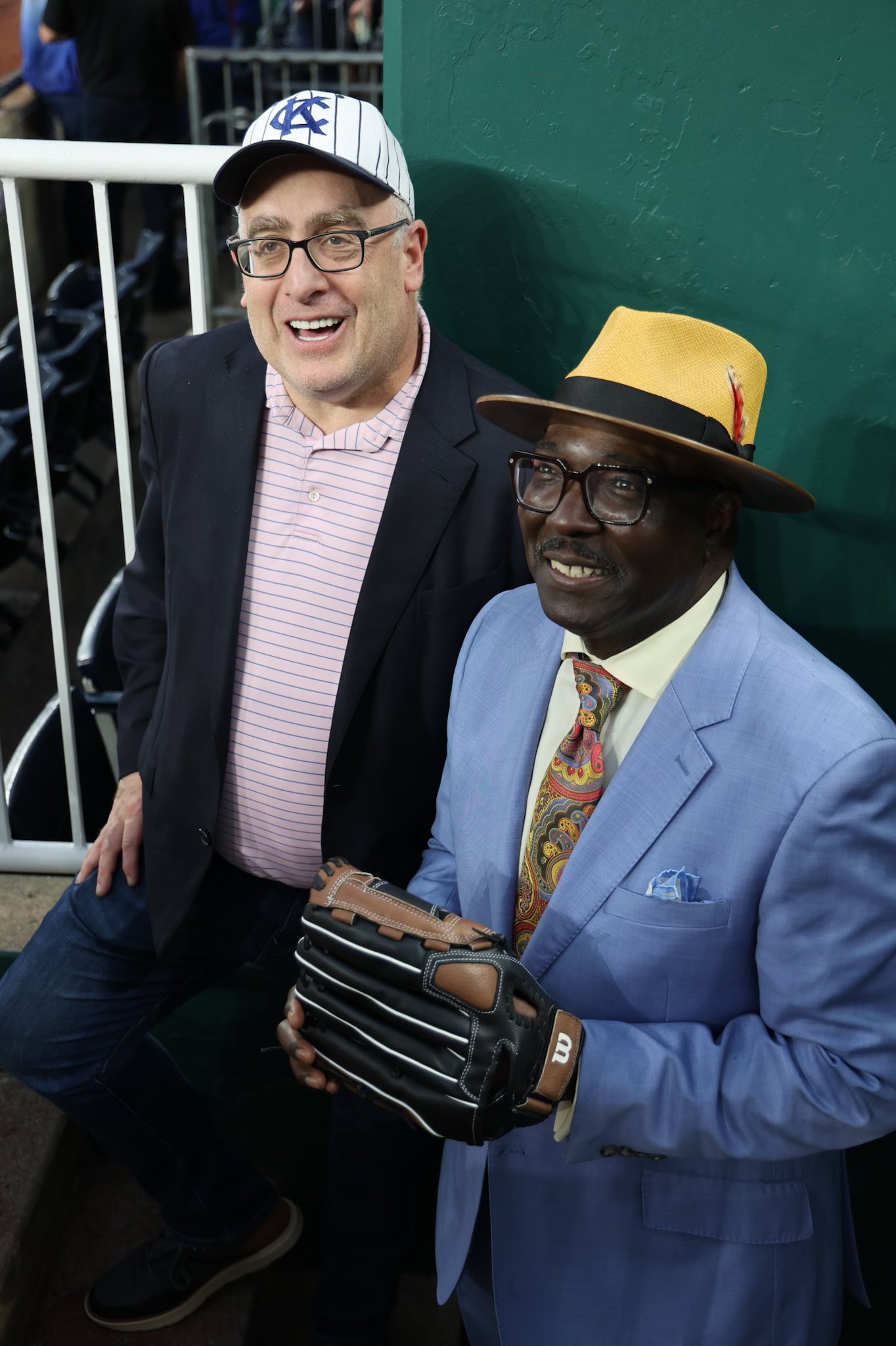
That excitement is never more apparent than when Joe writes about the Negro Leagues. Feel free to disagree, but no writer alive today has written more extensively, more exhaustively, or more reverently about the Negro Leagues than Joe Poz. The Soul of Baseball, written in 2007 after a cross-country trip with the legendary Buck O’Neil, is a must-read for any baseball fan. That book introduced Joe to Bob Kendrick, president of the Negro Leagues Baseball Museum in Kansas City, who Joe now calls his brother from another mother. This past Saturday night, at the “Salute to the Negro Leagues” in Kansas City, Joe – wearing a Monarchs hat – threw out the first pitch of the game to Mr. Kendrick.
In 2009, Joe wrote The Machine: A Hot Team, a Legendary Season, and a Heart-stopping World Series: The Story of the 1975 Cincinnati Reds. This book reached #17 on the New York Times Best Seller list. Venturing outside of baseball, in 2012, he wrote a biography of Joe Paterno (Paterno) that debuted at #1 on the NYT list. Remaining outside of baseball, and drawing on his time in Augusta, Joe wrote The Secret of Golf: The Story of Tom Watson and Jack Nicklaus in 2015. In 2019, Posnanski turned another trick, writing The Life and Afterlife of Harry Houdini. Then came the magnum opus: In 2021, Joe published The Baseball 100. Bookpage summed it up perfectly: “A true masterwork … 880 pages of sheer baseball bliss.”
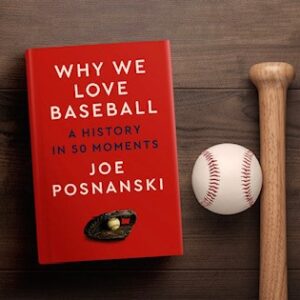
But Joe was not content. After writing nearly 900 pages counting down the 100 greatest baseball players of all time, injecting his unique perspective and asides into each name on the list, he decided we all needed to learn Why We Love Baseball, which was released earlier this month. Joe has been promoting this book for months, repeatedly saying that this one was the most fun to write, and that he could not wait for readers to dig in.
For another author, this might have seemed untoward or braggartly; for Joe, it was wholly natural. He was like a kid dragging his dad into the house to show him the Lego he built – he was so excited and proud of what he produced, he could not wait to share it with the world. I can testify (as can nearly every editorial publication) that each story is thoroughly researched, each player lovingly feted, each tangent seemingly unknown and unknowable and yet discovered. You cannot read the book and not feel how much joy Joe took in writing it, and how much joy he takes in having us read it.
Which brings me to last week. As part of the release of WWLB, Joe went on a whirlwind nationwide tour, meeting fans from Charlotte to Los Angeles, and many places in between. When too many people signed up to hear him talk about his book at Chevalier’s Books in L.A., they moved the event to the fabled Wilshire Ebell Theatre. It was only fitting – the venue has hosted artists since 1927, the year that Babe Ruth hit 60 home runs as part of the “Murderer’s Row.” A group of about 50 gathered to listen to Joe (along with Mike Schur, Molly Knight, and Nick Offerman) all talk lovingly about baseball.
When we moved to the Q&A portion of the night, Joe requested that each questioner tell the crowd how they fell in love with the game before asking their question. For Joe, the origin story of baseball is about family; it is about passing along the love from one generation to the next. And true to form, nearly every person who stood up had a tale to tell about a father, a son, or a friend who introduced them to the game, and kept that flame lit when they or their favorite team or player fell on hard times.
It is no less delightful to hear Joe speak about baseball in person than it is to read him on the page or to listen to his wonderful Poscast podcast. And that is because Joe is both a delightful human being and a charming raconteur. He has an encyclopedic knowledge about the history of the game, the players, and their individual stories.
Reading and listening to someone who loves baseball even more than I do is such a rarity, and such a pleasure. But, for my money, it is Joe’s non-baseball, non-sports-related essays that go right to my heart, and tug on the strings. After waiting more than 30 minutes to finally introduce myself to the man, I mentioned to him that my favorite story of his was the one about taking his daughter to see Hamilton in New York (click the link – it’s worth the price of a subscription). I could tell that that was not what he expected. And, for a brief moment, I believe I shocked him – and he seemed quite pleased. It is my sincere hope that in that moment, Joe got the same jolt of excitement, as fleeting as it may have been, that I feel each time I open JoeBlogs or flip the pages of one of his books.
They tell you to never meet your heroes. Well, last week I met one of mine. It lived up to all of my expectations; his stories, his humor, his warmth, didn’t disappoint. He may be the exception that proves the rule. The world needs more Joe Posnanskis; we need more people who are nothing short of delightful; we need more people with passion to spare and who are willing to share; we need people who simply bring a smile to your face. Do yourself a favor, buy one of his books, subscribe to his Substack, delve into the archives and the ephemera. You won’t regret it.
Thanks for having me, Joe.
PLAY BALL!!!