
Crushed Davis

I moved to Los Angeles in the summer of 1979. At that time, the Dodgers had an impenetrable infield, with Cey, Russell, Garvey, and Lopes.

Davey Lopes was in his eighth big league season, and he would go on to play in eight more. But by 1981, Lopes was beginning to see the end in L.A. The Dodgers had two second base prospects on the farm, Jack Perconte in Triple-A, and Steve Sax in Double-A. I was always confused as to why Sax leaped over Perconte. But my scouting skills shone bright when Sax won the Rookie of the Year in 1981, and Perconte played a total of 433 big league games. (I whiffed again (or did I?) when I vocally endorsed Chip Hale over Chuck Knoblauch to play second base for the Twins in the early ‘90s, but I digress.)

In the first week of the 1983 season, coming off that ROY, Sax made an errant throw to home plate in the ninth inning of a game against the Expos, and a switch flipped. By the All-Star Break, Sax had committed twenty-four errors, on his way to a total of 30 for the season. Fortunately, Sax was able to get his “yips” under control, and go on to play eleven more seasons, eight of them as a second baseman.

After 1983, fans and the media began referring to what happened in Los Angeles as “Steve Sax Syndrome.” But to baseball aficionados, it really was “Steve Blass Syndrome.” In 1971, Blass won 15 games with a 2.85 ERA, helping the Pirates win the World Series. In 1972 he was an All-Star, winning 19 games with a 2.49 ERA. But in 1973, he lost the ability to pitch. He walked 84 batters in 88 innings (triple his previous walk rate), hit twelve batters, threw nine wild pitches, and saw his ERA balloon to 9.85. Blass retired after pitching one game in 1974.

Mackey Sasser was a promising catcher for the Mets in the late ‘80s. His troubles began in 1990, exacerbated by a leg injury that forced him to remain crouched when he threw the ball back to the pitcher. It got to the point that Sasser simply could not throw the ball 60 feet to his battery mate, committing fourteen errors in just 87 games. Sasser caught half as many games in 1991, basically half as many as that in 1992, and then only sixteen more before he retired three years later.

This list could go on and on. We could include the aforementioned Chuck Knoblauch and Rick Ankiel and Jarrod Saltalamacchia, but there is no need to dig that deep. You get the point.

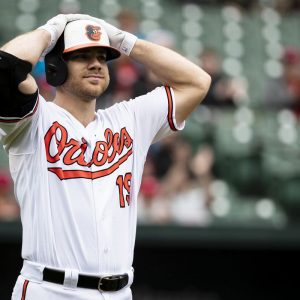
The reason for rehashing the syndromes of these players is in an attempt to make sense of what happened and is happening to Orioles 1B/DH Chris Davis. As recently as 2013, Davis led the league in homeruns (53) and RBI (138), won the Silver Slugger, and came in third in MVP voting.  In 2015, Davis hit another 47 dingers to lead the league, and then the Orioles signed him to a 7/$161M contract.

In 2016, Davis had a career high in strikeouts with 219 (only a 5% increase from his previous high the year before), but he also hit 38 homeruns. All seemed right with the world.

In 2017, Davis missed 34 games, but still managed to strike out 195 times, while hitting a swarthy .215 and slugging .423. A keen eye may have seen trouble on the horizon.

2018 is when the Crush Davis became Crushed Davis. He played in 128 games, struck out 192 times, hit .168, and slugged .296. And when the season ended, the Orioles still owed him $92M. The baseball world was agog with Davis’ performance; but, it should be noted, he has been forthright about his issues.

There was some hope that time away from the game and some tweaks with his mechanics would lead to better outcomes for the remaining three years of his deal. File that in the best laid plans category. As of this writing, Davis has yet to record a hit this season. He has struck out 13 of the 27 times he has come to the plate. If you go back to last season, he is 0 for his last 44 with 24 Ks. He is 1 for his last 55 with 27 Ks. In his last 559 PAs, he has 79 hits, 16 HRs, 46 walks, and 209 strikeouts! We could take these stats back to last his last 1,000 or 1,500 at bats, but they wouldn’t look any better.

I don’t relish listing any of the above. I have provided this information to denote that the yips are not the exclusive province of defensive players. It is quite clear that a couple of seasons ago, a switch flipped, and Davis can no longer throw the ball to first base, or back to the pitcher, or to home plate. He can no longer hit a Major League baseball. Sure, the broken clock theory is in play and he makes the occasional contact. And if the bat is in the right place at the right time, he is still strong enough to hit the ball really far. But, as a practical matter, Davis is more Steve Blass than Steve Sax.

I am not sure if there is a “right” thing to do. Far be it for me to tell a guy to hang ’em up and walk away from nearly $90M. Far be it for me to tell the Orioles to cut a franchise player or send him down to the minors. What I do know is that it is not fair to the team, the fans, but most especially, Chris Davis, to keep sending him up to the plate just to fail and flail – spectacularly – again and again.

I did have one thought: Mr. Davis could head about nine hundred miles southwest to Dothan, Alabama. Drive over to the campus of Wallace Community College and look for the baseball field. Seek out the head coach. I am sure Mackey Sasser – who came to grips with his yips with the help of Dr. David Grand – could have some helpful advice.

When he was at his best, Crush Davis was a joy to watch. No one hit the ball farther with less effort. He hit 223 homeruns over a six-year span. As a baseball fan, I sure hope he gets back there again.

PLAY BALL!!
Belt Tightening

Disclaimer: I may be biased.

I have spent the entirety of my career (save for four months at the very beginning) on the management side of the table. Agents and lawyers representing talent have been my professional foe for as long as I have drawn a paycheck. And while I am often exasperated by their efforts on behalf of their clients, I try to take solace in the fact that they are doing nothing more (or less) than providing zealous representation. I hope they feel the same about me.

When negotiating with talent to work on a collective endeavor, whether it is sports or entertainment, the game is non-zero-sum. In fact, the goal should be to have a winner on both sides. If management wins, they ostensibly have more resources to dedicate to the effort, which makes the likelihood of overall success that much higher. It doesn’t matter if you are talking about a movie deal or a baseball team. If the talent wins, they will be more inspired to excel and produce the best possible product. It doesn’t matter if you are talking about a Broadway stage or the friendly confines of Wrigley Field.

All of which makes baseball’s arbitration system so bizarre. For those of you unawares, baseball arbitration – which is available to players in years four through six of their career – works as follows: the player and his team exchange their desired salary. If they cannot agree, they submit the same to a three-judge panel. Each side is given one hour to argue their case, followed by a thirty minute rebuttal. After hearing both arguments, the panel decides which salary to award. There is no “meeting in the middle” or “splitting the baby.” There is a winner and a loser. In a non-zero-sum arena, this is a zero-sum game.

And here is the kicker, where things get really wonky: MLB rules require that the player be present for the hearing. So, when his team makes their 90-minute presentation to the panel justifying why the lower salary is appropriate and why the player’s higher ask is not, the player is forced to listen to all of the ways in which he is not as good as he thinks he is. Imagine asking your boss for a raise, and then having a seasoned trial attorney spend an hour and half telling you, to your face, why you don’t deserve it. I think I would prefer a simple “no” than suffer that humiliation. The player thinks he is the next Joey Votto, only to be told that he is really the next Joey Cora.

And when this process ends, win or lose, the player must suit up for an organization that told him how they truly feel. Talk about your labor relations.

This system, for the reasons stated above, is totally flawed. But it is the system that was collectively bargained for. Teams and players are incentivized to do their homework, prepare their case, and make their best presentation. By design, one side wins, one side loses. I am certain there are countless other ways in which a just result could be reached. But within the confines of what MLB and the MLBPA negotiated, players go into arbitration seeking to maximize their pay, while teams go in trying to minimize it. The goals are patent; there is no secret.

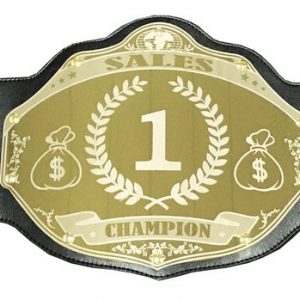
So when The Athletic reported last week that, at the end of year, when MLB teams have their annual arbitration seminar, they give out a belt to the team “that did the most to achieve the goals set by the industry,” there was a predictable outcry. Tony Clark, the MLBPA executive director responded by saying, “That clubs make sport of trying to suppress salaries in a process designed to produce fair settlements shows a blatant lack of respect for our Players, the game, and the arbitration process itself.”

Really? Is that what they are doing?

Isn’t this much ado about nothing? Why is Tony Clark suddenly clutching his pearls and claiming that teams are making “sport” of the process? Why is Clark totally fine with players being forced to sit idly by while they are run through the ringer in front their bosses, and then told to be happily on their way? With all of the talk about a minor league offers for major league players, and languishing free agents, and service time manipulation, does the fact that teams celebrate the one who was the most efficient really rise to the level of outrage? Don’t we have bigger issues to deal with?

And the idea that celebrating winning (however gauche a belt may be) shows a lack of respect is the same argument that flipping a bat is disrespectful to a pitcher. How can Clark take issue with trying to suppress salaries? Isn’t that the MacGuffin? Wasn’t the system put in place specifically to either suppress or expand salaries?

Belts aside, salaries have expanded…bigly. My questions for Clark would be: Should teams be offended and crying a lack of respect if Nolan Arenado’s representatives had a victory dinner when he received a record-breaking $26M arbitration award? Or if Mookie Betts and his team did a little victory dance when he won his arbitration and was awarded $20M. How about when Josh Donaldson got $23M coming off an injury-shortened season? What about Jacob deGrom’s $17M (up from $7.4M) or David Price’s $19.75M (a 41% raise)? Those salaries didn’t seem too suppressed.

As The Athletic article points out, according to MLB, players have won 18 of 32 hearings in the past two years, a 56% clip (up from around 40% historically). Teams gave out more than three-quarters of a billion dollars this past off-season to arbitration-eligible players. Marc Craig’s article intimates that the fight is unfair insofar as the teams have more information at their disposal, and they share that information amongst themselves. But the statistics above belie that. Players who have the goods, and who make the better presentation, get paid what they believe they are worth.

And let’s not lose sight of what is happening here. Teams are awarded the belt for a job well done. That is, they have taken their ninety minutes and convinced a group of neutral arbitrators that their position is correct. Players have that same opportunity. If you don’t want the batter to flip his bat…make a better pitch. If you don’t want teams to celebrate salary suppression…make a better case.

Again, teams could be a little more circumspect about the manner in which they celebrate their victories, but a $20 plastic belt certainly shouldn’t be the object of our derision. Now, if they gave a belt to the team that best suppressed service time, well, them be fighting words.

As a fan I worry that Tony Clark and the MLBPA are losing the forest for the trees and focusing on the wrong battles. And that makes me very nervous for the next CBA negotiation after 2021.

We are about a week into what looks to be an incredible season. Maybe the belt talk can go away. Maybe we can talk about Fernando Tatís Jr., Pete Alonso, and Chris Paddack breaking camp despite their rookie status; maybe we can talk about Bryce Harper making a home in Philadelphia; or Christian Yelich picking up where he left off. Maybe we can spend less time worrying about the inane actions of front offices and more time just enjoying this wondrous game.

PLAY BALL!!